Meet the Wichita fabricators behind major public art projects
In artworks at the city's new transit center and L.W. Clapp Park, Ten Works brings artists' visions to life.
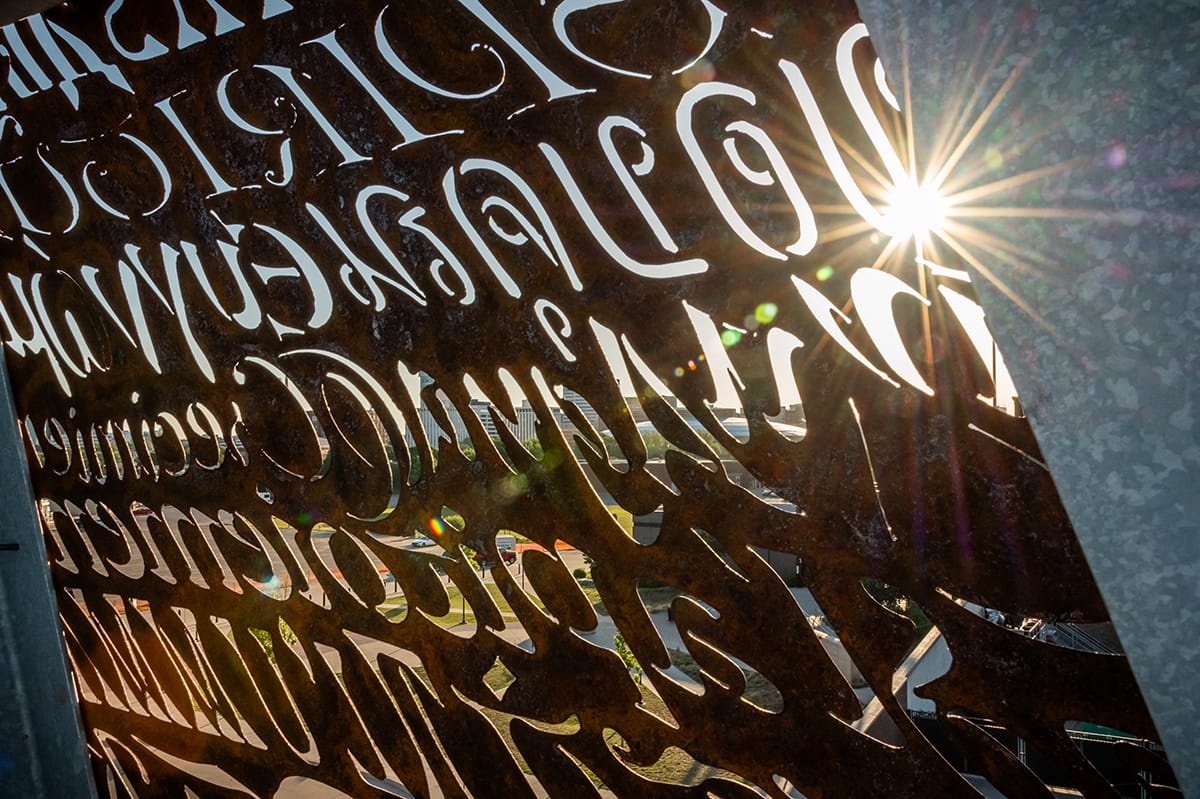
Wichita’s unique identity has long been stamped and tooled by public art. One of the city’s newest public spaces, the Wichita Transit Multi-Modal Facility at 217 S. Sycamore St. — familiarly known as The Hub — features six weathering-steel panels, each plasma-cut with reflections on local life written in the various languages of Wichita’s own residents. Artist Suikang Zhao conceived the work, but between the artist’s vision and the finished panels of steel sits a lengthy list of practical questions that must be answered with creative precision. What type of steel? How will the panels be cut and joined? How can they be fabricated and mounted to stay put through years of Kansas wind and weather? Answering those questions fell to a Wichita shop called Ten Works.
Its story begins with a building rather than a business plan. Nick Anneler was converting an old fire station — Wichita’s 1949 Fire Station No. 10 — into a home for his and his wife Kristin’s growing family when he discovered how much he loved working as a craftsman.
“When Nick started on that renovation, the building had all the fire engine bays, of course, and that’s where he started to get a taste for building things for himself,” says Sam Jossie, marketing and brand steward at Ten Works. “His friends started asking, ‘Hey, can you build a table, or can you build this, can you build that?’ And he would say yes to everything, and before you know it, he started hiring people to help build things. Everything else just grew from there.”
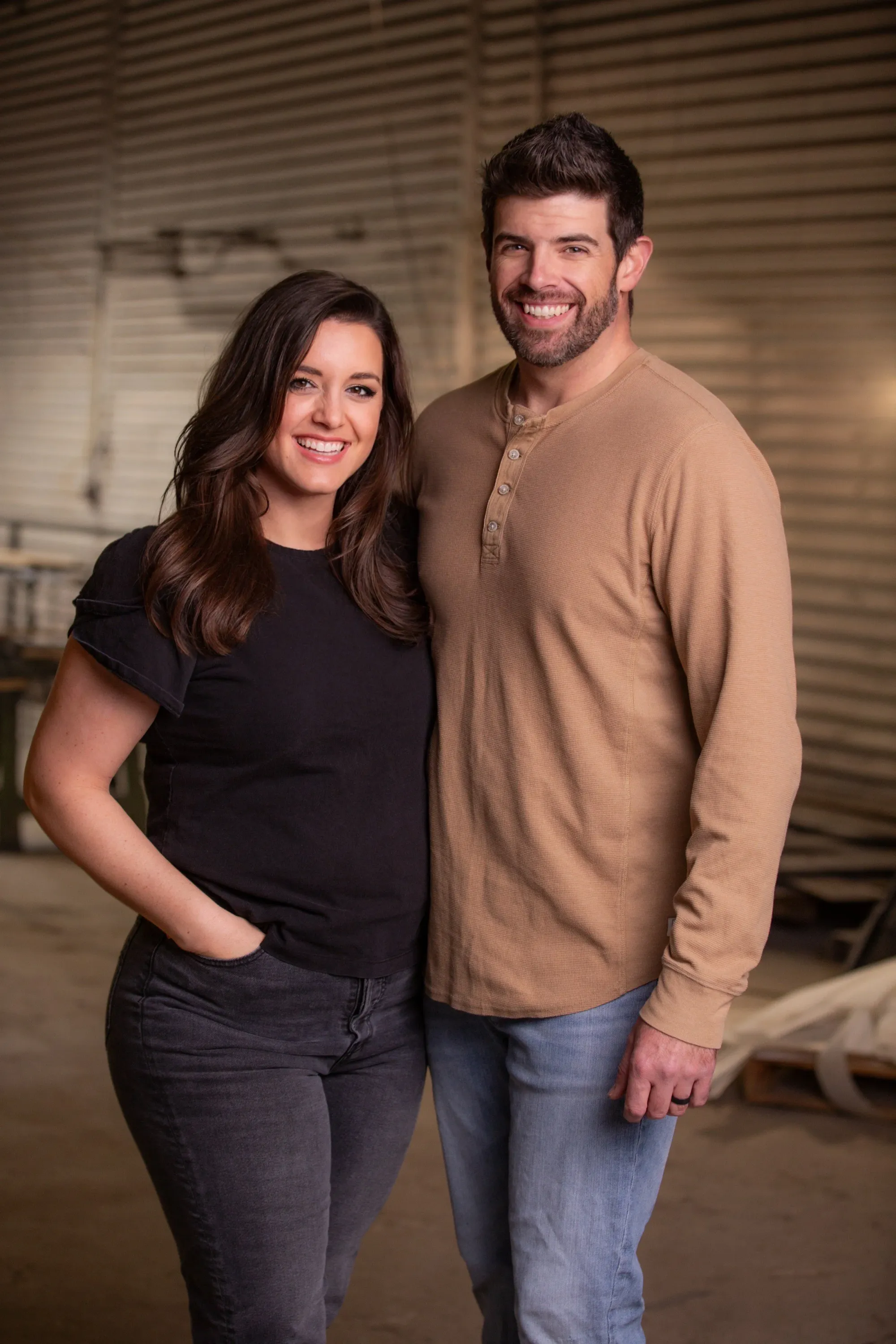
Anneler’s first big job, for Milkfloat, a locally owned bakery in Wichita’s historic Delano district, convinced the couple to go all in on a fabrication shop, which they first called Station 10 Studios. From their renovated fire station, they collaborated with a widening circle of craftspeople to turn on-paper ideas into functional objects and architectural elements that help make “livable environments — the places where we connect with each other,” in Jossie’s words.
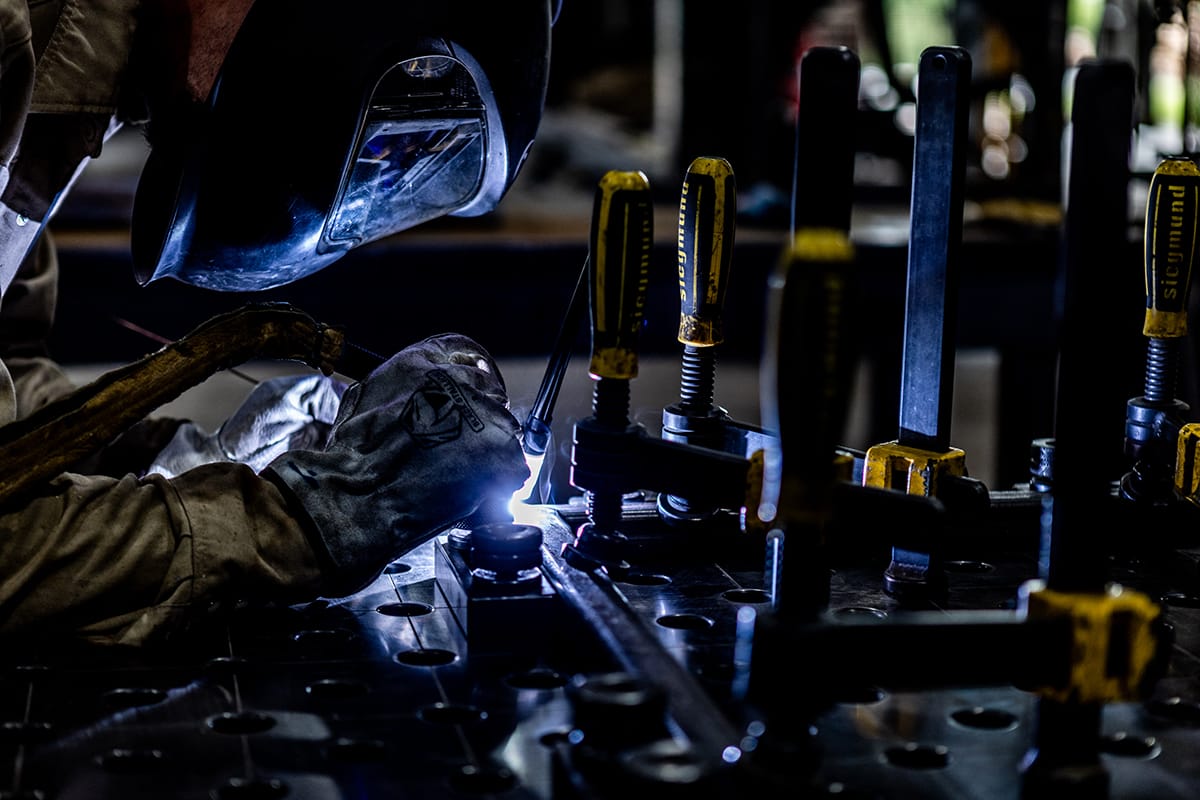
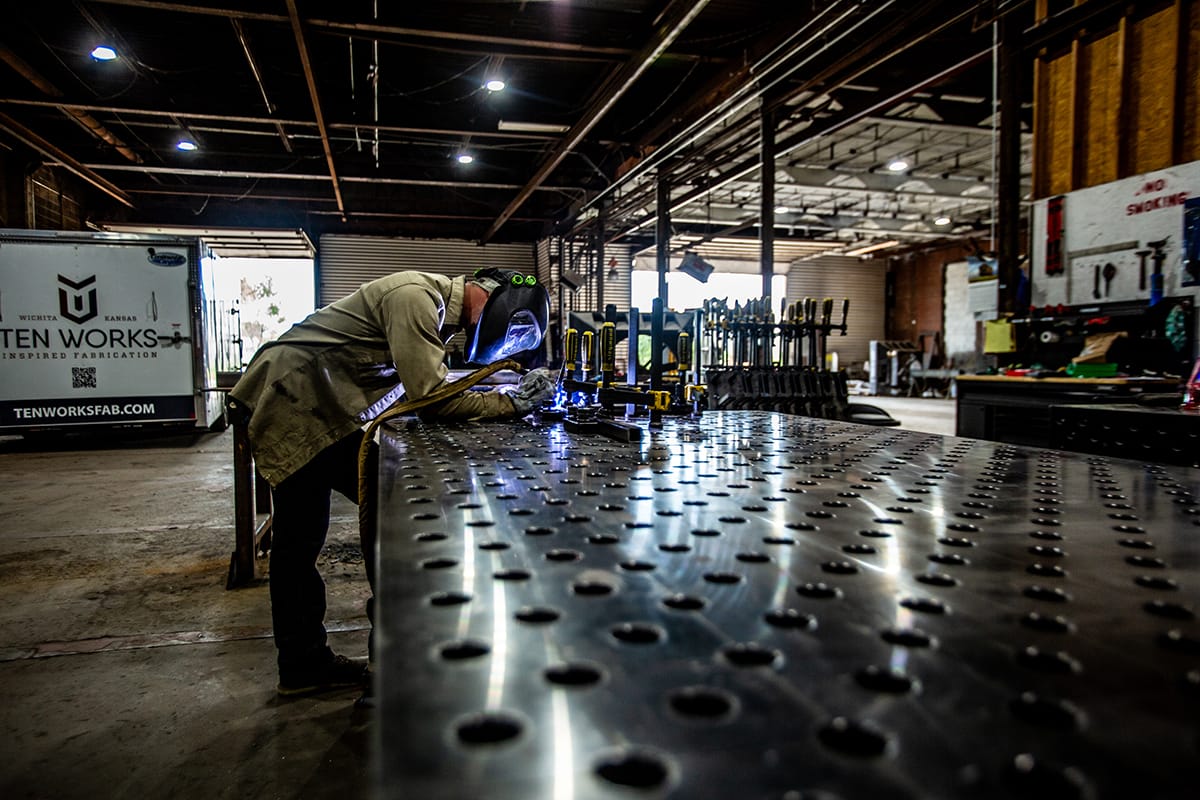
Process pictures from inside the Ten Works fabrication shop. (Photo courtesy of Ten Works)
Today, Ten Works is based out of a shop about 10 times the size of the fire station, with a team of more than a dozen people. Matthew Alumbaugh, a woodworking specialist who joined the company from Elderslie Woodworks, was the first to throw in with the Annelers. He brings his knowledge of local materials to the shop’s most detailed projects. Fabricator Miguel Adame arrived as a student from Southeast High School. Chad Hershberger is project development manager, and Matthew Chastain, who by his own admission is obsessed with precision detailing, is lead engineer. “Every single person on staff is highly creative and an artisan or craftsman in their own right,” Jossie says.
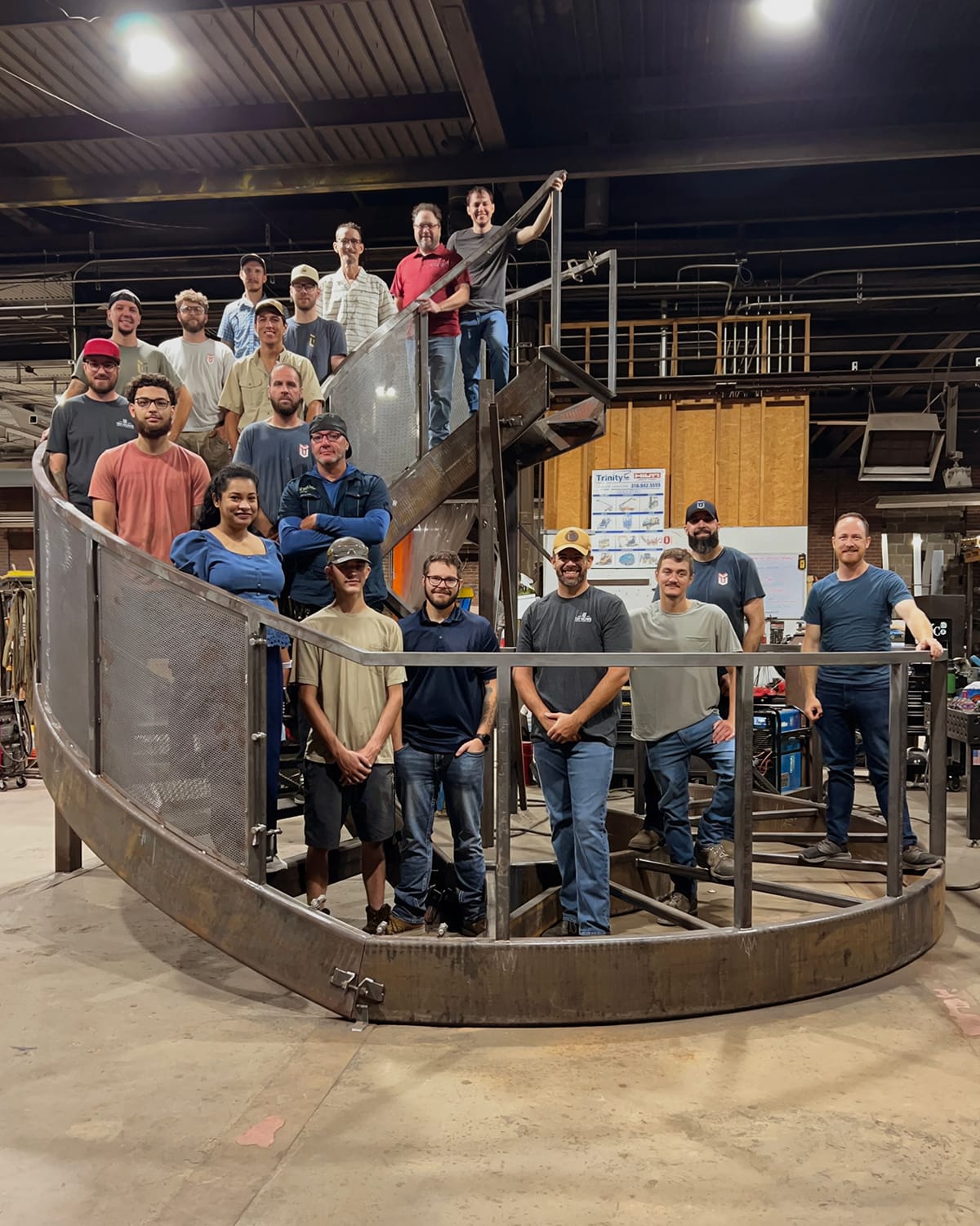
The company's stated values are collaboration, creative precision, ingenuity, and community. Riffing off its name, Jossie describes the work culture this way: “There is a lot of symbolism in the number 10, being ones and zeros, the basis of all binary code, or straight lines and arcs being the basis of all architectural creation, and ‘works’ just being works of art or works, well, just plain hard work — there is a good deal of that here. And, also, good works. Nick is very guided by his faith and just showing your personal good works has been a good influence. So, the name of the company is Ten Works, and the tagline is ‘inspired fabrication.’ You know, we are children of a creator. It’s just natural that we should be creative. It’s in our blood, bones, our DNA.”
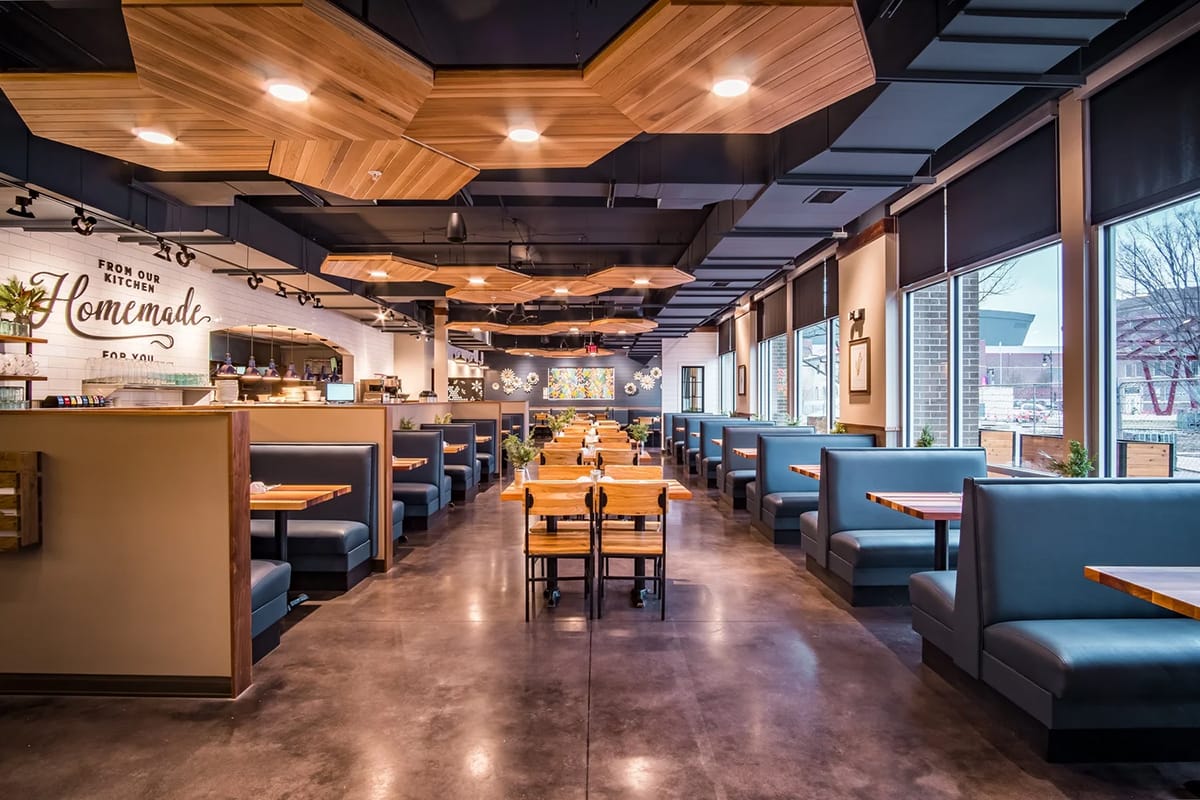
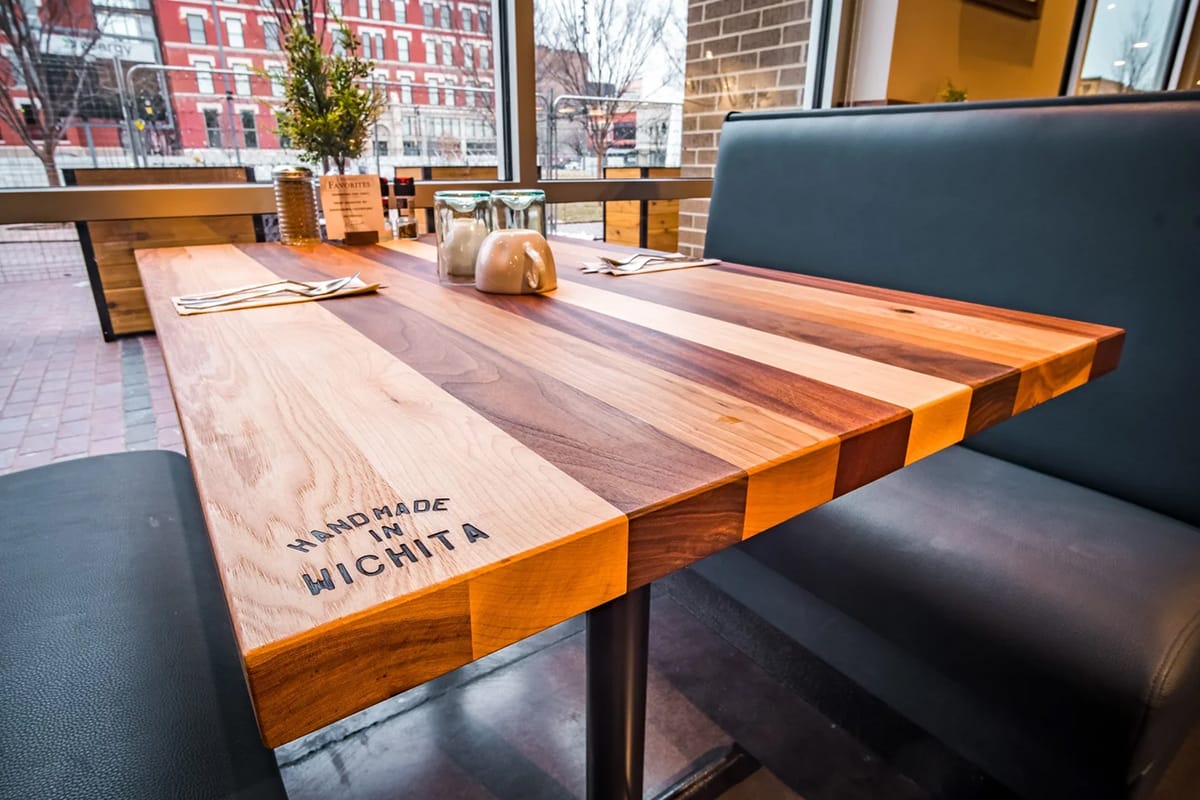
Ten Works helped create the furnishings of HomeGrown in downtown Wichita. (Photos courtesy of Ten Works)
Ten Works’ Chamber of Commerce profile describes a shop that fabricates metal, wood, glass, and plastic components as a single contractor, meaning one firm handles the work from start to finish. Most of its portfolio is architectural: stairs, railings, shelving, countertops, ceiling fixtures, screens, and doors for residences, businesses, and public facilities. Their work includes HomeGrown restaurants, known for their “handmade in Wichita” multi-species wood tables and hexagonal cedar and steel ceiling clouds.
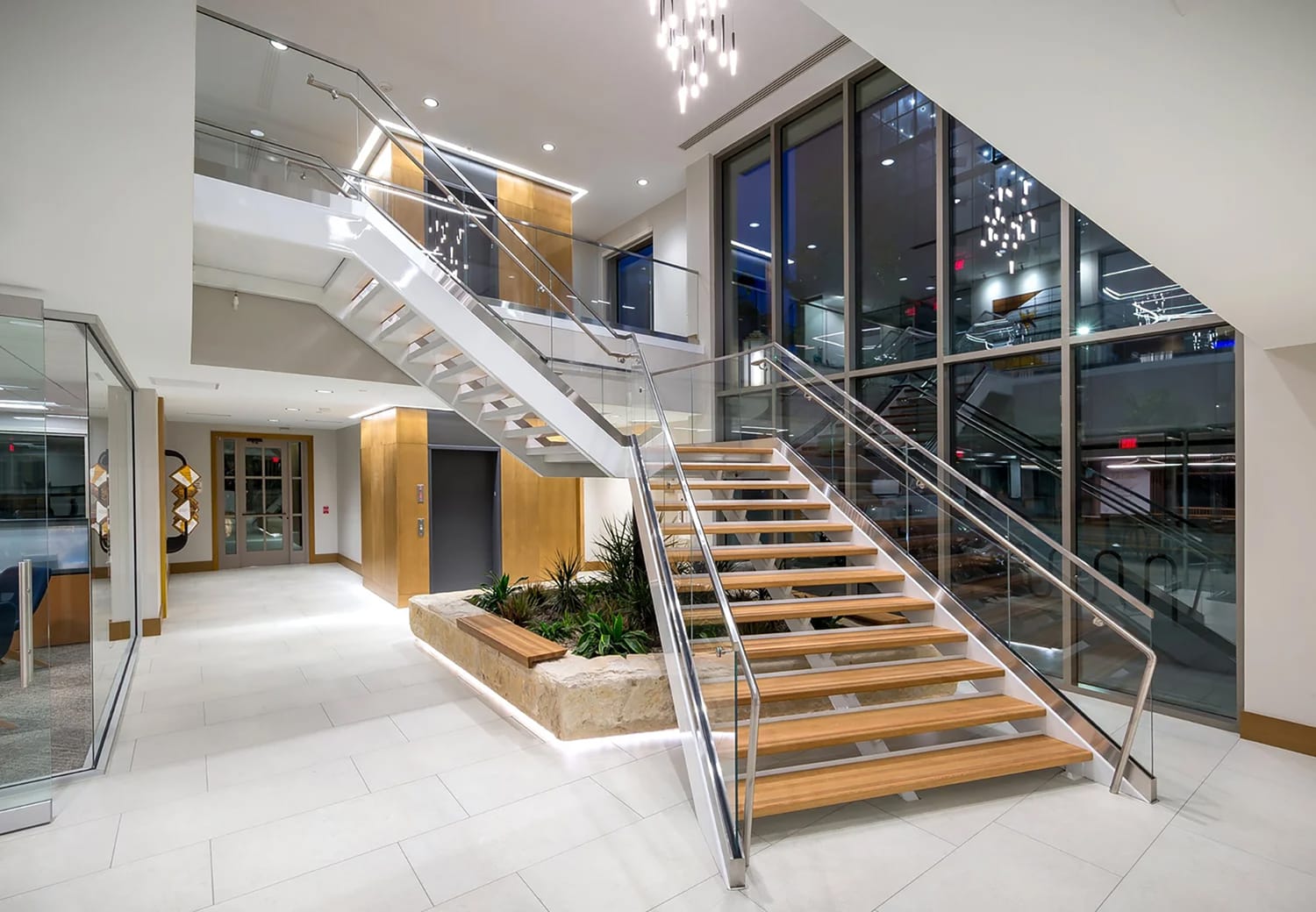
“Monumental staircases are our bread and butter,” Jossie says. The Kansas Health Foundation’s headquarters on Douglas Avenue shows off that work. While Shelden Architecture reworked the building to be more open and bright, Ten Works fabricated its showpieces. These comprise a monumental staircase with steel stringers in high-gloss automotive paint, white oak treads, and glass guardrails; a nearly 15-foot map of Kansas with each county cut separately from white oak–veneered plywood and finished in five colors; a backlit three-dimensional logo; and a wall of diamond-shaped panels that visitors rotate to learn the foundation’s history and mission.
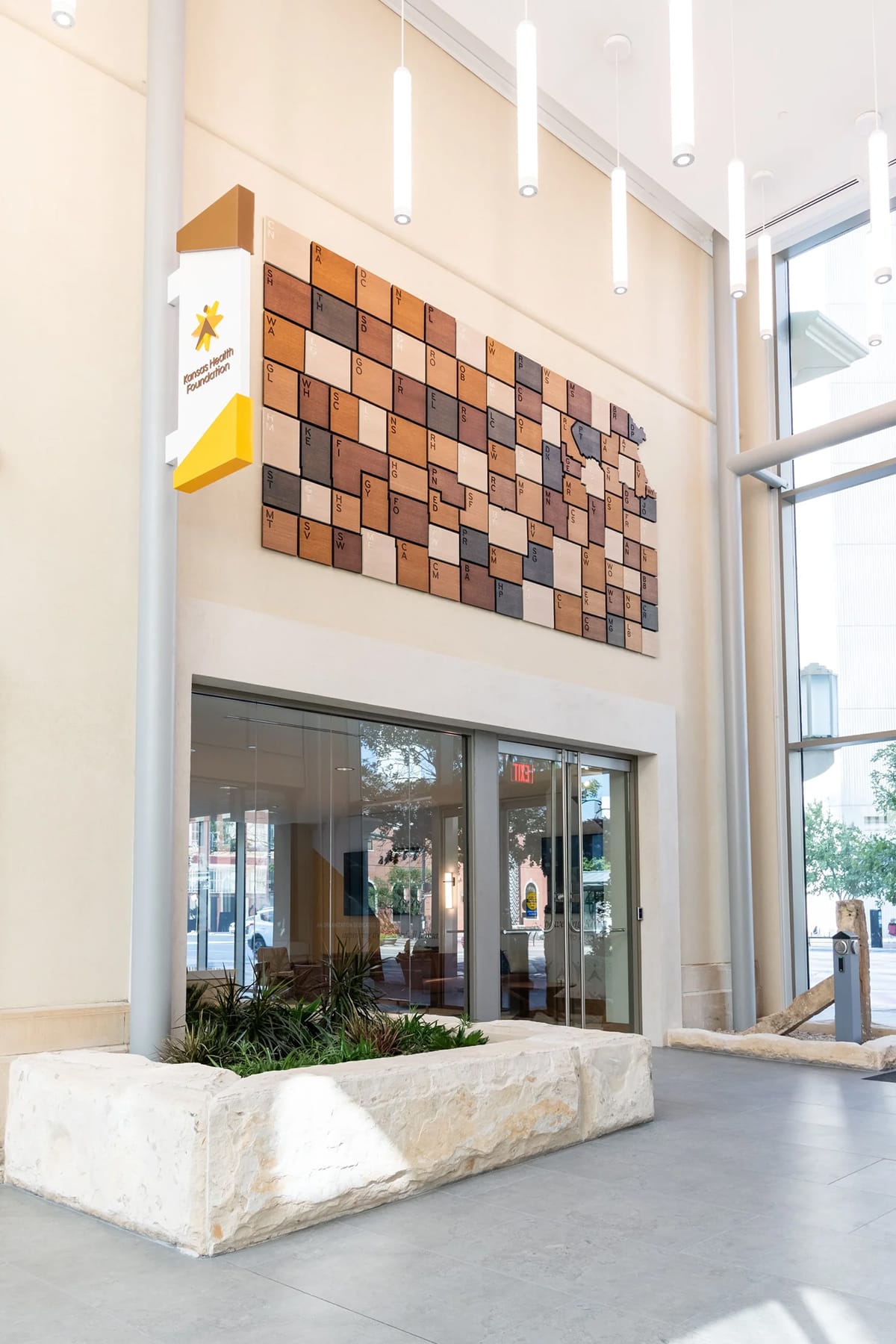
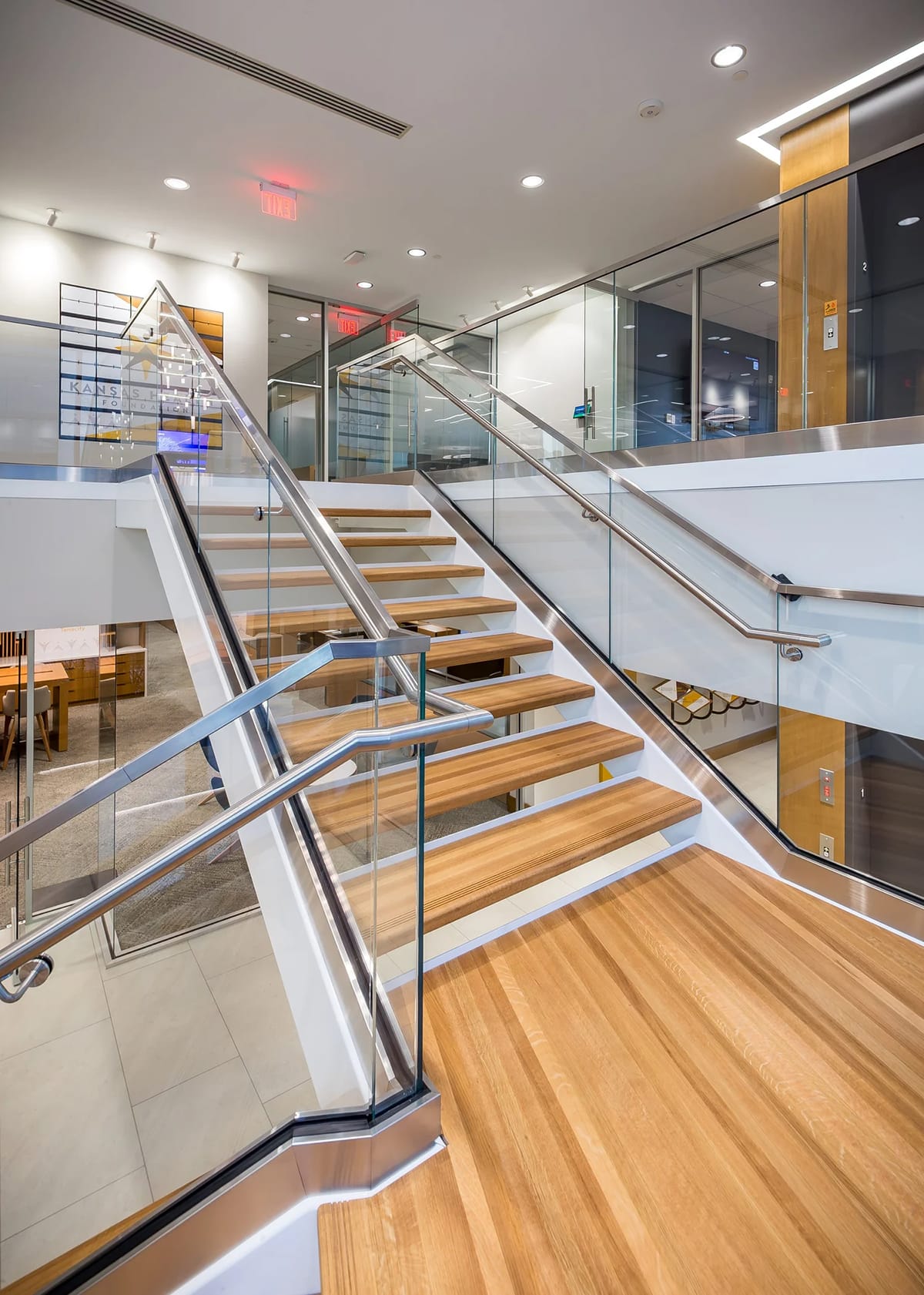
In addition to the flowing staircase at the Kansas Health Foundation, Ten Works created a large map of Kansas counties. (Photos courtesy of Ten Works)
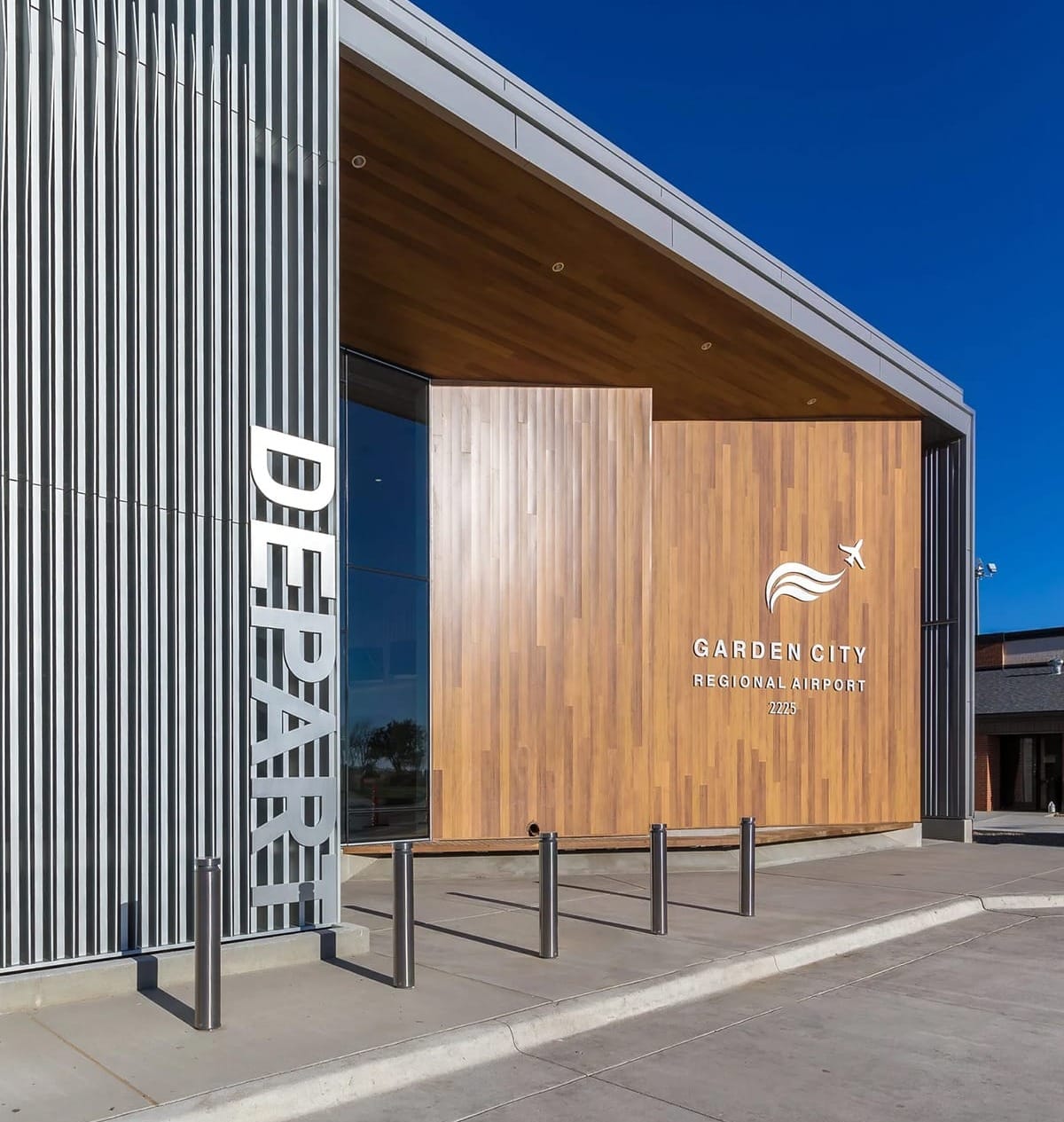
At the Garden City Regional Airport, Ten Works worked with HNTB Architecture and contractor Crossland Construction on a 32-by-18-foot feature structure for the exterior of the remodeled facility. The shop produced the connection components and an assembly and installation plan that allowed the piece to be flown in and bolted down on site, making it one of the shop’s most complex projects. “We tackle just about everything,” Jossie says.
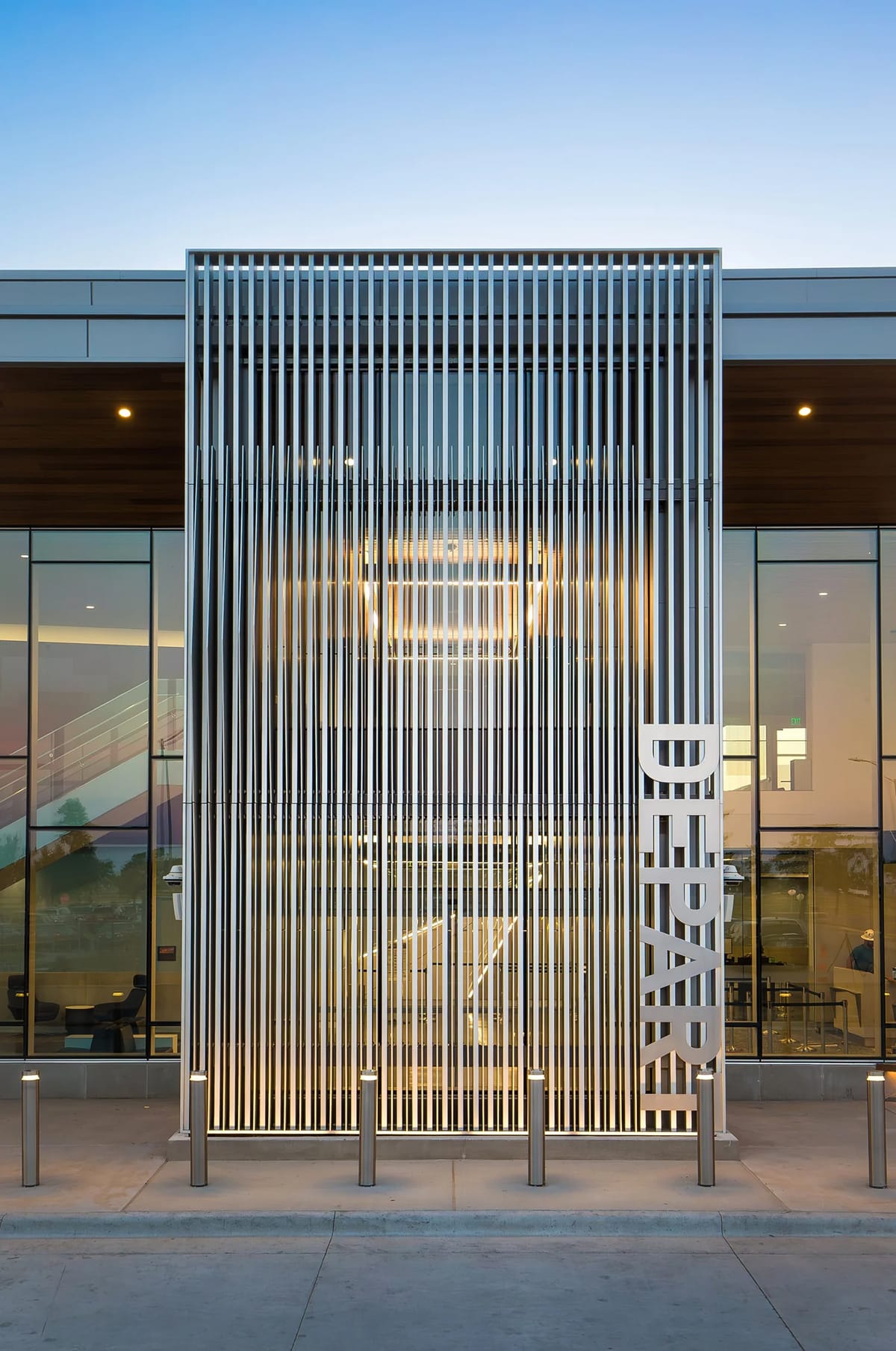
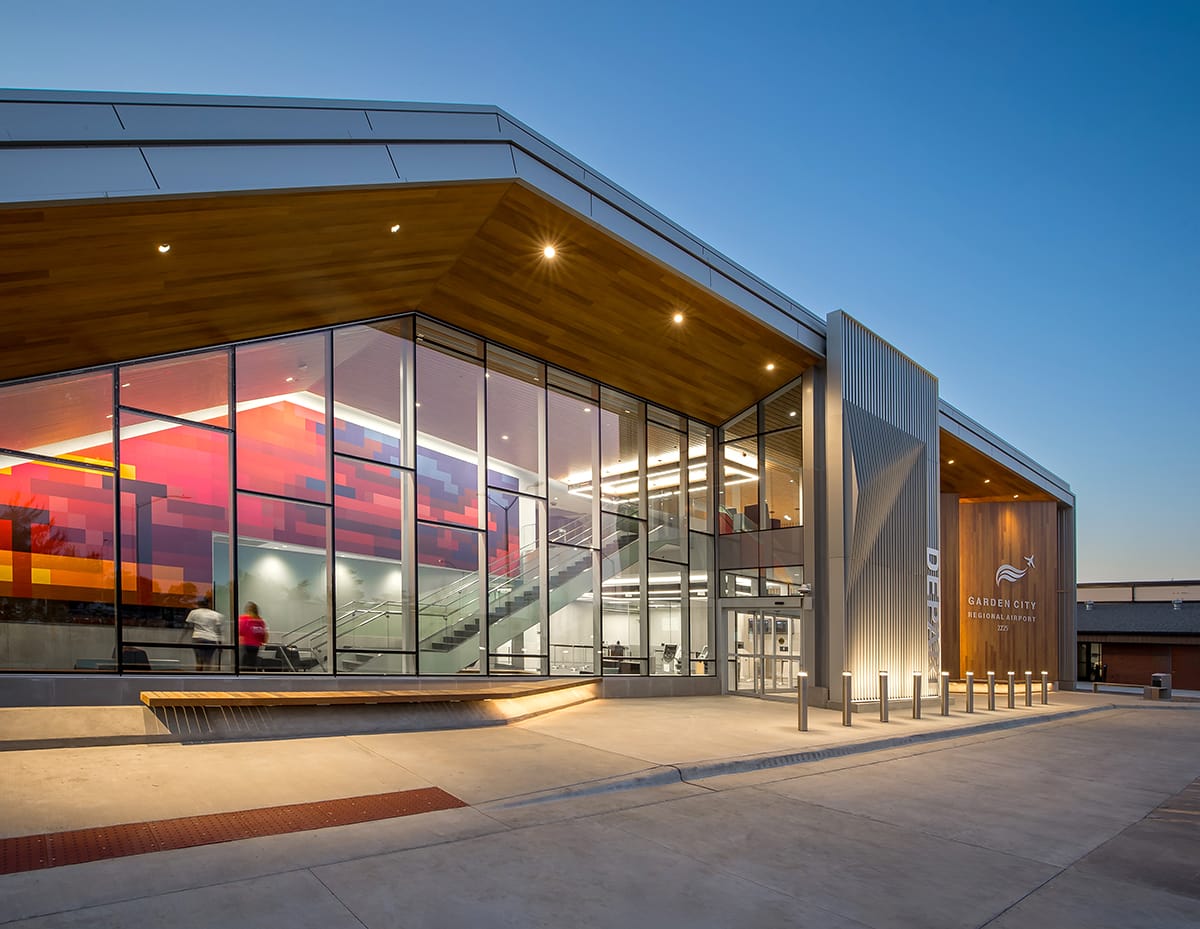
The installation at the Garden City Regional Airport is over 38 feet tall. (Photos courtesy of Ten Works)
The shop’s public art work is where its craftsmanship reaches the widest audience.
Public art is easy to take for granted until you try to imagine a place without it. Americans for the Arts made the case in its 2018 report “Why Public Art Matters,” which argues that public art humanizes the built environment and gives communities cultural, social, and economic value. Its survey figures are telling: some 70% of respondents believe the arts improve a community’s image and identity, and 73% say the arts help them understand other cultures. Researchers who studied a Philadelphia mural program over two years found improved perceptions of the pedestrian environment and neighborhood safety. While public art cannot solve a city’s problems, it can give people a reason to stop, look, and talk, and it indicates that somebody thought their shared space was worth making beautiful.
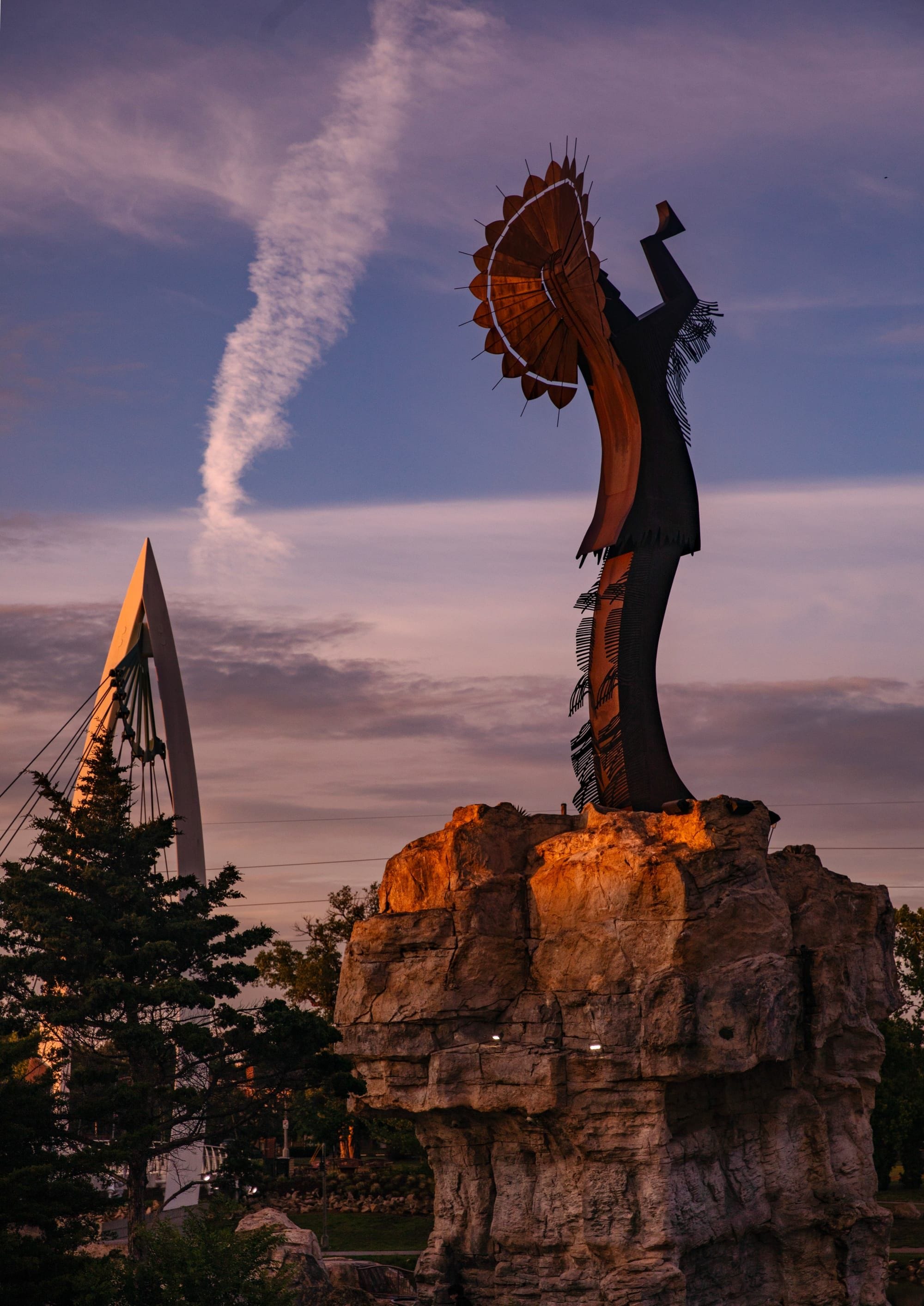
Wichita has been making that argument for a long time. Its most beloved landmark is Blackbear Bosin’s “Keeper of the Plains,” a 44-foot Cor-Ten (weathering) steel sculpture completed in 1974 where the Arkansas and Little Arkansas rivers meet. A 2006 project raised it onto a 30-foot rock promontory.
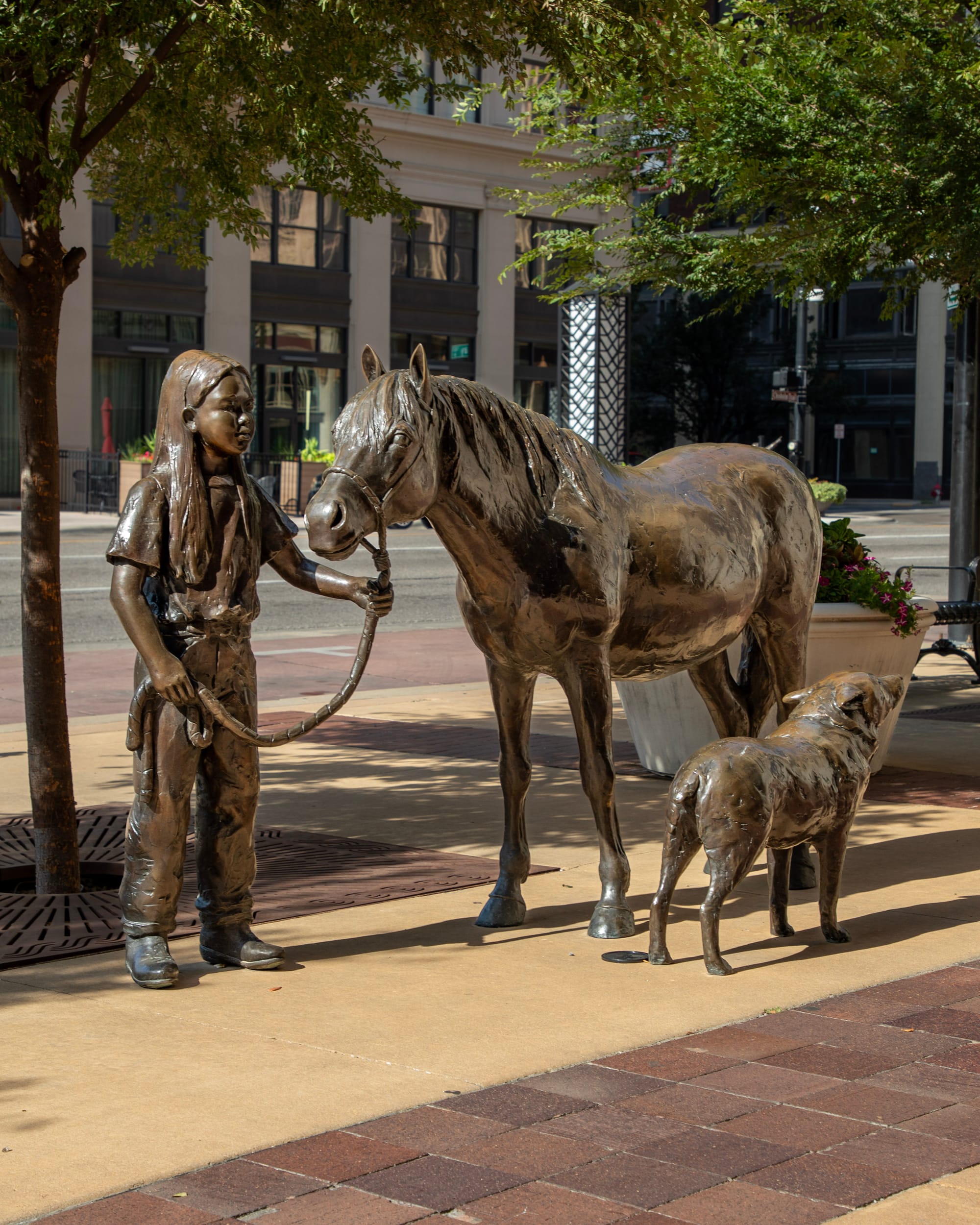
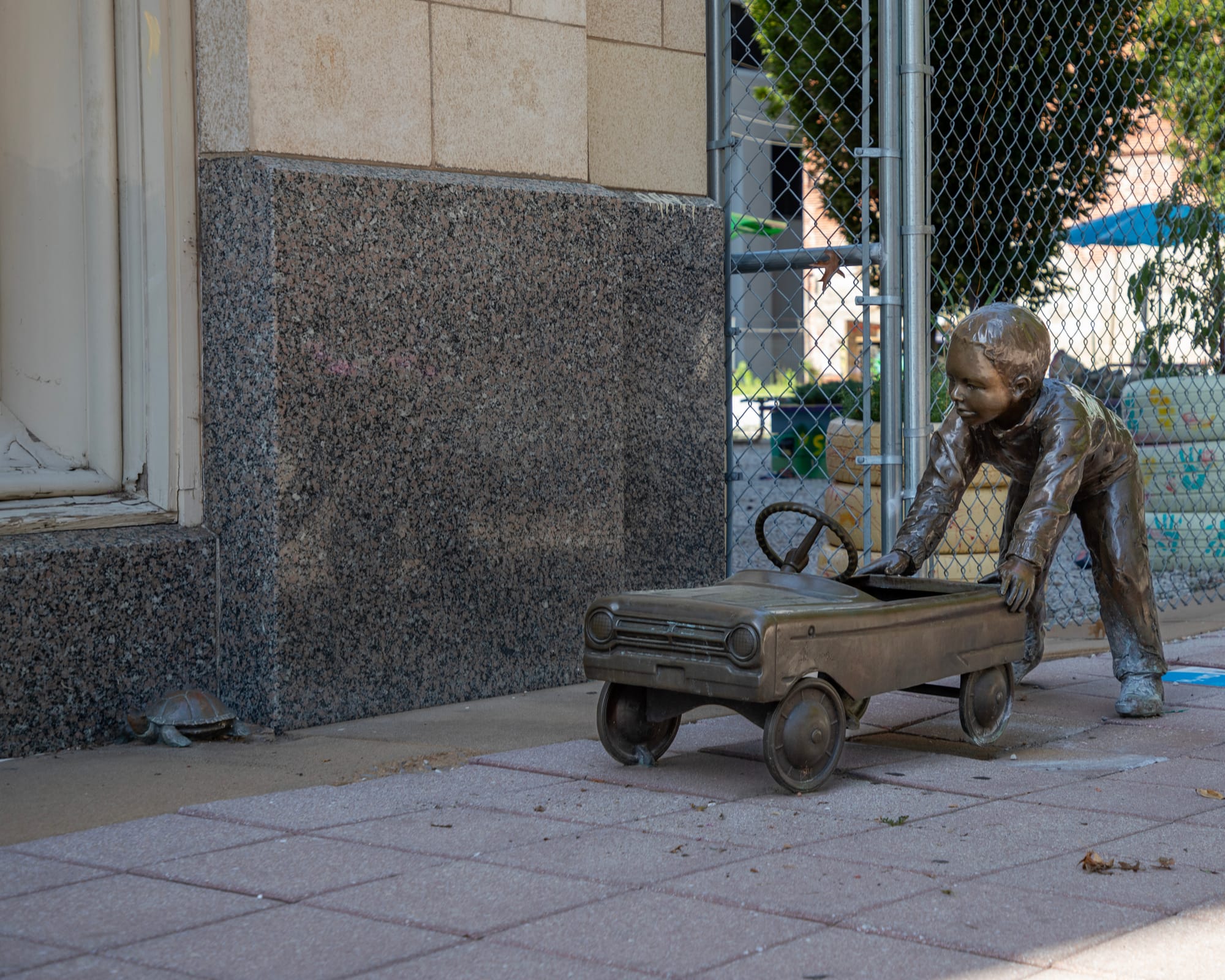
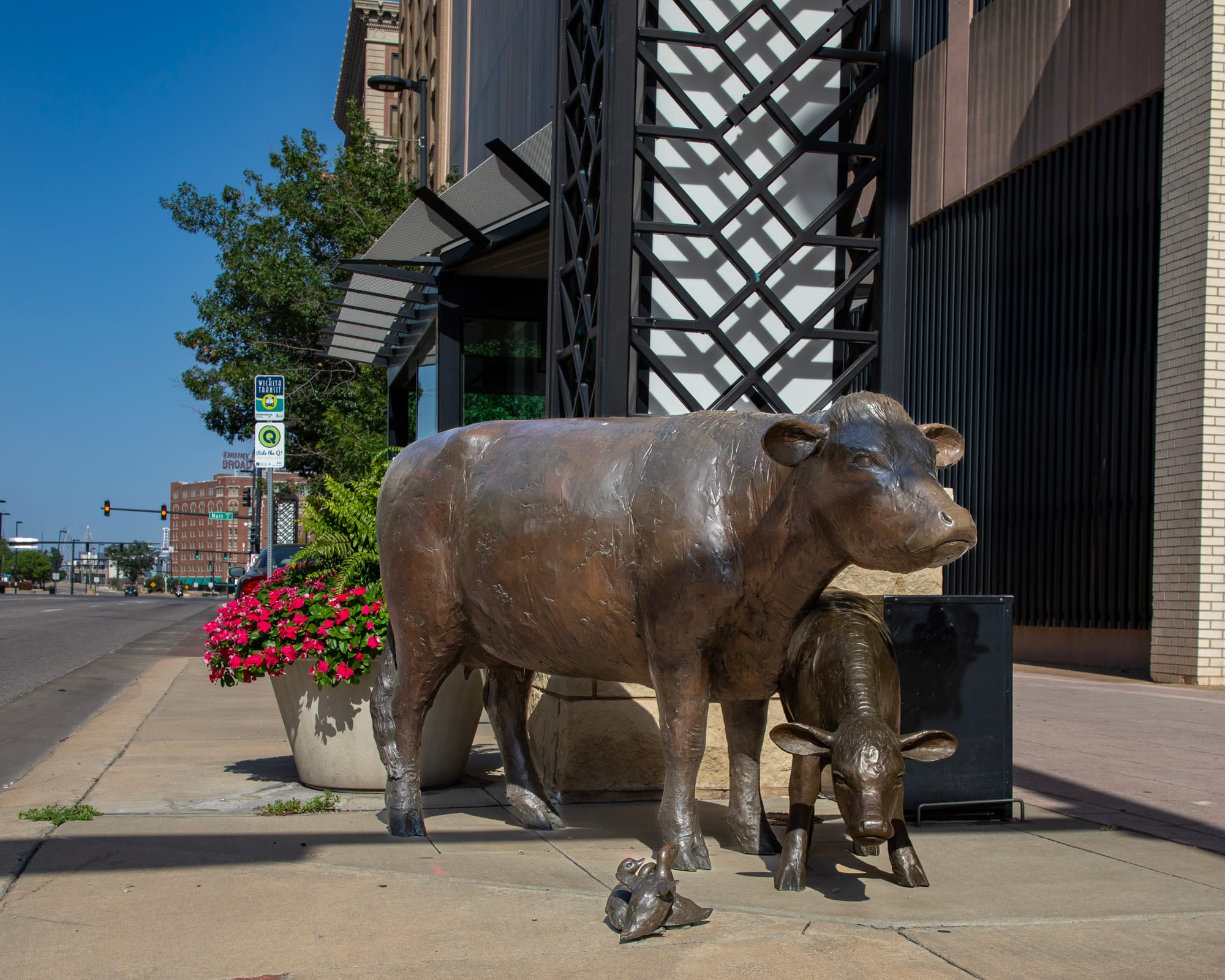
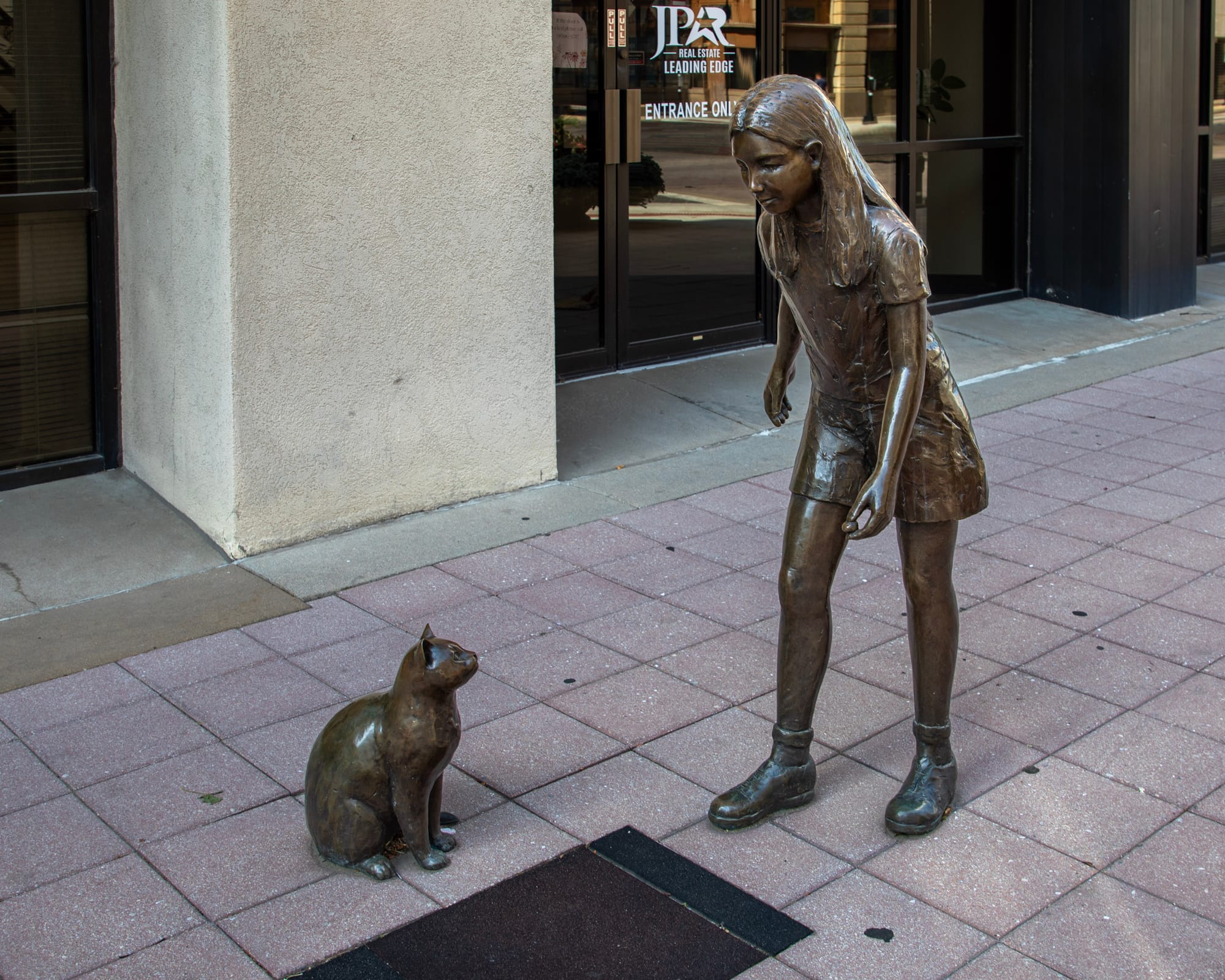
Works by Georgia Gerber: "Girl Leading Pony," 2000, bronze; "Boy Pushing Pedal Car," 2000, bronze; "Cow and Calf," 2000, bronze; "Cat (with Girl Playing Hopscotch," 2000, bronze. (Photos courtesy of the City of Wichita Public Art Collection)
Downtown, the DeVore Foundation commissioned Washington artist Georgia Gerber in the 1990s to create bronze sculptures along four blocks of Douglas Avenue as part of an effort to restore the urban core. Few public-art measures of success beat strangers dressing the bronze barefoot man in a hat or scarf for the winter weather.
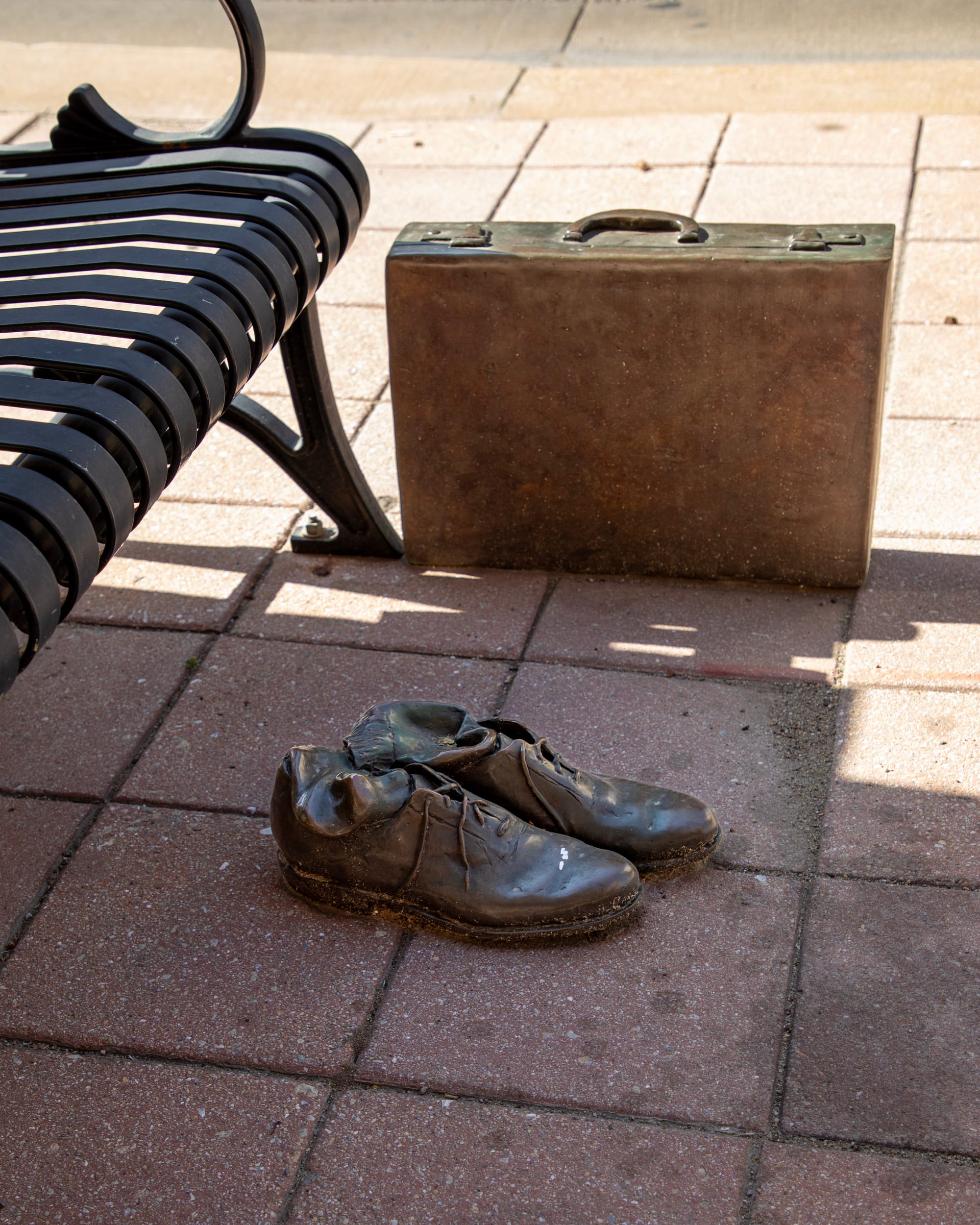
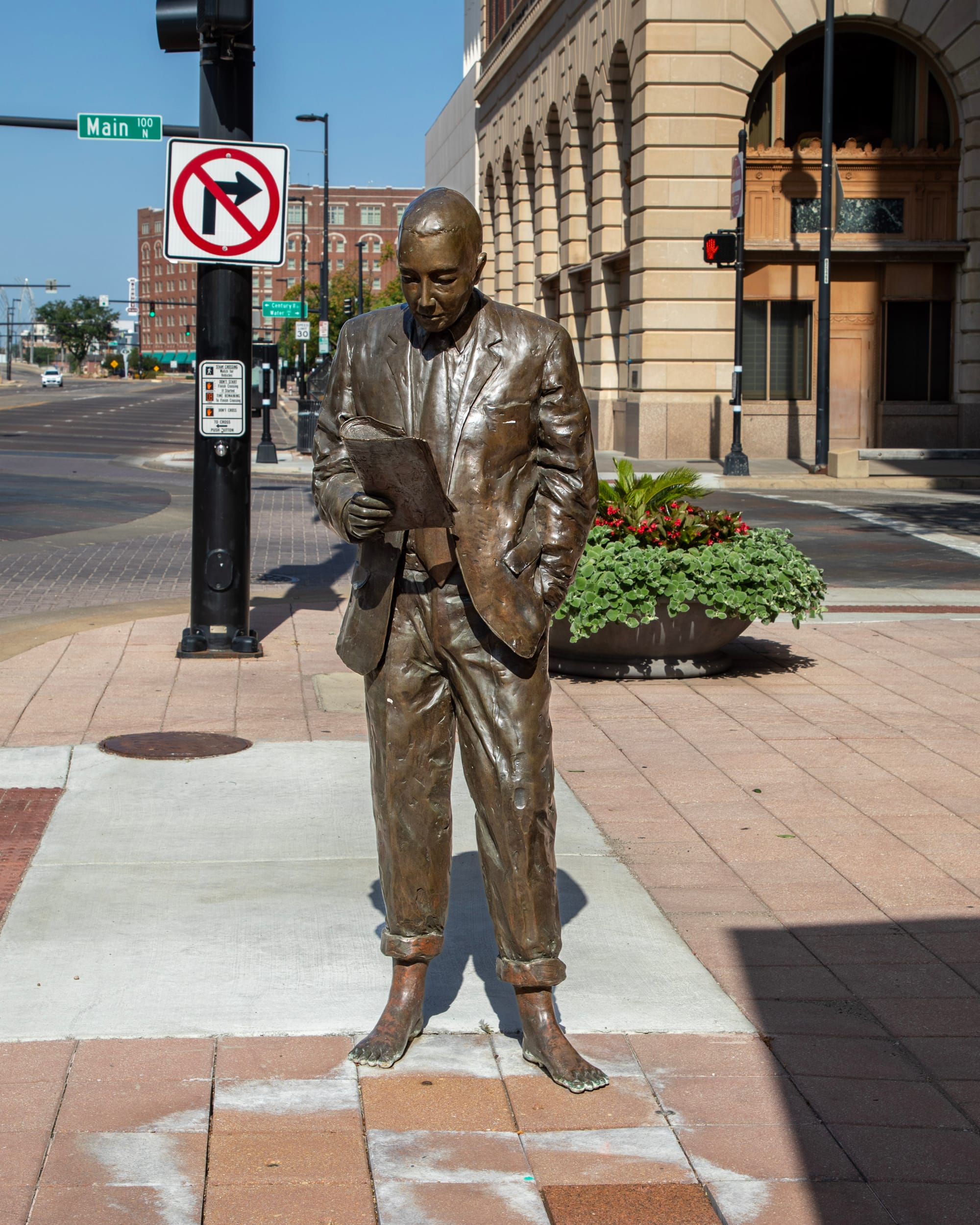
Georgia Gerber, "Business Man Cooling Feet Fountain," 2000, bronze. (Courtesy/City of Wichita Public Art Collection)
Wichita State’s Ulrich Museum maintains an outdoor collection of 89 works across campus, and the city’s own official collection has grown beyond 300 pieces.
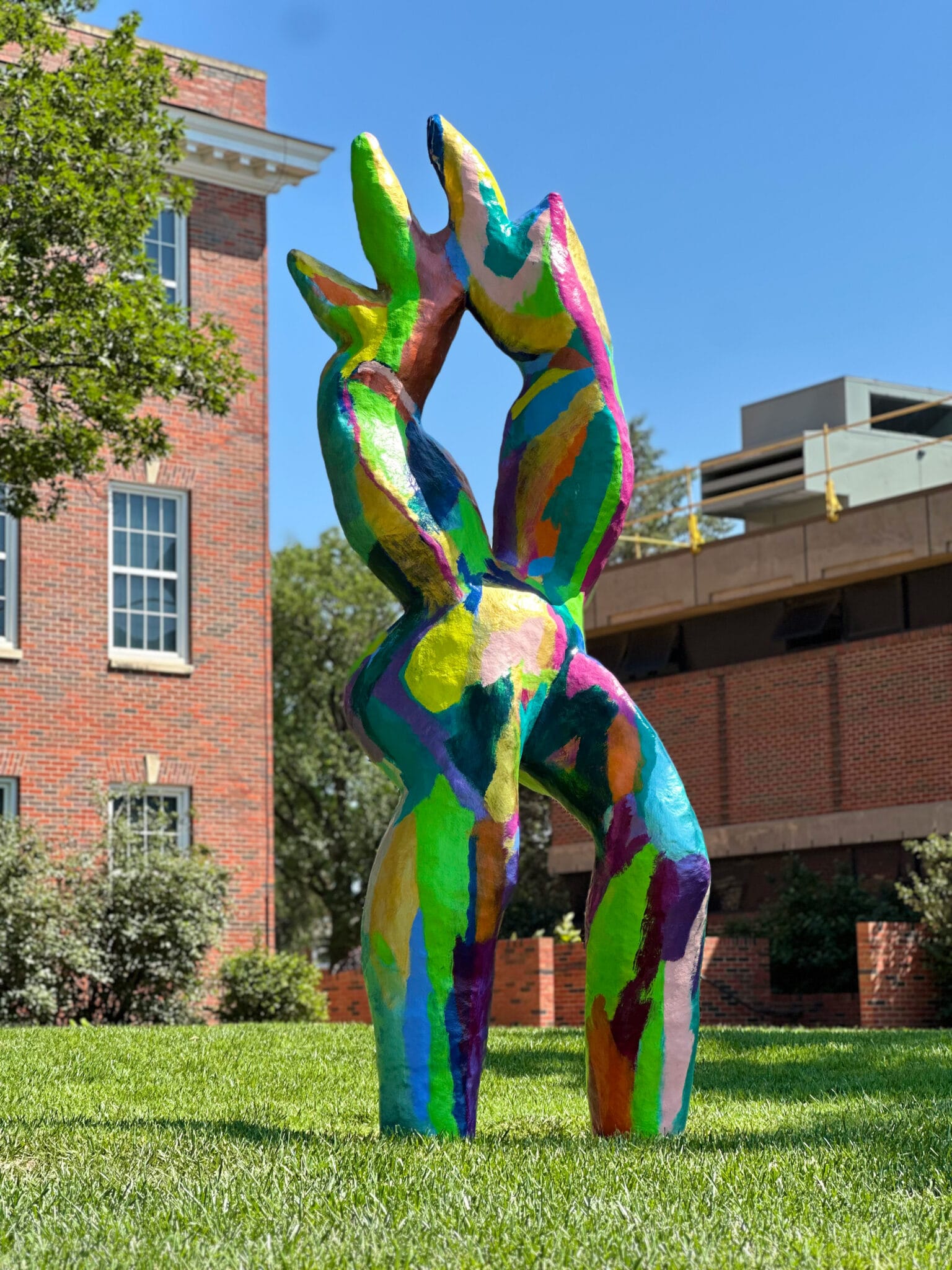
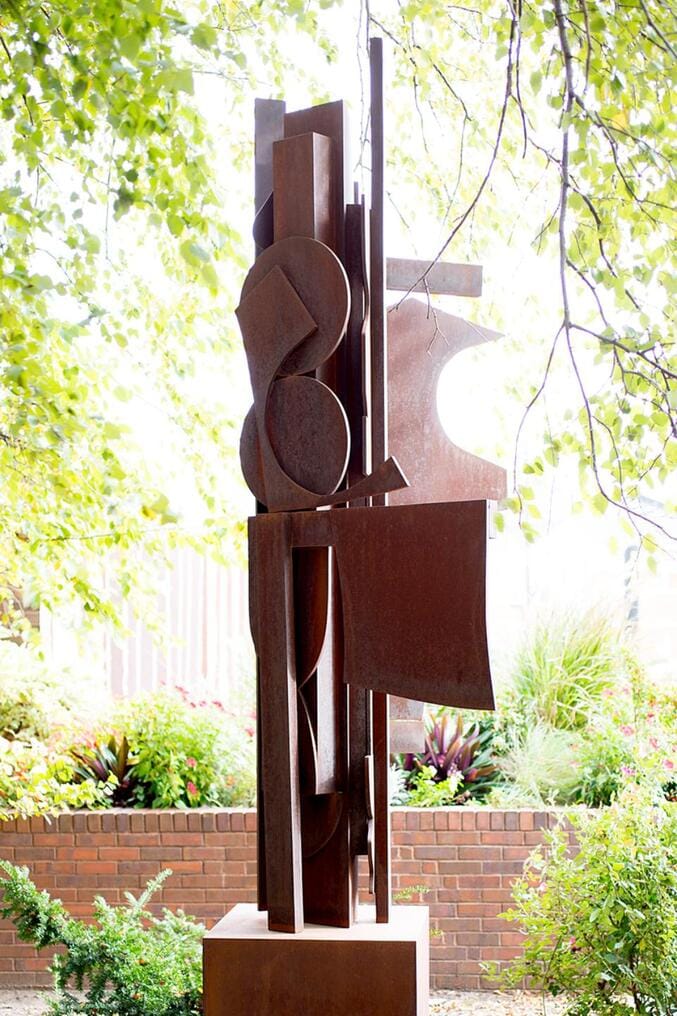
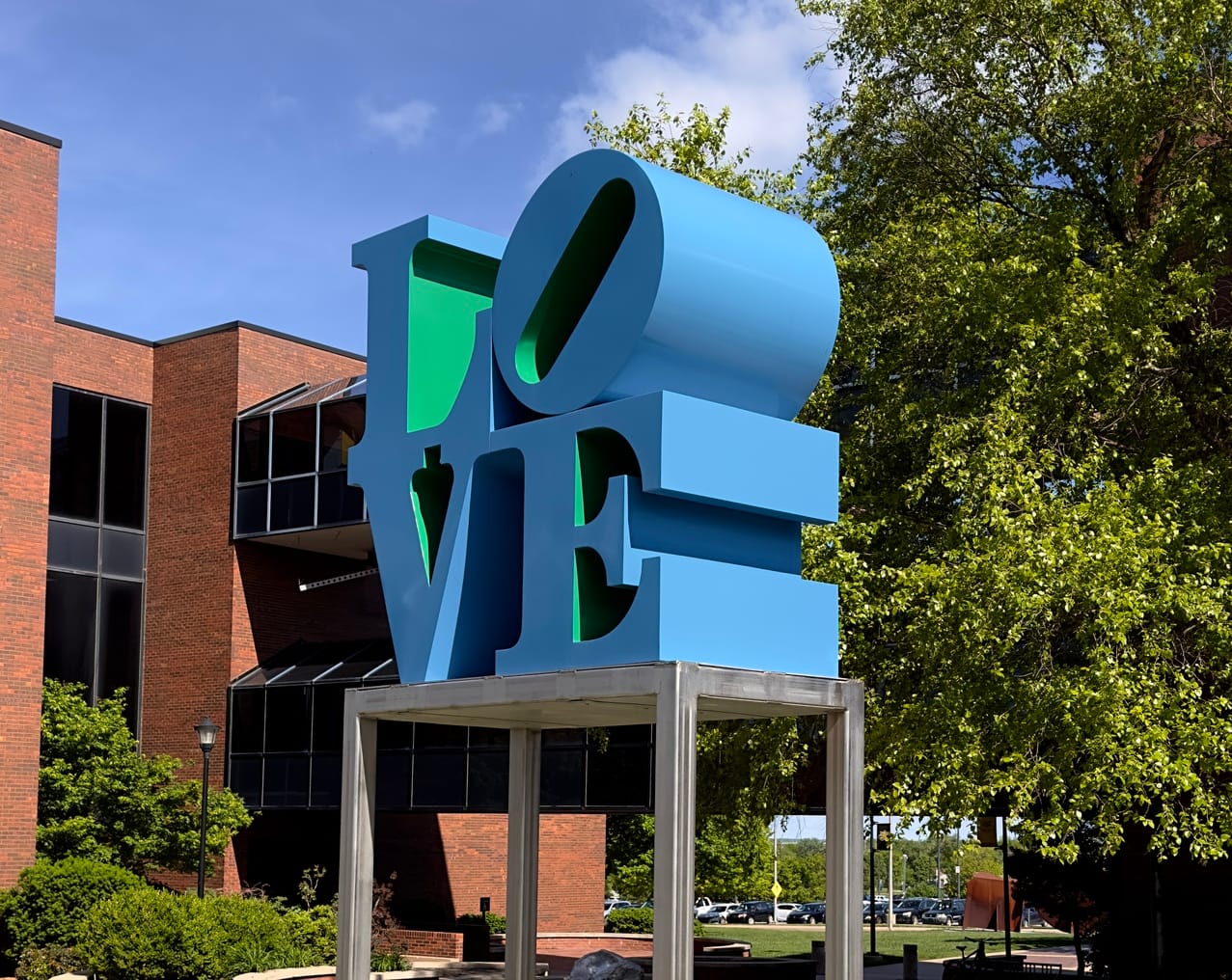
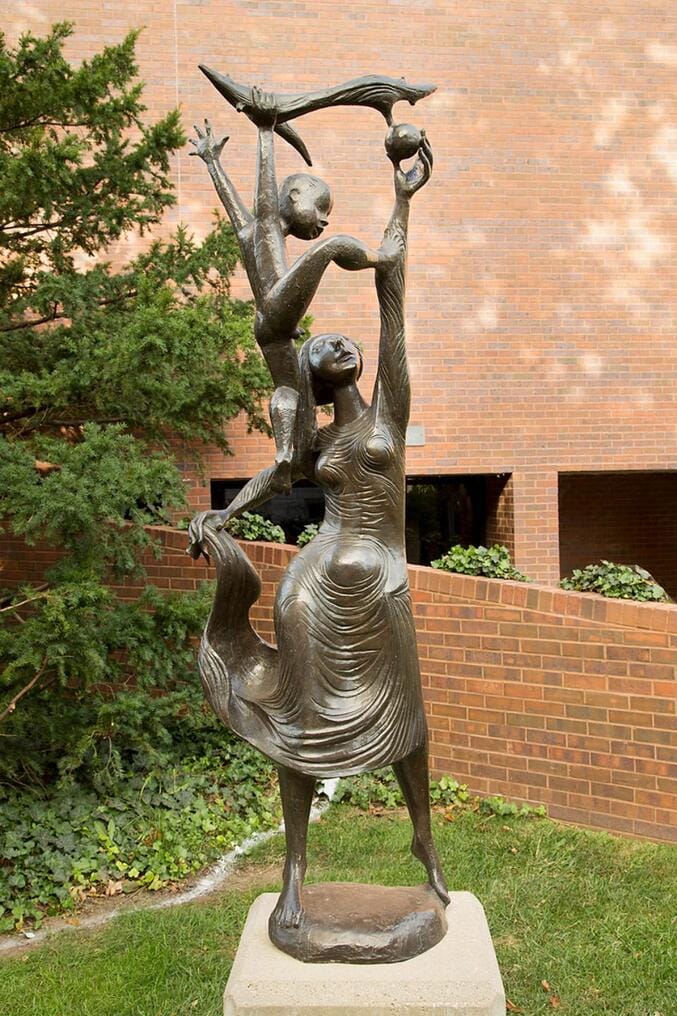
Works in the Ulrich Museum of Art's Martin H. Bush Outdoor Sculpture Collection: Bianca Beck, Untitled, 2025, Fiberglass, steel, and acrylic paint; Louise Nevelson, "Night Tree," 1971, Cor-Ten steel; Robert Indiana, "LOVE," 1966, aluminum and polymer resin; Milton Hebald, "Harvest," 1957, cast bronze. (Photos courtesy of the Ulrich Museum of Art)
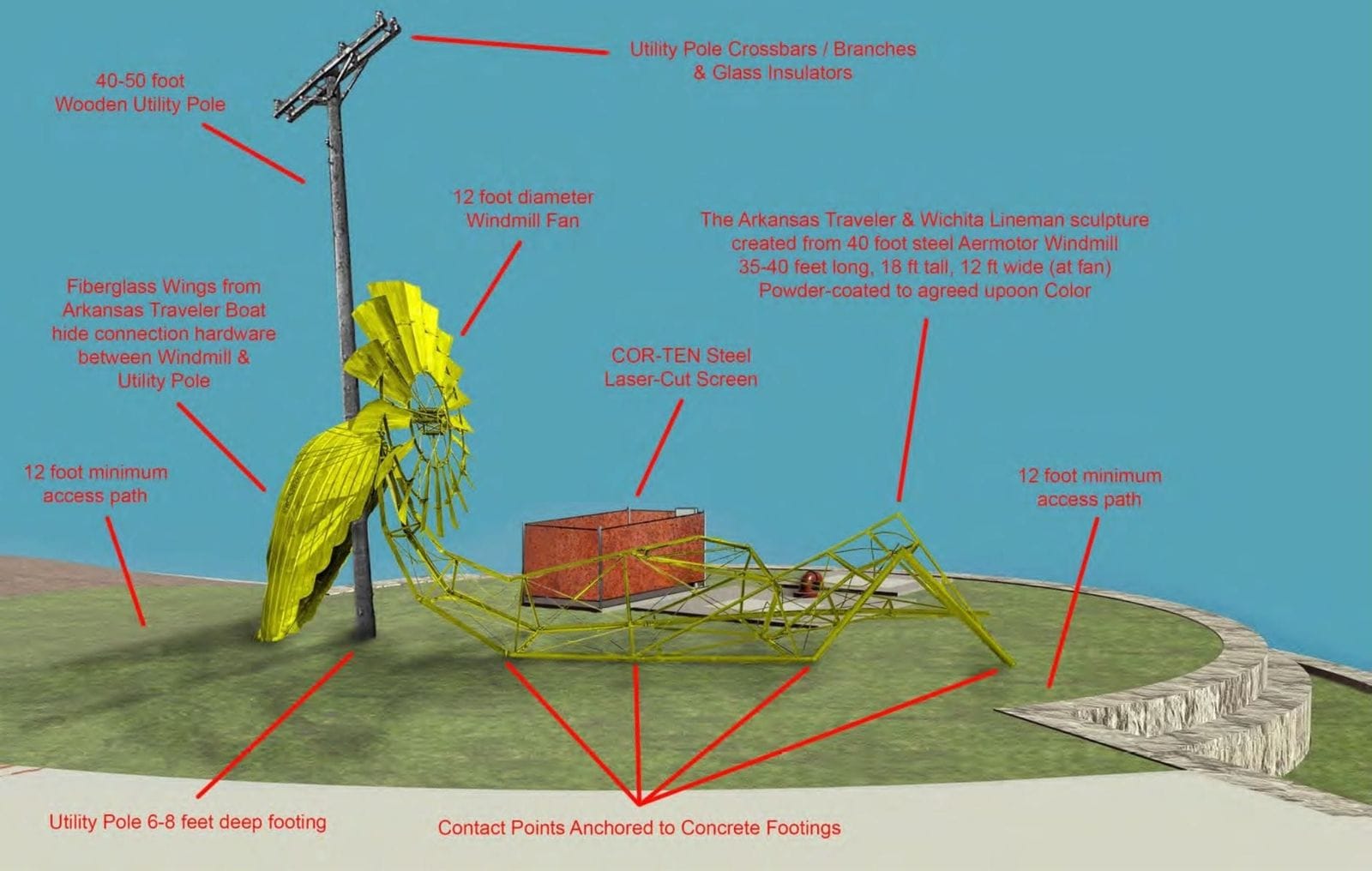
Policy can be a tool for sustaining and growing a public art collection. In 2019, the Wichita City Council approved a percent-for-art ordinance that allots 2 percent of certain capital improvement funds to public art, such as soon-to-be-installed riverfront artworks, including Scott Hocking’s “Wichita Lineman,” a steel-and-wood screen inspired by Kansas windmills and the Glen Campbell song.
“Our environment plays a big role in the way we feel as both individuals and as a community,” says Lindsay Benacka, director of the city’s Arts and Cultural Services. “When our spaces are aesthetically pleasing, especially when utilizing public art and thoughtful design, our experiences are often elevated. Public art is known to increase property values, prevent crime, and build civic pride by providing a sense of identity and belonging.”
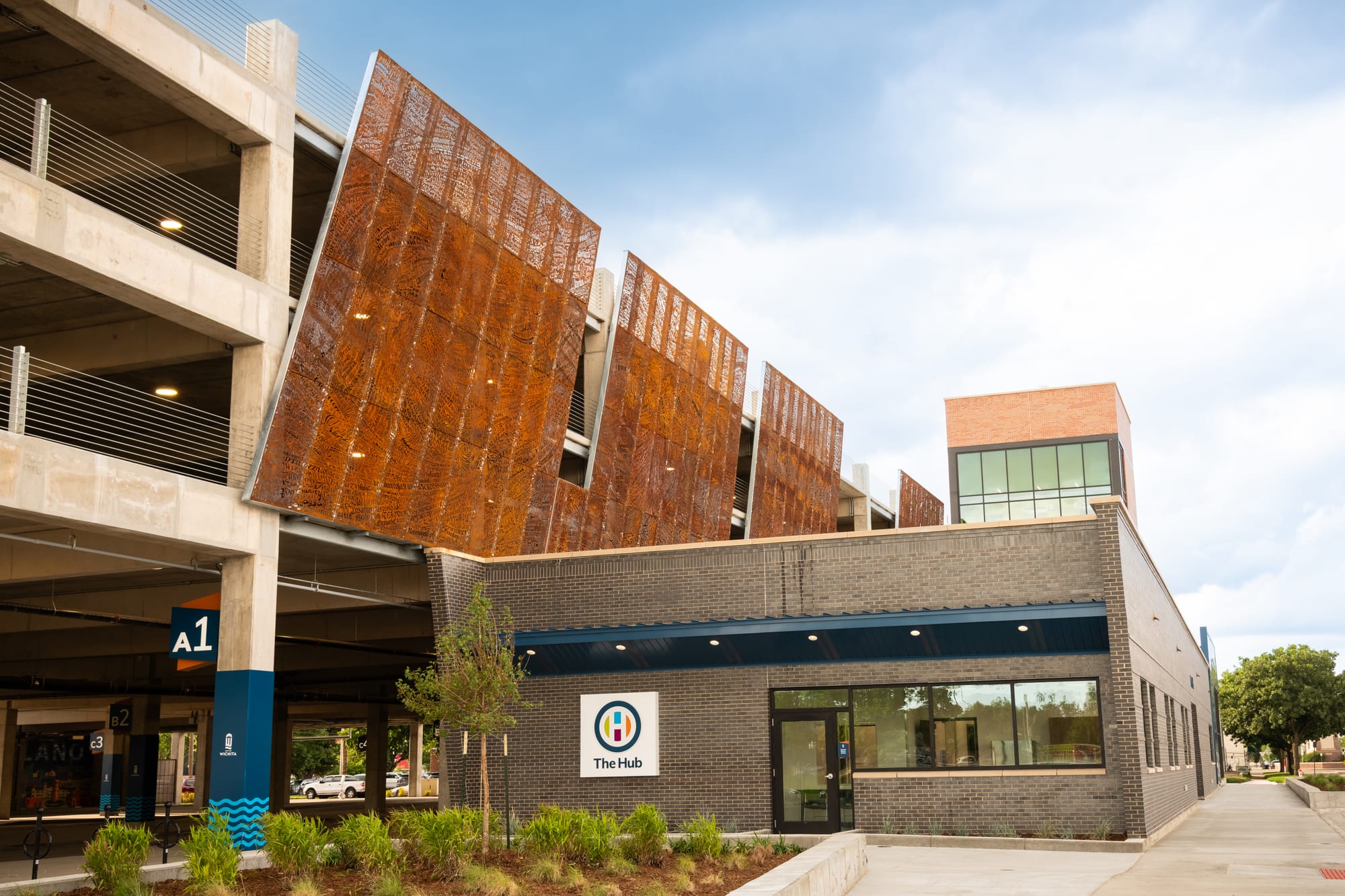
Back at The Hub, which opened in June 2026 and houses a central bus terminal and multi-level parking, the city set an art budget of $350,000. Zhao, a Chinese American artist based in New York City, was one of four artists selected. Ten Works fabricated “From Words to Art,” his vision for the façade screens, out of Cor-Ten — a low-alloy weathering steel that develops a protective rust-colored surface and needs little upkeep, which is exactly what you want on a busy transit structure.
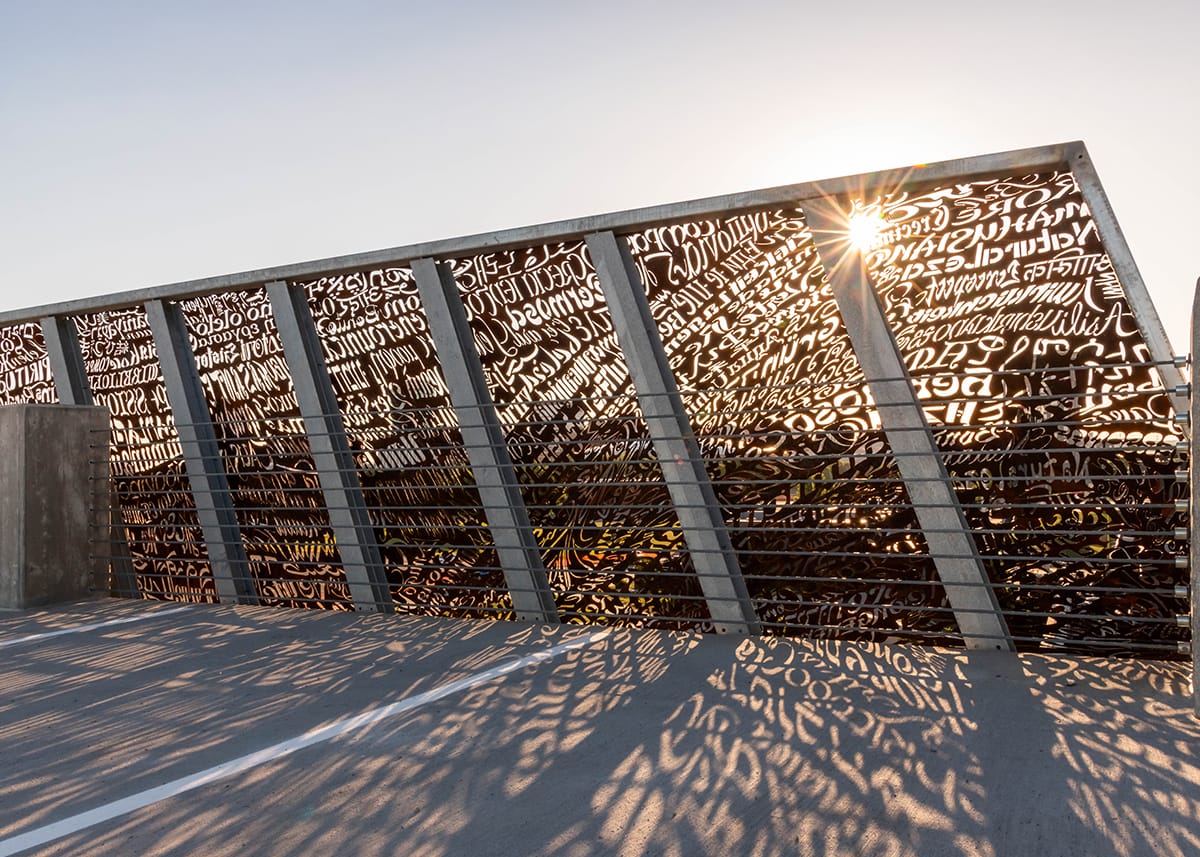
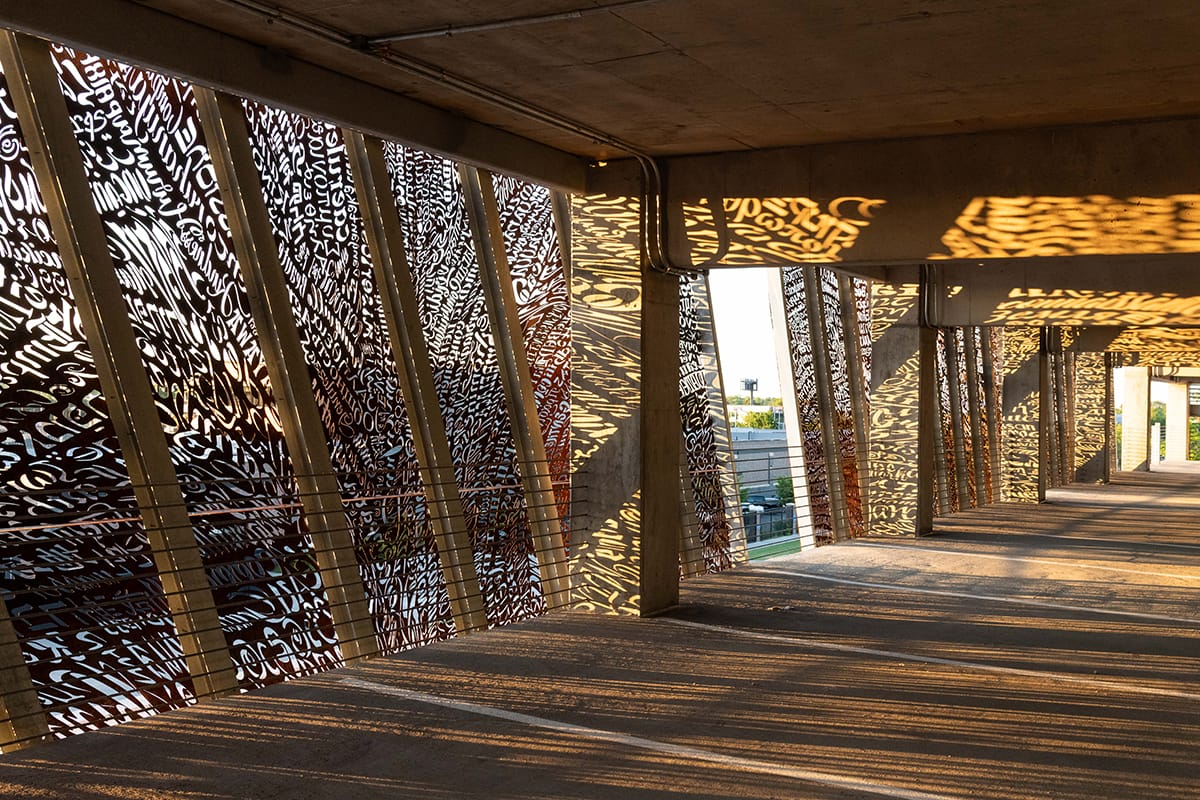
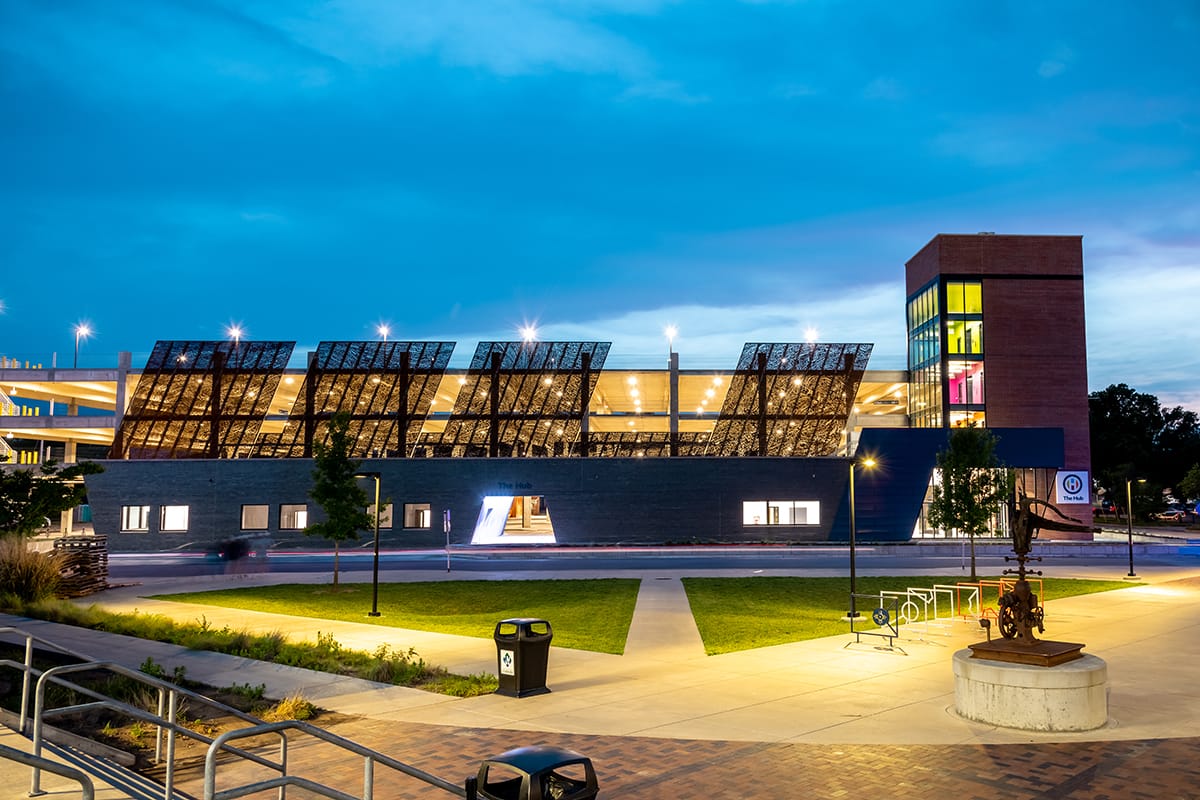
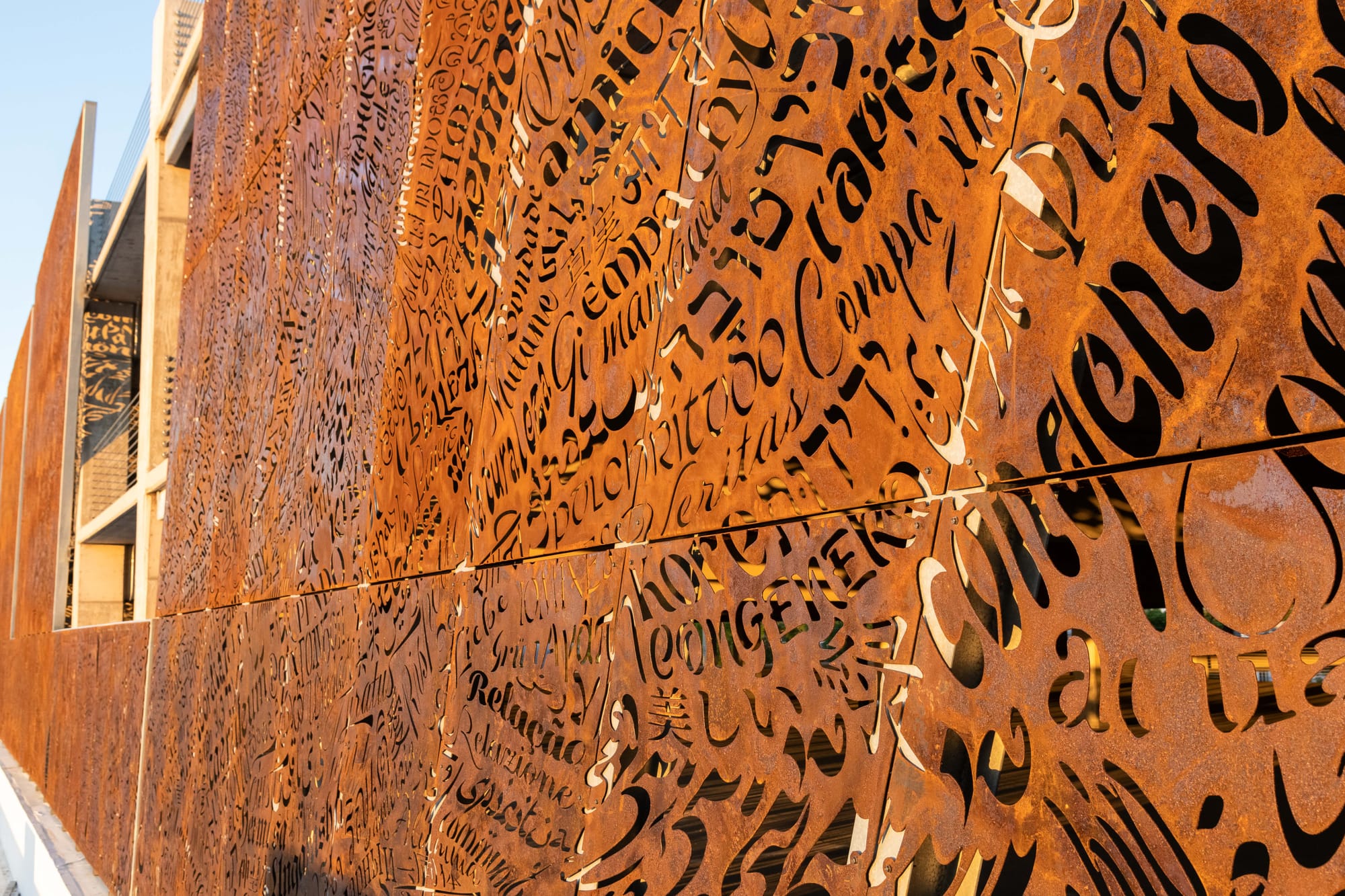
Views of the steel panels covering The Hub in Delano. Like the Keeper and Albert Paley's "Paragon," the panels are made of Cor-Ten steel, a material that weathers over time. (Photos courtesy of Ten Works)
In other cities, Zhao has also used words collected from residents, so the text-driven panels fit his community-collaborative practice. Northwest and Northeast Magnet high school students and local gallery crawl participants wrote short memories of growing up in Kansas, descriptions of their families, expressions of hope for the city’s future, and everyday greetings. Cut in overlapping lines of English, Spanish, Vietnamese, Lao, Arabic, Swahili, and Indigenous languages, these phrases map the demographic footprint of the surrounding neighborhoods. The idea of Wichita as a place for everyone is spelled out, literally, in a building that people pass through every day.
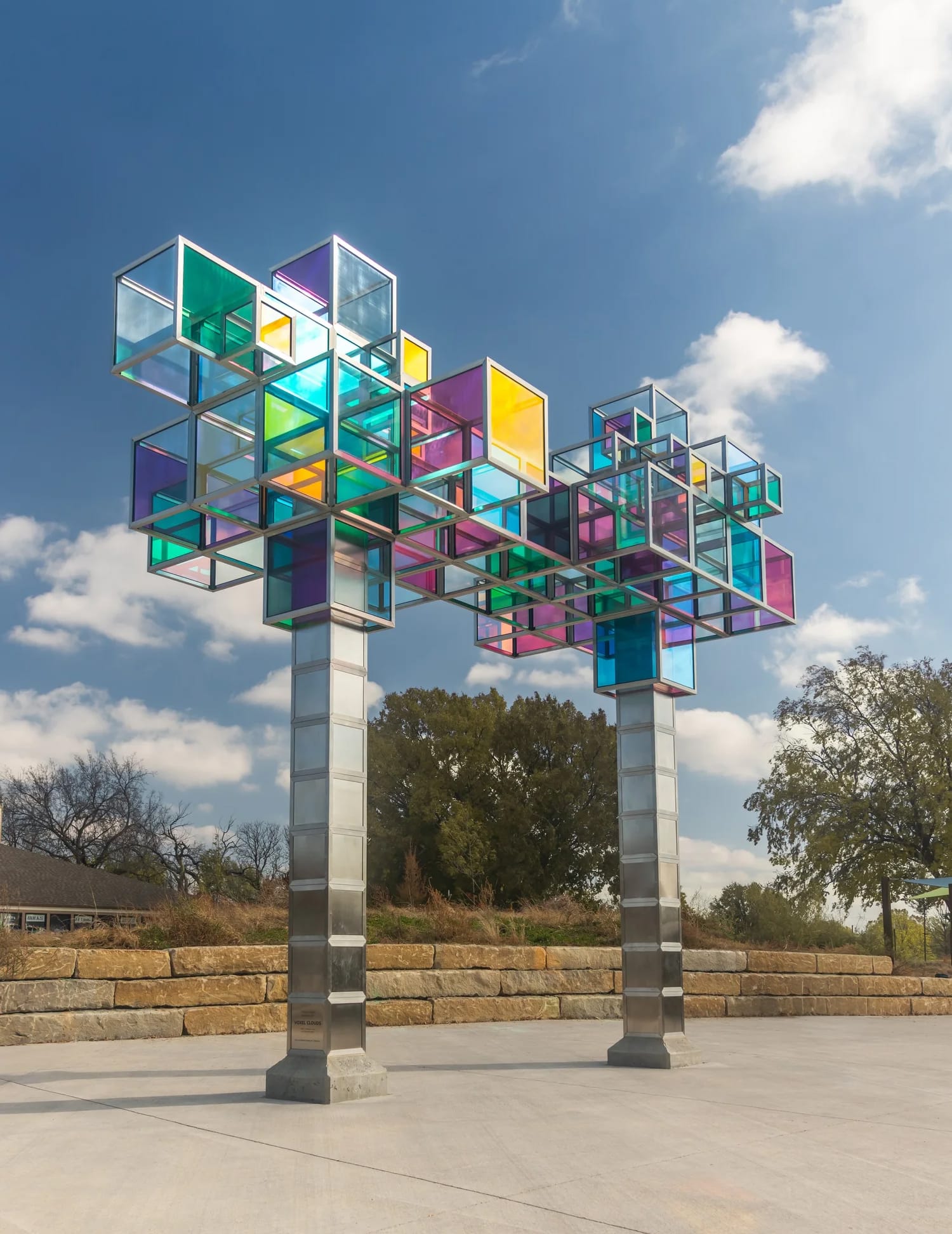
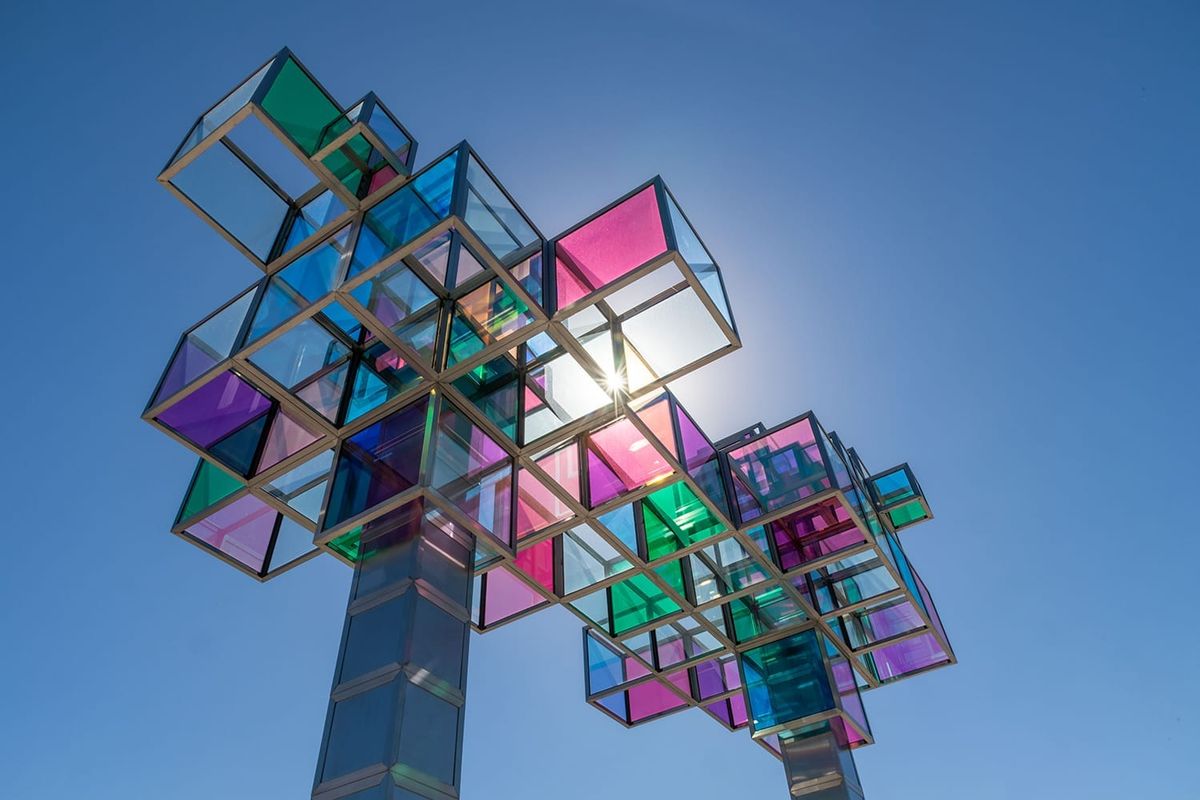
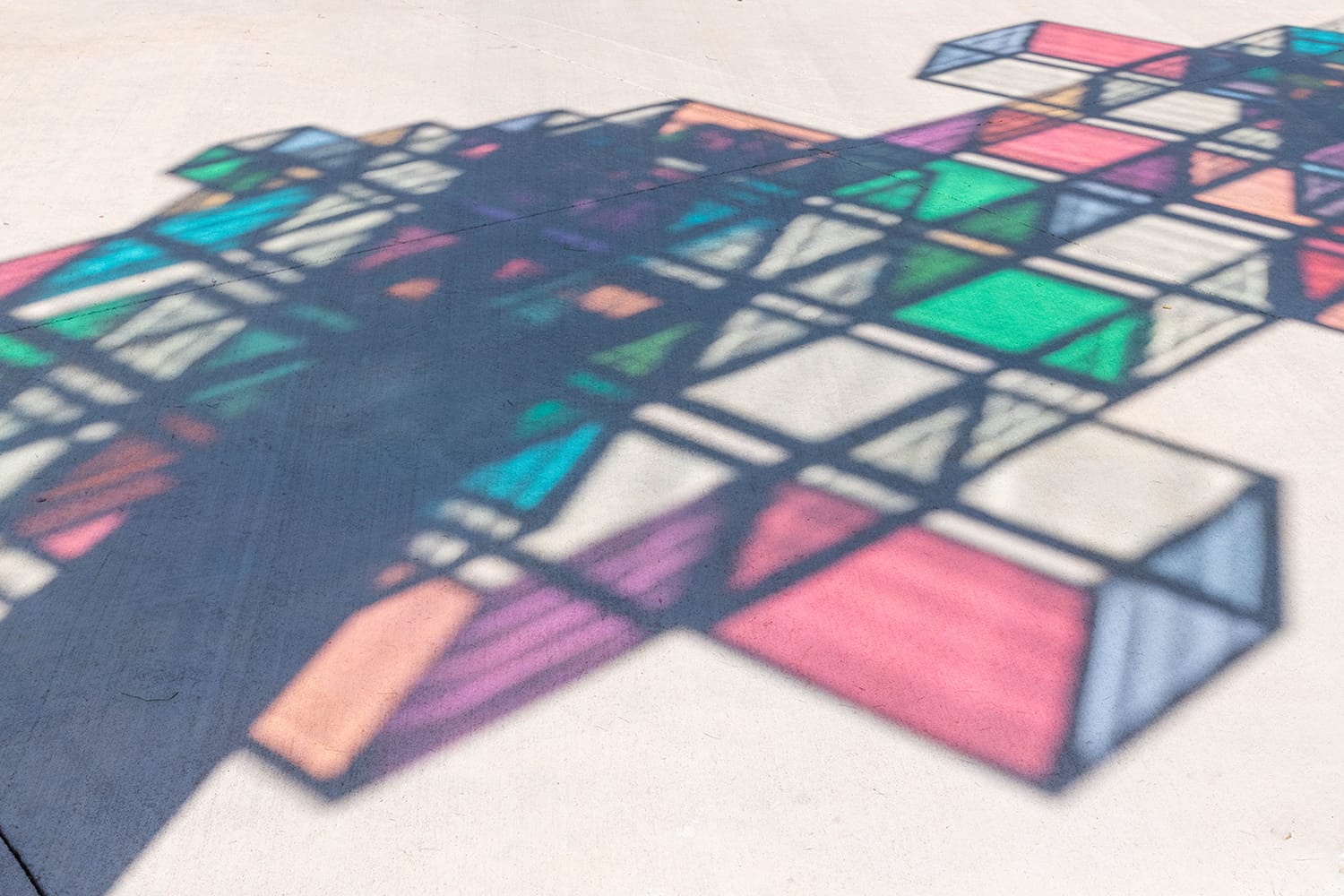
Another public work of art fabricated by Ten Works is “Voxel Clouds” by New York-based artist Osman Akan. Presented in 2025, it welcomes visitors to the recently renovated children’s area at Clapp Memorial Park on Harry Street in southwest Wichita. Ten Works engineered all of the components, footings, glass frames, and mounts for the roughly 19-foot-tall, 22-foot-long piece. The name comes from the voxel, the three-dimensional cousin of the pixel. The firm’s description notes that the shadows read as hopscotch to one generation, building blocks or magnetic tiles to another, and Minecraft blocks to a third. CODAworx named the piece one of its Top 100 Public Art Projects of 2025, and the Clapp Park project team received the Chris Cherches Award for Design Excellence from the Wichita-area Design Council.
When viewing public works of art, it's easy to focus on the artist’s name on the plaque and overlook the many artisans, engineers, craftspeople, and fabricators who played a part in its creation.
“A common misconception with the city’s public art program is that we don’t hire local artists or work in the local community when in fact over half of the public art projects solicited in the past few years commissioned local artists,” Benacka notes. “Even when artists who are not Wichita-based are engaged on public art projects, it’s very common for works to be fabricated locally and to use local artist teams to help with construction and installation.” Ten Works is a case in point.
Fire stations keep turning up in the shop’s story. In Rogers, Arkansas, Ten Works is fabricating the feature stairway of a new 18,000-square-foot fire station, and where most stations rely on poles to reach the bays, this stairway has a firefighter slide. Nick Anneler set out to make one old fire station livable for his family. His shop now does the same for the places the rest of us share: a lobby, an airport, a playground, and a city’s transit hub.
Connie Kachel White is a writer and editor who has written about the arts in Wichita for going on three decades now. White, whose communications gigs range from book-editing to investigative reporting, is the founding and current editor of Wichita State University’s The Shocker magazine. More of her writing can be found online at theshockermagazine.com and shockerconnect.com.
❋ Derby man has the kind of voice that turns heads — and chairs
❋ Socializing while sober: how some Wichitans are cultivating alcohol-free communities
❋ As a small creative business closes, the owner mourns
❋ Painting through it: Autumn Noire on 20 years of making art
❋ How a guy from Wichita resurrected 'Dawn of the Dead'
❋ Bygone Friends University museum housed curious collections
Support Kansas arts writing
The SHOUT is a Wichita-based independent newsroom focused on artists living and working in Kansas. We're partly supported by the generosity of our readers, and every dollar we receive goes directly into the pocket of a contributing writer, editor, or photographer. Click here to support our work with a tax-deductible donation.