The architecture of accumulation: Joshua Cross, Karen Holliday & Rachel Epp Buller at the Carriage Factory
With 'Pressed, Pieces, and Presence,' the Newton gallery continues its 'lineage of raw assembly and hard labor.'
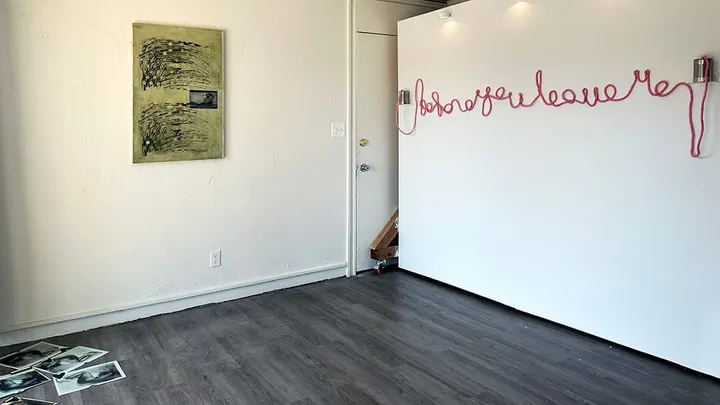
“Pressed, Pieces, and Presence,” a group exhibition on view through September 4 at the Carriage Factory Art Gallery in Newton, Kansas, features the work of Joshua Cross, Karen Holliday, and Rachel Epp Buller. Housed within the historic 1883 walls of the former J. J. Krehbiel Carriage Factory, the show invites reflection on pop culture, art history, and gender roles.
According to gallery director Mary Lee-McDonald, the title draws on concurrent realities: the physical compression demanded by printmaking, the piecemeal nature of assemblage and collage, and the lingering historical presence of the Krehbiel factory itself. By showcasing pieces that rely on the physical layering, compression, and reassembling of historical fragments, the exhibition provides a blueprint for how contemporary artists manufacture fresh cultural meaning out of remnants.
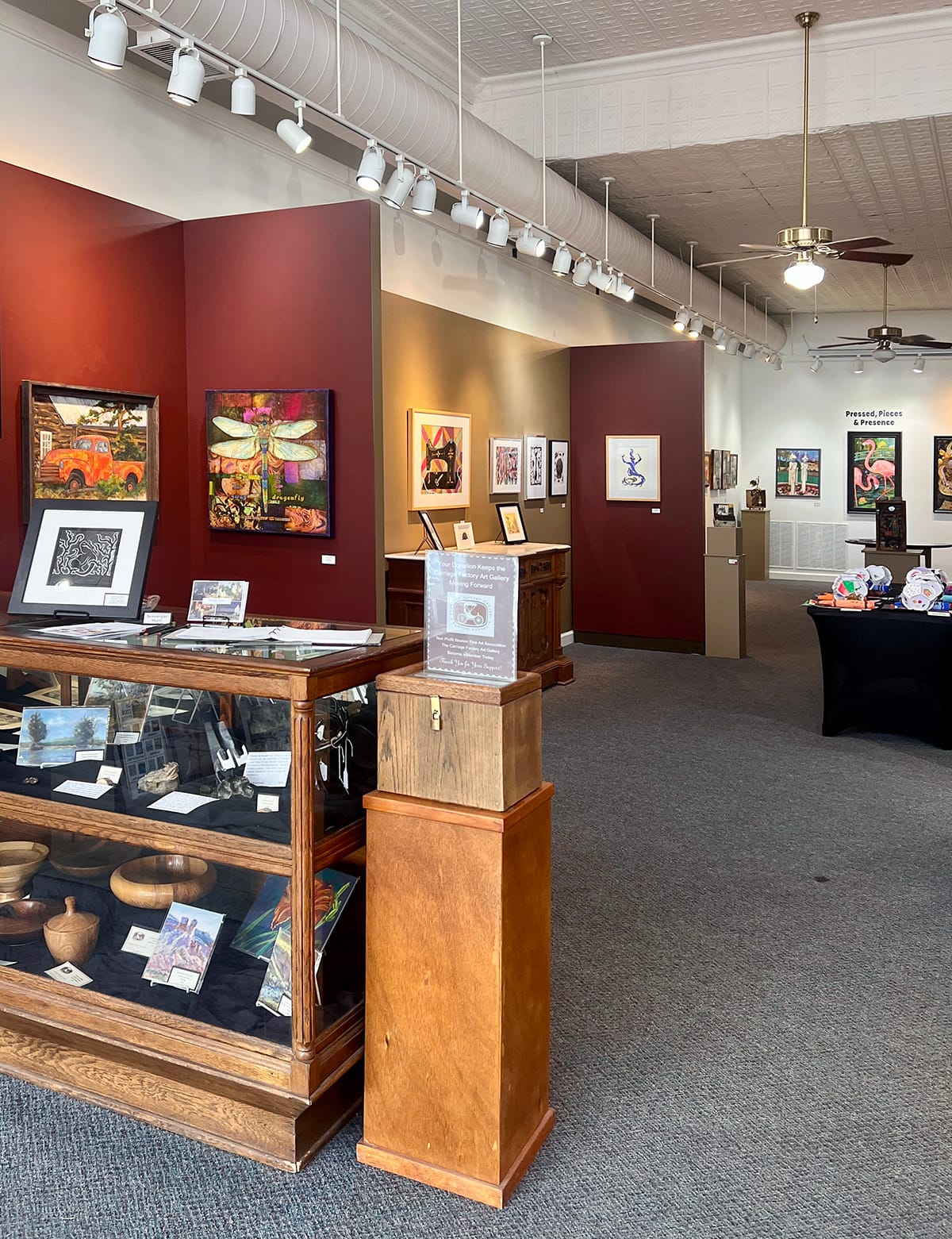
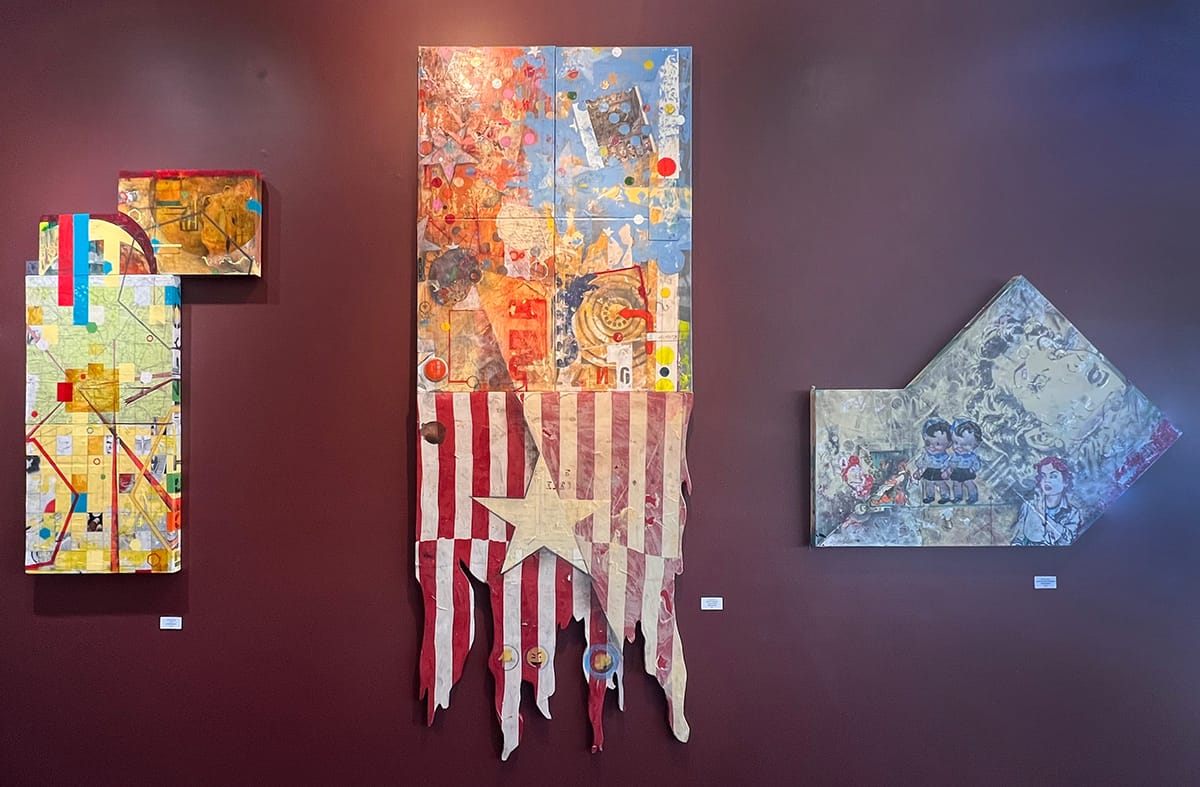
The physical geography of the exhibition creates active dialogues between the artists on its walls and freestanding panels. To the right of the entrance, three of Joshua Cross’ works stand as monumental, anchoring totems on a burgundy accent wall. These pieces establish a narrative collision between mid-century comic book illustrations and heavy, textured abstraction.
In Cross’ smaller mixed-media work “Bumble,” a diver in a vintage-style helmet grips a speargun in the foreground. She’s juxtaposed against a hand-drawn whale swimming in a field of deep crimson, gold leaf, and stamped polka dots. The surface is split between smooth pop art line work and a heavily distressed background.
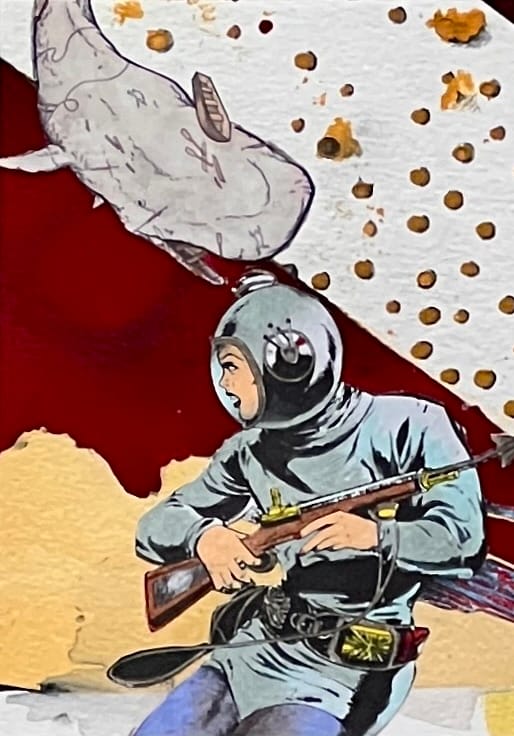
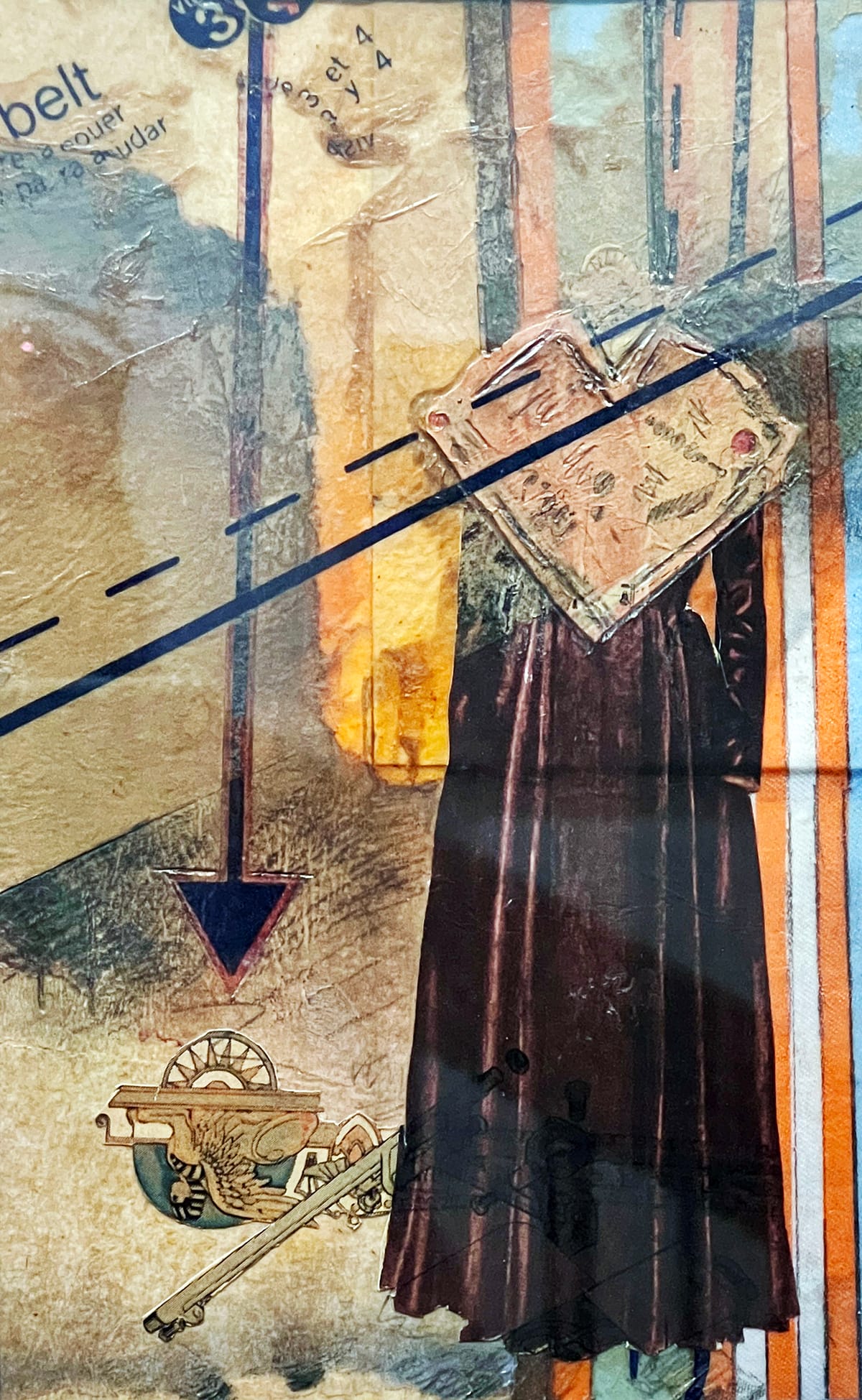
From left: Joshua Cross, “Bumble,” mixed-media on paper, 7 by 5 inches. Photo courtesy ofJoshua Cross; “Gussied Up,” mixed-media on paper, 8 by 5 inches. Photos by Skyler Lovelace for The SHOUT.
Similarly, in “Gussied Up” the artist builds the composition out of a complex, translucent tapestry of historical fragments. Cross constructs the background out of vintage sewing patterns — complete with visible English and Portuguese text instructions. The central female silhouette has a large paper heart layered on it. Slashes of vertical orange and blue stripes frame the scene, infusing a sense of industrial geometry on the romantic composition.
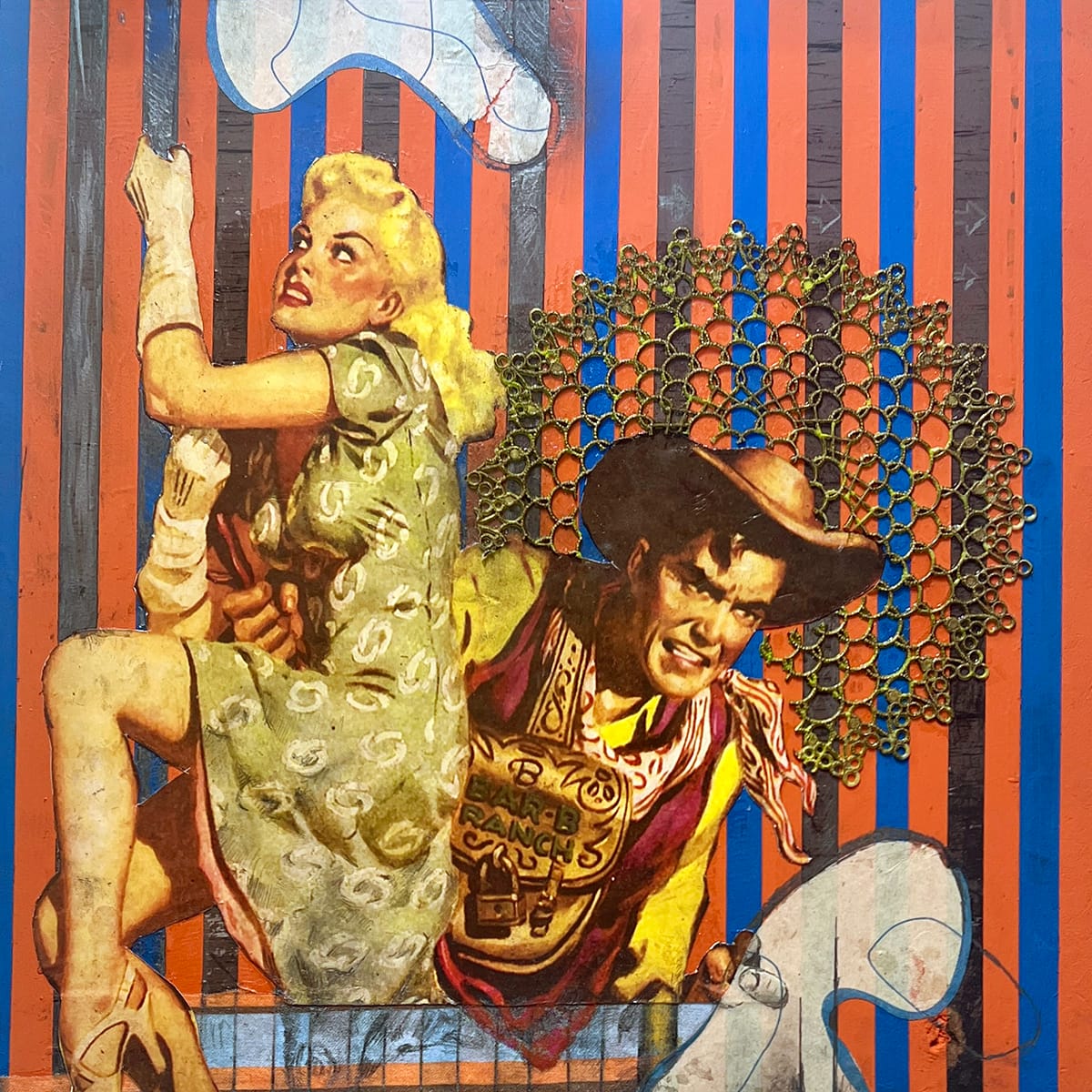
In “Sain’t,” Cross balances a similar pattern of vertical blue and orange stripes with vintage imagery. Organic clouds of white paint disrupt the rigid geometry of the background stripes. A blonde woman clings to one of the stripes, looking upward in distress. Meanwhile, a scowling cowboy in a yellow shirt and Stetson hat pushes past a metallic gold doily. Cross expertly balances a symbol of aggressive masculinity with intimate, domestic textures.
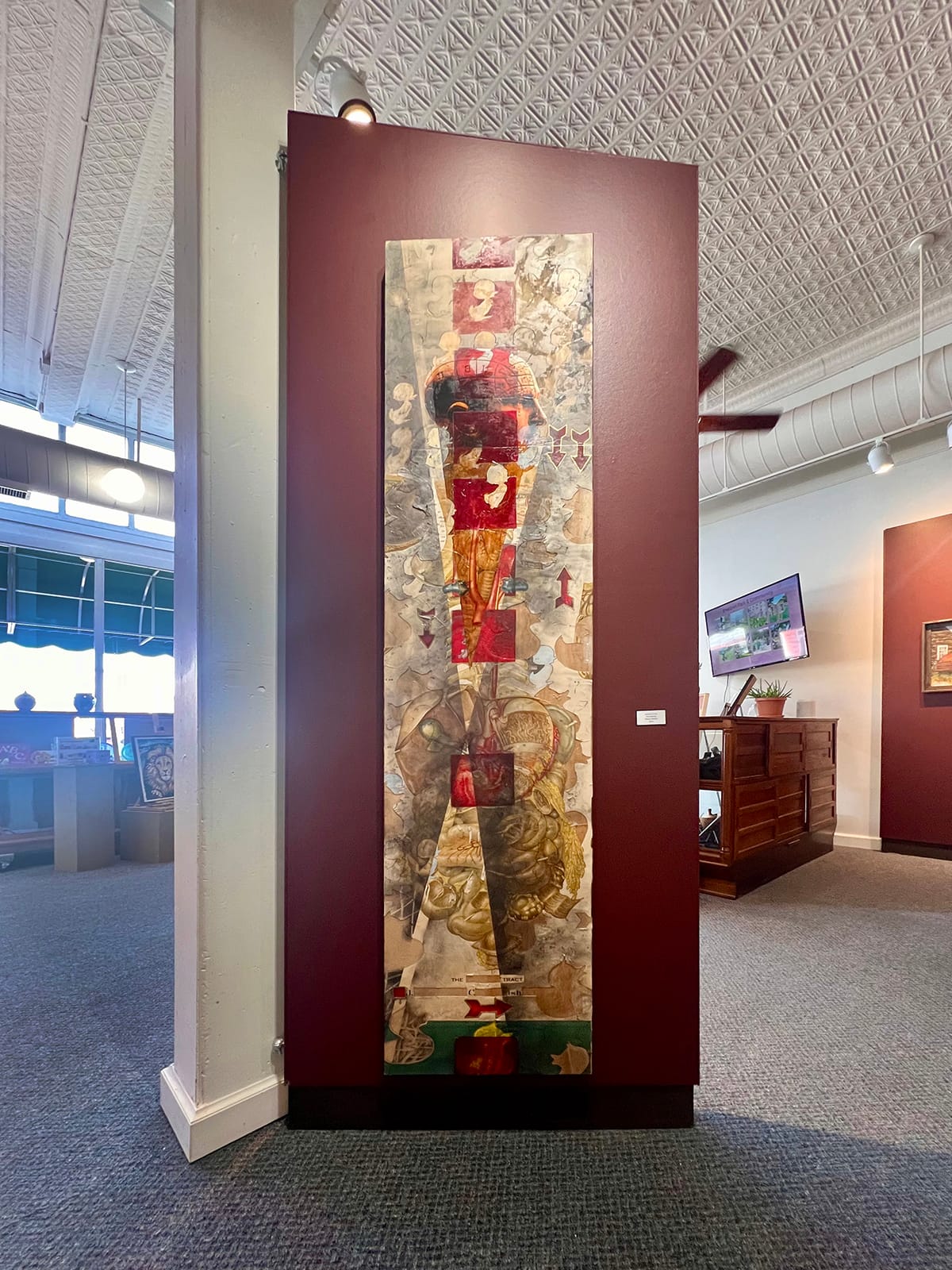
Presented on a deep maroon accent wall, the 80-inch tall collage and paint on panel piece titled “The Skinny” explores the visceral architecture of the human form. The composition presents a layered totem pole of anatomical and psychological charts. Crimson-stained medical diagrams of the human heart and chest cavity underpin an illustrated profile of a human head mapped into numbered phrenological quadrants.
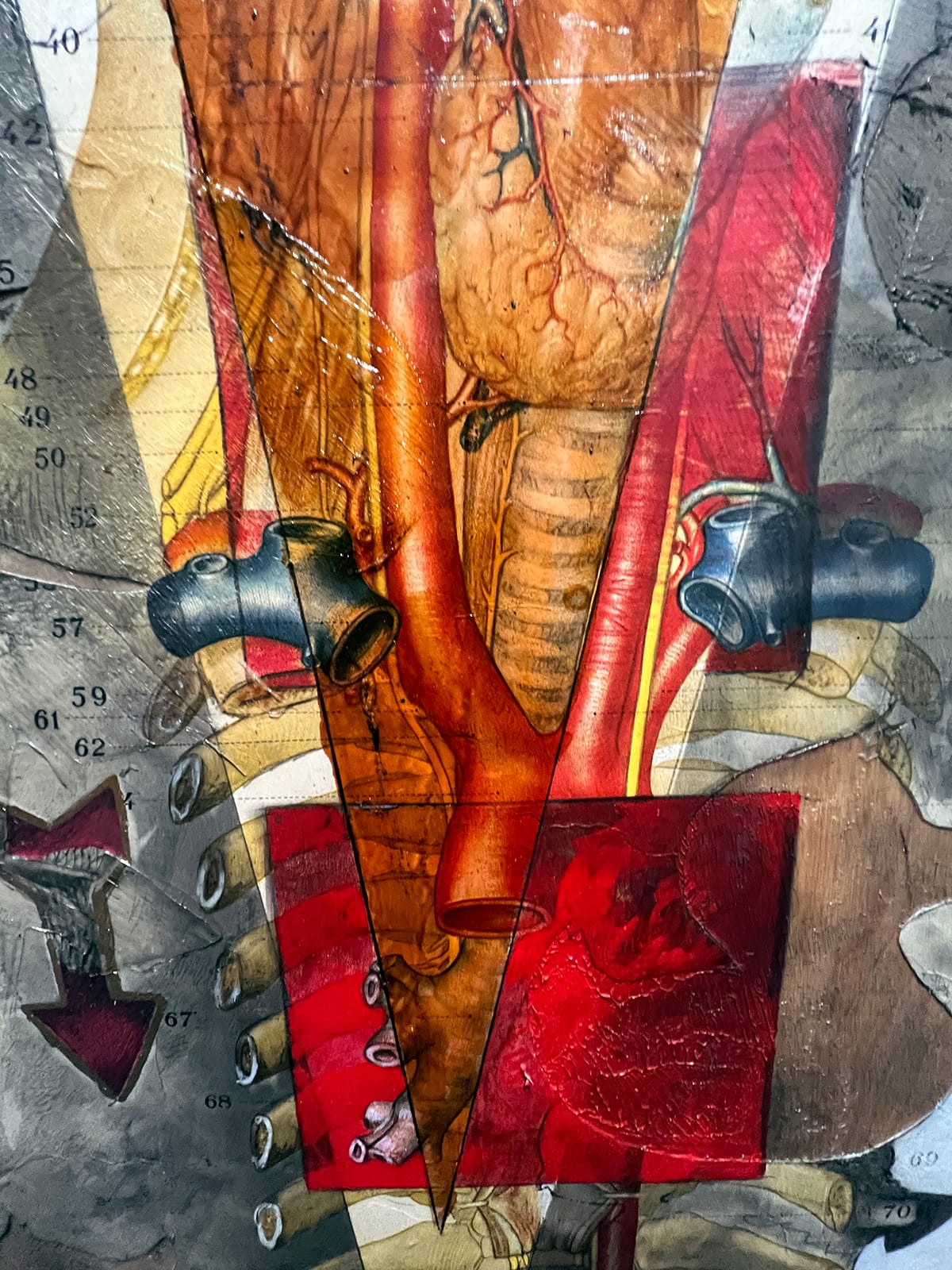
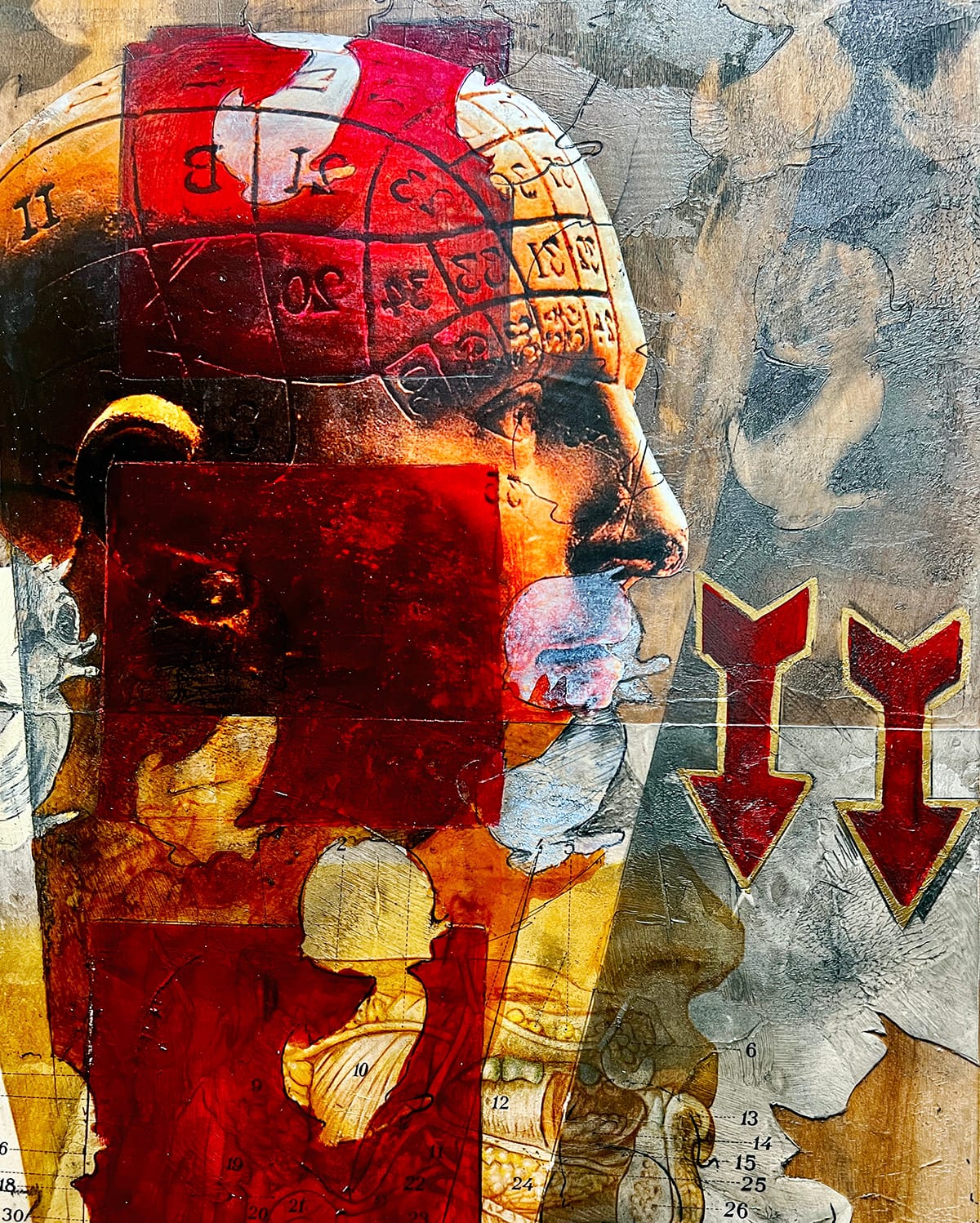
Joshua Cross, “The Skinny” (details), mixed-media on panel, 80 by 18 inches. Photos by Skyler Lovelace for The SHOUT.
Cross revealed during the opening reception that the painting functions as an autobiographical mapping of his personal struggles with celiac disease. The ducks that pattern “The Skinny” refer to the phenomenon of appearing to float on a smooth surface while “paddling like crazy” underneath the waterline. The piece anchors an intense bodily anxiety and serves as a public monument of human resilience.
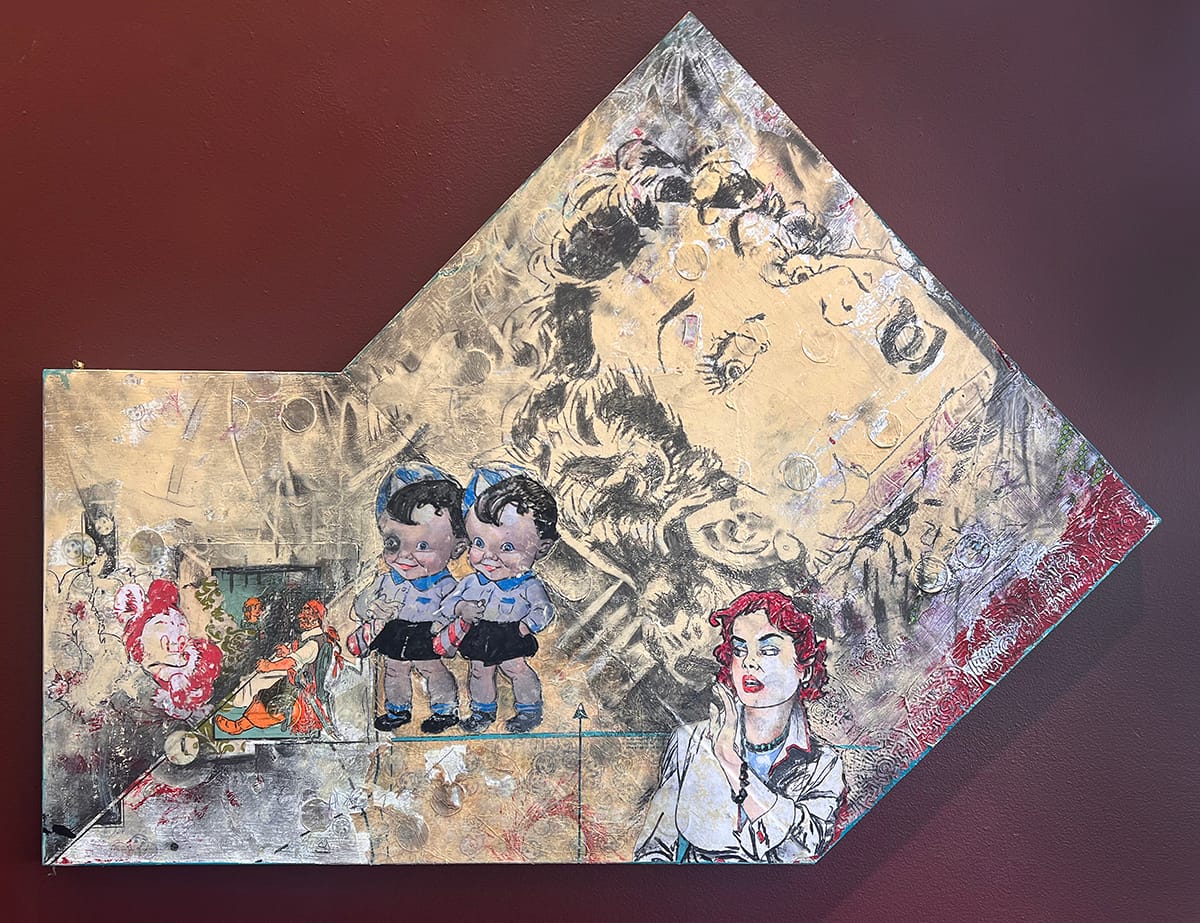
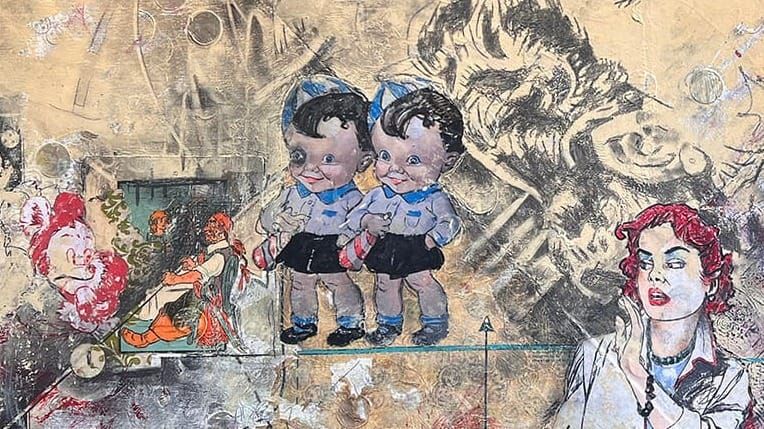
Cross’ “Transformative Widgetry,” an unconventional, arrow-shaped mixed-media on panel work that juts dramatically across the gallery wall, represents a psychological map of mid-century domesticity. The surface features a massive, ghosted illustration of a woman's startled face, a pair of vintage Campbell's Soup-style Kewpie doll twins, and a starkly rendered, red-haired woman gesturing in the foreground. Cross overlays these emotionally charged vintage graphics onto a shimmering field of distressed silver and gold, creating a tension between commercial nostalgia and fine-art opulence.
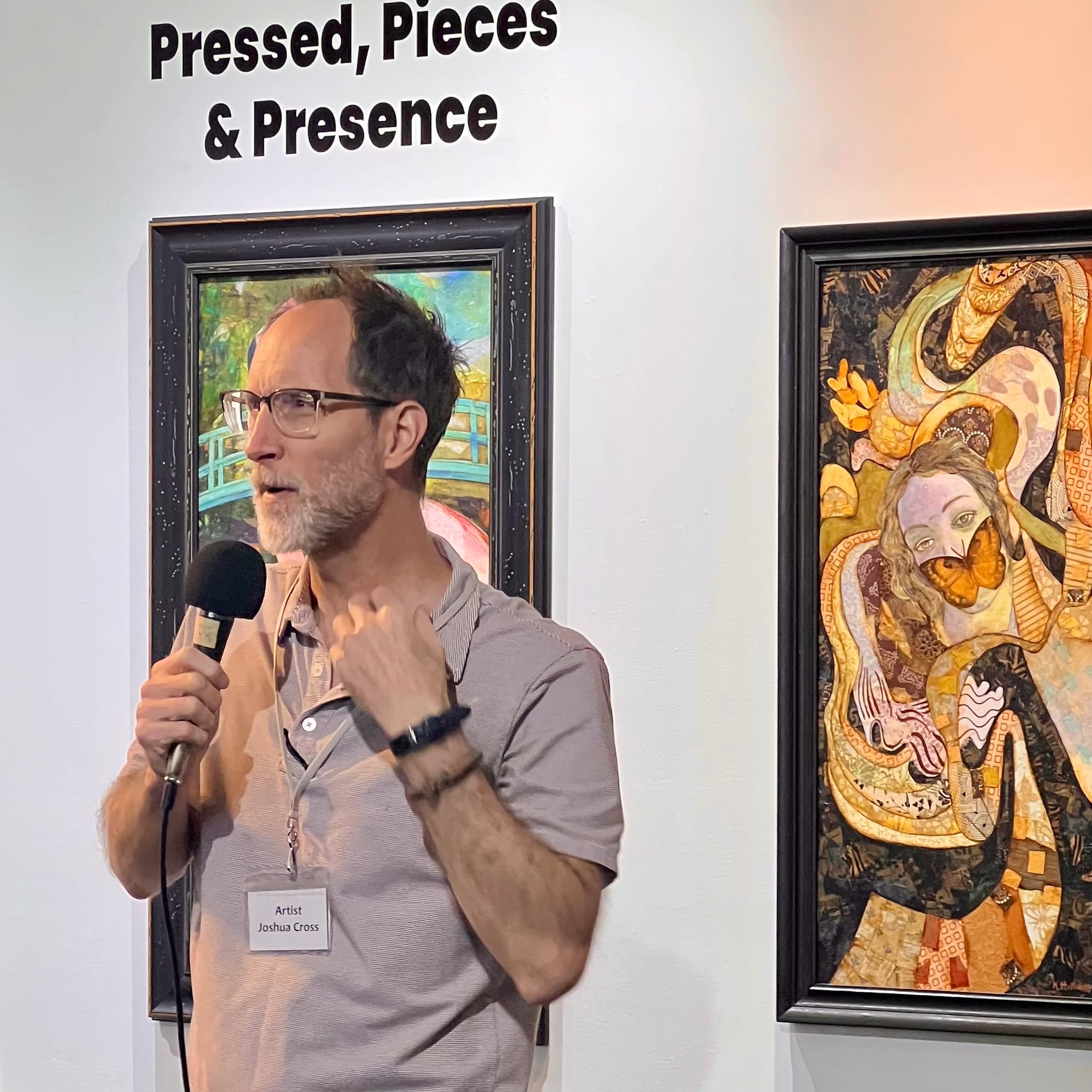
Cross brings a deep historical curiosity to his work, driven by what he describes in his artist’s statement as an obsession with the "history of things" and the mechanics of human creation. Operating as a self-described "observer, filter, lurker, blender, (and) fun house mirror," he creates works that reflect a seasoned understanding of community and material survival. His community-centered approach anchors his 25-year tenure as an artist and educator working primarily with rural and at-risk populations — experience he currently brings to his role as an art professor and head of interdisciplinary studies at Hesston College.
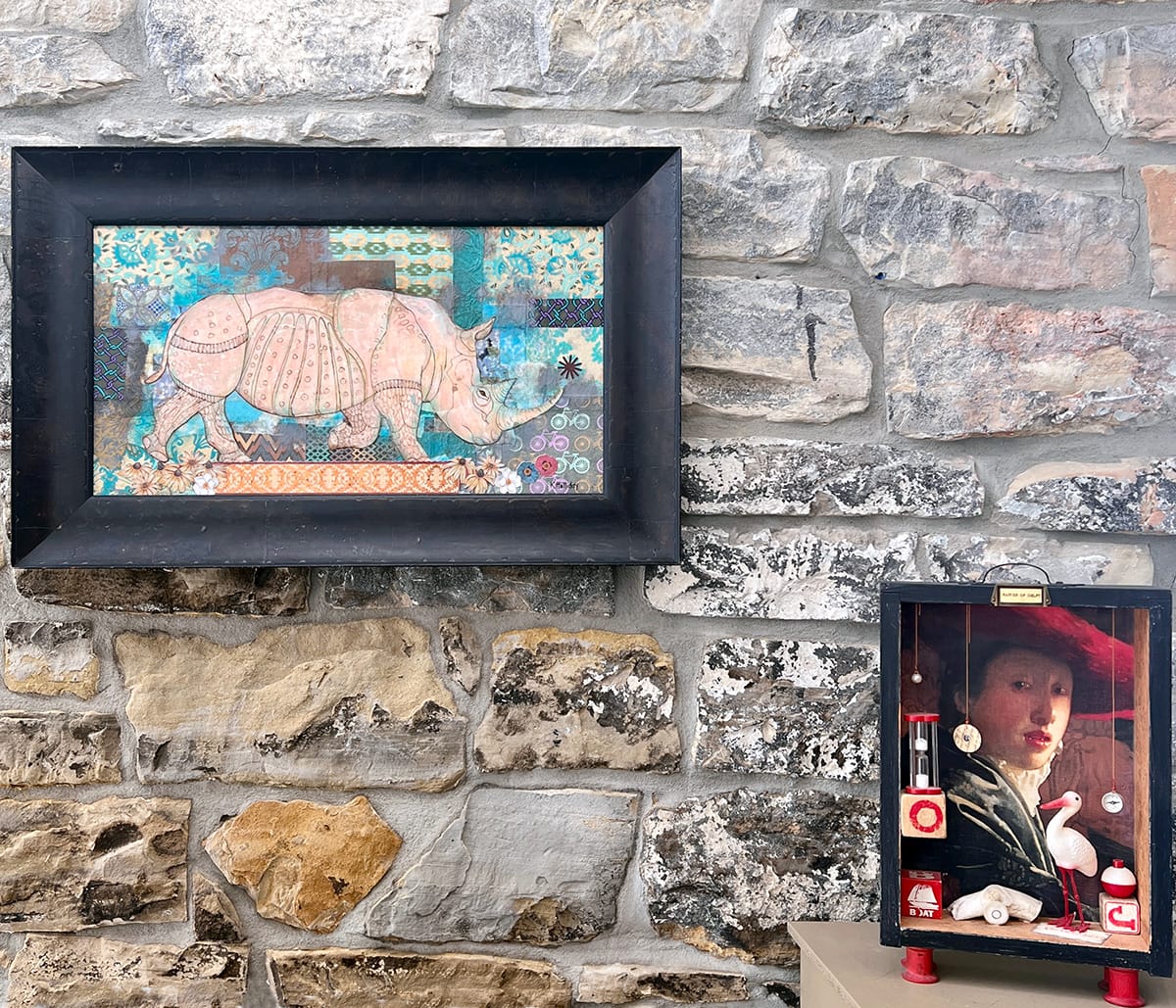
Lee-McDonald’s curation utilizes the Krehbiel building’s physical architecture to heighten the domestic and historical textures of the artworks. Near the entrance, Karen Holliday’s work is mounted directly onto the building's exposed interior walls, highlighting the physical friction between the heavy, ancient limestone and the delicate paper fragments embedded in Holliday’s compositions.
Holliday specializes in the retrieval of vintage papers, antique ledger sheets, and old maps to piece historical shards into new narratives. The artist possesses a diverse professional background. Originally from Wichita, she cut her teeth in the field of graphic design, learning "old school" layout methods before pivoting to technical drafting for the oil and civil engineering industries. Her clean lines and intricate assemblages — honed through studies at Wichita State University and Garden City Community College — reveal a draftsman's eye obsessed with the architectural layout of the "vintage past."
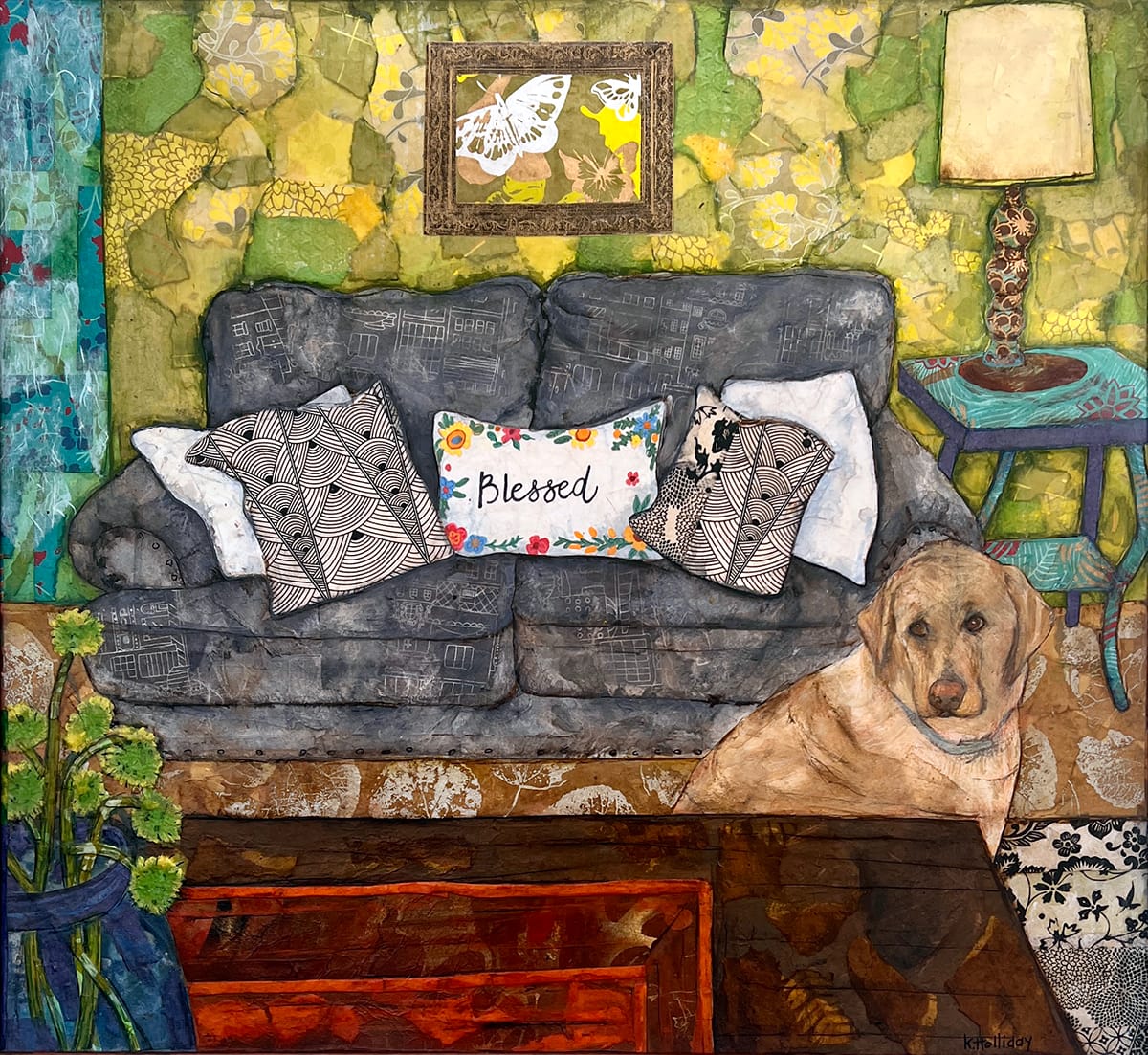
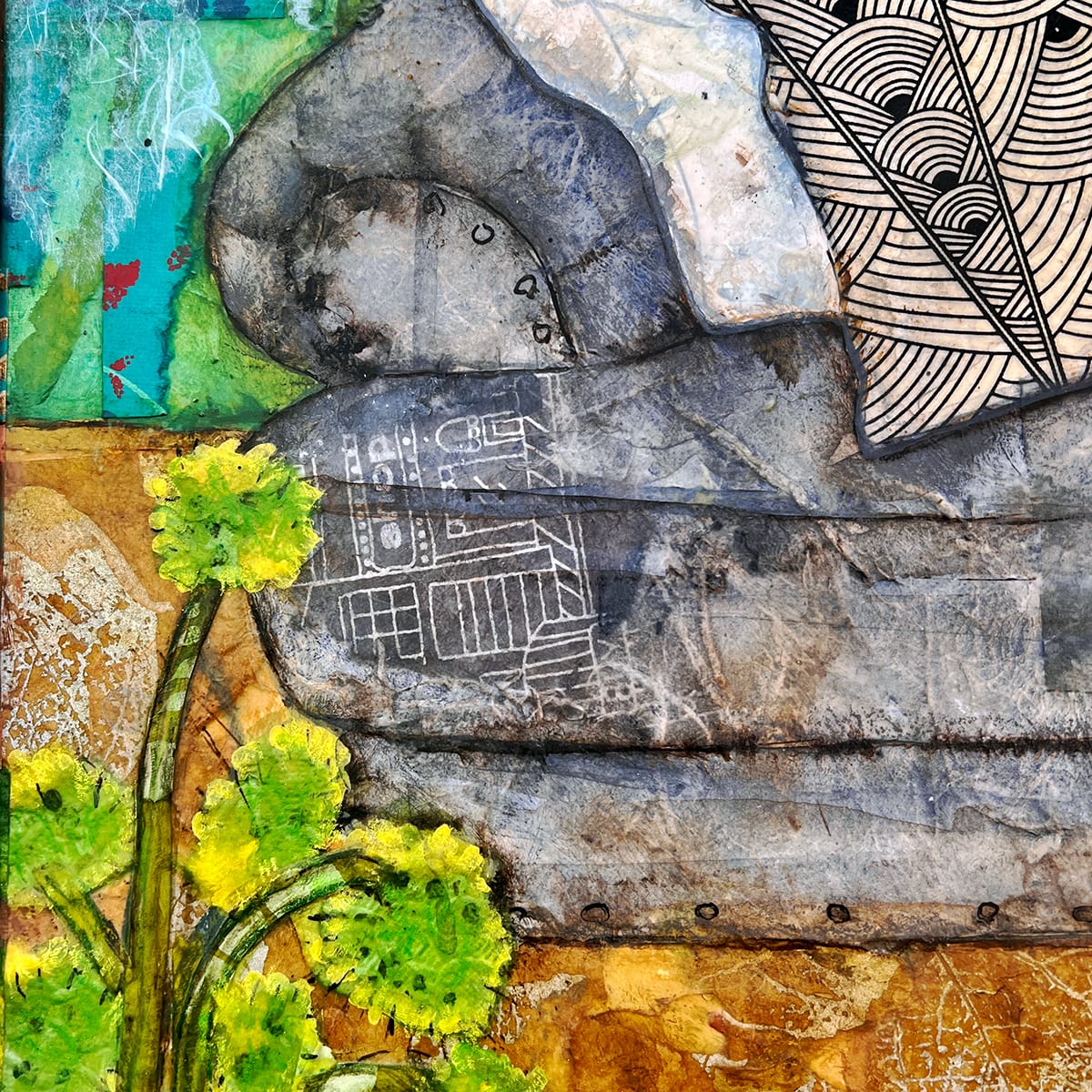
In “Blessed,” Holliday builds a cozy domestic vignette, using a dizzying array of patterned papers. A golden retriever gazes off-frame. A gray sofa overlaid with schematic drawings is piled with geometric throw pillows flanking a central cushion bearing the text "Blessed." The entire composition is built from meticulous fragments: swirling green wallpapers, wood-grained coffee table cutouts, and a tiled floor pattern. In this highly textured environment, every surface feels intensely decorated.
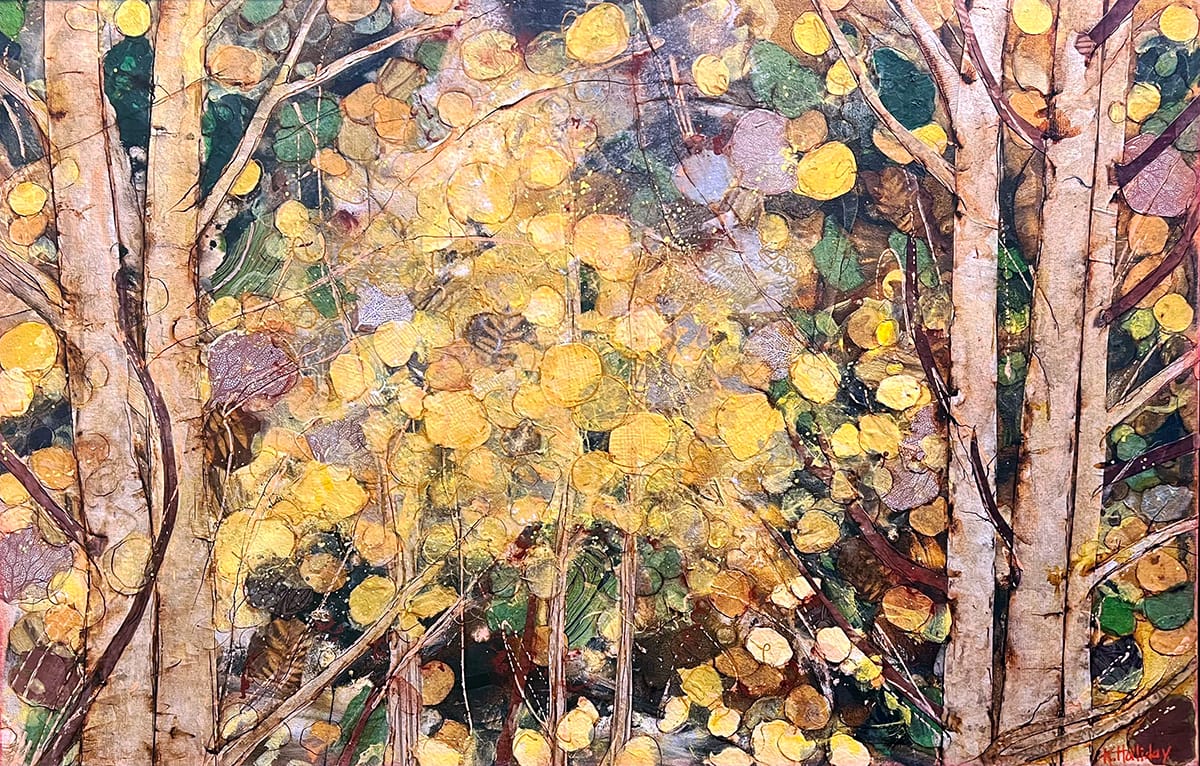
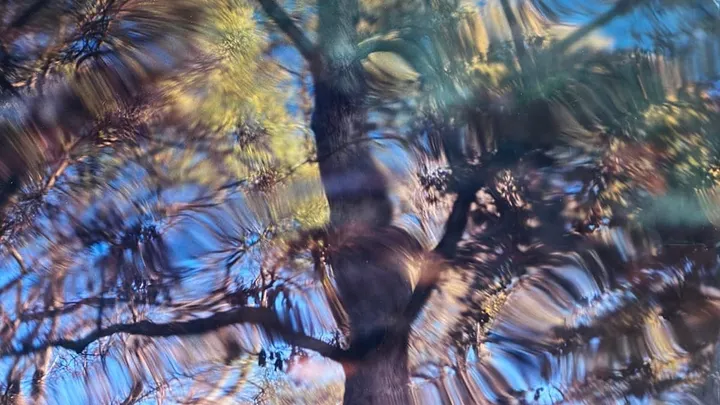
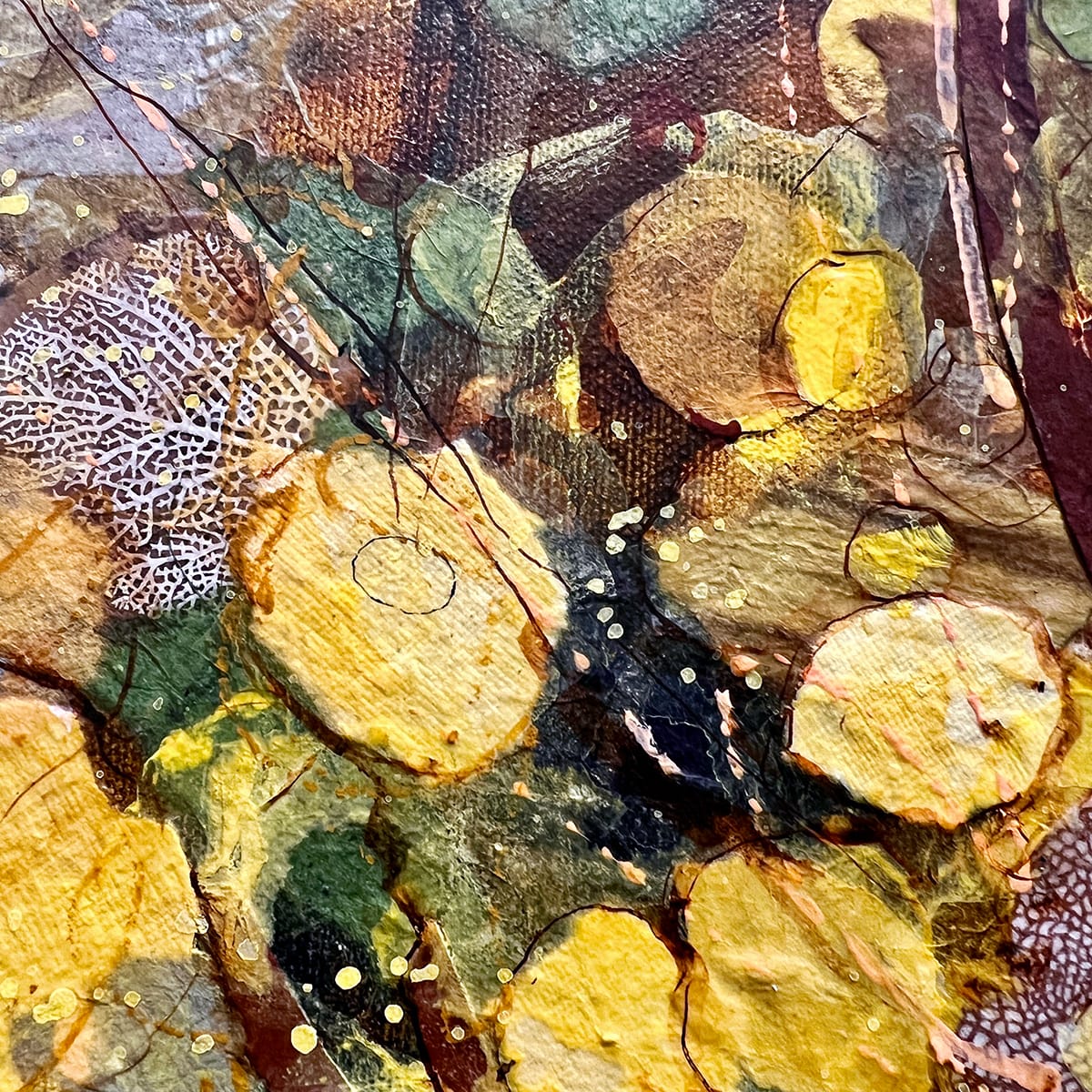
Holliday shifts to an equally complex impressionistic nature study with “Leaves of Absence.” In this collage, overlapping translucent paper discs mimic the dense canopy of a birch grove. The mosaic of golden yellow, olive green, and deep amber circles captures the shimmering quality of dappled sunlight. Fine lace patterns are embedded into the leaf layers, adding even more tactile textile density to the playfully named scene.
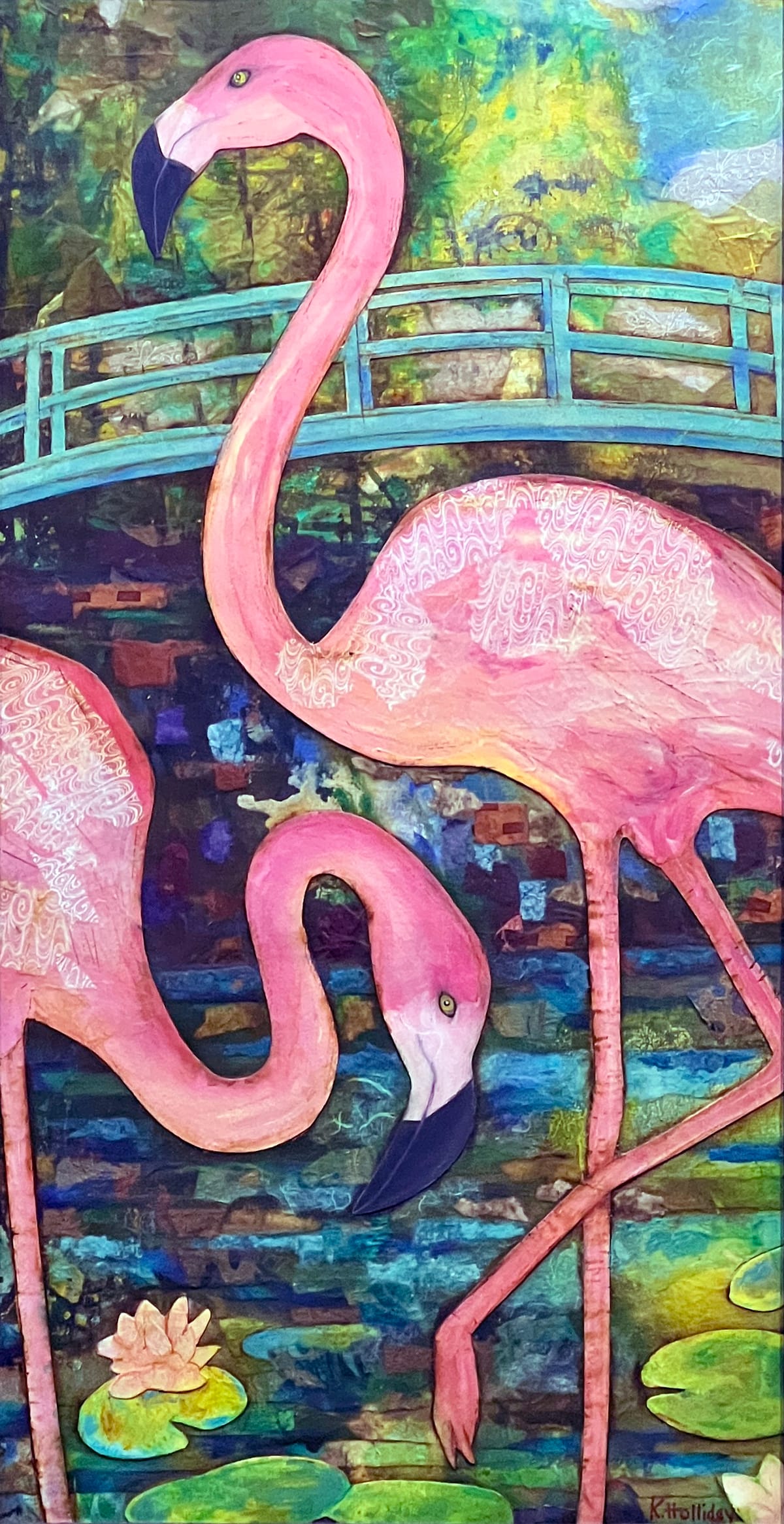
Holliday’s “Monet’s Garden” transports the viewer to a highly patterned, vertically oriented iteration of Giverny. A soft blue-green rendition of Claude Monet's famous footbridge spans the background, while two pink flamingos dominate the foreground. Holliday coats the birds' bodies in delicate white lace stenciling. The piece combines art historical prestige with playful, contemporary ornamentation.
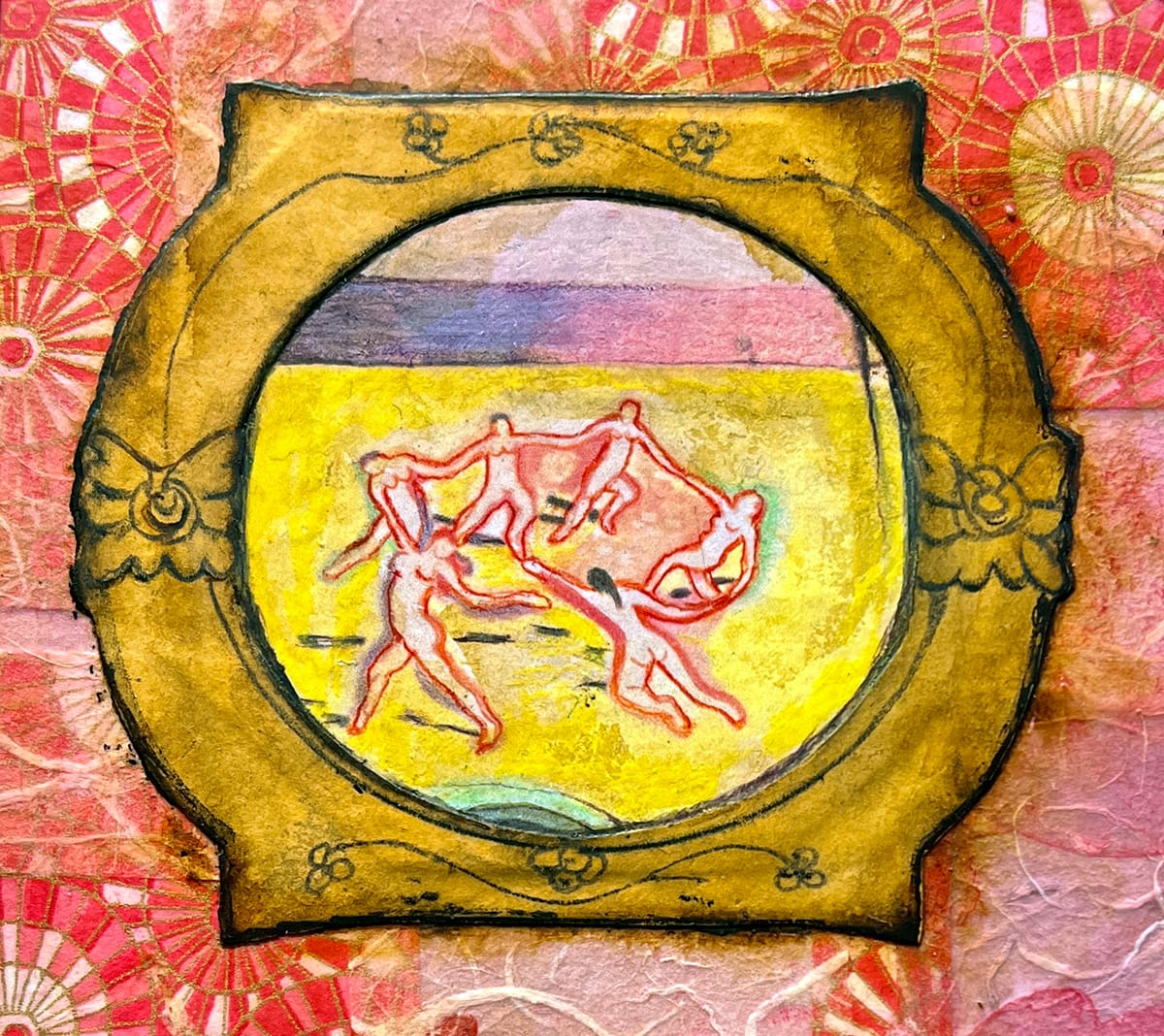
Historical precedents also inform “Odalisque,” which presents a contemporary twist on the classic reclining nude by depicting a woman in denim and sneakers lounging on a red settee. On the upper left wall, an oval-framed artwork features a line-drawn vignette of nude figures locked in a circular dance — an unmistakable nod to Henri Matisse's “La Danse.”
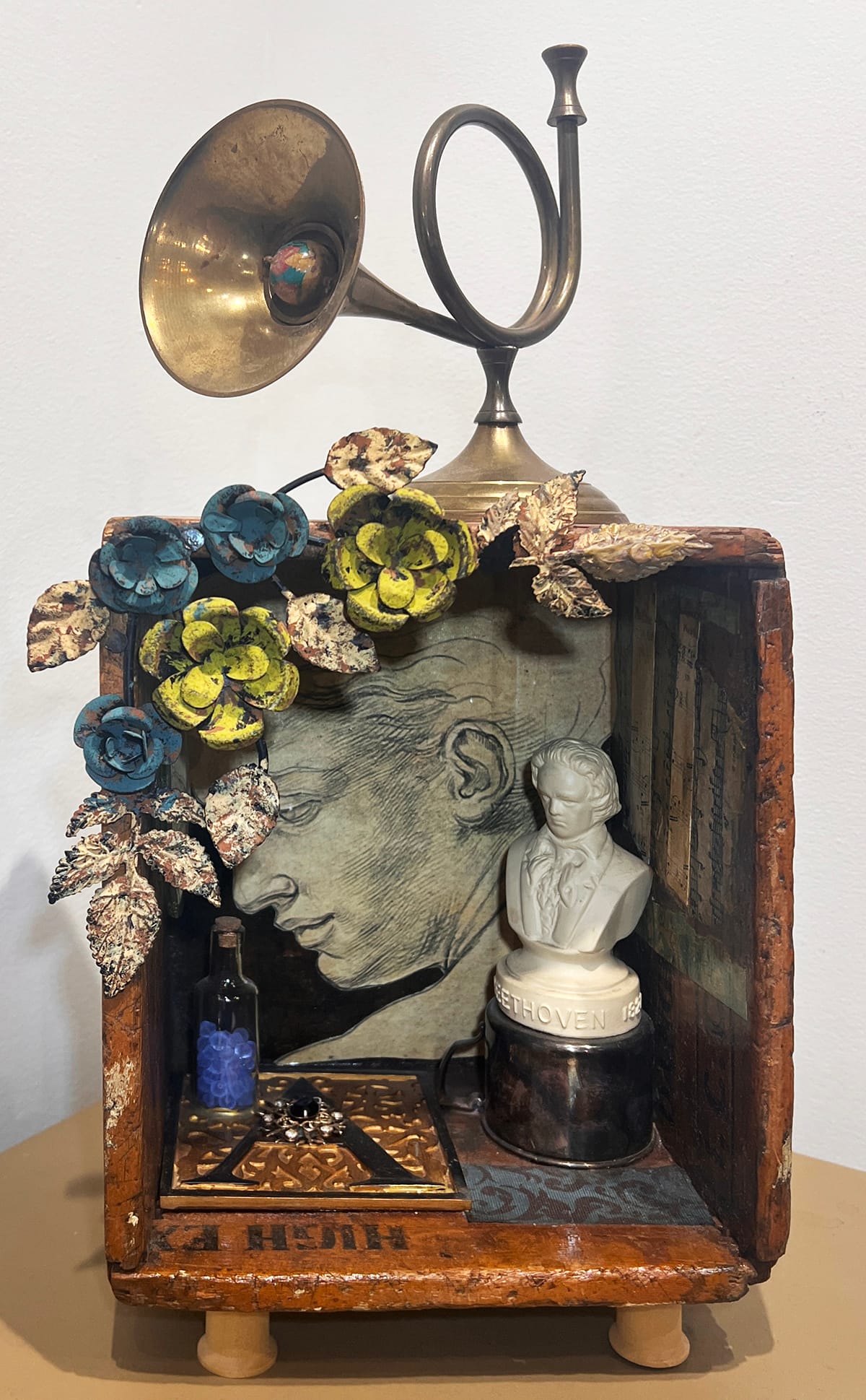
Departing from flat surfaces, Holliday’s three-dimensional shadow box assemblage, “Für Elise,” acts as a tactile reliquary dedicated to classical music. Enclosed within a weathered, rustic wooden crate marked with faded industrial stenciling, the box displays a small porcelain bust of Beethoven. The bust is flanked by an antique glass vial filled with blue beads, a fine profile sketch, a brass musical horn curling out of the top, and a creeping vine of metal flowers painted in chipped blues and yellows.
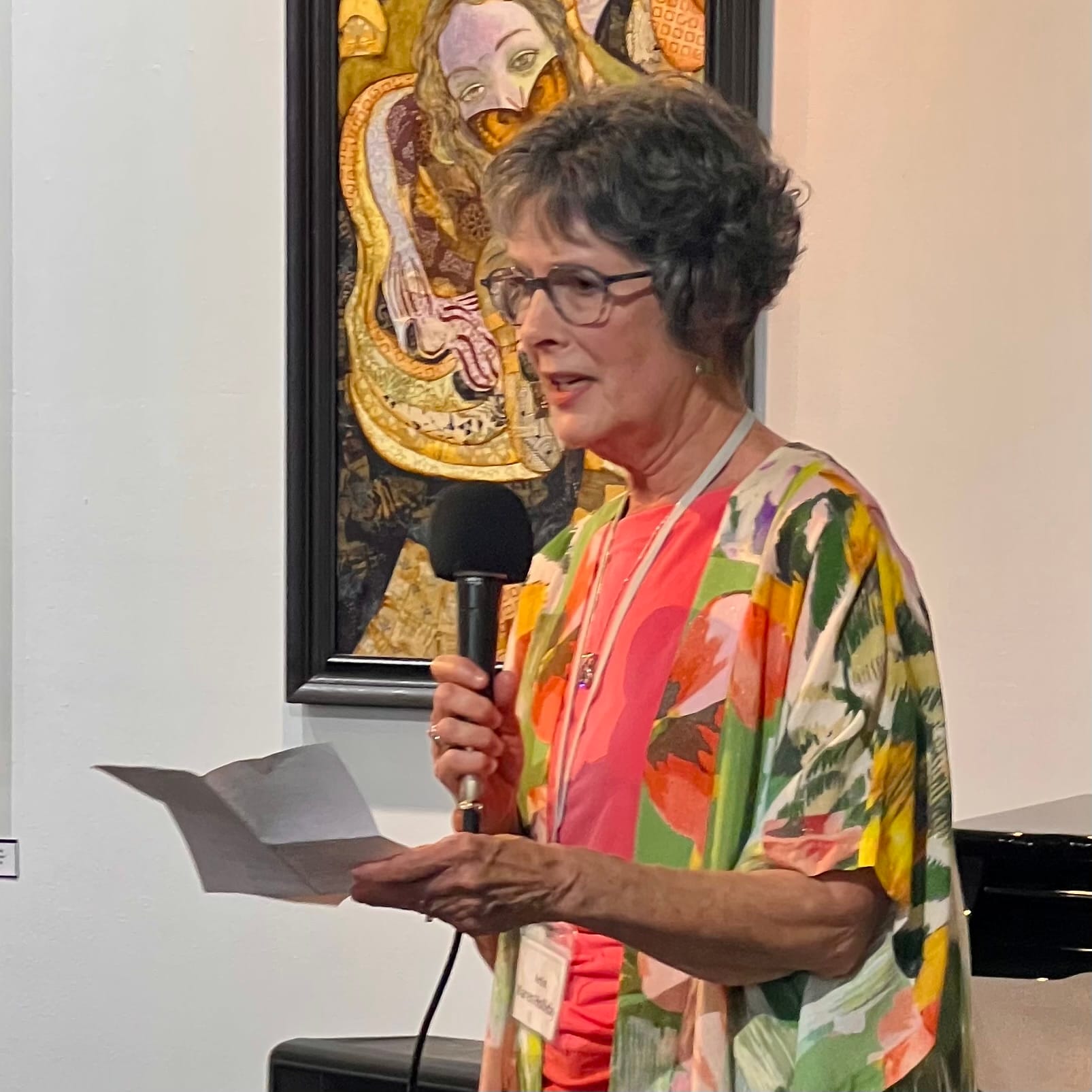
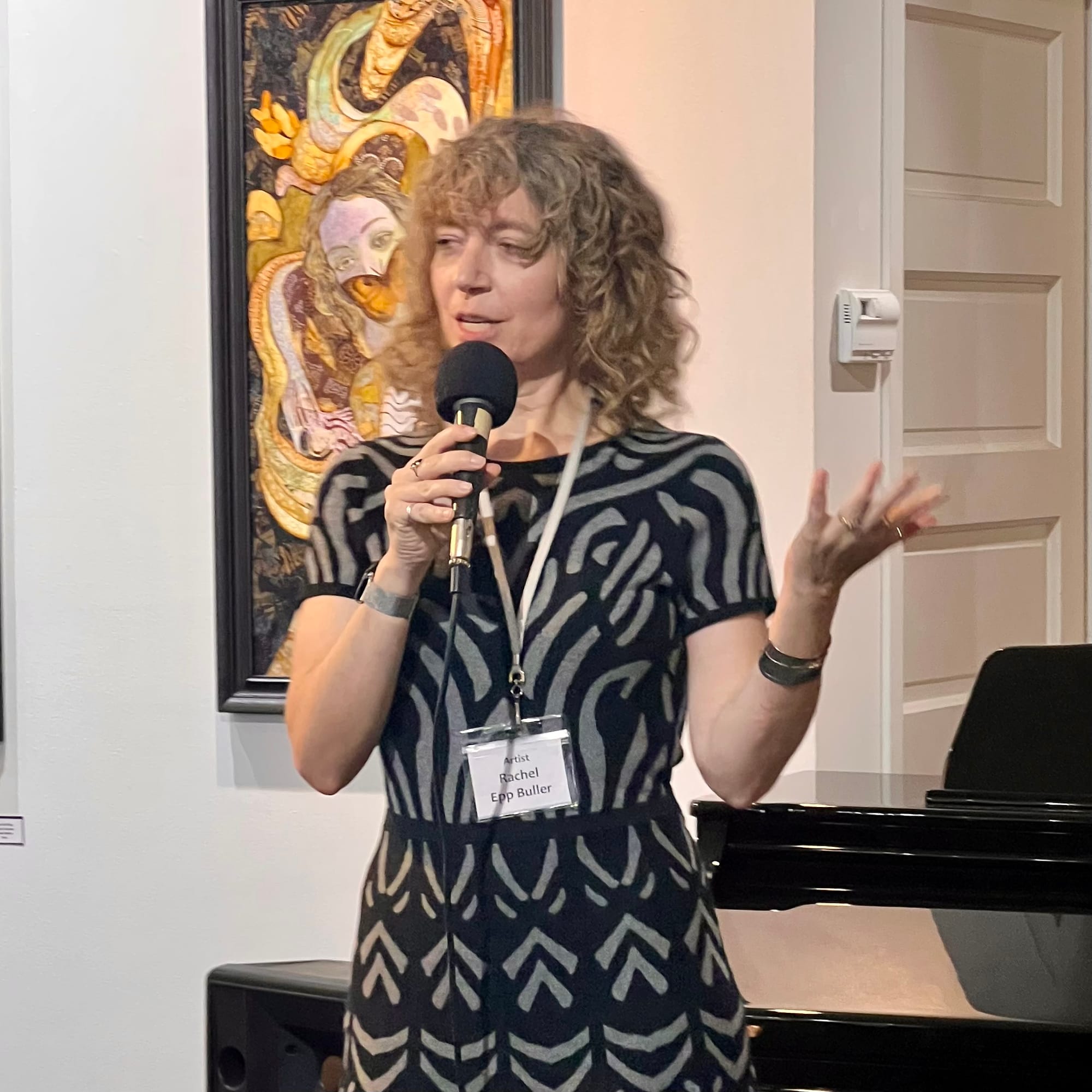
Cross’ and Holliday’s explosions of color and texture are brilliantly interrupted by the exhibition corners displaying Rachel Epp Buller's print series. Mounted on a neutral partition wall, Buller’s clean black frames and monochromatic fields anchor the center of the gallery. Buller’s process-oriented exhibition choices reflect her multi-hyphenate practice as a visual artist, feminist art historian, and professor of visual arts at Bethel College in Newton. During the opening night artist talk, Buller shared that she created several pieces as live classroom demonstrations to teach process and technique to her students. As a two-time Fulbright Scholar and a certified practitioner in deep listening, Buller’s work incorporates generations-old maternal traditions of making, including embroidery and the intricate cut-paper work known as scherenschnitte. In her prints, she explores listening as an artistic method enacted through structural movement.
Buller’s dialogue unfolds inside a space built by J.J. Krehbiel, the 19-century industrialist who served as a co-founder and first board president of Bethel College. By mounting her contemporary print series within the historic 1883 factory walls erected by her own academic institution's founder, Buller’s work establishes an impeccable, full-circle lineage that bridges modern regional pedagogy with Newton’s foundational manufacturing labor.
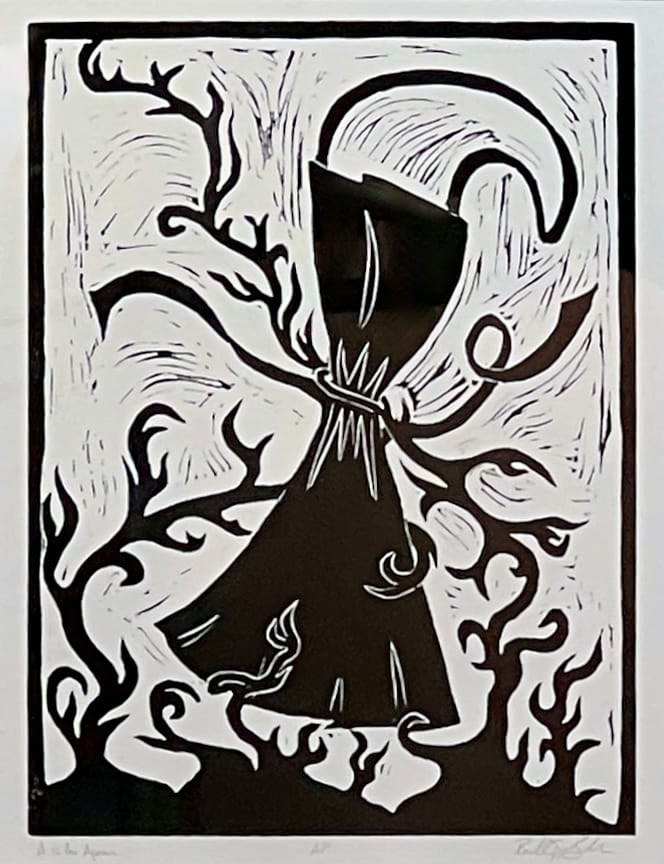
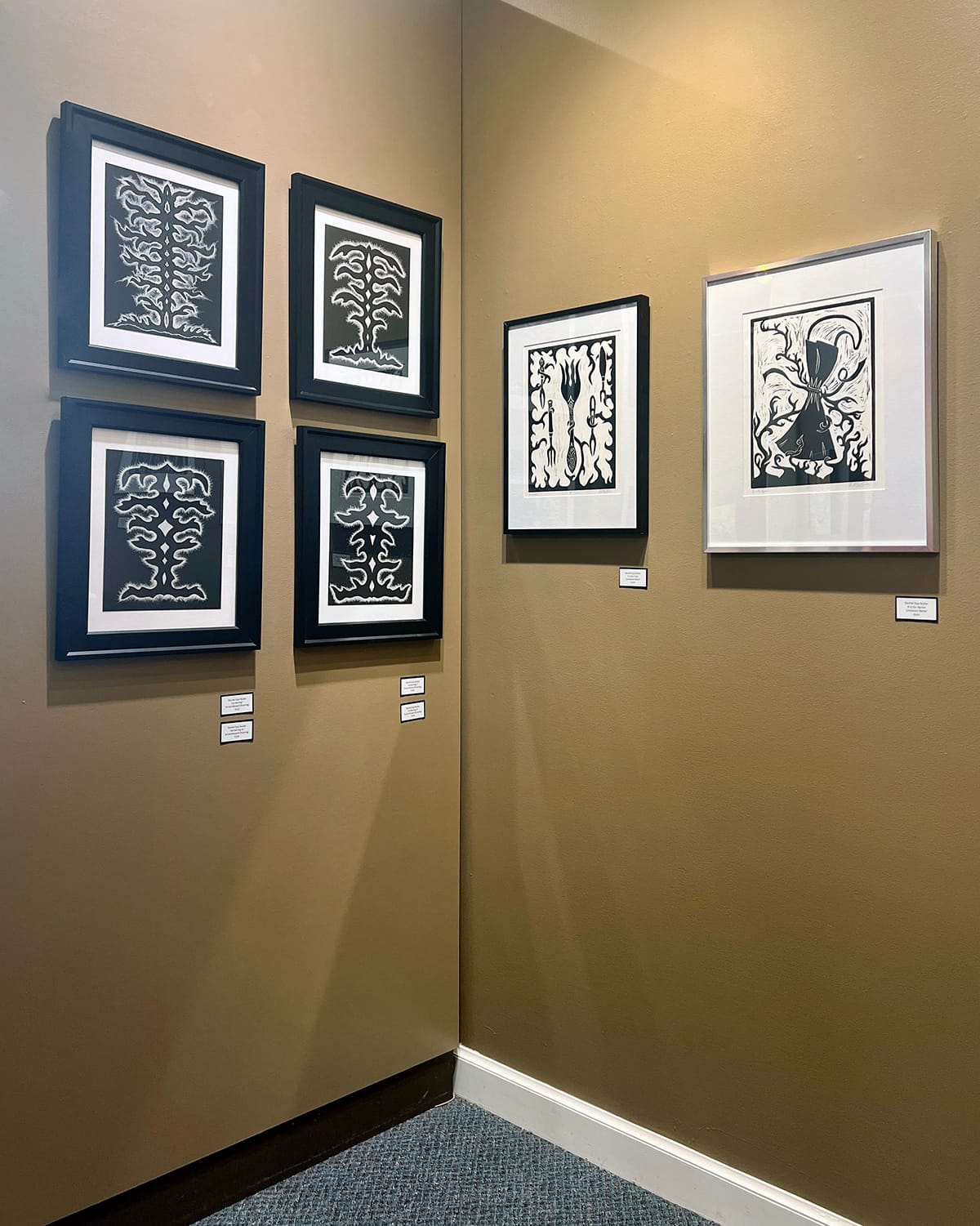
In the linoleum relief print “A is for Apron,” Buller isolates the silhouette of an apron against a turbulent background of black and white organic shapes. Heavy, expressive gouges in the linoleum create a vine-like movement that threatens to engulf the garment. In the related linoleum relief print “R is for Rolling Pin,” Buller frames a traditional wooden rolling pin with black brambles that creep inward from the margins.
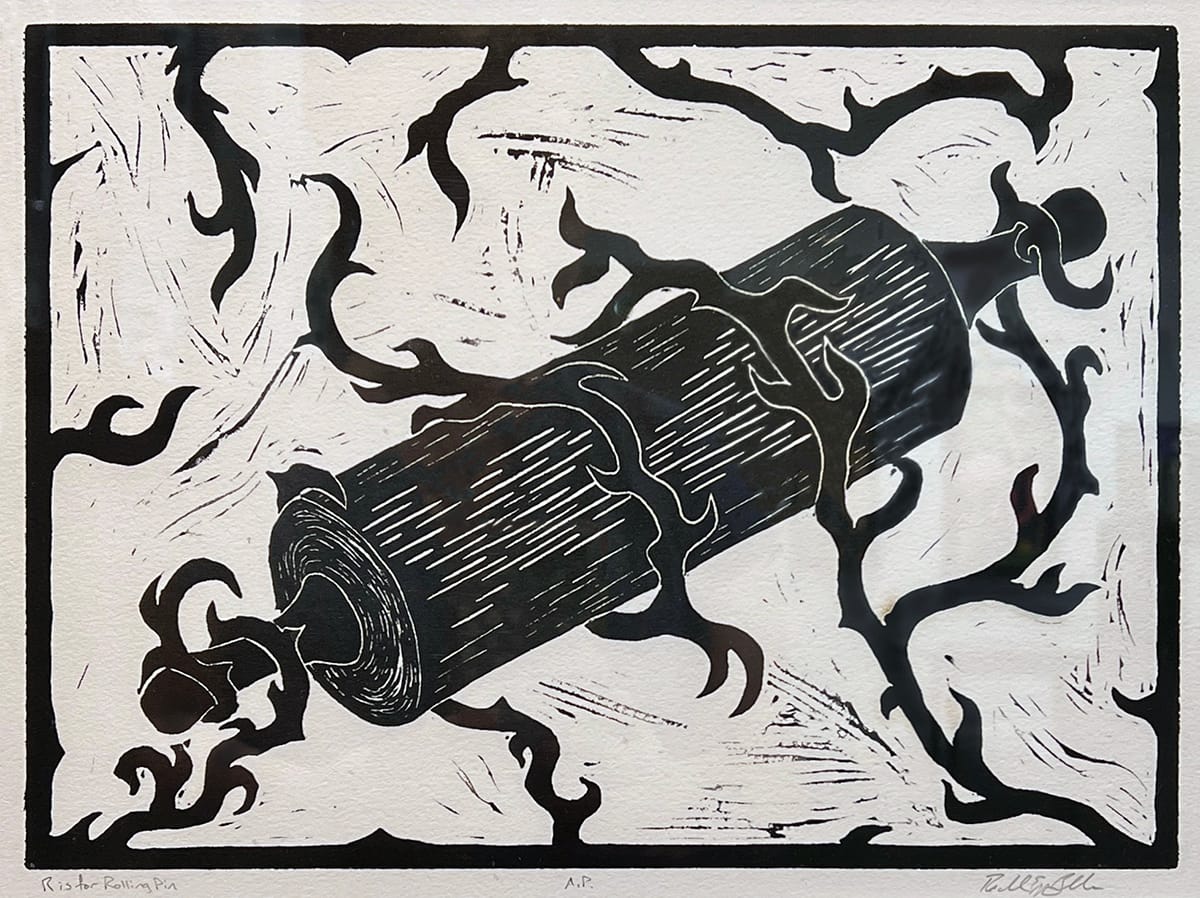
By binding familiar kitchen items in aggressive vegetation, the prints imbue quiet domestic objects with psychological tension. During the opening night artist talk, Buller connected her alphabetical exploration to Martha Rosler’s influential 1975 feminist video performance, “Semiotics of the Kitchen.” Just as Rosler wielded kitchen tools to articulate domestic frustration, Buller’s high-contrast prints transform familiar implements into symbols of resistance.
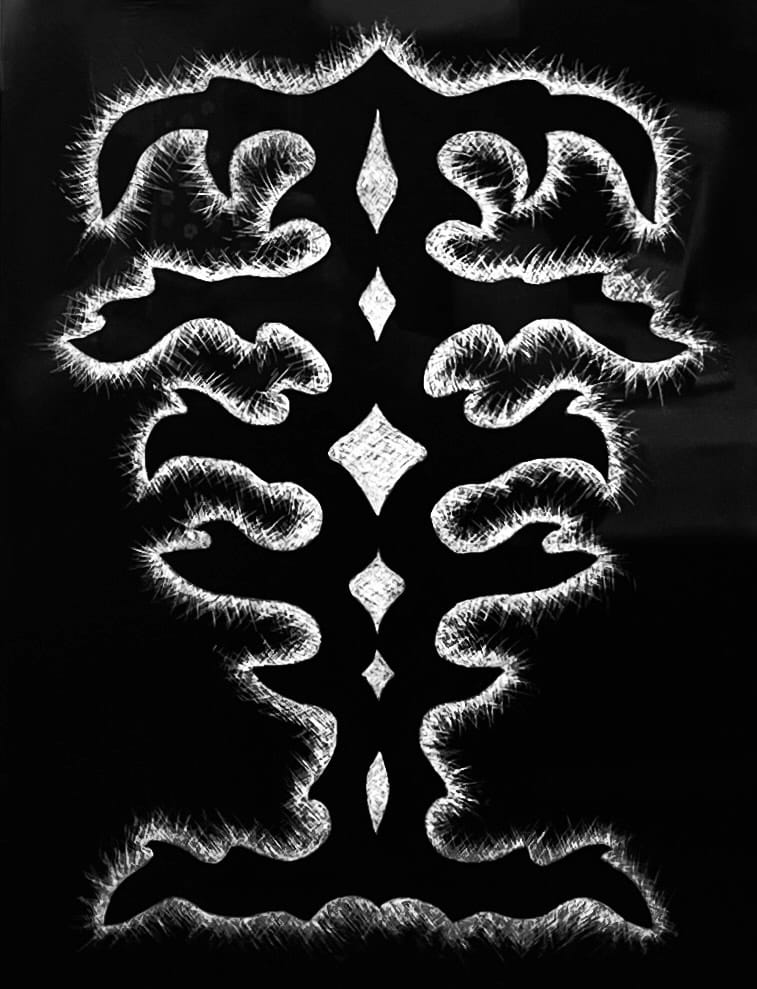
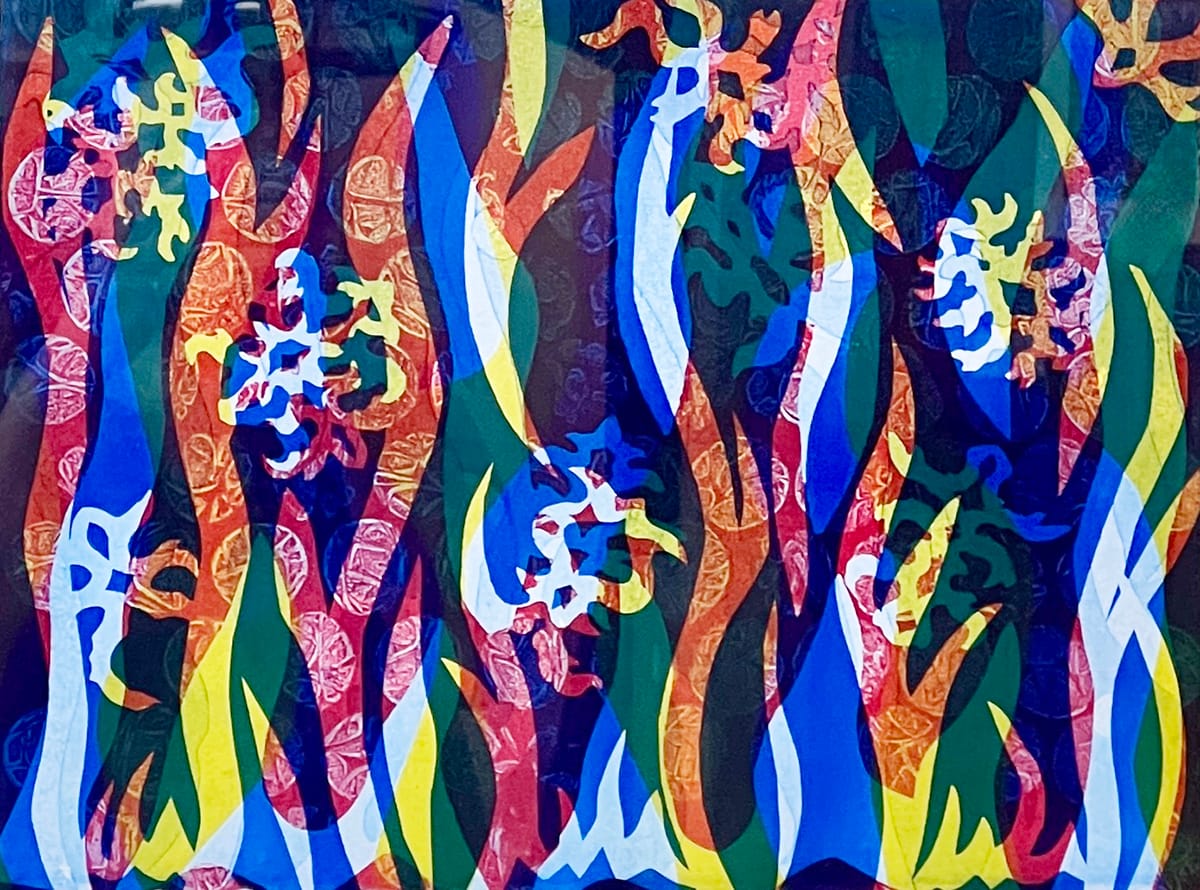
Rendered on scratchboard, in “Gardening III” Buller employs a dense network of fine, incised lines to pull a symmetrical form out of a black void. The resulting image resembles a skeletal plant structure vibrating with energy. Shifting texture and color palette, “In The Reeds II” presents a dynamic monoprint saturated with deep blues, fiery oranges, and rich crimsons. Sinuous vertical bands mimic the movement of river reeds shifting in a current. Both compositions achieve dense visual texture while presenting thriving, chaotic ecosystems.
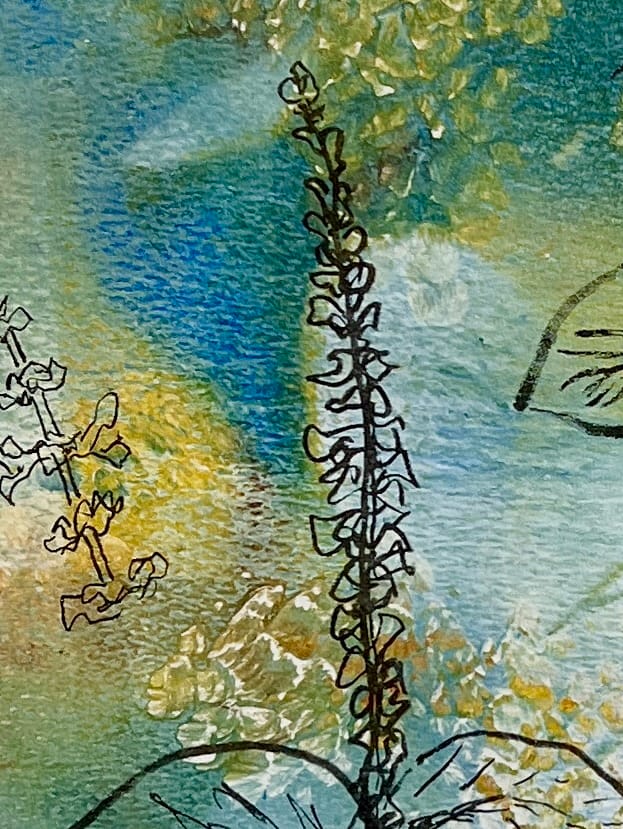
Buller’s square ink and monotype piece “Texture and Basil Study” blends soft, watery washes of cerulean blue, olive green, and pale gold. Fine, sketchy black ink lines trace the delicate contours of blossoming basil plants, focusing on the spiked structures of their seed heads and the gentle curves of their leaves. The overall effect captures the fleeting imprint of garden life.
By staging Joshua Cross’ heavily textured mixed-media works, Rachel Epp Buller’s process-oriented domestic prints, and Karen Holliday’s intricate, historical collages together, “Pressed, Pieces, and Presence” suggests that the accumulation of material layers is a powerful language for tracking human time. The exhibition does not merely sit inside the historic 1883 limestone structure; it continues a lineage of raw assembly and hard labor. For viewers, the collection of works provides a vital example of strong contemporary art that manufactures fresh meaning out of the compressed shards of our shared history.
The Details
"Pressed, Pieces, and Presence," an exhibition of works by Joshua Cross, Rachel Epp Buller, and Karen Holliday
July 11-September 4, 2026, at the Carriage Factory Art Gallery, 128 E. 6th St. in Newton, Kansas
The Carriage Factory Art Gallery is open noon-5 p.m. Tuesday through Friday and 10 a.m.–5 p.m. Saturdays.
Admission is free, and the facility is accessible to people with physical disabilities.
Learn more about current and upcoming exhibitions on the Carriage Factory Art Gallery website.
Skyler Lovelace wrangles pixels, pigments, and poetry into new shapes at the Studio School in Wichita, Kansas. She leads a poetry group in the former principal’s office and hosts Art Club and StitchKraft in upstairs classrooms. She is also the creator of "Frequencies of Place," a project exploring the intersection of architecture and the human heart
❋ Derby man has the kind of voice that turns heads — and chairs
❋ Socializing while sober: how some Wichitans are cultivating alcohol-free communities
❋ As a small creative business closes, the owner mourns
❋ Painting through it: Autumn Noire on 20 years of making art
❋ How a guy from Wichita resurrected 'Dawn of the Dead'
❋ Bygone Friends University museum housed curious collections
Support Kansas arts writing
The SHOUT is a Wichita-based independent newsroom focused on artists living and working in Kansas. We're partly supported by the generosity of our readers, and every dollar we receive goes directly into the pocket of a contributing writer, editor, or photographer. Click here to support our work with a tax-deductible donation.