Heritage & modernity: 'Street Nihonga: The Art of Jimmy Tsutomu Mirikitani' & Yoshida women printmakers at the Spencer Museum of Art
The two exhibitions explore how artists of Japanese heritage combine traditional approaches with contemporary concerns.
From a Western cultural standpoint, we often glorify traditional Japanese art as a luxury item. We might associate Nihonga (Japanese paintings) or Mokuhanga (Japanese woodblock prints), with the décor in upscale tea houses or encounter them in museums.
However, as with any art form, when the practitioners of the craft move through time, history, and geography, tihey carry their heritage with them through geopolitical and socio-economic changes. The artists introduce new subjects into traditional mediums, which gives birth to new, evolved techniques that allow them to better engage with the changing worlds in which they live.
This spring, the Spencer Museum of Art at the University of Kansas presents two exhibitions exploring how Japanese and Japanese-American artists modify and evolve their cultural heritage through their diasporic and generational experience. They use traditional craft as a means of reflecting on their lived and collective experience.
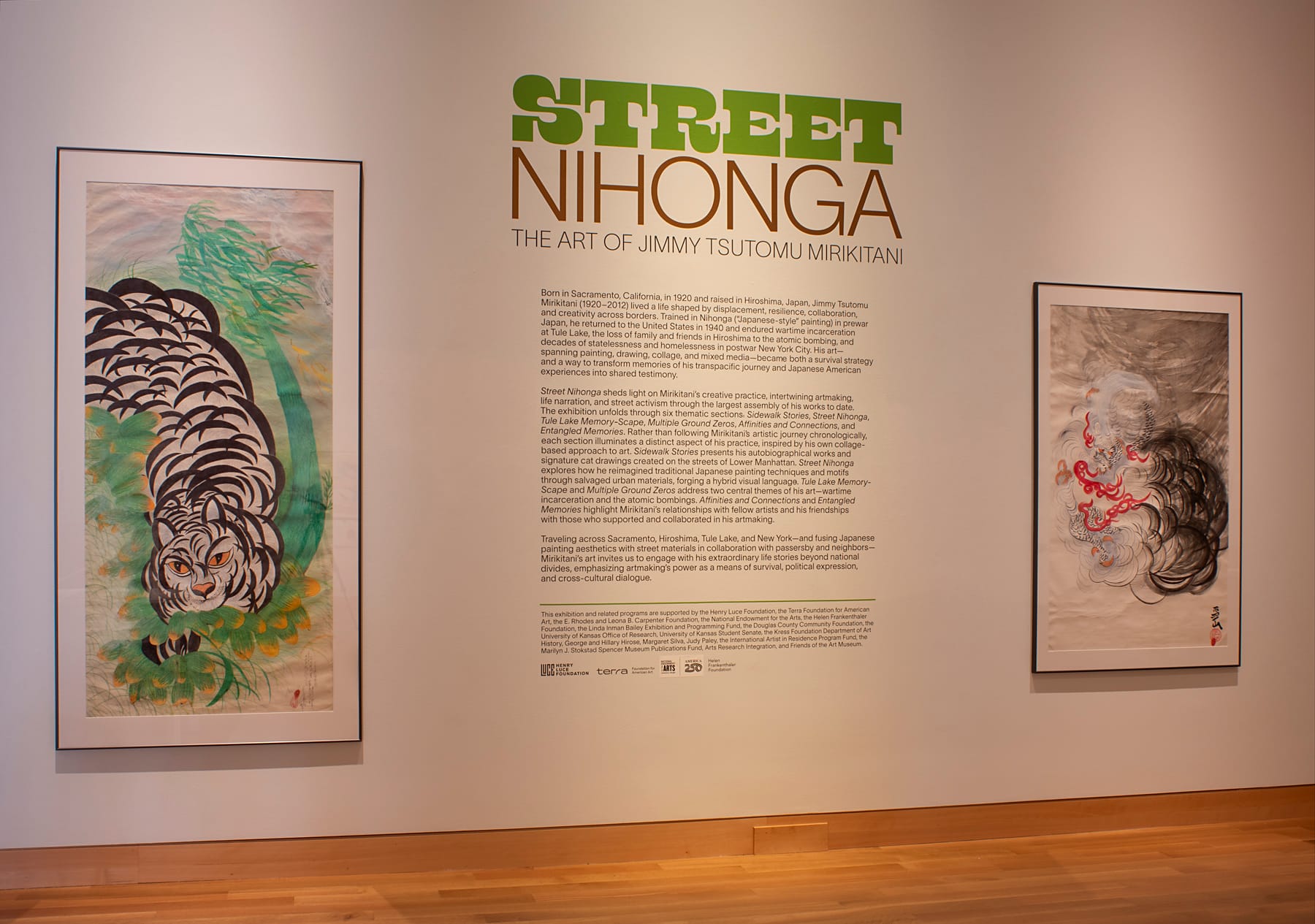
“Street Nihonga: The Art of Jimmy Tsutomu Mirikitani” takes over the museum’s main gallery space and spans two floors. This retrospective exhibition focuses on the California-born, Hiroshima-raised Nihonga painter Jimmy Tsutomu Mirikitani (1920-2012), who received Nihonga training in pre-war Japan.
Mirikitani’s life was marked by displacement, loss, grief, and uncertainty. After moving back to the United States in 1940, the U.S. government placed Mirikitani in a Japanese detention camp at Tule Lake in California. During the same period, he lost family and friends in the atomic bombing of Hiroshima. Afterward, he spent decades wandering the streets of New York City, using art-making as a means of surviving his unhoused state and to translate and archive his experience of displacement, survival, and resilience into tangible form.
The exhibition is organized into six chapters: Sidewalk Stories, Street Nihonga, Tule Lake Memory-Scape, Multiple Ground Zeros, Affinities and Connections, and Entangled Memories.
Sidewalk Stories and Street Nihonga focus on works created between the 1980s and 2000s. In both series, the artist stays true to traditional Nihonga elements, using motifs such as cats, tigers, birds, koi fish, oranges, bamboo, and creatures and characters from Japanese folklore, often laid out in long, vertical, scroll-like compositions.
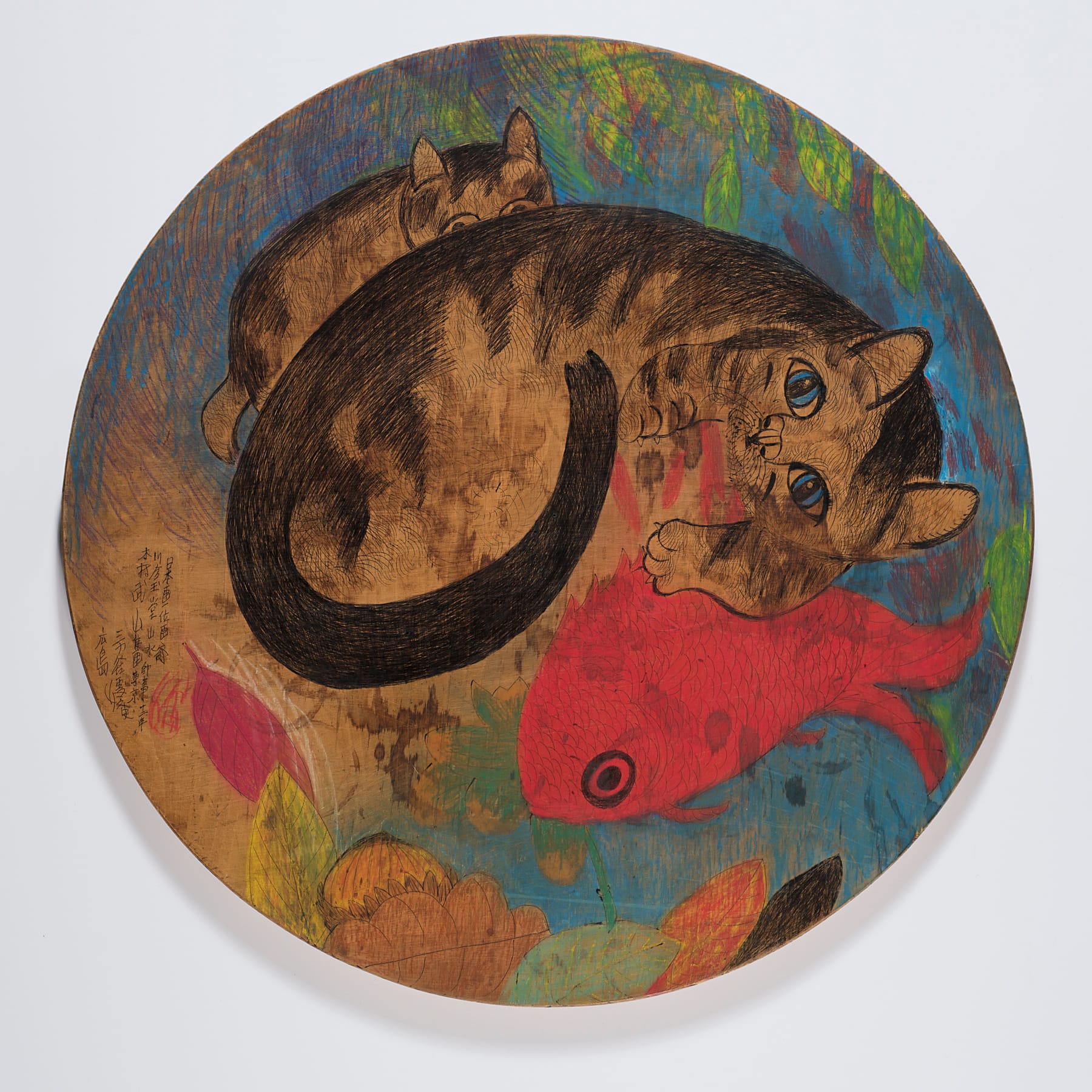
Due to the extreme scarcity he experienced as an unhoused person, however, Mirikitani made necessary adjustments to the usual techniques and materials. He learned to utilize every medium he could find: ballpoint pens, colored pencils, and occasionally crayons to achieve more saturated colors. The resulting works display a combination of loose cross-hatching and tones that range from bright and neon to dull and matted. Take, for example, the two drawings “Untitled (round table cat)” and “Untitled (Hiroshima 'Gionbō' persimmon).”
In “Untitled (round table cat),” Mirikitani upcycles a circular tabletop and draws on it a giant cat with black stripes using ballpoint pen repeated lines. A smaller cat is hidden behind its body. The background consists of interwoven blue, neon green, yellow, and red marks and shapes. These colors recede into the naked wood, indicating a transition from water to the bank. The larger cat holds a bright red goldfish under its paw, its blue eyes bright with excitement. Perhaps this is a mommy-kitten pair, and the mother cat’s happiness is both a result of catching her prey and the ability to now feed her offspring.
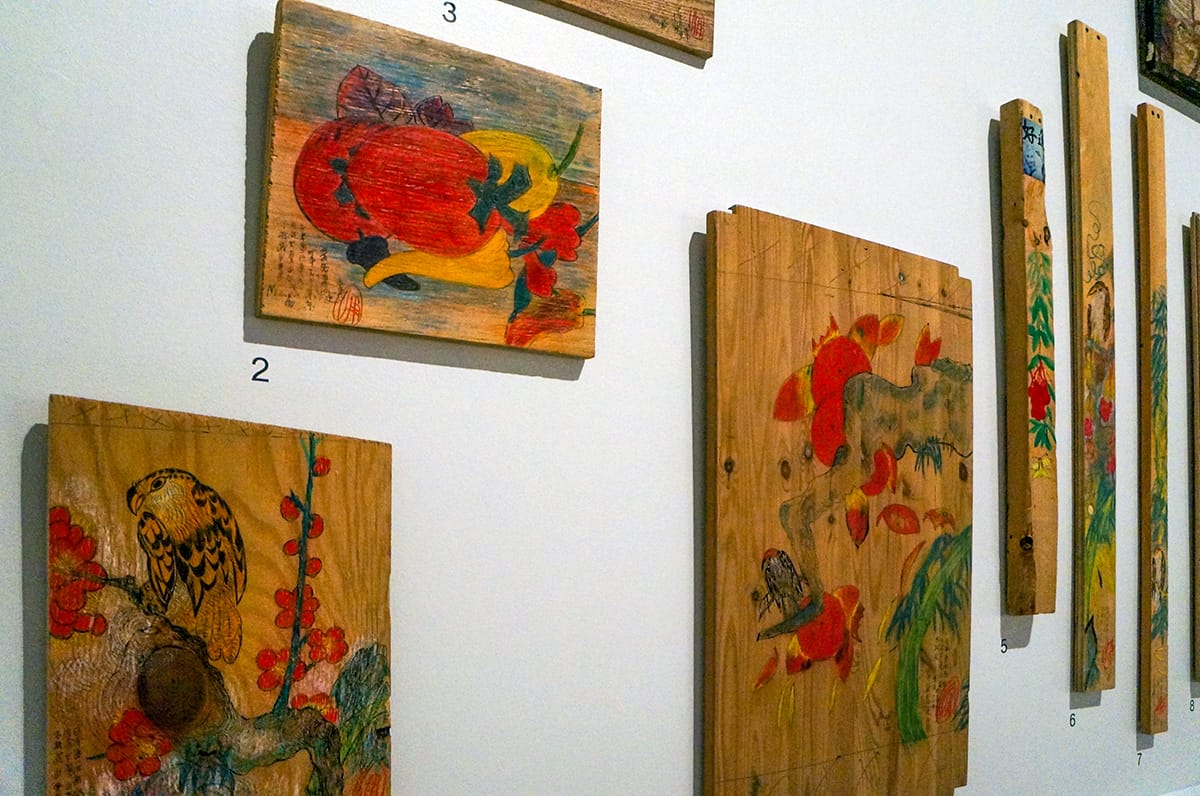
In “Untitled (Hiroshima ‘Gionbō’ persimmon),” Mirikitani uses colored-pencil shades of cyan, orange, red, and brown to capture a bountiful branch of a giunbō persimmon plant — a rare, premium persimmon variety from Hiroshima. In Nihonga, persimmons represent harvest and rural nostalgia. Here, the artist depicts the textured branch laden with fruit and leaves, some of which are falling, and uses classic complementary color combinations such as orange and cyan as well as light brown and green to capture the subtle hues of color-changing trees in the fall.
Mirikitani’s paper pieces, like “Untitled (Hiroshima ‘Gionbō’ persimmon),” were later collected, matted, and framed by collectors. They hang neatly on the walls of the Spencer Museum, barely showing a trace of the artist living on the streets. However, the rest of the works Mirikitani created during this post-encampment period are on discarded wooden panels.
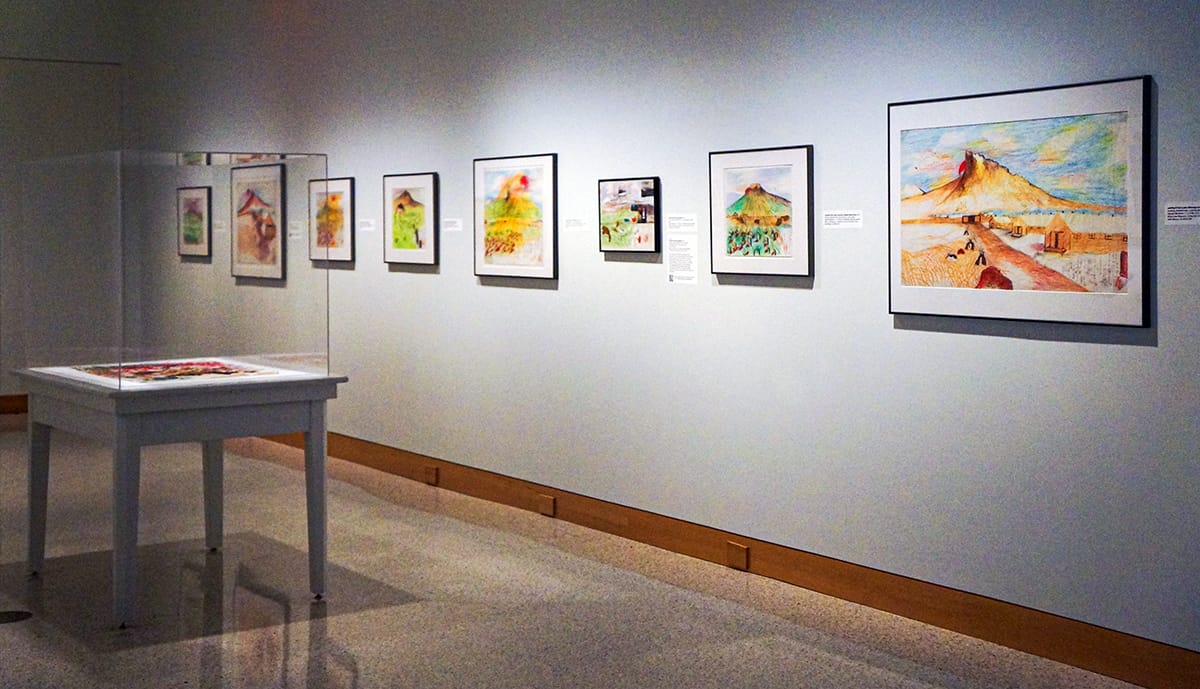
Mirikitani’s Tule Lake Memory-Scape series is on display on the second floor of the museum, documenting a period of pain, isolation, and mistreatment in his life. Due to his controversial “no” to serving in combat in the U.S. military, Mirikitani was sent to the Tule Lake Relocation Center in May 1942. He stayed there until the camp’s closure in 1946. A year prior to his release, he was coerced into renouncing his U.S. citizenship, followed by another year of forced labor under “relaxed internment.”
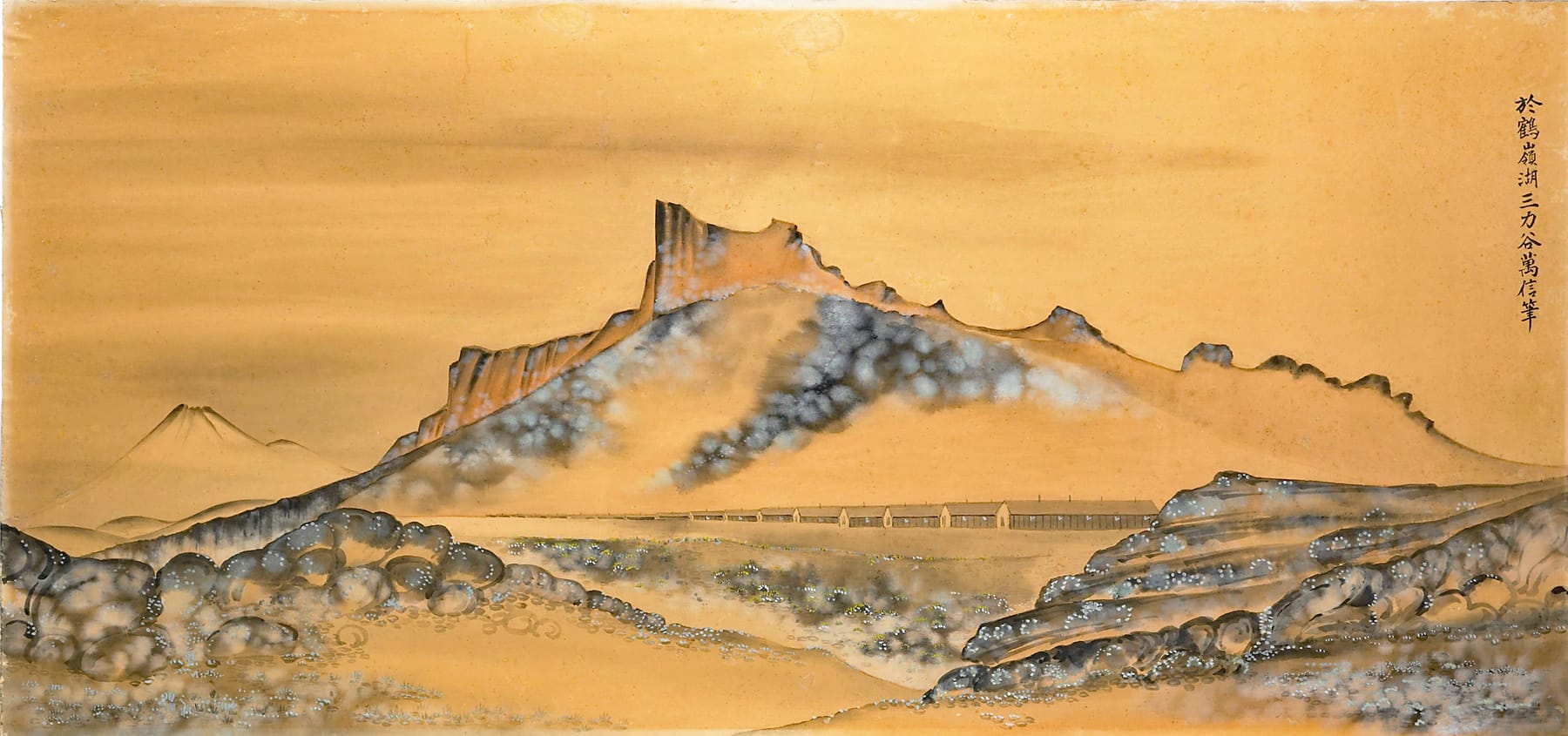
Most of the memory-scapes portray views of the endless rows of Tule Lake barracks, with Castle Rock and Mount Shasta in the background. These pieces are haunting. In “Untitled (Tule Lake),” Mirikitani uses yellow-toned paper, white paint, and black ink to depict a desolate landscape where Castle Rock and the hills in the foreground are covered by an ominous layer of white dust. The row houses sit silently in between, looking like a long train headed into the mountain, never to return.
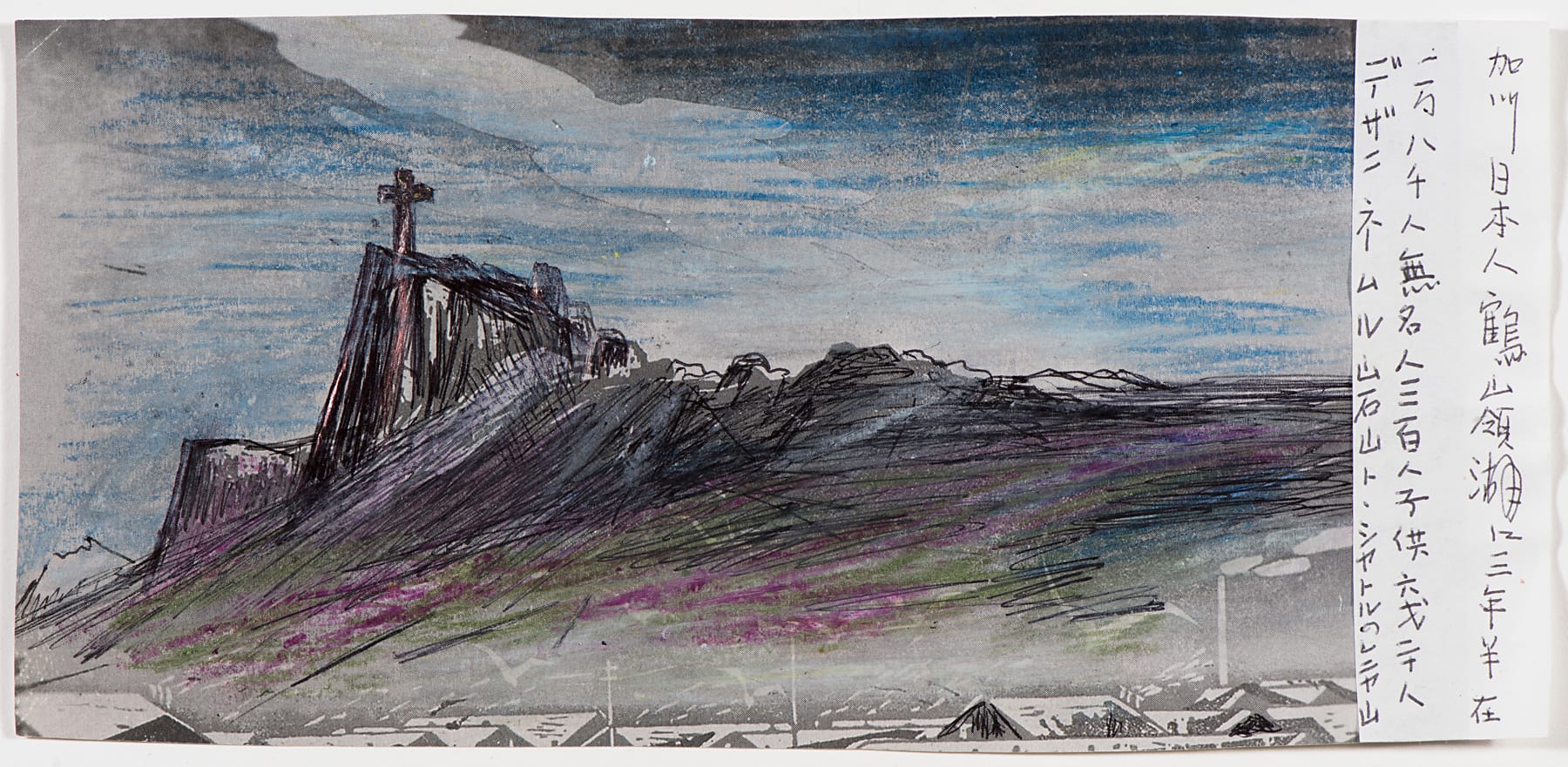
The despair becomes more conspicuous in “Untitled (Tule Lake: Castle Rock Mountain, barracks, cross),” in which a cross stands on top of the mountain under a stormy sky, and the roofs of the barracks are barely visible on the bottom edge of the composition. In the far right margin Mirikitani lists the headcount of the residents at the encampment: “28,000 nameless individuals. Three hundred children. Twenty of them were 6 years old.”
From his time at the detention camp until his death in 2012, war, destruction, death, and global aggression are recurring themes in Mirikitani’s work.
In the Multiple Ground Zeros series, the artist combines Nihonga techniques with collage to investigate the violence happening across the world after World War II. The term “ground zero” originally referred to nuclear impact points, including the Trinity test site in New Mexico and the bombing in Hiroshima and Nagasaki in Japan. The term was later used to describe the location of the World Trade Center in New York City (Mirikitani’s adopted home) after its destruction on September 11, 2001.
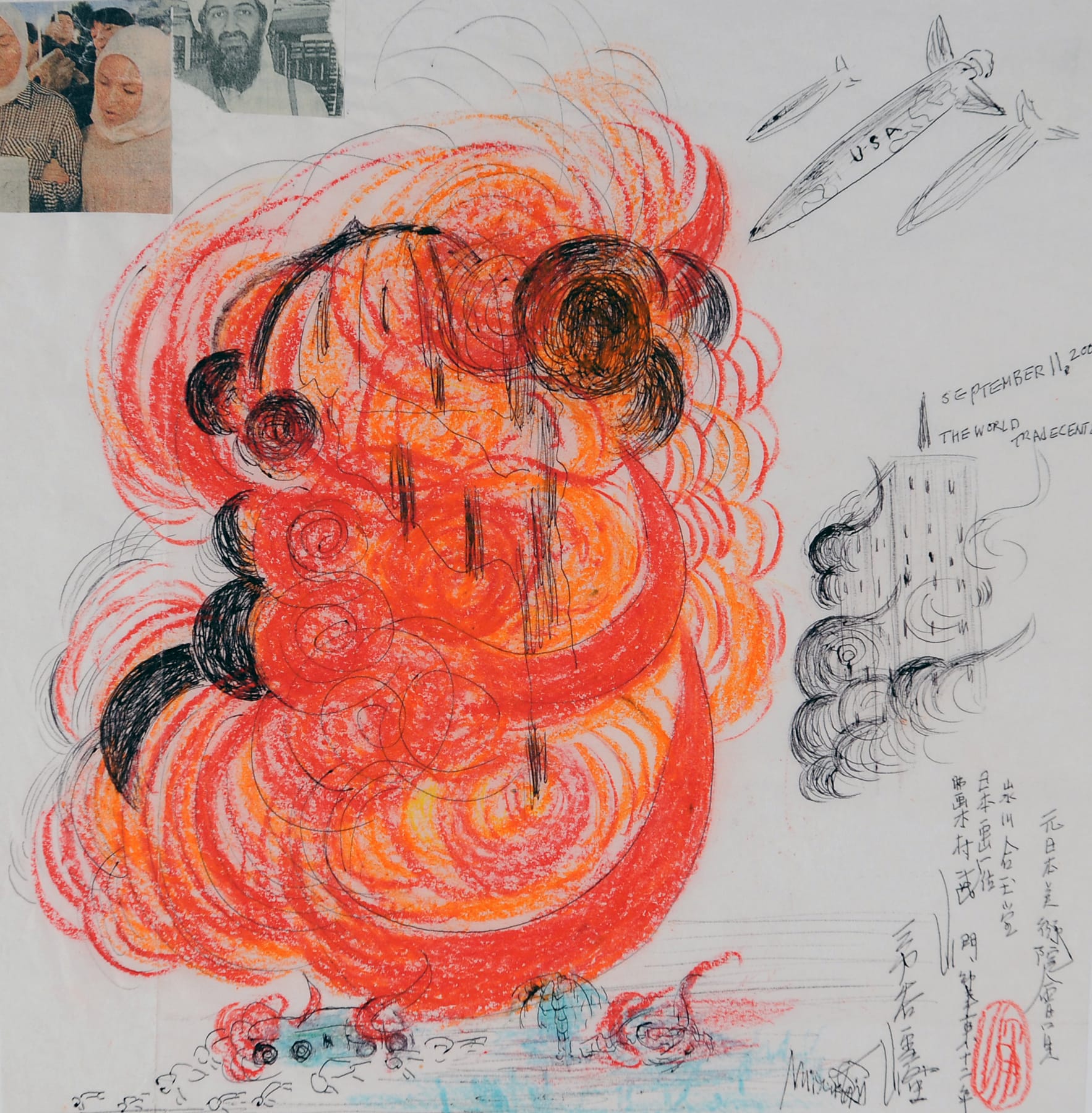
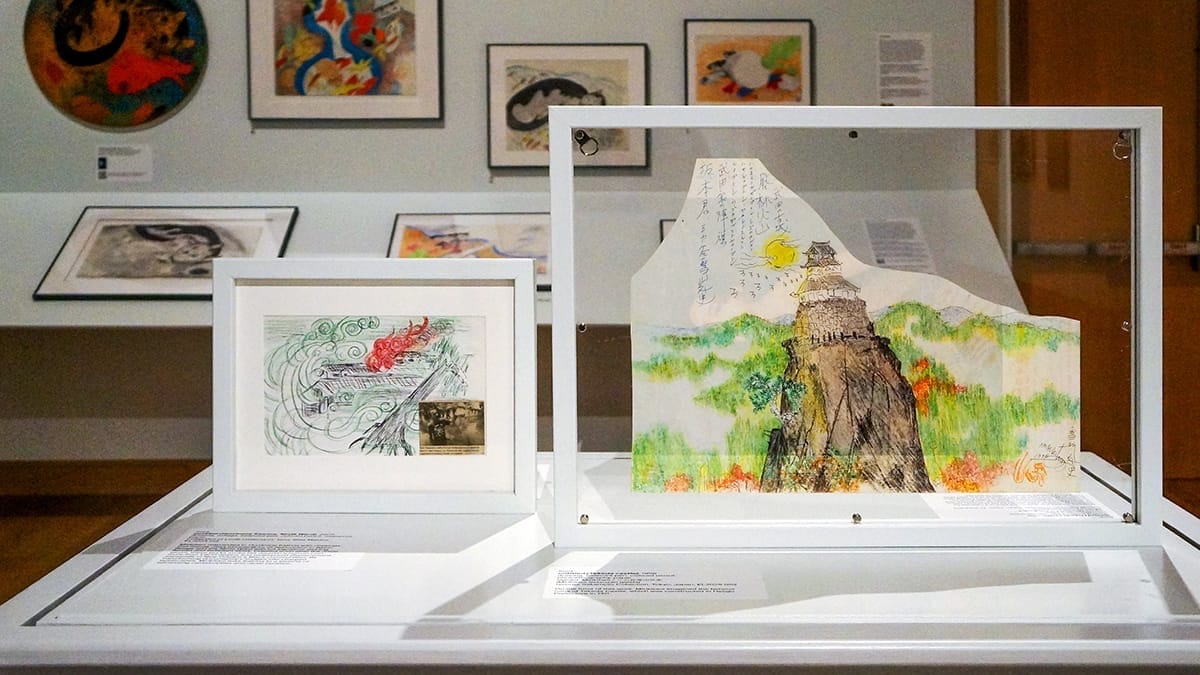
Having lost friends and family in Hiroshima, Mirikitani’s ground zeroes are sites of commemoration. Hiroshima’s Atomic Bomb Dome and New York’s World Trade Center become central motifs throughout this body of work. In “Untitled (Hiroshima/World Trade Center),” Mirikitani captures the burning Atomic Bomb Dome with bomber planes (used in 9/11) emblazoned with “USA” flying toward the dome engulfed in red and orange crayon flames. A smaller, monochrome ballpoint pen sketch of the World Trade Center under attack is at right. The flames in the World Trade Center sketch have the same shapes and forms of those around the burning dome. These similarities link the two acts of violence, invoking a deeper reflection on the interconnectedness of seemingly separate global tragedies. Mirikitani collages a photo of women wearing hijabs as well as a newsprint image of Osama Bin Laden in the upper left corner of the drawing.
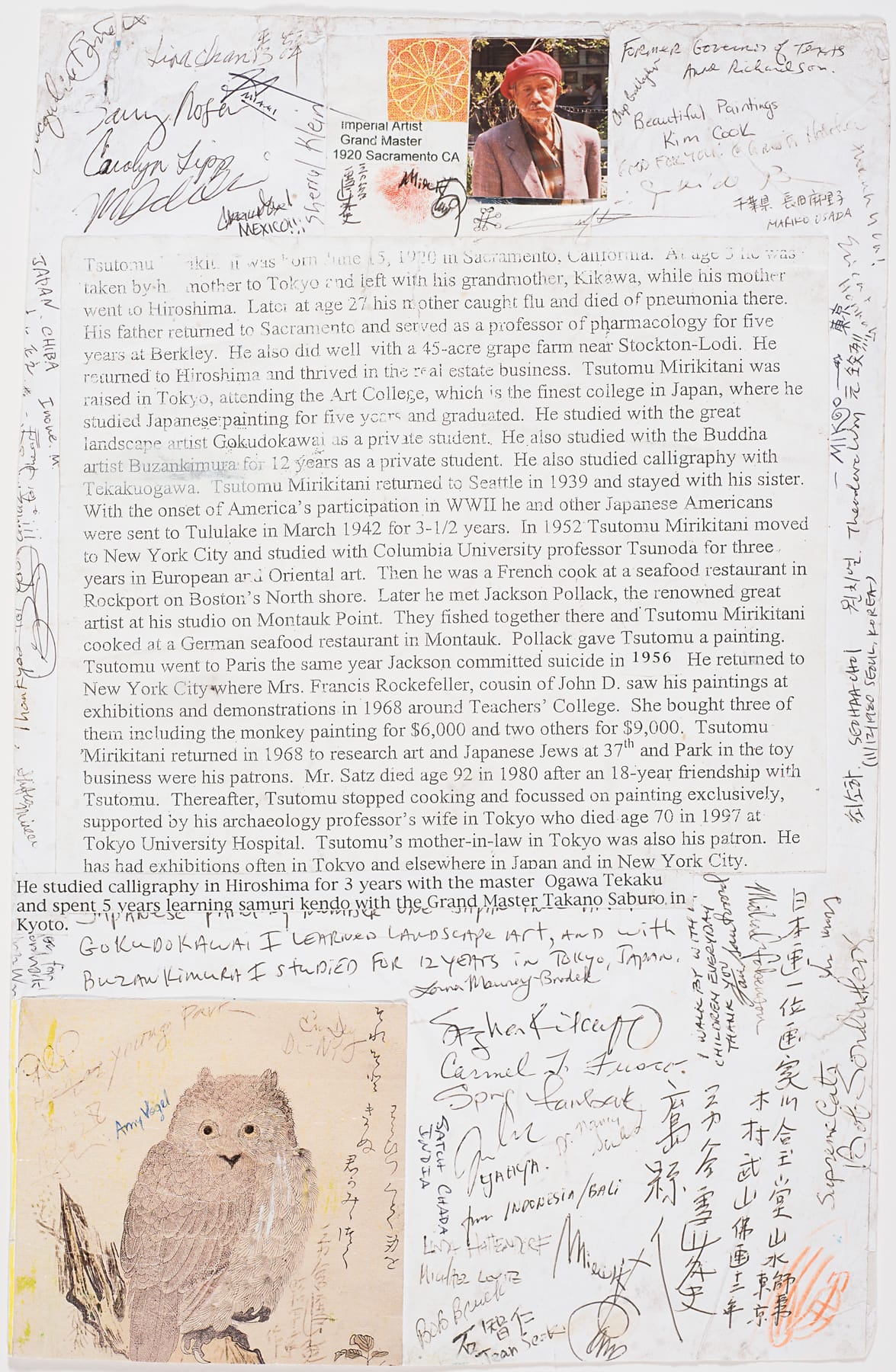
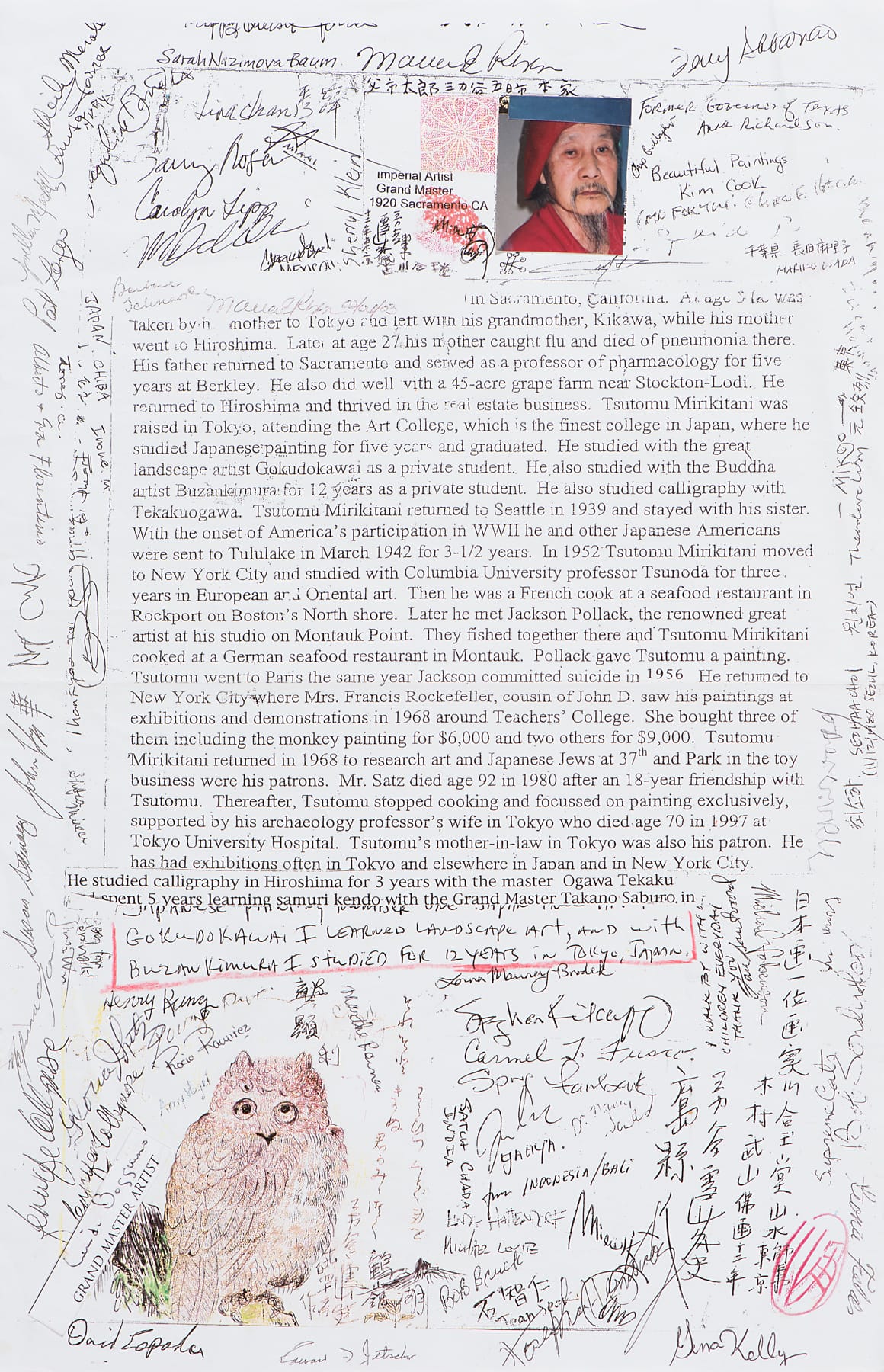
From left, works by Jimmy Tsutomu Mirikitani: "Untitled ('education paper' with owl 2), before 2001, collage, ballpoint pen, colored pencil, photography, and photocopying; "Untitled ('education paper' with owl)," before 2001, collage, ballpoint pen, colored pencil, photography, and photocopying. Photos courtesy of the Spencer Museum of Art.
The works in Multiple Ground Zeros mark a noticeable change in Mirikitani’s style. Here, the artist appears to be transitioning from a focus on traditional Nihonga drawing methods to using Nihonga as an educational platform by adding collage images to the compositions as well as cultural and historical references.
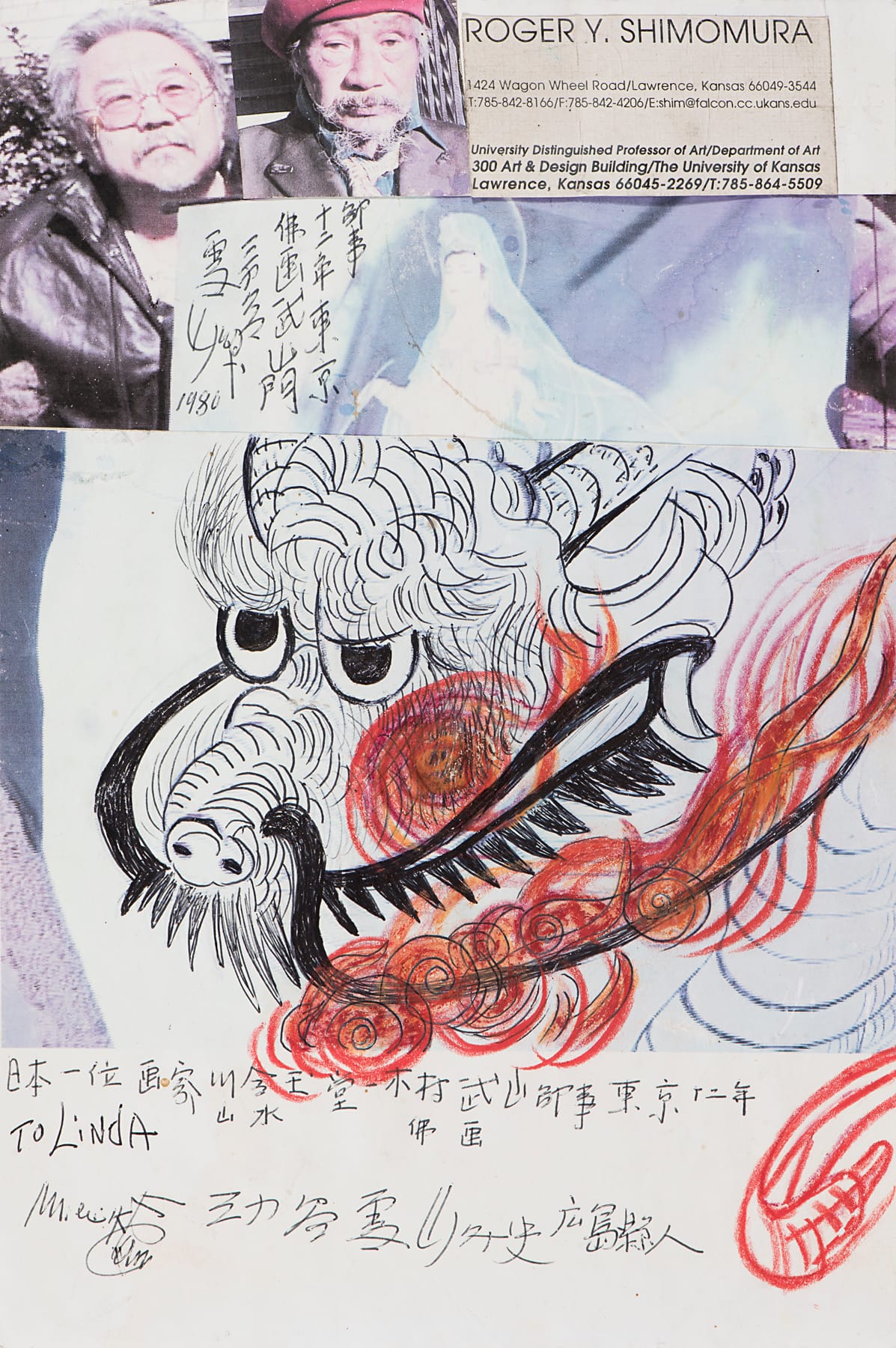
This shift manifests further in the final two “chapters” of the exhibition. Departing almost completely from the Nihonga format, the pieces in the Affinities and Connections and Entangled Memories sections offer a glimpse into Mirikitani’s mind. In these series, the artist uses newspaper clippings, photos sourced from publications, and his own personal photographs to build storytelling infographics.
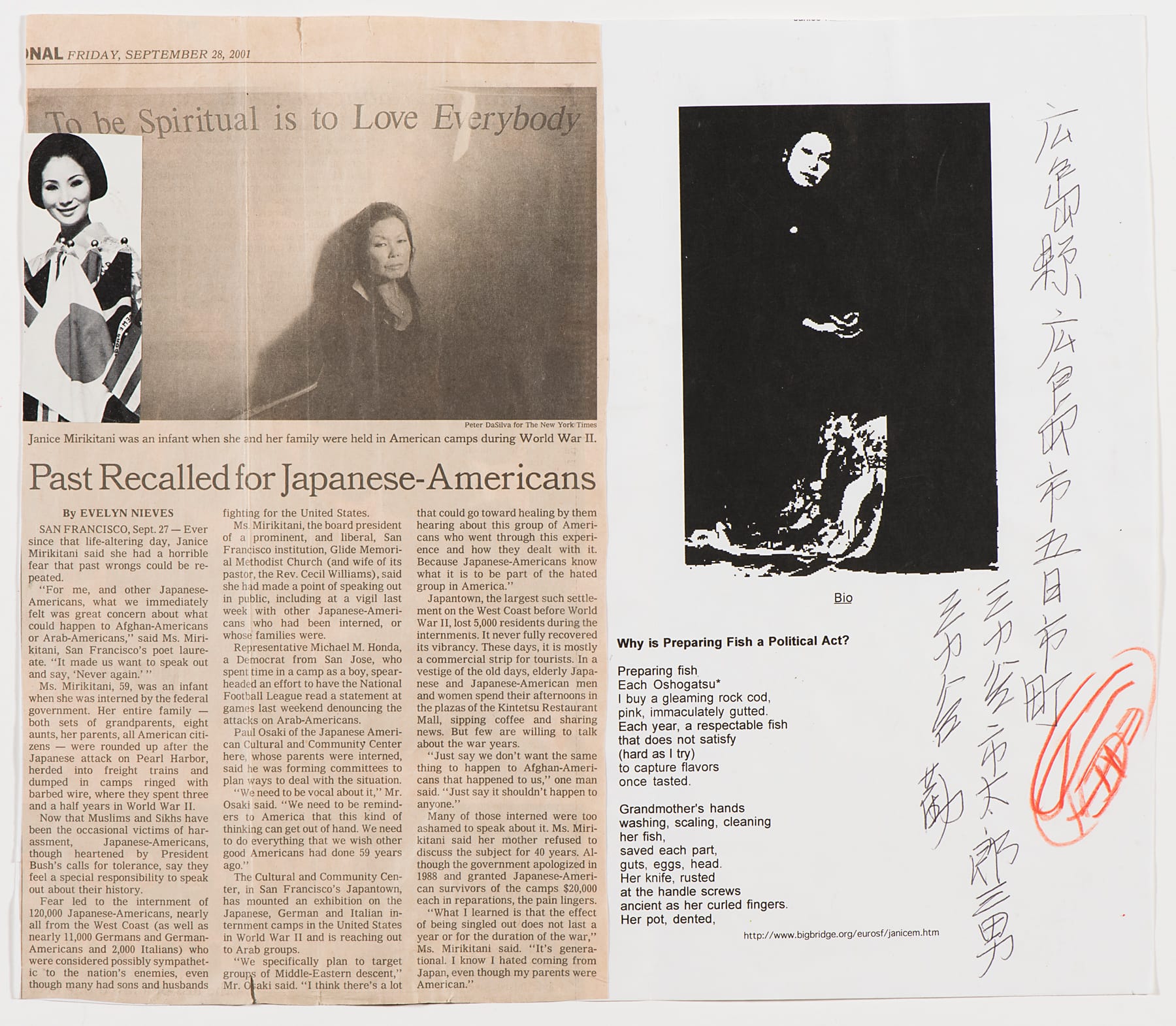
In “Untitled (Janice Mirikitani: ‘Past Recalled’),” Mirikitani brings together a copy of his cousin Janice Mirikitani’s poem “Why is Preparing Fish a Political Act?” on the right and a 2001 New York Times article about the poet’s post-9/11 reflection on the left side of the work. Here, it is as if the artist is borrowing his cousin’s words to explain the motivation behind his own artistic pursuits.
Similarly, Mirikitani expresses his deep camaraderie with the Japanese American artist Roger Shimomura by placing their headshots side by side along with Shimomura’s business card on the top edge of his “Untitled (Roger Shimomura and white dragon).” Below the collaged elements, a drawing of the head of a fire-breathing white dragon in black ballpoint pen with red colored pencil flames emerges — a beast often associated with blessings, divine protection, purity, lightness, and hope.
Looking at Mirikitani’s work as a whole, it seems he was as much an educator as he was an artist. He used his work to teach the world about Nihonga and his experience as a Japanese American as well as his life as a stateless and homeless man in the U.S.
The accompanying exhibition, “Brush, Block, and Blood: Three Generations of Yoshida Women Printmakers” is on view in the museum’s third-floor gallery. It traces over a century of the matrilineal tradition of woodblock printmaking in the Yoshida family.
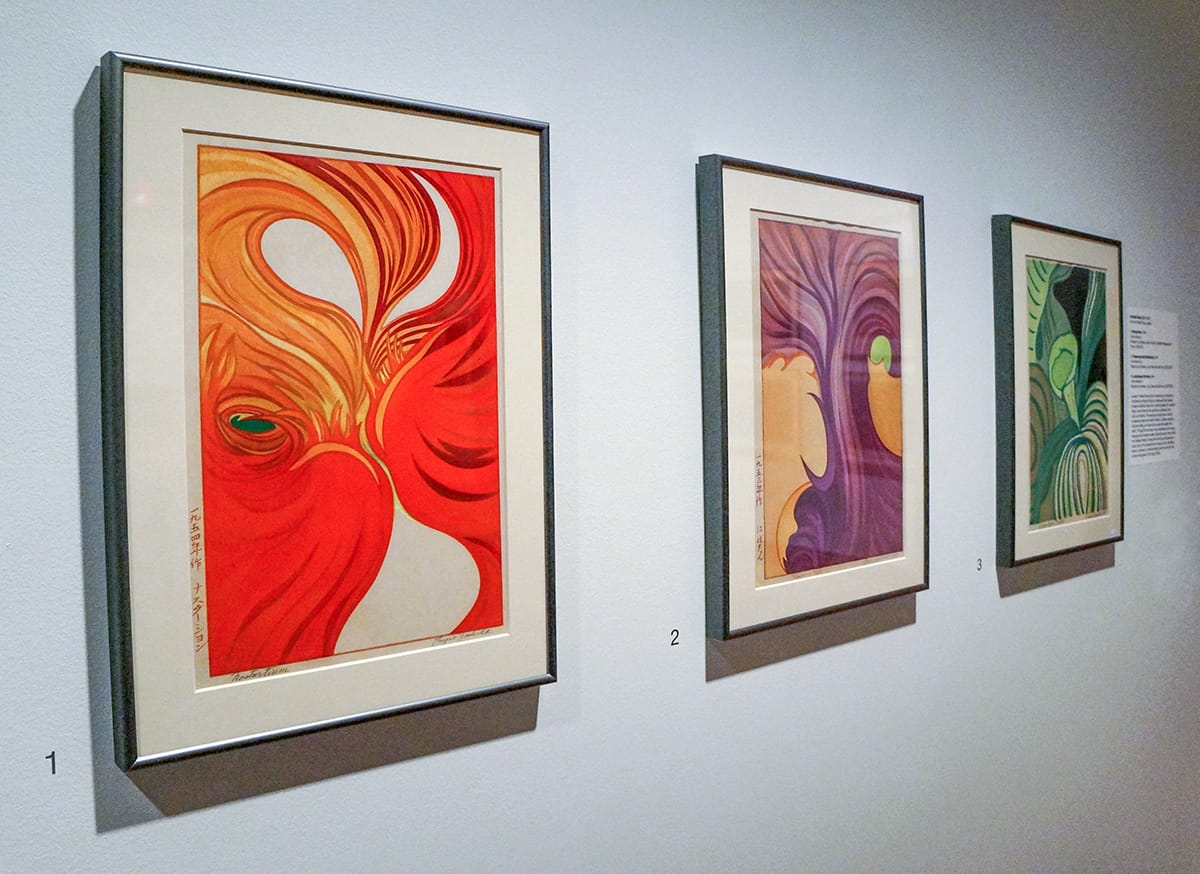
The exhibition featured selected works from Fujio Yoshida (1887–1987), Chizuko Yoshida (1924–2017), and Ayomi Yoshida (born 1958), demonstrating the different elements they introduced to their printmaking practice over the years.
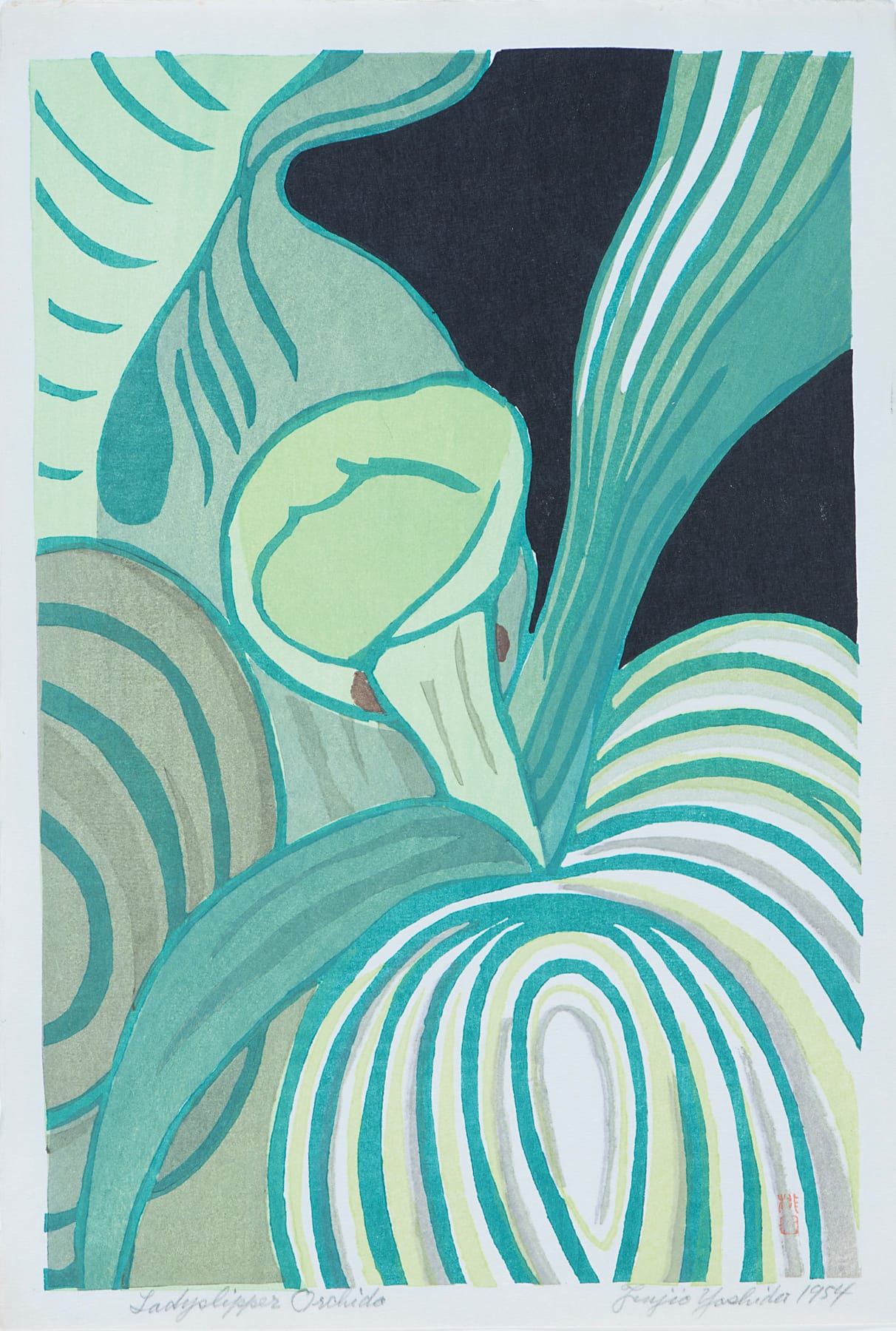
Born into an artist family in Tokyo, Fujio began making art as early as 8 to 12 years old and later received traditional training at a Tokyo school of Western painting. Due to her adopted brother and future husband Hiroshi Yoshida’s influence, she was one of the few Japanese women artists who had the privilege to be welcomed into the art world in her early career. Her best-known works are her flower prints, which reinterpret floral motifs into simple, linear forms in response to the technical constraints of woodblocks. In “Ladyslipper Orchids,” for example, a close-up image of the flower in shades of green features undulating lines and abstract shapes on a stark black background. Fujio’s pieces flatten the flowers and emphasize fluid forms and bold contours.
Fujio’s daughter Chizuko built on the fluidity and rhythm in Fujio’s flower prints, creating abstract designs that visualize music and musical performances, with surprising similarities to works by Wassily Kandinsky. But contrary to her mother’s tendency to simplify and omit, Chizuko pushed the boundaries of complexity in her works and captured astonishing details in her later prints. Having spent her life in Japan, however, in most of her designs she utilized traditional Japanese motifs.
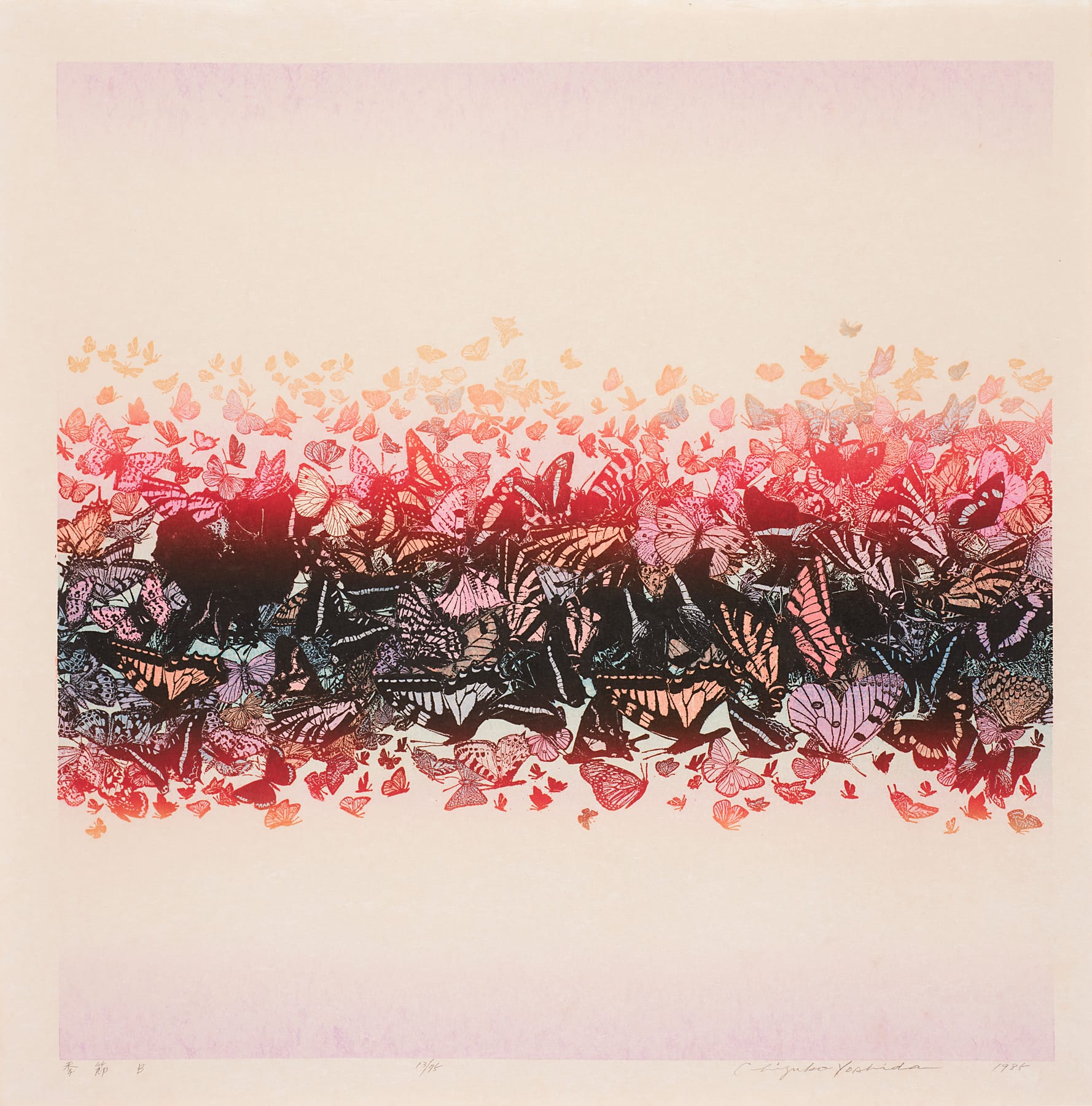
“Kisetsu (Season B)” depicts a horizontal band of fluttering butterflies that runs through the center of the otherwise almost blank paper. The butterflies, including monarchs, appear in shades of periwinkle, lavender, pink, and coral, and Chizuko uses a bright gold-red-blue gradient as the mass of insects fades in size and detail toward the top and bottom of the band, the colors resembling a sunrise on the water. On top of the gradient, a layer of darker colors serves as the contour lines. Pale purple tints the upper and lower edges of the paper.
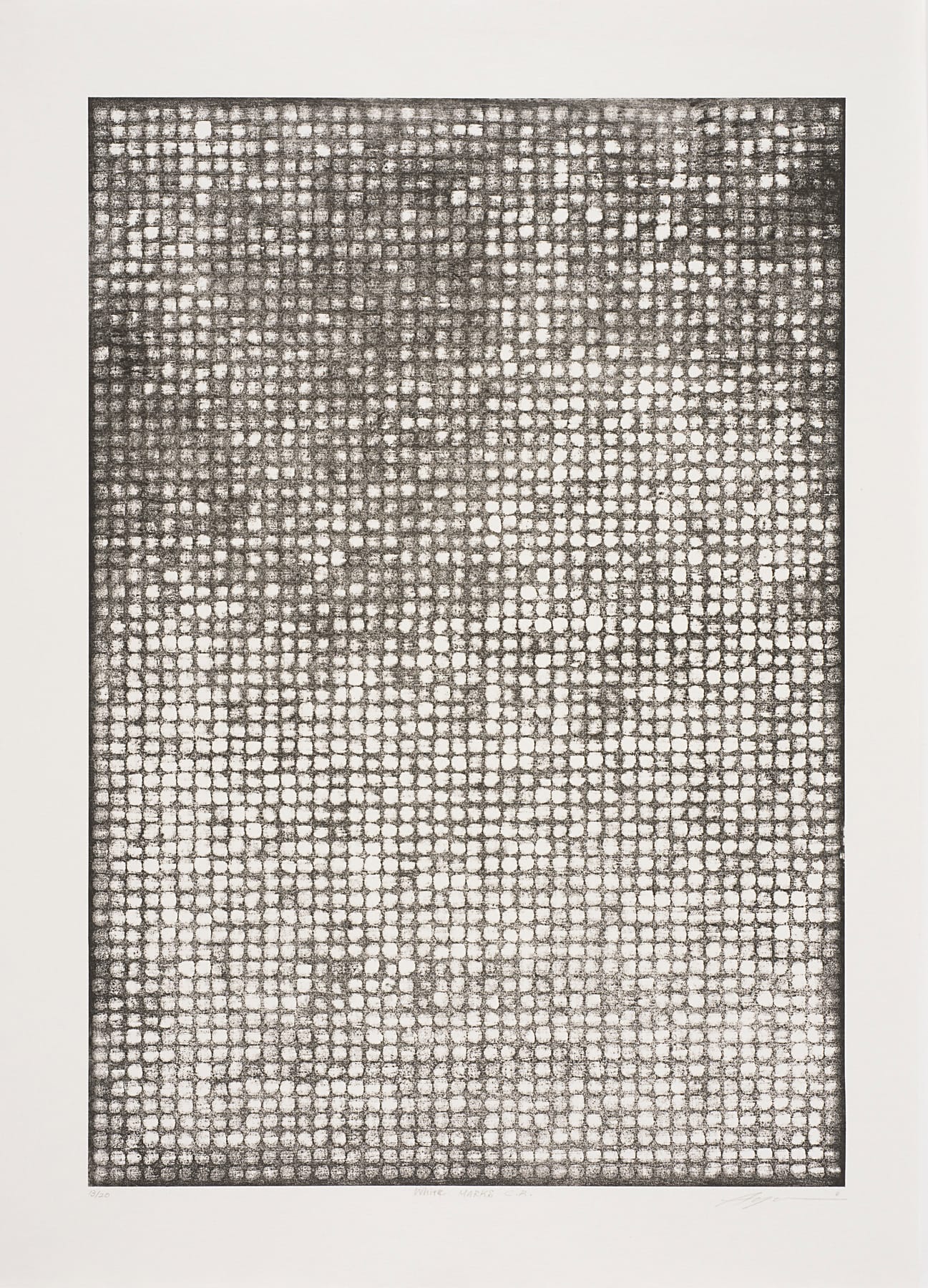
Following her mother’s legacy, Ayomi furthers Chizuko’s fine-detail vocabulary. Focusing on the repetition of patterns and interactions of different colors, Ayomi emphasizes shape, form, and texture in her prints. In “White Marks C.R.,” the artist carved hundreds of precise oval impressions into plywood blocks, then printed them in repetition to form a grid of white marks on a dark background. The result is a rhythmic network of tiny white cubes or circles that looks like a dense window screen.
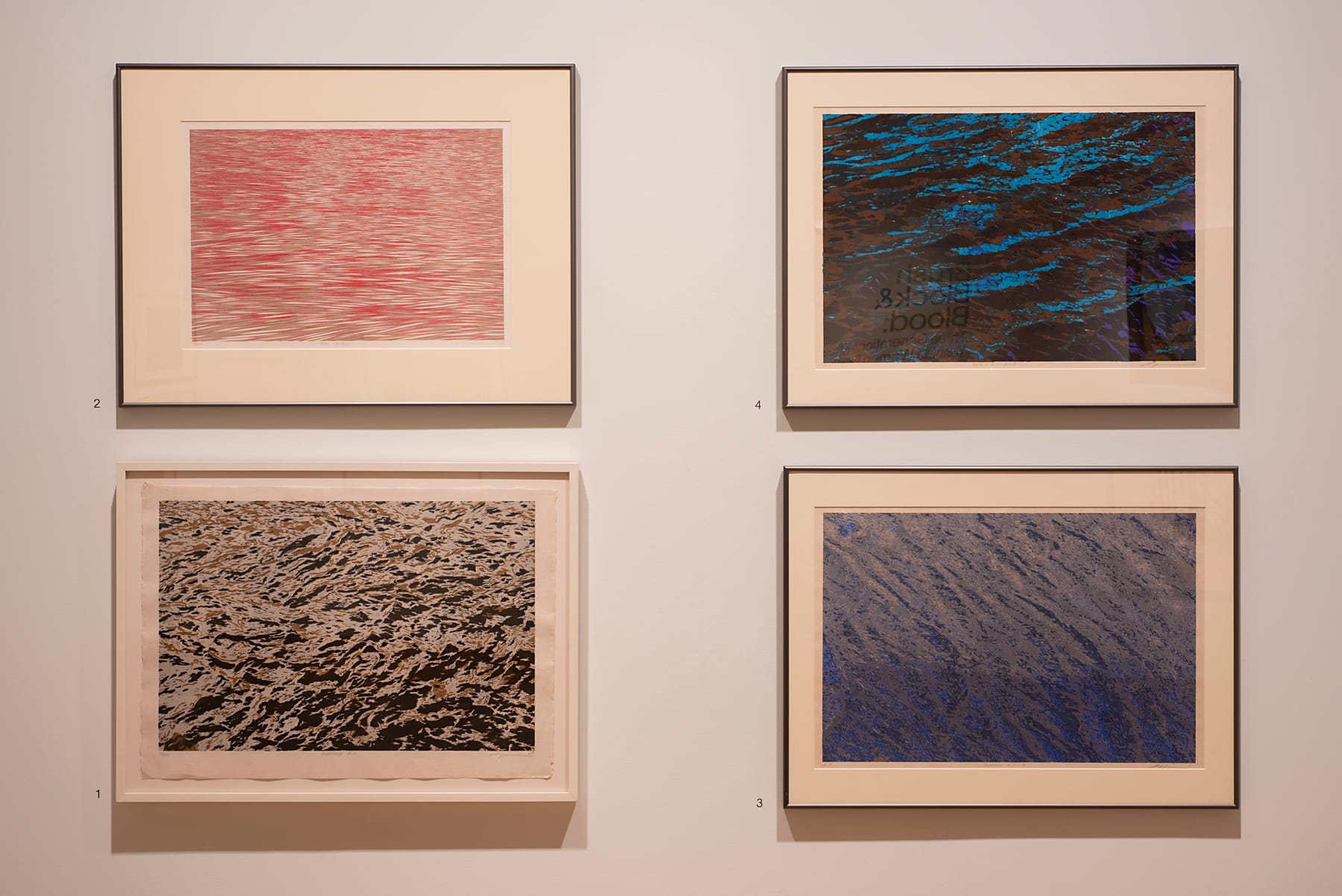
In her “Surface” series, Ayomi captures the mesmerizing movement of the water in the Kanda River, a central motif in her practice. In preparation for this body of work, Ayomi walked the entire length of the Kanda River — a rich waterway threading through West Tokyo as well as Ayomi’s personal life. The results are layers of white and red, blue-black-red, black-brown-white, or black-grey-blue, lapping over one other as each layer was carved separately. These rich textures portray the wavy reflections of the water surface at different seasons and times of day, providing a mesmerizing haven in the bustling modern city.
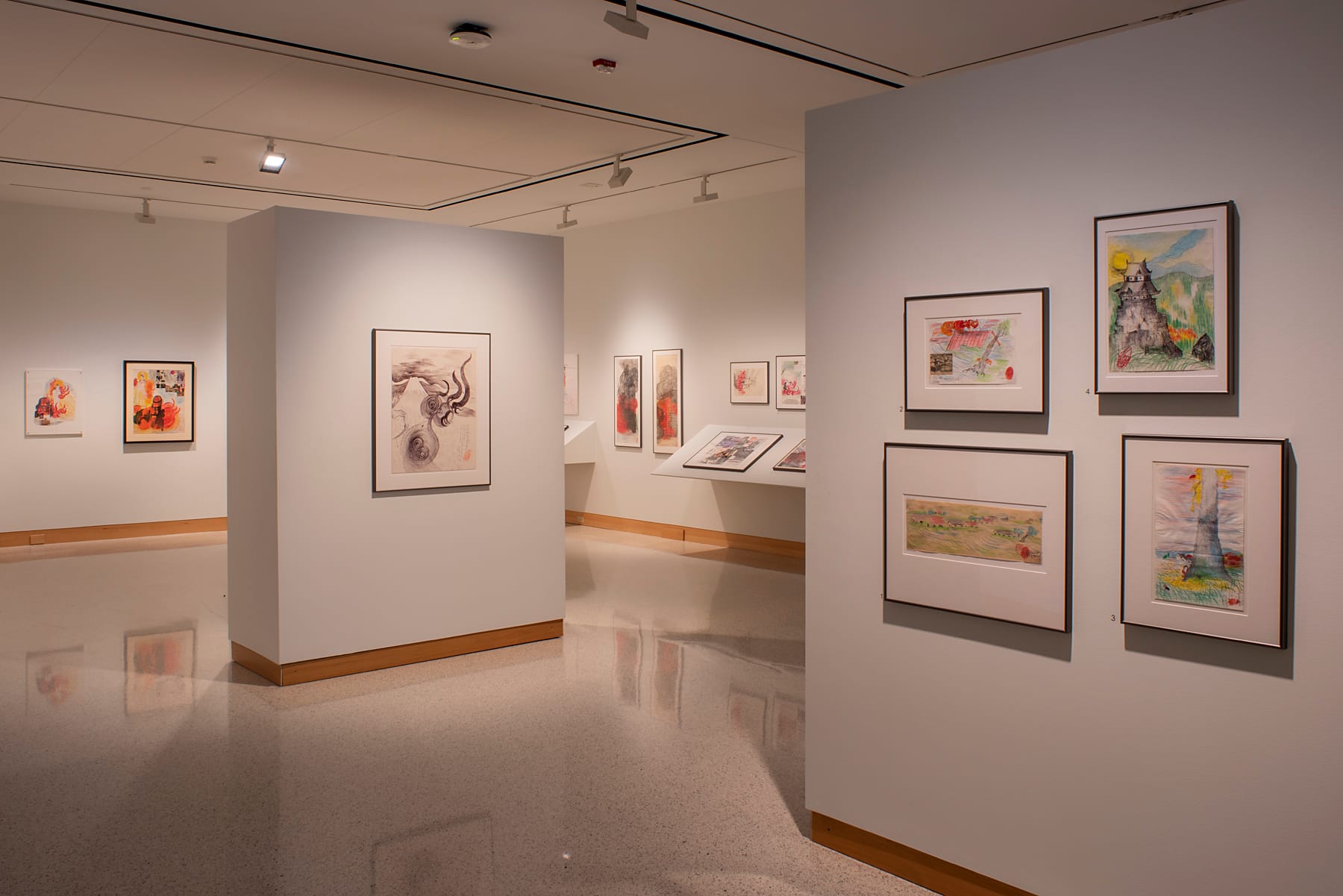
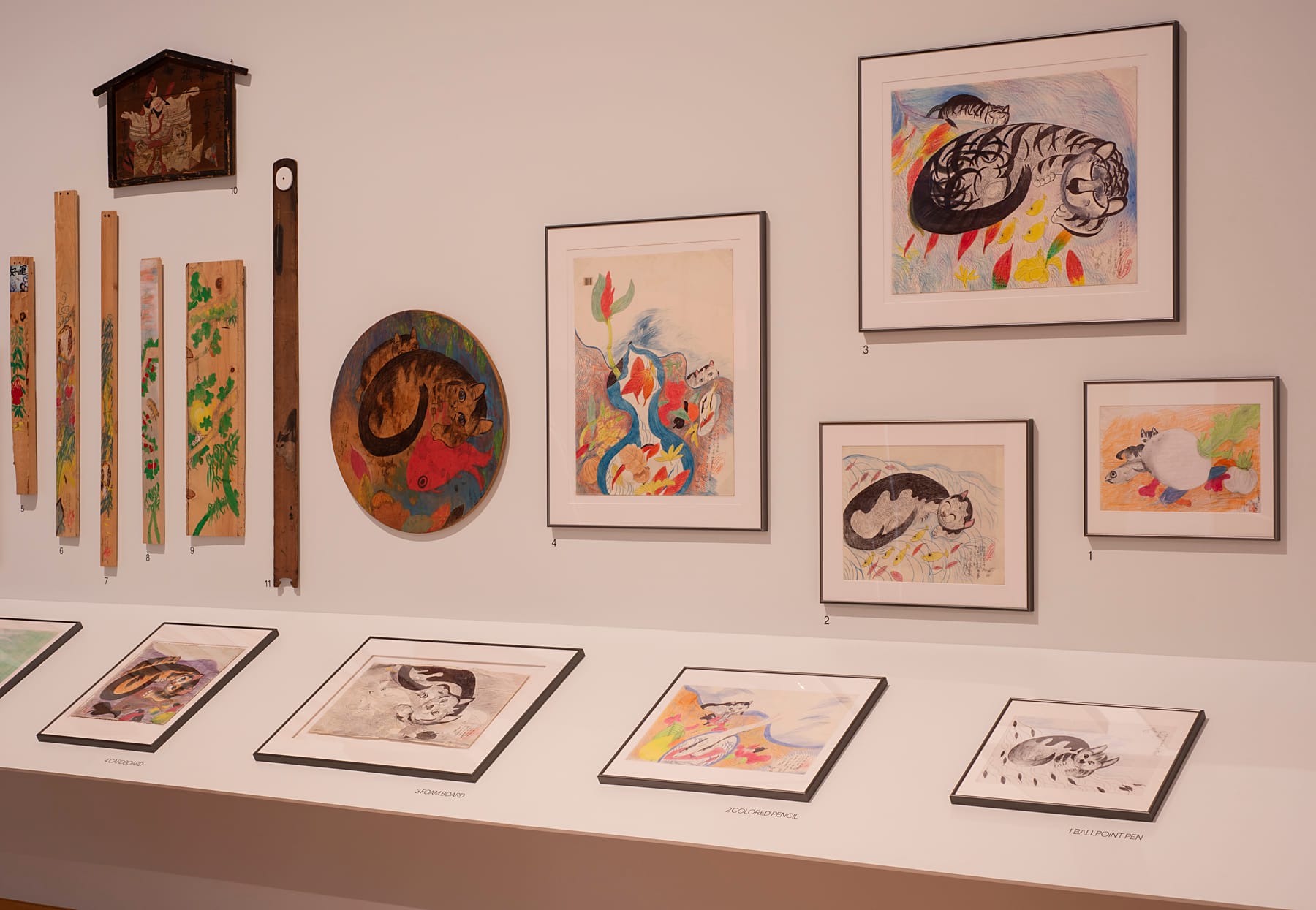
Installation views of the exhibition “Street Nihonga: The Art of Jimmy Tsutomu Mirikitani.” Photos courtesy of the Spencer Museum of Art.
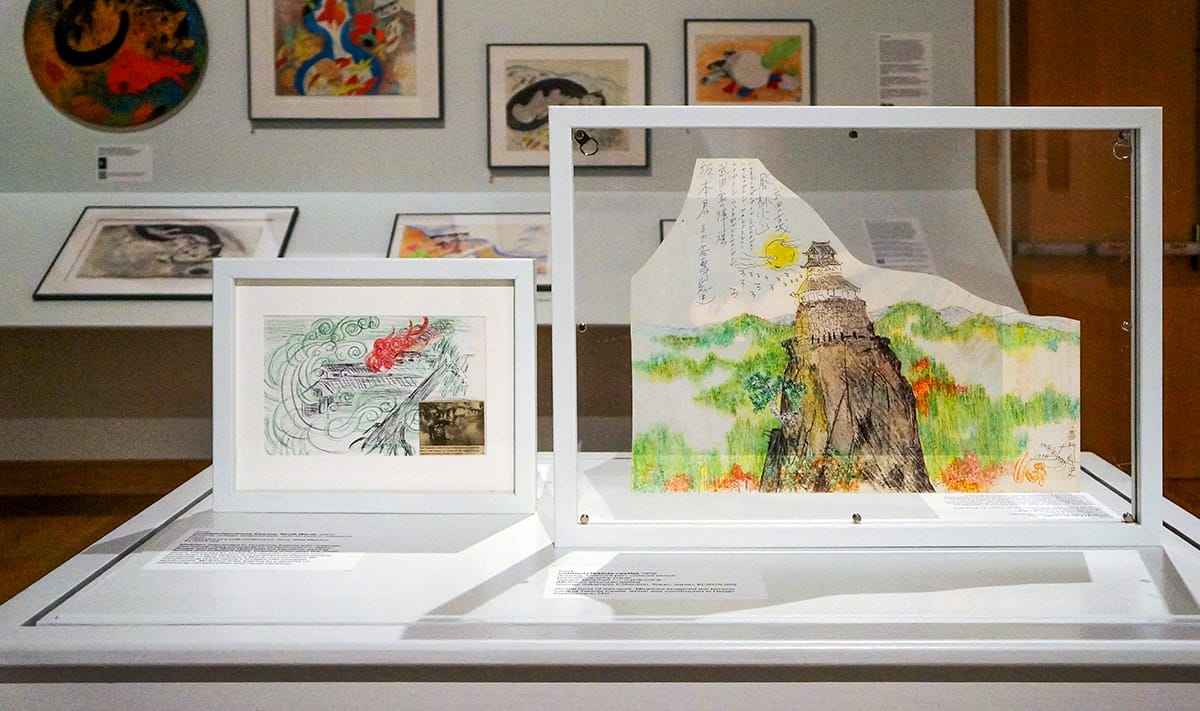
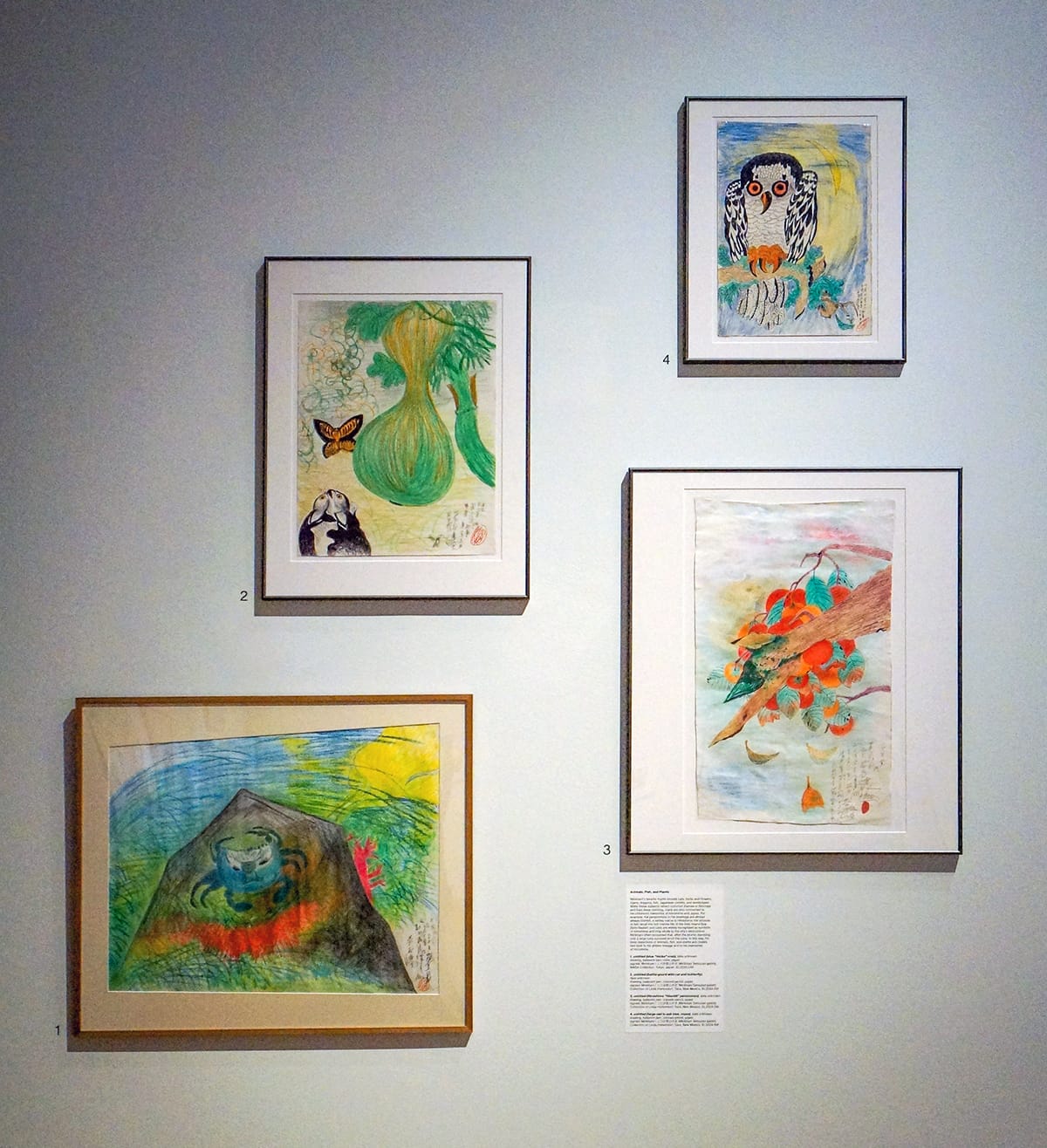
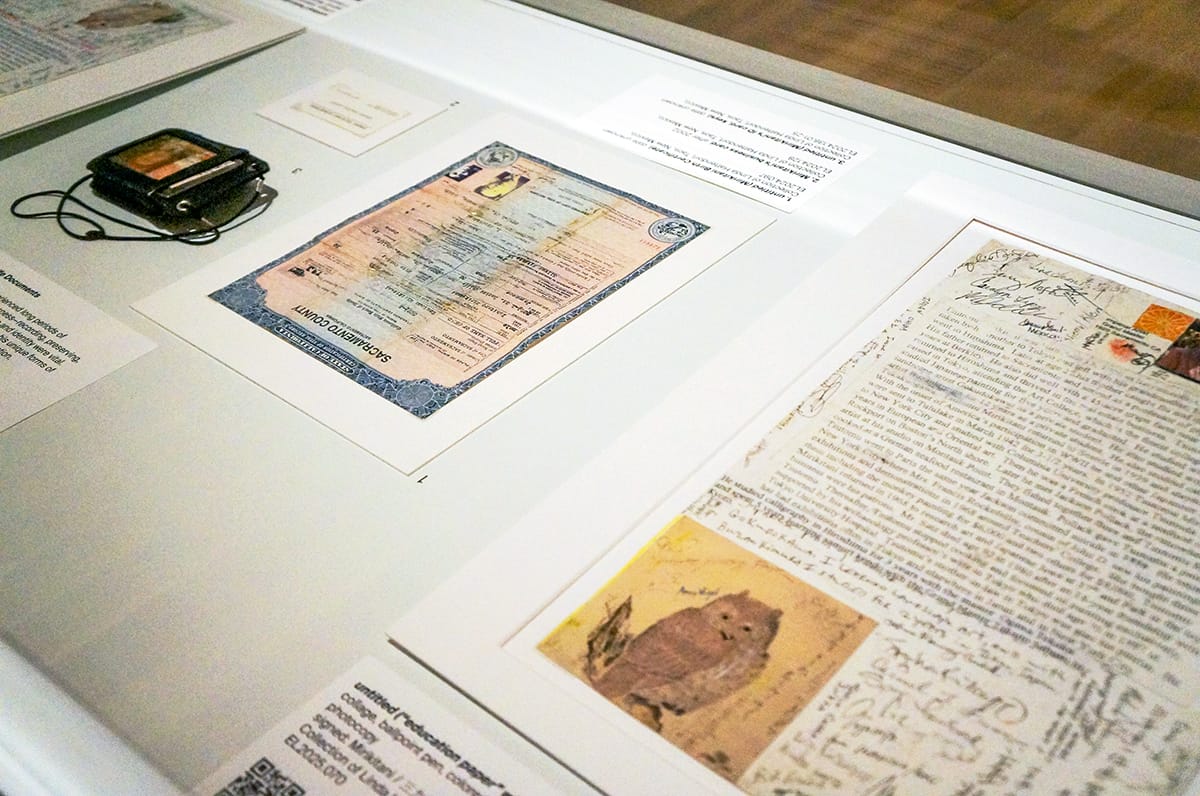
Installation views of the exhibition “Street Nihonga: The Art of Jimmy Tsutomu Mirikitani.” Photos by Xiao Faria daCunha for The SHOUT.
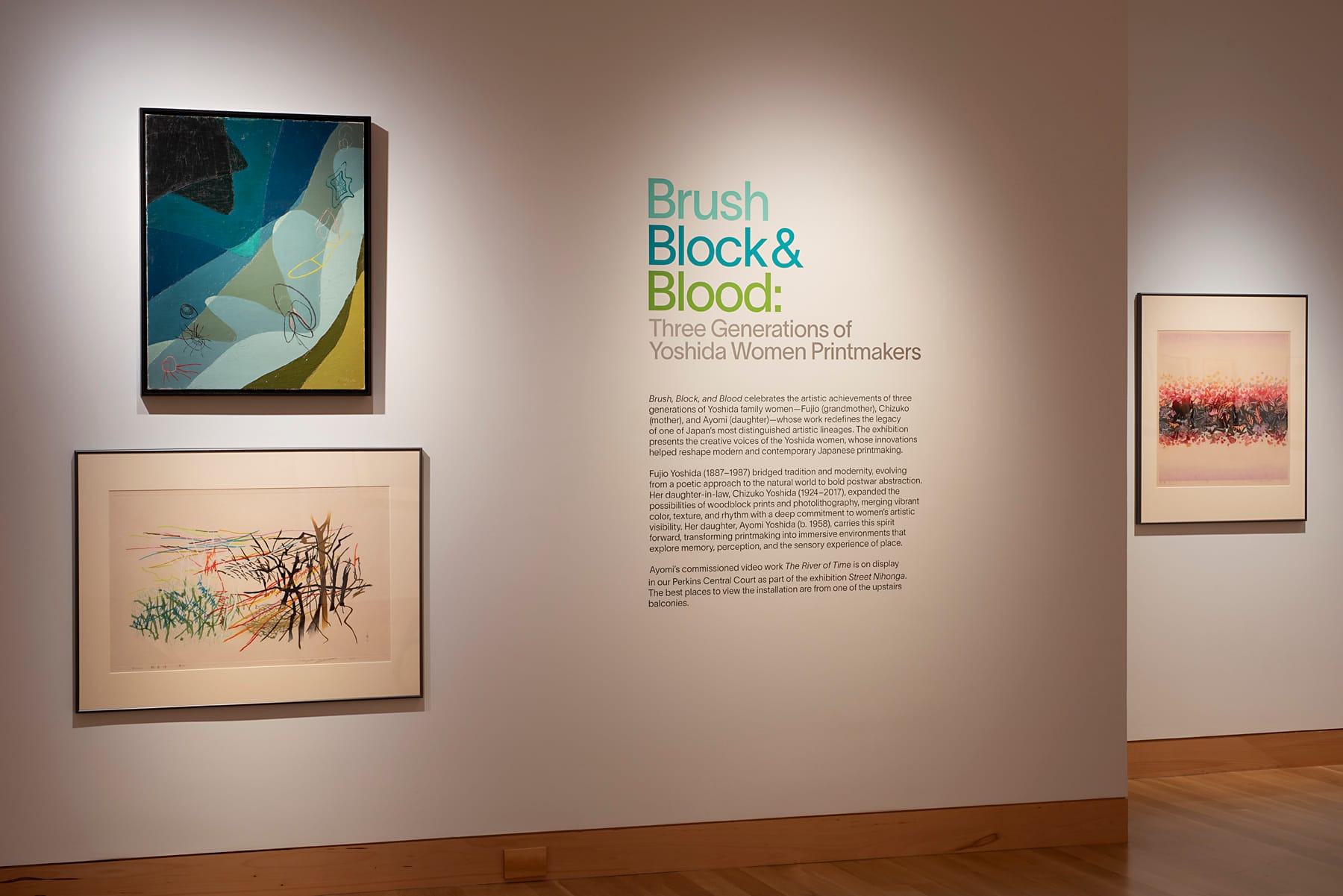
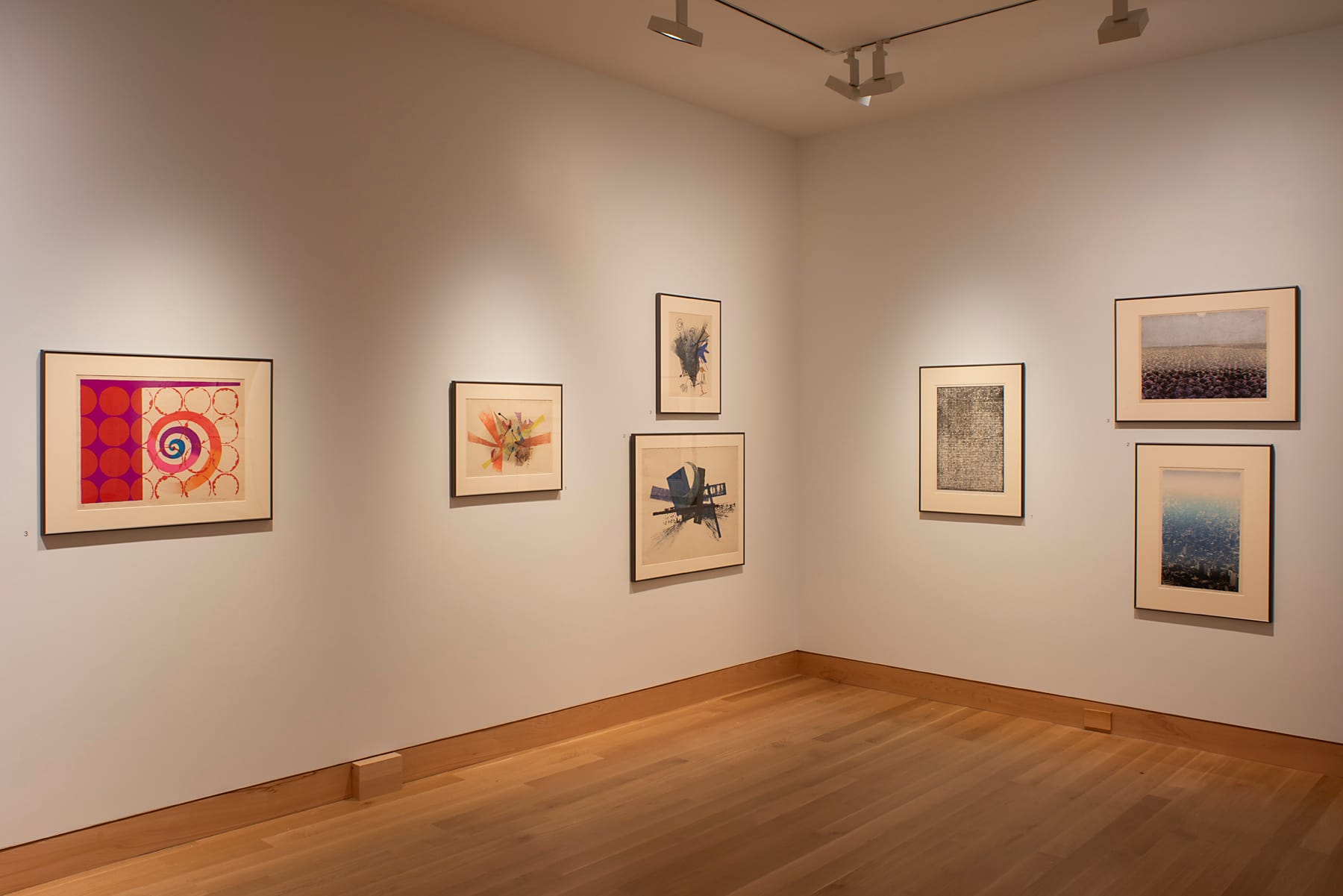
Installation views of the exhibition “Brush, Block, and Blood." Photos courtesy of the Spencer Museum of Art.
The Details
'Street Nihonga: The Art of Jimmy Tsutomu Mirikitani' & 'Three Generations of Yoshida Women Printmakers'
February 19-June 28, 2026 at the Spencer Museum of Art at the University of Kansas, 1301 Mississippi St. in Lawrence
The museum is open to the public rom 10 a.m.-5 p.m. Tuesday-Friday and noon-5 p.m. Saturdays and Sundays. The Spencer also offers evening hours until 8 p.m. on Thursdays.
Admission is free, and the facility is accessible to people with physical disabilities. Free parking for museum visitors is available in designated spots on the first level of the Mississippi Street Garage next to the Kansas Union during museum hours. Visitors will need to have their parking validated at the museum.
Learn more about "Street Nihonga: The Art of Jimmy Tsutomu Mirikitani"and "Brush Block and Blood" on the Spencer Museum website.
Xiao Faria daCunha is a practicing visual artist, curator, art writer, and essayist musing about the living experience as a Chinese diaspora and woman of color in America’s heartland. Her visual art practice is multidisciplinary and ventures among mixed-media illustration on paper, textile, printmaking, and mixed-media collage. Xiao was the former Managing Editor for Urban Matter Chicago and her bylines have appeared in Chicago Reader, BlockClub, BRIDGE.CHICAGO, KCUR, The Pitch KC, and more. She considers all her practices essentially journalism practices to speak on behalf of those who haven't been heard and shed light on what hasn't been seen, whether it's emotional, cultural, or societal.
❋ Derby man has the kind of voice that turns heads — and chairs
❋ Socializing while sober: how some Wichitans are cultivating alcohol-free communities
❋ As a small creative business closes, the owner mourns
❋ Painting through it: Autumn Noire on 20 years of making art
❋ How a guy from Wichita resurrected 'Dawn of the Dead'
❋ Bygone Friends University museum housed curious collections
Support Kansas arts writing
The SHOUT is a Wichita-based independent newsroom focused on artists living and working in Kansas. We're partly supported by the generosity of our readers, and every dollar we receive goes directly into the pocket of a contributing writer, editor, or photographer. Click here to support our work with a tax-deductible donation.