Splitting Hairs: Hong Chun Zhang at the Mulvane Art Museum
A three-decade survey of the Chinese American artist’s work features precise visual metaphors and a sharp eye for cultural differences.

Artist Hong Chun Zhang traveled from her birthplace in China to the United States, arriving in California before relocating to Kansas in 2004. In the course of her journey through changing landscapes and cultures, Zhang’s site-responsive work captures her observations of the complex people and world around her.
“Journey to the West: A Survey of Hong Chun Zhang’s Art, 1996-2026” at Topeka's Mulvane Museum of Art marks the 30th anniversary of the artist’s immigration to the United States and highlights Zhang’s works from this period. As a retrospective, the show demonstrates how Zhang’s style and practice have evolved with time in response to her changing environments, while the subjects of her drawings and paintings remain grounded in site-specific concerns, often in connection with cultural contexts and geographic features.
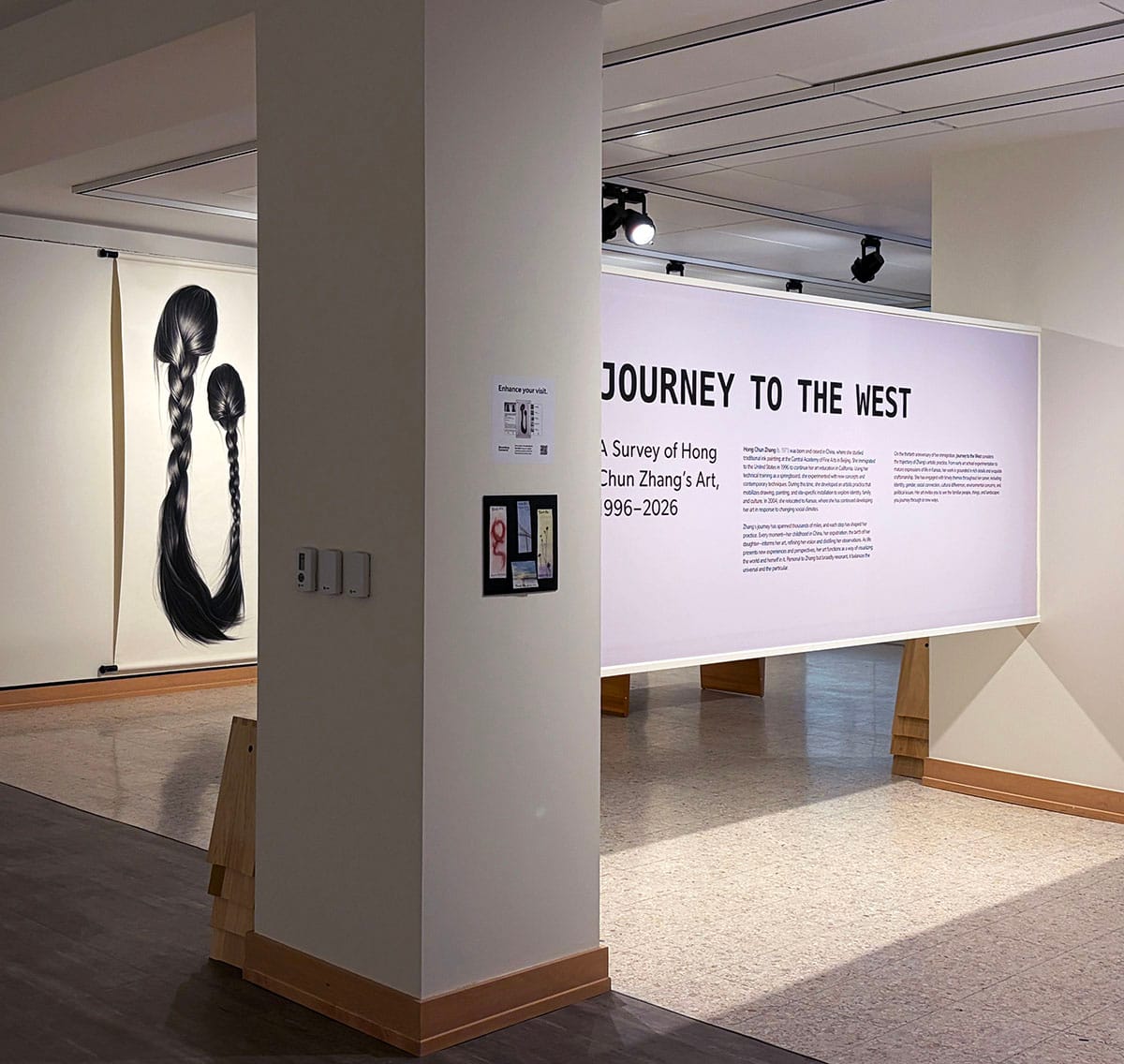
Beginning with the museum’s South Gallery, the show features Zhang’s traditional Chinese ink paintings from her early years. The Center Gallery highlights her formative graduate school work in California, where she developed her signature long, black hair motif. The exhibition concludes in the North Gallery with the artist’s most recent meditations on cultural boundaries and wide-open spaces inspired by her found home in Kansas. Each work in ”Journey to the West” reveals Zhang’s contemplative approach to reinterpreting both the familiar and the new in often disarming ways.
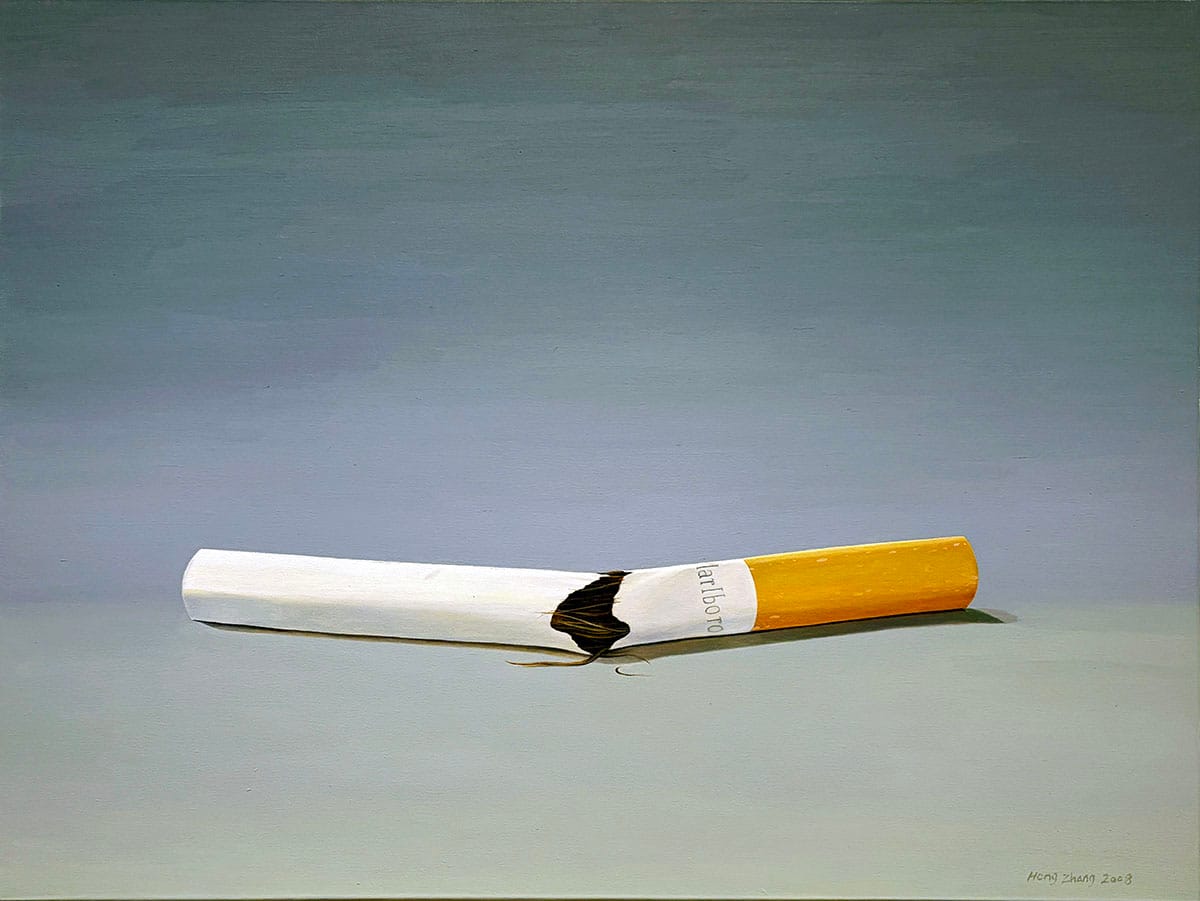
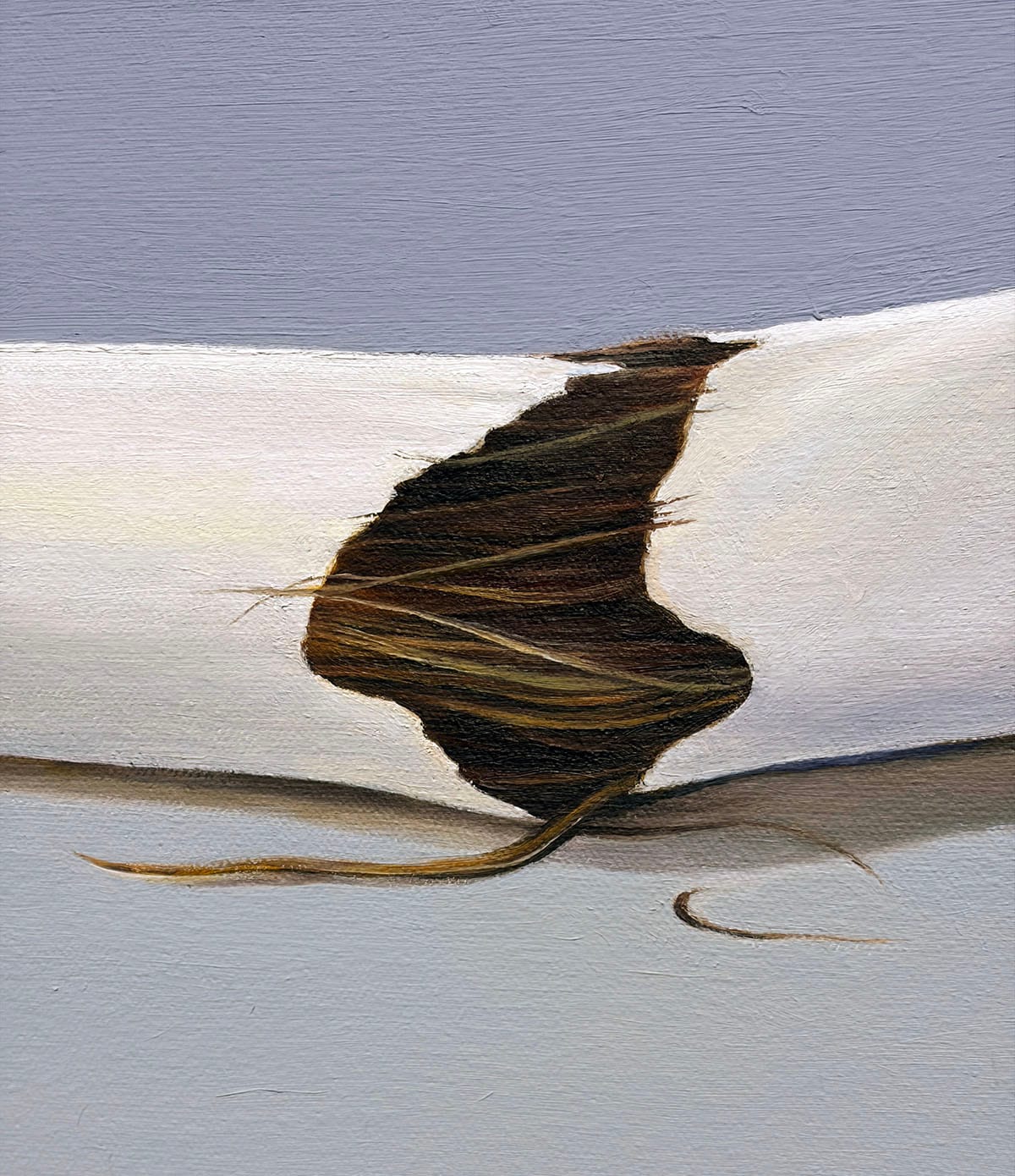
Hong Chun Zhang, “Hazard,” 2008, oil on canvas, 30 by 40 inches and detail of “Hazard.” (Abby Bayani-Heitzman/The SHOUT)
Hong Chun Zhang, “Reset,” 2022, Chinese ink on Italian fabric with scrolls, 40 by 110 inches. (Abby Bayani-Heitzman/The SHOUT)
Born in China in 1971, twin sisters Zhang Chunhong (Hong Chun Zhang) and Zhang Chunbo (Bo Chun Zhang) were encouraged as artists from a young age. Their father was a professor at the Lu Xun Academy of Fine Arts, founded in 1938 as a training center for Chinese Communist Party artists, and the twins were sent to the Fine Arts School affiliated with the China Central Academy of Fine Arts in Beijing for their secondary education. After graduating, they attended the Central Academy of Fine Arts, one of the most prestigious, renowned, and competitive art institutes of higher education in China. Bo Chun enrolled in the printmaking program, while Hong Chun was admitted to the Chinese ink painting program.
During her time at the Central Academy of Fine Arts, Zhang produced works dominated by Chinese characteristics, but she also began developing her unique perspective, focusing on gendered subject matter and challenging traditional rules of composition in Chinese ink paintings. A pair of representative works included in the show, “Public Shower #1” and “Public Shower #2,” are traditional Chinese ink and watercolor paintings on rice paper. But the scene pictured in both is the interior of the university public bathhouse — a quotidian experience for a student like Zhang rather than the serene natural landscapes or idealized human figures generally included in Chinese ink paintings.
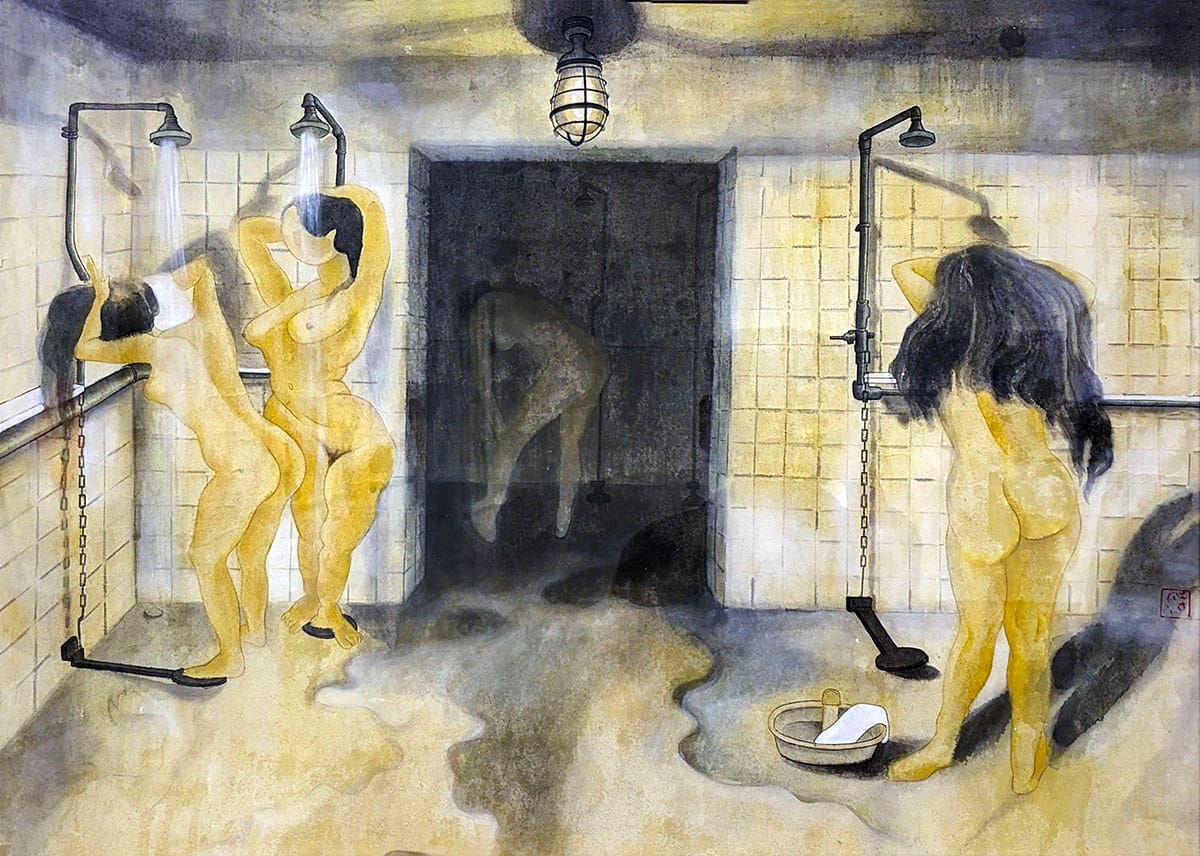
“Public Shower #1” presents four nudes, and “Public Shower #2” shows women in various stages of undress after their shower, but neither painting is framed voyeuristically. The former is rendered in soft, indistinct lines and smudged brushstrokes, imitating the rising steam of hot water and blurring the four bathing women. The viewer’s perspective is that of an observer standing within the inner shower space among the women rather than that of an outsider.
Three women in the foreground wash their bodies and hair, relaxed in a way that shows the natural beauty of their curves and flowing hair without treating the scene as a spectacle. The fourth figure scrubs her leg in the darker back room, focused on cleaning and refreshing herself in private rather than striking a provocative pose for some imagined viewer.
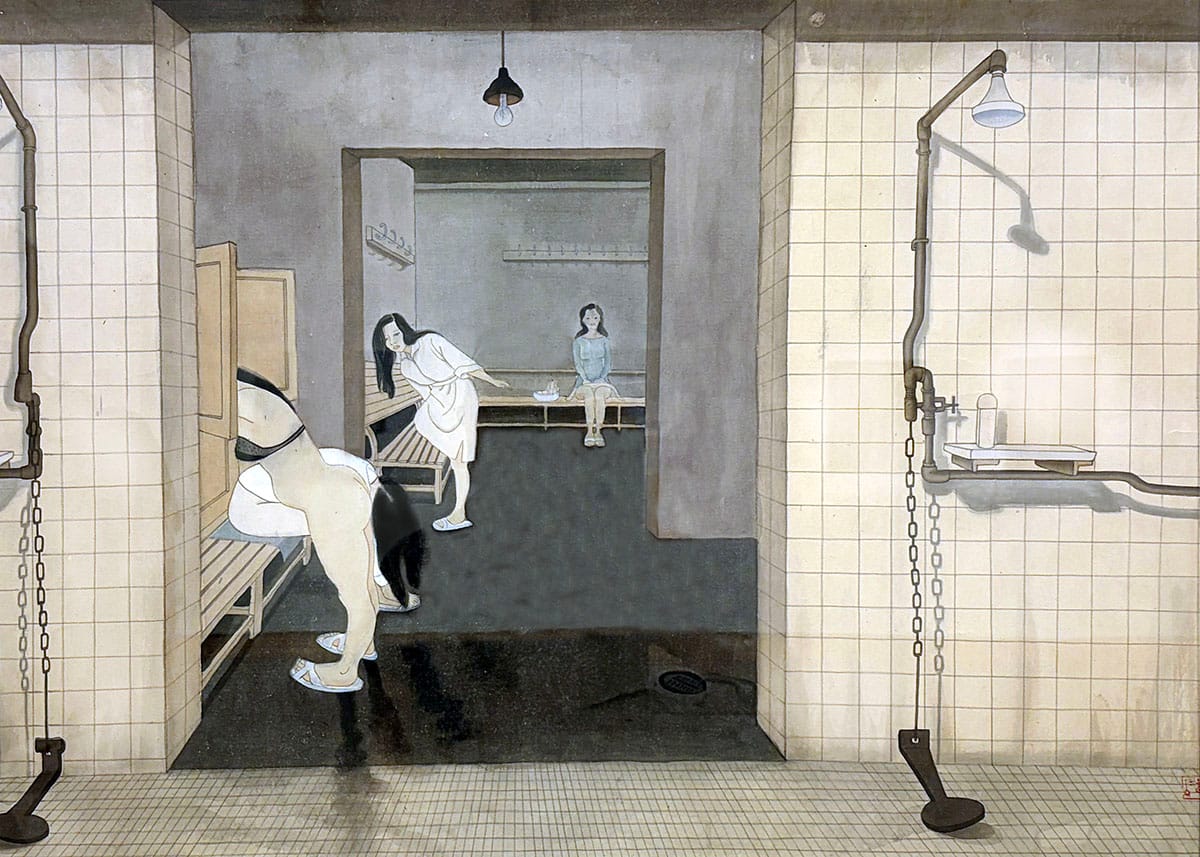
In “Public Shower #2,” Zhang draws the figures with sharp clarity as they change in the outer dressing room. The perspective in this composition is once again of a viewer standing in the inner shower space, this time facing outwards toward the dressing room. Taken together, the images can be read as two angles to a single vantage point — the perspective of a woman in the bathhouse looking at the figures ahead of her and those behind. In “Public Shower #2,” the faces of a few women are visible. One woman in a robe looks toward the viewer unguarded, simply noting the presence of others, while a girl sitting in the back room sits quietly and contemplatively, perhaps finding a moment of peace in the middle of a busy day.
Zhang’s careful balance of the personal and particular with the universal and abstract shines in the show. Several of her early works draw on personal experiences to create intimate portraits, but she abstracts them by refusing to depict specific people, instead obscuring faces or substituting them for objects.
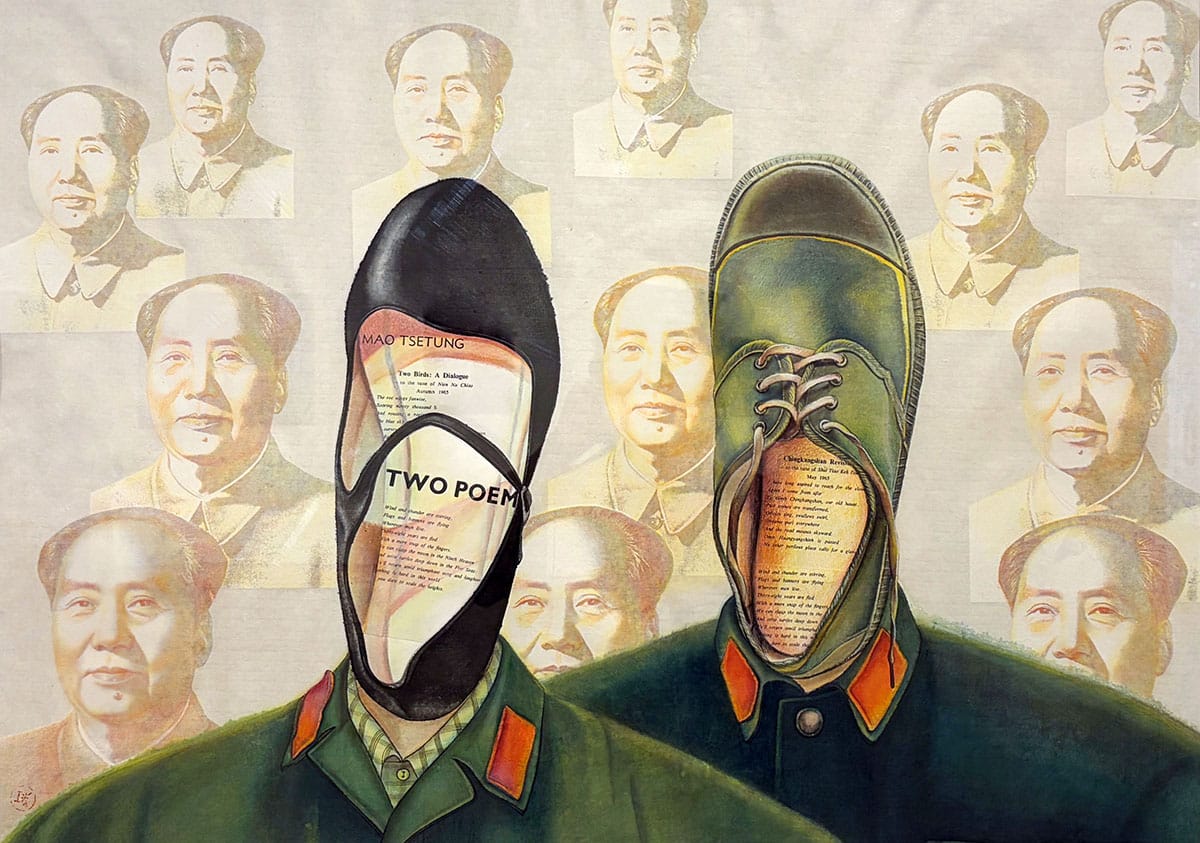
Another pair of paintings, “My Parents” and “My Grandparents,” feature footwear rather than actual human figures or faces. In “My Grandparents,” two tiny lotus slippers are squeezed between a pair of tall, black leather boots, signaling the relationship of confinement and control that defined marriage in her grandparents’ time. In contrast, “My Parents” presents a more equitable image, with both the mother and father figure dressed in utilitarian uniforms and represented by similar-sized, casual shoes. However, the rigid constraints of Chinese communism dominates the latter painting, with the face of Mao Tse-tung plastered across the background and selections of “Quotations from Chairman Mao Tse-tung” lining the soles of Zhang’s parents’ shoe-heads.
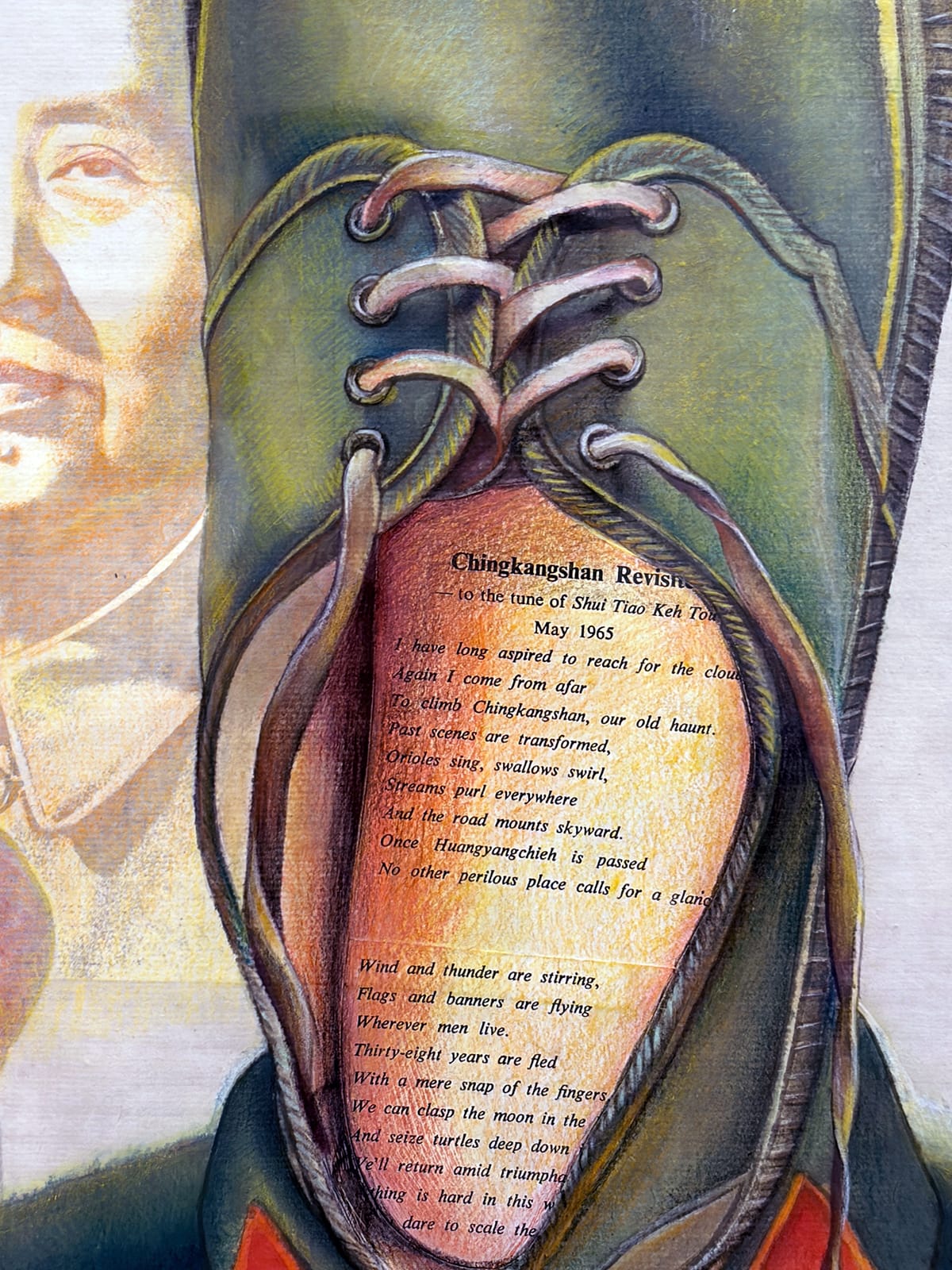
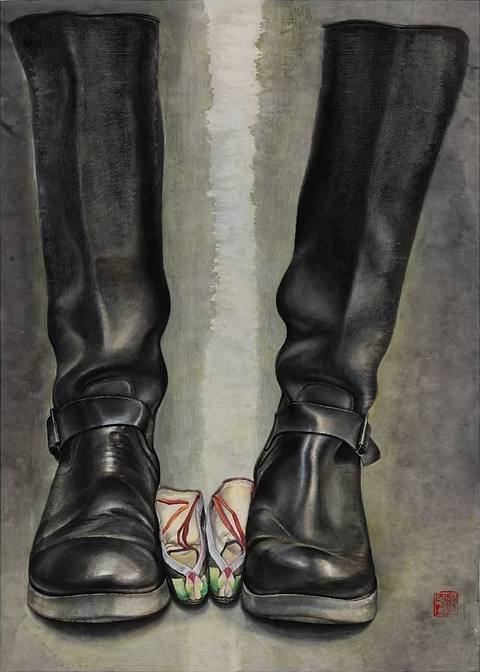
Detail of “My Parents” and Hong Chun Zhang, “My Grandparents,” 1998, Chinese ink and watercolor on rice paper; 28 by 20 inches. (Abby Bayani-Heitzman/The SHOUT)
In using cultural symbols to depict her family, Zhang renders her personal understanding of each identity in layers of meaning. The portraits therefore depict both her individual family and the socially defined roles of mother, father, grandmother, and grandfather in their respective lifetimes. The artist captures the gendered family dynamics and shifting political identities in China’s tumultuous modern history between the pair of works — the contrast between the portraits is stark despite spanning the difference of a mere handful of decades.
The empty boots, slippers, and sneakers also bring to mind the idiom to fill someone’s shoes, suggesting that Zhang perhaps sees the path her parents and grandparents walked as routes available to her. However, critiques woven into the images, from the oppressive grey tones and clear power imbalance of “My Grandparents” to the de-individualized and politically defined figures of “My Parents,” reveal the Zhan's sobering view of the environment that shaped her elders’ understanding and treatment of sex, gender, and equality. As works created during Zhang’s time at graduate school in California, they are visualizations of the artist’s reconsideration of her family history from an entirely separate and distinct cultural vantage point.
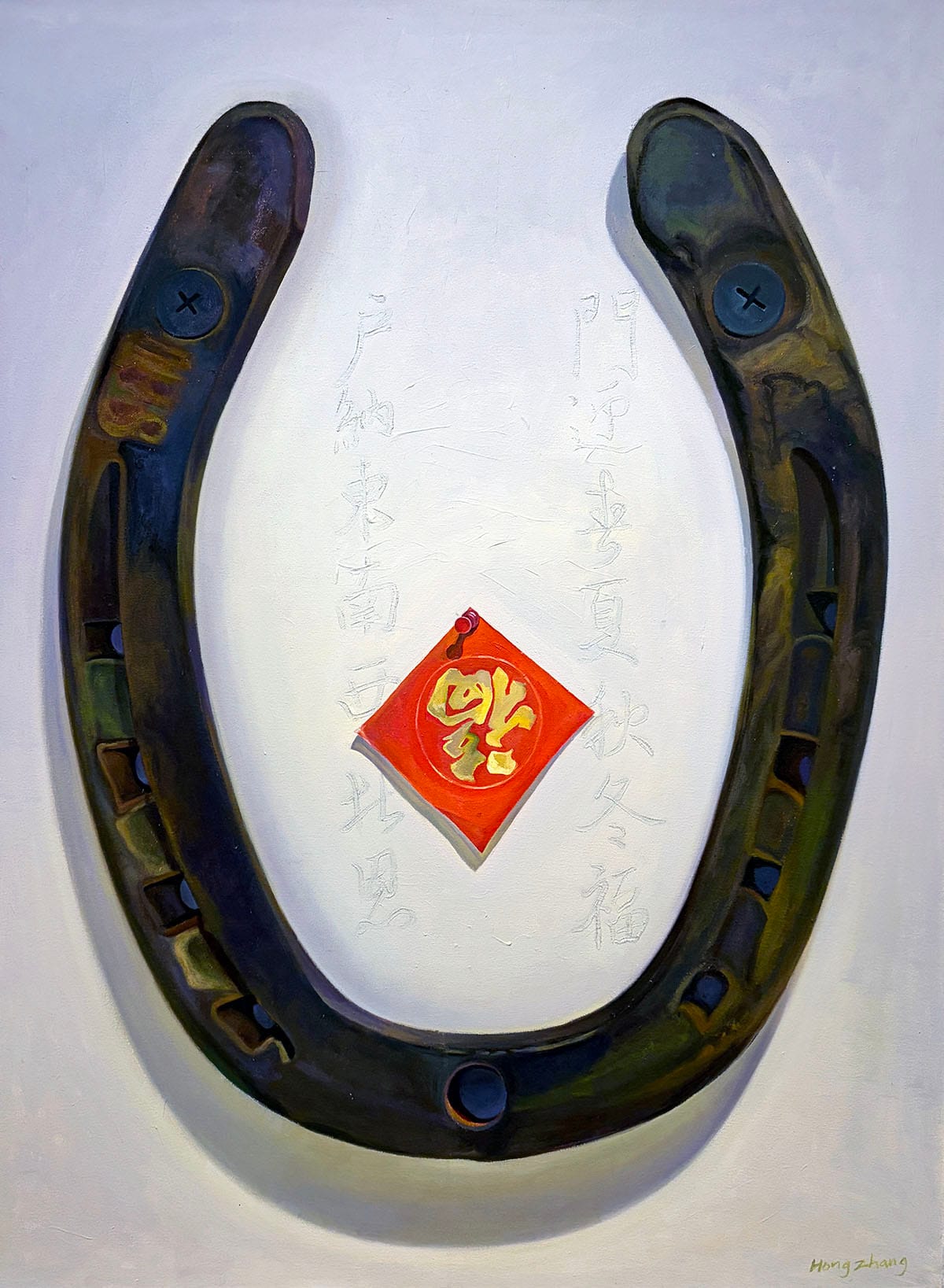
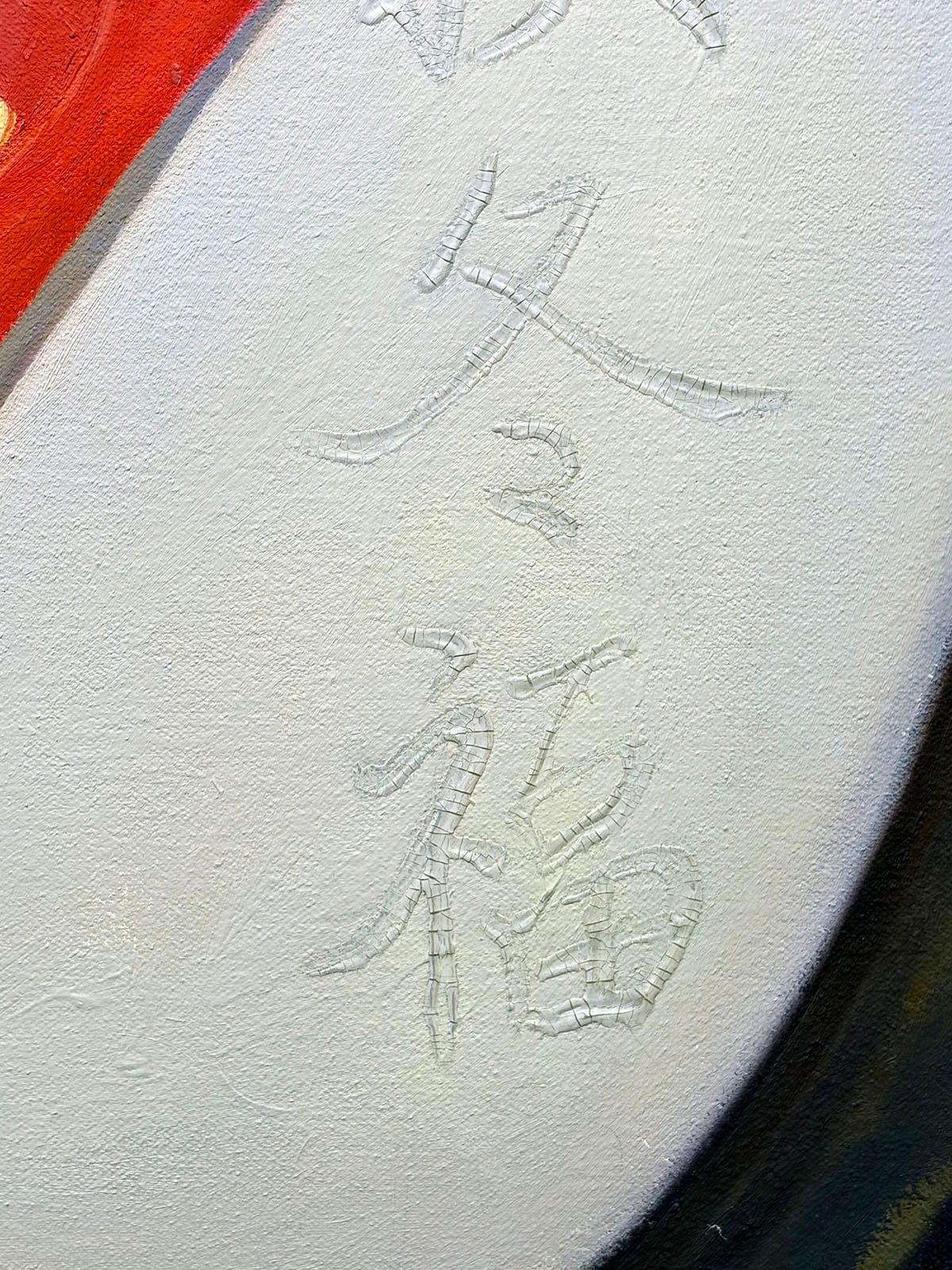
Hong Chun Zhang, “Good Fortunes,” 2003, oil on canvas, 45 by 33 inches; detail of “Good Fortunes.” (Abby Bayani-Heitzman/The SHOUT)
During her time in California, Zhang confronted cultural differences and her evolving perspective as an artist through several oil paintings. “Good Fortunes” focuses on the concept of auspiciousness in both Chinese and Western cultures by pairing an upturned horseshoe with the Chinese character for “good fortune” in gold lettering on a red background. The horseshoe dominates the painting visually, creating a Western container for the Chinese symbol. But on closer inspection, we can see additional Chinese characters barely visible in the background, as if lightly etched onto a plaster wall. This suggests that, while the painting is undoubtedly exploring how an American environment can shape an art practice rooted in traditional Chinese forms and techniques, the artist’s cultural background and the additional layer of perspective it allows will always be present.
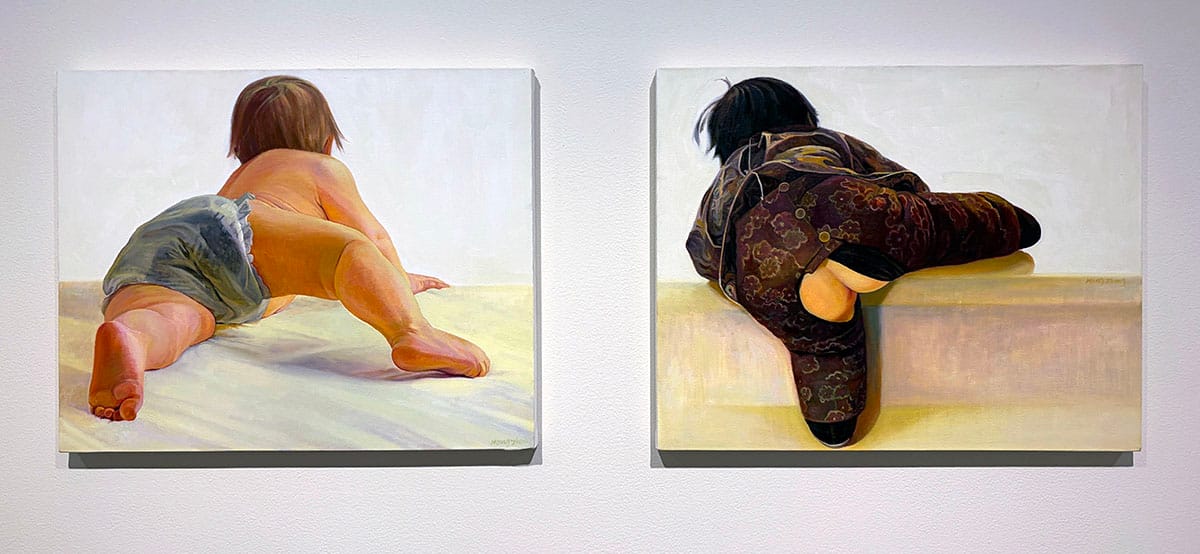
Hong Chun Zhang, “Cultural Training,” 2003, oil on canvas (diptych), each 24 by 30 inches. (Abby Bayani-Heitzman/The SHOUT)
In a similar vein, “Cultural Training” is a diptych of oil paintings that compares the development of a diapered Western baby with that of a Chinese baby in kai dang ku, or “split-crotch pants.” In the Western world, babies are generally diapered to prevent them from making a mess of themselves, their clothes, and their surroundings. In China, split-crotch pants were historically used to allow infants to relieve themselves without removing their clothes, making potty training more practical for family members who could simply hold the baby while they urinated or defecated. Additionally, the Western baby is naked aside from the diaper, while the Chinese baby is dressed in a top, bottom, and shoes, further showcasing the various approaches to childrearing across cultures.
In the diptych, both babies crawl forward with their right leg pulled up. Despite the difference in complexion and dress, the two children move remarkably similarly, pointing to the universality of infant growth and learning across cultures. The work is further enriched by contemporary context, as diapers have become quite common in the urbanized areas of China, while Western parents are beginning to recognize the advantages of split-crotch pants, which are anecdotally said to support faster toilet training.
While cultural contrasts and juxtaposition have remained a common theme in Zhang’s work throughout her career, the signature motifs she developed during graduate school in California represent the heart of the show. The new body of work Zhang created during this period was both personal and universal, and it also signaled a conscious departure from the traditionally small-scale Chinese ink painting style.
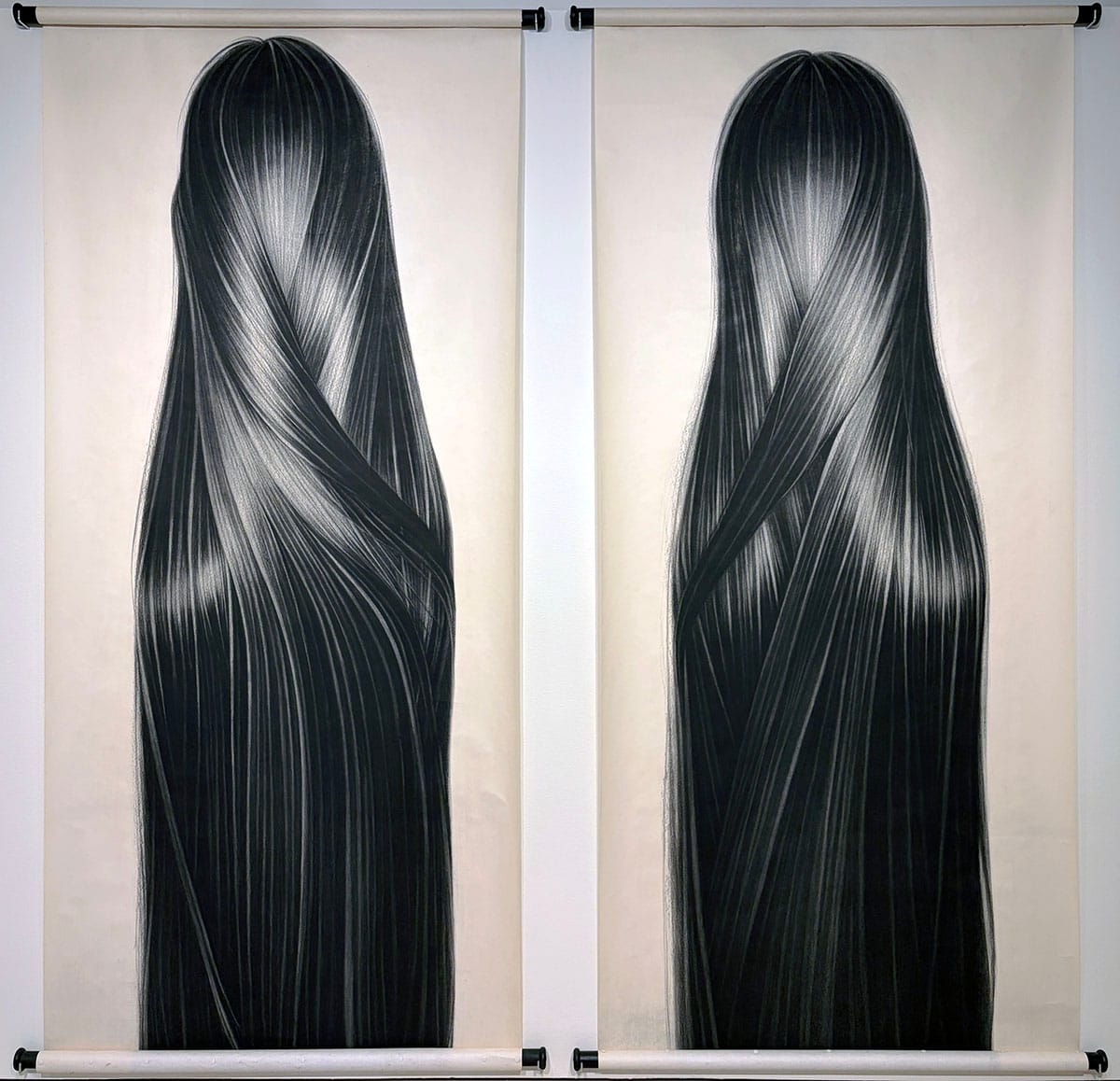
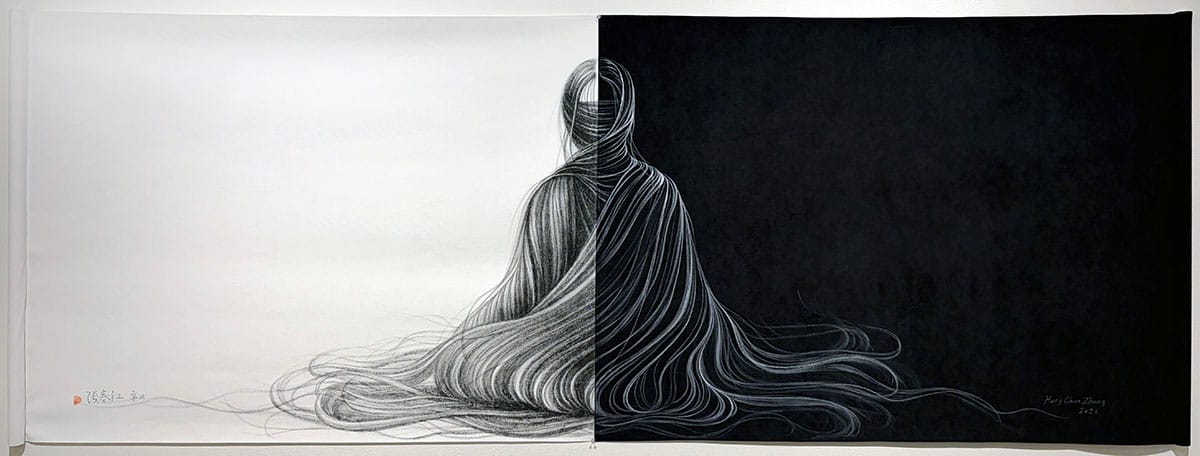
In the Center Gallery, large-scale charcoal drawings constitute the heart of the show. The first, “Twin Spirits #1 Diptych,” is a dual-portrait of the artist and her identical twin sister Bo Chun. As with previous works where Zhang has considered sex and gender from a critical and distinctly feminine perspective, these portraits focus on hair beyond its function as a traditional symbol of Chinese womanhood and beauty. Created to evoke menshen hua (door god prints), paired symmetrical illustrations of divine guardians hung at entrances to ward off evil spirits, the charcoal drawings are intended to hang side-by-side and radiate a powerful, confident, and intrinsically linked sense of protective energy.
The hair in these drawings is so long that it covers the figures’ bodies and even reaches past the edge of the visible paper, continuing into the rolled portion of the bottom scrolls. The two figures of hair, although balanced, are not mirror images of one another. The hair of both figures is draped inwards toward the other, but there are clear distinctions between the two: The figure on the left possesses hair that curves gently and falls in soft waves, while the righthand figure has straighter hair that reaches across the figure’s back in more defined strands.
As a twin, Zhang explores womanhood through both herself and her sister with this work. The pair of intimate portraits of the artist and her sister on massive floor-to-ceiling scrolls appear to be concerned with personal identity, but the faceless figures are simultaneously the known feminine self and an unknown feminine other, repositioning culturally gendered symbols like long hair to be viewed as more powerful than passive. In the place of door gods, the long black hair appears as a powerful and protective force, embodying the strength and divine potential of femininity. This cultural revisionism is a rich site in which Zhang forges new motifs as a modern Chinese American woman.
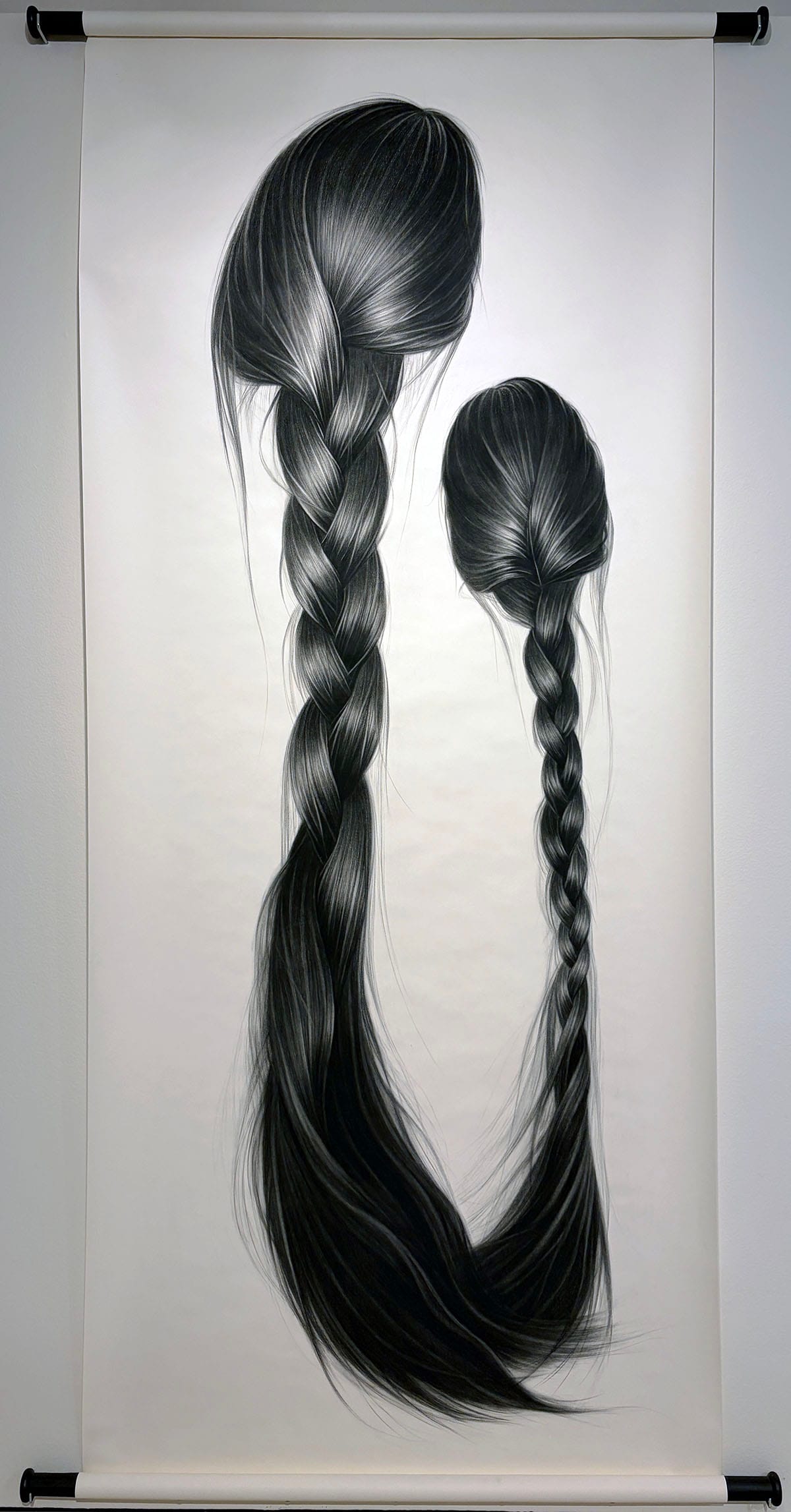
In Zhang’s work, hair is rendered so carefully, so meticulously, that a great mass of it appears impressive not only because of its size but also because of its fine detail. Individual strands become visible through razor-thin highlight work that reproduces the silky, shiny texture of straight black hair. “Bond,” the second work included in the Central Gallery, builds on the hair motif by picturing the matching long, braided locks of Zhang and her daughter, the two heads tilted affectionately toward one another. Here, the smooth continuity of the hair is complicated by plaits, where three separate strands are woven in, through, and around one another, and a distinct pattern of shadows and highlights segments the hair along the braid.
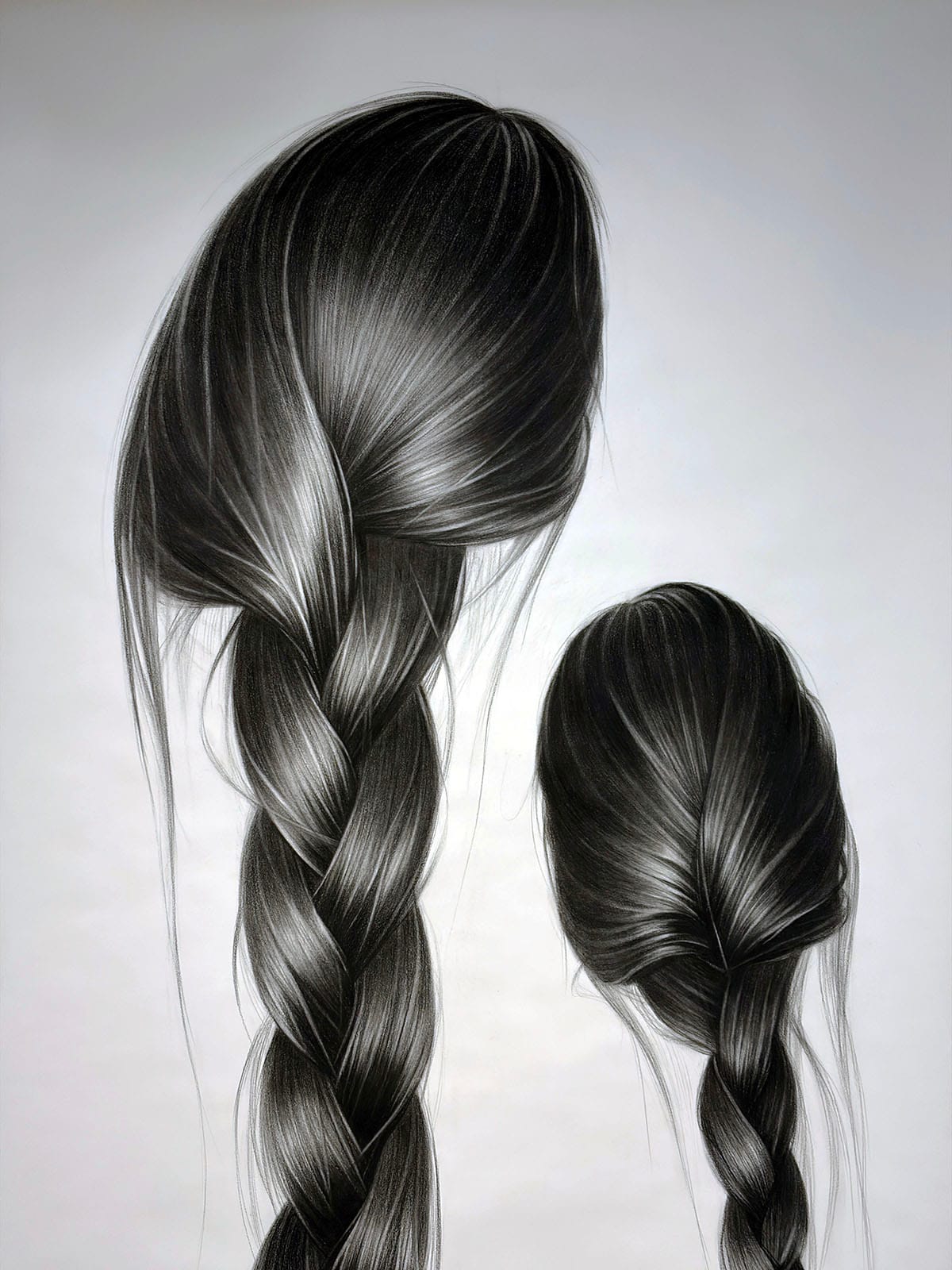
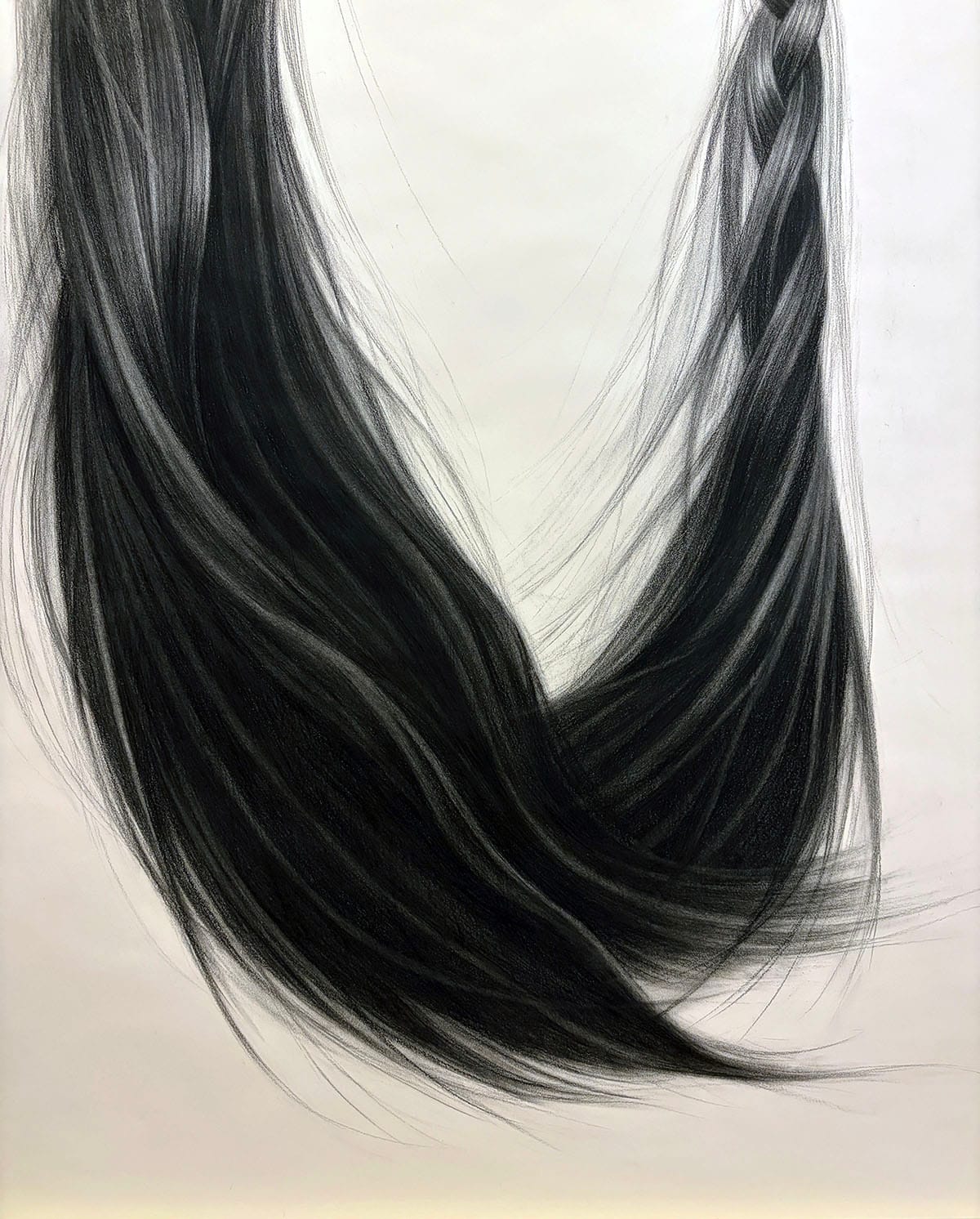
Details of “Bond.” (Abby Bayani-Heitzman/The SHOUT)
This woven texture speaks to the nature of family relationships in a way that “My Parents” and “My Grandparents” fail to capture. Rather than confining and defining her daughter in this work, Zhang celebrates their shared life while also recognizing and appreciating their differences: The smaller head of hair in the drawing is braided more tightly and appears thinner overall, the composition is balanced in the way that the larger, thicker head of hair leans inward and the loose end of its lush braid curls upward and toward the right, lending the right side of the canvas weight. Pictured here, as in “Twin Spirits,” is a relationship of love and protection. The artist depicts both sisterhood and motherhood as sources of strength.
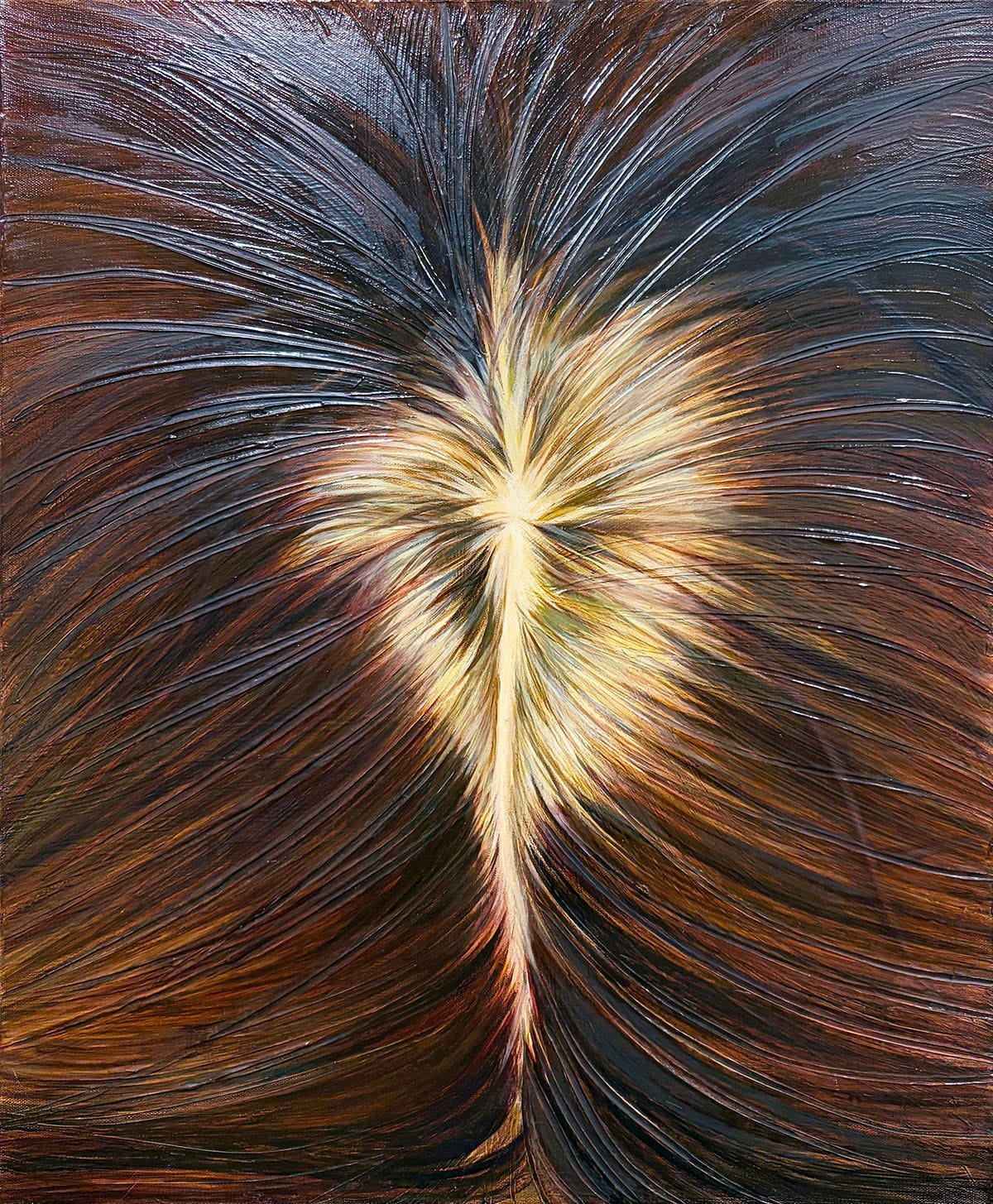
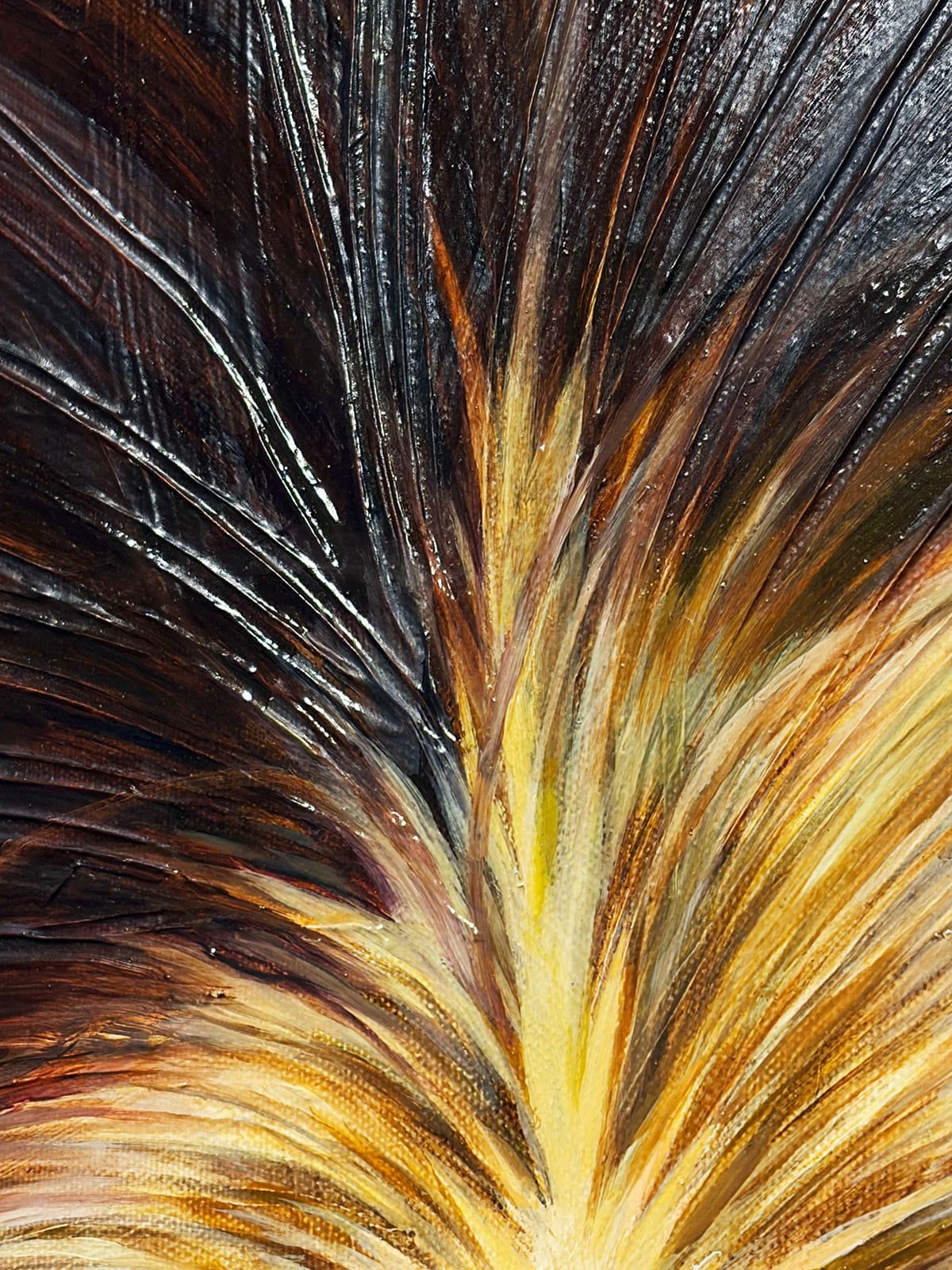
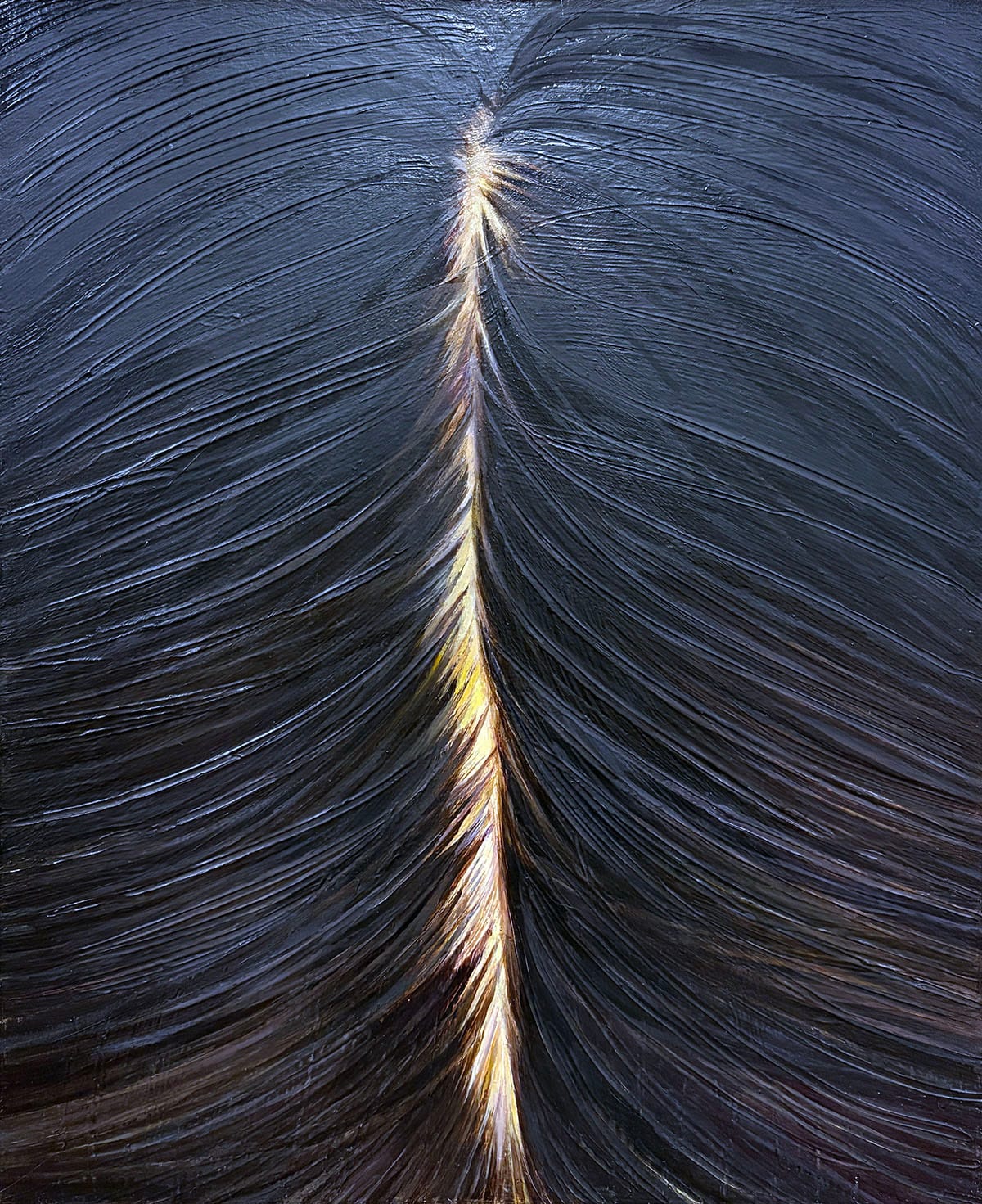
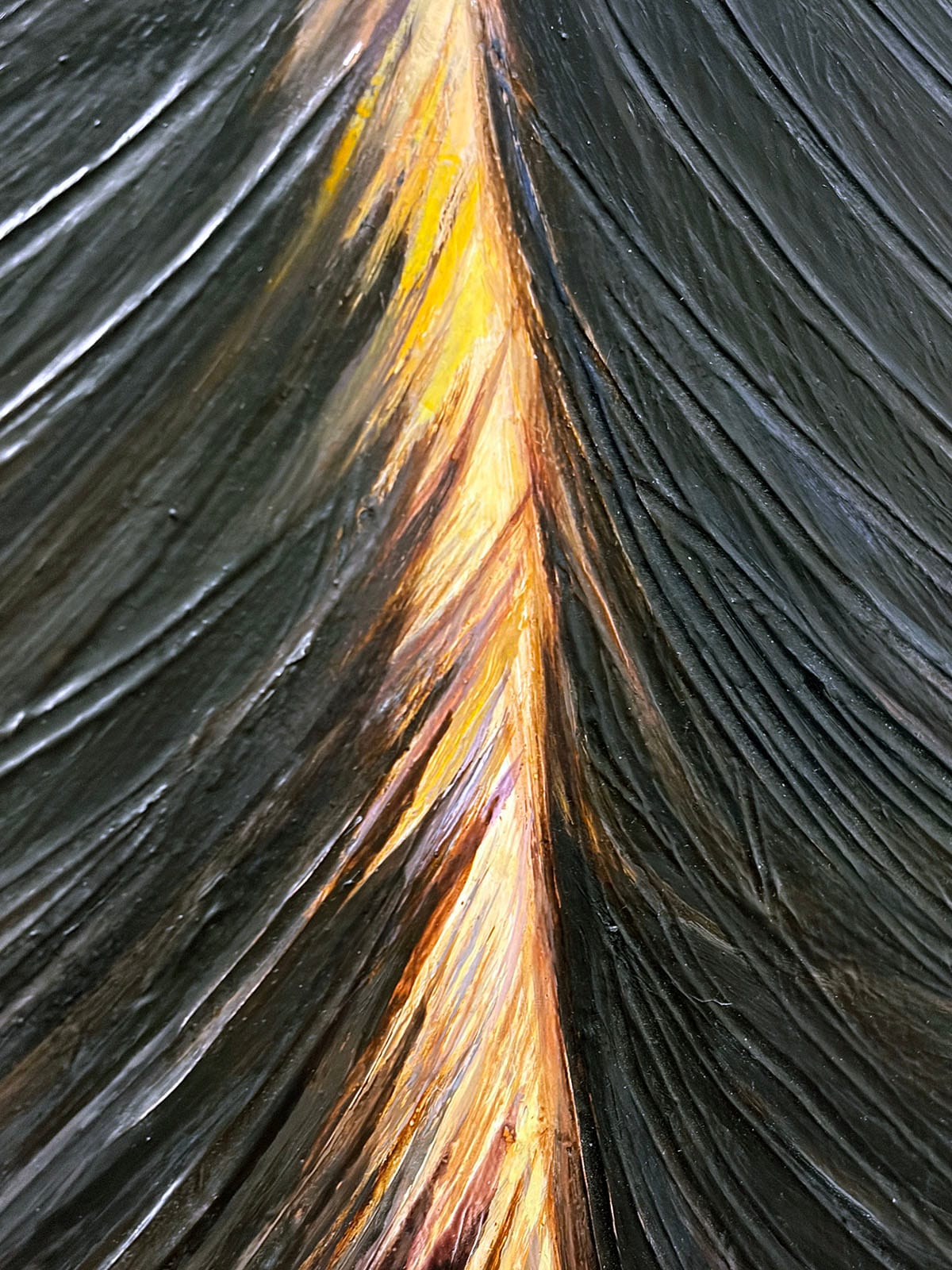
Hong Chun Zhang, “Red,” 2004, oil on canvas, 24 by 20 inches; detail of “Red;” Hong Chun Zhang, “Black,” 2004, oil on canvas, 24 by 20 inches; detail of “Black.” (Abby Bayani-Heitzman/The SHOUT)
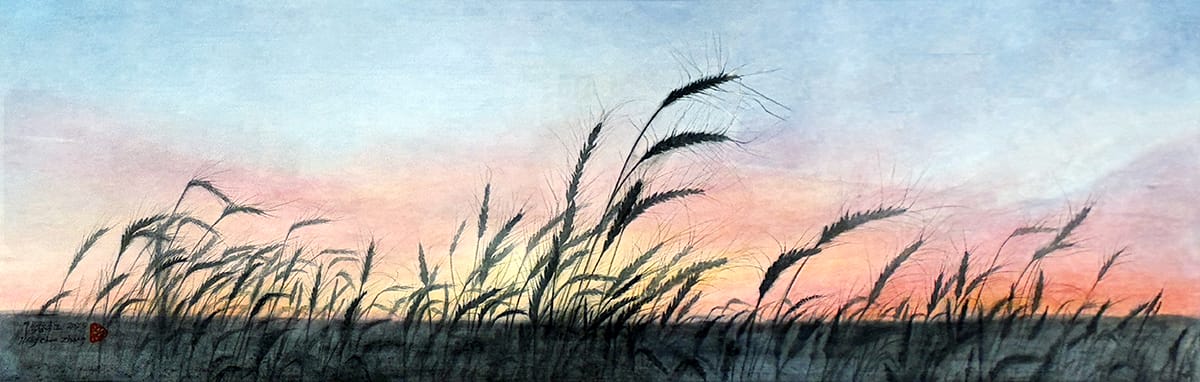
The techniques that Zhang developed in her hair-centric works resurface in surprising ways in many of her recent landscapes in the North Gallery. Since moving to Kansas in 2004, Zhang has incorporated aspects of the Midwest into her art practice, utilizing her method of rendering long hair to create environmental scenes of tornados and tallgrass prairies. Since 2020, Zhang’s medium of choice has also shifted from large charcoal drawings to Chinese ink paintings on Italian fabric. Interestingly, this development is partially a return to form for Zhang, who was formally trained in traditional Chinese ink paintings, but also a new, mature departure from the intimate and personal subject matter that appeared in her early work.
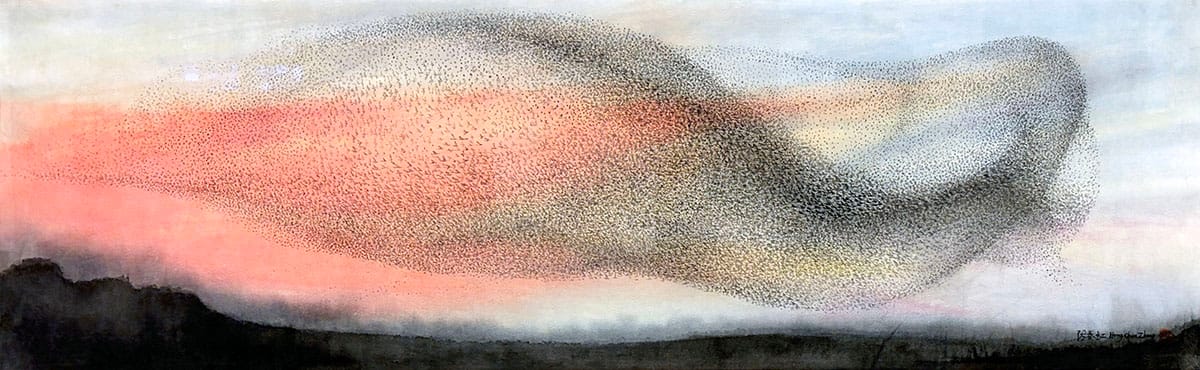
In these recent works, Zhang is not only looking at herself and those around her to make sense of the changing world but also to the natural environment. In “Sunset Magic,” Zhang portrays the sky over Kansas as a vast, open area bound only by the dark horizon, gently sloping below. A massive flock of birds occupies a majority of the sky, swooping about in gentle, flowing waves not unlike the shape and texture of hair in Zhang’s other works. The tiny birds appear as grey and black silhouettes of varying sizes, depending on their proximity to the viewer, and a small contingent appears to break away in the lower right-hand corner of the flock. The wide-open sky and the birds careening through it suggest an expansive sense of freedom. Perhaps at this point in her career, Zhang has found a place where she feels artistically unbound, open to experimentation, and on the edge of discovery.
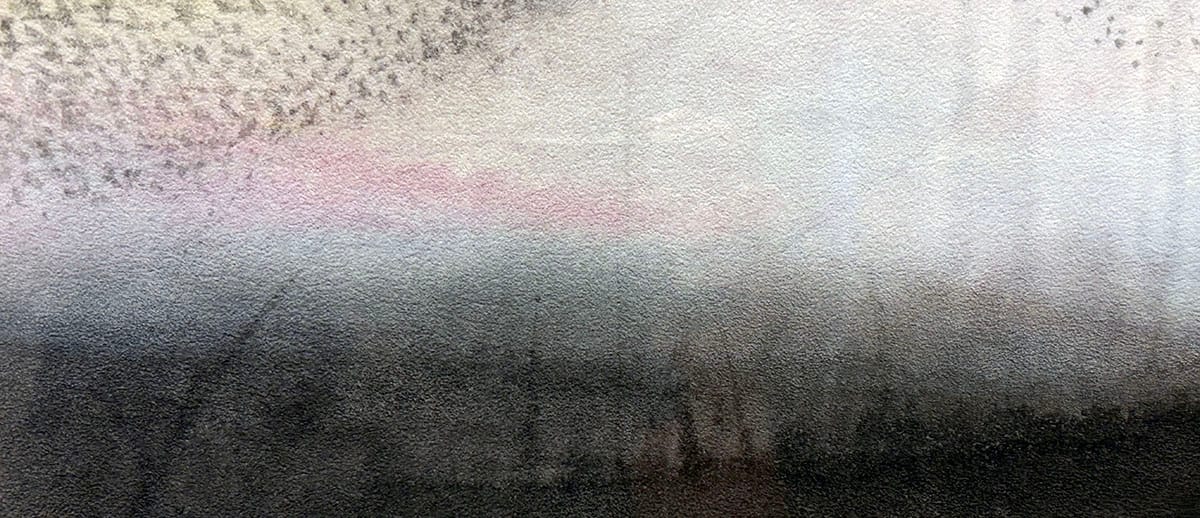
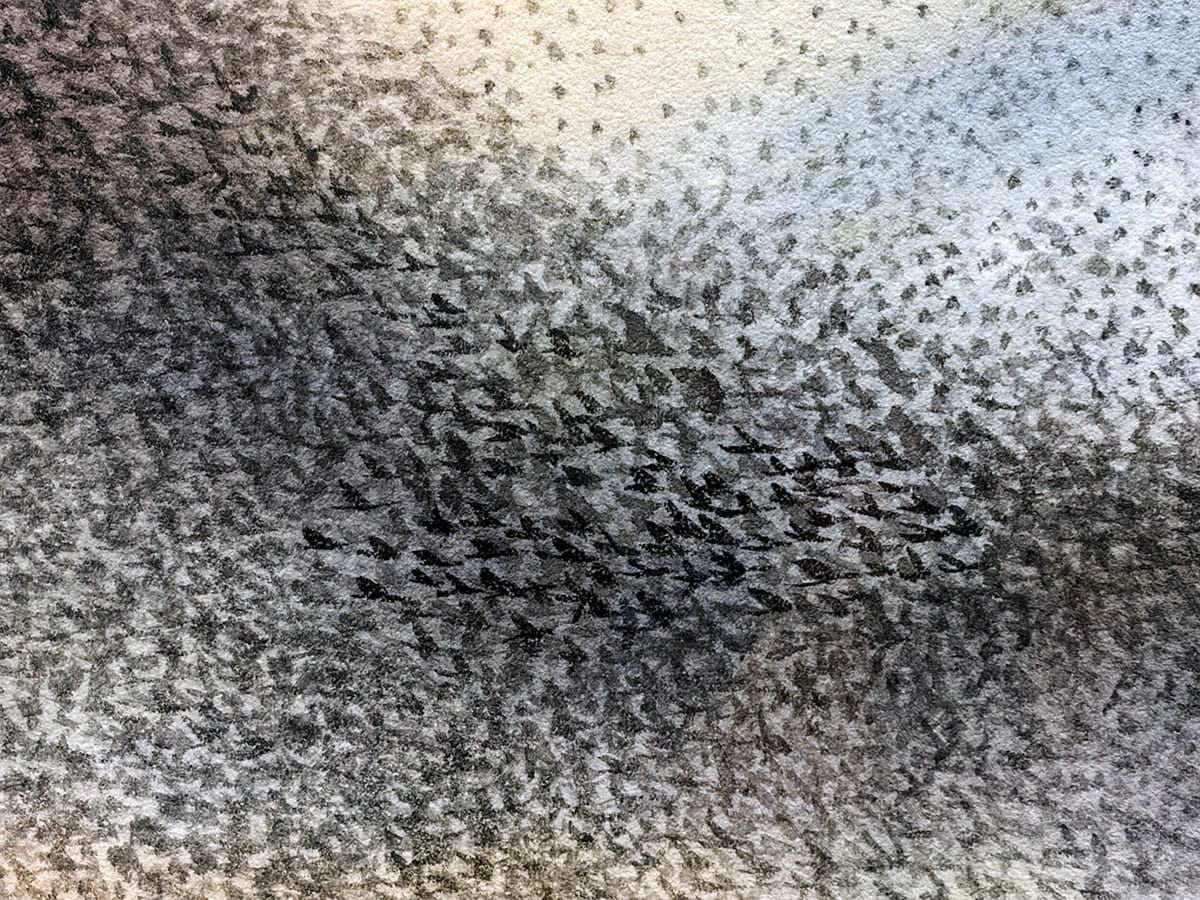
Details of “Sunset Magic.” (Abby Bayani-Heitzman/The SHOUT)
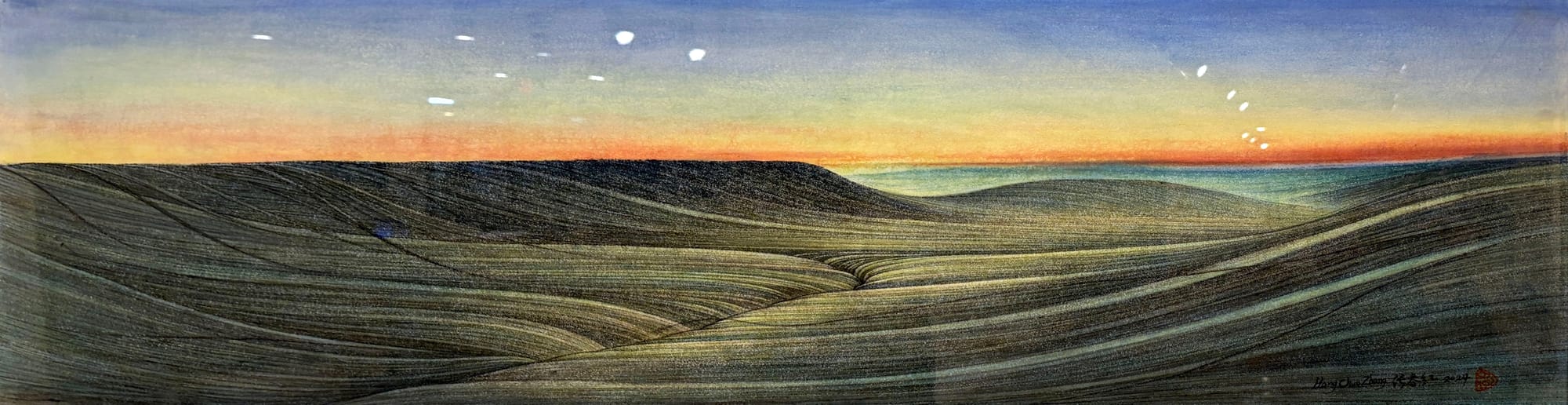
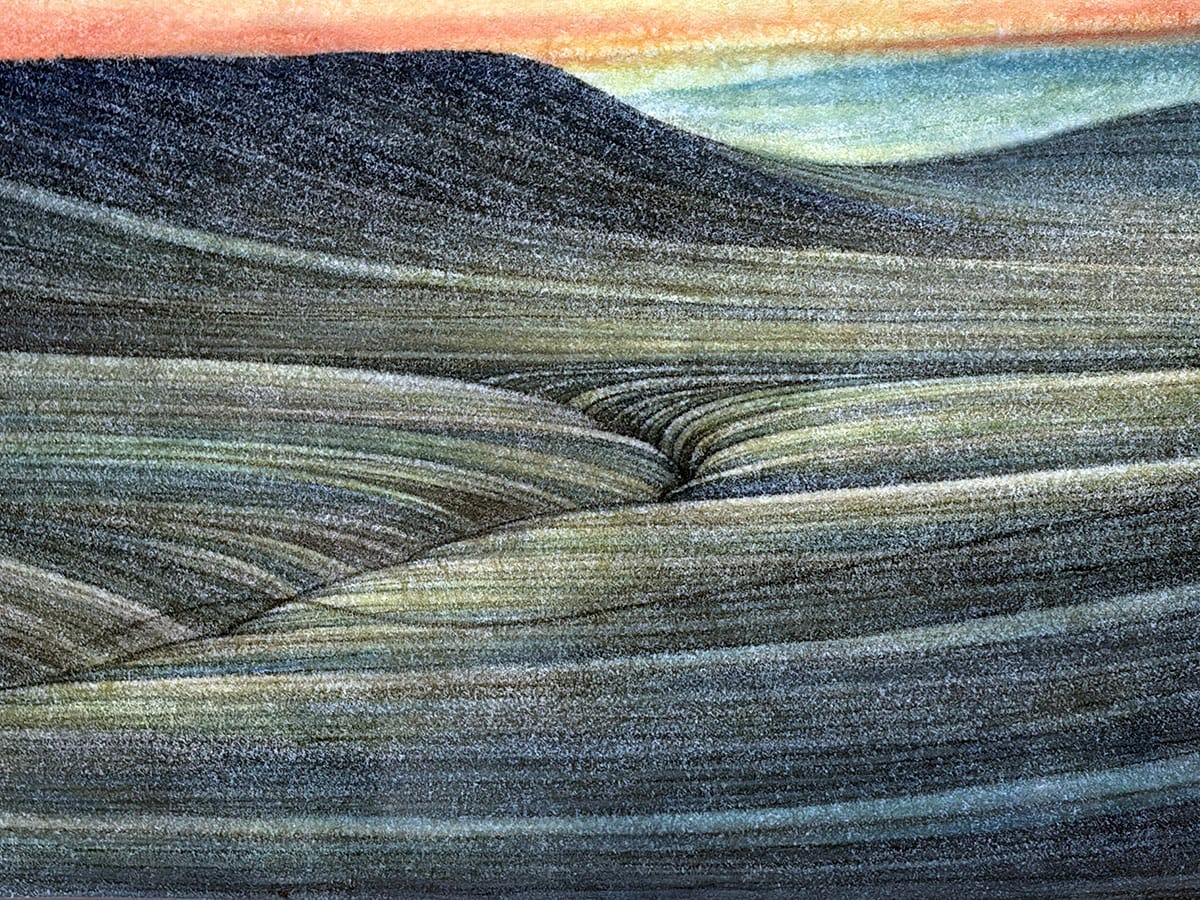
“Flint Hills Sunset” utilizes precise linework to suggest the topography and ecological diversity of the Flint Hills region, with wild prairie grasses covering the hills and hollows, bending in the wind to flow like waves. The golden glow radiating from the center of the painting casts the scene in an almost transcendental light, picturing the prairie as a land of beauty and richness. Long, curving strokes that crest the distant plateau and reach inwards from the boundaries of the painting appear as loose strands of hair creeping into the landscape from some external source. The intrusion reminds the viewer of the piece’s connection to Zhang’s larger body of work.
If viewers move through the exhibition chronologically, beginning in the South Gallery and ending in the North Gallery, one of the last works they encounter is “Prairie Burning.” The Chinese ink and watercolor painting on Italian fabric depicts a familiar scene for many Kansans: a field fire. The burn appears to be making its way leftwards, with the active flames tracing the boundary between unburned fuel ahead of the fire and the charred grass behind. Thick smoke rises and drifts towards the right side of the sky, carried by the breeze.
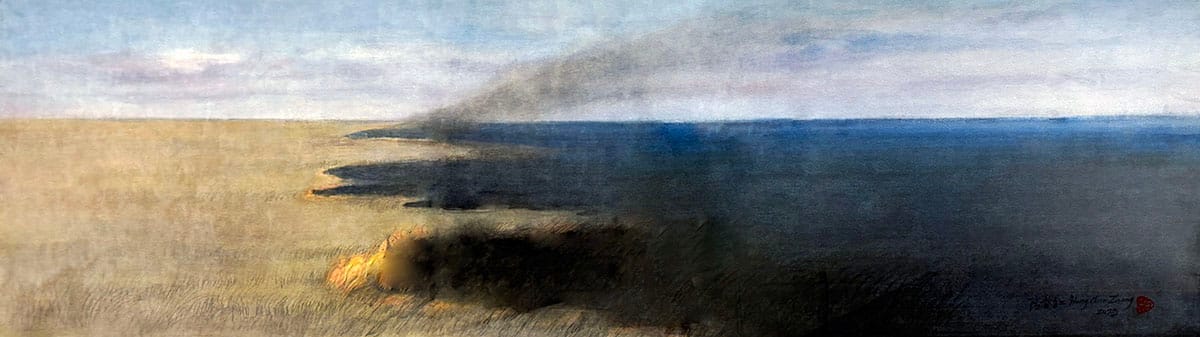
In this painting, individual stalks of prairie grasses are visible near the burn and disappear into a golden sea of grain as they recede in the distance. The short, thin strokes of waving grass, reminiscent of Zhang’s hair motif, catch fire and transform into the curling smoke rising above the field. While the burned portion of the grass occupies two-thirds of the landscape, the image is not one of death — it is an image of transformation.
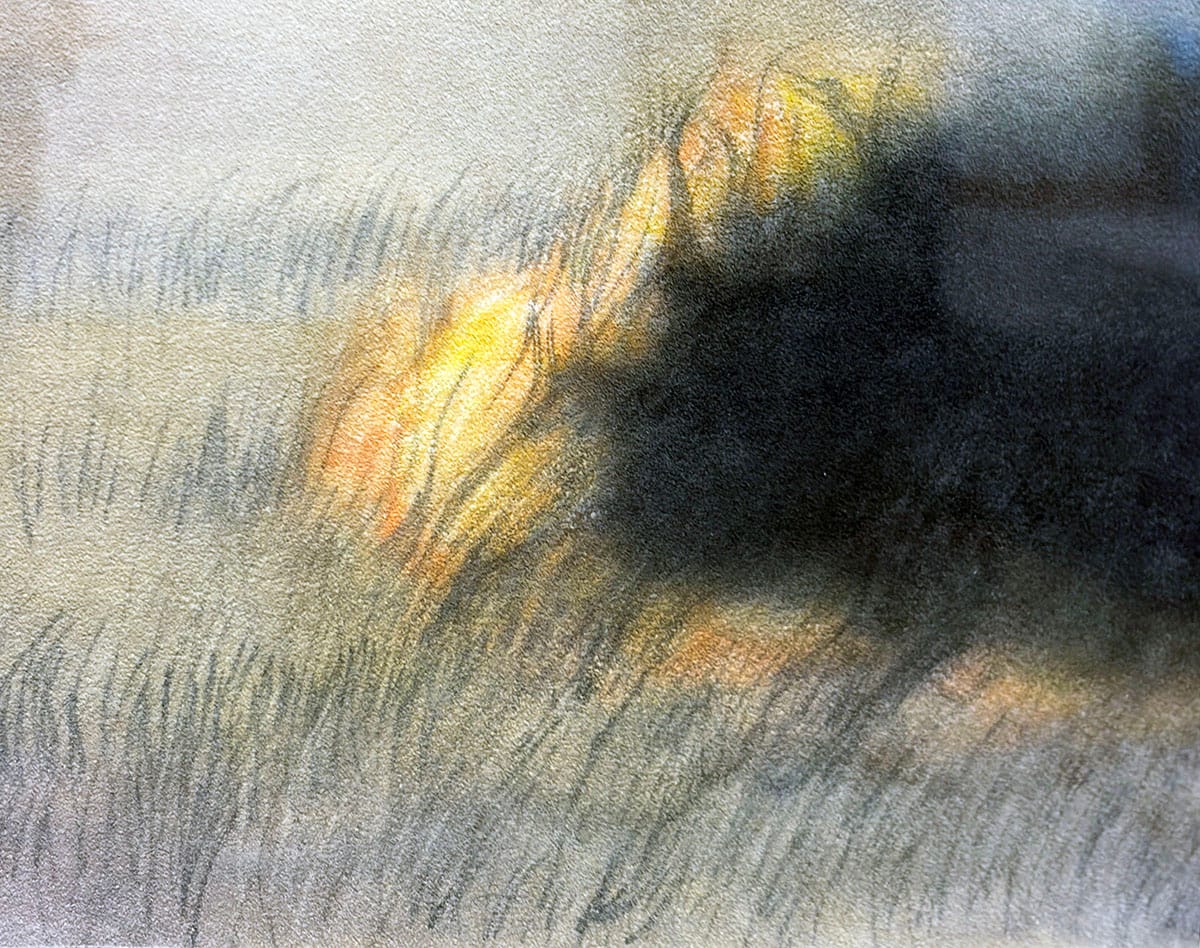
Although a still image, there is much movement evident in the work, from the spreading fire to the rising smoke. The grass burns from the right to the left, much like traditional Chinese writing is read from right to left. However, the smoke carries the burnt remnants of the grasses upwards and over the charred blackness below it, drifting past the boundaries of the painting into some unseen space.
Zhang’s body of work has likewise evolved and changed over time, moving from concerns rooted in Chinese traditions to broader examinations of gender and identity across cultures, and from family history and personal experience to shared observations of the natural world. As an artist, she has burned a powerful path forward for herself, but that path will not define the rest of her career. Rather, like the smoke in “Prairie Burning,” her continued experimentations with Chinese ink and Italian fabric are sure to find Zhang rising above the expectations set by her previous work and joyously flying into the next undiscovered frontier.
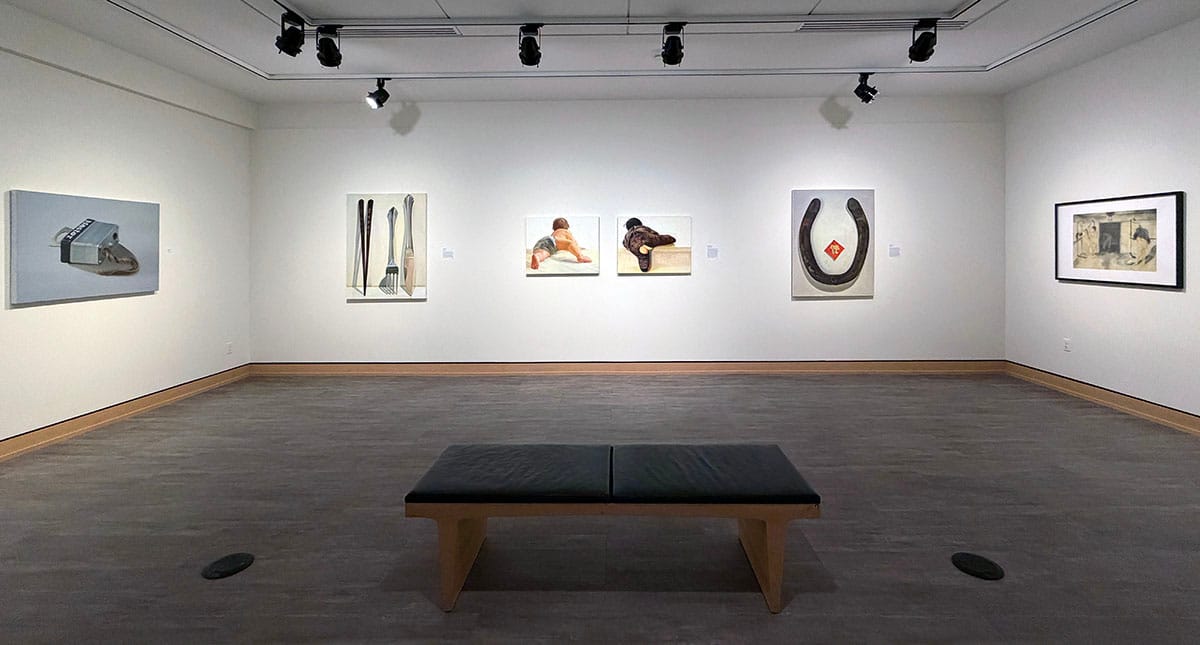
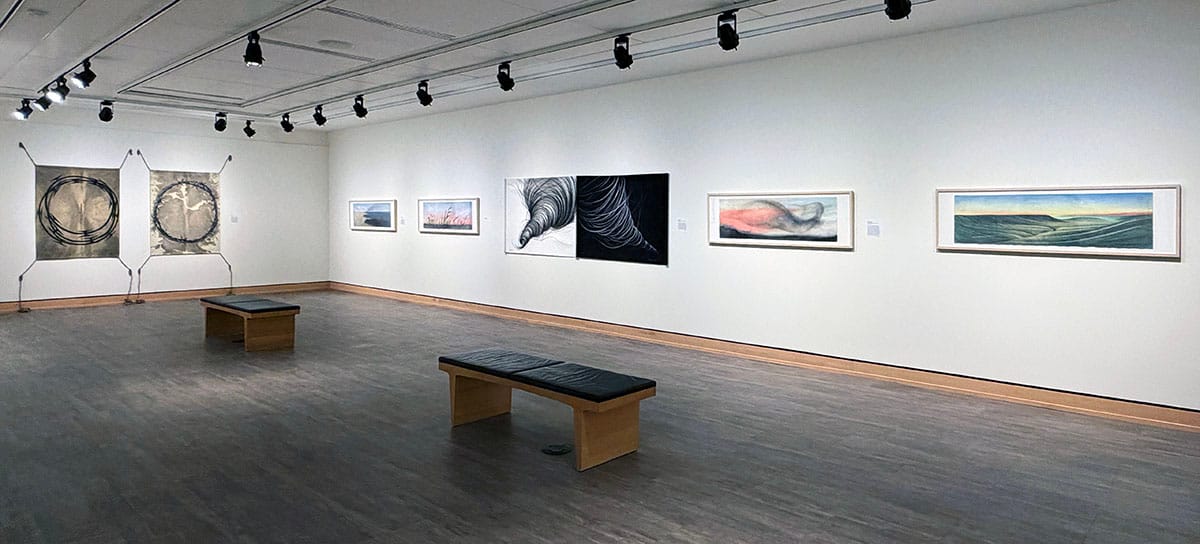
Installation views of “Journey to the West: A Survey of Hong Chun Zhang’s Art, 1996–2026” at the Mulvane Art Museum. (Abby Bayani-Heitzman/The SHOUT)
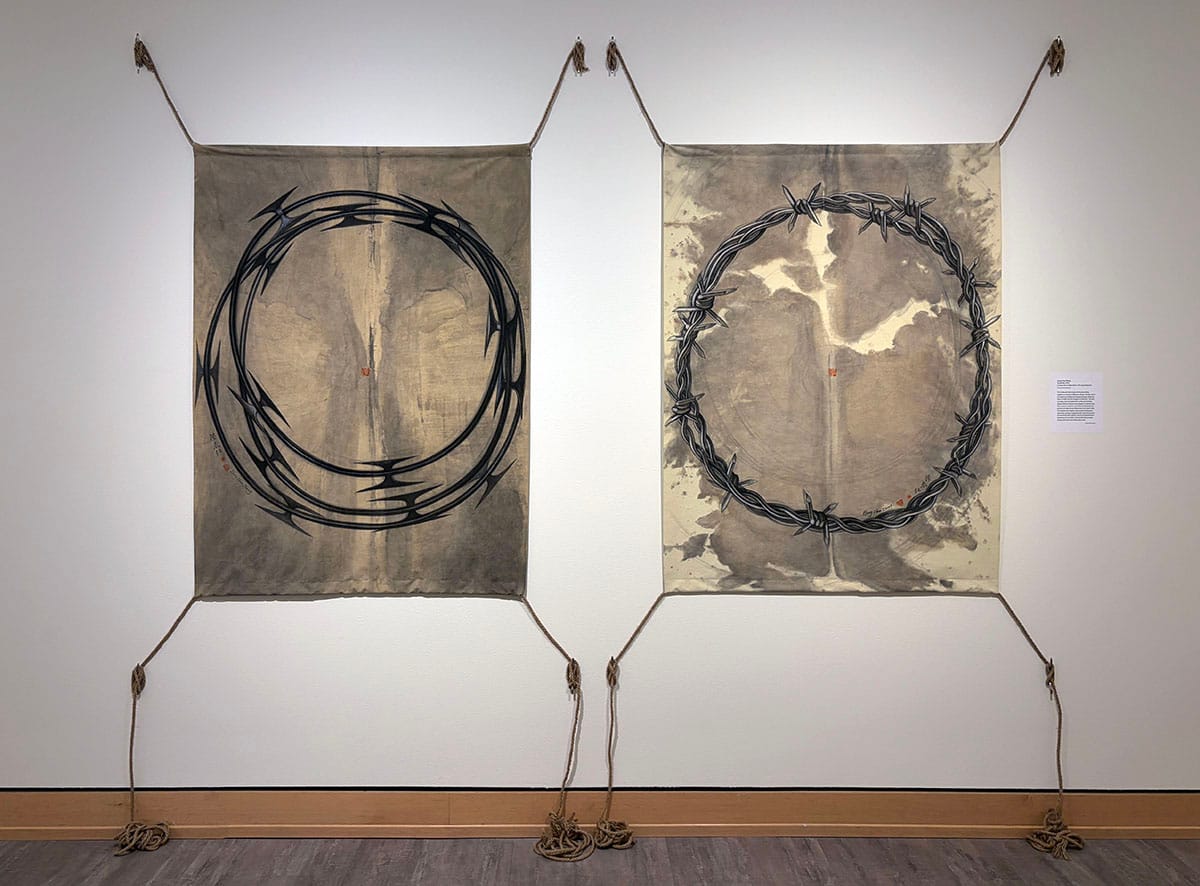
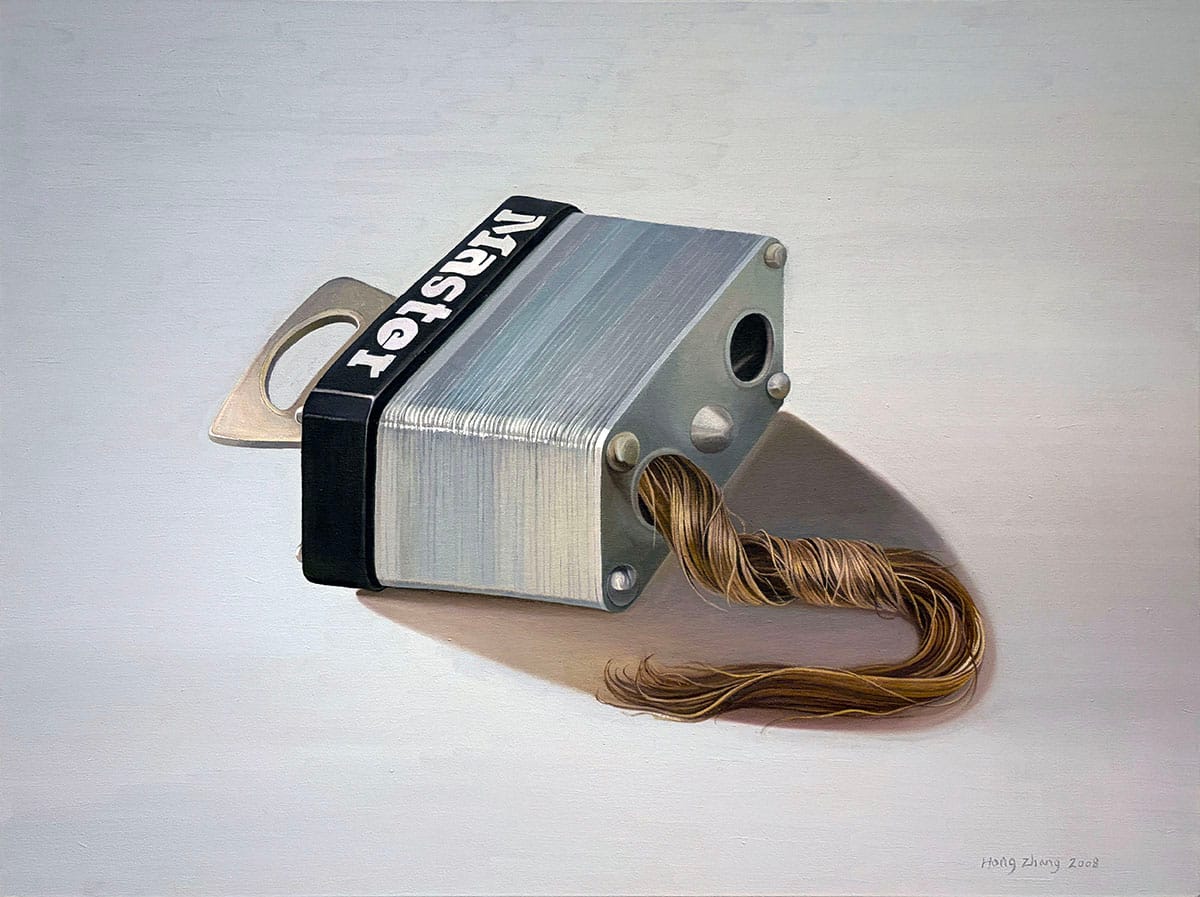
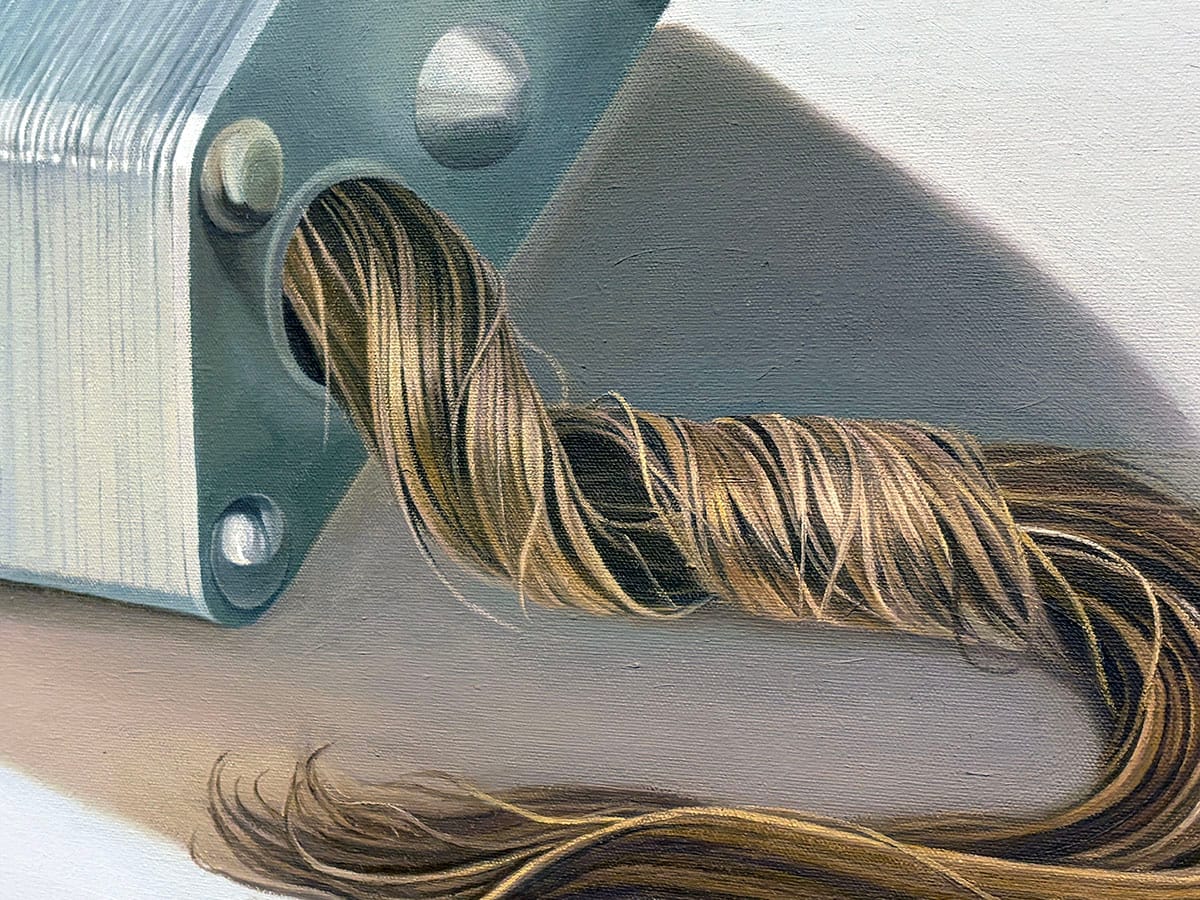
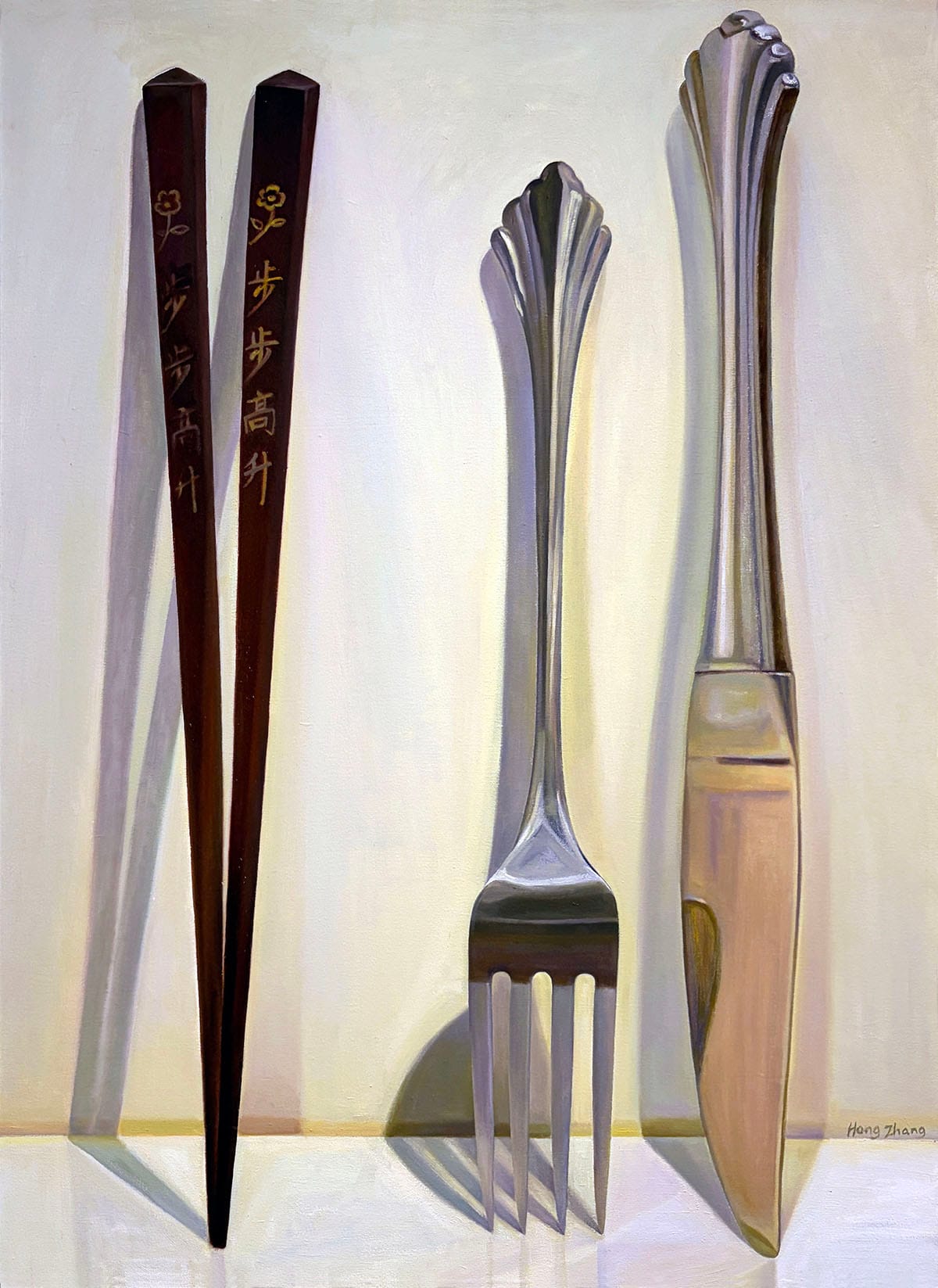
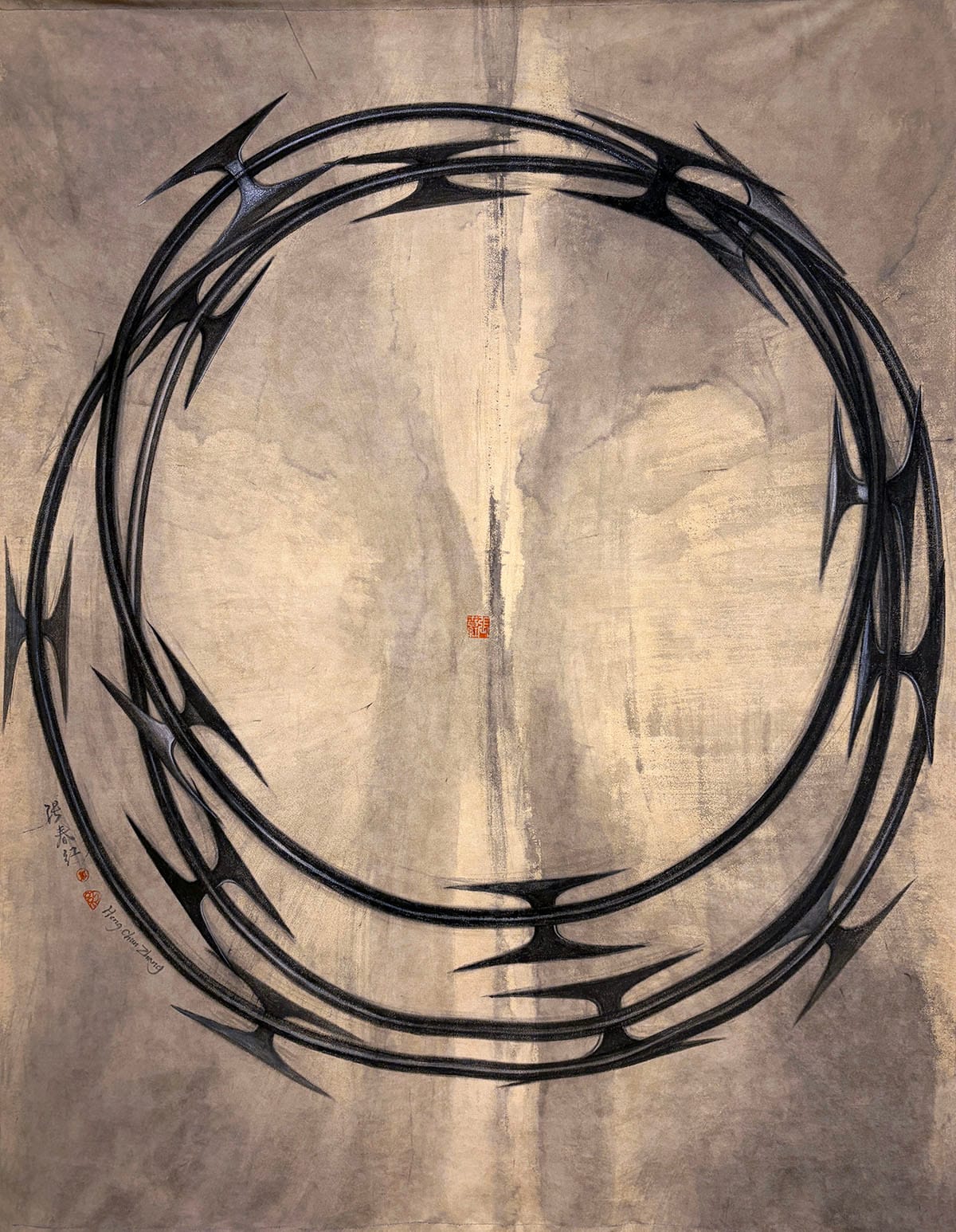
Works by Hong Chun Zhang from top left: “Round-Up,” 2025, Chinese ink on Italian fabric with ropes, each 60 by 40 inches; “Lock,” 2008, oil on canvas, 30 by 40 inches; detail of “Lock”; “Hunger,” 2003, oil on canvas, 45 by 33 inches. (Abby Bayani-Heitzman/The SHOUT)
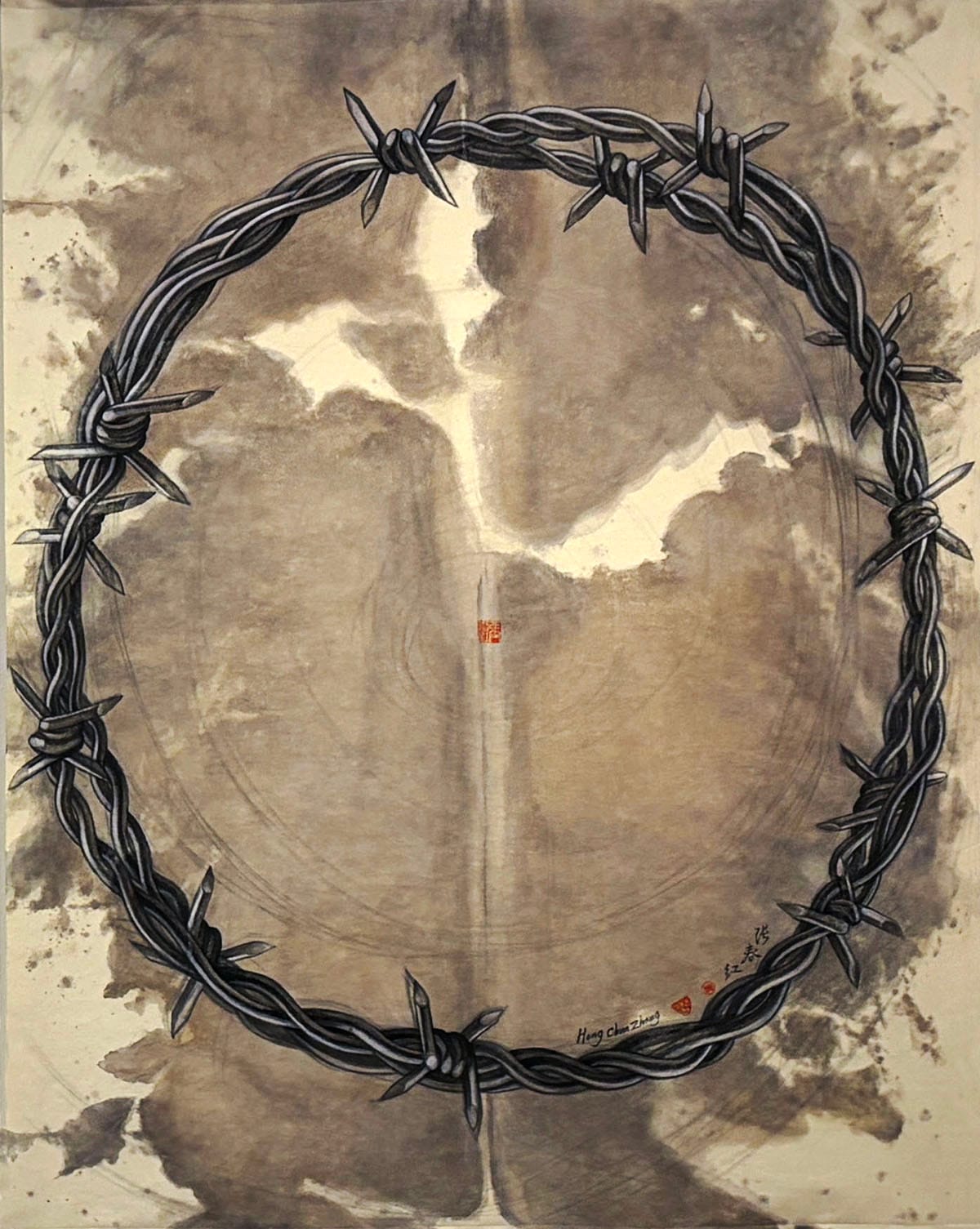
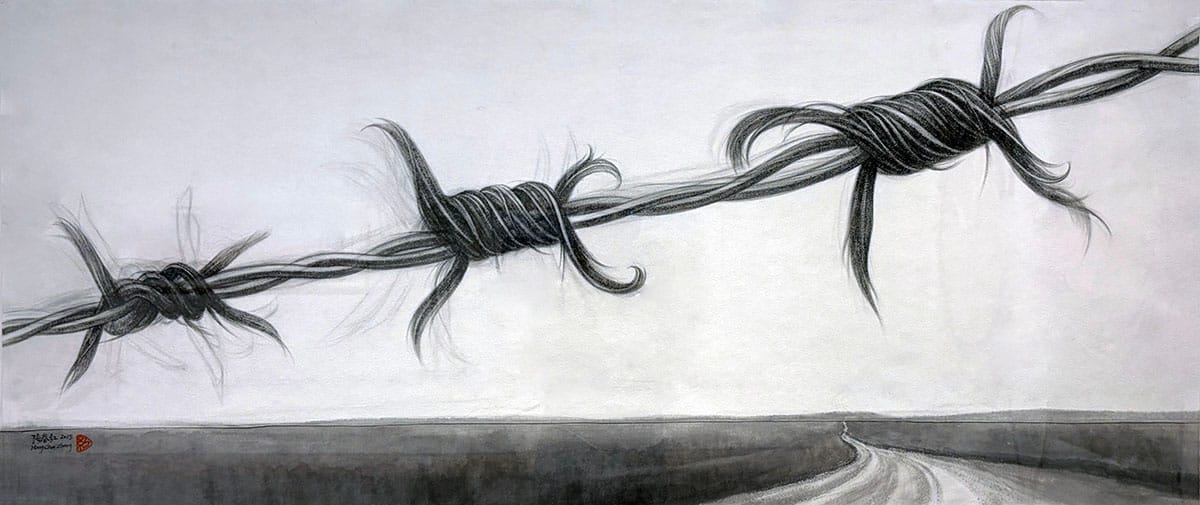
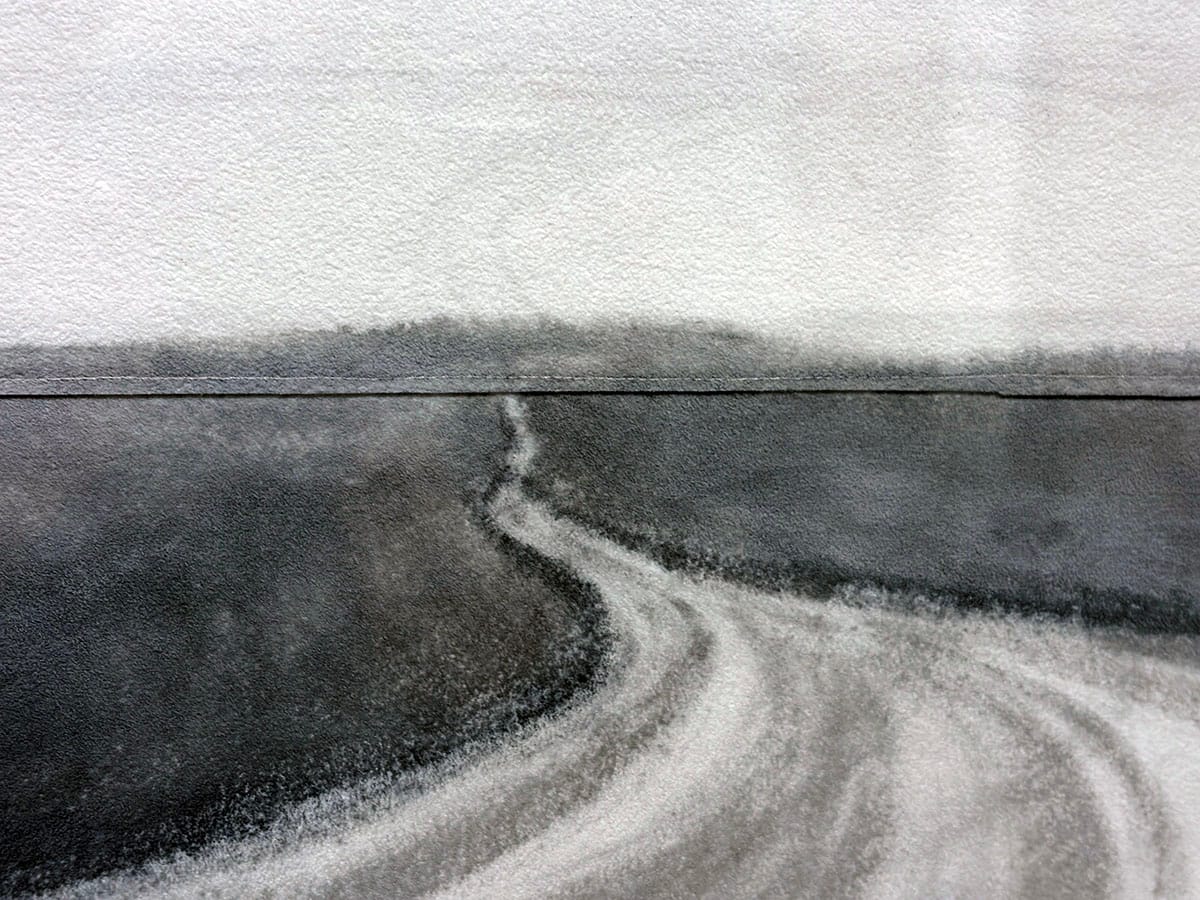
Works by Hong Chun Zhang from top left: Details of “Round-Up”; “Barbed,” 2024, Chinese ink on Italian fabric, 24 by 57.5 inches; detail of “Barbed.” (Abby Bayani-Heitzman/The SHOUT)
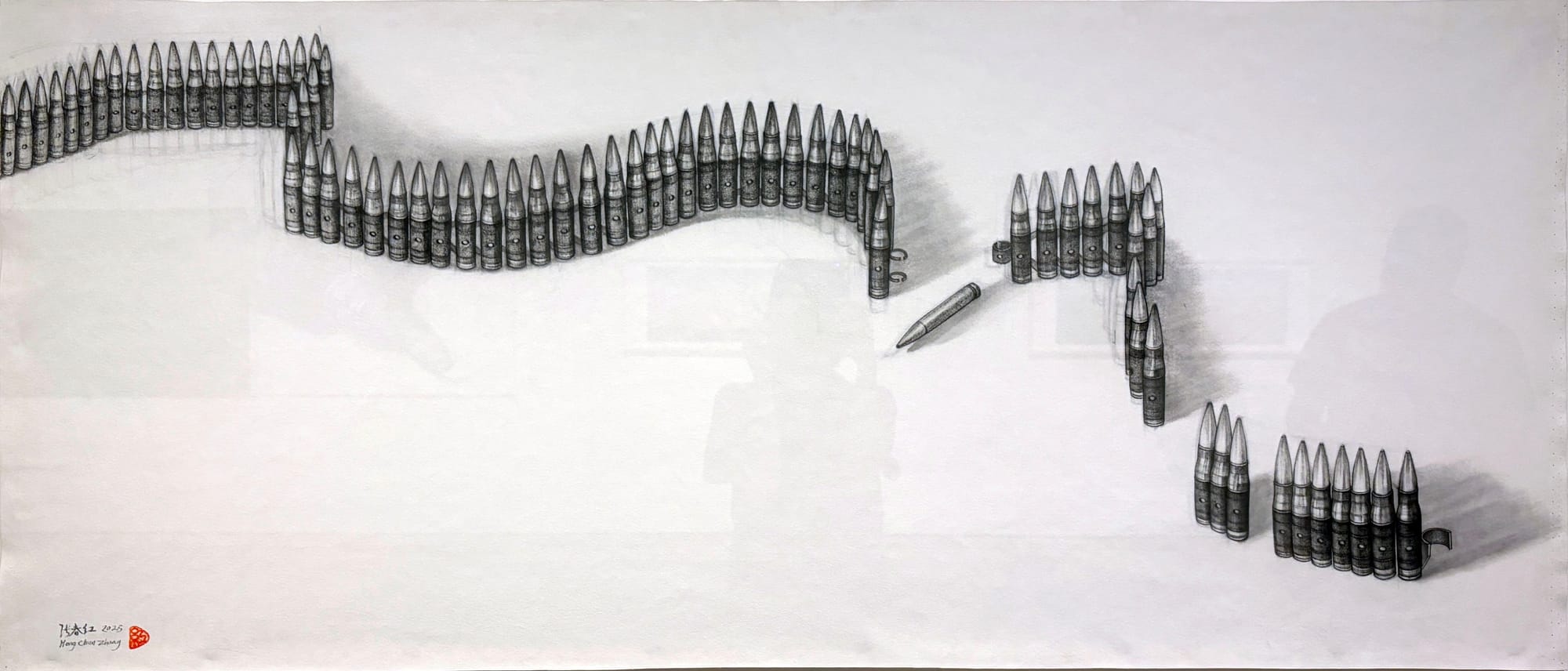
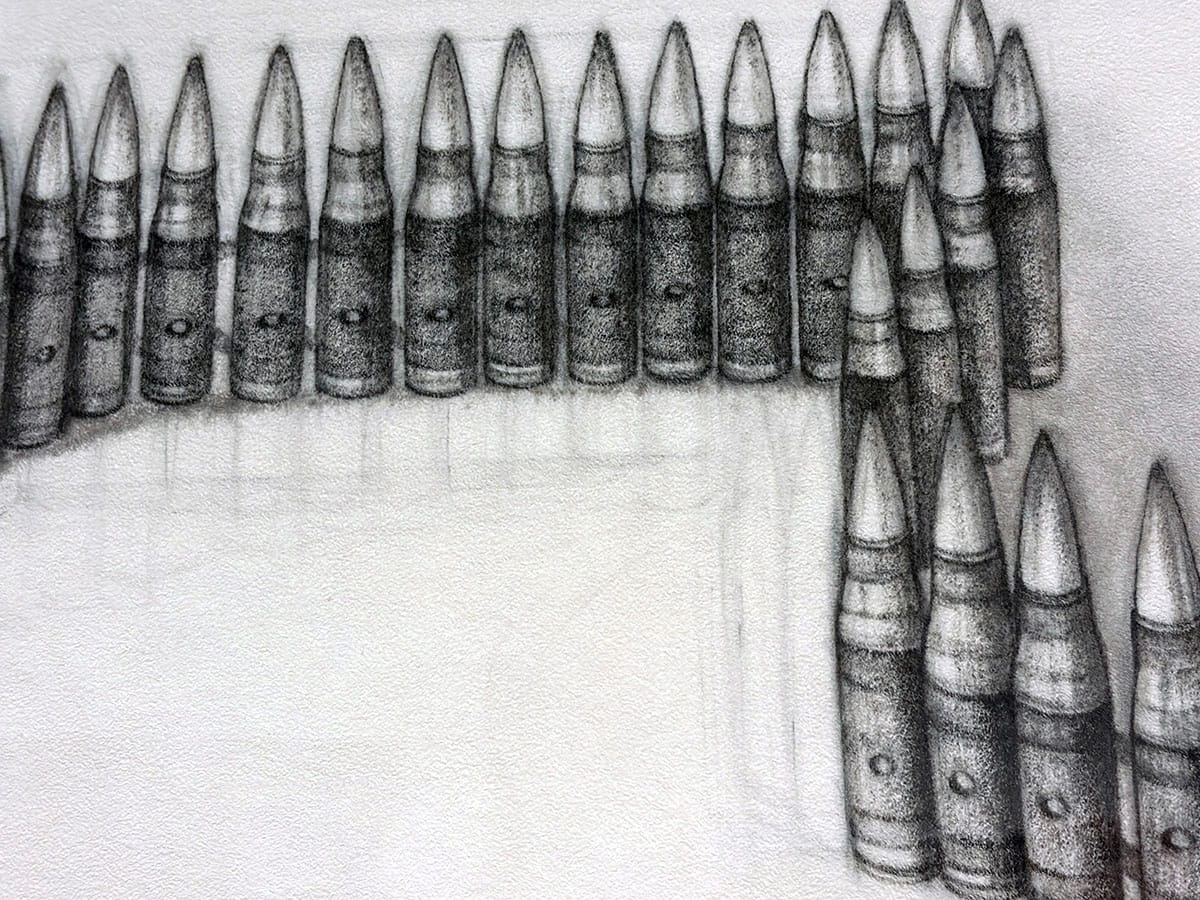
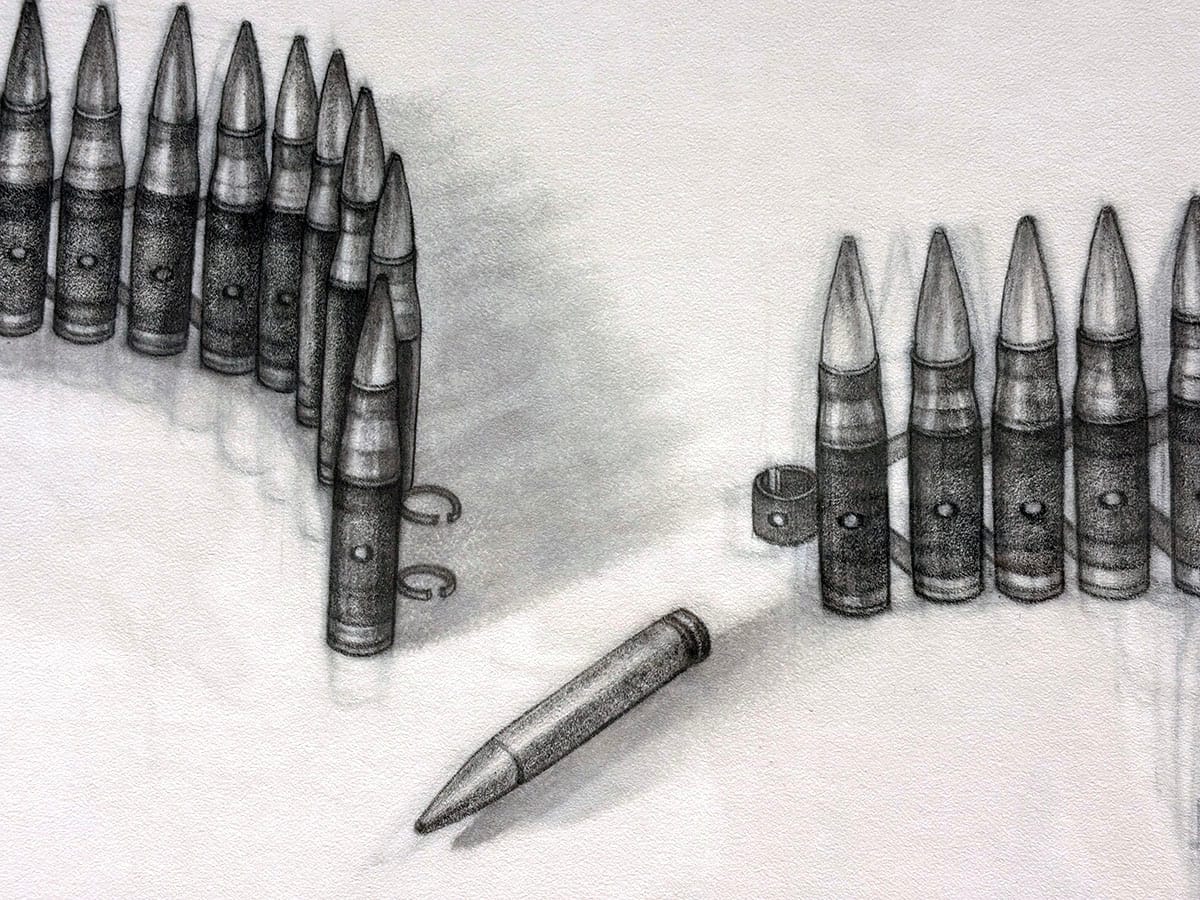
Hong Chun Zhang, “Borderline,” 2025, Chinese ink on Italian fabric; details of “Borderline.” (Abby Bayani-Heitzman/The SHOUT)
The Details
“Journey to the West: A Survey of Hong Chun Zhang’s Art, 1996-2026”
May 29-October 10, 2026, Mulvane Art Museum at Washburn University, 1700 S.W. College Ave., in Topeka, Kansas
The exhibition is located in the main level galleries. The Mulvane is open noon-7 p.m. Tuesdays, noon-5 p.m. Wednesday through Friday, and noon-4 p.m. Saturdays.
Admission is free, and the facility is accessible to people with physical disabilities.
Learn more about current and upcoming exhibitions on the Mulvane Art Museum website.
Abby Bayani-Heitzman is a Filipino American writer from Northeast Kansas. She received her Master of Arts in English from Wichita State and participated in the second cohort of the Kansas Arts Commission’s Critical Writing Initiative.
❋ Derby man has the kind of voice that turns heads — and chairs
❋ Socializing while sober: how some Wichitans are cultivating alcohol-free communities
❋ As a small creative business closes, the owner mourns
❋ Painting through it: Autumn Noire on 20 years of making art
❋ How a guy from Wichita resurrected 'Dawn of the Dead'
❋ Bygone Friends University museum housed curious collections
Support Kansas arts writing
The SHOUT is a Wichita-based independent newsroom focused on artists living and working in Kansas. We're partly supported by the generosity of our readers, and every dollar we receive goes directly into the pocket of a contributing writer, editor, or photographer. Click here to support our work with a tax-deductible donation.