
With Juniper Arts, vulnerable kids get to be kids again
A Wichita nonprofit provides art and music classes to children in foster care and juvenile detention.
Editor's Note: SHOUT contributor Stefania Lugli wrote the following story for The Journal, a publication of the Kansas Leadership Center. It is republished here with permission.
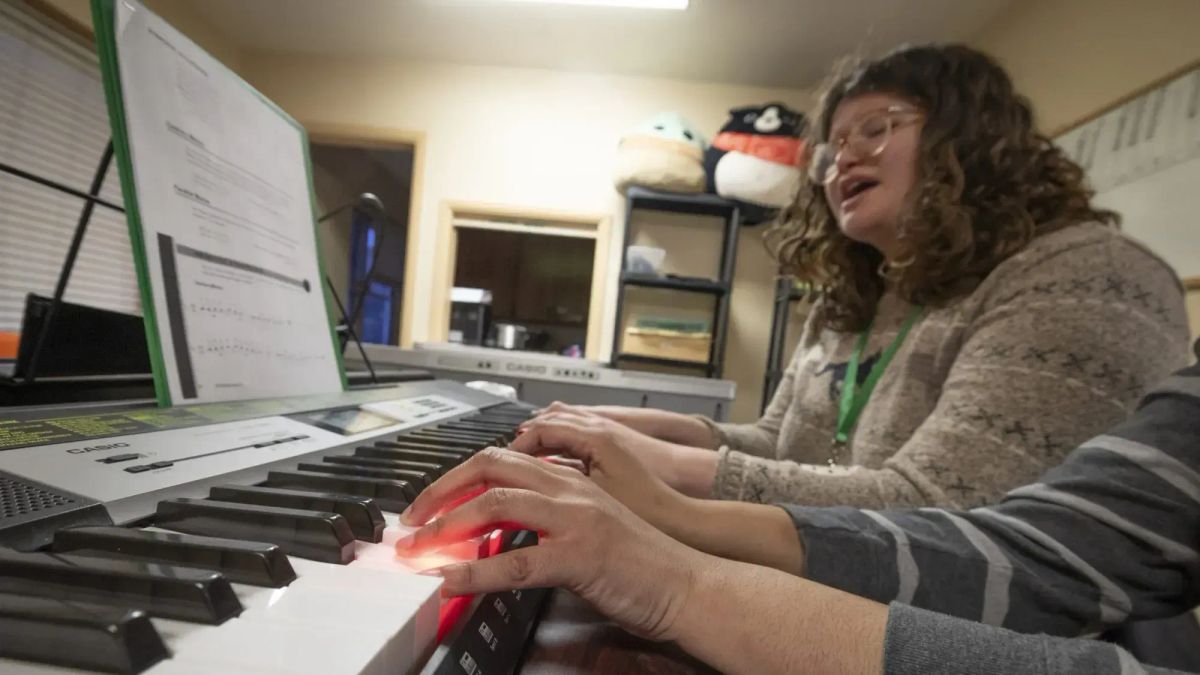
A dozen teenage girls work delicately with bright strands of yarn, weaving in and out of a handheld loom under the watchful eyes of volunteers. In a different space, on another night, kids press keys — some hesitantly, others vigorously — on separate pianos, filling the room with melodies that sonically clash but play in unison.
These kids, ranging from ages 10 to 18, are from foster care homes, juvenile detention and other youth residential facilities — places and situations where they can be in constant survival mode.
Even if kids are safer in custody, the disconnect from their families and stable placement traumatizes them. It can rob their brains of the foundation they need to develop. The foster care to homelessness or prison pipeline is “pretty slick,” as Lisa Paine describes it.
Paine, the founder and executive director of Juniper Arts Academy, established her program in Sedgwick County after interviews with youth residential and juvenile detention officials emphasized the gap experienced by kids in such situations: a lack of space to just be a kid.
“There were a lot of places helping youth build job skills, life prep and learn about healthy relationships. The things I found missing were traditional childhood development spaces,” she said. “The kids weren’t playing sports or able to be in piano lessons. They weren’t able to be in school choirs or participate in a whole year of a theater program because they’re being bounced around so much.”
Juniper Arts Academy is arts and music education with trauma-informed processes, using social-emotional tools for children in need of the reprieve. Paine, with a background in the arts, nonprofit and education, started the academy in 2021 to bring the art to the kids’ doorstep.
Its method goes beyond providing supplies and supervision. Each instructor and volunteer is trained in Trust-Based Relational Intervention, an evidence-based approach to support traumatized youth.
“Trauma can actually stunt childhood development up to half their age. So I could be working with a 16 year old, and developmentally they could be 8 but have the street smarts of a 30 year old,” Paine said. “Their brain has not been in a space where they felt safe to grow, so giving them these traditional childhood experiences in a space that is trauma-informed allows them to do some of that catch-up work.”

That catch-up work can be out of reach for some. Art and music education is expensive and youth residential facilities often lack the resources to meet more than a child’s basic needs: food, shelter and safety. Juniper Arts works with various agencies in the Wichita arfea, such as EmberHope, the Wichita Children’s Home and Youth Horizons. Juniper Arts sends instructors and volunteers weekly to teach art and music to resident children, aiming to reignite their spirits and trust in adults.
“Their brains are just on high alert. They get stuck in that survival mode and sometimes their reactions don’t seem to match the situation they’re in. That happens sometimes, where people are like ‘Whoa, it’s not a big deal dude. I was just correcting how you’re playing the chord,’” Paine said. “But if we don’t understand that maybe the last time that kid received a correction, they were abused … their brain is going into protect mode.”
Studies show that art and music naturally calms the body. Children that have arts as an outlet can strengthen their autonomy and self-esteem, helping them deal with trauma and address emotional behaviors. The therapeutic nature of art and music frees kids from day-to-day constraints, releasing stress and encouraging healing.
ShaQiyla Banks, a senior independent living trainer for the Sedgwick County Juvenile Detention and Residential Facility, said that Juniper Arts is a gift for the kids. The programming shows them different ways to cope or find a neutral state.
“Sometimes they’re dealing with strong emotions, and they don’t do well with those strong emotions. Being able to learn different techniques, whether it’s through music or art, just really plays a significant role here at our detention facility,” she said.
Banks said there is often resistance to the classes from newbies who usually find the idea corny. But they are quickly won over.
“They’re like, ‘Oh we’re about to listen to or play a ukulele.’ But they’ve never even been exposed to a ukulele,” she said. “That’s the thing about exposure. Once you’re exposed, you can’t be unexposed, right? Now it’s, ‘I actually do like this.’ They’re learning and they’re able to share with their friends and family and spread the information to other people. It’s kind of a chain effect.”

Mandy Powell, the school liaison and activities coordinator for EmberHope’s Newton campus, said her kids often roll their eyes at the concept prior to taking the classes. Time and time again, though, she is in awe of the transformation kids go through, particularly those with disruptive behaviors.
A lot of children in foster care struggle to build positive, lasting relationships and don’t know how to regulate their emotions. Juniper Arts, Powell said, pierces their armor and shows kids their potential. She reflected on one student who was particularly rowdy.
“Very, very disruptive. Really angry, cussing everyone out. So we got her to Juniper. I’ll tell you, those people are saints. Lisa is amazing. I don’t know how she got through to this kid, but she went from running off and being disruptive to helping Lisa run the group,” Powell said.
Leaning into creativity brings kids to a spot where their bodies can feel at ease and they can connect to those around them. Their brain can stop its fight-flight-freeze circuit and instead activate to absorb new information and build relationships.

Working with clay — literally using your hands to push and pull material — forces tension out of the body, Paine said. The vibrations from bucket drumming distract from other internal frictions. Choir encourages kids to work together to create one, united song.
“It’s very interesting to watch the bodies of the youth relax. What’s happening scientifically is that their heartbeats literally start aligning with the people in the room,” she said. “With choir, it’s because you’re breathing together. You’re going to inhale at the same time, you’re going to exhale at the same time.”
The Juniper Arts instructors and volunteers ask about each child’s nicknames and pronouns before they meet for the first time and burst through the doors with tons of positive energy. They are quick to celebrate every child, for any reason.
“Our kids, for some of them, this is probably the most well-behaved they are in the day. The kids know what to expect and know the routine. They have the ability to be themselves,” Powell, with EmberHope, said. “They can walk in the door in this awful mood and when they walk out at the end of the group they’re in a better headspace. Seeing the way my kids react to them and all the good things that come out of it, I really wish all foster kids had that.”
Children in foster care and the justice system need advocates like Paine and her network of teachers within Juniper Arts to remind them of their youth and malleability. Juniper Arts is a safe space for them to be more than their trauma. For example, Paine is not allowed to know why a child is incarcerated, a barrier she is thankful for.
“‘Each of us is more than the worst thing we’ve ever done,’” she said, quoting Bryan Stevenson, who wrote Just Mercy. “Not getting to know about what these kids have done allows me to meet the whole child.
“They need people who they know believe in them and are gonna raise up that good part. That’s just as strong, they just need to know how to use it.”
Stefania Lugli is a reporter for The Journal, published by the Kansas Leadership Center. She focuses on covering issues related to homelessness in Wichita and across Kansas. Her honors include being a national finalist for a Nonprofit News Award in investigative reporting last year and a two-time fellow with the Solutions Journalism Network. The Kansas Press Association also recently named her one of 2025's journalists of the year.
❋ Derby man has the kind of voice that turns heads — and chairs
❋ Socializing while sober: how some Wichitans are cultivating alcohol-free communities
❋ As a small creative business closes, the owner mourns
❋ Painting through it: Autumn Noire on 20 years of making art
❋ How a guy from Wichita resurrected 'Dawn of the Dead'
❋ Bygone Friends University museum housed curious collections
Support Kansas arts writing
The SHOUT is a Wichita-based independent newsroom focused on artists living and working in Kansas. We're partly supported by the generosity of our readers, and every dollar we receive goes directly into the pocket of a contributing writer, editor, or photographer. Click here to support our work with a tax-deductible donation.