Painter Jason Needham finds depth, nuance in foliage
In a solo show at Reuben Saunders Gallery, Needham utilizes vibrant hues to acknowledge the quiet comfort and abundance of nature.
Recently, a friend mentioned that a tree’s roots go as deep into the earth as the tree itself is tall. I think about that bit of trivia every single day — about the abundance of nature, above us and below us. Jason Needham’s “Borderland: New Landscape Paintings” exhibition, on view at Reuben Saunders Gallery through May 30, explores that bounty.
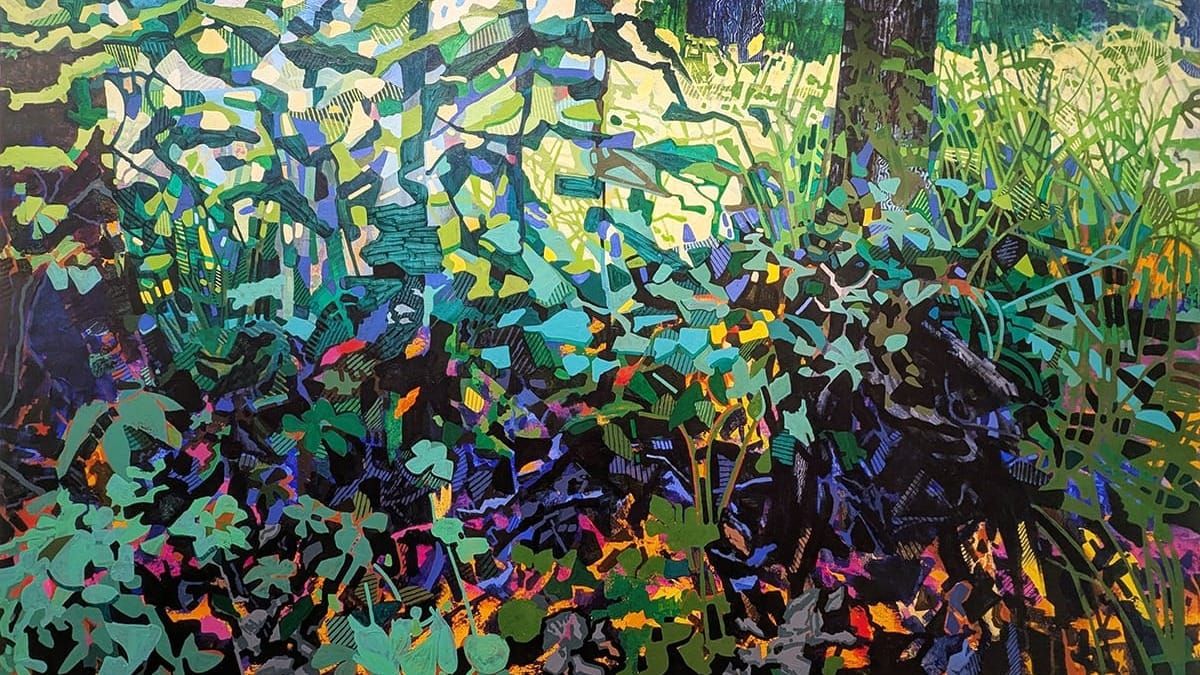
In the title piece “Borderland,” Needham depicts fallen branches and bark as they intermingle with the vibrancy of the forest undergrowth. The pale tans and soft browns form rigid, linear breaks in the otherwise lush greens, yellows, and cobalt blues of the organic shapes sprinkling the space around tree trunks.
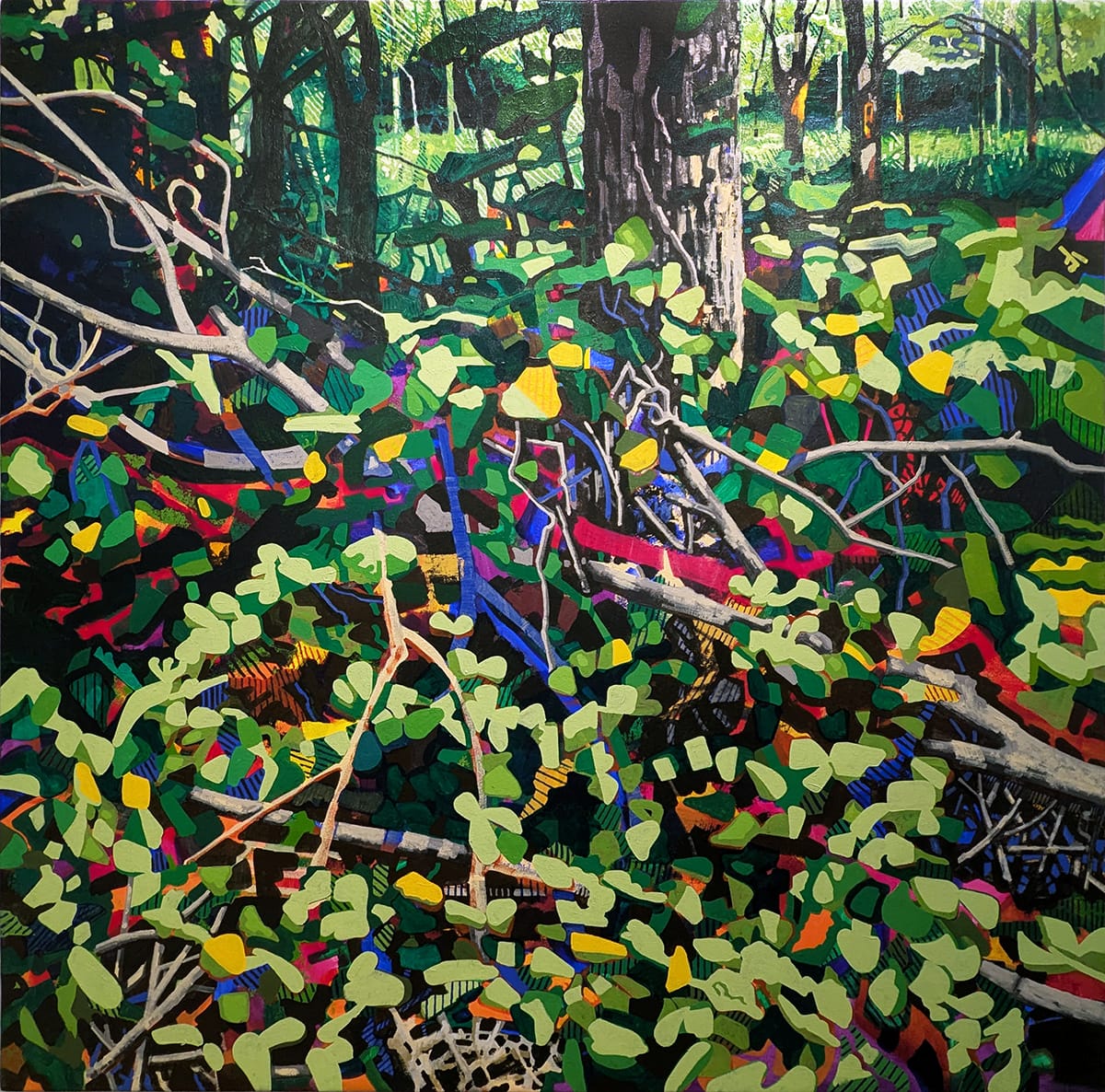
This linear break slices the composition diagonally, from top left to bottom right. The effect is one of separating the intimate richness of the foreground and more unbending, upright nature of the background. The cool-colored bark is a stark contrast that highlights not only the hues of the undergrowth, but also the layered colorblocking and blotching of other shapes. Deep in the foliage are even smaller line breaks — shadows, perhaps — that reinforce this difference. They play off the various greens, from lime, to kelly, to forest.
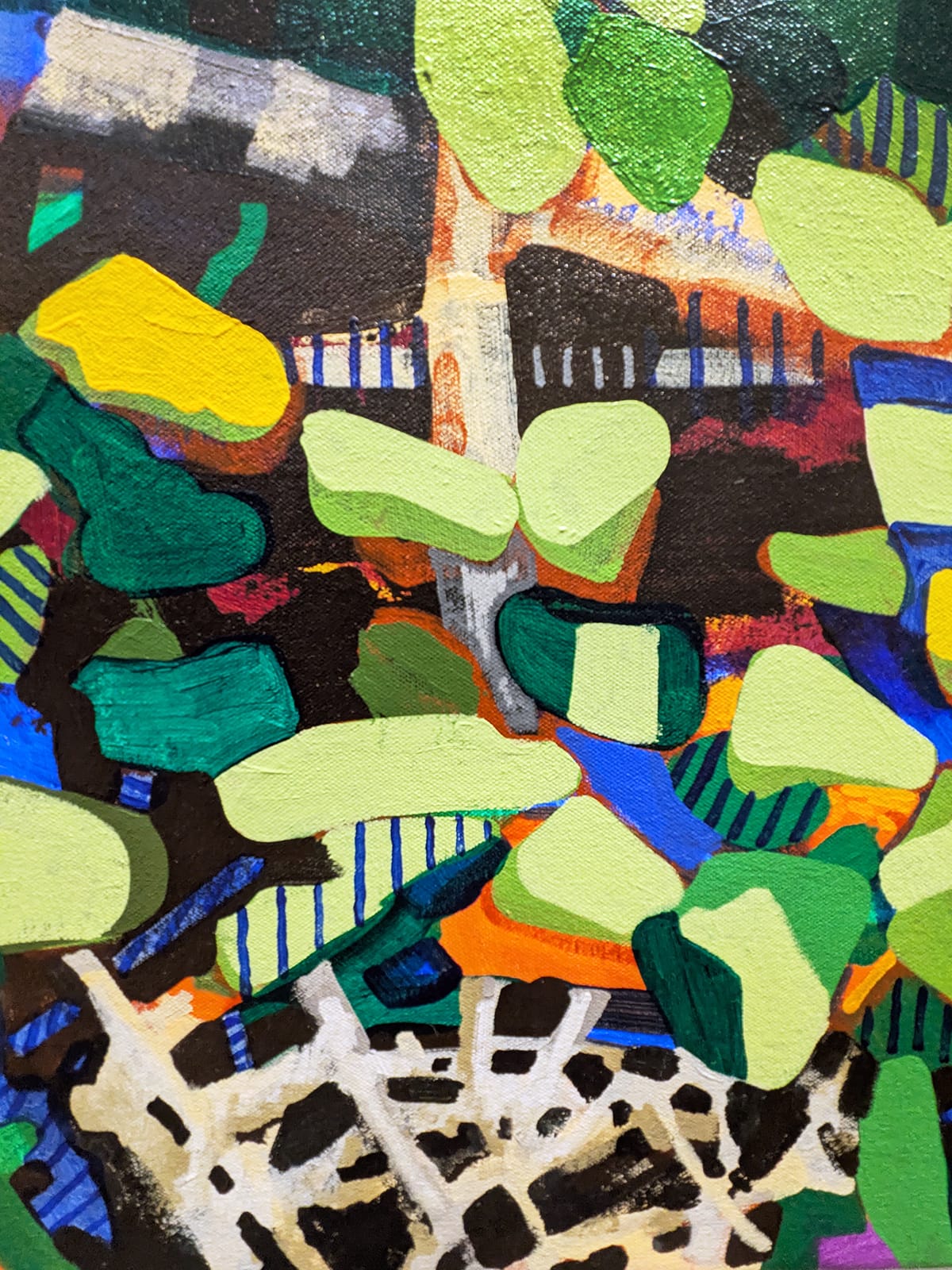
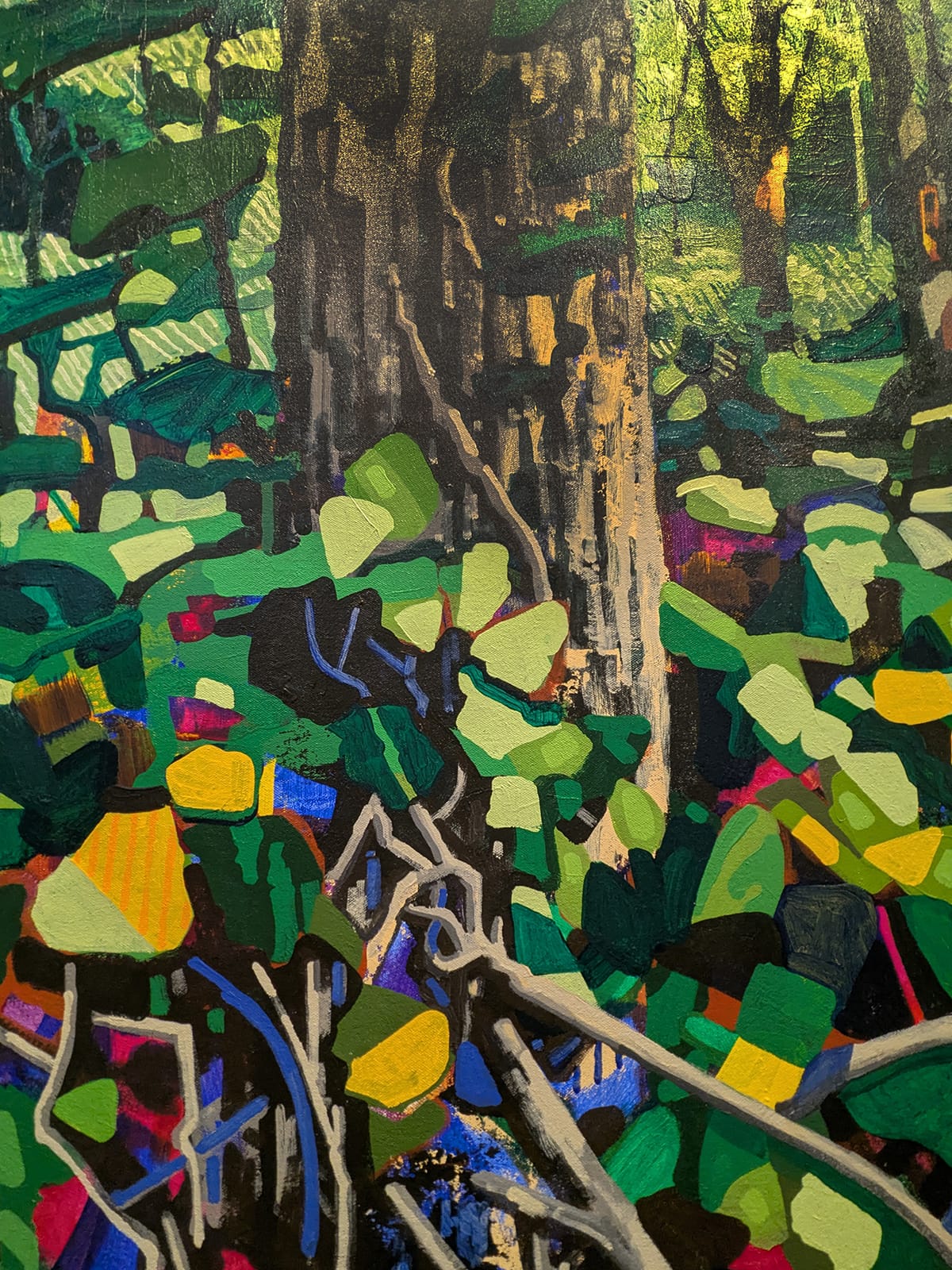
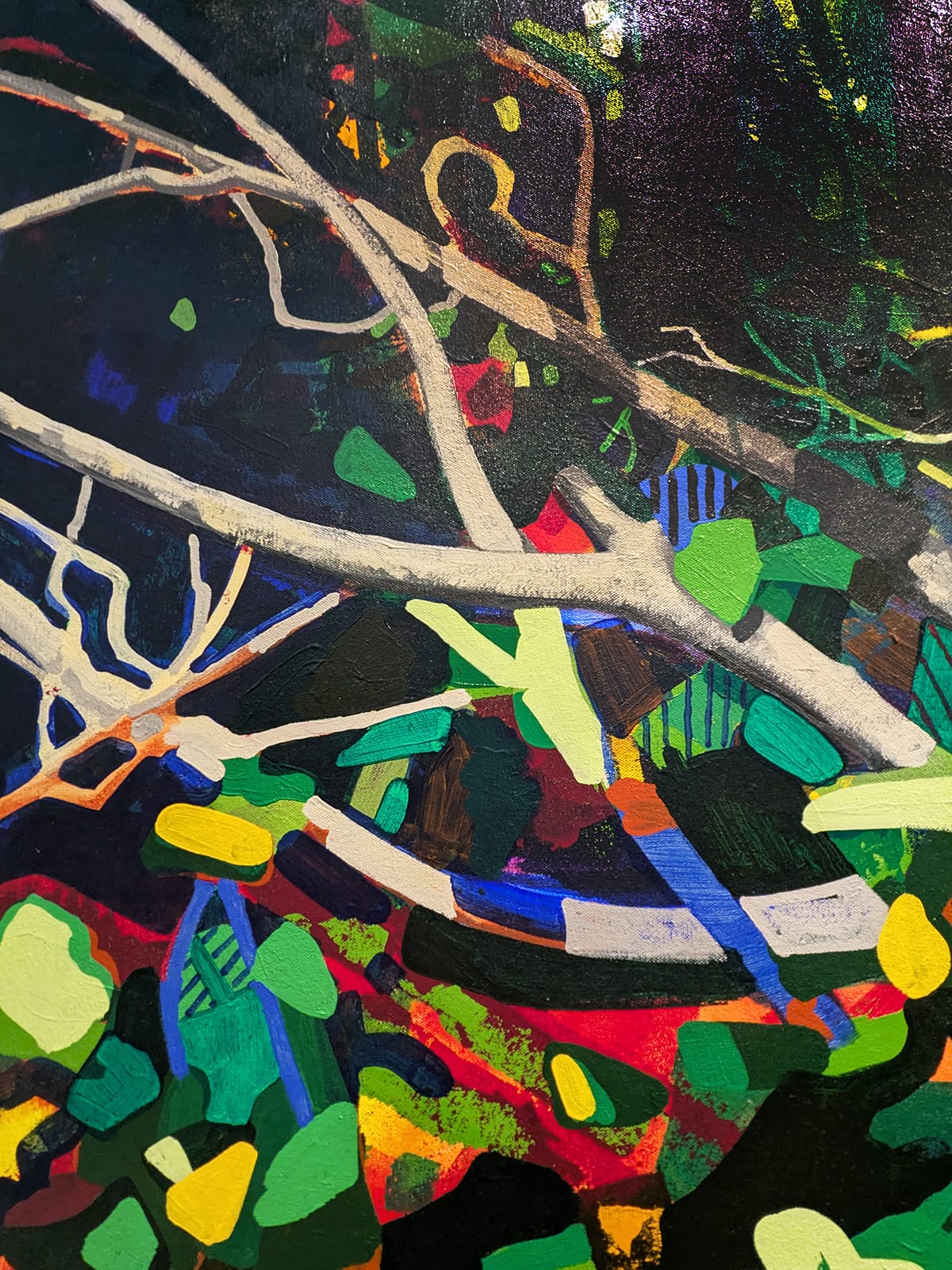
Detail views of Jason Needham’s “Borderland,” acrylic on canvas, 60 by 60 inches. Photo by Shelly Walston for The SHOUT.
While viewing this work (and others by Needham), I found myself wanting to reach out and touch the lines, to trace the texture of bark. Indeed, Needham uses different brushstroke techniques for the bark in each of his paintings. Some bark he creates through layering large swathes of color, black on top of orange on top of yellow; some he portrays as a pulling away of color through imperfect lines, as if he ran his finger along the slowly drying blues to create texture through absence; and some bark — like that in “Borderland” — he renders through cool, single-color, opaque brushstrokes.
The ways Needham represents bark vary throughout the show, but the color palette remains consistent, creating a throughline, a general envelopment, in the eight pieces on view.
While “Borderland” features the interplay of tree, bark, and ground cover, “Wild Morning” imagines a curtain of growth pushing up from the ground. Needham is a master of layering color, and his aplomb is on display in this 48-by-36-inch canvas. Oranges cover cobalt; forest greens layer atop softer blue hues; and, in the far depths of the painting, pink and fuchsia pop.
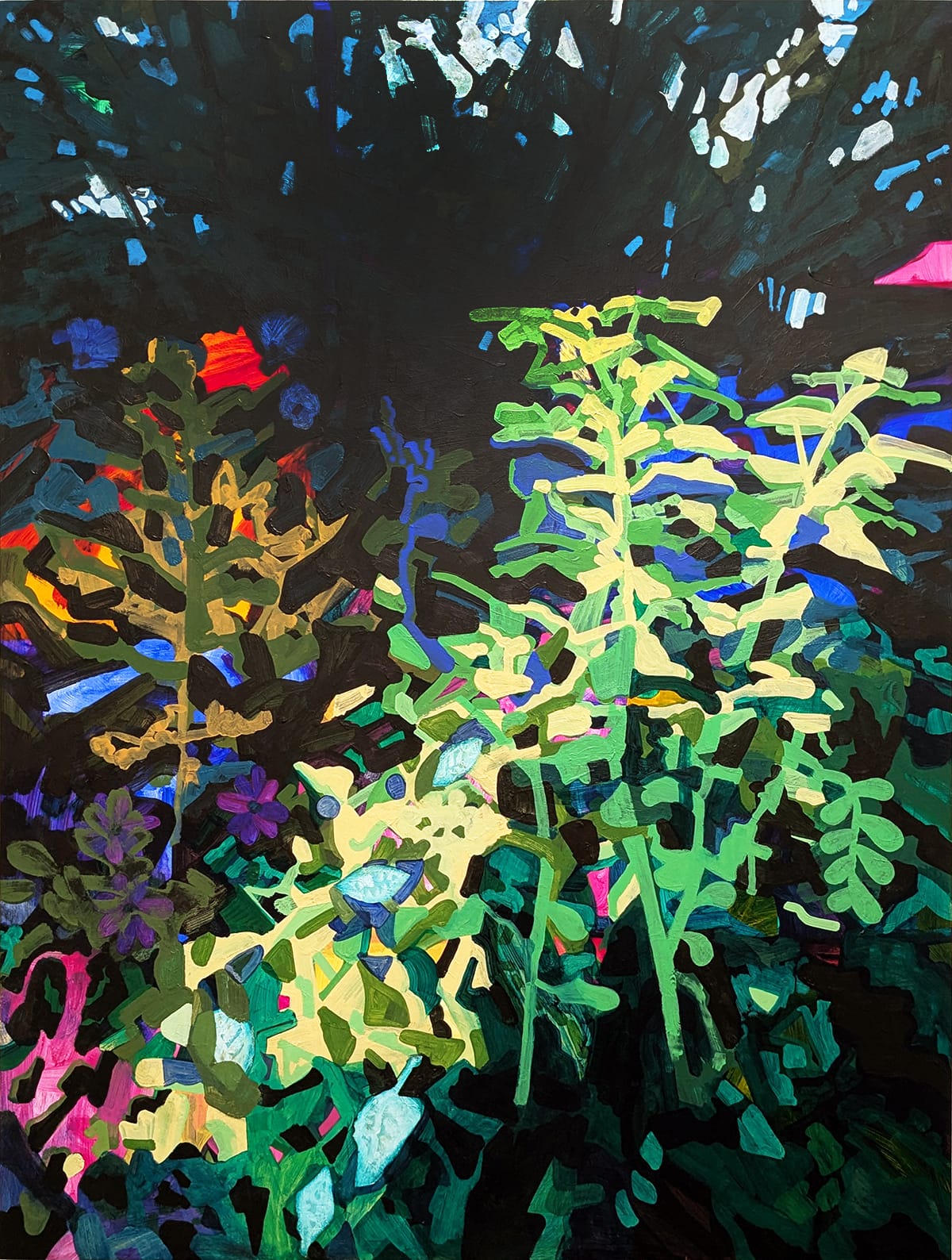
Needham’s brushstrokes in this piece are wide, languid, yet assertive. These bushes and hedges are firmly rooted in the landscape; they might sway in a gentle breeze, but they remain. Again, Needham plays with contrast, light and dark, foreground and background; he also challenges the viewer with perspective, top and bottom. He achieves a balance in this painting, and it’s a reflection of the same balance nature personifies.
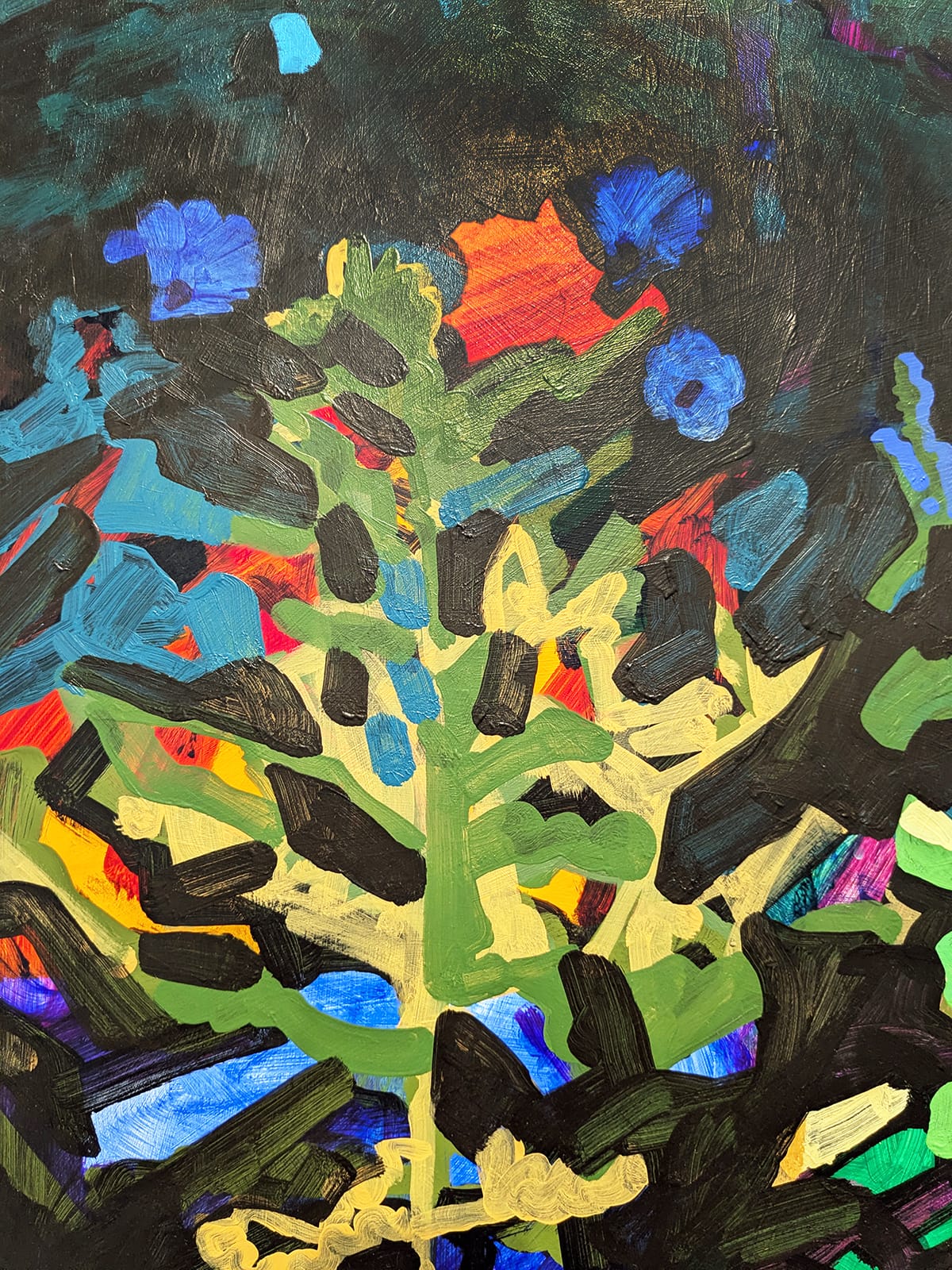
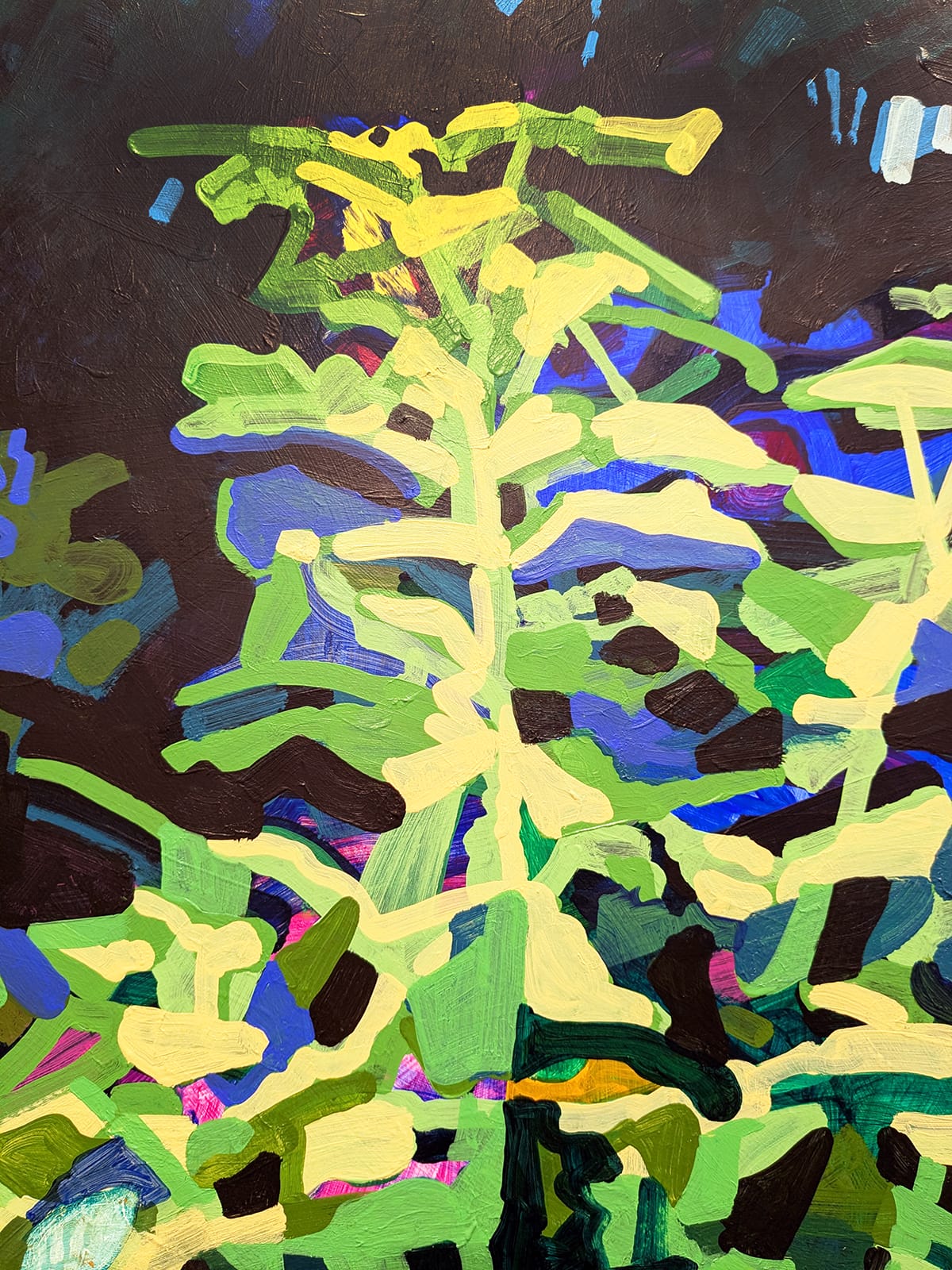
Detail views of Jason Needham’s “Wild Morning,” acrylic on canvas, 48 by 36 inches. Photo by Shelly Walston for The SHOUT.
“Shadow Kingdom” features a house hidden in the depths of the landscape — the only painting on display to indicate human footprints on the terrain. The house cuts a horizontal line across the background with a subtle red and blue that takes shape at the conclusion of a yellow path. Also unique to this work is the clear presence of autumnal colors: gold, ochre, red, and orange. There’s a sense of sunsetting — not in the literal sense — that shows the end of a cycle and the comfort of a home nestled in nature. The golden leaves have yet to blanket the forest floor, but a small pile in the foreground indicates the inevitable. “Shadow Kingdom” is comforting, and I’d gladly cozy up to the fireplace in Needham’s imagined dwelling place.
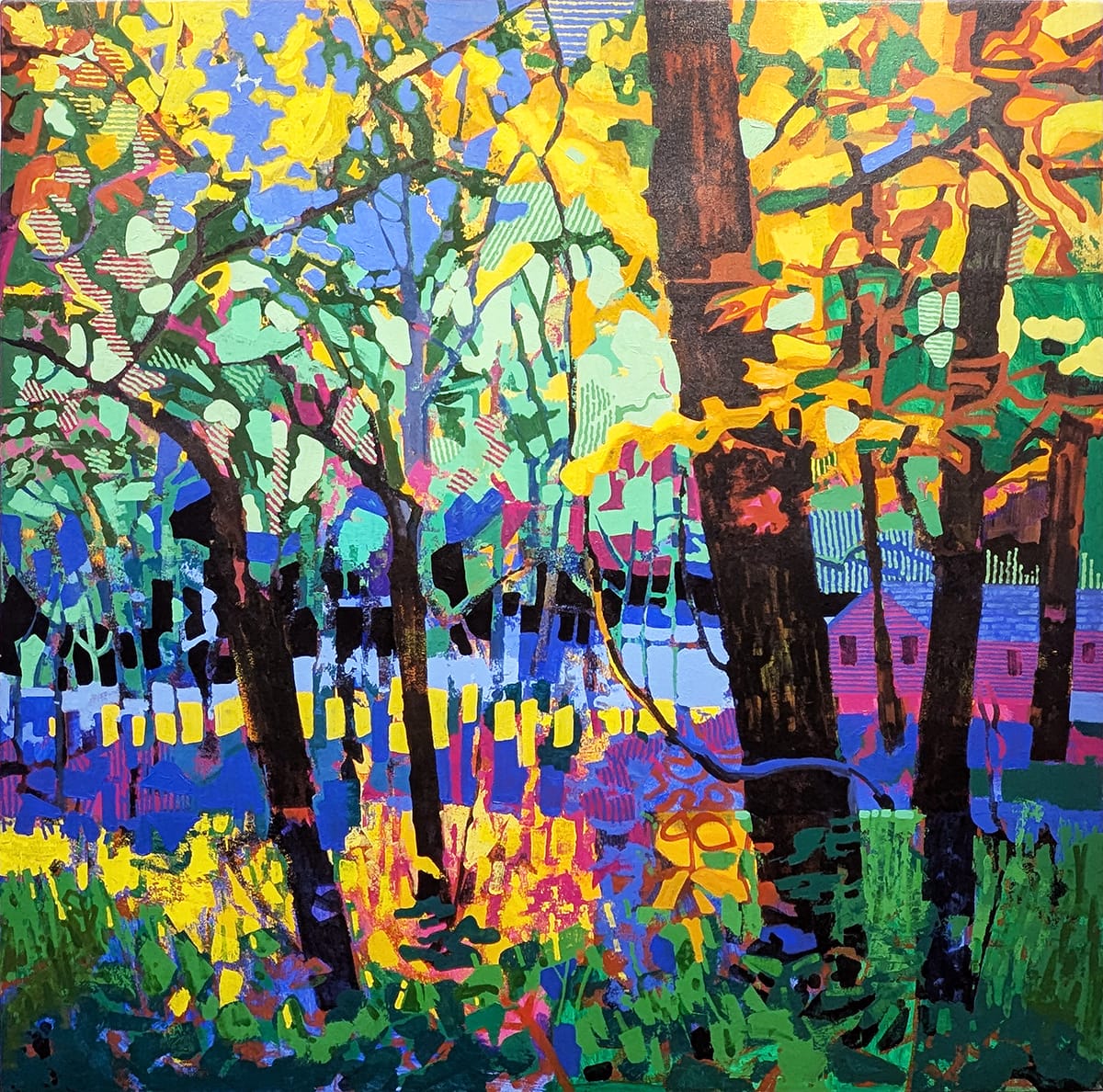
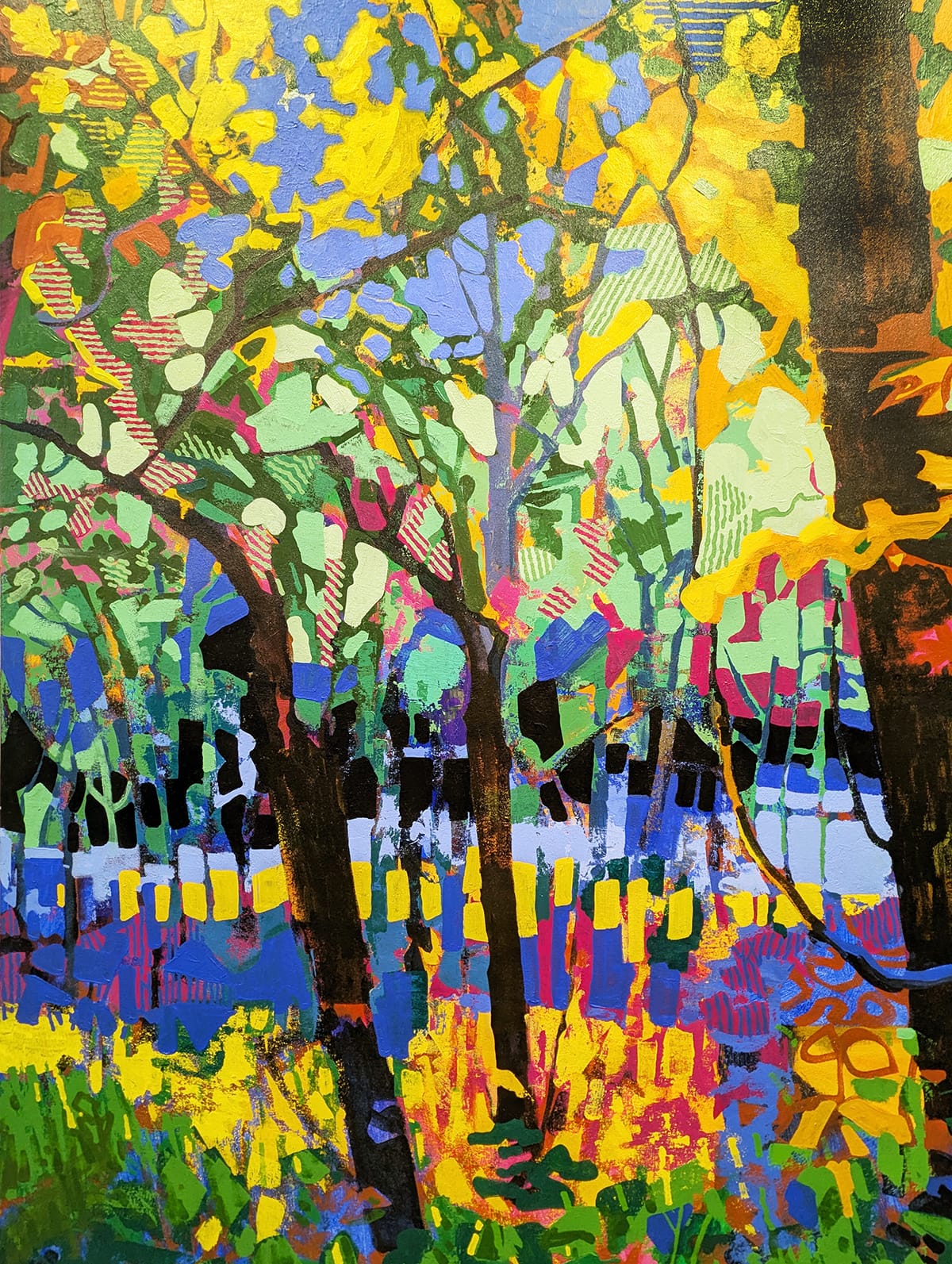
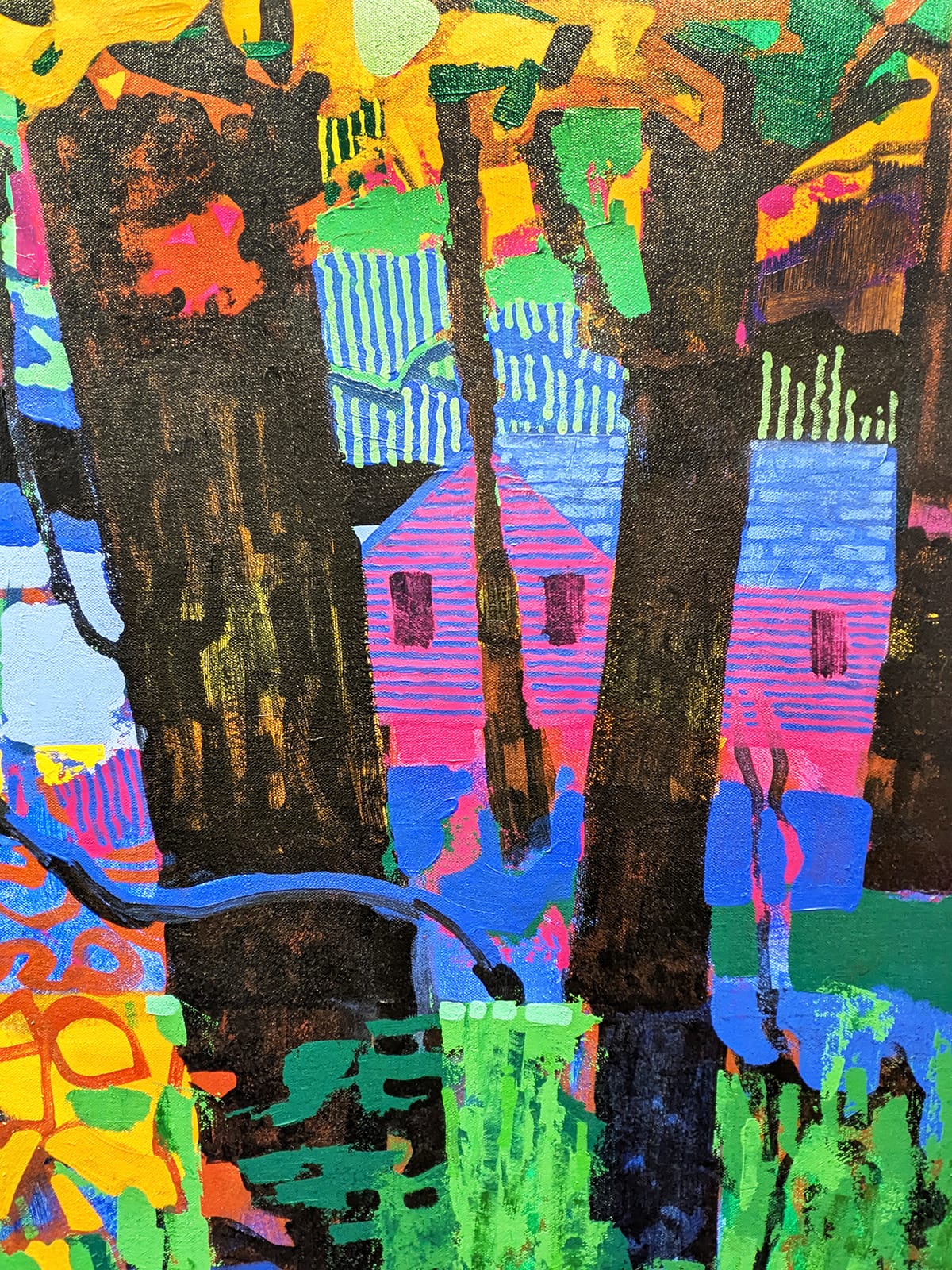
Detail views of Jason Needham's “Shadow Kingdom,” acrylic on canvas, 48 by 48 inches. Photos by Shelly Walston for The SHOUT.
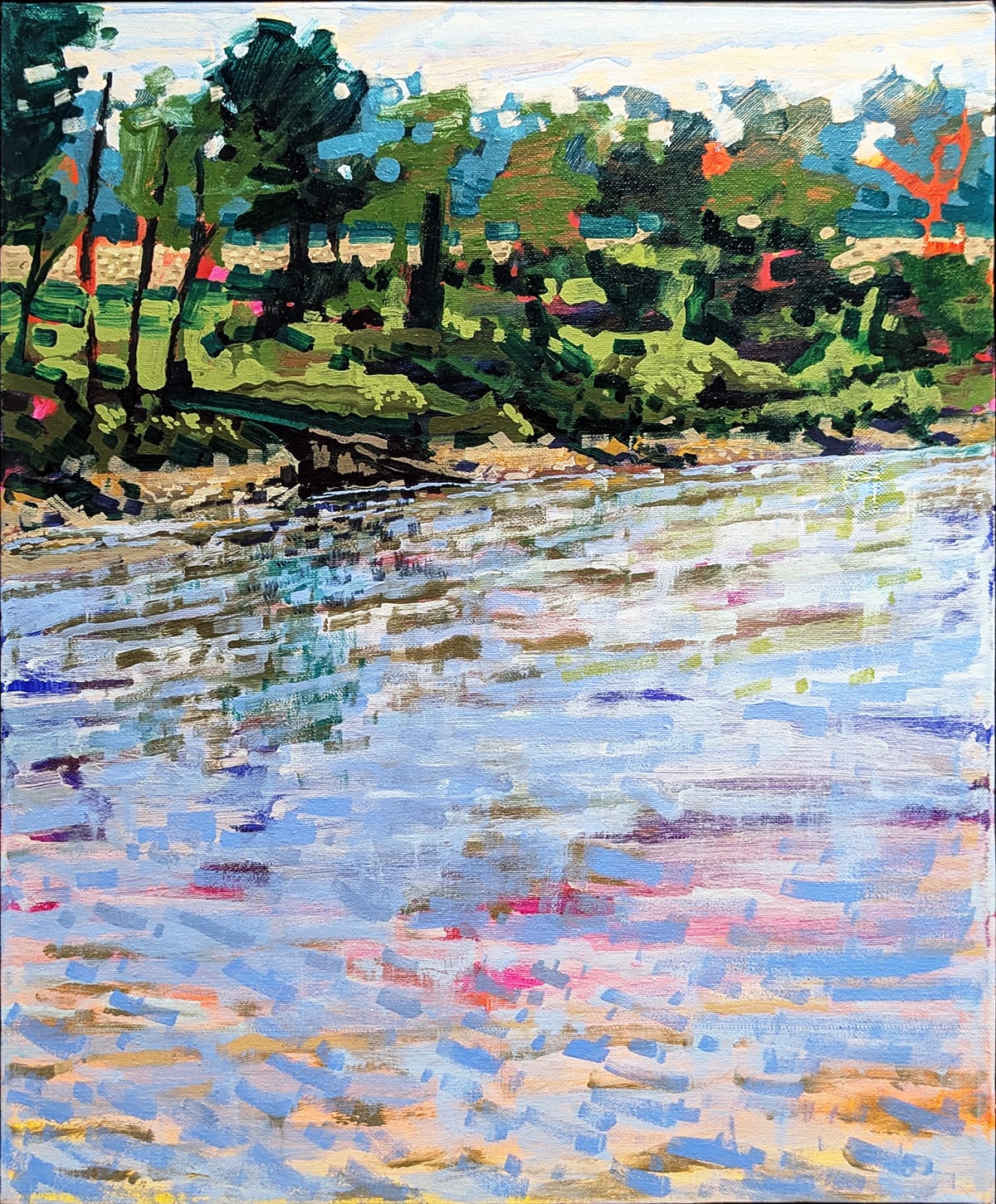
“Untitled — River” stands out due to Needham’s use of pastels, yet the comfort and quietude so apparent in his other works show up just as prominently here. This piece, palid and unassuming, is paired with “Untitled — Forest,” and the two are noticeably smaller than the grand scale of the other canvases on display (they are both 16 by 16 inches). It’s in “Untitled — River” that the viewer can clearly see Needham’s use of an impressionist style, where his brushstrokes are obvious, varied in length, and reminiscent of Claude Monet’s. The water in “Untitled — River” goes from murky greens and browns to slowly meandering blues and purples, and then it meets the viewer in the foreground with more rapidly flowing blues and oranges.
The overall experience of Jason Needham’s “Borderland” exhibition— through its texture, color, depth, and contrast — is encompassing, as though the viewer could step through, into the canvas, and onto the soft, variable undergrowth. The bark yearns to be touched, the yellow path to the house begs to be found, and the abundance of nature all around longs to be acknowledged.
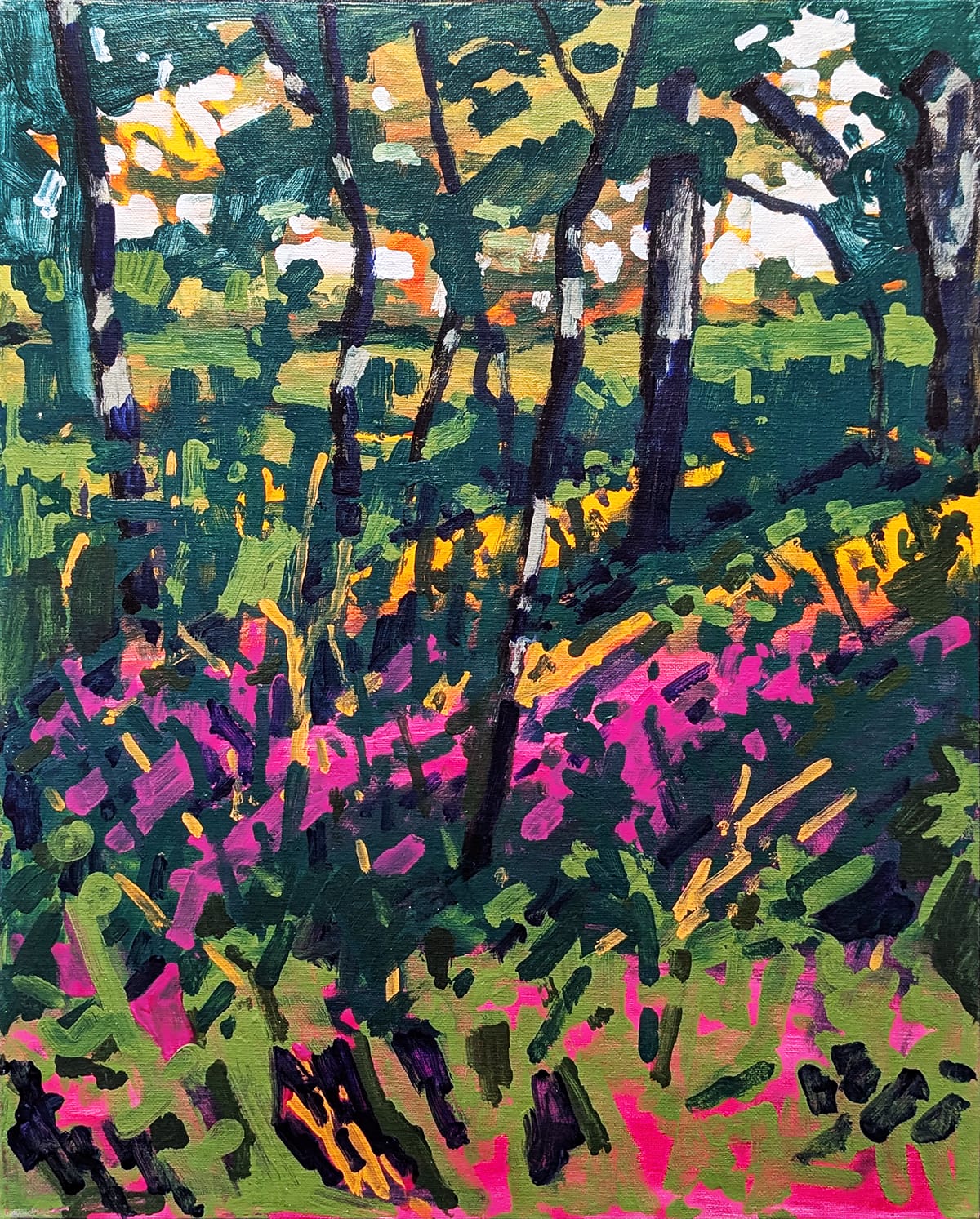
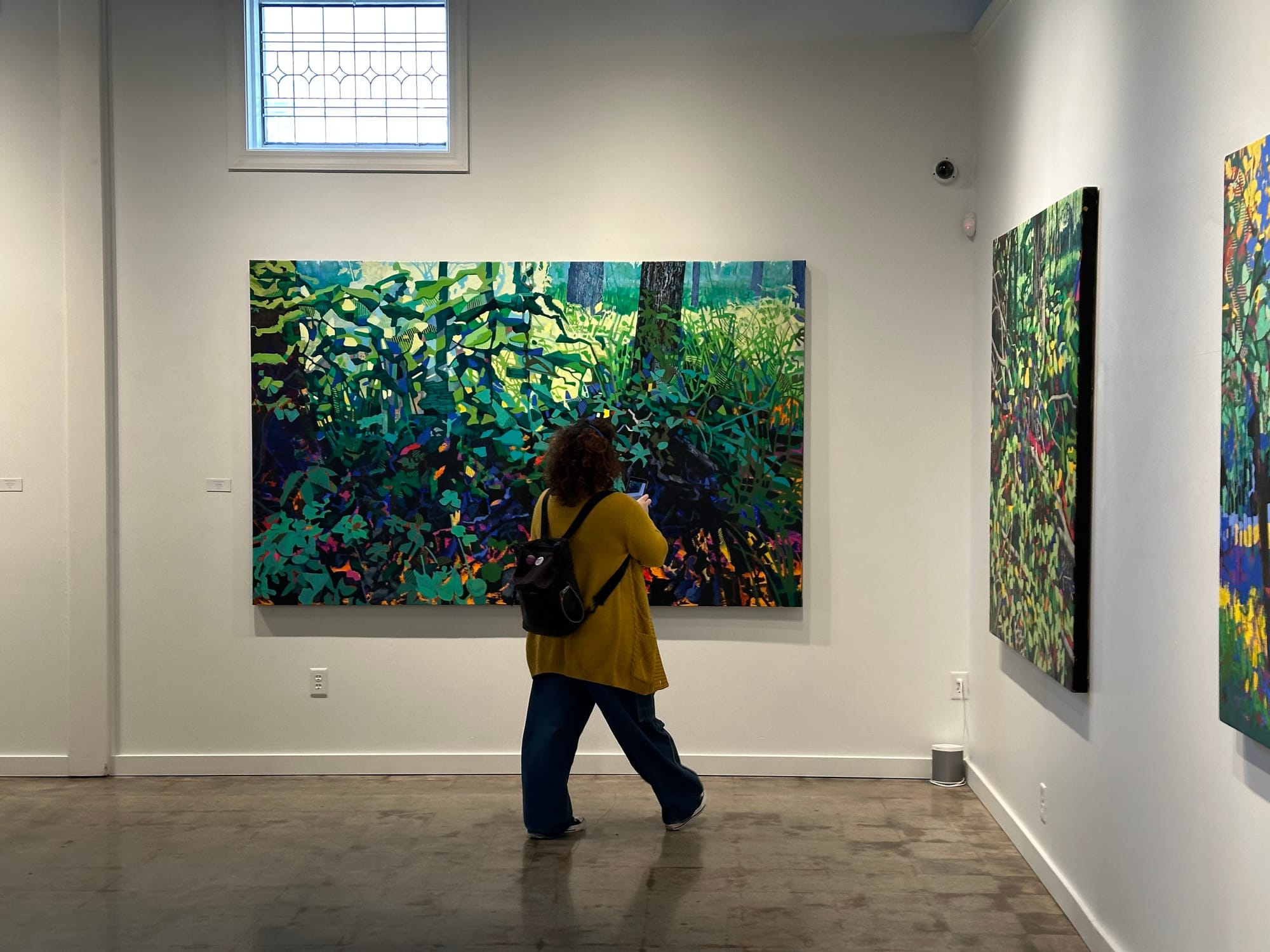
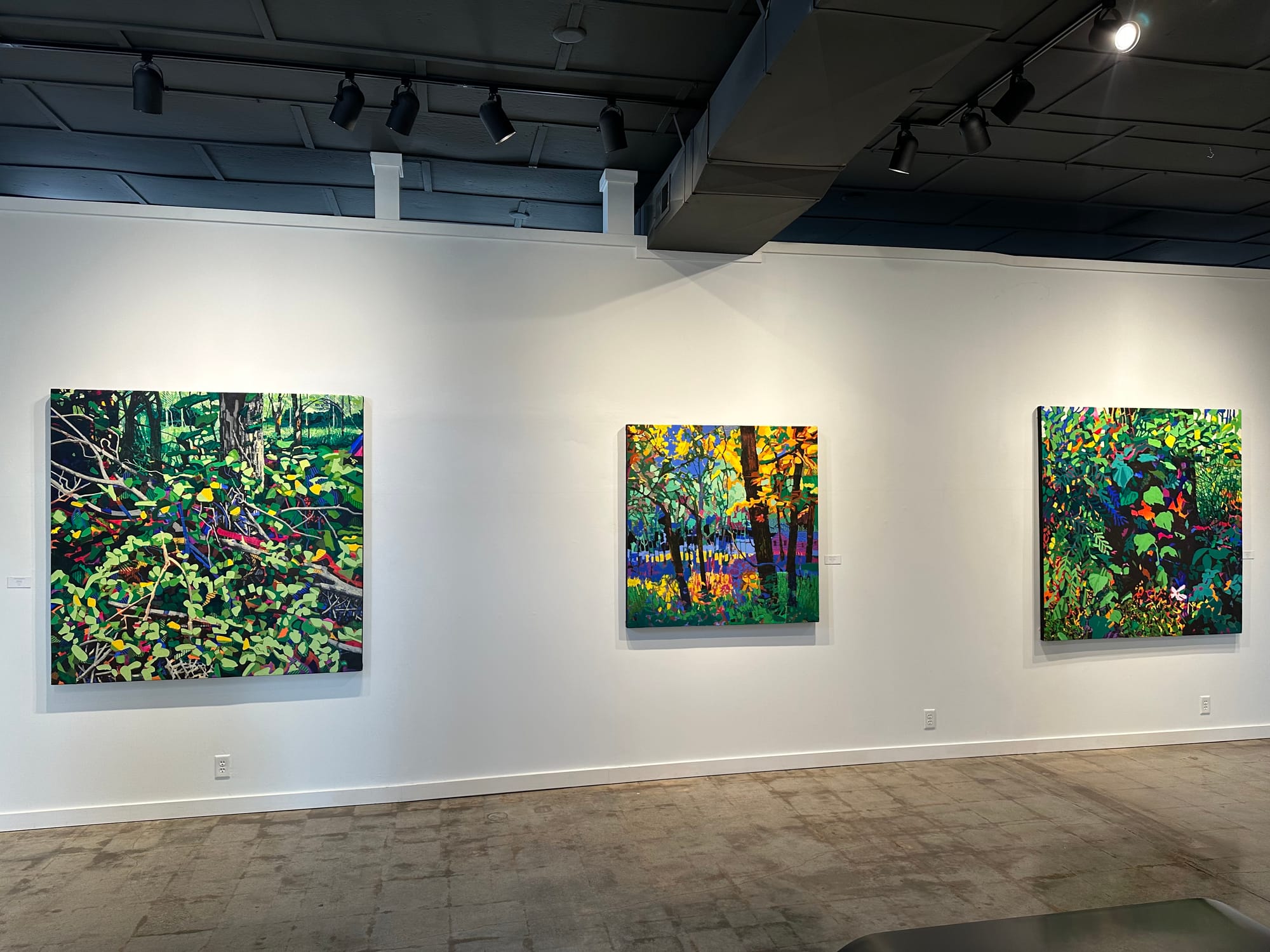
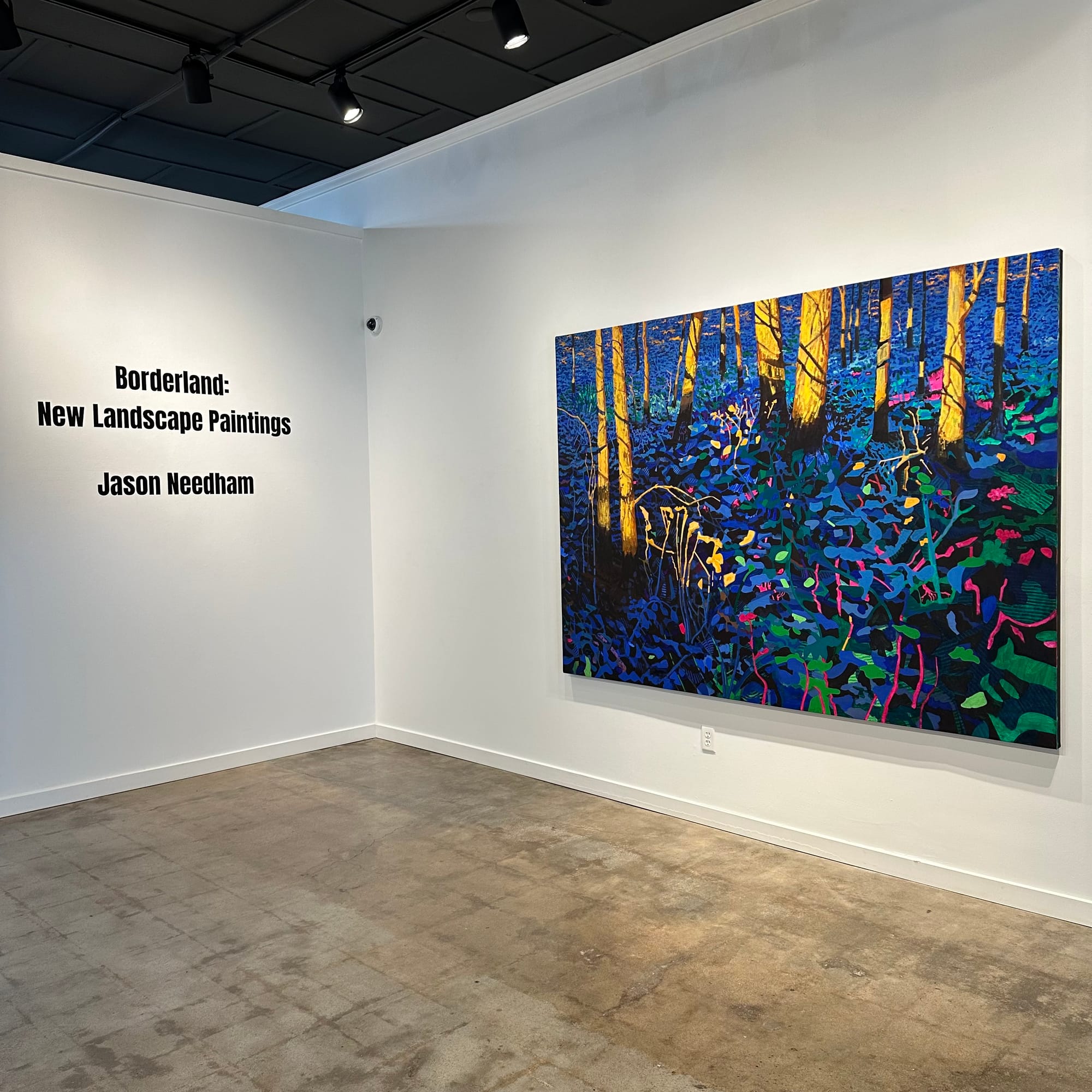
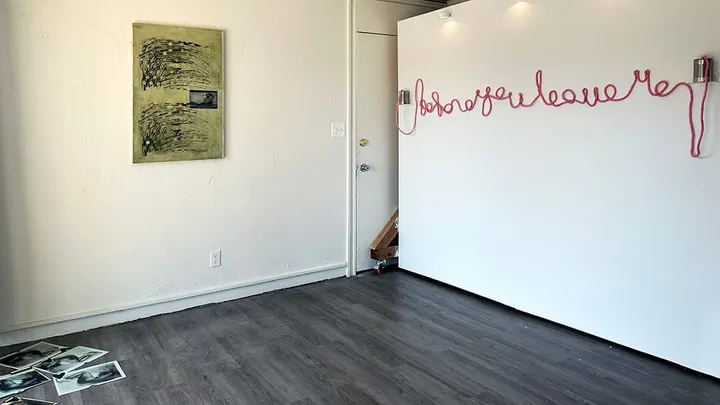
Installation views of “Borderland: New Landscape Paintings — Jason Needham,” on view at Reuben Saunders Gallery. Photos courtesy of Reuben Saunders Gallery.
The Details
“Borderland: New Landscape Paintings — Jason Needham”
May 1-30, 2026, at Reuben Saunders Gallery, 3215 E. Douglas Ave. in Wichita
Reuben Saunders Gallery is open from 10 a.m.-5:30 p.m. Tuesday through Friday and 10 a.m. - 4:00 p.m. Saturdays.
Admission to the gallery is free, and the facility is accessible to people with physical disabilities.
Shelly Walston is an educator, reader, writer, and collector of commemorative state plates, and she's been teaching English at the high school level for more than two decades. When not grading essays, working on her novel, walking the dogs, or playing strategy games, you'll find Shelly sprawled on her couch, reading a book. More of her writing and book reviews can be found at shellywalstonwrites.com.
❋ Derby man has the kind of voice that turns heads — and chairs
❋ Socializing while sober: how some Wichitans are cultivating alcohol-free communities
❋ As a small creative business closes, the owner mourns
❋ Painting through it: Autumn Noire on 20 years of making art
❋ How a guy from Wichita resurrected 'Dawn of the Dead'
❋ Bygone Friends University museum housed curious collections
Support Kansas arts writing
The SHOUT is a Wichita-based independent newsroom focused on artists living and working in Kansas. We're partly supported by the generosity of our readers, and every dollar we receive goes directly into the pocket of a contributing writer, editor, or photographer. Click here to support our work with a tax-deductible donation.