Artist-driven and unrepeatable: The Wichita Symphony’s ‘Neon Strings’
The WSO Connects program featured music by minimalist composer Philip Glass and new-wave pop hits in a concert at Odd Fellow Hall.
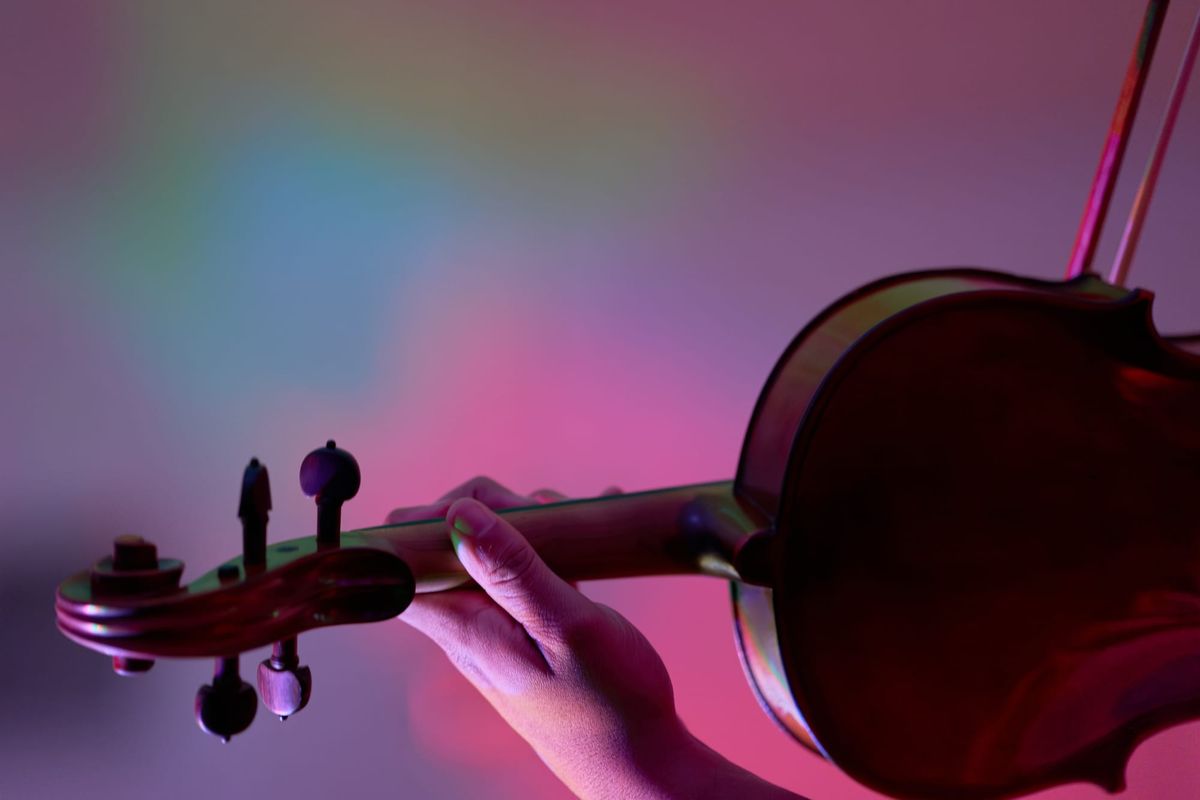
About three years ago, I started to get ads in my Facebook feed for “Candlelight Concerts.” These ads featured photos — taken nowhere in Wichita that I could recognize — of elegantly dressed string players adrift in a sea of hundreds of electric candles. A tribute to Taylor Swift was the advertised musical fare. It didn’t look like my kind of thing. I even wondered if, given the clearly inauthentic and fantastical imagery, it might be some kind of bait-and-switch scam.
Well, it’s not a scam, I later learned — but it is the Wichita manifestation of a multi-billion-dollar, multi-continent, venture-capital-funded enterprise.
Fever, the Madrid-based tech company behind Candlelight, launched its event discovery and ticketing app in 2014, then started to design and market test Candlelight and other Fever-branded “experiences” a few years later.
“Wherever you are in the world,” a recent report in VAN Magazine notes, “the feel of a Fever Candlelight concert is the same.” Fever ensures this uniformity by providing its musician-contractors with detailed scripts for every moment of a Candlelight event, from the greeting and farewell — which must solicit positive reviews and social media follows — to the exact setlist and arrangements used. Unusually negative audience responses may prompt an analyst at headquarters to review the concert recording, rate it based on a lengthy list of “key performance indicators,” and perhaps blacklist misbehaving contractors.
The Candlelight Concerts have no artistic mission at all. Every choice Fever makes about Candlelight is driven by the market logic of selling something that people will pay for while keeping costs as low as possible. Under this logic, variation is a liability, making an enterprise more costly to manage and more difficult to scale.
Lacking that variation — which is to say, lacking creativity — Candlelight is of scant interest to classical music’s practitioners and core fan base. Yet its success in turning out paying crowds for chamber music, in cities large and small, month after month, can’t be ignored by the leaders of mission-driven performing arts organizations such as the Wichita Symphony Orchestra.
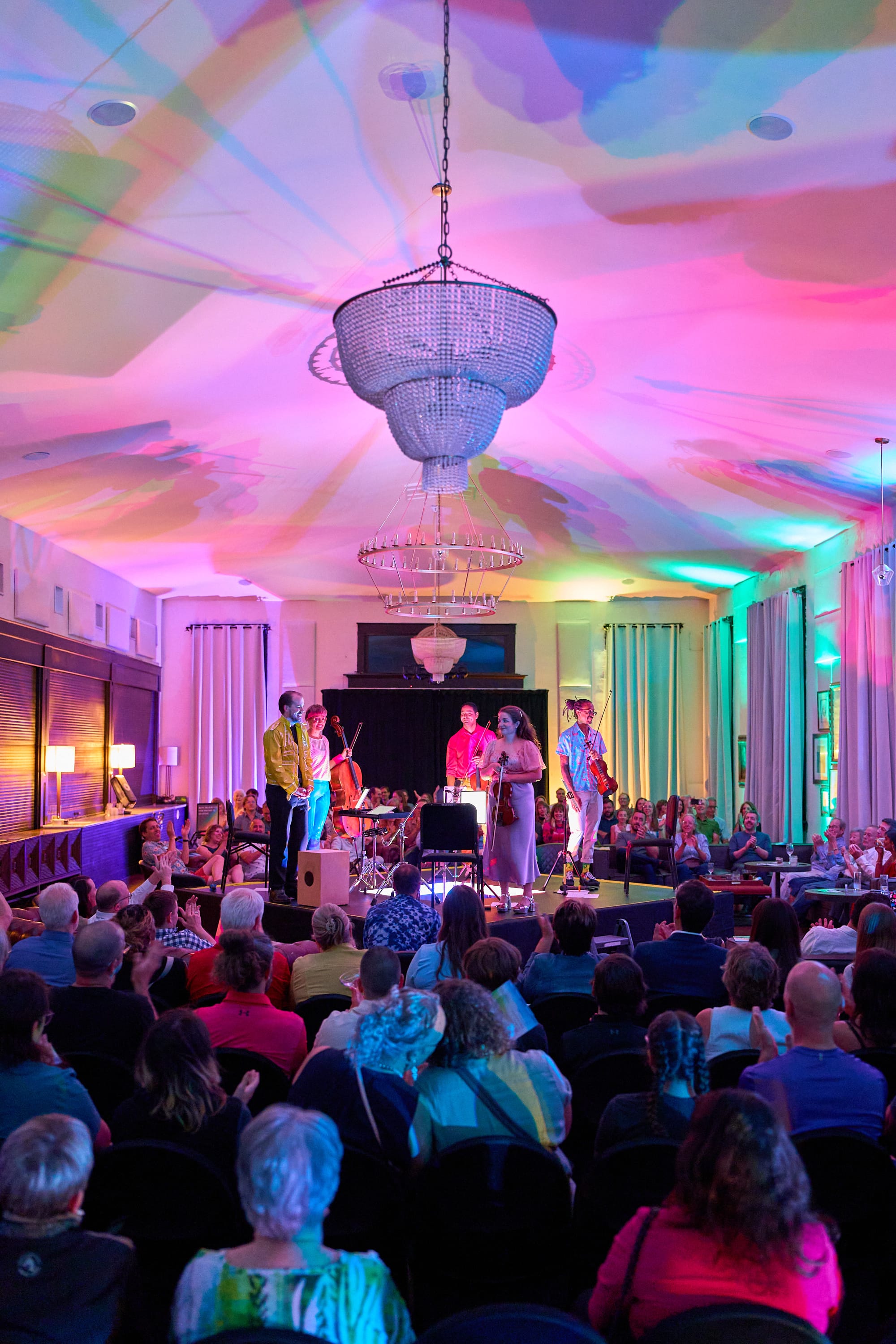
The latest concert in WSO’s Connect series, Friday night’s “Neon Strings” at Odd Fellow Hall, copied audience-friendly elements of Candlelight: a 60-minute runtime with no intermission, a distinctive historic venue rather than a traditional theater or hall, atmospheric lighting, arrangements of pop hits for strings. The important difference is that this was an artist-driven, unrepeatable event, not a widget on a globalized assembly line. As such, I found it satisfying and enjoyable. I’m guessing audience members who wouldn’t call themselves classical fans felt the same way.
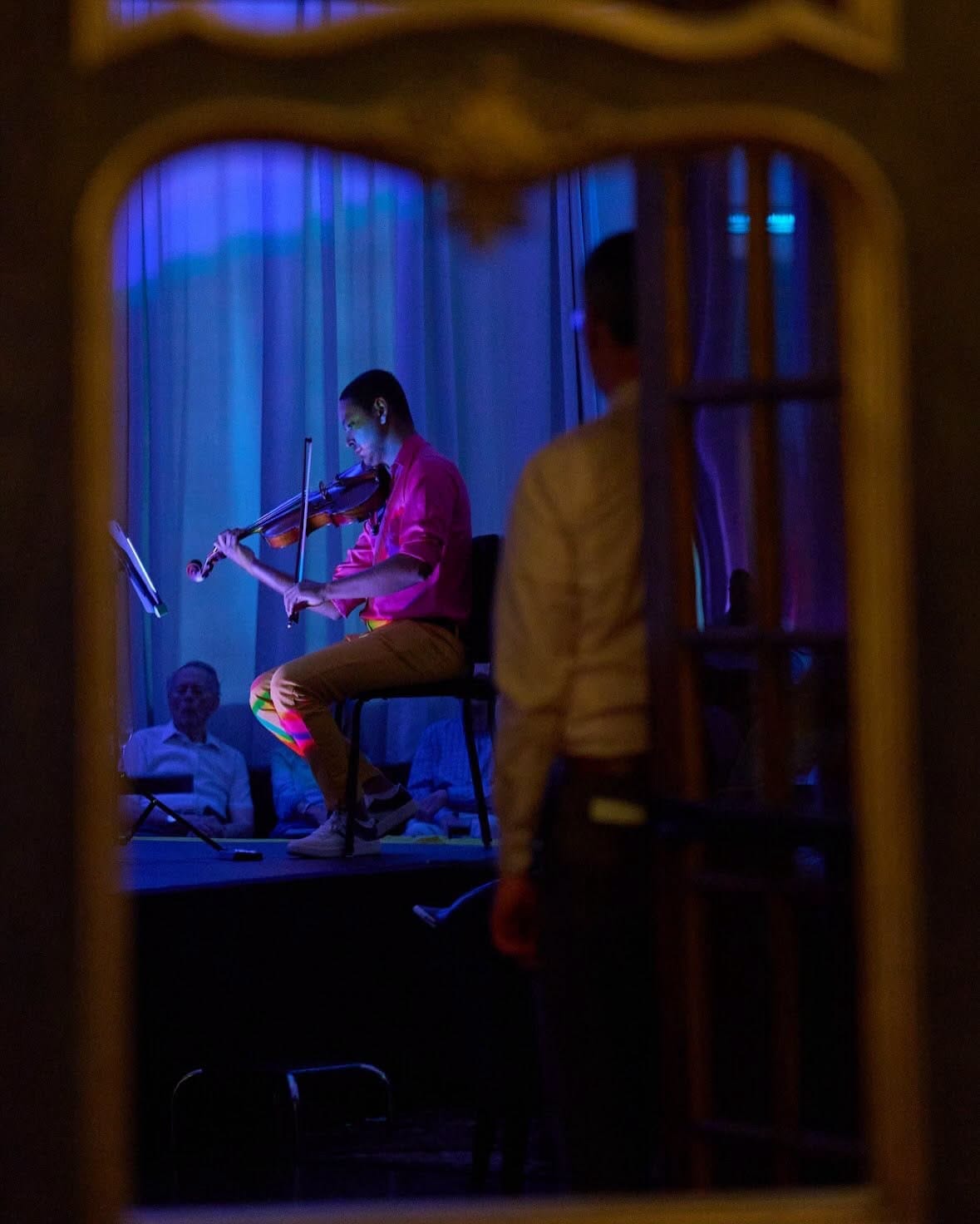
The event’s subtitle was “Philip Glass and the 1980s New Wave,” and the program alternated movements from Glass’s String Quartet No. 3 “Mishima” (1985) with piquant arrangements of 1980s pop hits. The pop arrangements let each member of the ensemble demonstrate their ability to lay down a groove or fire off a riff.
In Talking Heads’ “This Must Be the Place,” violist Ricardo Cavalcante interjected slurpy upward fillips with a sense of wit that put a smile on my face.
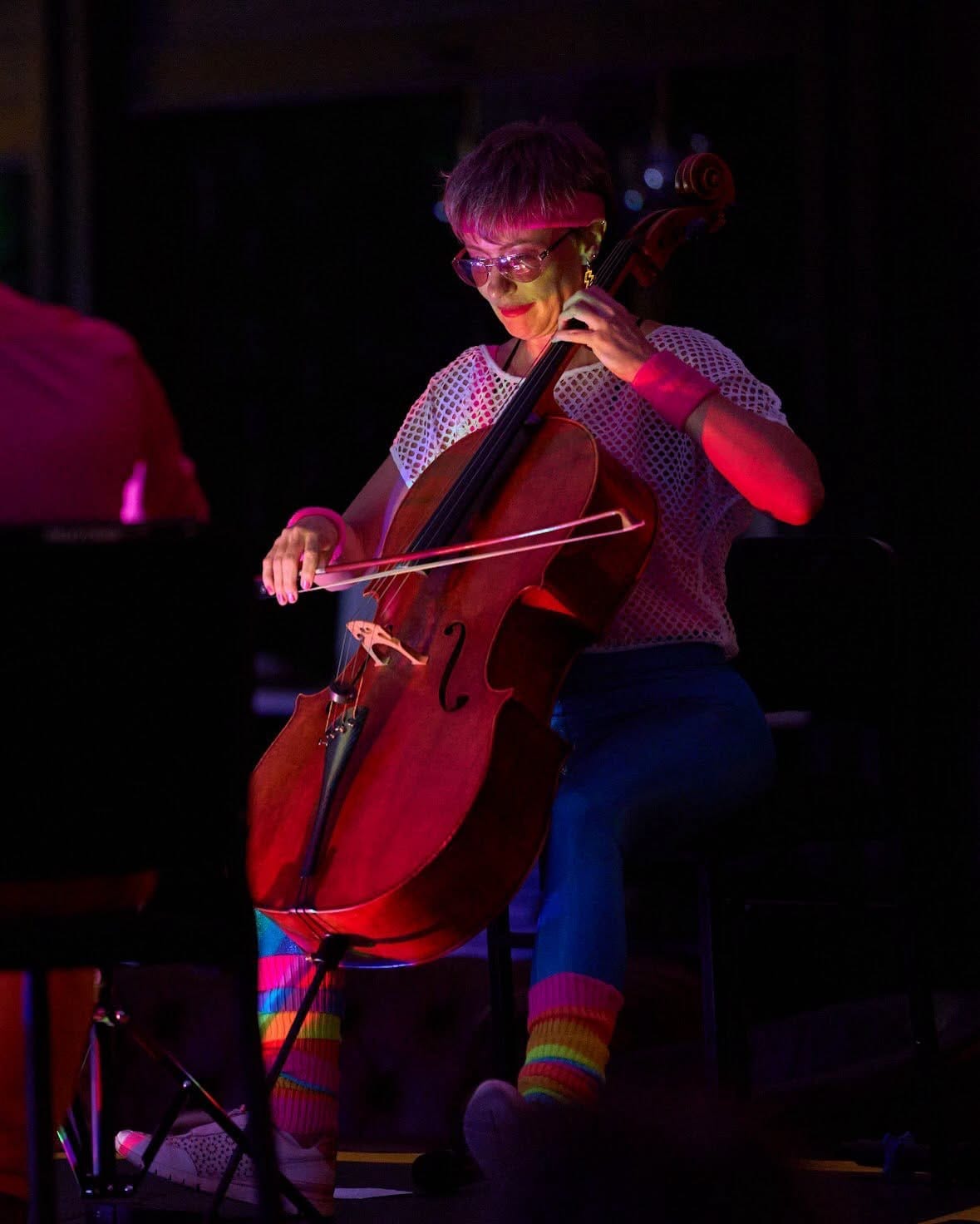
Cellist Quinn Lake executed crunchy double-stops in “Everybody Wants to Rule the World” and rugged but accurate spiccato in “Dancing With Myself.”
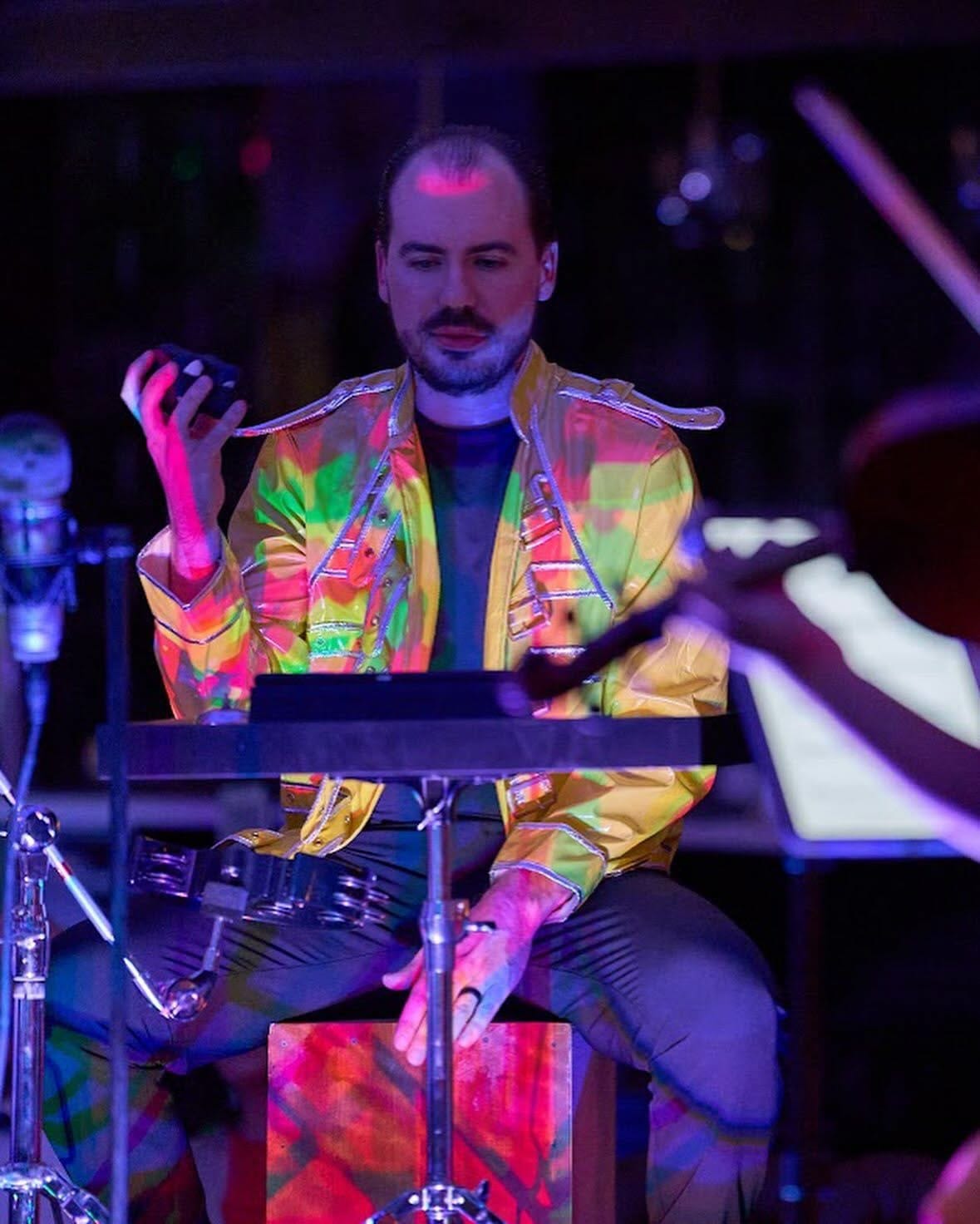
Joining Lake in the “rhythm section” for the pop numbers was WSO percussionist and operations manager Joseph Mikelait, playing the cajón and some auxiliary instruments. The WSO was smart to add him to the standard string quartet; he provided a lot of verve. In the encore piece, Madonna’s “Material Girl,” he added rings of a desk bell following each repetition of “I am a Material Girl” (words no one was vocalizing, but which everyone was surely singing in their heads). To me, this instantly evoked a mental picture of Madonna at the reception desk of some luxury hotel, impatiently waiting for service — and I don’t think I was alone in that, because the bell rings drew laughs from the audience.
Violinists Tim Jones and Hannah Cartwright took turns carrying melody lines, and they played with an accuracy and slender sprightliness that gave these well-loved tracks a fresh gleam, as though a coat of varnish had been removed.
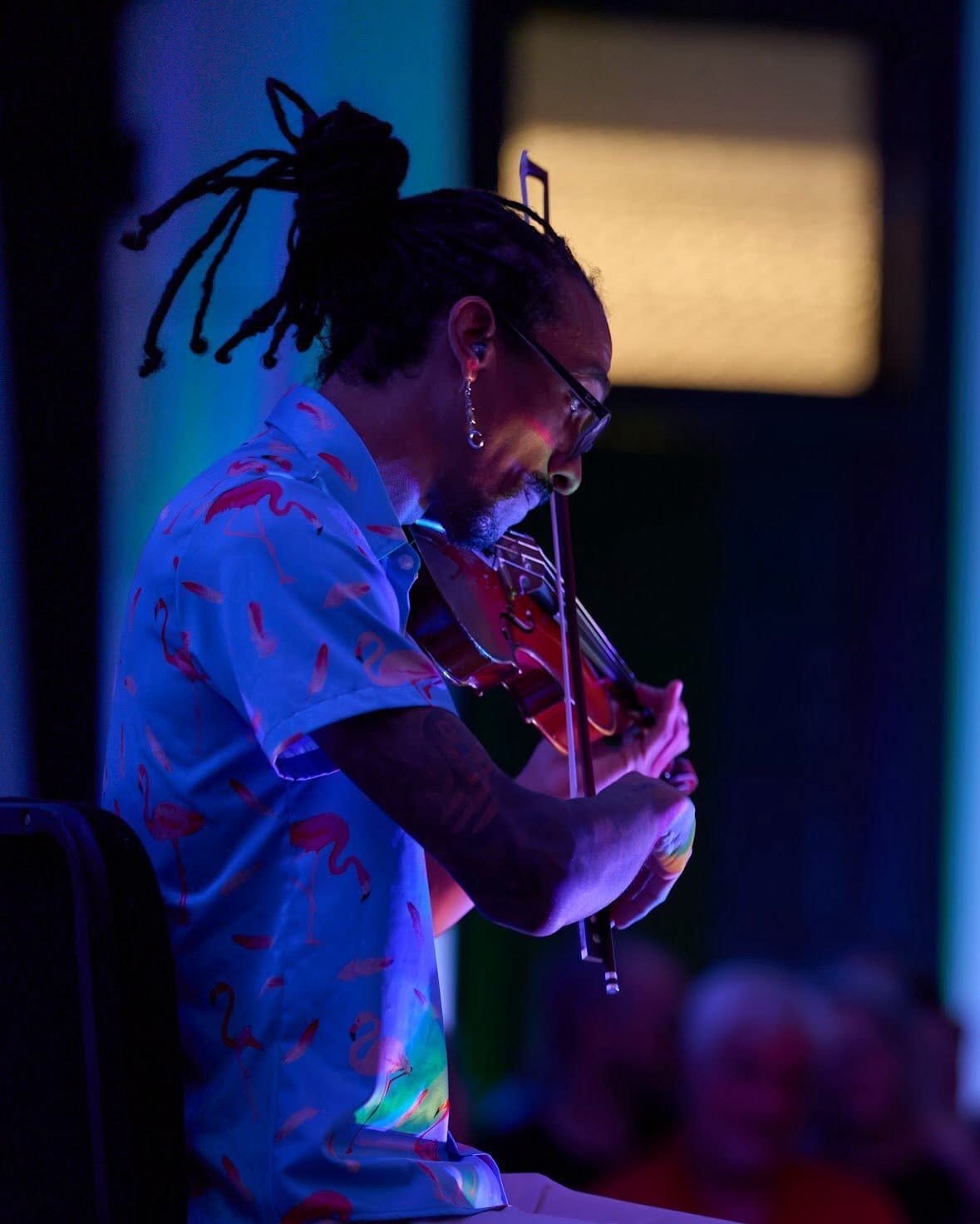
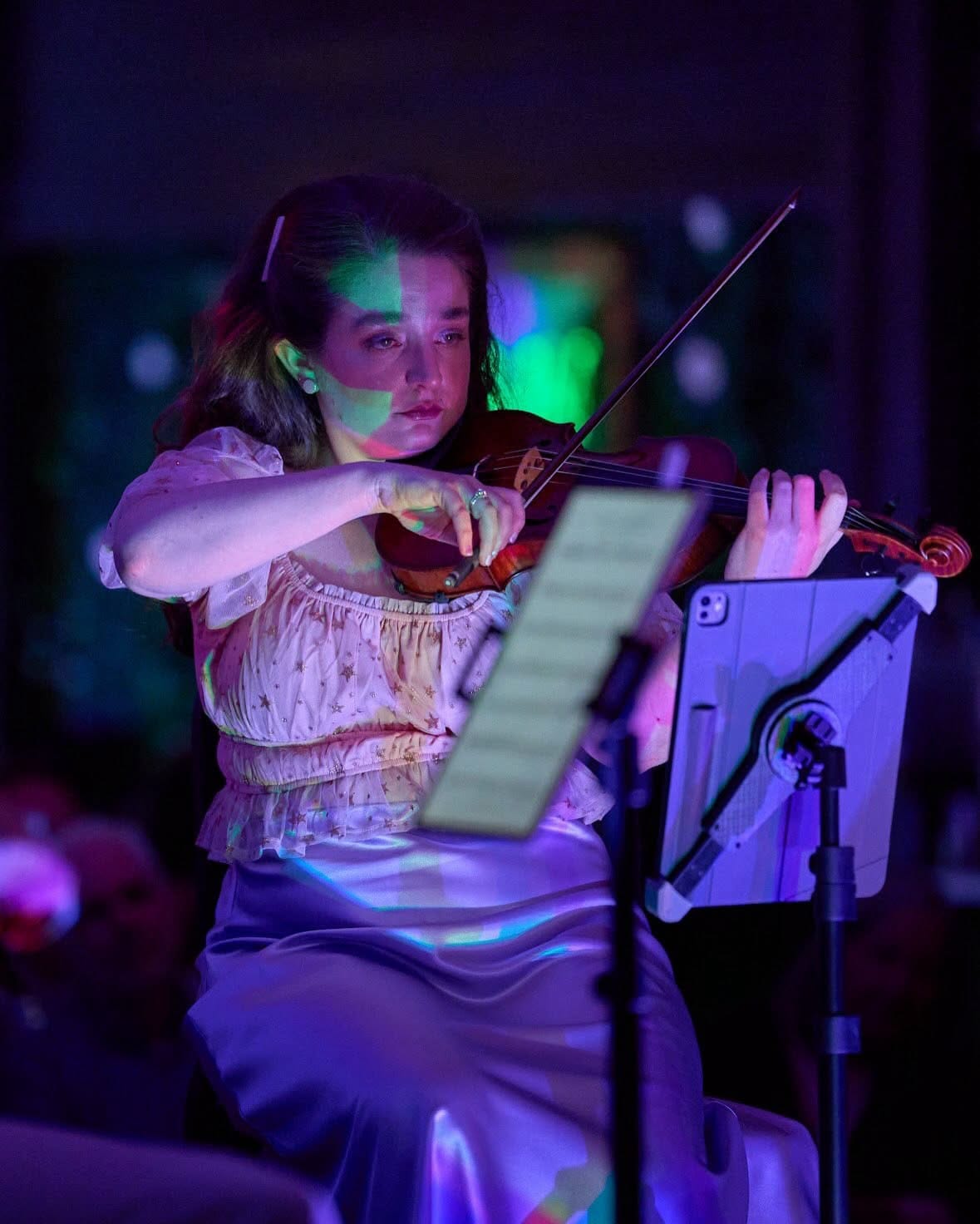
Violinists Tim Jones and Hannah Cartwright bring new life to the well-loved track list. (Grant Seymour/Wichita Symphony)
And yet! Even as I bopped along and enjoyed the whole vibe, my classical-music brain kept getting impatient. A string quartet is composed of four virtuoso musicians, and music written to fully exploit their skill gives the players a great deal to track, decide and execute, all of those choices flowing down from their brains and out of their hands at a prodigious rate. A pop song’s richness is often in the performer’s voice, and in the persona their voice evokes. Arrange a pop song for strings and that voice — along with the lyric content — is missing: The audience adds it back in from memory. However spirited the playing, there was less in these charts to render than the musicians had in them to give. Through most of the New Wave sets, their fullest powers were held in abeyance—
—only to be released again the next time they returned to “Mishima,” a quartet in six short movements drawn from Glass’ soundtrack to the film of the same title. With each return, I fancied I could feel the musicians snapping into a flow state, a state of optimized awareness and multilateral functioning. Such a state is more or less required to perform this music; one might even say that such states are this music’s subject or point. Performing this “music with repetitive structures” (as Glass termed it) means tracking expression at multiple levels. Inaccurate execution at the level of the note or measure risks rendering a piece incoherent, but a note-perfect and perfectly rhythmic reading is inert if it doesn’t have breath at the level of the phrase, and if it doesn’t have drama and swerve at the level of the section or whole movement.
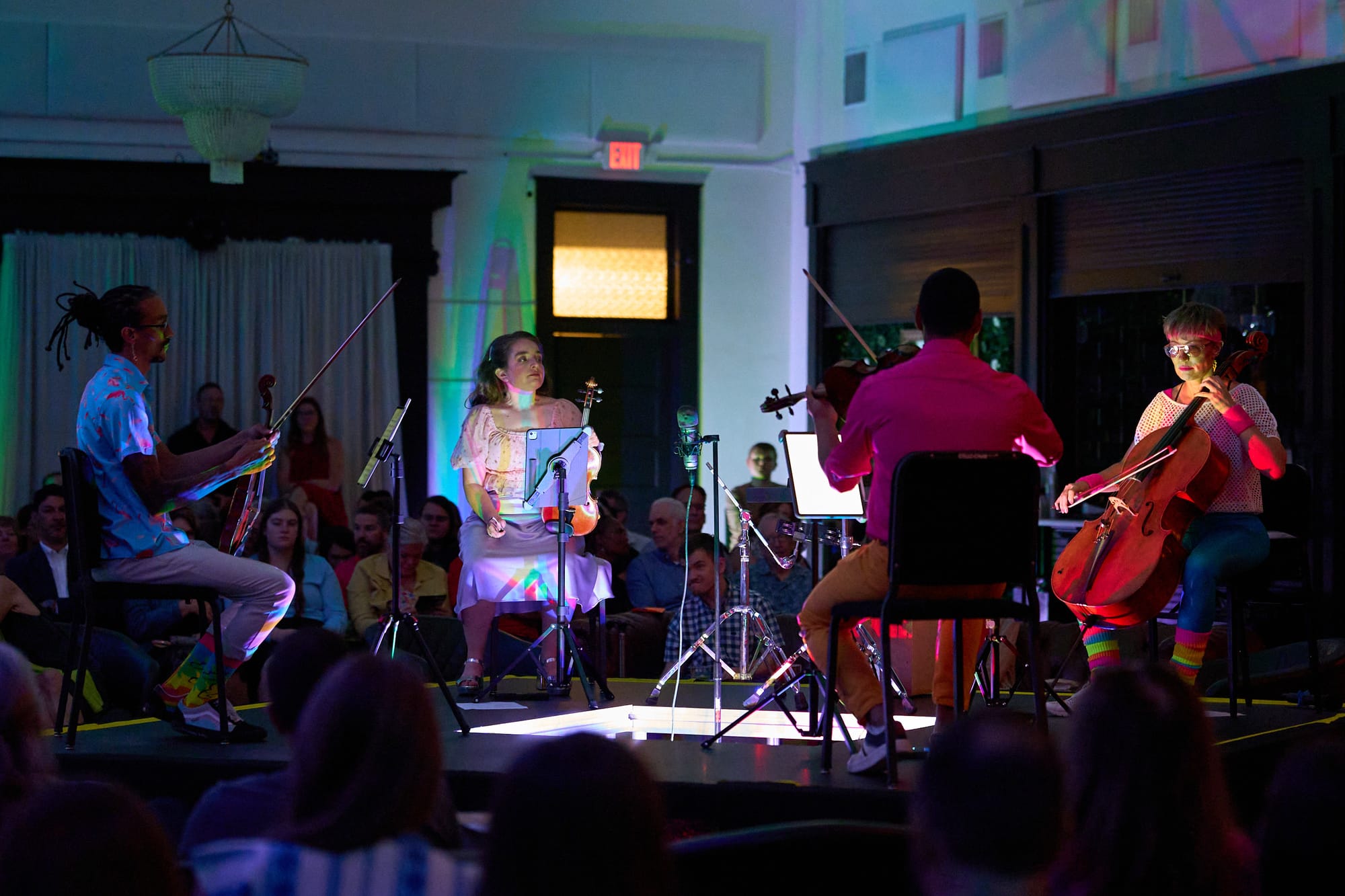
Nowhere was this clearer than in the sixth and final movement. On the page, it’s metered in 6/4, but as played by the WSO quartet, it was experienced as two enmeshed meters at once: quick, three-beat measures folded inside a 4/4 that rose and fell with the pace of a slow inward and outward breath.
Sam Jack is a poet, a classical tenor, and the adult services librarian at Newton Public Library. He performs with several local groups, including Wichita Chamber Chorale, Wichita Grand Opera, and Opera Kansas. He received a Master of Fine Arts in creative writing from the University of Montana.
❋ Derby man has the kind of voice that turns heads — and chairs
❋ Socializing while sober: how some Wichitans are cultivating alcohol-free communities
❋ As a small creative business closes, the owner mourns
❋ Painting through it: Autumn Noire on 20 years of making art
❋ How a guy from Wichita resurrected 'Dawn of the Dead'
❋ Bygone Friends University museum housed curious collections
Support Kansas arts writing
The SHOUT is a Wichita-based independent newsroom focused on artists living and working in Kansas. We're partly supported by the generosity of our readers, and every dollar we receive goes directly into the pocket of a contributing writer, editor, or photographer. Click here to support our work with a tax-deductible donation.