How Wichita's relationship with 'Tripodal' has evolved over a half century
James Rosati's 1972 modernist sculpture was part of a larger movement across the country. With time (and a time capsule), the work has gained some respect from the city it was built for.
“What is that supposed to be?”
Hang around in the vicinity of any abstract piece of visual art and sooner or later, you're bound to hear the question.
If the art is outside the walls of a museum, it comes up all the sooner. The untitled Picasso sculpture on Chicago’s Daley Plaza has been likened to a dog, a baboon, and a woman. Anish Kapoor’s “Cloud Gate” became “the bean.” R.M. Fischer’s “Sky Stations” — four shiny, metallic sculptures placed high atop the concrete pylons of a Kansas City convention hall — were quickly dubbed “the hair curlers.”
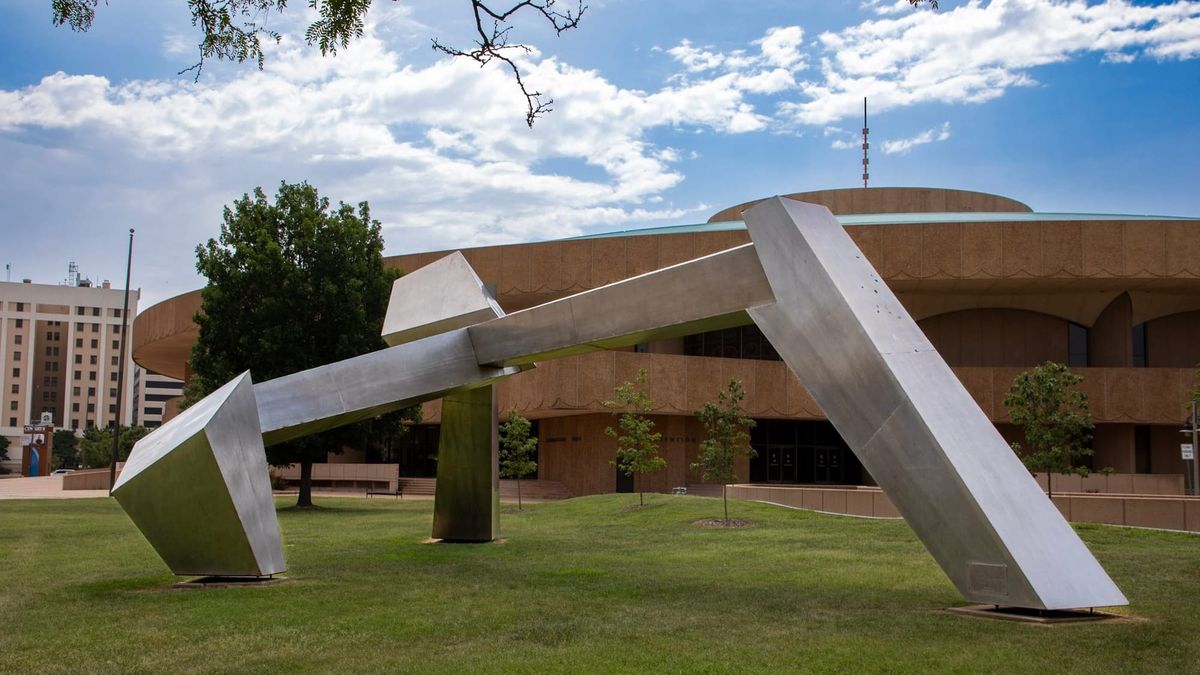
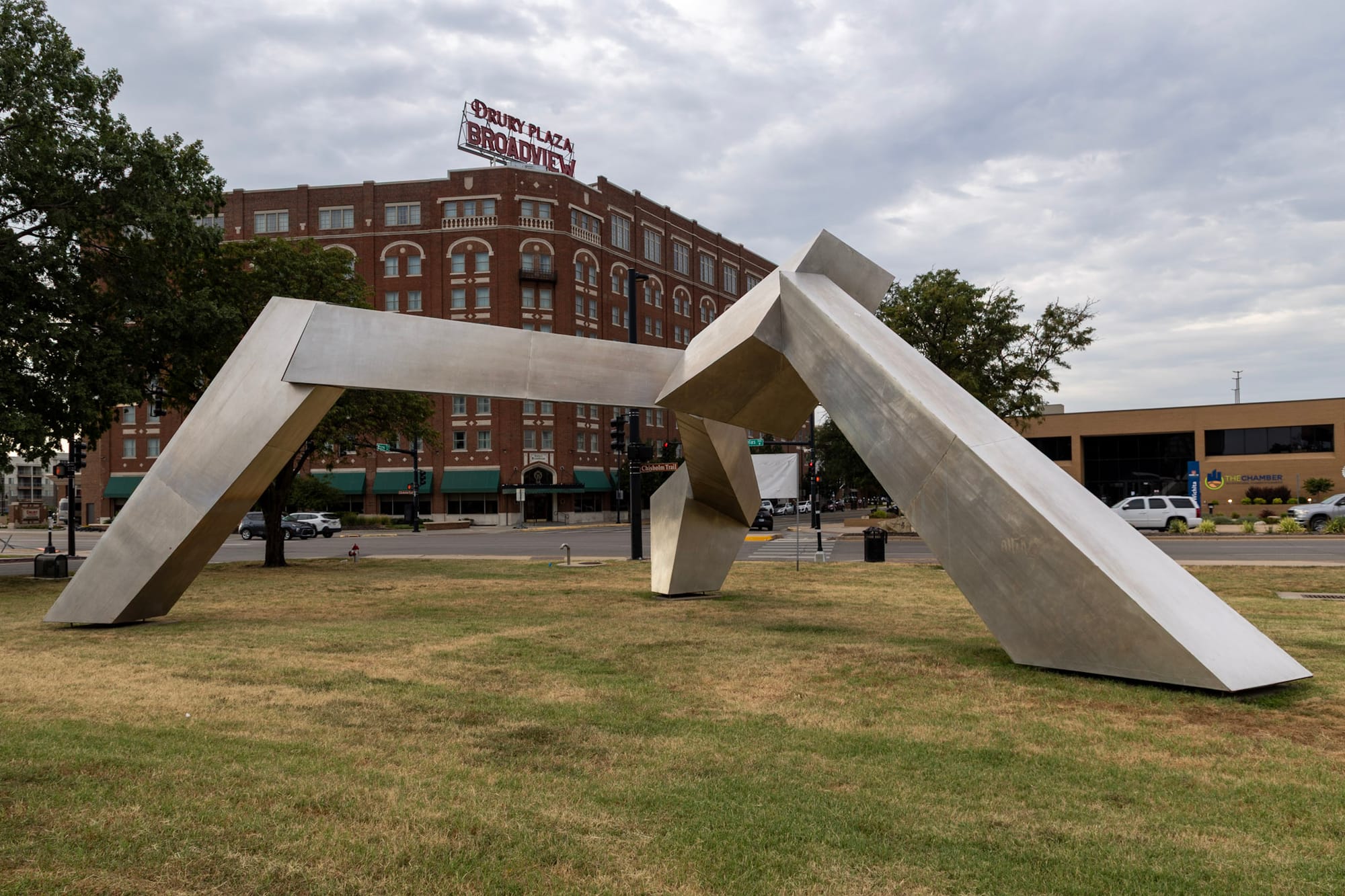
Perhaps things would have been different if Wichitans had ever come up with a pet name for “Tripodal,” the 1972 sculpture by James Rosati that sits outside Century II — perhaps then we would have developed a bit more affection for it. But as it is, and despite the best efforts and best intentions of many civic-minded people, Wichita has never fallen in love with what was meant to be its signature modernist monument.
The late 1960s and early 1970s were boom years for works like “Tripodal,” which is to say abstract, metal sculptures in public places. These were years when “cities desperately needed symbols of civic pride, and establishment institutions badly needed some good public relations,” writes the art historian Harriet Senie. In Wichita, public art initiatives were part of a broader push to define the city as forward-looking, dynamic, modern, and advanced — the kind of place worth betting on and investing in at the start of its “second century.”
Thus it was that the local activism that led to “Tripodal” started not with a society of art-lovers, but with a sub-committee of the Community Livability Committee of the Wichita Area Chamber of Commerce. This committee, the Second Century Sculpture Committee, first met in February 1969.
Committee members’ hopes were buoyed, no doubt, by the June 1969 debut of Alexander Calder’s “La Grande Vitesse” on a large government plaza in Grand Rapids, Michigan.
“La Grande Vitesse” can be translated as “great swiftness,” and the sculpture has fleetness and a sense of motion playfully frozen. Arching curves of bright-red sheet metal seem to burst from five spots in the concrete of the plaza, surging as high as 55 feet.
Coverage of reactions to the sculpture in The Grand Rapids Press reflects some surprise and confusion from members of the public, many of them being exposed to contemporary abstract art for the first time ever. But that surprise and confusion quickly turned into surprised delight.
In the weeks following the Calder’s dedication, the Press started to carry notices that indicated how quickly warm feelings were developing among Grand Rapidians. A local bank gave away “Vitesse” bracelet charms as incentive to open savings accounts. A social club threw a “La Grand Vitesse Party,” with attendees wearing all red.
“Hard-nosed businessmen get lyrical over it,” Robert Sherrill wrote in the New York Times. “One told me: ‘We had lost our identity. The Calder was like a great big heart bringing us to life again.’ Another businessman said: ‘The Calder expressed something: That this town dared to do something.’”
The Calder was the first sculpture to result from a new National Endowment for the Arts grant program, Art in Public Places. Isamu Noguchi’s Seattle “Black Sun” (nickname: “the donut”) was the second. Wichita, city commissioners were told in December 1969, could be home to the third. An NEA grant for $45,000 would need to be matched by $64,000 in contributions from Wichita citizens. “No city tax funds would be involved in the project,” the Wichita Beacon assured.
Art in Public Places grants were intended to be prestigious, both for the artists receiving commissions and for the cities giving them. To safeguard that prestige, while still leaving room for some local-community engagement, the grants required formation of a seven-member artist selection committee, with three members chosen by local communities and four appointed by the NEA.
The Wichita committee assembled here in May or June 1970 and also traveled to New York to visit Rosati’s studio. Locals included Phillip Kassebaum, president of the Wichita Art Museum; John Frazier, president of the Wichita Art Association; and Paul Woods of First National Bank. The NEA’s foursome was landscape architect M. Paul Friedberg, art professor Dore Ashton, UC Berkeley museum director Peter Selz, and Brandeis University museum director William C. Seitz.
Seitz had spent the months leading up to the committee visit organizing a major Rosati show at Brandeis’s Rose Art Museum and writing several appreciative articles about the artist, including the December 1969 cover story in Art News magazine.
“Boldly juxtaposed volumes cohere at a moment just prior to that when they could slide apart and crash,” Seitz wrote in a catalog article for Rosati’s Brandeis show. “More than any physically kinetic sculpture I know, these works elicit a kinesthetic response that activates nerves and muscles as well as eyes.” It seems likely that Seitz had a strong influence on the committee’s choice, which was announced on July 10, 1970, in Wichita, with Rosati on hand to speak to reporters.
“The specific sculpture site has not been designated,” the Beacon reported, “but Rosati indicated a preference for it closer to the river than to buildings. It should be positioned for exposure from both directions, he said.”
The next year and a half was filled with fundraising and awareness-building exercises by the Second Century Committee, by NEA officials, and by Rosati, who made the trip from New York to Wichita at least five times. On August 5, 1970, Brian O’Doherty, director of the NEA’s Visual Arts Program, stopped in Wichita and predicted to reporters, “People will come from far afield to see it, as they do the Calder sculpture in Grand Rapids.” In December 1970, Rosati visited with the public at Wichita Central Library, viewed sculptures by schoolchildren, and gave a luncheon talk to the Wichita Rotary club.
“As a practical matter,” one waggish Rotarian reportedly asked Rosati, “what if we don’t like it?” Rosati replied with a “no comment,” then remarked jokingly that it could always be returned. He struggled to answer questions about what he intended to make — or perhaps it’s more accurate to say that he struggled to answer in a way that would satisfy an audience with almost no frame of reference for abstract sculpture.
“It will be painted exactly like an automobile,” Rosati remarked, “sandblasted, painted, rubbed, painted and rubbed again.” Asked about possible titles, he allowed that he was considering “remuda,” meaning a corral full of horses. He said he was drawn to the idea by his fondness for Kansas’ rail fences, according to the Eagle, but this gesture toward something representational may have backfired with his audience because — as the paper commented in a follow-up editorial — in lumber-poor Kansas, barbed-wire fences are more characteristic than split-rail.
Whatever enthusiasm may have been missing among local businesspeople, the Second Century Committee got eager participation and buy-in from educators during the 1970–1971 school year. In the fall, art teachers presented hands-on abstract art lessons in elementary schools. “By making it themselves, they develop some understanding not only for their own work, but for other people’s as well,” elementary art coordinator Shirley Knepper told the Eagle. “Experience is such an important part of empathy.”
Wichita’s schoolchildren were also asked to contribute financially, and thousands of them ponied up their pocket change. These donations were mostly symbolic, but they nevertheless added up to more than $1,600.
(Today, it’s hard to imagine school administrators allowing a civic fundraiser to blanket every elementary classroom in the district — but it was nothing unusual back then. My mother, Alison Davis Jack, was a fifth-grader in 1970–1971. In addition to the lessons and appeals about “Tripodal,” she remembered similar classroom efforts in 1966, when students were enlisted as fundraisers and campaigners in support of the bond issue that established the Sedgwick County Zoo.)
The educational efforts paid off on March 31, 1971, when Rosati returned to Century II to unveil the maquette, or design model, of “Tripodal.” Before a crowd dominated by students and their families, Rosati and the Second Century Committee accepted a check representing the student contributions, along with a sheaf of papers with the signatures of thousands of student supporters. An Eagle reporter asked “some 20 people” whether its abstract nature bothered them. To the reporter’s surprise, they all said that no, it didn’t.
In the upbeat newspaper coverage from this time period, there is no direct statement that sculpture campaigners had difficulty meeting their fundraising target, but this seems to have been the case. In Grand Rapids, donations totaling $80,000 had come together relatively quickly, and sufficient private support seemed assured from early on. In Wichita, on the other hand, the private fundraising goal was quietly lowered from $64,000 to $45,000, yet the committee was still looking to raise a last $4,000 on December 27, 1971 — 17 months into the campaign, and with fabrication of the sculpture having already begun.
Another indication of financial constraint had emerged in May 1971, when Second Century Committee chairman James Crawford disclosed to the Eagle that it would not be financially possible to build “Tripodal” in Rosati’s preferred material, stainless steel, while also using his preferred metal shop, North Haven, Connecticut’s Lippincott, Inc. The sculpture would have to be executed in cheaper aluminum, instead, Crawford told the paper.
The tenor of the conversations Rosati, Crawford, and other Wichita officials must have had about this point goes unrecorded. But by the following month, the parties had arrived at an acceptable solution: A Wichita firm, Architectural Metal Products Inc., would build an interior metal armature for the sculpture, then affix panels to it with bolts from the inside to avoid marring the stainless steel surface.
“It’s good to know it is going up with this kind of structure inside. It will be so strong,” Rosati said.
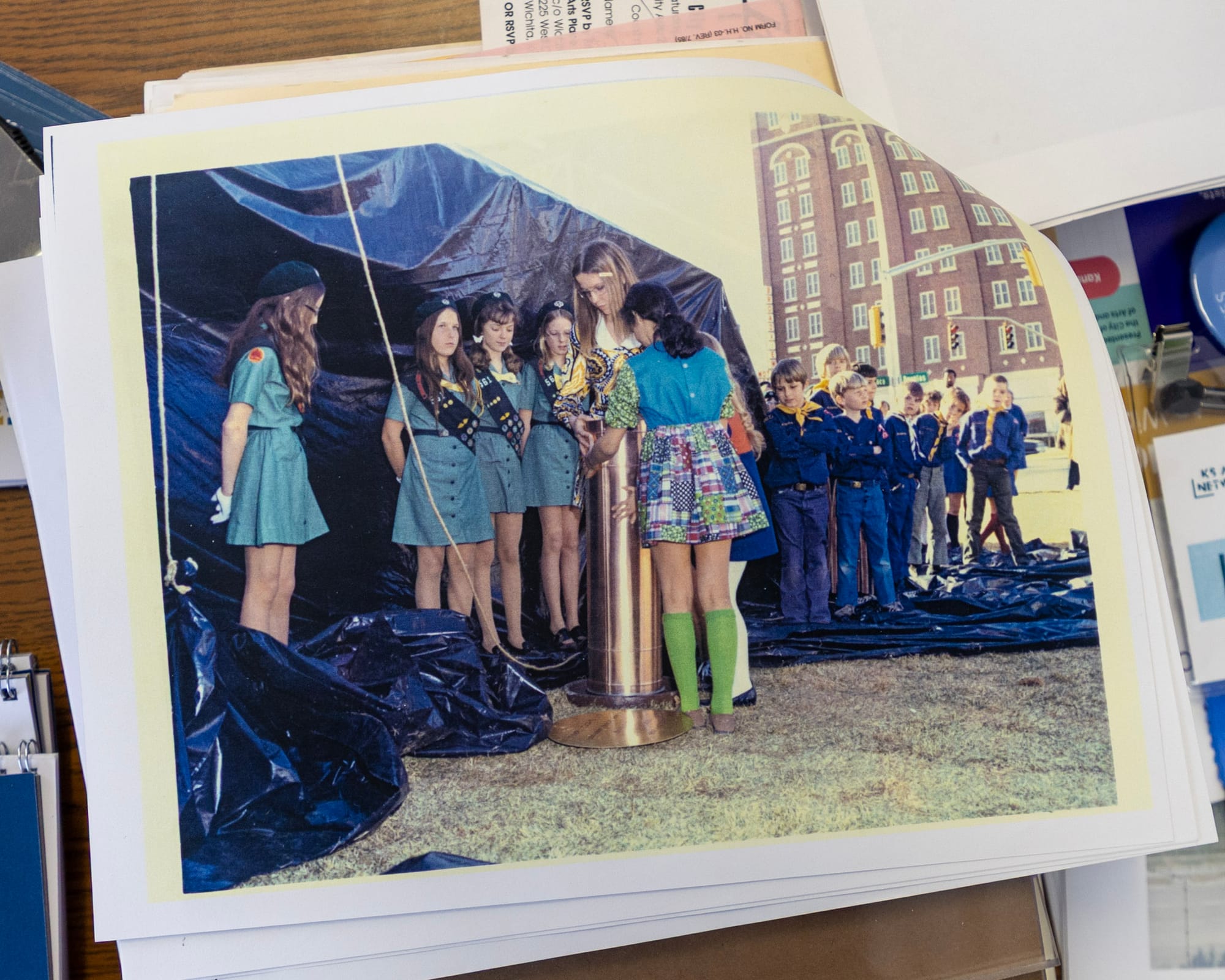
For “Tripodal’s” unveiling on March 8, 1972, the Eagle did not publish a crowd size estimate. The Catholic Advance, which was frankly hostile toward the whole project, reported that “a record number of about 200 persons were present.” A front-page photo in the Eagle shows a sparse crowd arrayed on the grass west of Kennedy Plaza, while dignitaries packed onto an elevated viewing platform. Tripodal was ringed by Boy and Girl Scouts as the sculpture was unveiled.
“From this touching little ceremony today, you already have the feeling it’s owned by the community. There’s a sense of pride in it,” O’Doherty, the NEA official, said. “The people who don’t like it now aren’t afraid of having their say on art, and that’s good. They’ll be educating themselves through their anger.”
“Tripodal’s” appearance on a busy downtown corner brought it to the attention of many Wichitans who had paid little notice to the buildup of media coverage over the past two years. On Saturday, March 18, KLEO disc jockey Mike Miller and a crew of volunteer welders and painters held their own unveiling at the corner of Harry and Oliver, in the presence of “several hundred people,” according to the Eagle.
The “KLEO Tripodal” cost just $90, instead of $90,000. It was a literal pile of junk, matching Miller’s angry description of “Tripodal”: a dilapidated jalopy piled high with radiators, bicycles, muffler pipes, and other odds and ends. Trying to be a good sport, city commissioner Gary Porter attended and commented that this second sculpture “could set the Century II Committee back another century.”
A month later, a “mysterious piece of art,” described by passersby as a “white statue or blob,” made its appearance beneath “Tripodal.” The blob, about 5 feet 10 inches high and made of plaster of paris, sported a sign saying: “Our contribution to art — tax free.”
On Halloween of 1972, another anonymous jokester put up a sign saying “For sale by owner,” again likening the Rosati to junk left out by the curb.
The 1971–1972 school year had been the first in which Wichita Public Schools implemented mass desegregation busing, a step the district was forced to take under threat of loss of federal funding. “Tripodal’s” debut — a piece of inexplicable art stamped with a seal of approval from DC bureaucrats — contributed to a general sense of grievance against the government among the city’s white residents. On November 20, 1972, the Eagle reported that a citizens group, “Please Listen Inc.,” had been formed “over concerns about local government’s lack of responsiveness to the people’s voice.”
The group’s spokeswoman said “no one issue or incident” prompted forming the group, but rather an “accumulation” of concerns: forced busing, “violence in schools” — and “the $100,000 Tripodal sculpture at Century II.”
Discussion of “Tripodal” tapered off after 1973, but surged again in January 1996, when the Eagle broke the news that its inner steel armature was “rusting to death.” A local firm, Brothers Julian Sculpture, estimated the repair cost at $200,000. Public Art Advisory Board member Dora Timmerman said that she didn’t relish the idea of trying to raise that sum from private donors, let alone asking taxpayers to foot the bill.
“If it were a piece that the community really, really wants as a whole, then that’s one matter,” she said. Her instinct was backed up by the result of an Eagle telephone call-in poll: a majority of callers, 449, favored letting the sculpture go, while 399 said that somebody — not necessarily taxpayers, but somebody — should pay to save it.
In June of the following year, the advisory board and union representatives announced a solution that required neither fundraising nor public funds: a complete overhaul “to be carried out through an extraordinary collaboration between area trade unions, vendors and service companies,” entailing volunteer labor “valued at $80,000 but free to the city.” Workers disassembled “Tripodal” on June 28, 1997, anticipating its return in “about 45 days.”
On January 12, 2002 — nearly five years later — two cranes lowered the 11-ton structure back into its place on the lawn outside Century II.
The volunteer-driven plan had perhaps saved “Tripodal” from the scrap heap, but the union tradesmen were, naturally, pretty busy with paying work. Thousands of hours of labor were ultimately donated to the restoration project, just over a much more extended timeline. The city of Wichita also ended up kicking in $9,000 to buy some replacement steel panels, and CityArts hired professional restorer Randy Julian, of Brothers Julian, “to re-create the surface’s brushed-texture finish.”
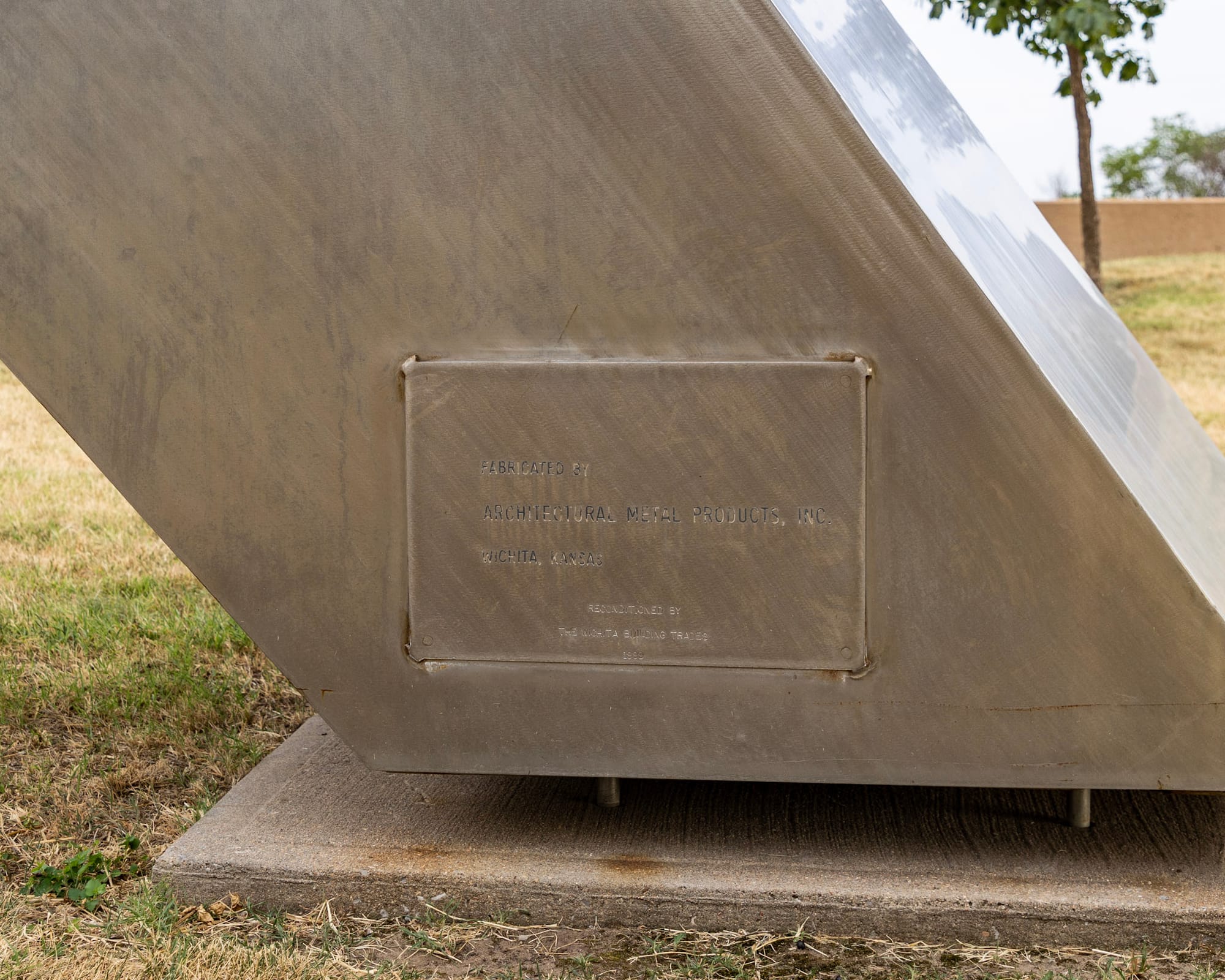
“Tripodal’s” return still left one loose end: a time capsule.
The sheaf of student signatures that was handed over in 1971 was then sealed into a metal cylinder and buried beneath the sculpture at its unveiling with a plan to unearth it and open it 25 years later — right around the time “Tripodal” was being disassembled and removed from view. It’s not hard to see why nobody chose that occasion to throw a party for the sculpture’s silver anniversary.
Wichita’s public art staff cannot say with certainty when the tube left the ground; the likeliest guess is that it surfaced during the removal, when the leg it sat beneath was already being dug out. Perhaps someone meant to open it 45 days later, when the sculpture was supposed to be back. But 45 days became five years, staff turned over, and the capsule slipped everyone’s mind.
It slipped so thoroughly that in 2008, when an Eagle reporter went looking for it, the city’s arts and culture director at the time, John D’Angelo, was under the impression that it had never moved. But the capsule was not under “Tripodal.” It was, it turned out, sitting unremarked in a classroom at CityArts, where staff finally came across it last year.
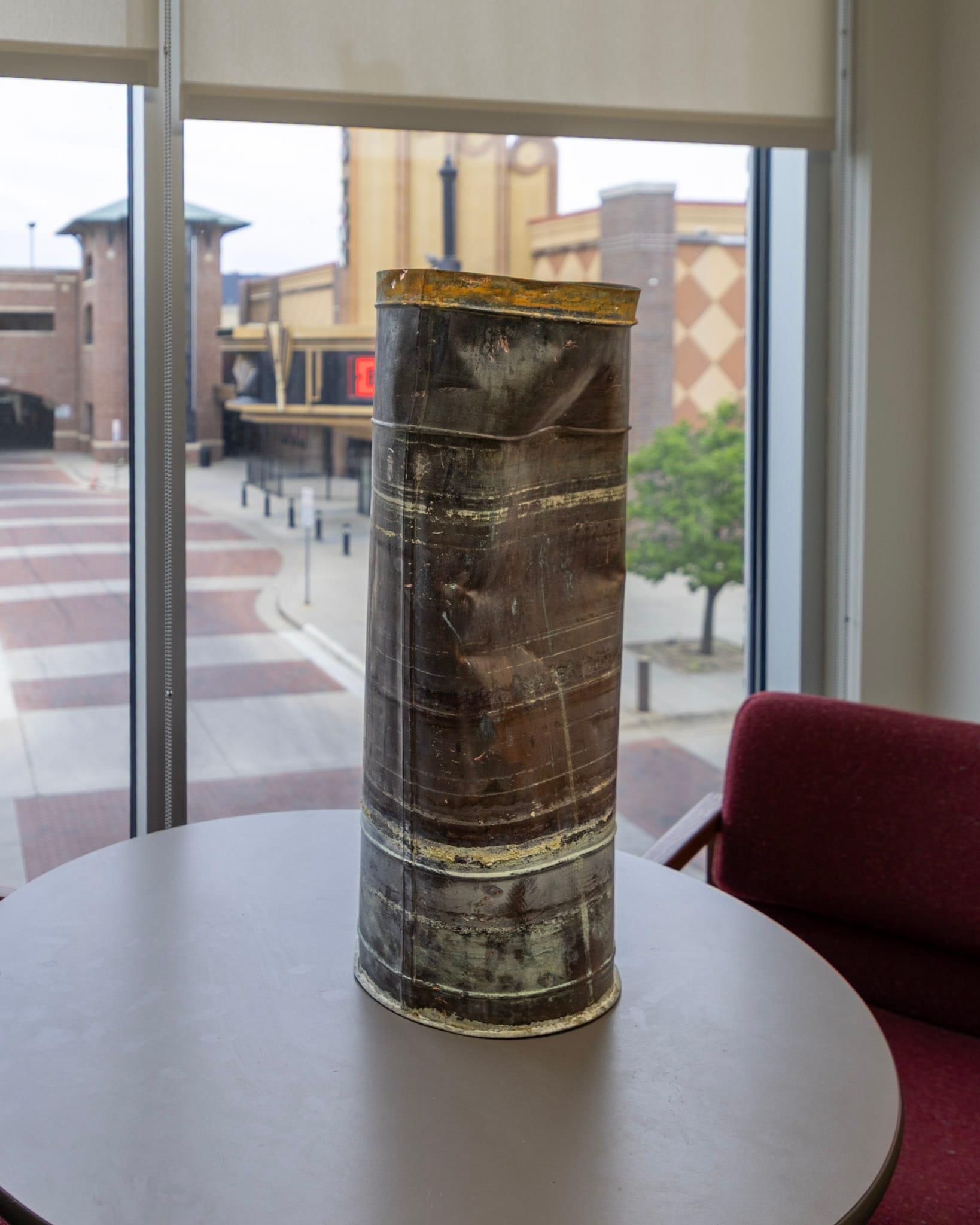
By then, the pages had paid for their years underground. Water had gotten into the tube, and the sheets had been through it — “hot then cold, hot then cold, wet and dried out, repeatedly over the years,” said Michelle Enke, the local-history librarian who took charge of the project of conserving and documenting the capsule’s contents.
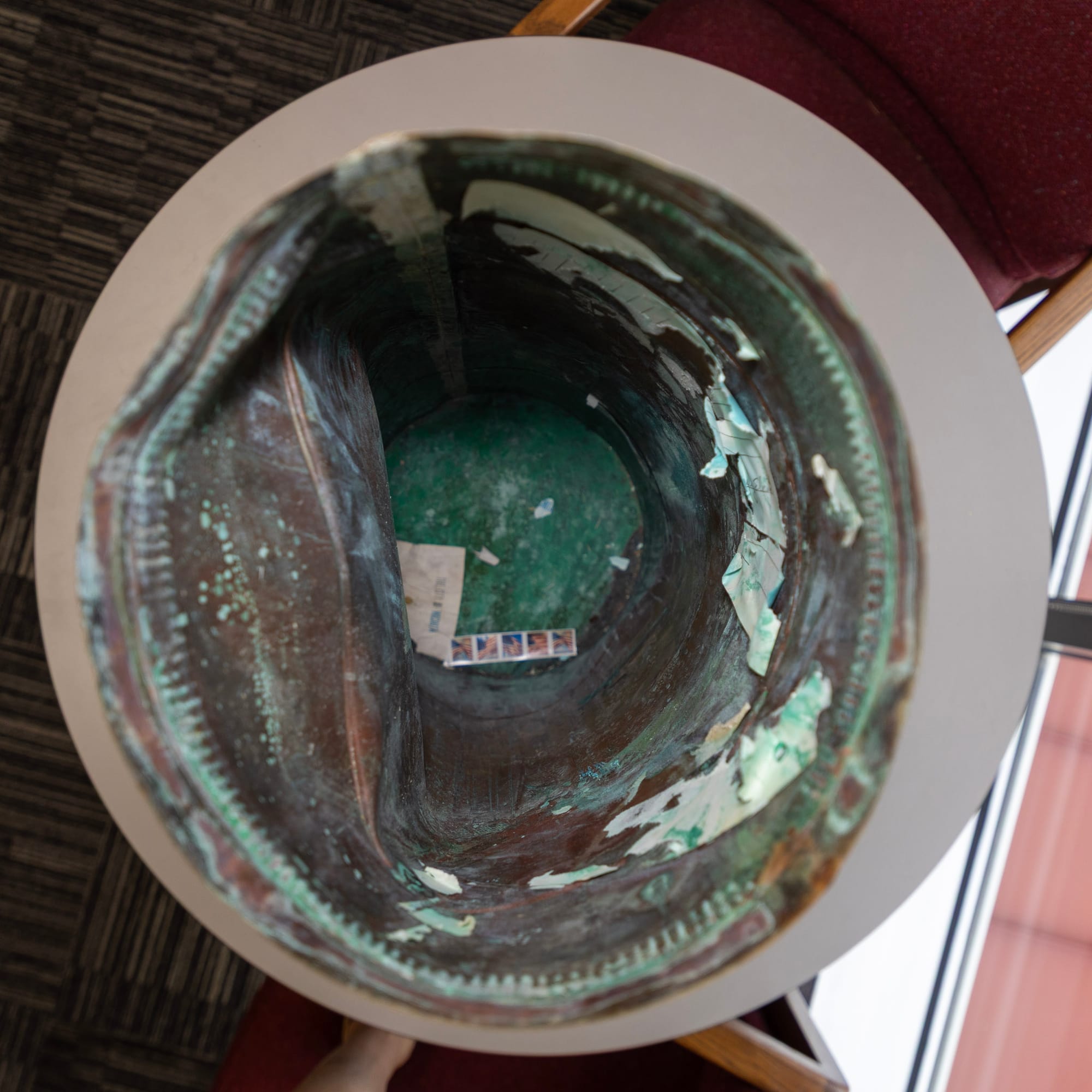
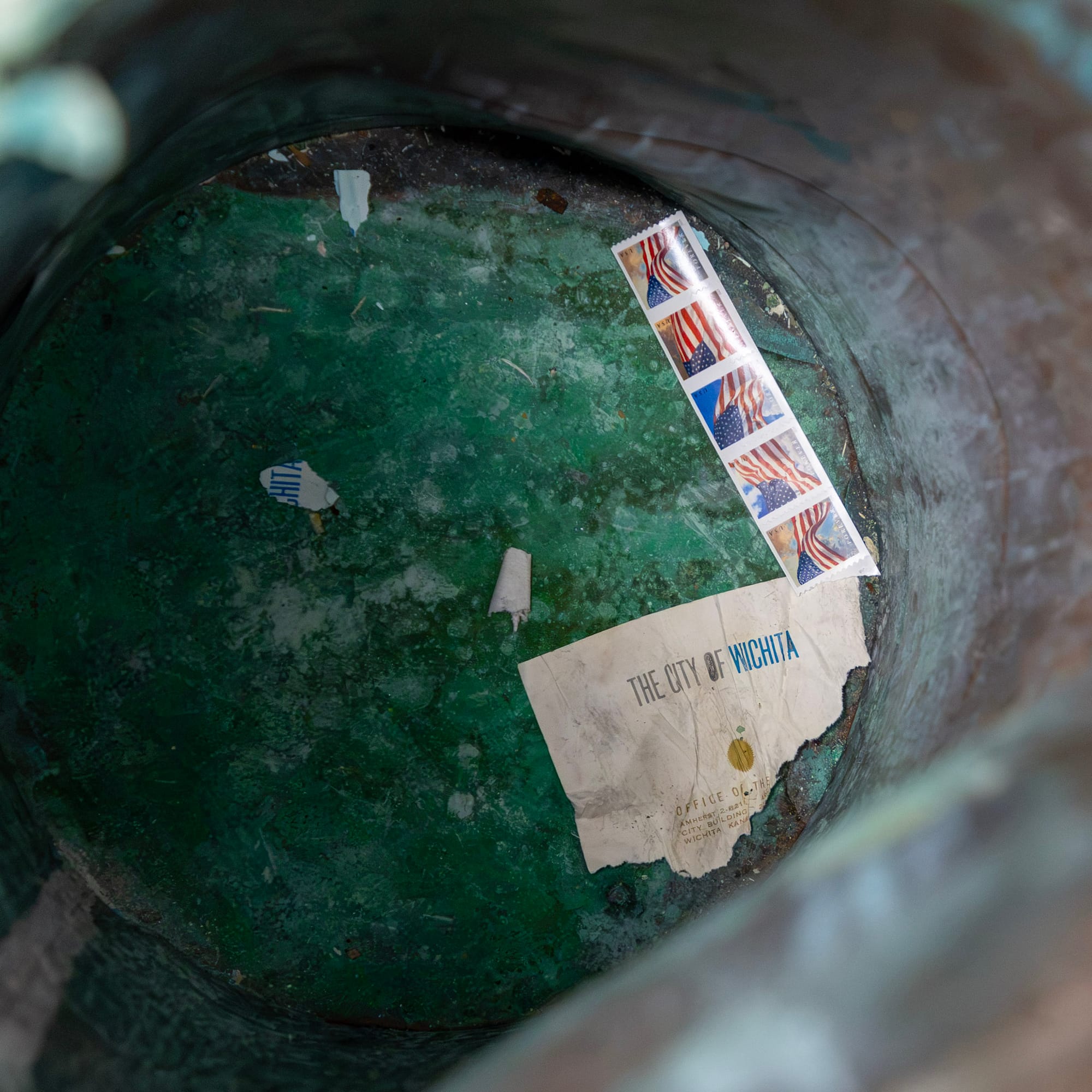
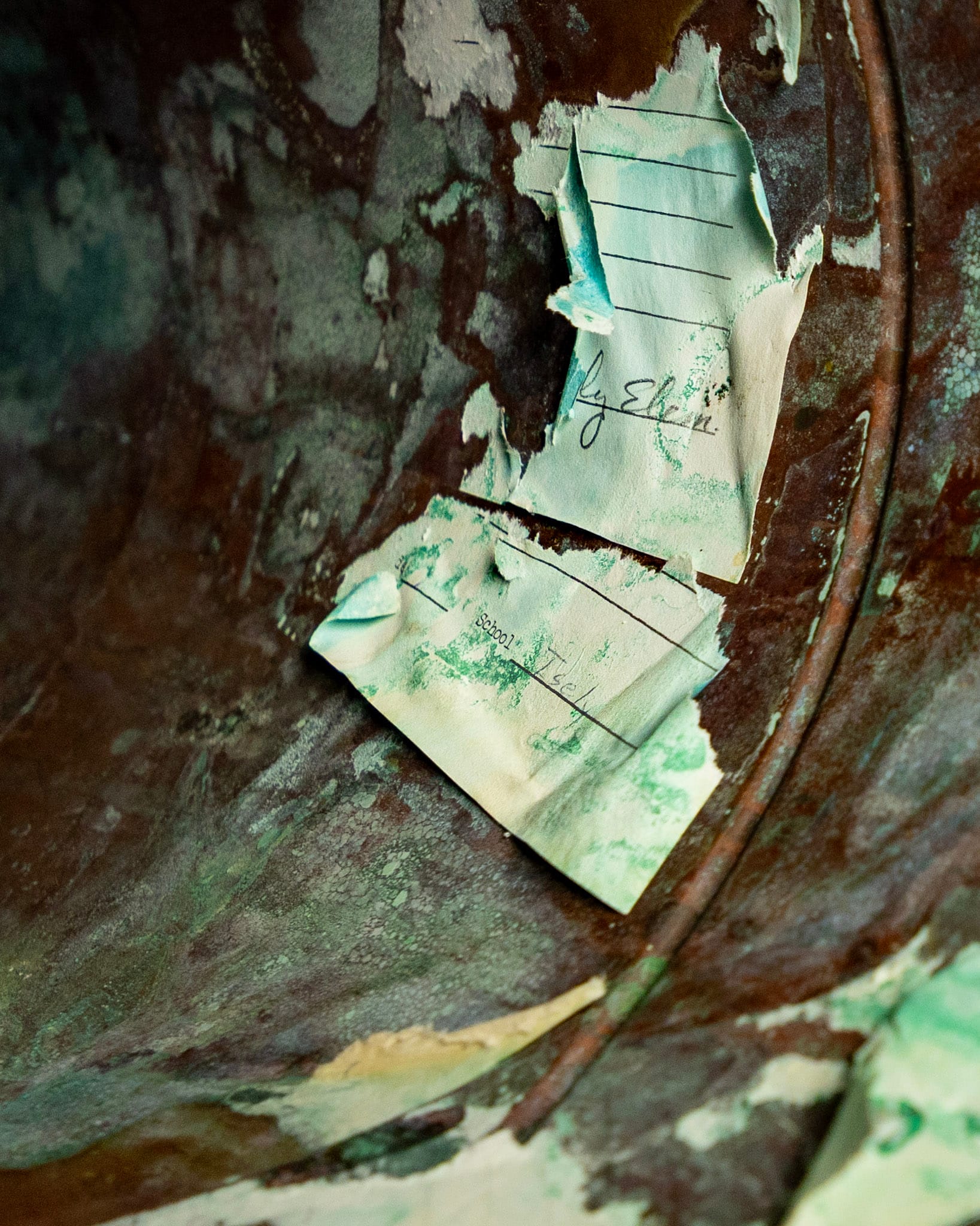
Green oxidation and paper fragments inside the recovered “Tripodal” time capsule. Some pages adhered to the metal and could not be freed; part of an Isely Elementary School student's signature remains legible on one. Photos by Kendra Cremin for The SHOUT.
When the capsule reached the Wichita Public Library, the stationery inside had accordioned, slumped, and fused into a single stuck mass. Library staff and volunteers eased the sheets apart, sorted them by school and then by grade, and set about the delicate work of making them flat enough to scan. The mayoral stationery had good fiber content, as it happened, so one volunteer brought in her iron and pressed the pages on its lowest setting. It took nearly four days, but the pages flattened out beautifully, allowing them to be scanned.
The scans now live on the library’s digital archive, with names transcribed and searchable, so the Wichitans who were schoolchildren in 1971 can go and find their own signatures. (Not all of them will. About one page in 20 came out of the ground unreadable.)
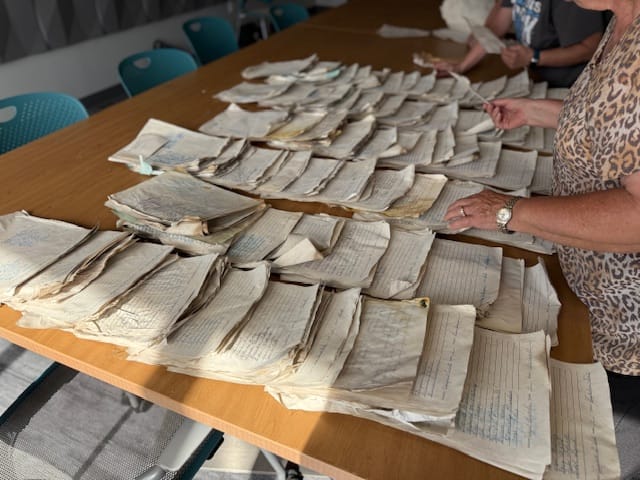
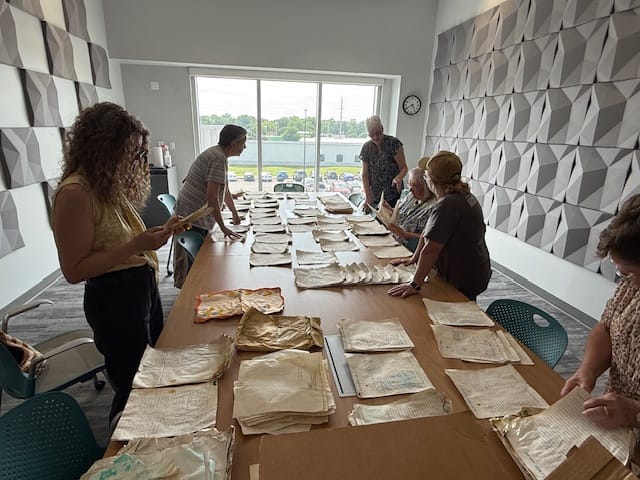
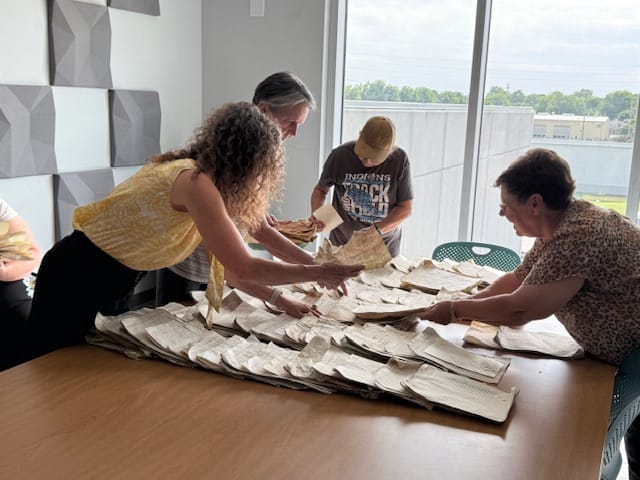
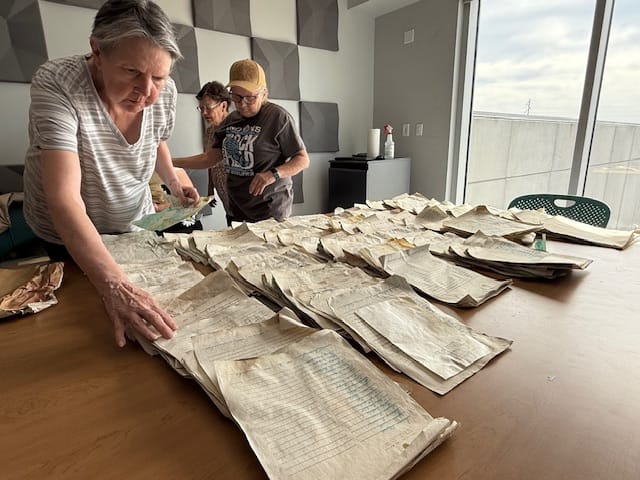
Volunteers at the Advanced Learning Library and public art manager Jana Erwin separate and sort through the signature pages recovered from the time capsule — crumpled after decades underground — before the painstaking work of flattening, scanning, and indexing them began. The pages are now part of the Wichita Public Library’s digital archive. Photos courtesy of the City of Wichita.
There is a small irony folded into all of this, which is that the 1972 capsule had a predecessor. It replaced an earlier one, a 1950 “time cylinder” of elementary-school signatures, eight volumes of them, sponsored by the Eagle. That capsule was pulled from the ground at some point, displayed at the historical museum and a few other places, and slated for reburial. It never went back. The books drifted, eventually, to the library; the rest of what was in it has never been found. Wichita, it seems, has been sealing its children’s names into cylinders and then misplacing them for the better part of a century.
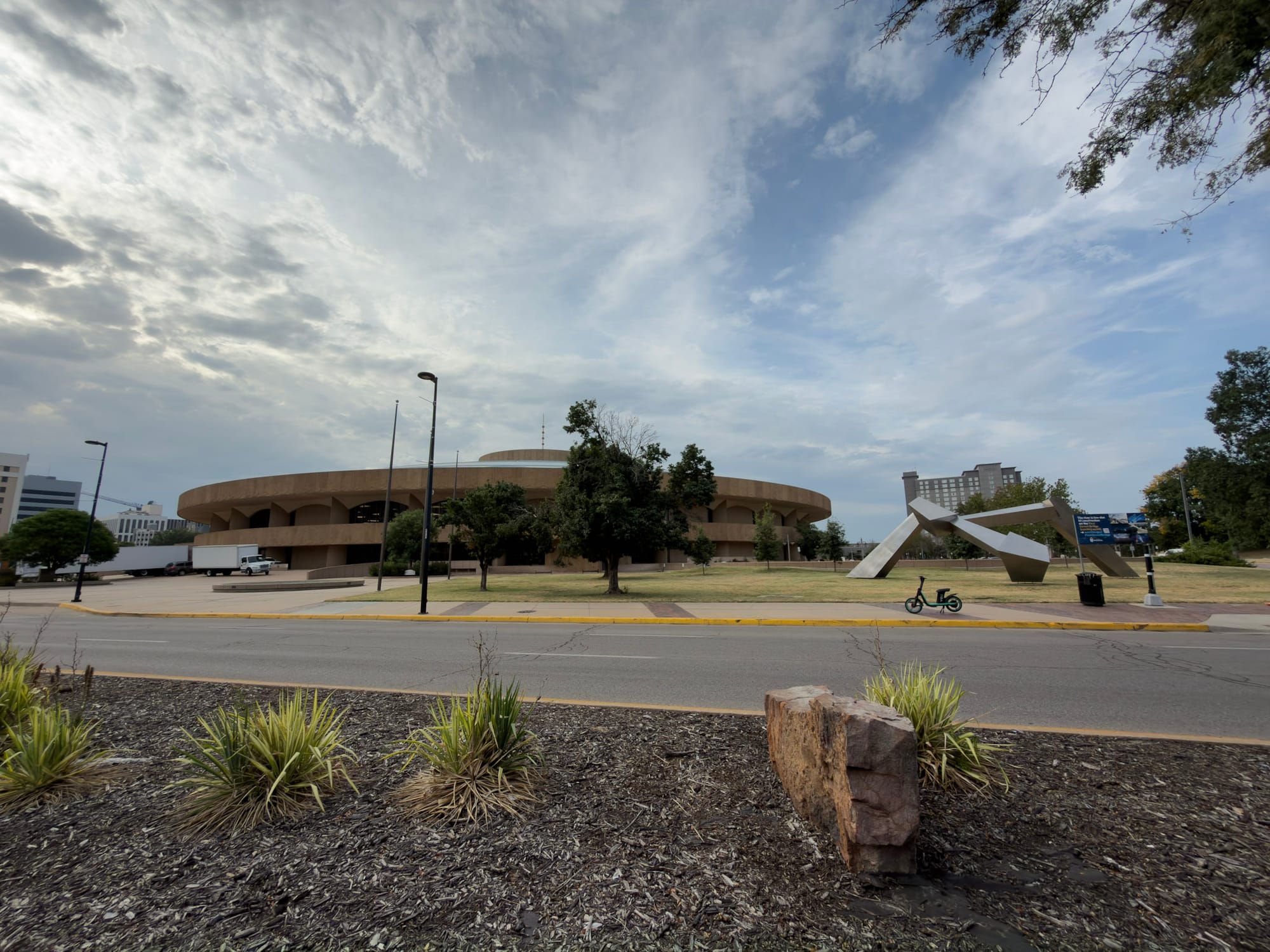
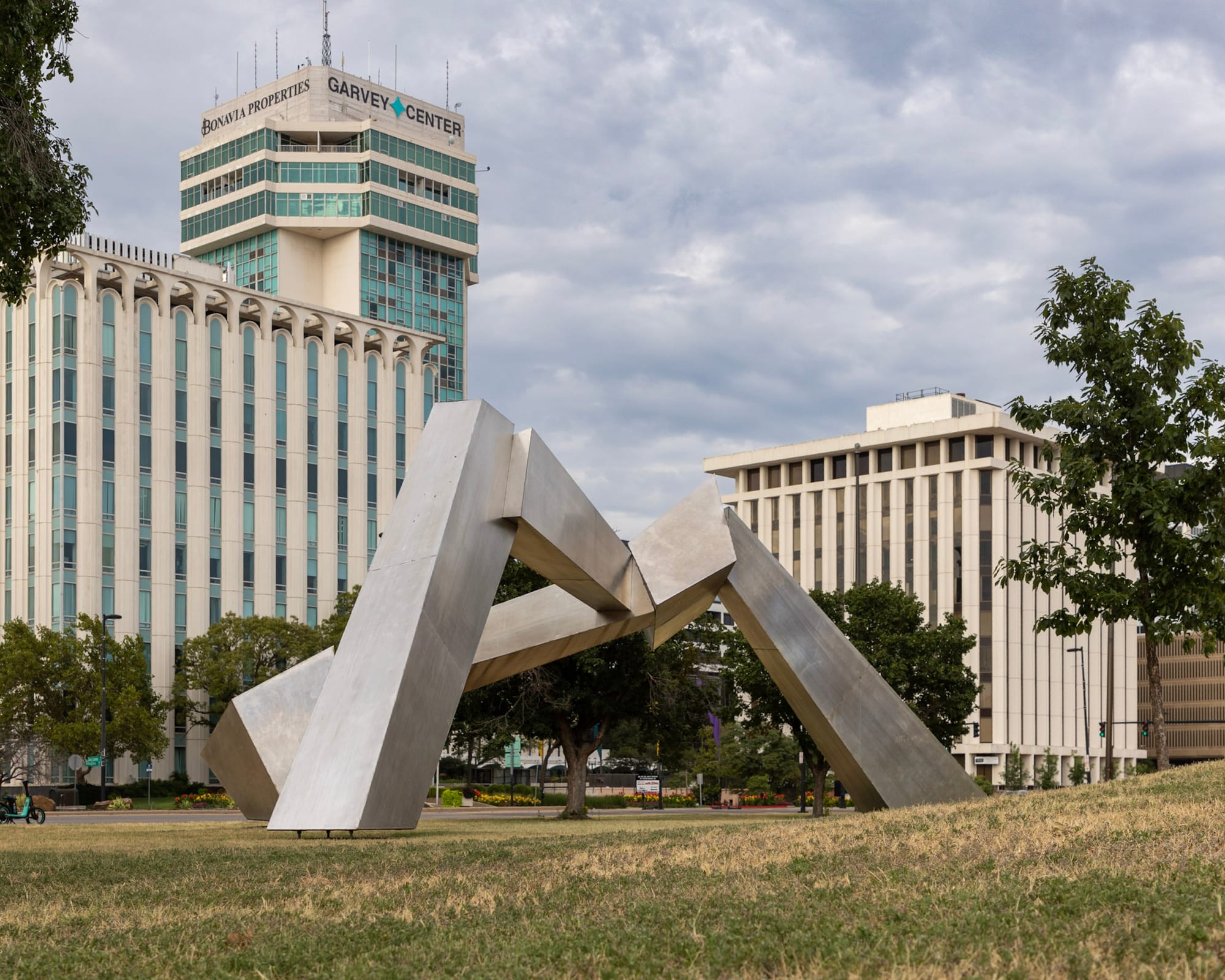
“Tripodal,” meanwhile, has somehow avoided being misplaced. Wichitans debated moving it in front of City Hall, to the grounds of the Wichita Art Museum, or elsewhere. But Rosati said in 1977 that he preferred to keep it where it was, and there it has stayed: three tapering legs on the lawn between Century II and the street. Wichita has kept it, if not out of love then out of responsibility — out of a desire not to be the sort of city that would let something like that go.
But to that impertinent question — what is that supposed to be? — there’s still no answer.
“It’s like plucking a rose from a bush and sticking it in a vase,” Rosati said in a 1970 interview. “Why does someone have to ask what it means? Why can’t he let me have the joy of the flower? I don’t think art’s any different.”
“Tripodal” is still there, after the turmoil and exasperation of half a century, where anyone can go and take a look at it. Hundreds of people drive past it every day.
The Details
James Rosati, “Tripodal”
Stainless steel and steel (alloy)
The sculpture is located at 225 W. Douglas Ave. in downtown Wichita.
Learn more on the Public Art Archives page for “Tripodal.”
Sam Jack is a poet, a classical tenor, and the adult services librarian at Newton Public Library. He performs with several local groups, including Wichita Chamber Chorale, Wichita Grand Opera, and Opera Kansas. He received a Master of Fine Arts in creative writing from the University of Montana.
❋ Derby man has the kind of voice that turns heads — and chairs
❋ Socializing while sober: how some Wichitans are cultivating alcohol-free communities
❋ As a small creative business closes, the owner mourns
❋ Painting through it: Autumn Noire on 20 years of making art
❋ How a guy from Wichita resurrected 'Dawn of the Dead'
❋ Bygone Friends University museum housed curious collections
Support Kansas arts writing
The SHOUT is a Wichita-based independent newsroom focused on artists living and working in Kansas. We're partly supported by the generosity of our readers, and every dollar we receive goes directly into the pocket of a contributing writer, editor, or photographer. Click here to support our work with a tax-deductible donation.