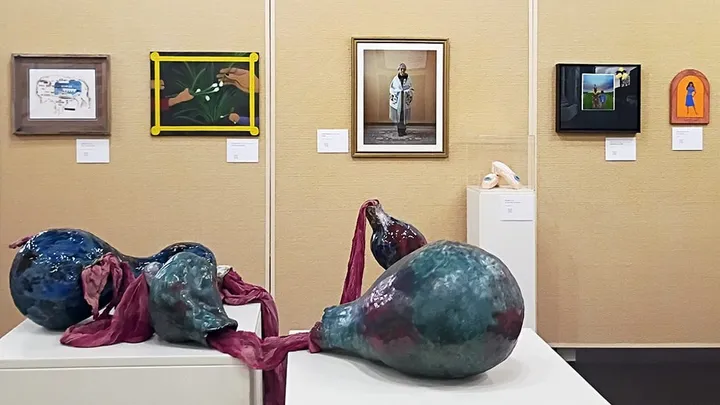
Richard H. Alpert shows Seuss-like sculptures at Pittsburg State University
The works in Alpert's exhibition "Primary Traces," asks visitors to utilize their imagination and enter a state of wonder.
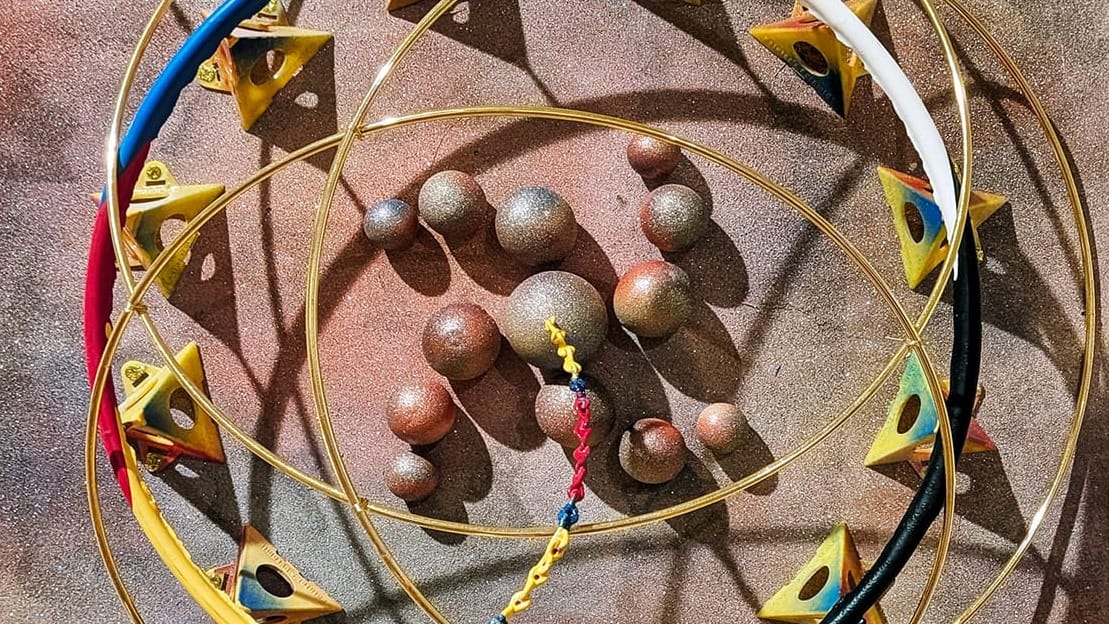
What is the purpose of a toy? It can be educational, entertaining, challenging, used alone, or with a group of friends. With a toy, one can simulate scenarios, emulate heroes, and broaden the imagination. Toys employ a range of stimuli to elicit a variety of behavioral or biological responses. In other words, the purpose of a toy is to stimulate the brain and senses. The wide spectrum of toys and play is the subject of Richard H. Alpert’s evocative exhibition “Primary Traces,” on view in Porter Hall at Pittsburg State University in Pittsburg, Kansas, through May 18.
I typically visit art exhibitions alone so I can fully engage with the work, make notes, photograph, and ponder without being rude to a companion. But Pittsburg State University is close enough to the regional art mecca of Bentonville, Arkansas, that I added it to my visit and invited my mom along for a full weekend art excursion. This was the perfect exhibition to bring along a companion with a good sense of humor, and we had great fun together interpreting Alpert’s forms alongside their titles.
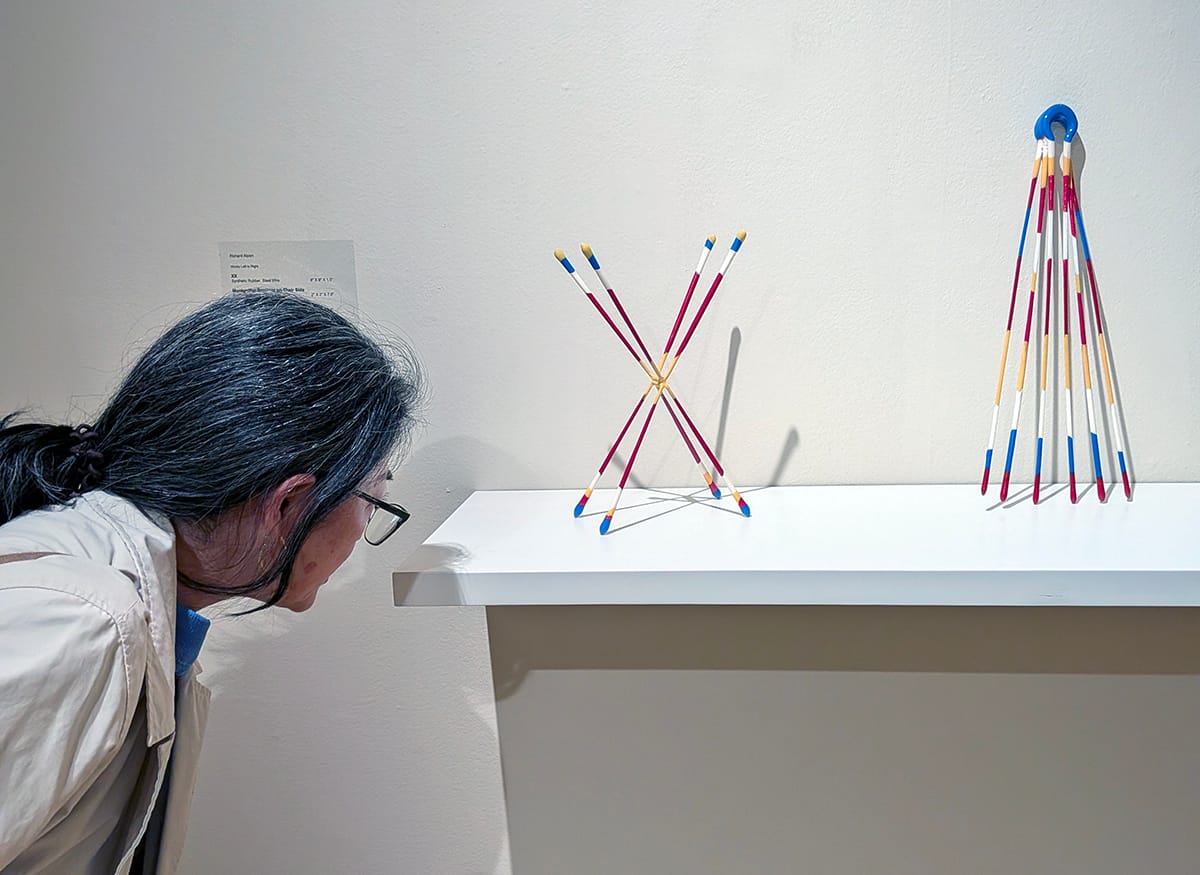
The University Gallery is the largest of the three galleries within the three-story art department in Porter Hall, formerly used as the original library at Pitt State. Smaller works are displayed in thematic groupings on shelves and thoughtfully arranged pedestals along the walls and circling the load-bearing column in the center of the gallery. Larger works hang balanced on pivot points on the wall and some lie directly on the floor. Created from 2019 to 2025, Alpert’s 35 steel wire and synthetic rubber sculptures, paintings, and multimedia works on display in “Primary Traces” cleverly and elegantly refine the definition of what a toy is and for what it can be used. Alpert’s work invites the viewer to stretch their imagination within the realm of play.
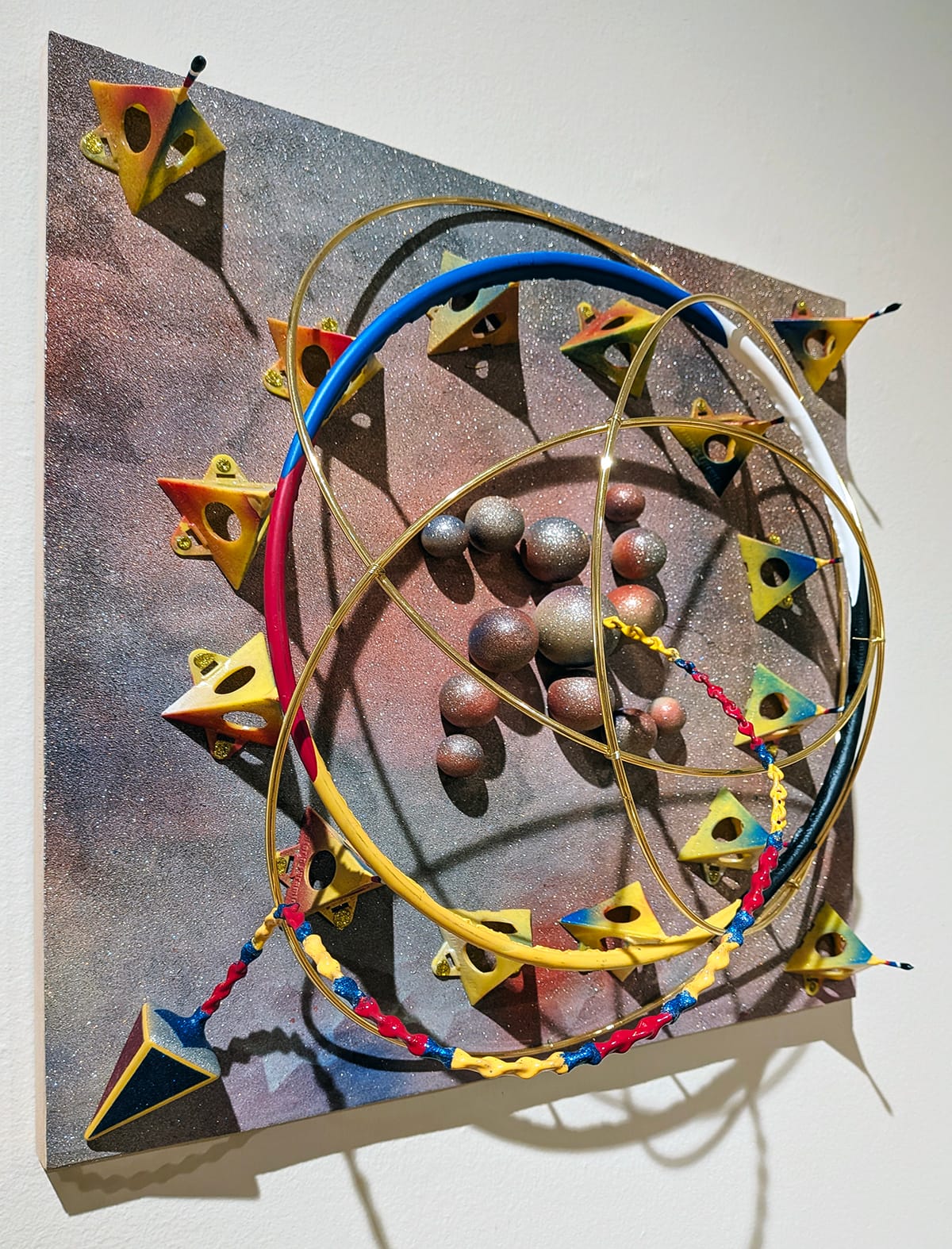
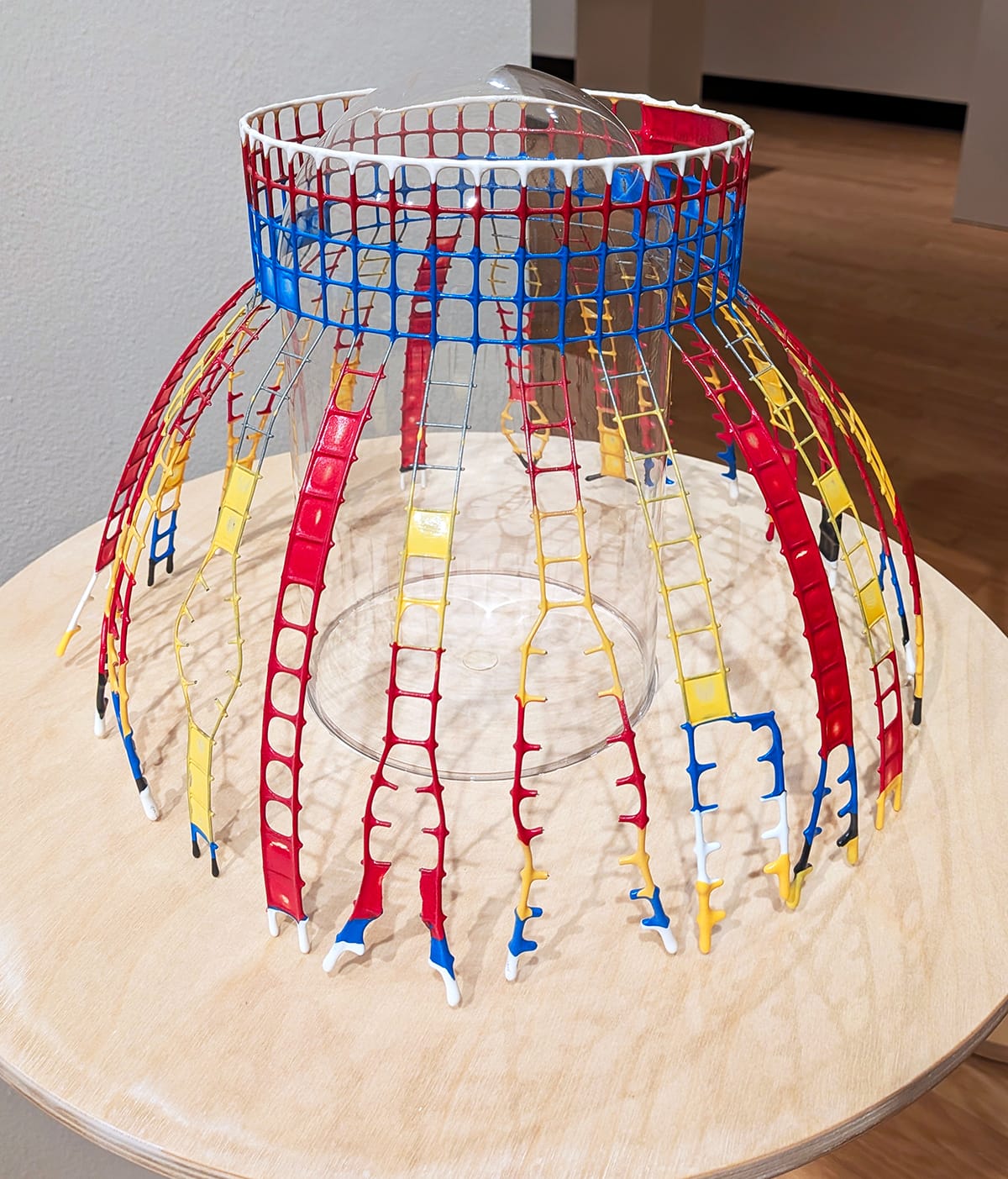
“Within this group, I am exploring the boundary between formal art and playful experimentation,” Alpert writes in a statement on his website. “Using primary colors, whimsical shapes and forms I’m trying to create a state of mind nurtured by imagination, curiosity, and wonder. These sculptures trace this attempt.”
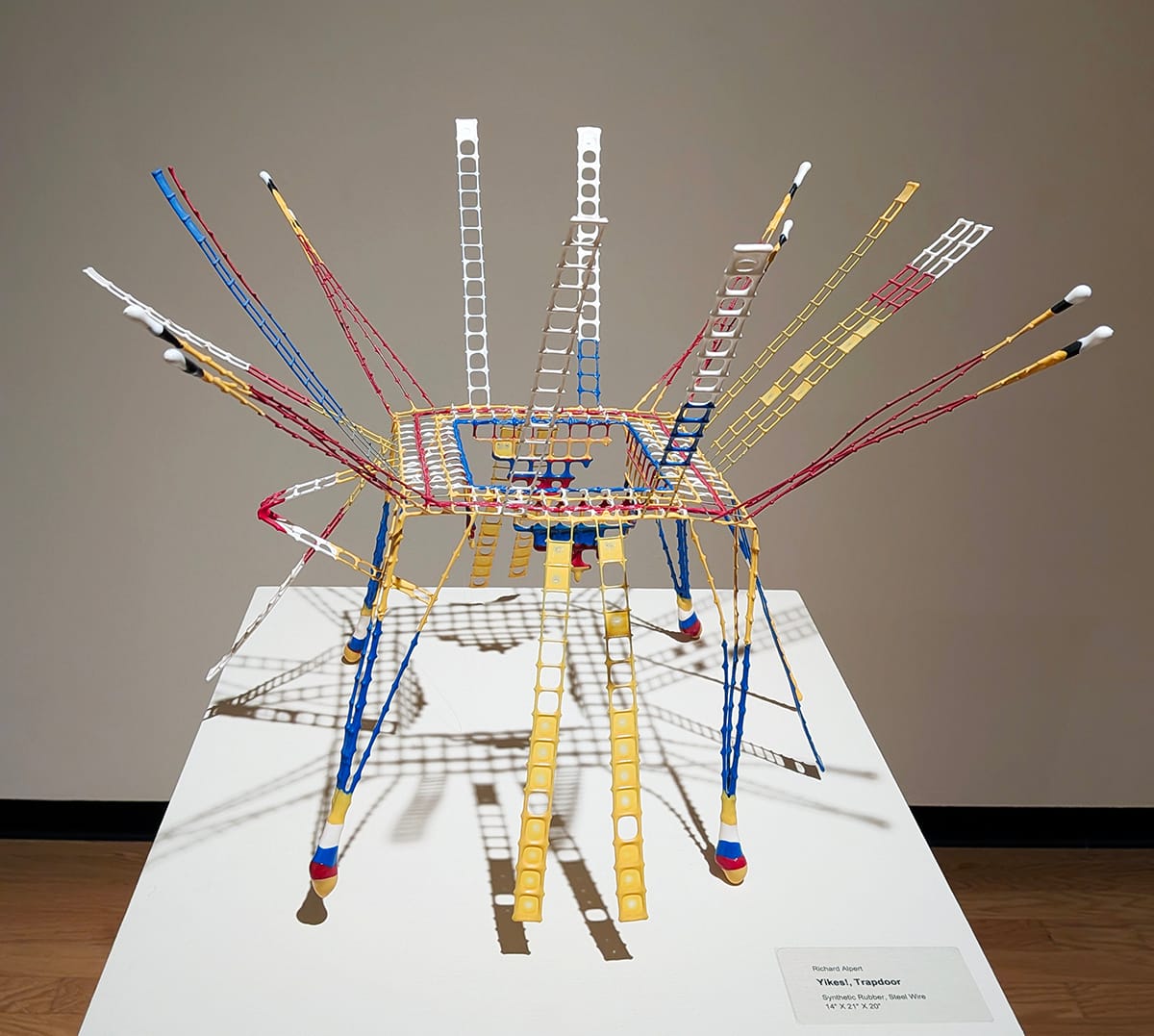
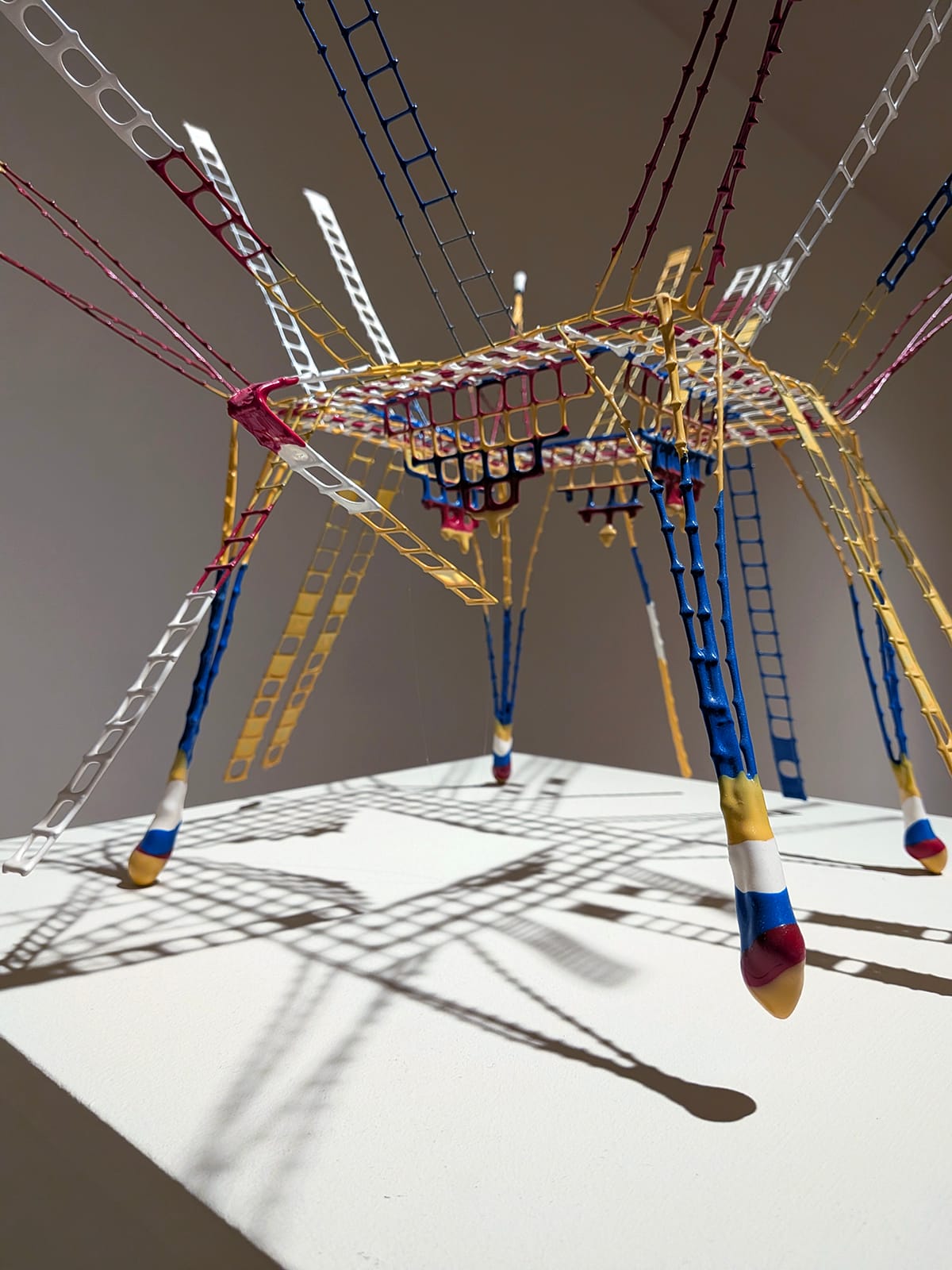
Richard H. Alpert, “Yikes!, Trapdoor,” synthetic rubber, steel wire, 14 by 21 by 20 inches. Photos by Jessy Clonts Day for The SHOUT.
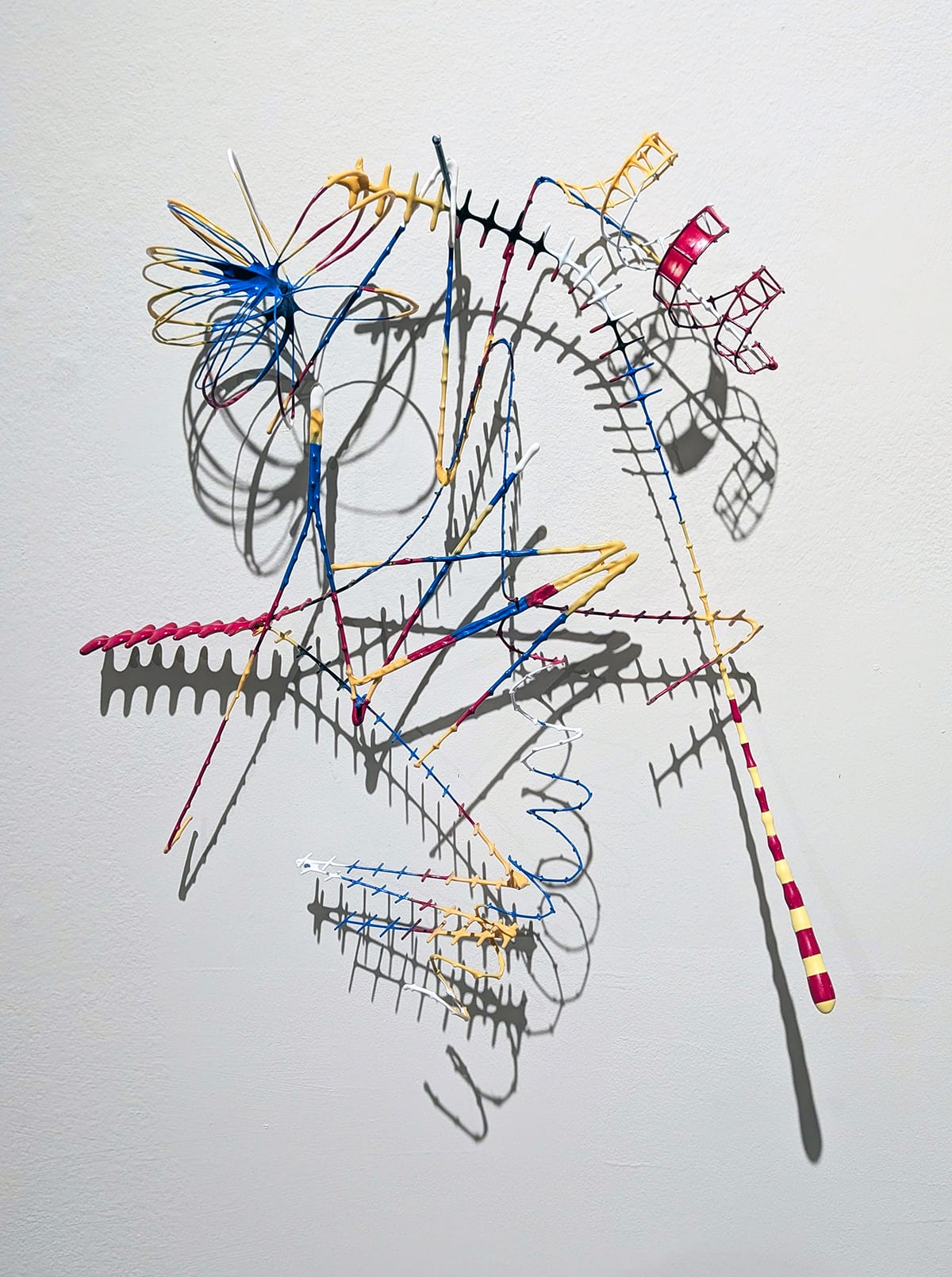
Many of Alpert’s forms, characterized by long, wiry lines or grids ending in ballooning shapes of Mondrian-esque primary colors look like "space toys for Dr. Seuss," as my mom noted. Some forms evoke interstellar vehicles with many ladders split down the middle, like “Crown Down” and “Yikes! Trapdoor,” or bulbous weapons, like “Mars Attacks.”
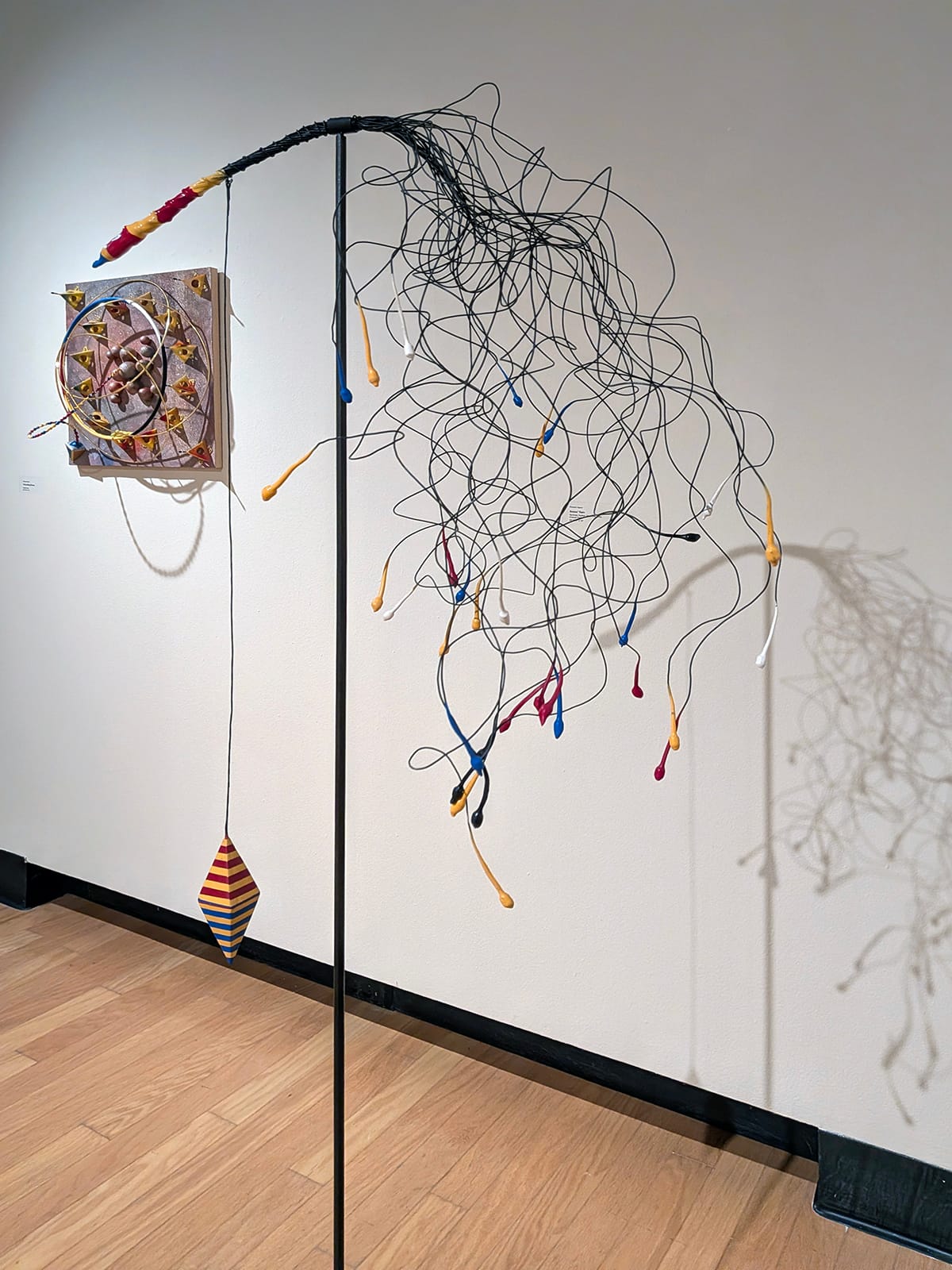
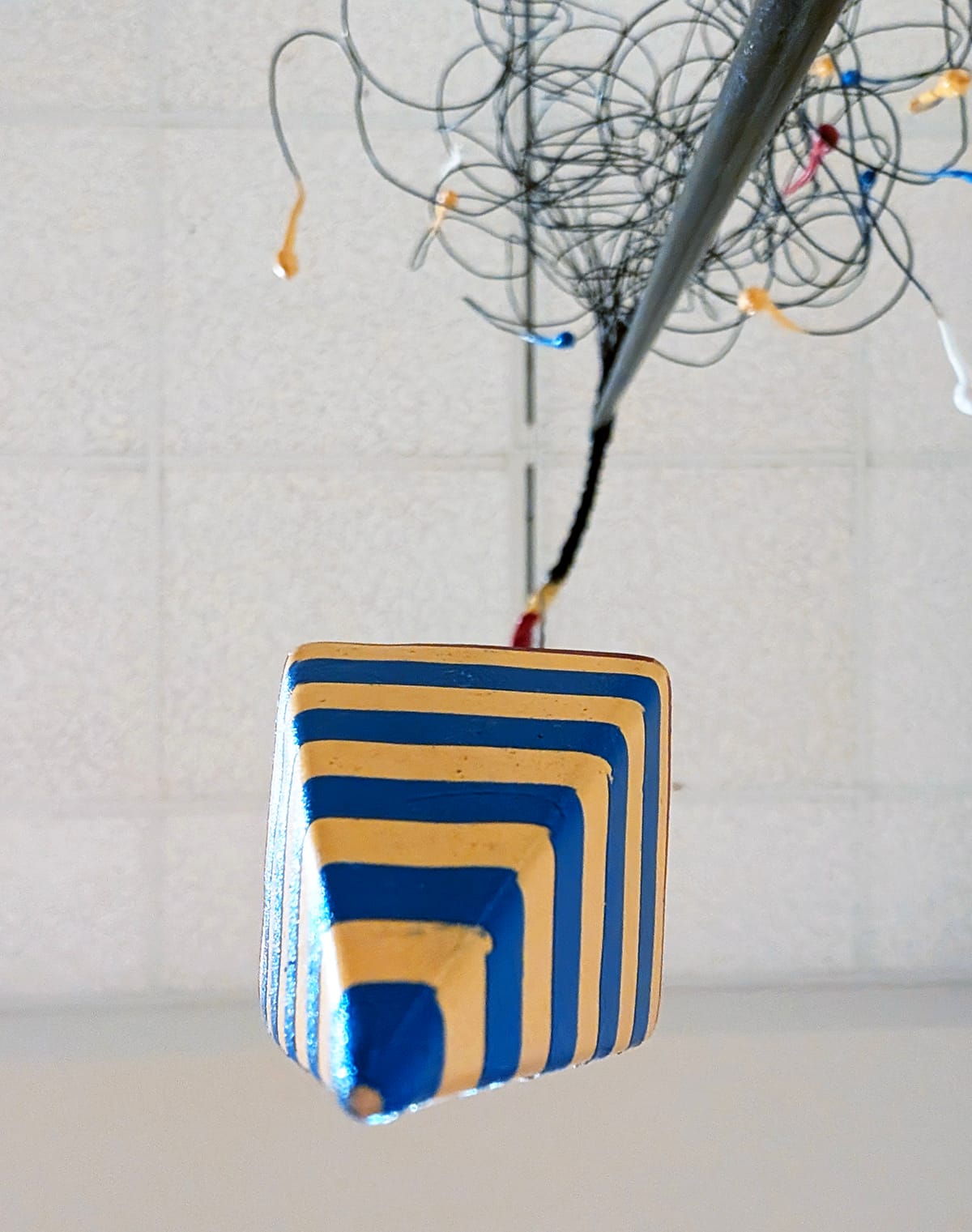
Richard H. Alpert, “Seuss’ Rain,” synthetic rubber, steel wire, lead, enamel paint, 65 by 25 by 15 inches. Photos by Jessy Clonts Day for The SHOUT.
One form titled “Seuss’s Rain” recalls colorful raindrops falling at the ends of a tassel of curly wires, bound together with a tidy red and yellow handle. From the handle hangs, like a pendulum, a three-dimensional diamond, striped-candy red and school-pencil yellow on top, with the same striped pattern in yellow and royal blue on the bottom. Perfectly balanced at its center point on a stand more than five feet tall, the “rain” showered my tiny mom as she delighted in discovering its title, having just described Alpert’s work as “Seussian.”
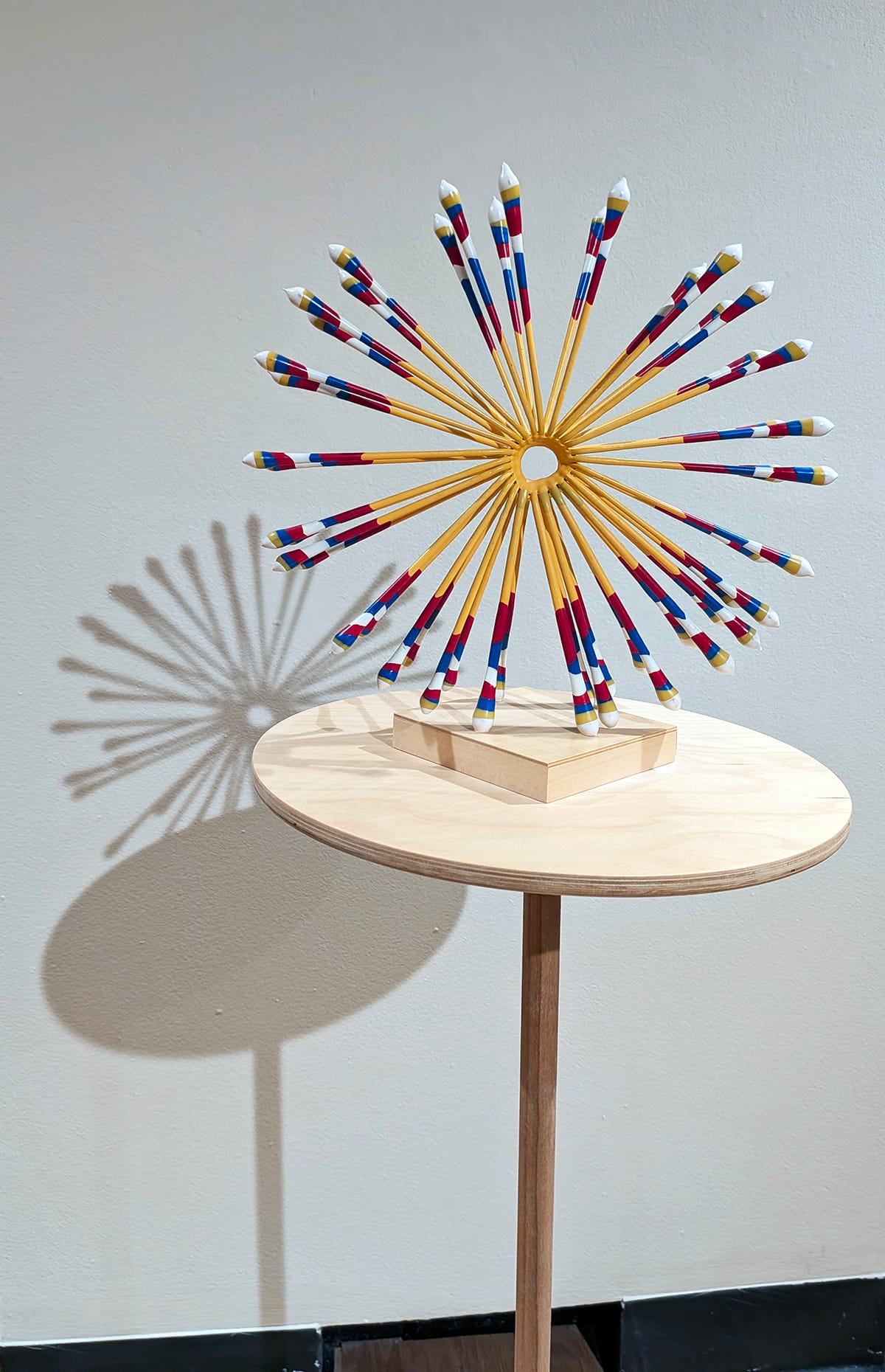
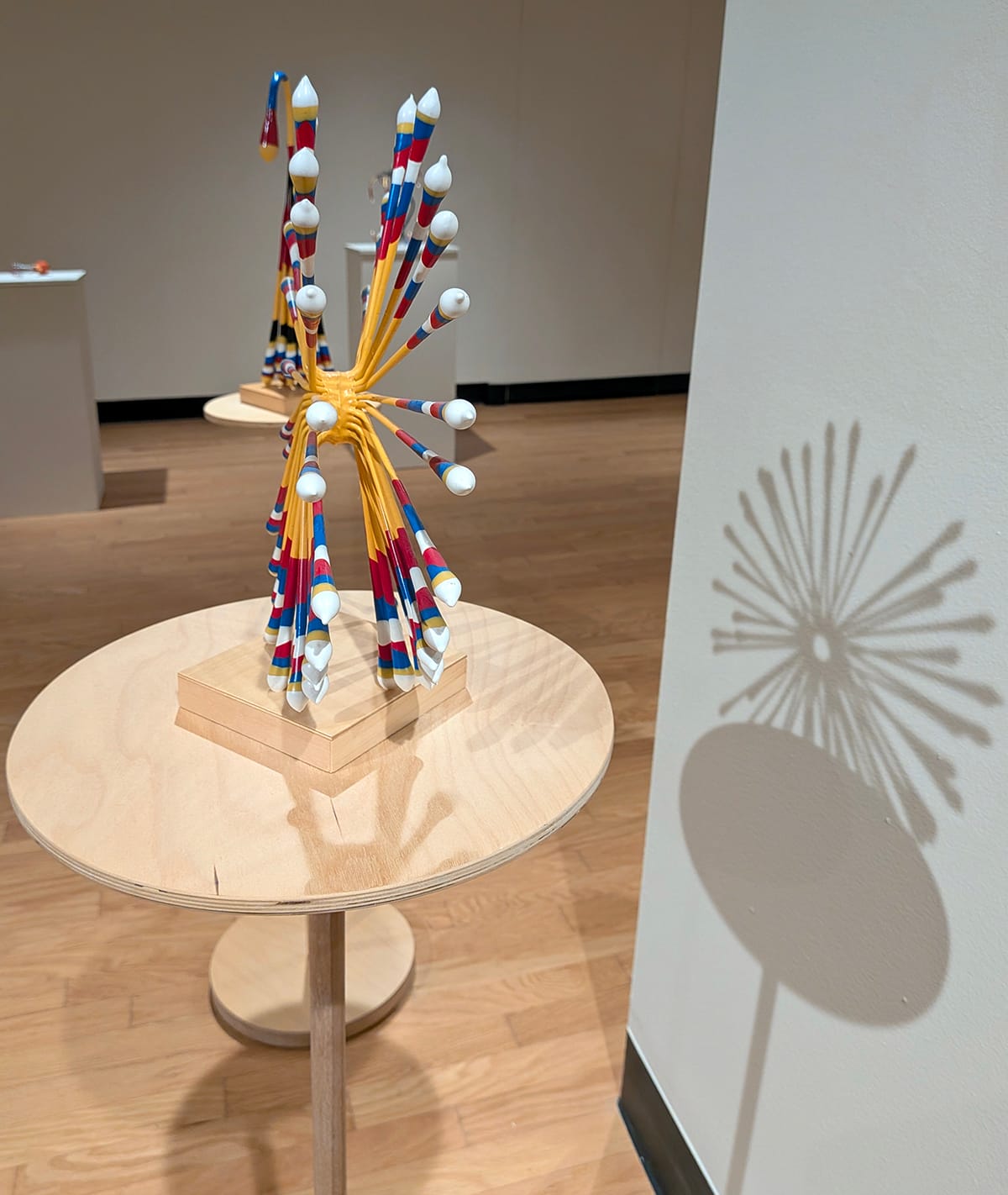
Richard H. Alpert, “Radial,” synthetic rubber, steel wire, 13.5 by 13.5 by 3 inches. Photos by Jessy Clonts Day for The SHOUT.
It was difficult to photograph the slight, wire structures on the gallery shelves and pedestals — many are under 1 foot in height though not lacking in form. They cast fascinating shadows, particularly “Radial,” a wheel of spokes dipped in white, yellow, green, red, and blue around a yellow center, and the spirals and zigzags of “Elements,” which is reminiscent of the board game Mouse Trap — a game that teaches children the basics of kinetic energy through building simple machines out of levers and cranks. Alpert names a spectrum of influences for his practice, including physicist Richard Feynman, sculptor Bill Geis, conceptual artists Bruce Nauman and Marcel Duchamp, engineer Gustav Eiffel, and historian Jacob Bronowski. He no doubt drew from this long list of engineer and physicist influences to create this work.
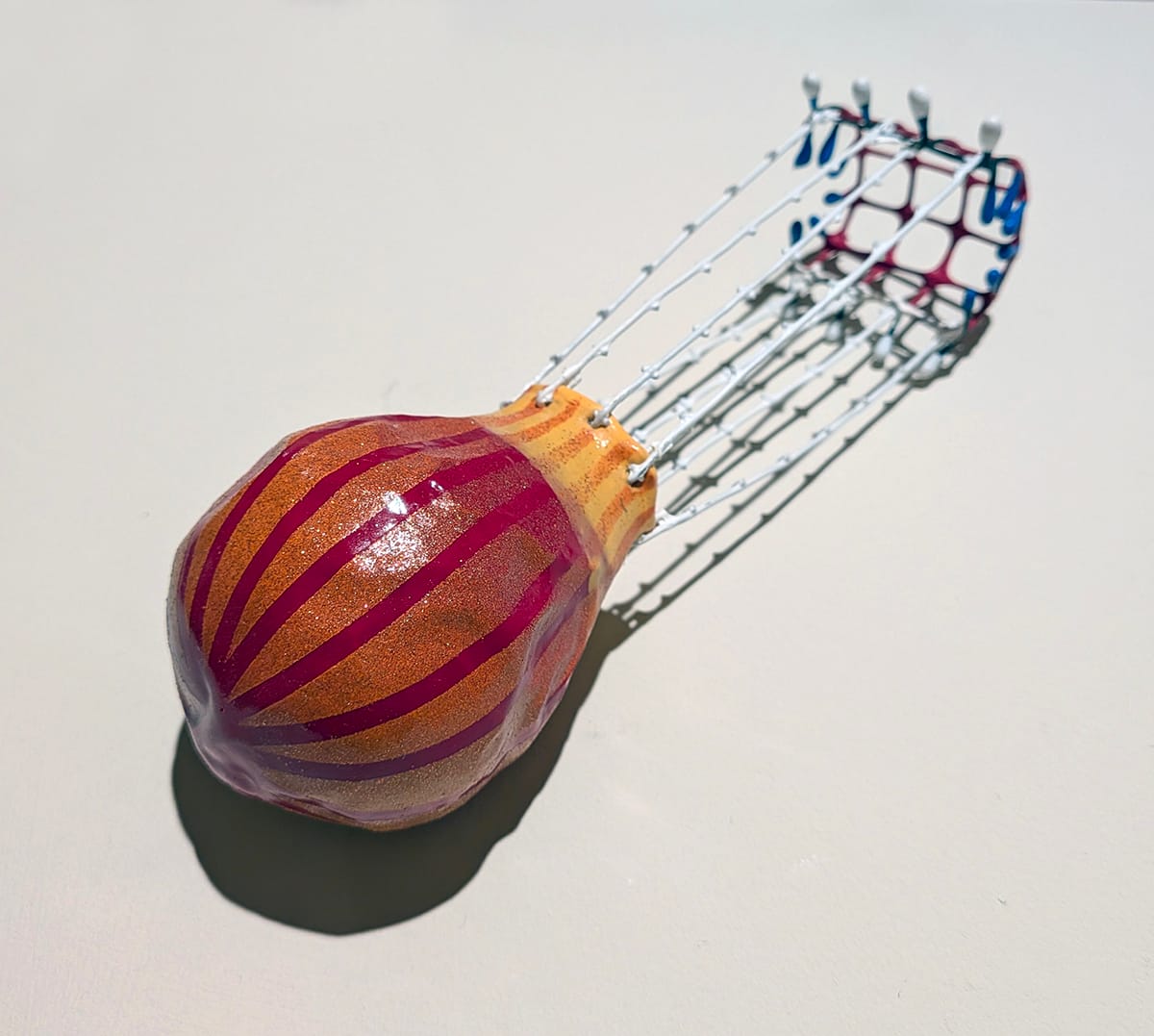
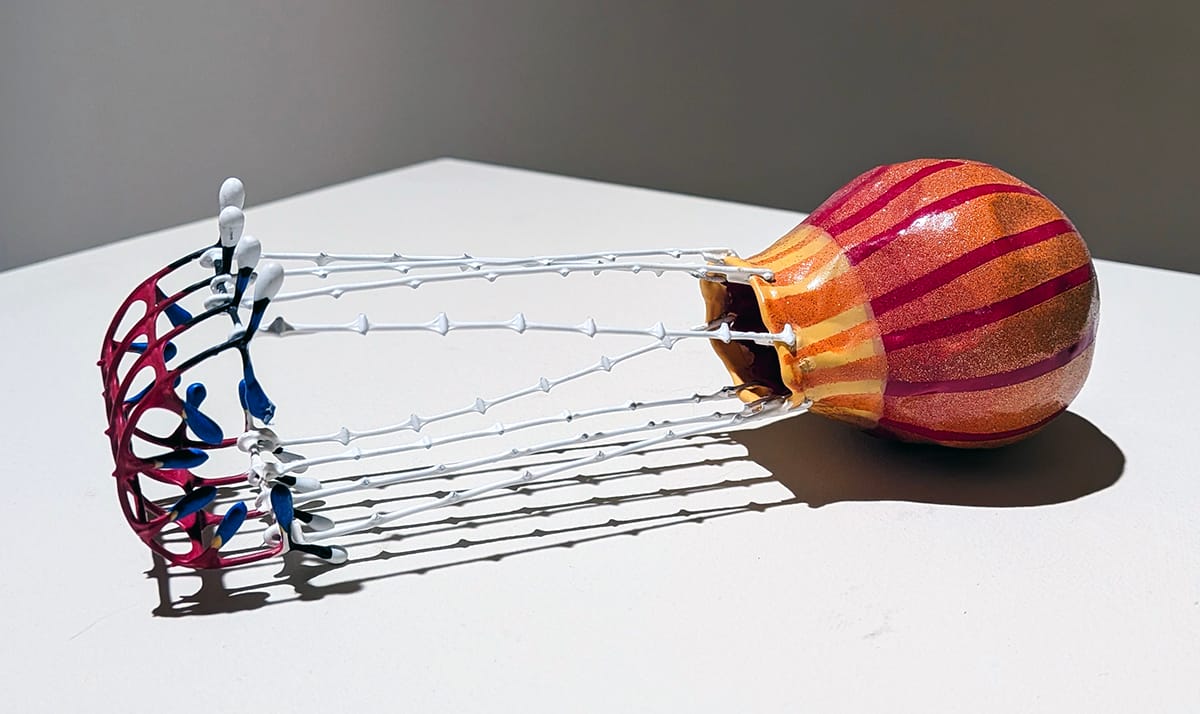
Richard H. Alpert, “Montgolfier Brothers on their Side,” synthetic rubber, steel wire, 2 by 2 by 7.5 inches. Photos by Jessy Clonts Day for The SHOUT.
He also draws on the influence of inventors in the work “Montgolfier Brothers on Their Side,” which looks like a hot air balloon on the ground, its “basket” and “balloon” lying on their side. The Montgolfier brothers are credited with giving humans the first capacity for flight in 1783, inventing the first practical hot air balloon.
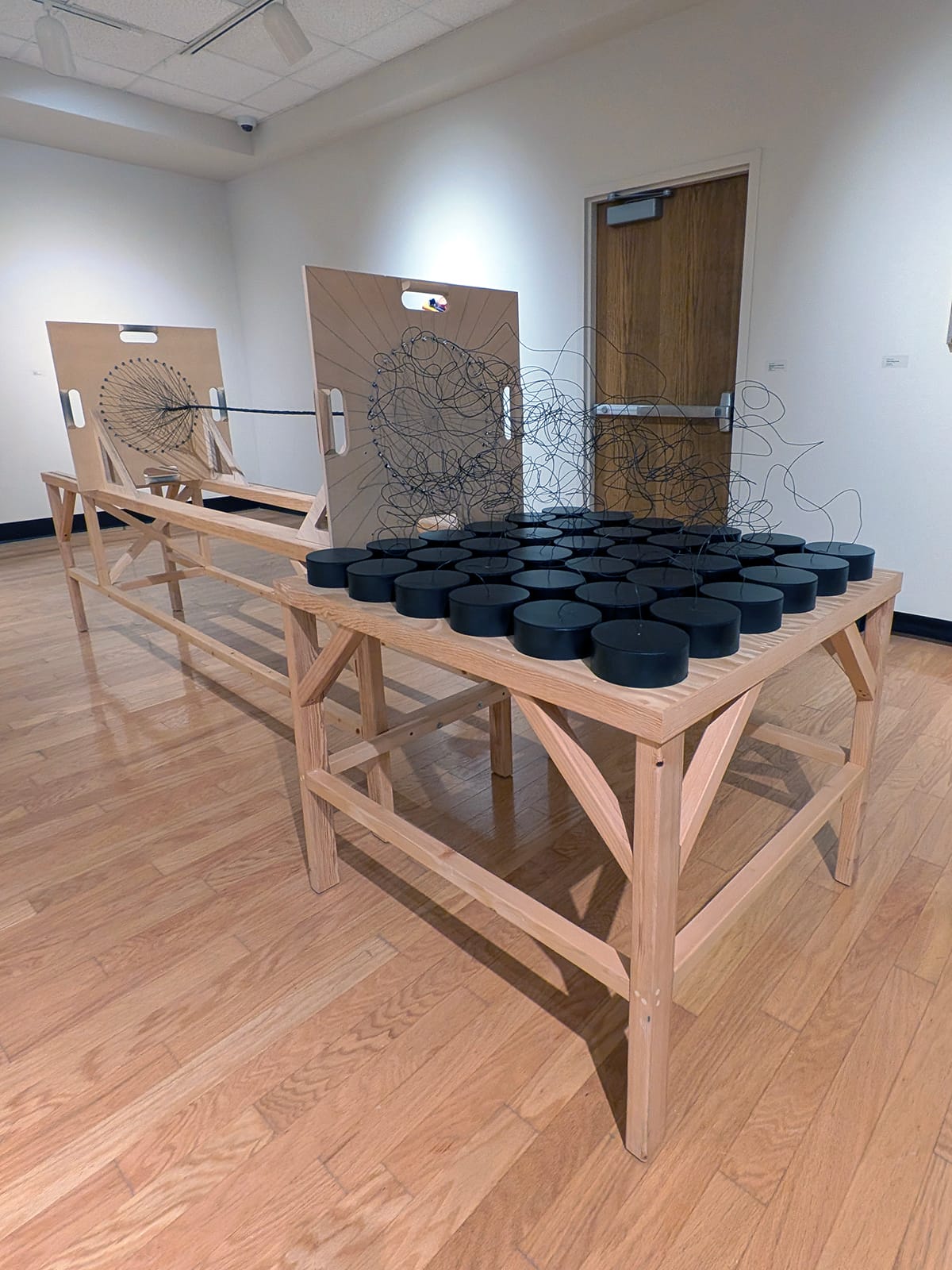
The largest sculpture, at eleven feet long, three feet wide, and nearly five feet tall, “Mechanism for Twisting Wire (Cosmos I)” looms along one side of the gallery. Like the inner workings of a brain, a jumble of curly, tangled wires — 36 in total — are each singularly attached to their own circular form and wired into a circle on a flat board, then pulled through and twisted into place. The wires become a neat straight line, stretching more than two feet along a plane, then Alpert once again threads them through grommets within a second board, aligning them in a twisted circle. When pulled along the table plane, the tangled wire becomes detangled, making order out of chaos and cleanliness out of a mess. "I want to pull it to see how it works," my mom asserted. We learned from the gallery manager that for this exhibition “Mechanism for Twisting Wire” is stationary.
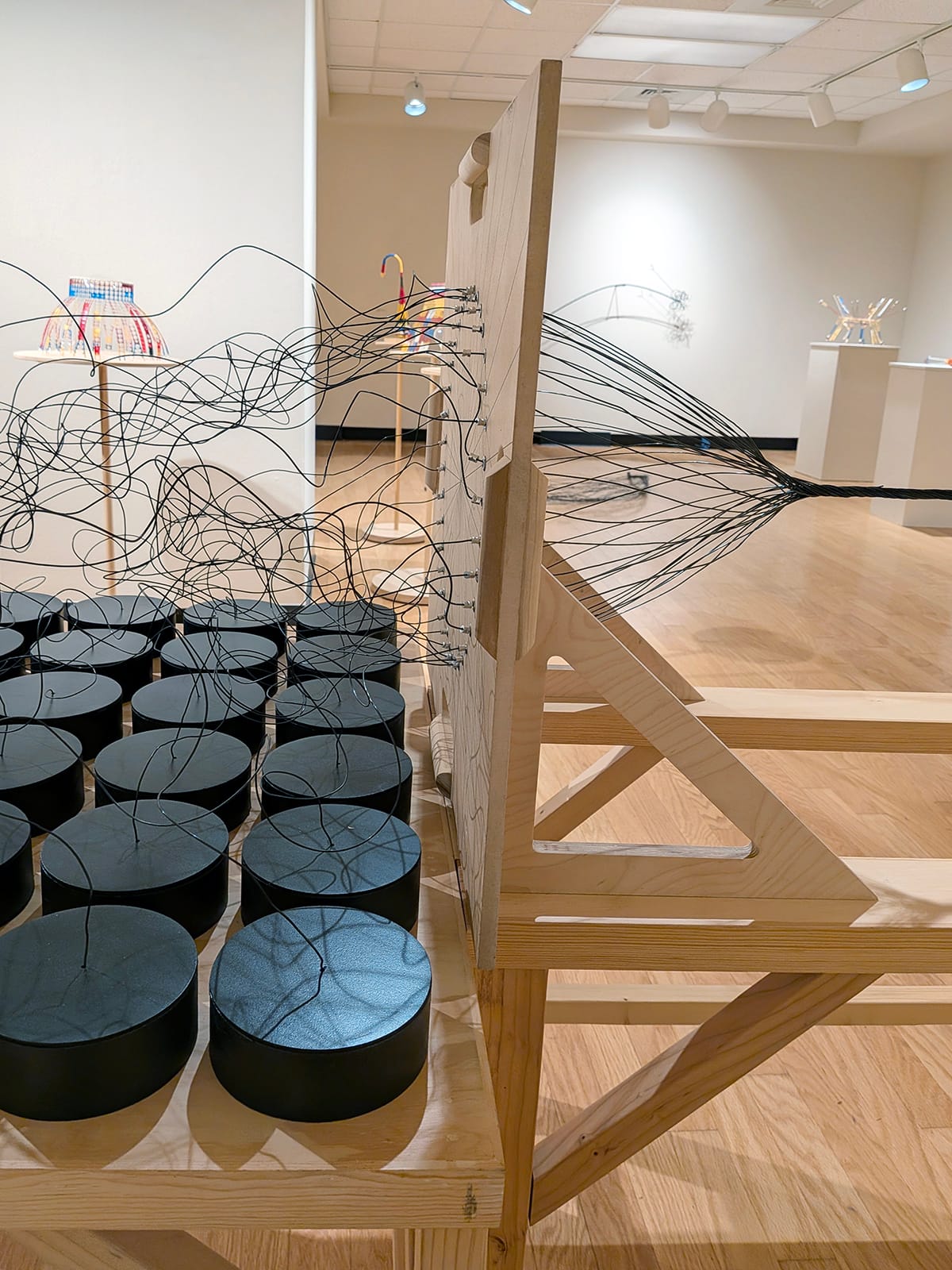
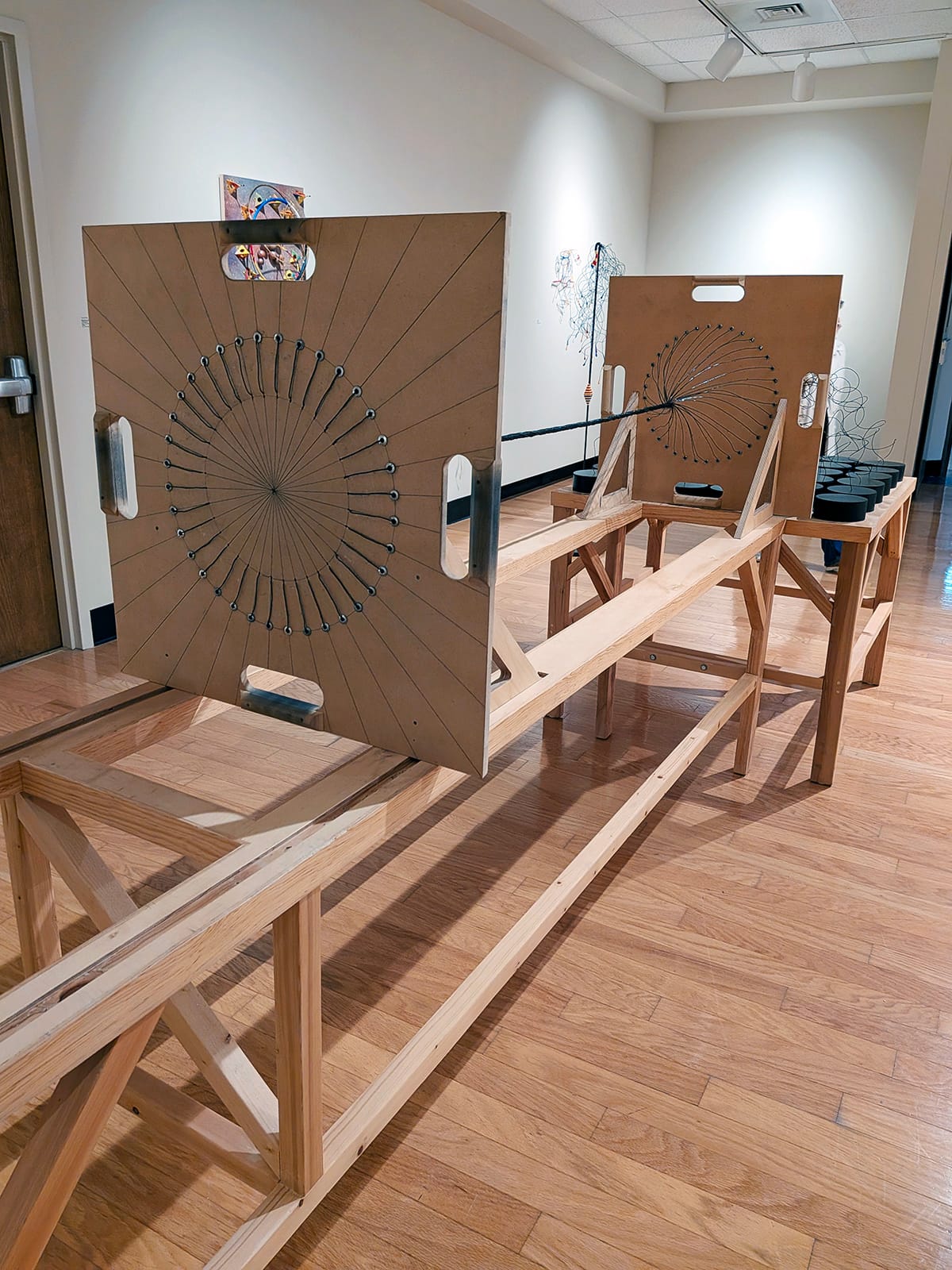
Richard H. Alpert, “Mechanism for Twisting Wire (Cosmos I)” details, wood, steel wire, miscellaneous metal fittings, 59 by 132 by 36 inches. Photos by Jessy Clonts Day for The SHOUT.
An Instagram reel shows Alpert demonstrating how "Mechanism" functions as he manually twists the wire straight by torquing the board in his hands, pulling and tapping it on the platform between each twist. As you can imagine, it is loud work, all banging wire and wood.
My mom and I paced around and around the large work, trying to make sense of how it was built and how it is used. When I explained this to Alpert in a phone interview, he commended us, noting that it is an important piece for him.
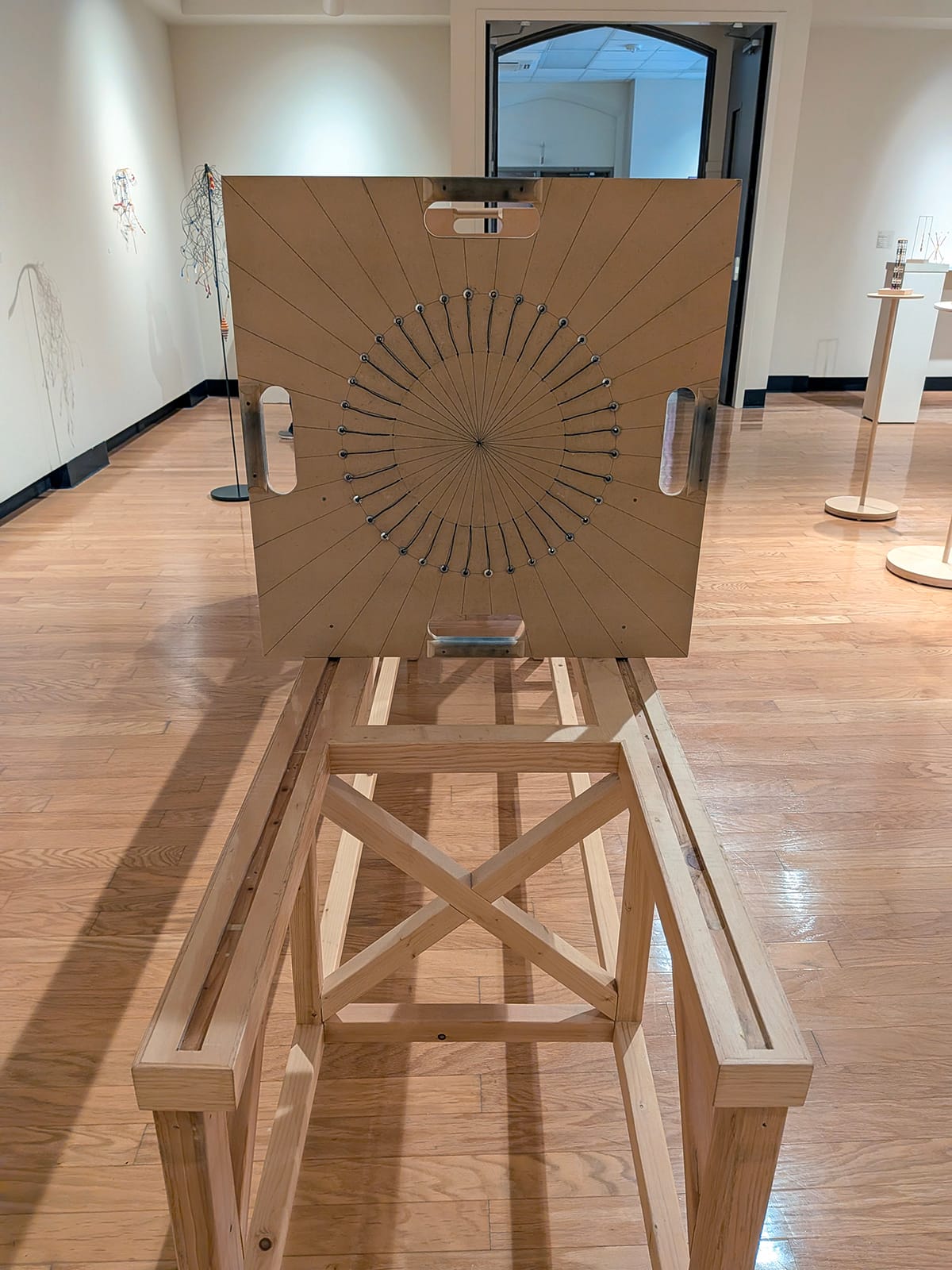
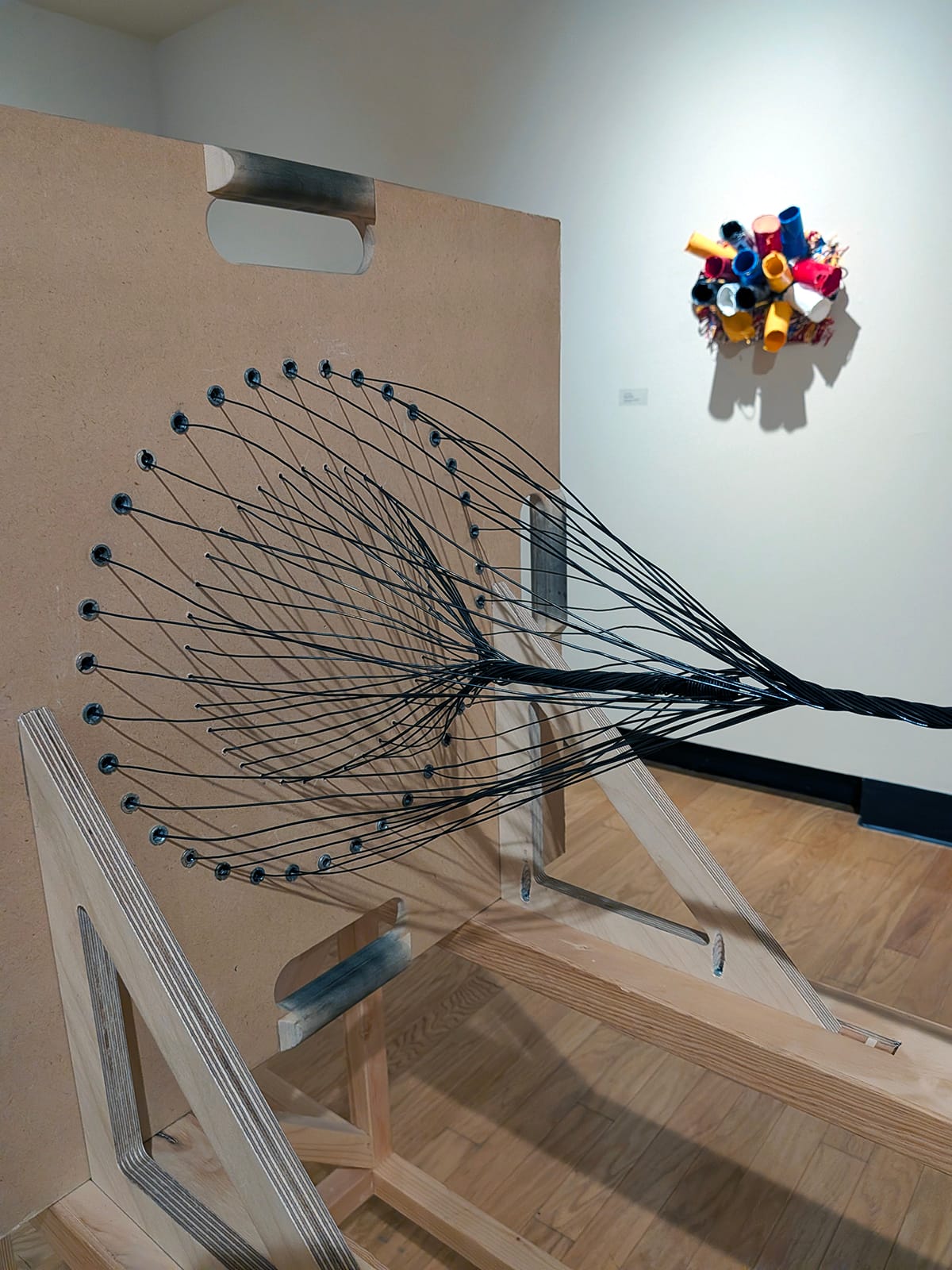
Richard H. Alpert, “Mechanism for Twisting Wire (Cosmos I)” details, wood, steel wire, miscellaneous metal fittings, 59 by 132 by 36 inches. Photos by Jessy Clonts Day for The SHOUT.
“It is my concept of the universe,” Alpert revealed. When I explained my interpretation, that he was trying to make order out of chaos, he agreed.
“The wire, it’s coming out of some mysterious something, or 36 little mysterious somethings. Where is this coming from? And it somehow gets organized. What is being applied to this chaos? I don’t think it’s ever going to be answered, and that’s great because that leaves a door open for me. I love cosmology, it's just so fertile.”
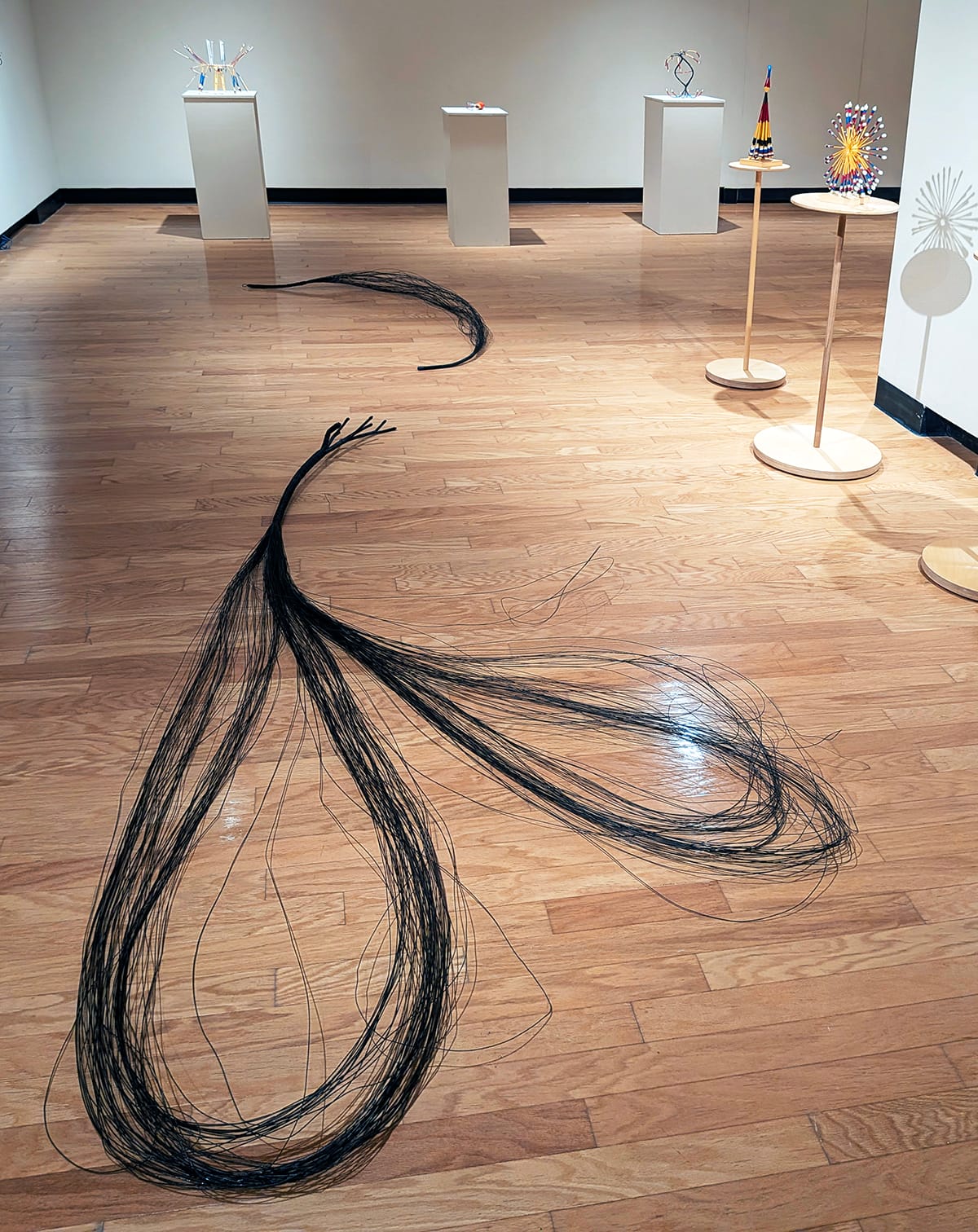
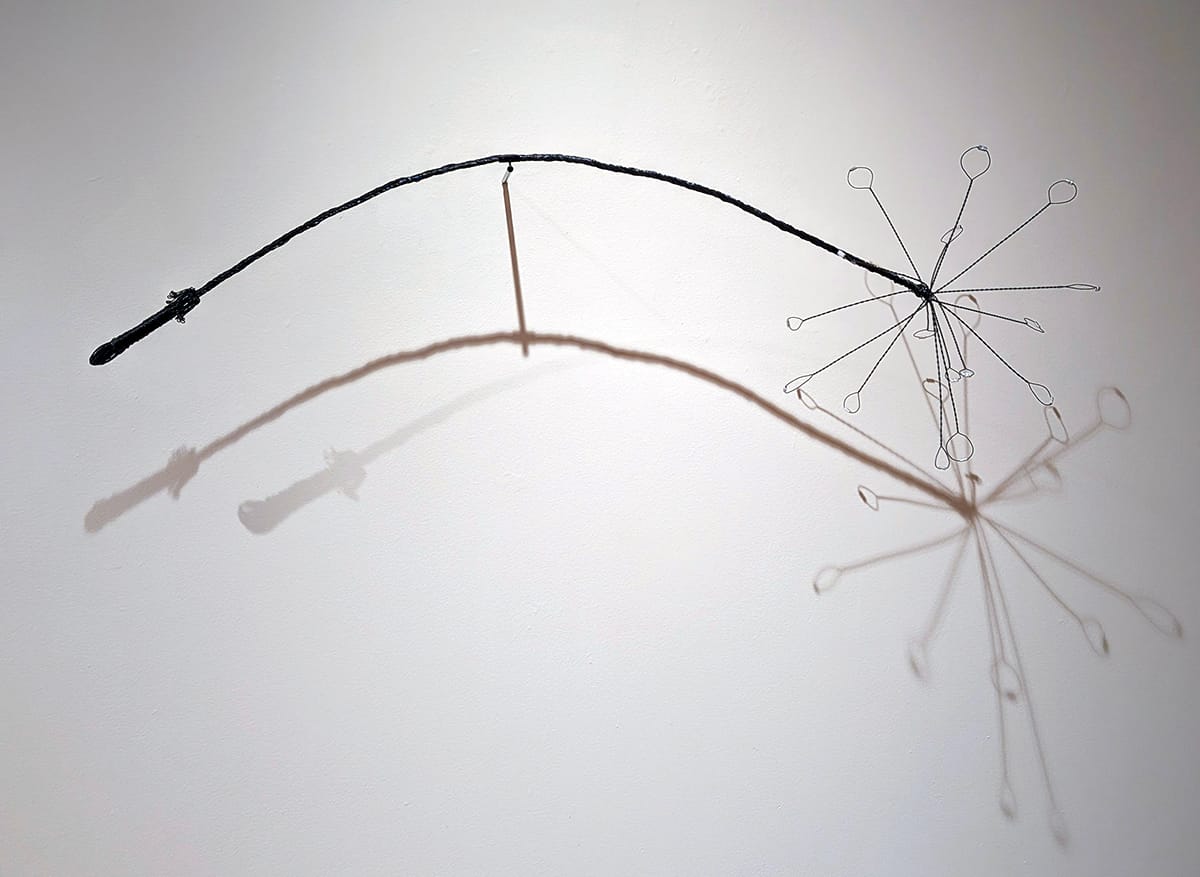
Of course, play can always take a darker turn, especially as we leave childhood behind. It is hard to ignore the elephants in the room: the two wire whips on the floor, each stretching nine feet long. When asked about the thematic separation of these works from the rest of the collection, Alpert acknowledged that although they look and feel separate from the colorful rubberized works, he also invites viewers to interpret them for play. “There are those kinds of toys, and there’s a big part of me that’s an adult, so, I try to trace back to that other side.” “Big Wire #1 (Double Whip)” and “Big Wire #2 (Single Whip)” stretch the thematic scope of the collection perhaps farther than most of the smaller works combined.
At 78 years old, Alpert still approaches his work with fervor. Winning a National Endowment for the Arts grant in 1979 did nothing to quell his ambition, though he likened the grant to a death knell. After receiving the grant his relationships suffered, as though others assumed he had “arrived,” and he stopped receiving attention from the art world. “I got no references from other artists. Nobody came to my studio, I had to crawl to galleries to get my work seen. It was suicidal,” he reflects. He is now answering calls for art nationwide, which is what led him to showing “Primary Traces” at Pittsburg State.
“Listen, I’m at the end of my life. I don’t have a lot of years left, and it’s either now or never. I get up in the morning and I take a big bowl out of the cupboard and I fill it full of cereal called 'determination.' I do it every morning and I’m not quitting until something hits me. There is no limit to how high the hill can go.”
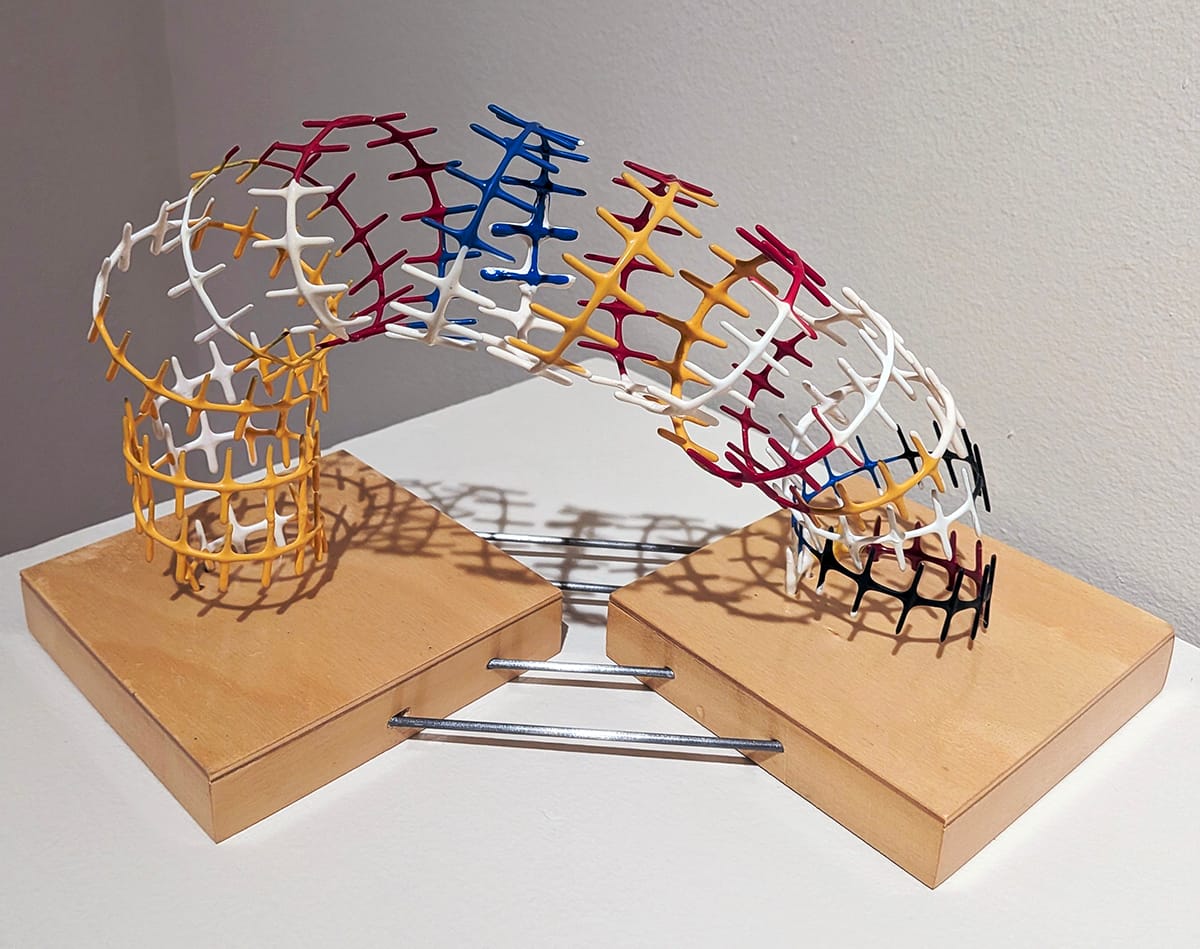
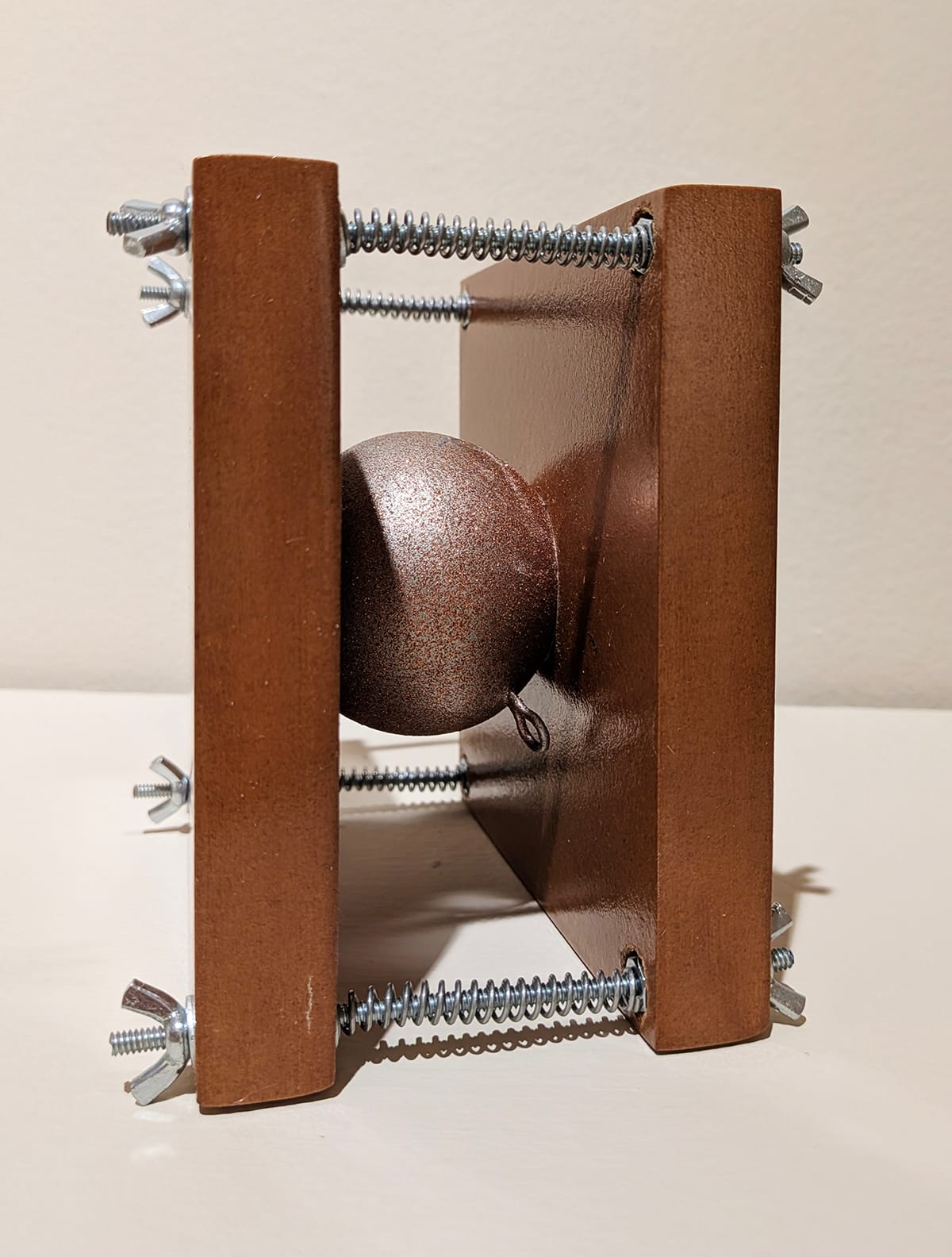
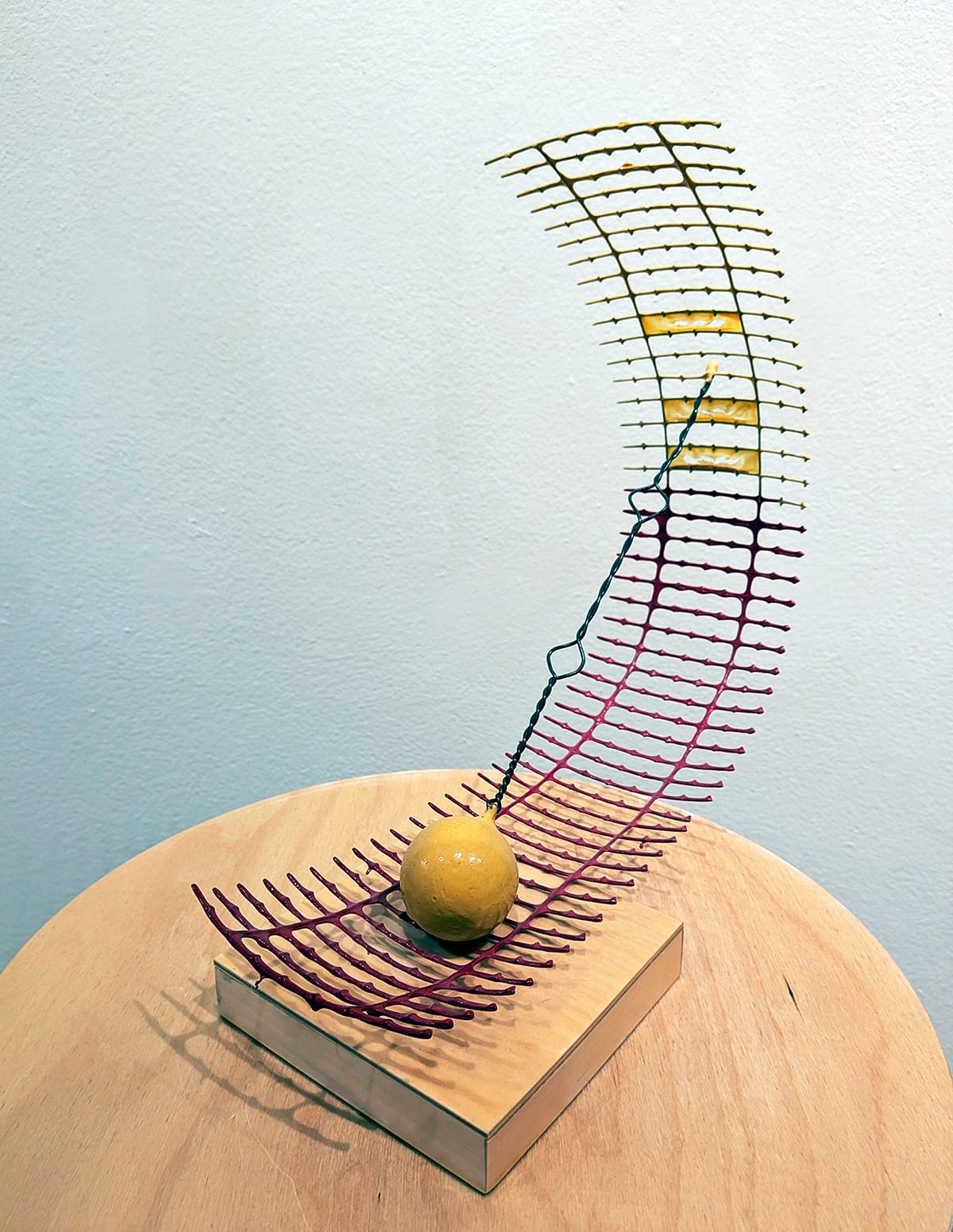
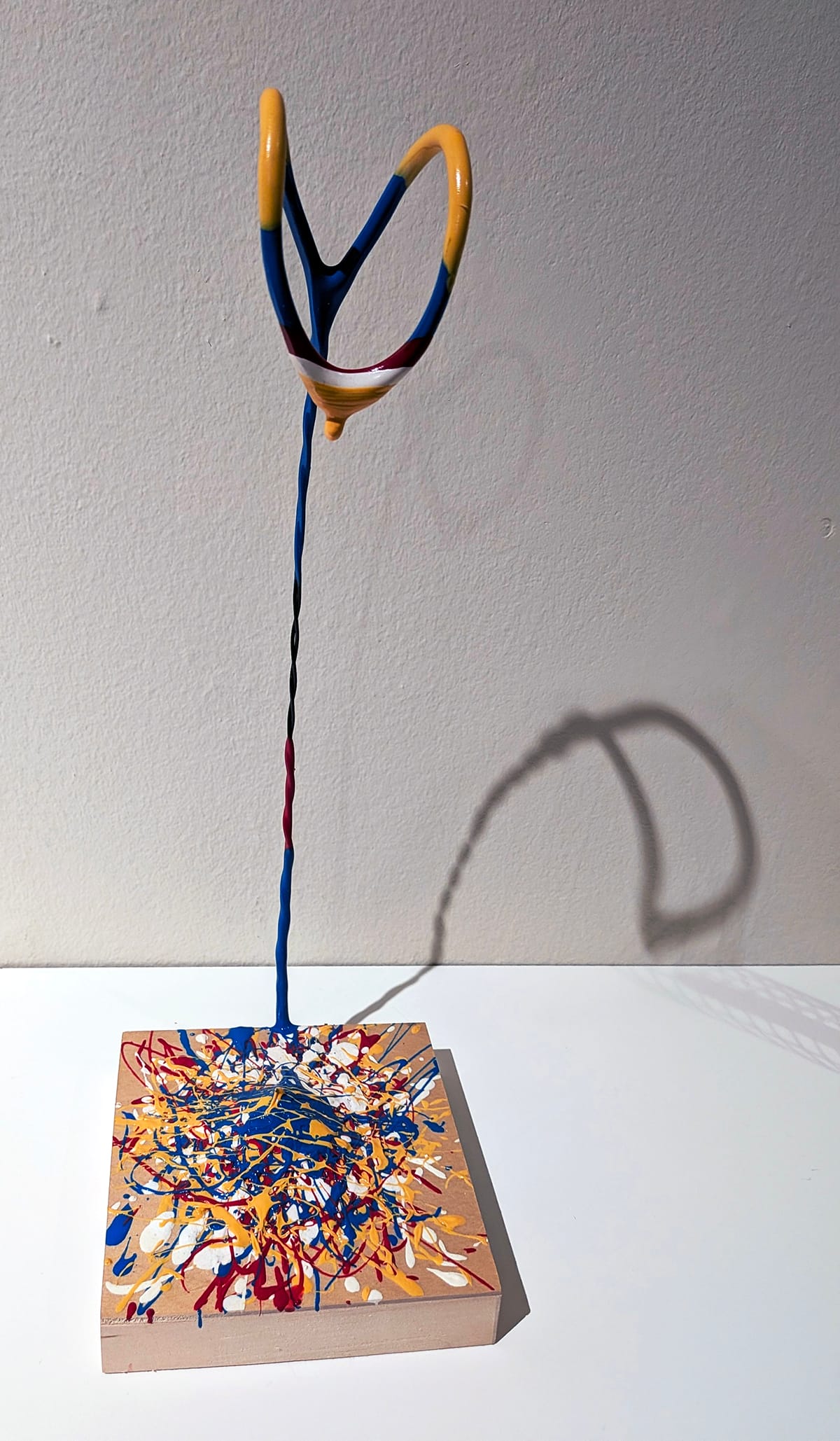
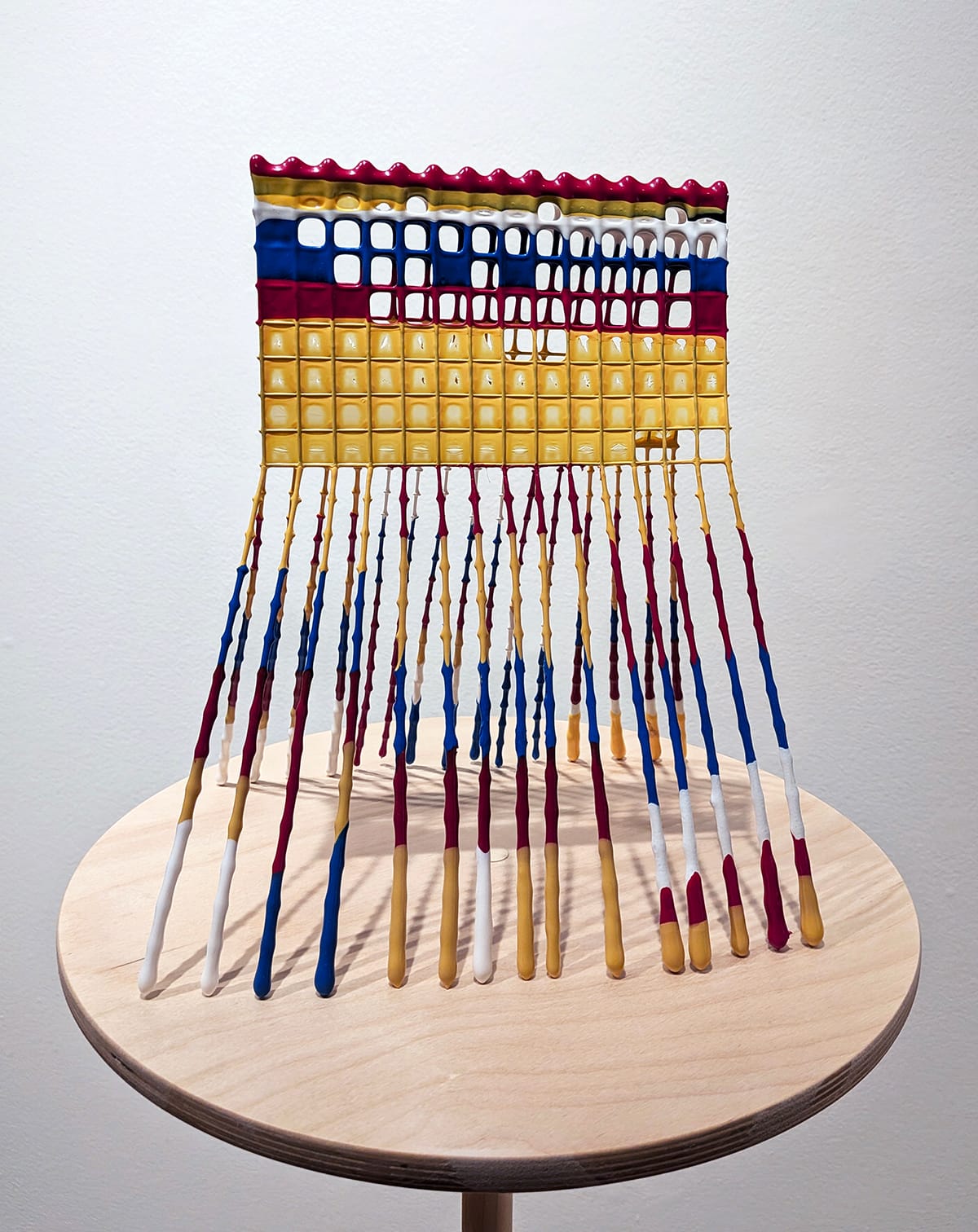
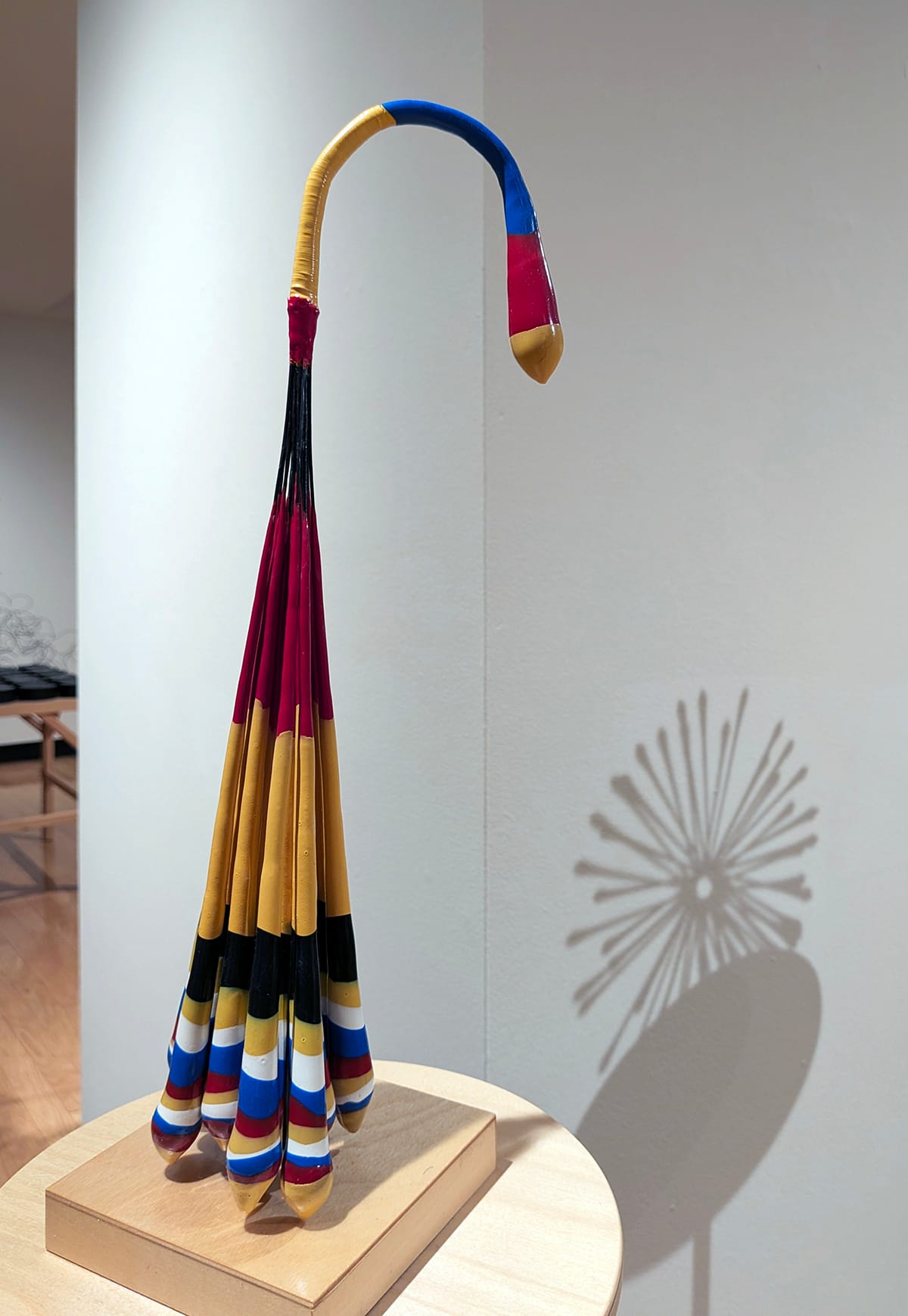
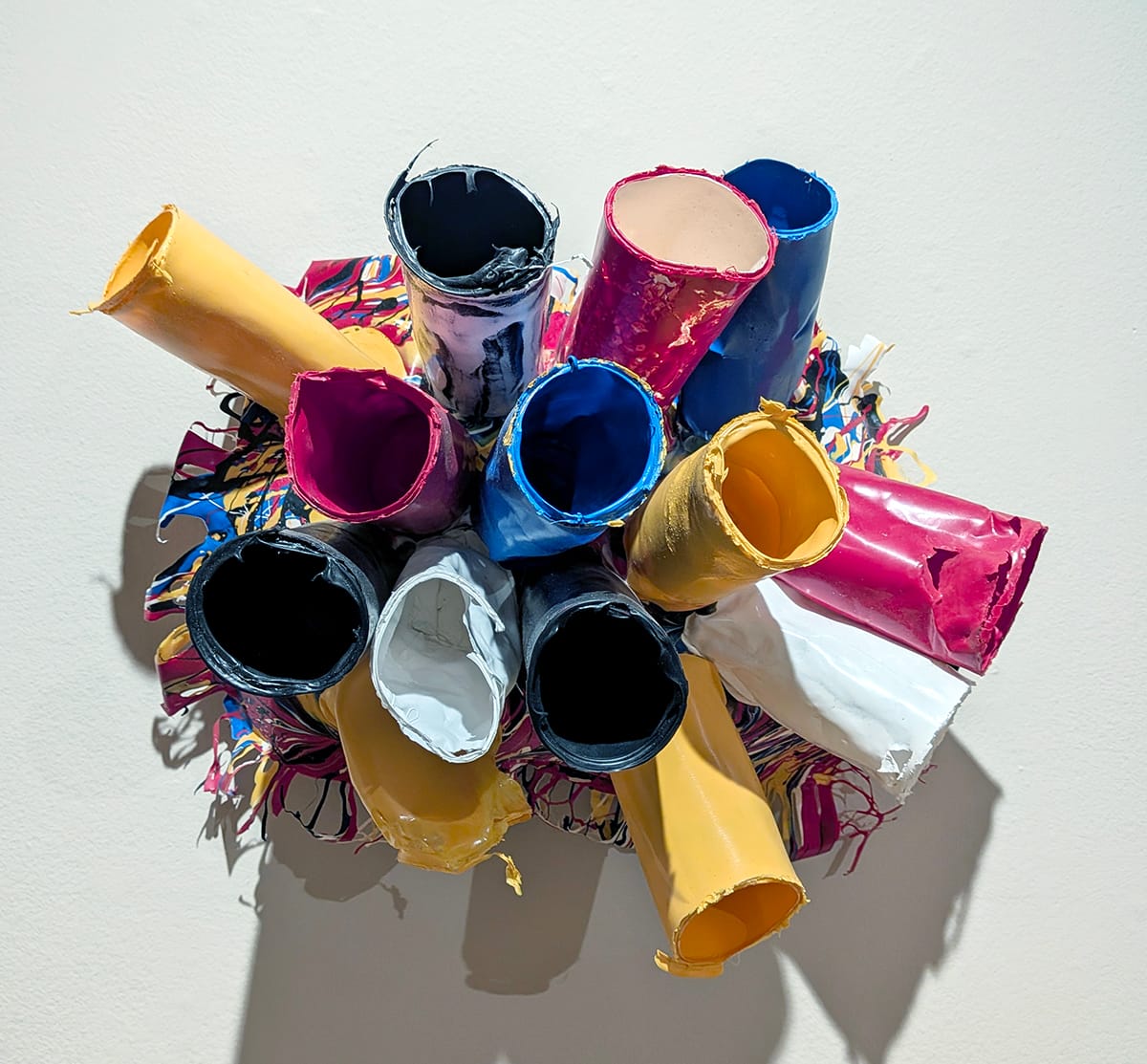
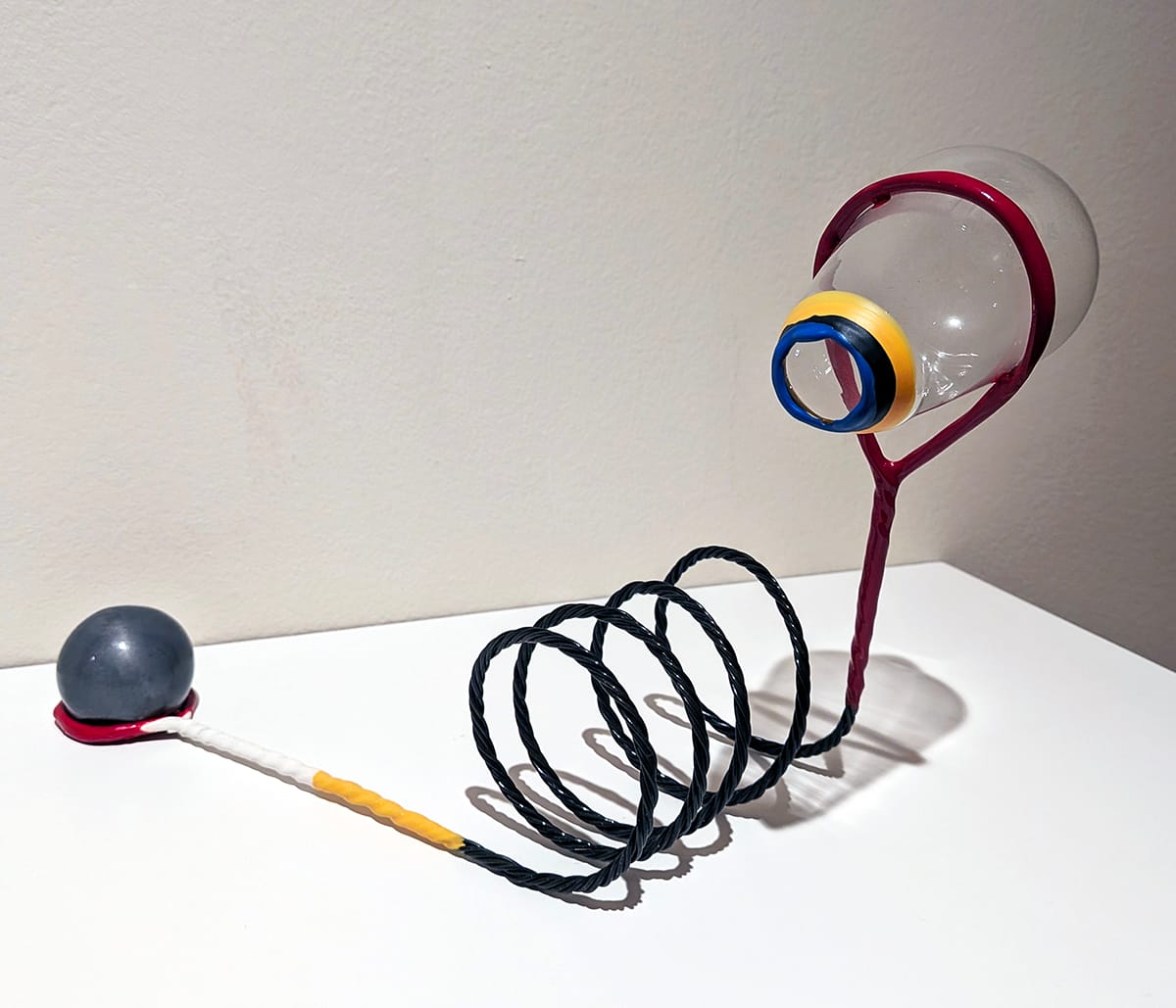
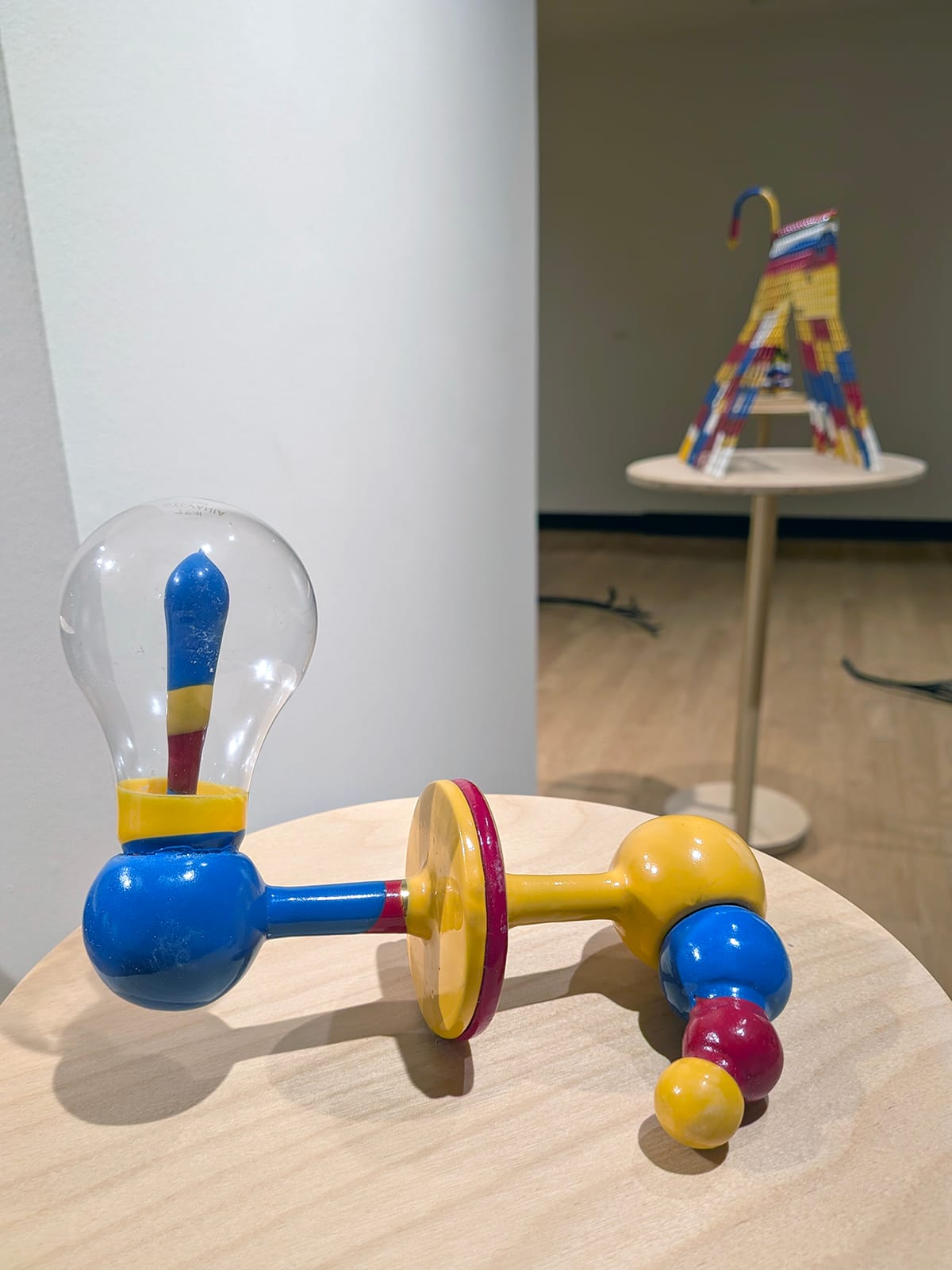
Works by Richard H. Alpert, from top left: “A to B,” synthetic rubber, steel wire, wood, 7.5 by 15 by 7 inches; “Ball Squeeze,” wood, lead, metal, enamel paint, 5 by 5 by 4 inches; “Cesta,” synthetic rubber, steel wire, lead, 12.5 by 6.75 by 12 inches; “Drip,” synthetic rubber, steel wire, 14 by 5 by 5 inches; “Factory Facade,” synthetic rubber, steel wire, 12 by 7 by 7.5 inches; “Hang On Boys,” synthetic rubber, steel wire, 18 by 8 by 7 inches; “Kicked Cans,” synthetic rubber, steel wire, 13 by 17 by 9 inches; “Light Goes On, Big Idea,” synthetic rubber, steel wire, lead, glass, 2 by 2 by 7.5 inches. Photos by Jessy Clonts Day for The SHOUT.
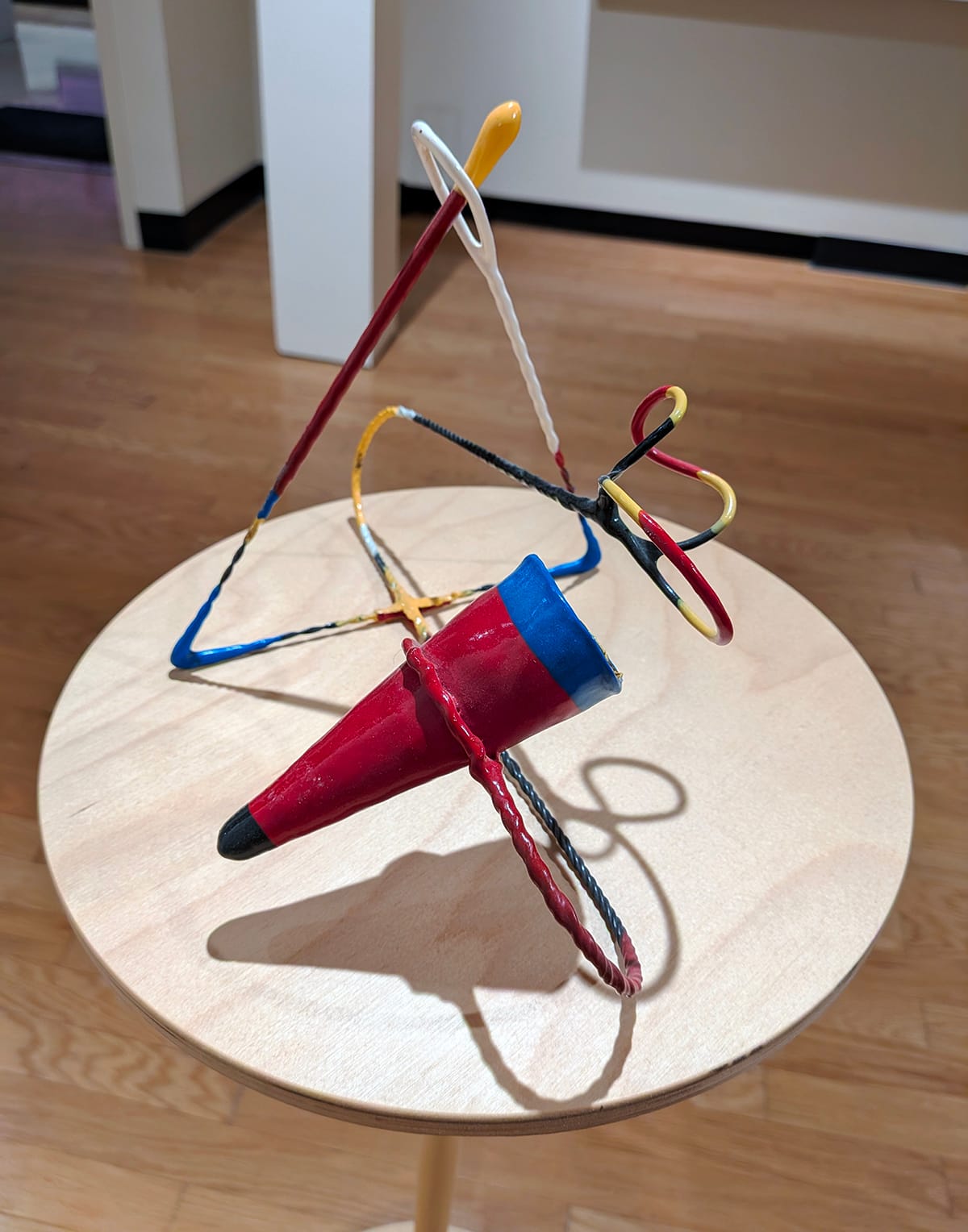
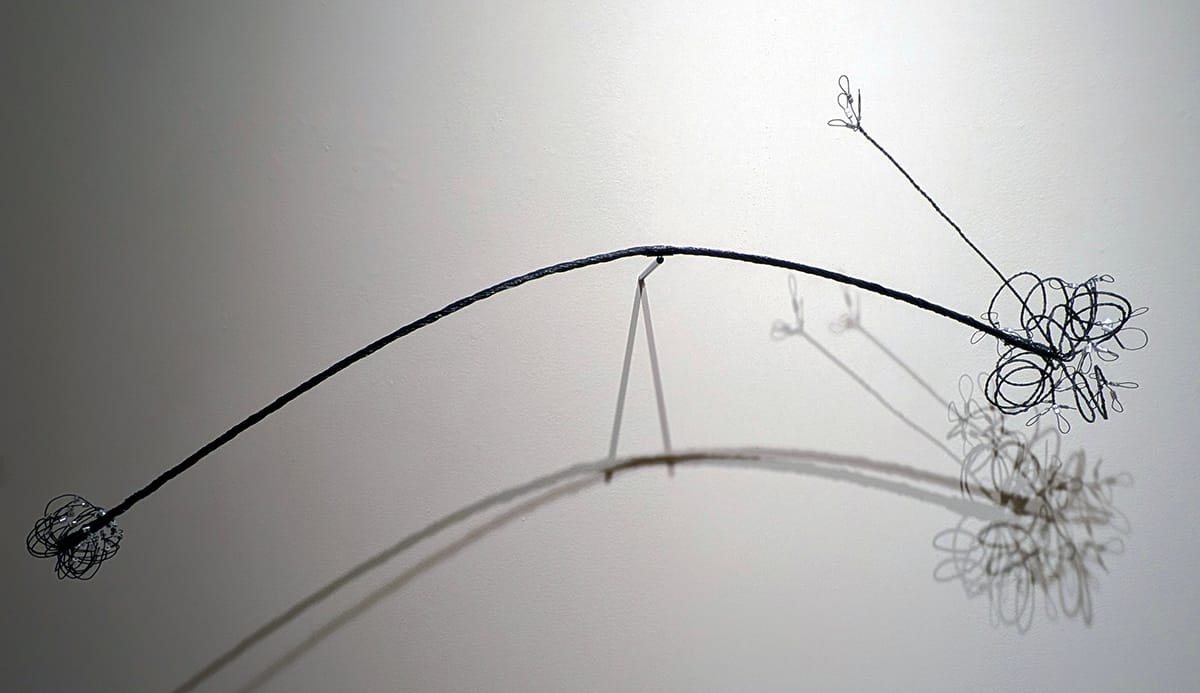
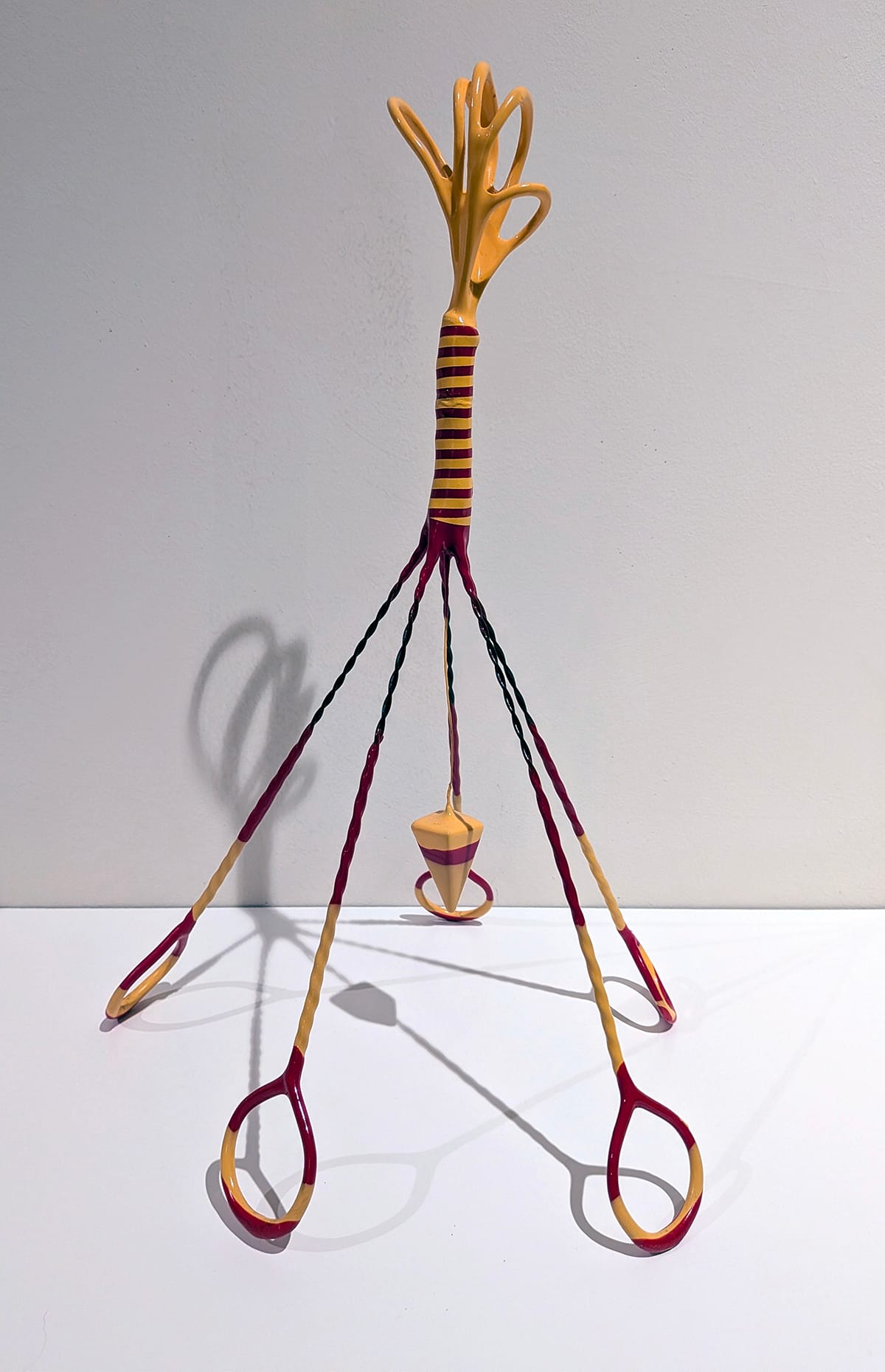
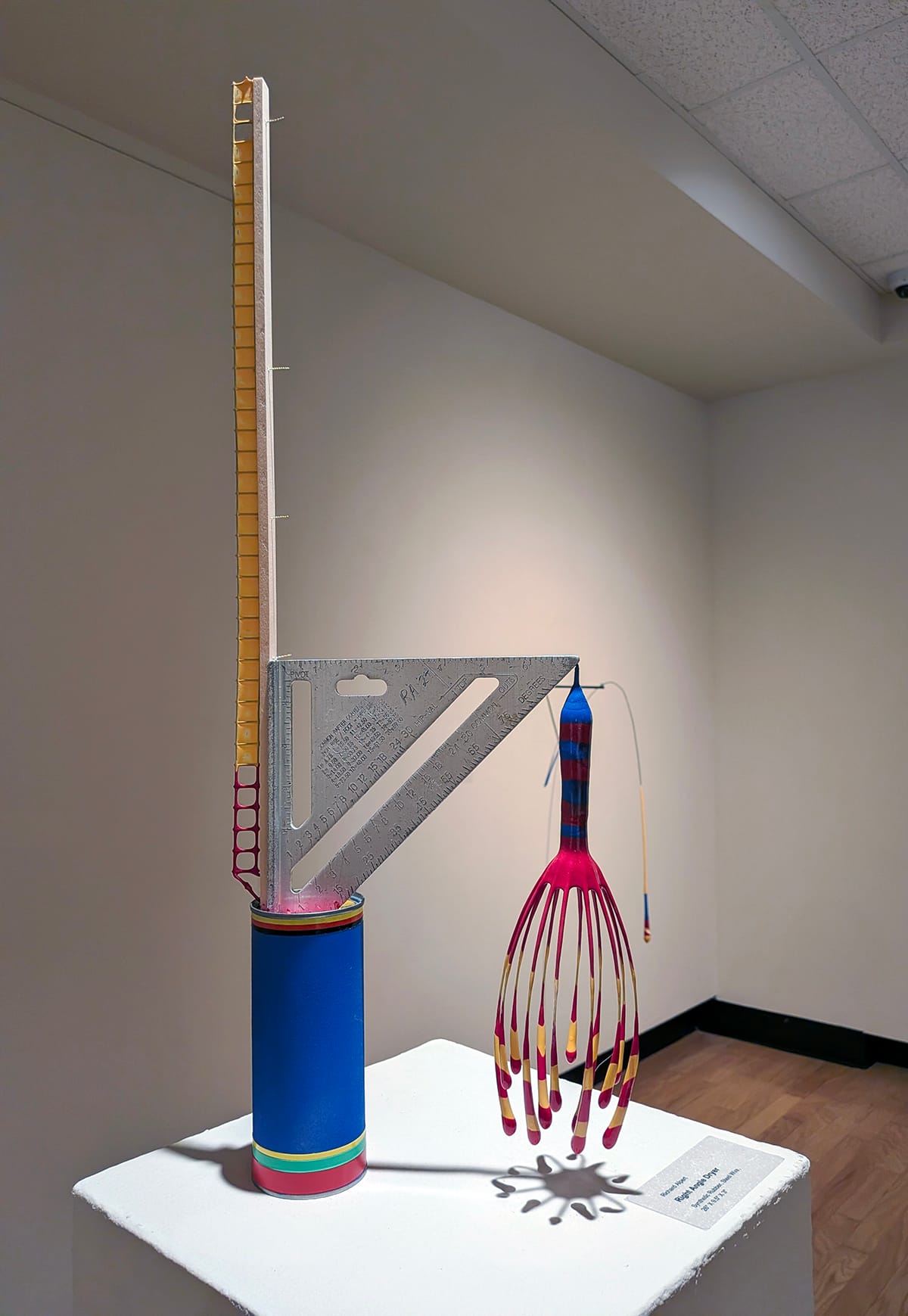
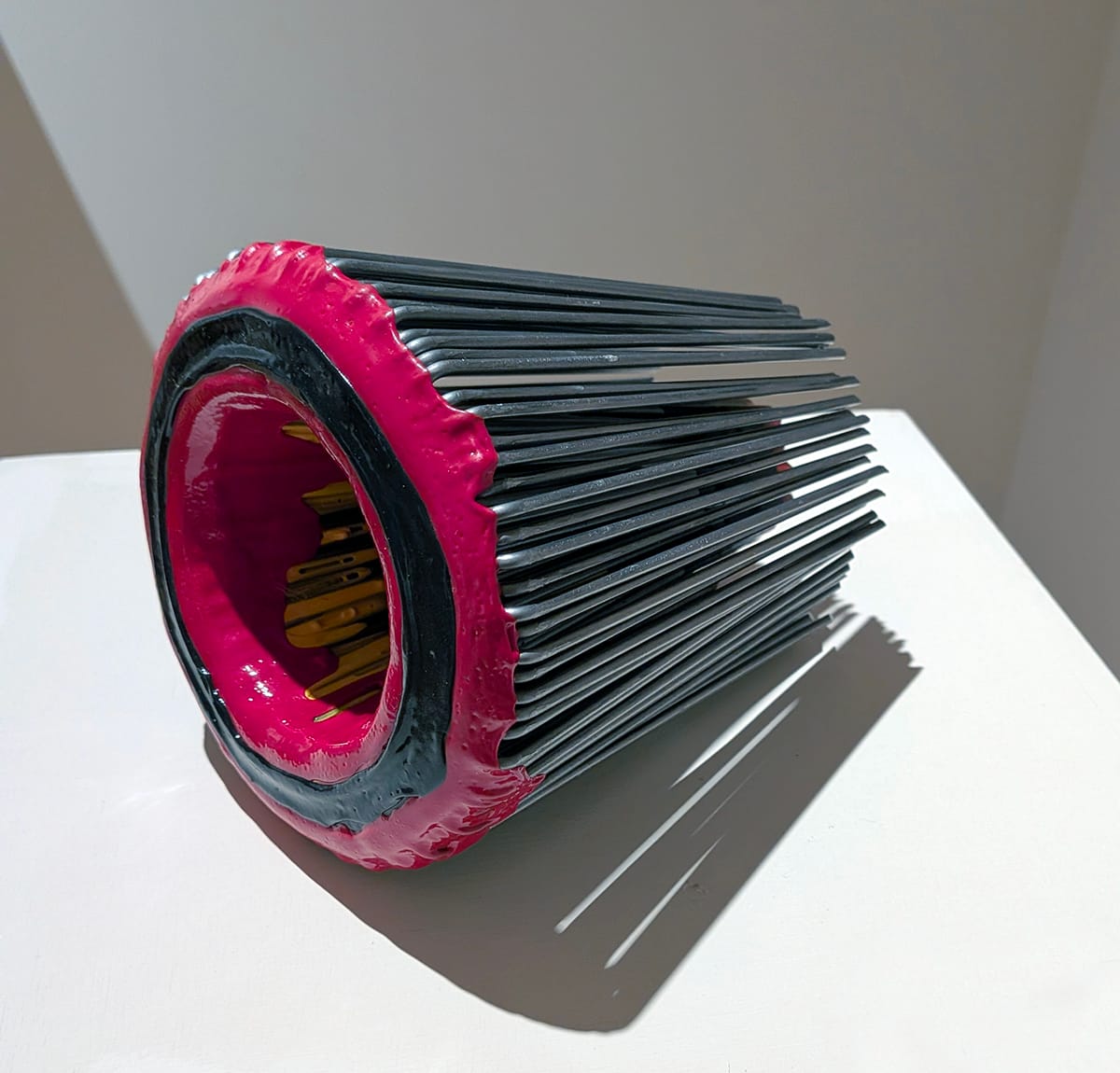
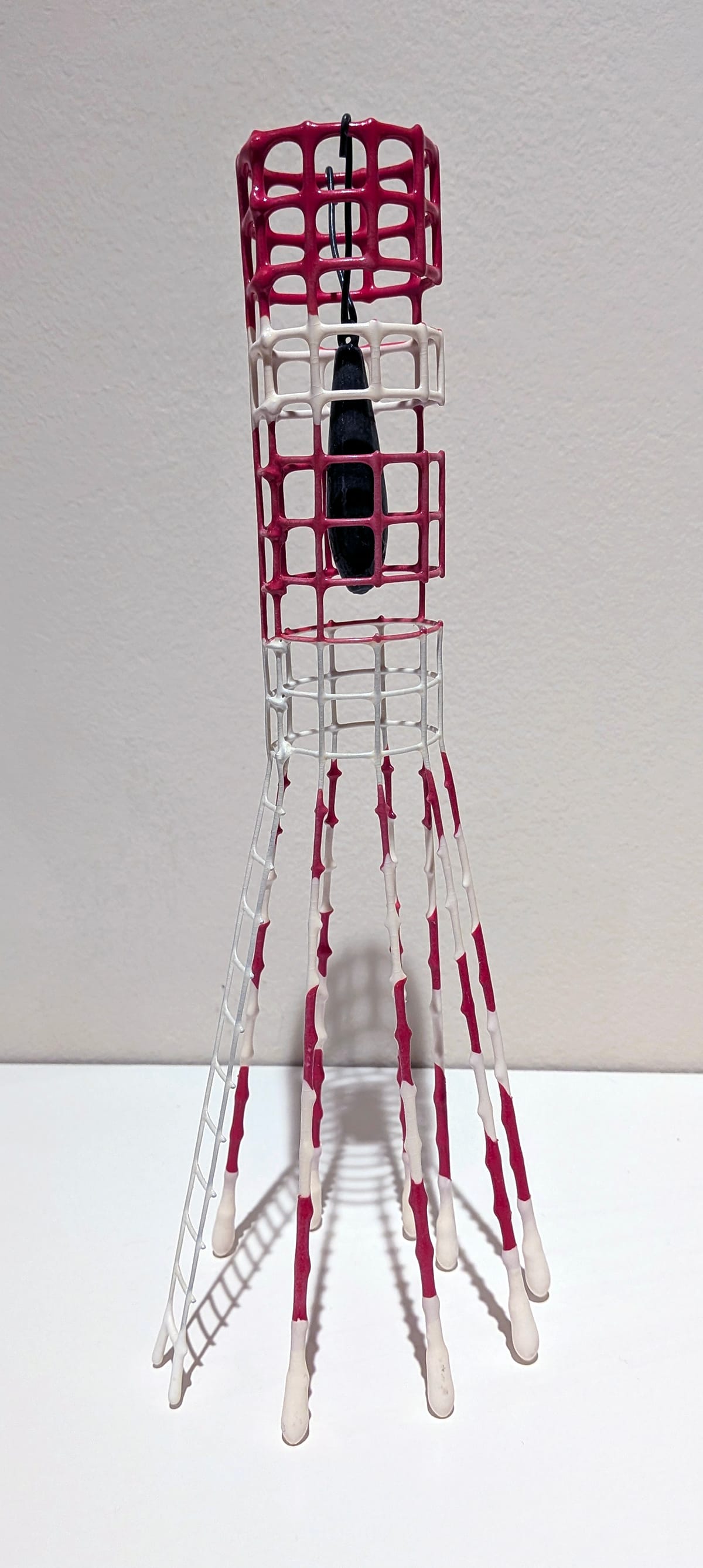
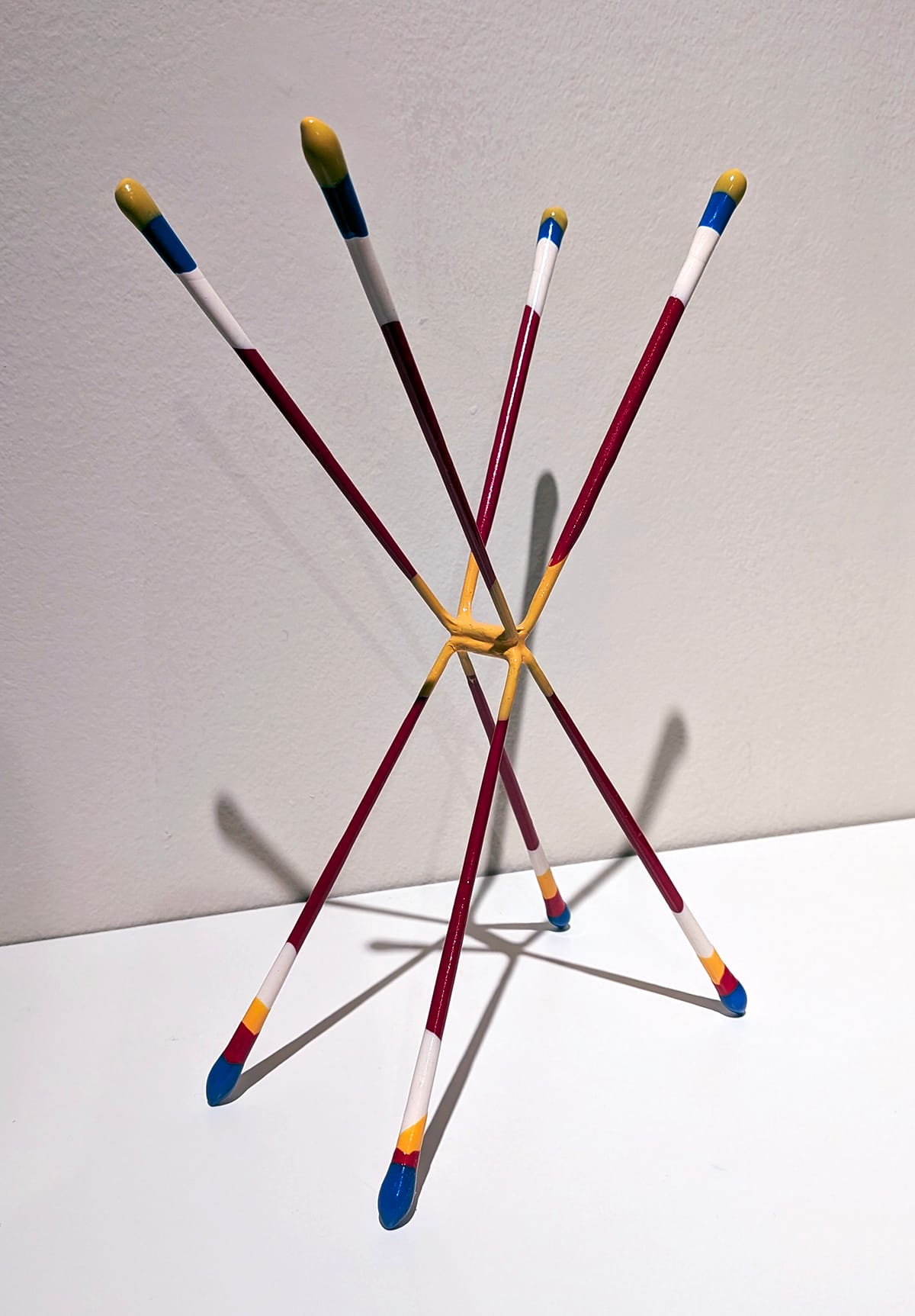
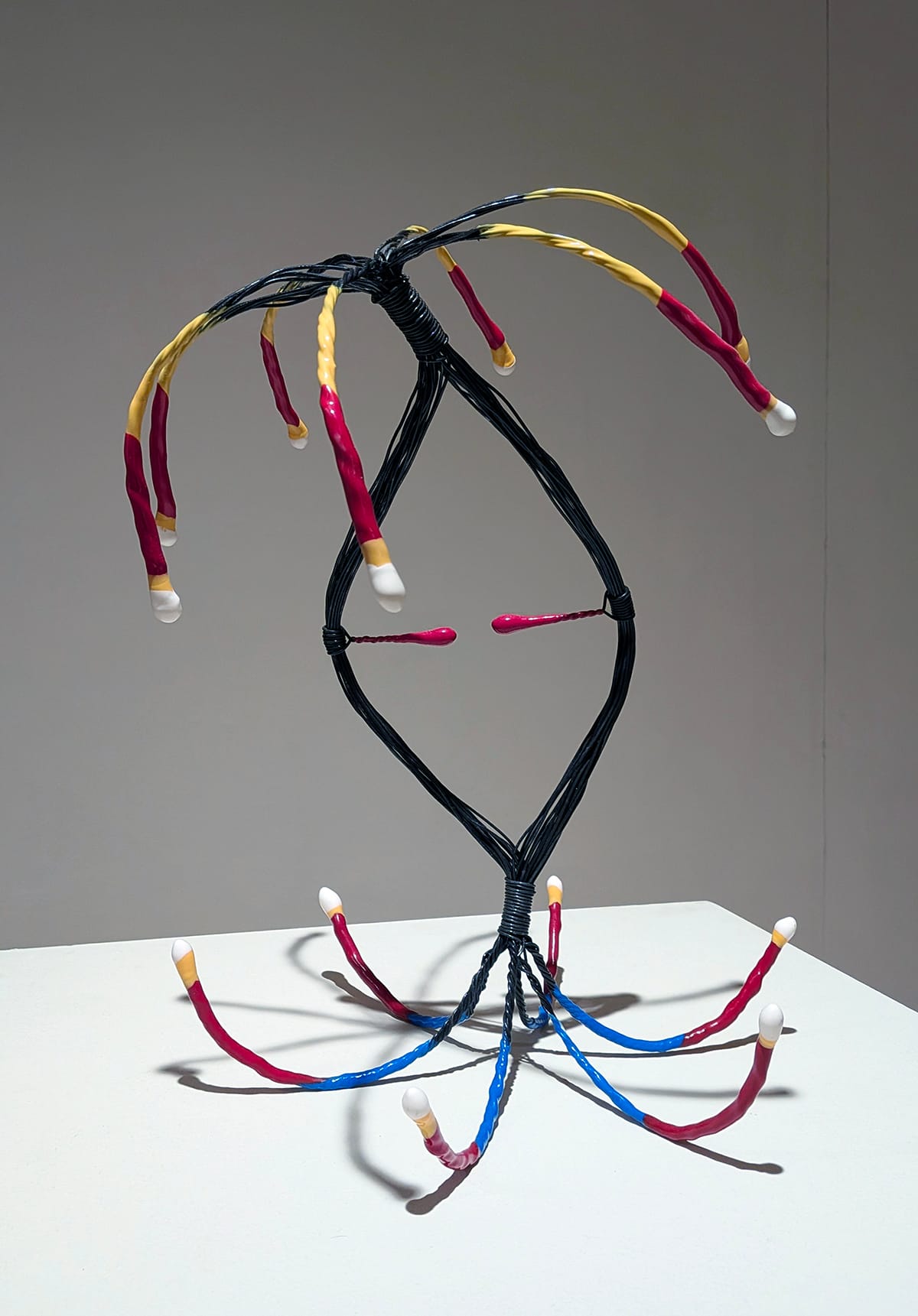
Works by Richard H. Alpert, from top left: “Male Mind,” synthetic rubber, steel wire, 7.5 by 11 by 7.5 inches; “Offshoot,” steel wire, aluminum ferrules, 12 by 48 by 8 inches; “Plumb Tower,” synthetic rubber, steel wire, lead, 14 by 9 by 9 inches; “Right Angle Dryer,” mixed media, 25.25 by 0.75 by 33.83 inches; “Ringmaster 2,” synthetic rubber, steel wire staples, 5.5 by 5.5 by 6.25 inches; “The Gadget,” synthetic rubber, steel wire, lead, 11.25 by 4.25 by 4.25 inches; “XX,” synthetic rubber, steel wire, 8 by 9 by 1.5 inches; “Young Girl with Parasol Contemplating Her Reflection in a Pool of Water,” synthetic rubber, steel wire, 15 by 11 by 10.5 inches. Photos by Jessy Clonts Day for The SHOUT.
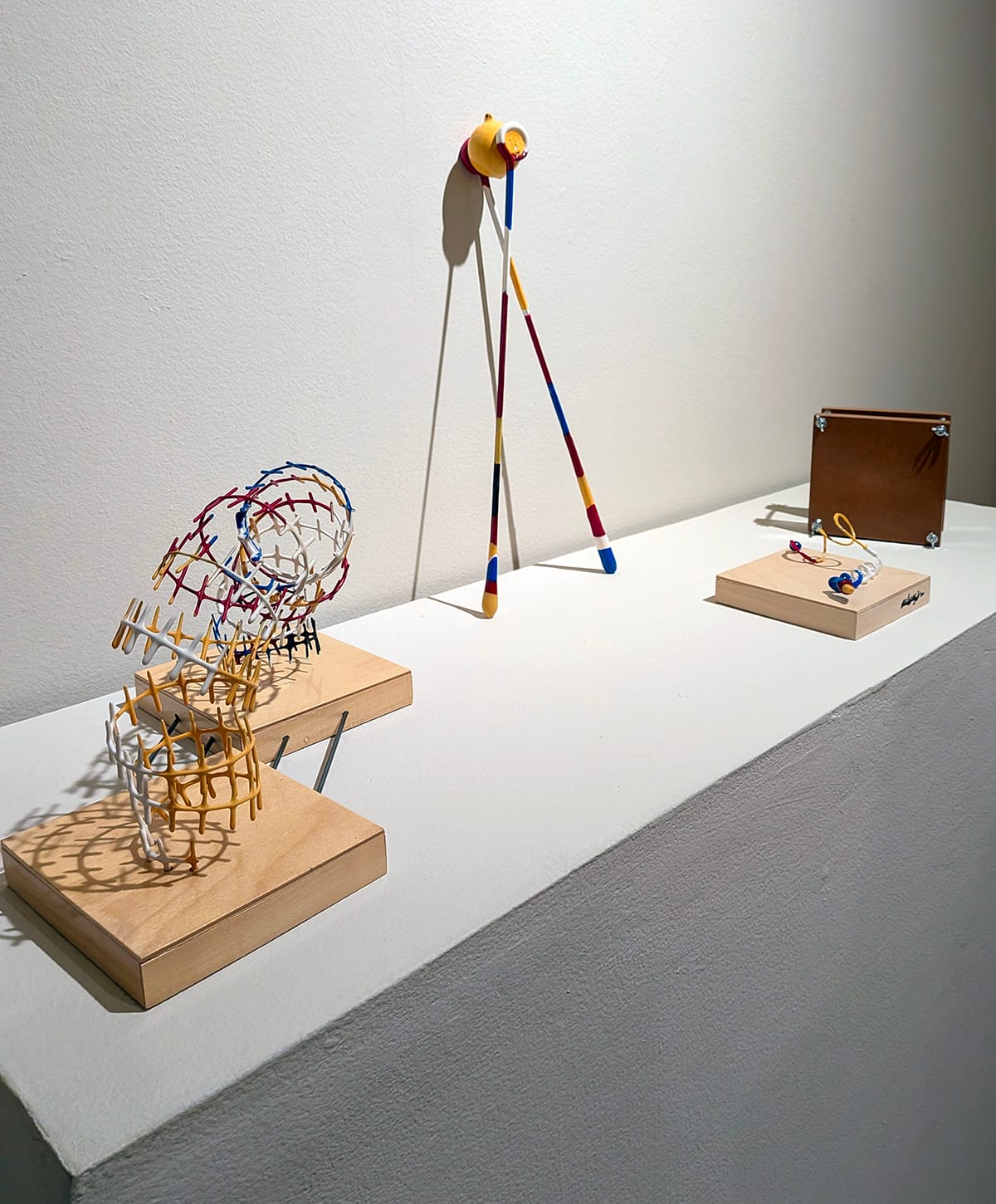
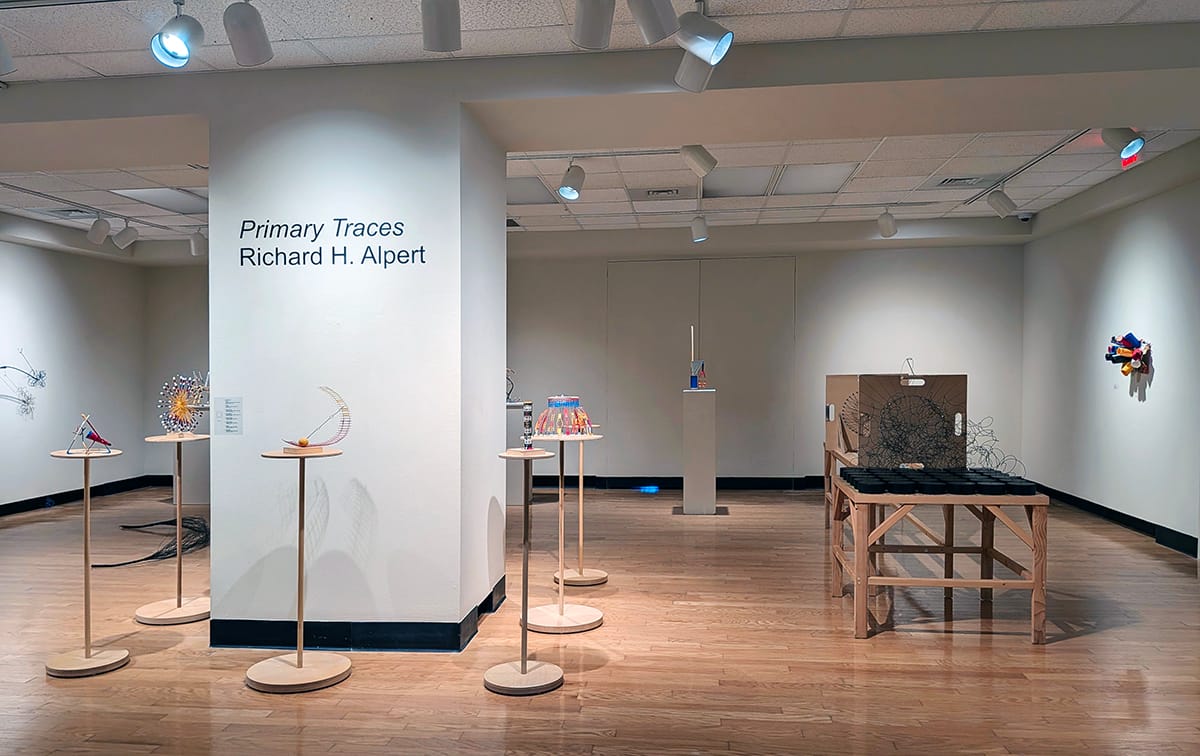
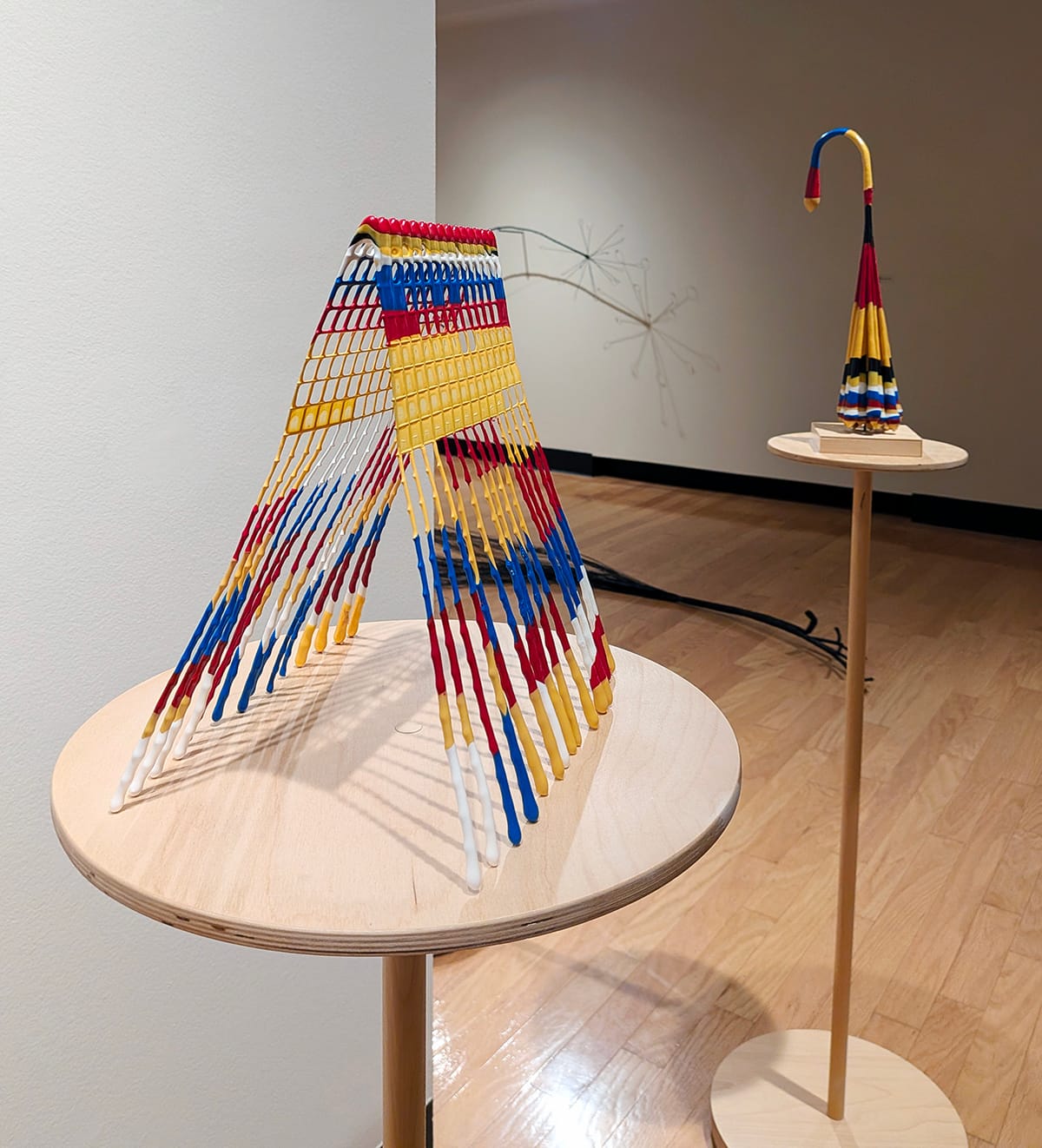
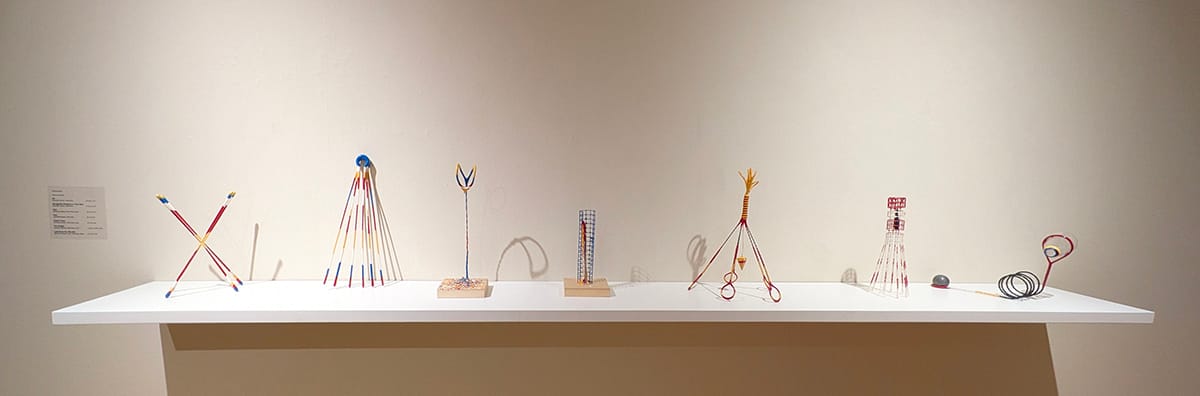
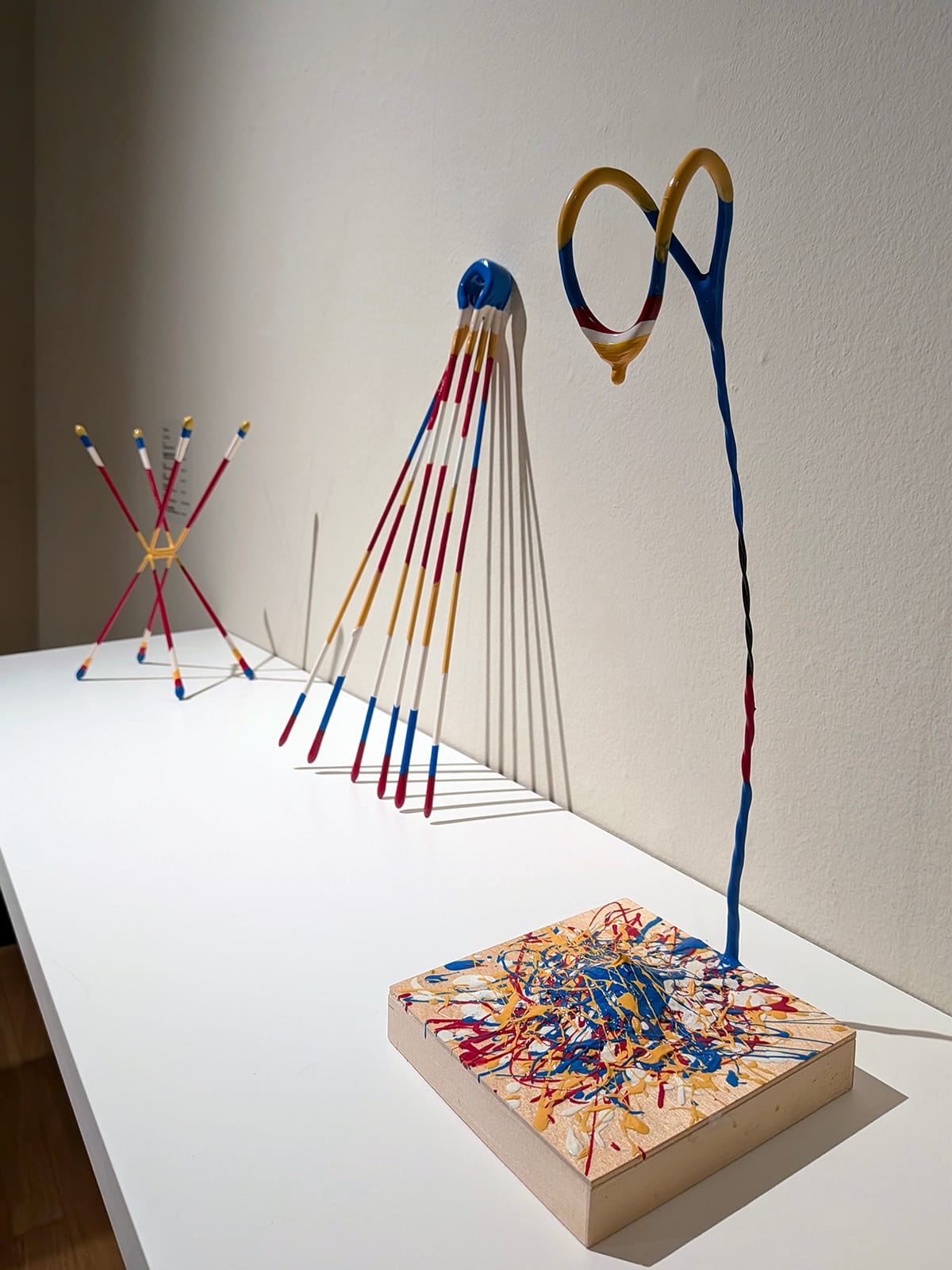
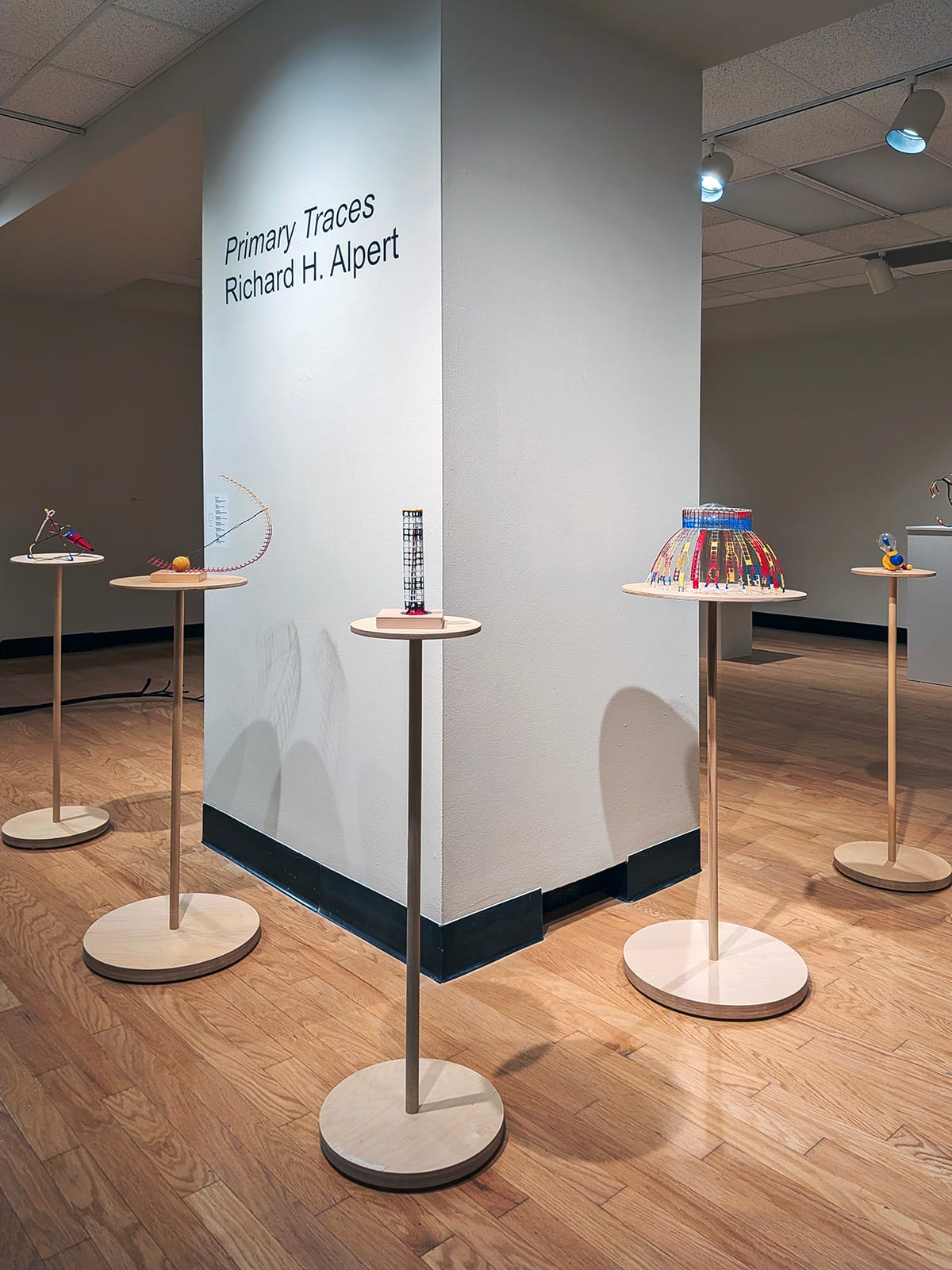
Installation views of "Richard H Alpert: Primary Traces" in University Gallery at Porter Hall, Pittsburg State University. Photos by Jessy Clonts Day for The SHOUT.
The Details
"Richard H Alpert: Primary Traces"
March 28-May 18, 2026, University Gallery at Porter Hall, Pittsburg State University, 202 East Cleveland Ave. in Pittsburg, Kansas
University Gallery at Porter Hall is free and open Monday through Friday from 8:30 a.m. to 4:30 p.m. Admission is free, and the facility is accessible to people with physical disabilities..
Jessy Clonts Day is a writer, roller skater, mother, and fourth generation Kansan. After living ten years in the American South and Southwest, she and her spouse returned to Kansas to raise their family, where the sunsets are otherworldly and the arts community is alive and well.
❋ Derby man has the kind of voice that turns heads — and chairs
❋ Socializing while sober: how some Wichitans are cultivating alcohol-free communities
❋ As a small creative business closes, the owner mourns
❋ Painting through it: Autumn Noire on 20 years of making art
❋ How a guy from Wichita resurrected 'Dawn of the Dead'
❋ Bygone Friends University museum housed curious collections
Support Kansas arts writing
The SHOUT is a Wichita-based independent newsroom focused on artists living and working in Kansas. We're partly supported by the generosity of our readers, and every dollar we receive goes directly into the pocket of a contributing writer, editor, or photographer. Click here to support our work with a tax-deductible donation.