How Wichita's 'Passiflora Sorma' was reborn
The 2003 sculpture by Tim Berg, Chris Frank, and Ed Langston was an inexpensive project that initially lasted 15 years.
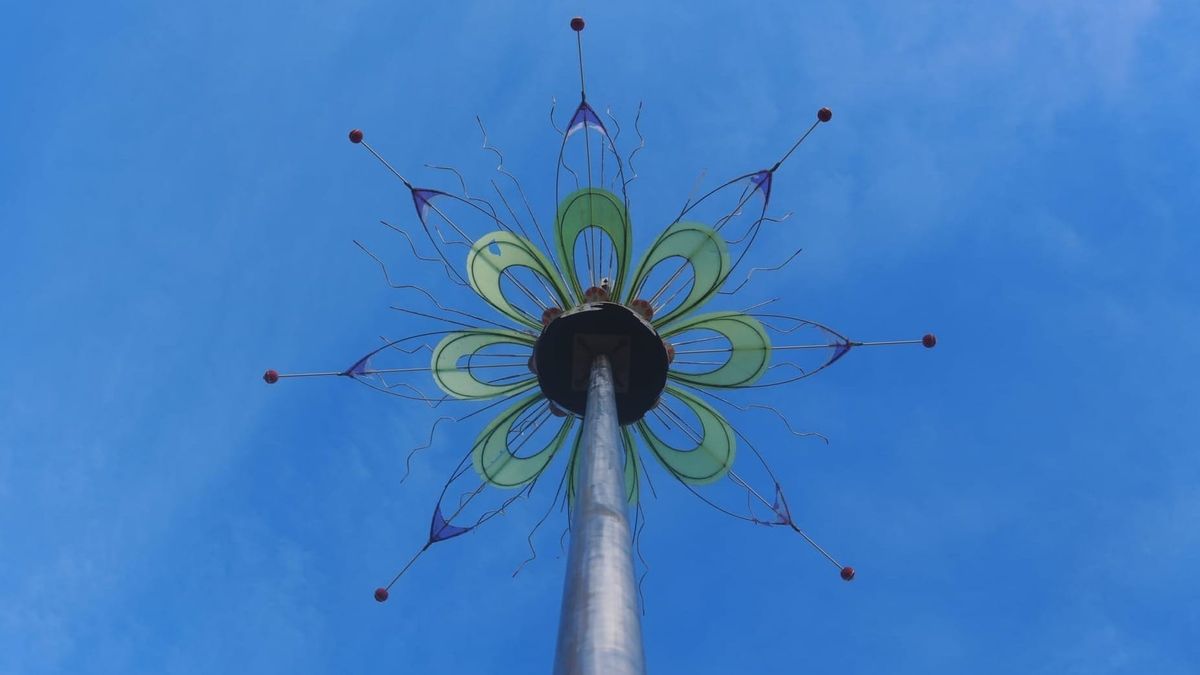
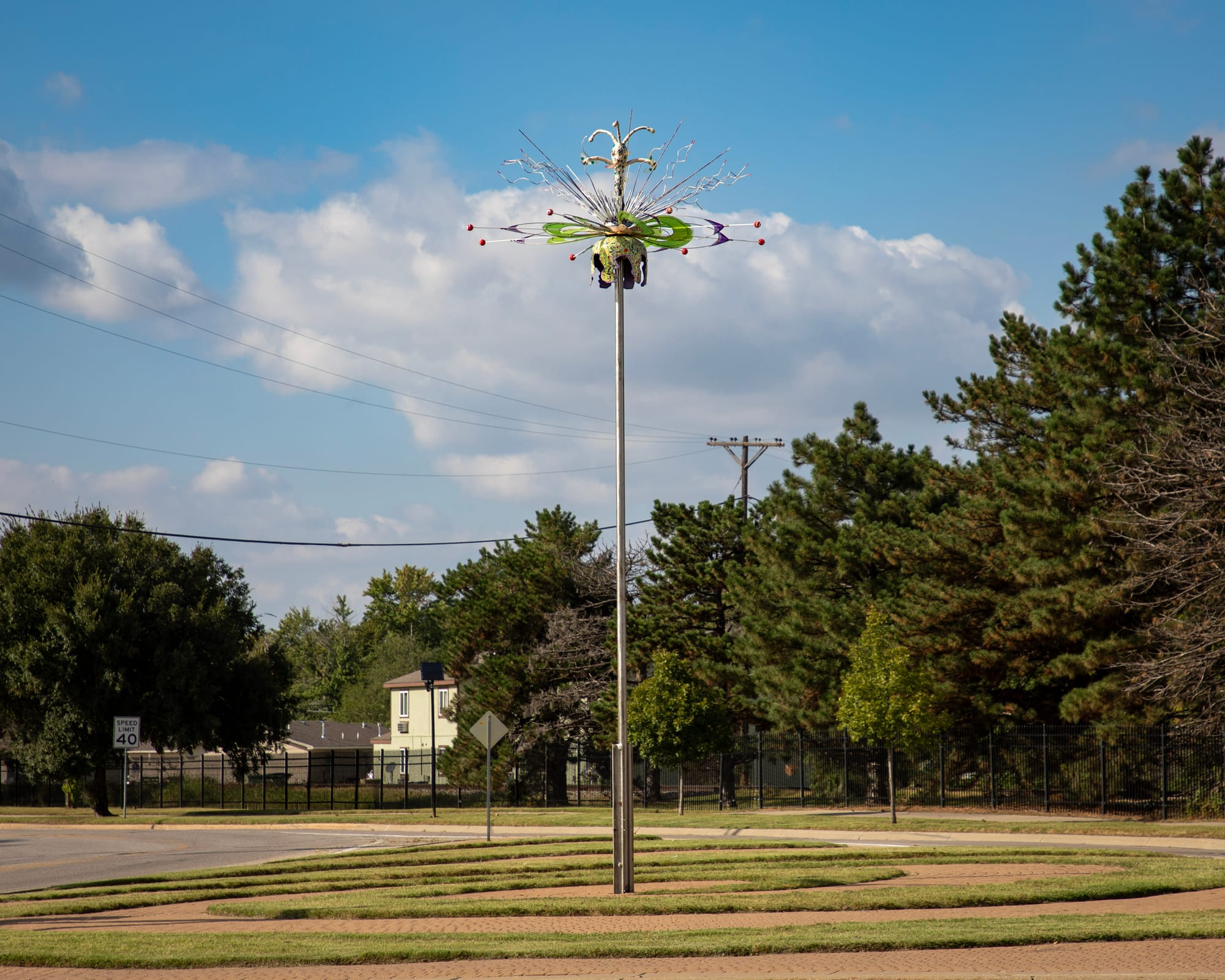
“Passiflora Sorma” stands triumphant on Wichita’s west side.
The sculpture by Tim Berg, Chris Frank, and Ed Langston was part of the planned redesign at the intersection of Central Avenue and Zoo Boulevard in June 2003. After strong winds knocked it over, the artists rebuilt and reinstalled the sculpture in 2019.
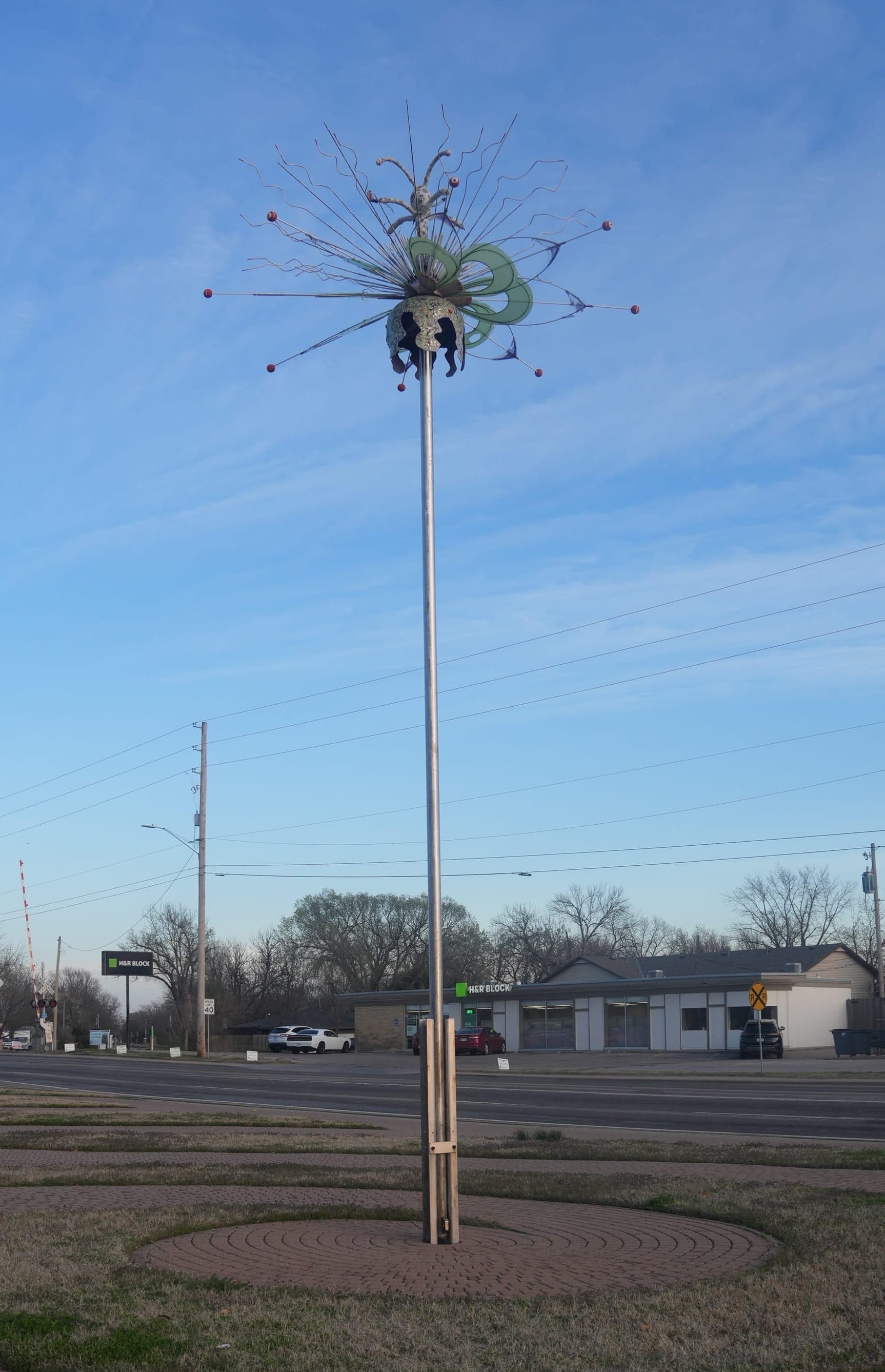
While the 2003 sculpture is an abstract floral design, it strikes me more as a sword buried deep in a grassy spiral.
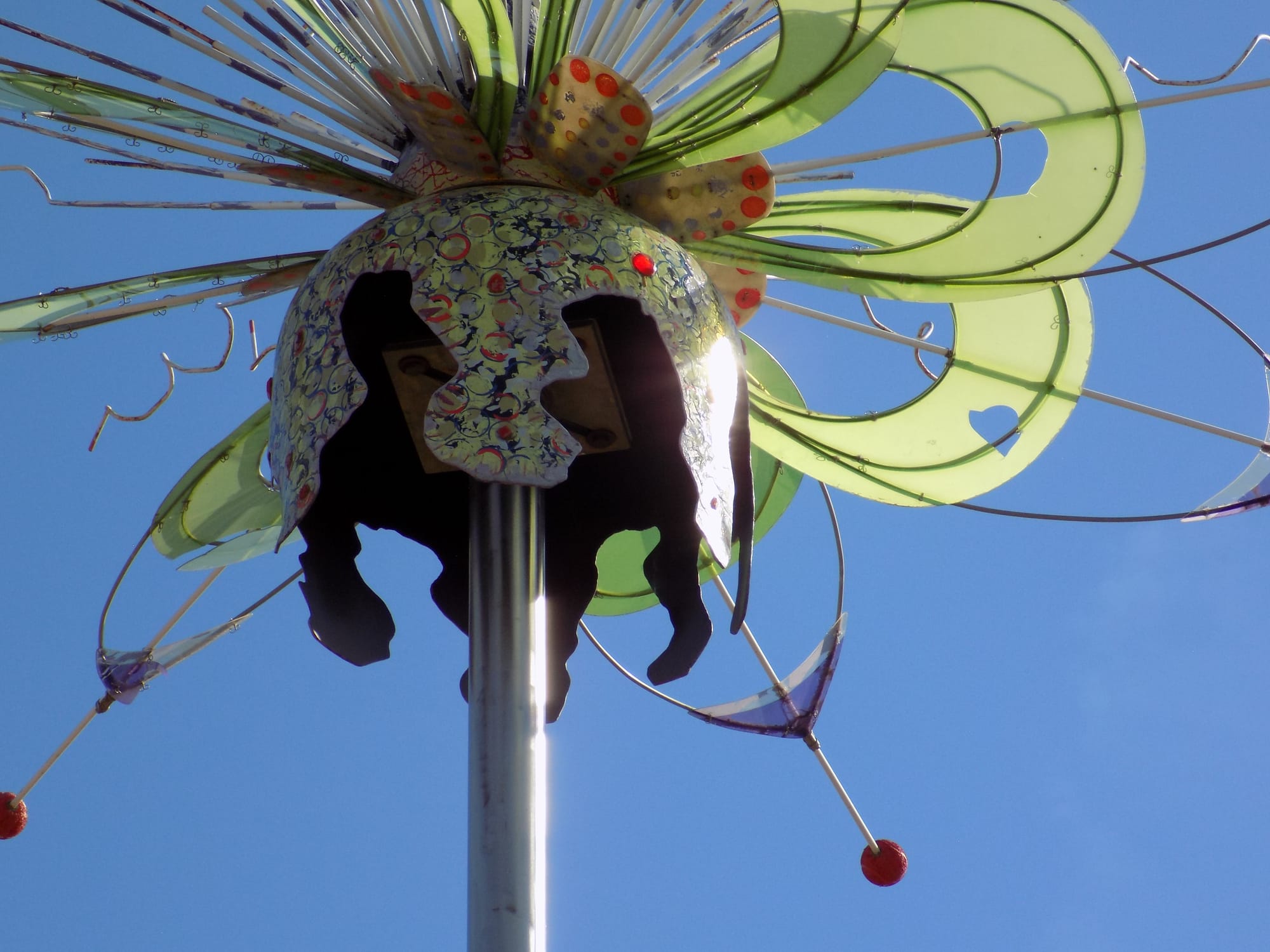
On a shiny steel post nearly as tall as an utility pole, a helmet perches on the hilt of an eccentric soldier’s grave-marker. The helmet is the focal point of the sculpture.
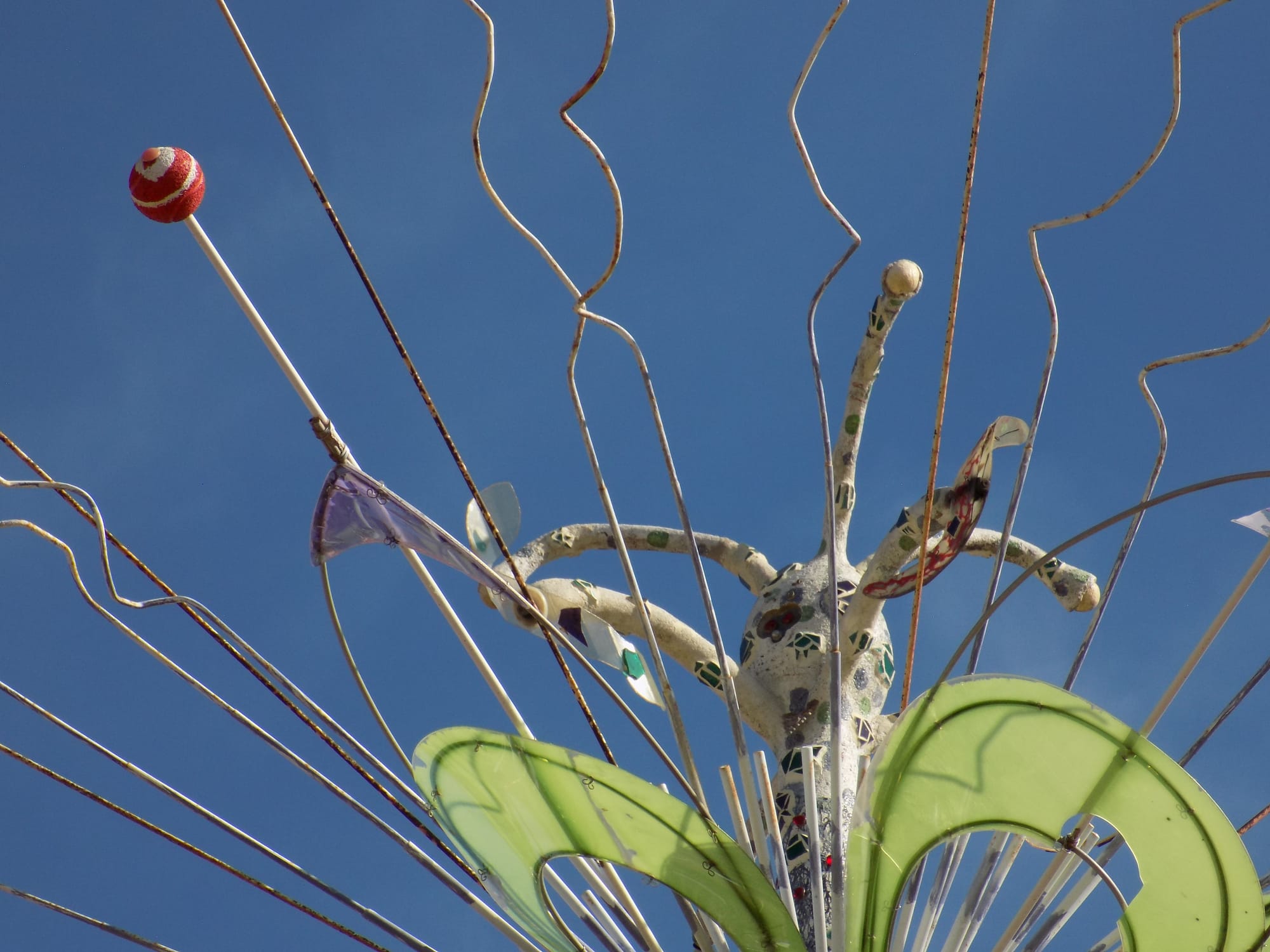
A polka-doted, tentacled figure — a sort of jester hat — sits at the work’s highest point. This is likely representative of the stamens and anther filaments of the organism’s anatomy. Although the Public Art Archives page for “Passiflora Sorma” lists only steel (alloy) and acrylic paint as materials, it's clear that a variety of mosaic elements are attached to what could be a ceramic form.
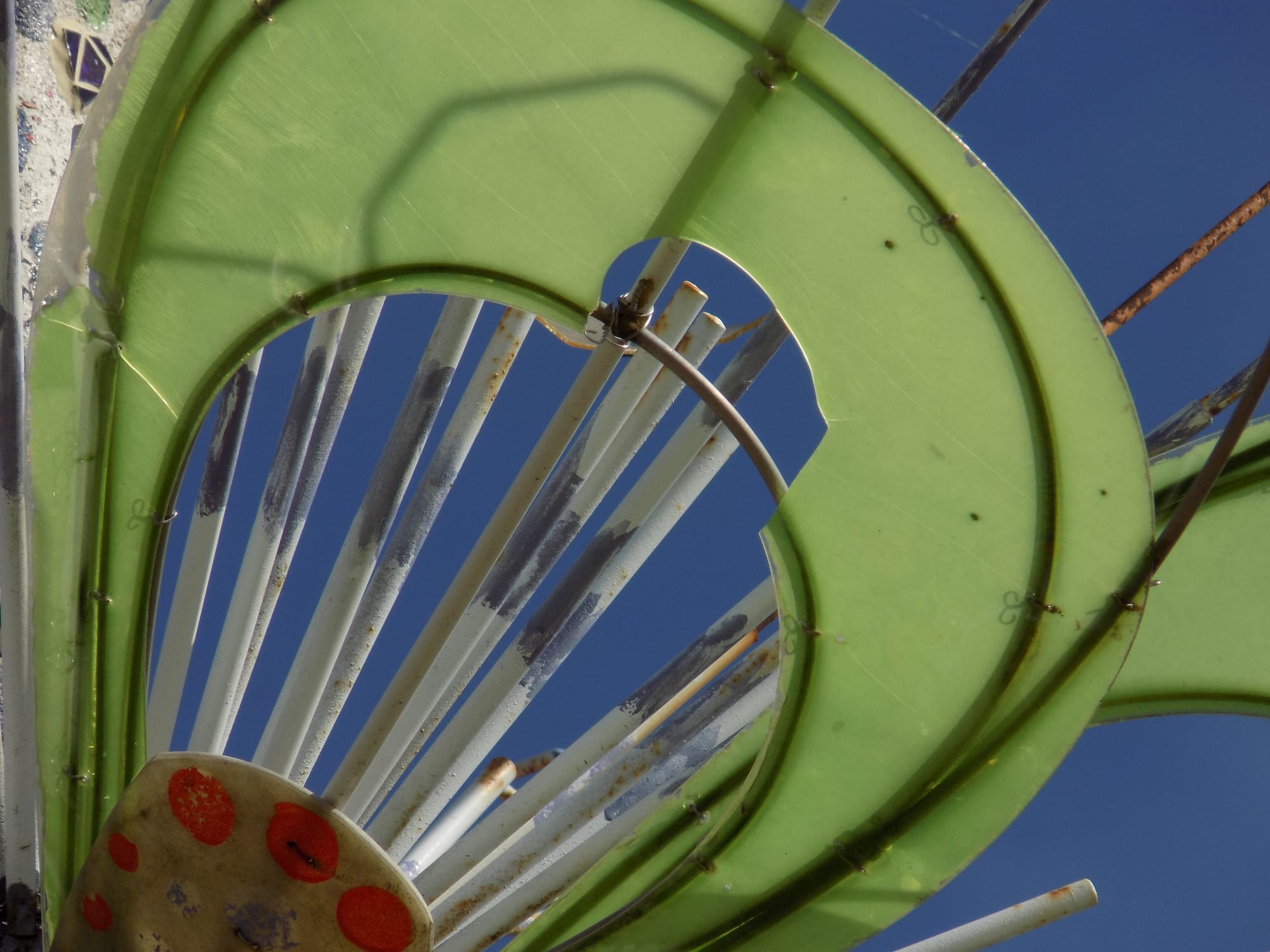
Not to mention what may be tennis balls painted red and white like targets. They cap the ends of six metal spikes, which intersect with the petal shapes that have soft lilac at the pointed tips and lime green arches in the center. Some of the green and lilac material has eroded over time.
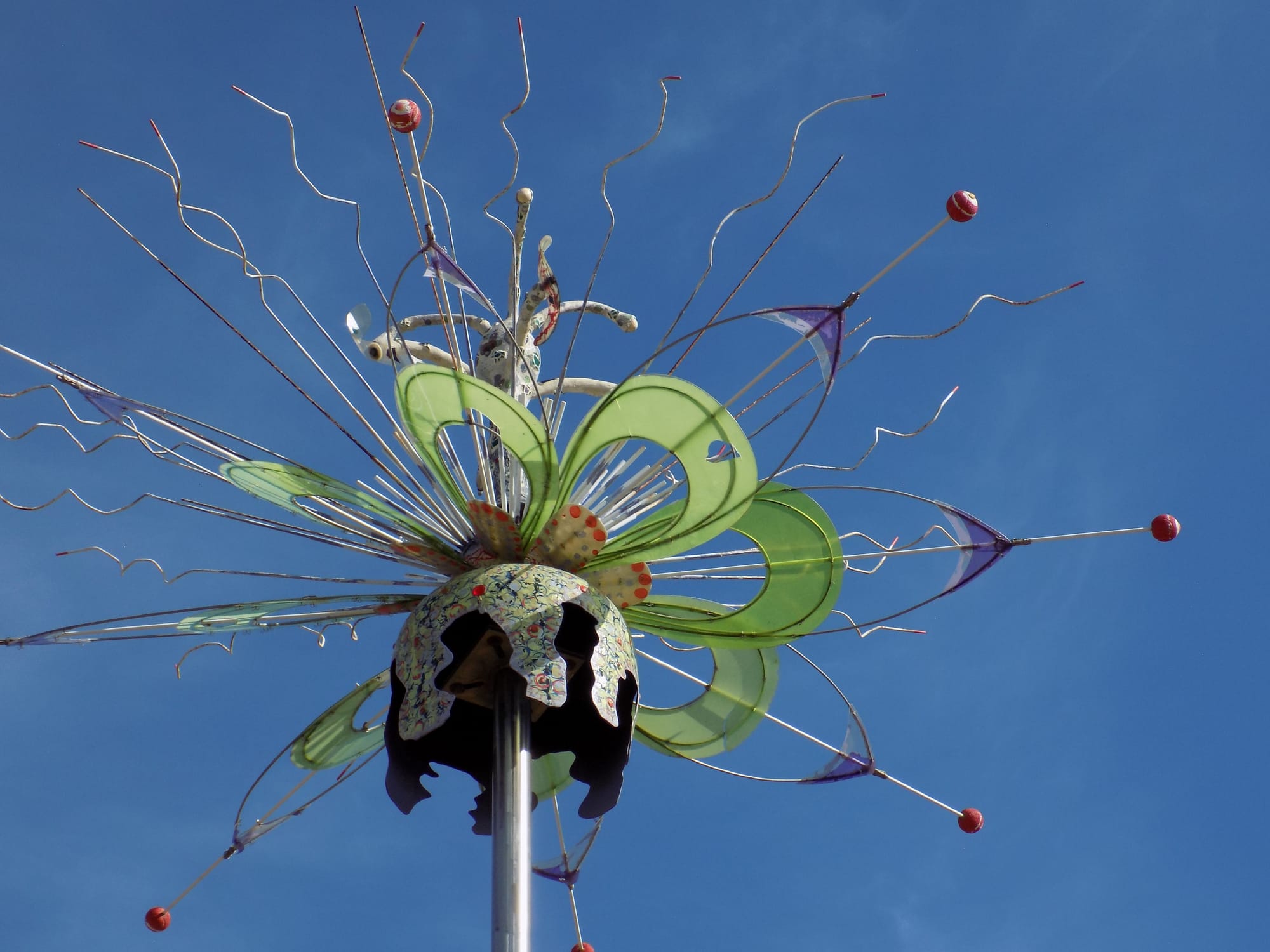
At the base of the petals, we meet the core of this strange flower. Here is the helmet that, upon closer inspection, might better resemble a propeller hat. Its edges drip down in wavy strands, and an array of colorful dots and crimson rhinestones cover the surface.
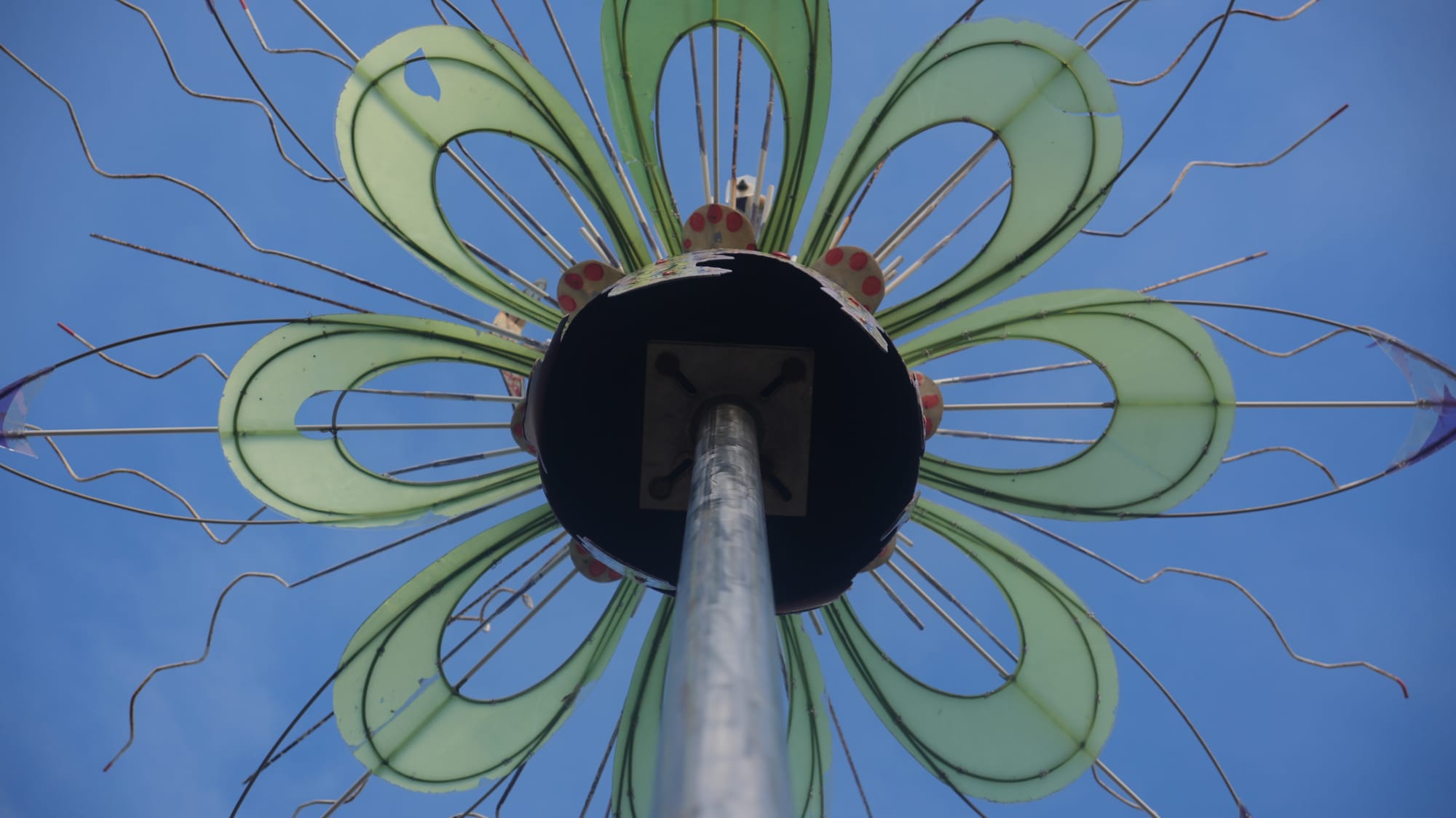
“Passiflora Sorma” is named after a variety of the eccentric passiflora flower (passionflower) species. When Frank was working on the piece, he learned that “Sorma” is a Greek phrase for “secret medicine.”
“It’s a one of kind genus — only one on the planet,” he said of the unique name.
In an interview with The SHOUT, artist Ed Langston said he and his collaborators had no idea how long the sculpture would be on view. “The city gave us $300 and we just were there for the exposure and fun. We didn’t know how long it would last.”
Langston took charge of the topmost piece. He utilized metal wire and concrete, inspired by S.P. Dinsmoor's Garden of Eden in Lucas, Kansas.
“I was sort of in charge of making that, since I’ve done some concrete work in the past," he said. "I had an idea that it would hold up well because of the Garden of Eden.”
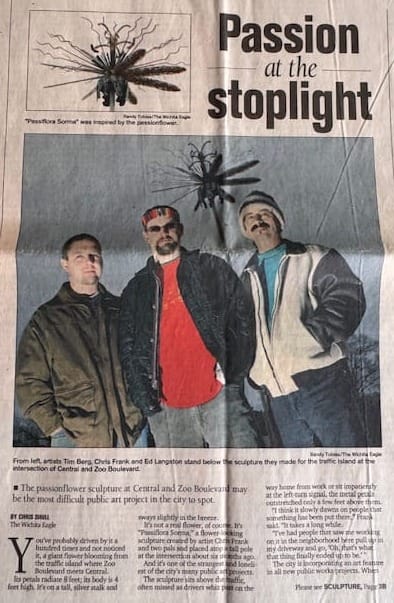
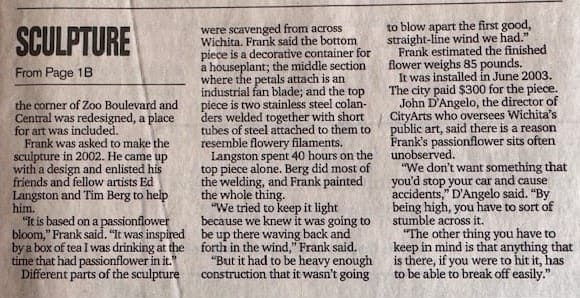
In a February 3, 2004 Wichita Eagle story, the three artists are pictured in front of their collaborative work. Images courtesy of Chris Frank.
Frank worked on the color and texture of the lower section. He and Langston were in charge of the aesthetic portions of the work, while Tim Berg handled the mechanics.
“My brother-in-law was an extremely talented metal worker — he was kind of the nuts-and-bolts guy,” Frank said.
Given the original sculpture's low budget, the artists collected bobs and bits around the city to use. “We scoured junkyards, we went to the Yard store for odd stuff to use,” Frank mentioned.
“We were just kind of turned loose,” Chris Frank said. “We were blown away that it came down when it did. It lasted, good lord, 15 years? We didn’t know it would be up that long.”
A 2018 Wichita Eagle article details the damage done to the sculpture by a foe Wichitans know all too well: the wind. A strong wind gust blew west Wichita's "quirkiest public art" off its pole, reported Matt Riedel.
After the crown of the sculpture toppled in 2018, the artists received $3,000 to repair it.
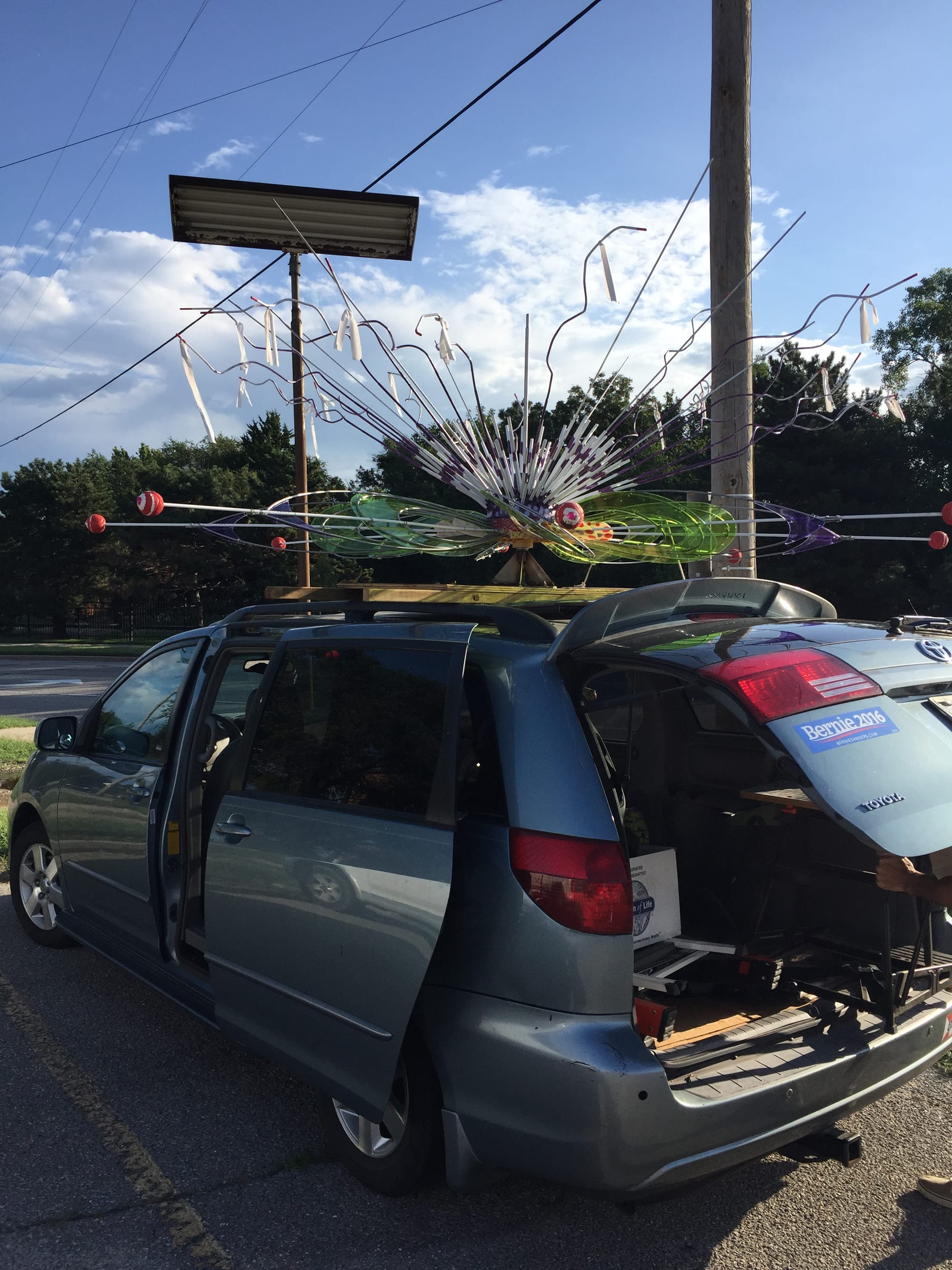
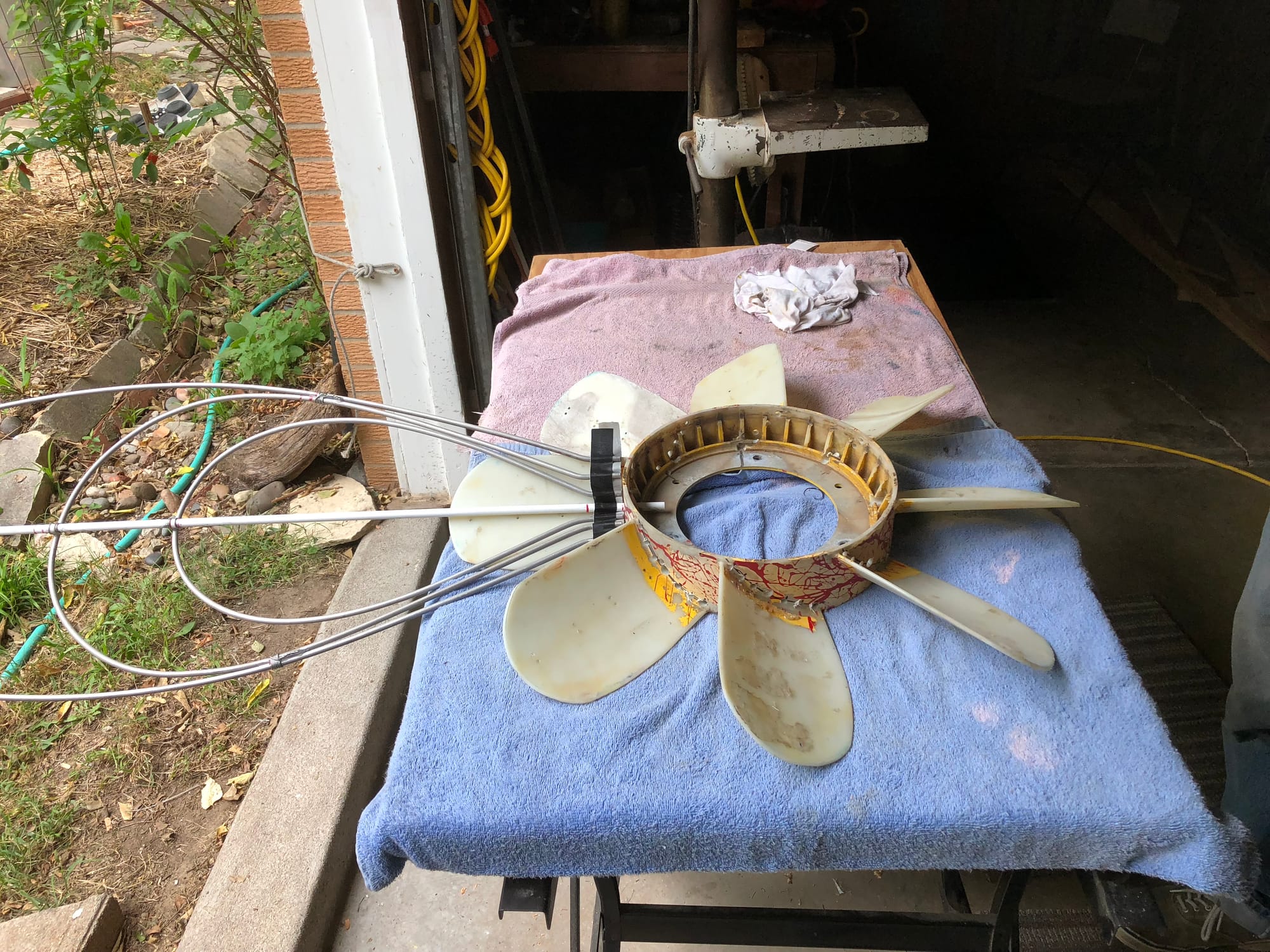
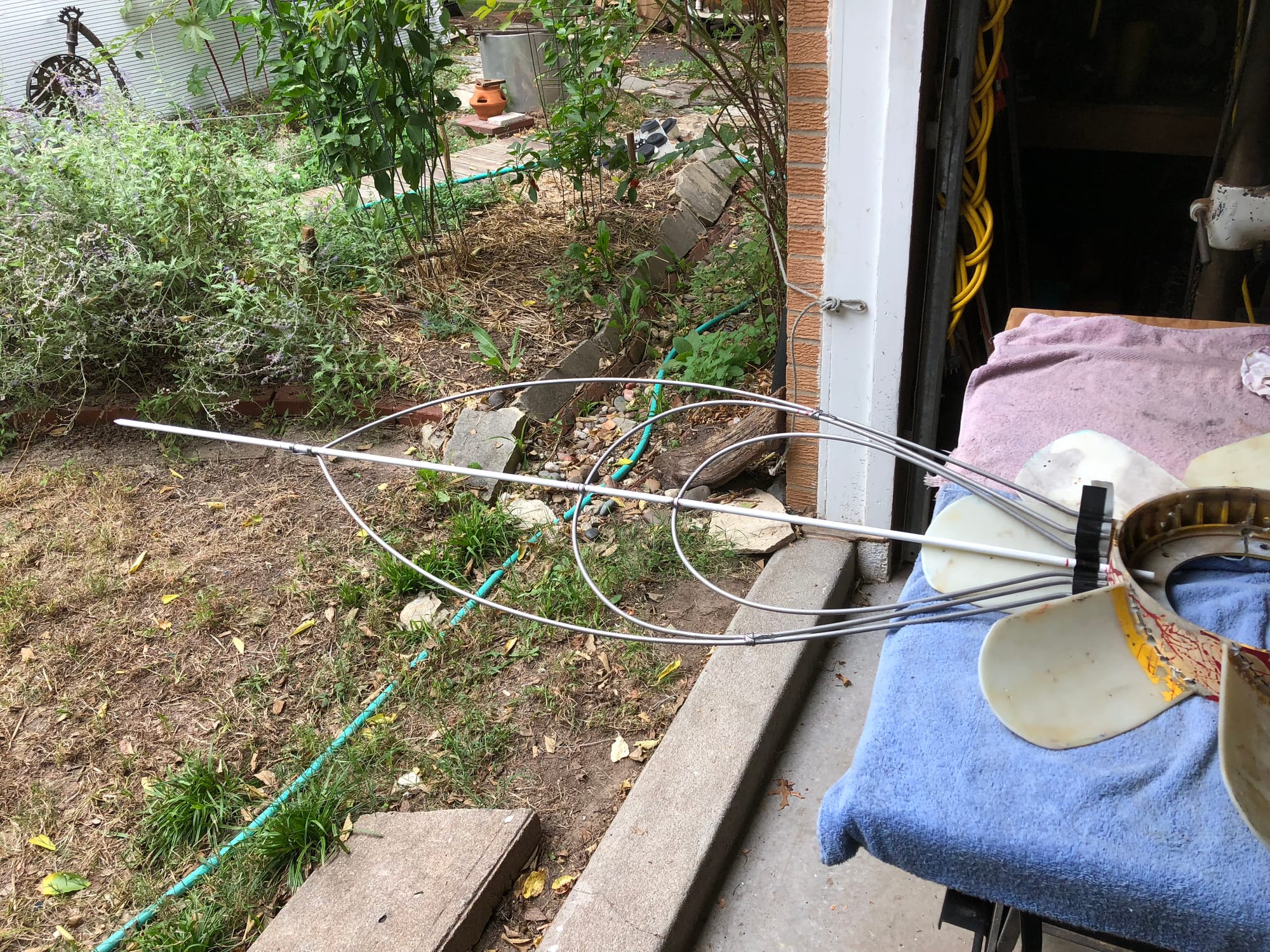
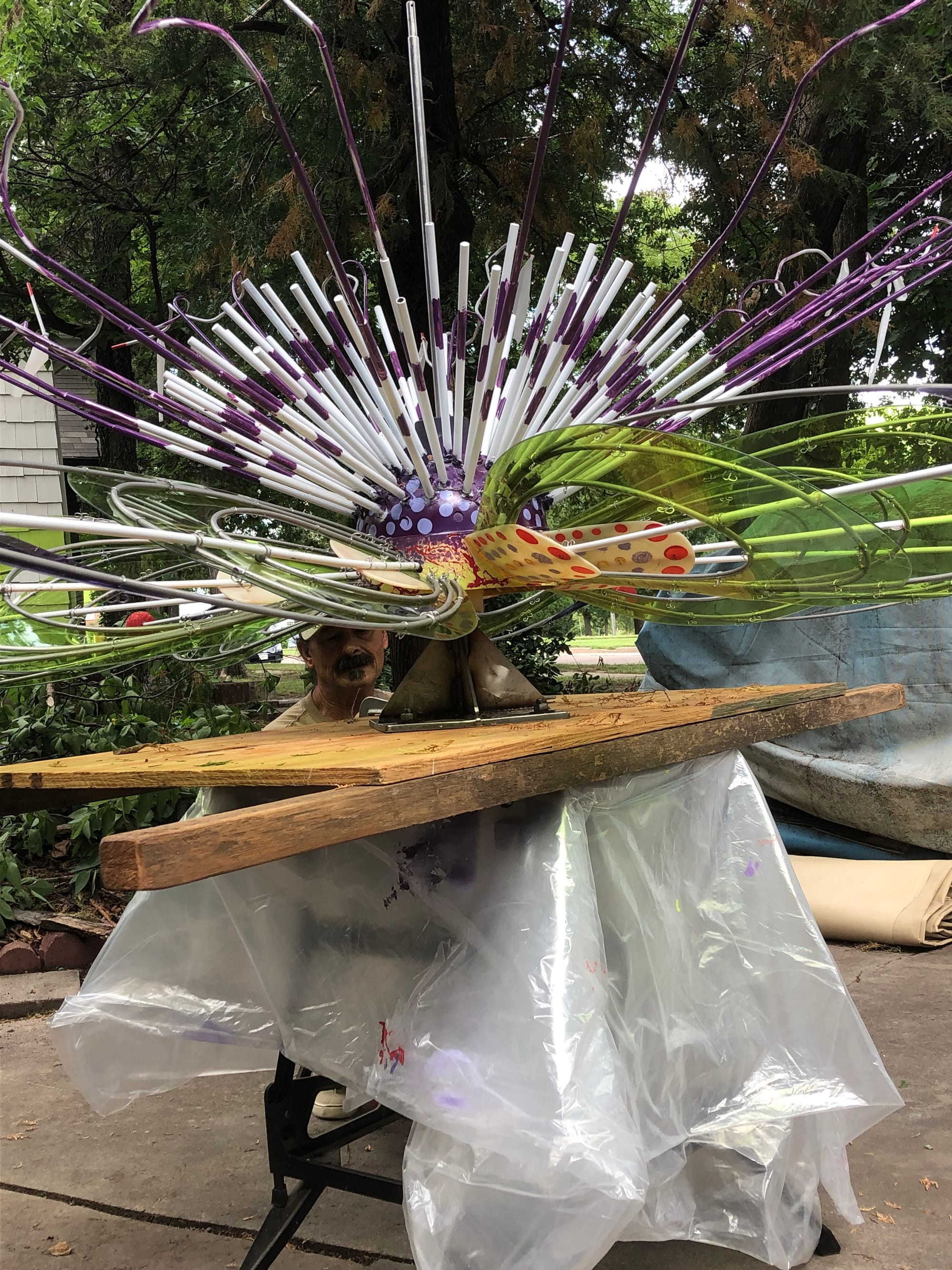
Close up photos from the 2019 reinstallation emphasize not only the trauma the sculpture has borne in the last seven years, but the incredib P
"The first one was just a little rough — it looked like an assemblage kind of piece, like folk art," Frank said. "The second time around it was more intentional, not exactly ‘fine arts,’ but closer to it."
More durable, too.
“The second version was designed with the wind in mind," Frank said. "The material in the petals is made out of polycarbonate, a really durable material ... It probably would’ve weathered that storm.”
The reinstallation took place on August 17, 2019.
The drastic nature of the damage to "Passiflora Storma" may have accounted for its relatively speedy restoration. But many works in the City of Wichita's Public Art Collection have been deteriorating for years.
Luckily, five months after the reinstallation of "Passiflora Sorma" in 2019, the City Council passed an ordinance to create a Percent for Art program. The ordinance allocates 2% of Wichita’s public project funds to public art. Up to 10% of those funds can be earmarked for maintenance and restoration of the city's public art collection.
The city now conducts annual condition assessments and prioritizes restoration accordingly, said Jana Erwin, the city's public art manager, in an email. Since 2022, eight artworks have been restored or received conservation treatment. Four more are set to begin the process this year.
"Passiflora Sorma" is a reminder that public art can last — but only if we care for it.
The Details
“Passiflora Sorma”
Chris Frank, Ed Langston, and Tim Berg
Steel (alloy) and acrylic paint sculpture
The sculpture is located at 3200 W. Central Ave. in Wichita
Learn more on the Public Art Archives page for “Passiflora Sorma.”
Taylor Waller is a mixed-media artist, an art historian, a journalist, and an editorial assistant for The SHOUT.
❋ Derby man has the kind of voice that turns heads — and chairs
❋ Socializing while sober: how some Wichitans are cultivating alcohol-free communities
❋ As a small creative business closes, the owner mourns
❋ Painting through it: Autumn Noire on 20 years of making art
❋ How a guy from Wichita resurrected 'Dawn of the Dead'
❋ Bygone Friends University museum housed curious collections
Support Kansas arts writing
The SHOUT is a Wichita-based independent newsroom focused on artists living and working in Kansas. We're partly supported by the generosity of our readers, and every dollar we receive goes directly into the pocket of a contributing writer, editor, or photographer. Click here to support our work with a tax-deductible donation.