John Legend helps usher in a new beginning for the Orpheum Theatre
The performance served as a door onto the past and a mirror of Wichita now.
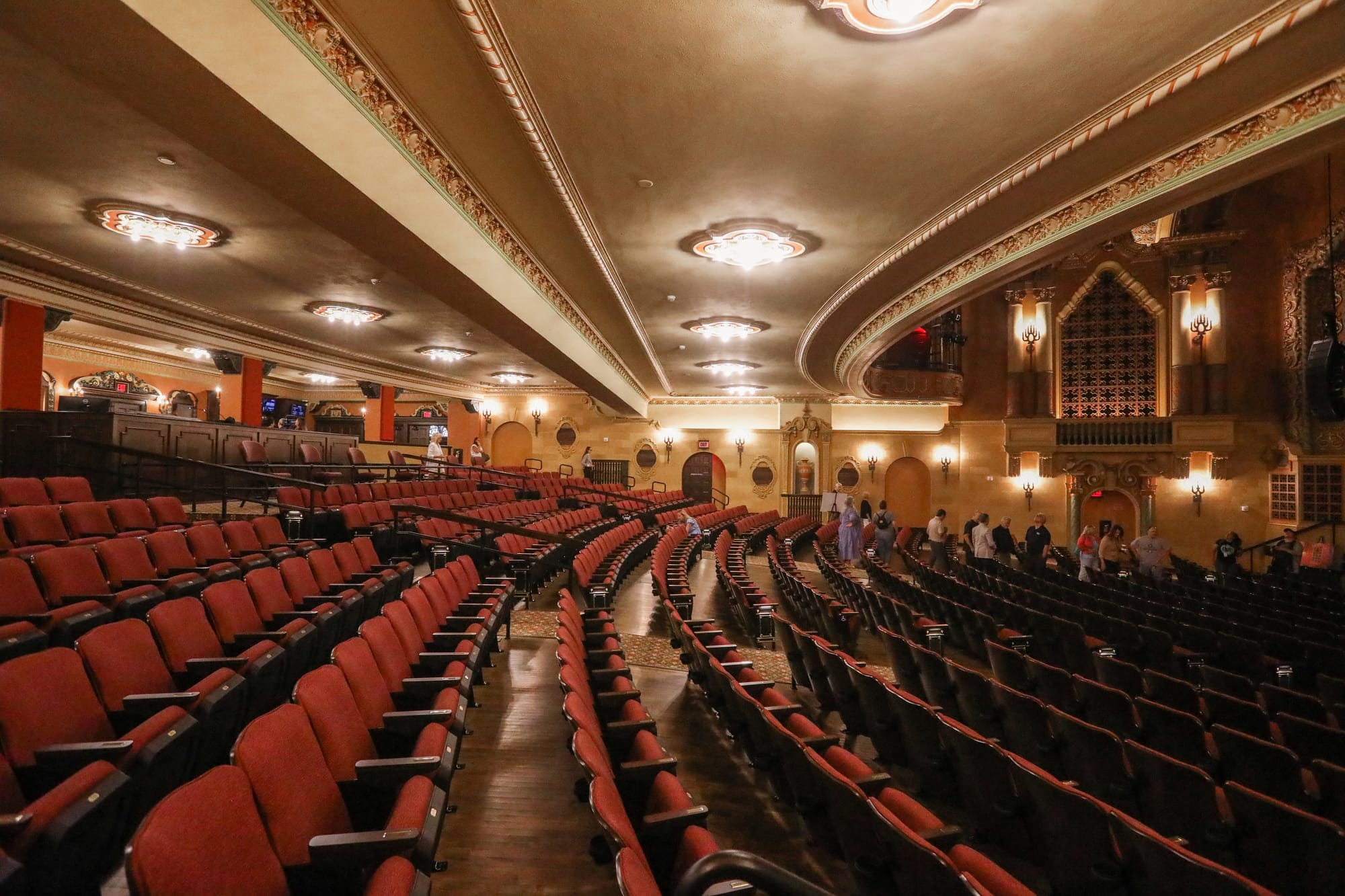
They’re very comfortable.
That’s the short answer to “How are the seats?” — the question that is top of people’s minds, based on interactions before and after I attended the John Legend concert that reopened the Orpheum Theatre on Sunday.
To elaborate a bit: The seats aren’t especially wide, but they’re not too narrow either, and the orchestra-level legroom was more than sufficient for this 6-foot-tall correspondent. The cushions are firm and plush. Gone is the downward slope that the old chairs — thriftily recycled from an old movieplex — imposed on complaining backs and posteriors. Sightlines are excellent.
The seating was far from the only aspect of the revitalized Orpheum that impressed Sunday’s sell-out crowd. Most attention-grabbing was the new (old) fire curtain, part of architect John Eberson’s original 1922 design for the theater. It shows a Spanish torero and his sweetheart strolling through a colorful fantasy version of an Andalusian marketplace while being eyed by a parrot on a perch.
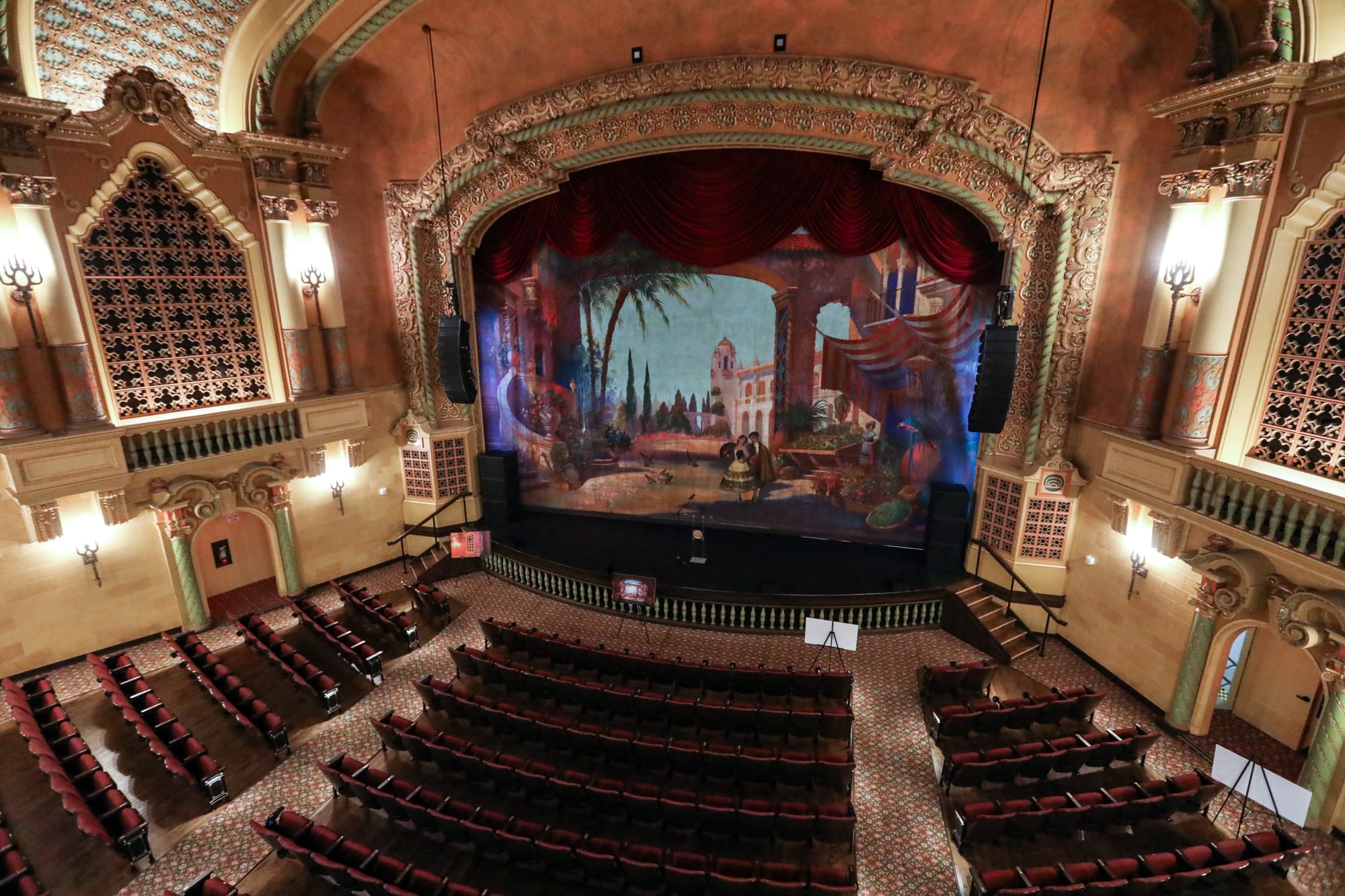
The curtain had hung, unseen but well-protected, in the theater’s rafters for decades. In a pre-show speech, Orpheum executive director Stacee Olden explained that during the restoration, the original asbestos-based curtain was encapsulated and affixed to a modern fire curtain in order to make it, once again, a functional part of the building. Its silent rise to reveal John Legend’s piano drew its own round of applause.
Those who remember the Orpheum from before this restoration will be struck by the difference the replastering and repainting — with a lovely, unusual, detailed color palette reconstructed through historical research — makes in the overall impact of the space.
Before, the “atmospheric” effect Eberson intended — of sitting out under the stars on a spring evening in the Mediterranean — was something you could pick up on if you knew to look for it; if you knew to look past the splotches, the patches, the crumbling plaster and the fading paint.
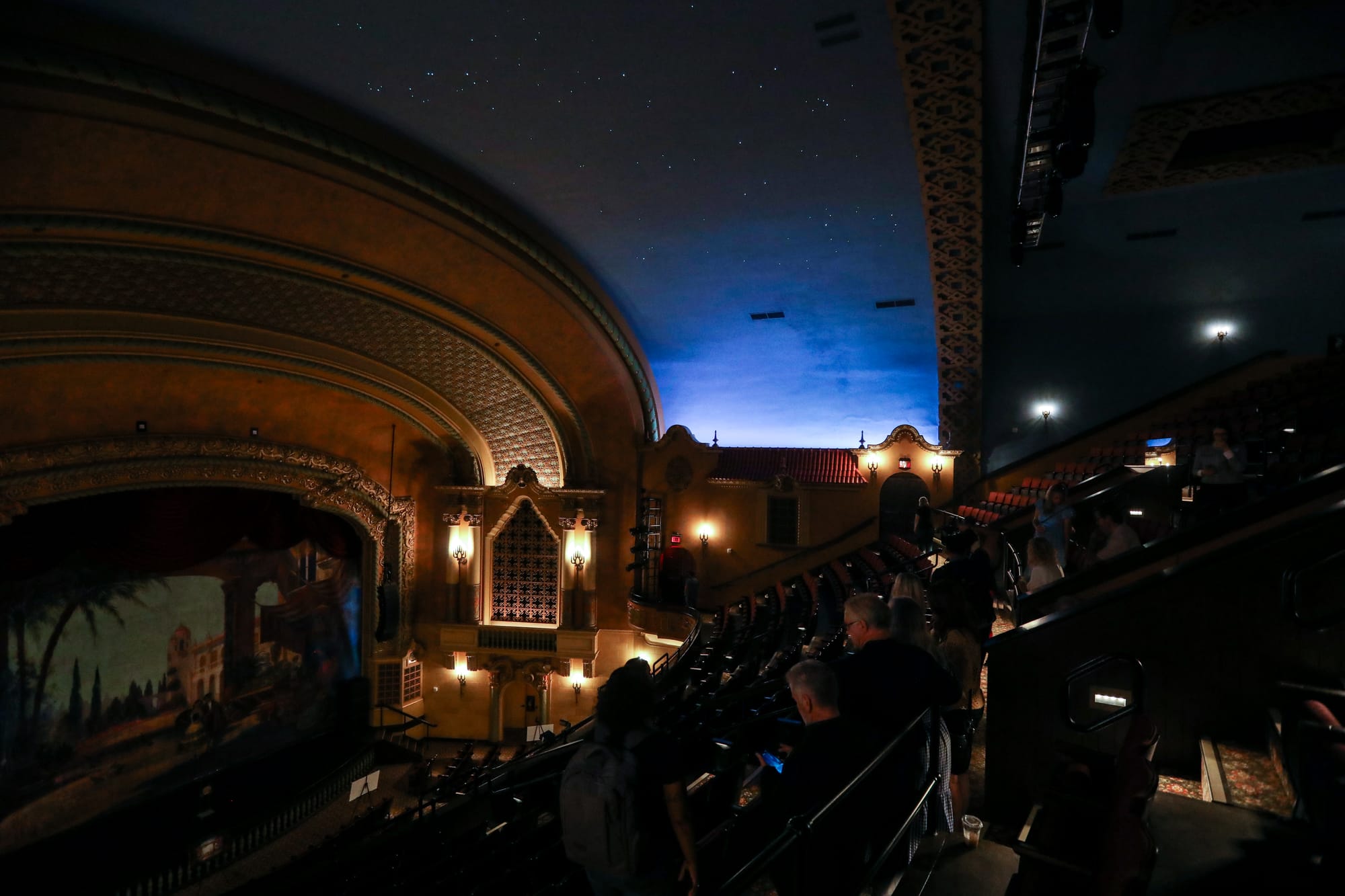
Now that effect really grabs you. It’s easy to indulge in the fantasy, especially if you step upstairs to the balcony level, where the barrel roof tiles and the star lights twinkling in an artificial deep-blue twilight are more visible.
The Orpheum now serves not just as a doorway into a fantasy version of Spain, but also, at least in my mind, as a portal back to the bygone Wichita of a century ago — a time when a typical weekend night saw more than 20,000 Wichitans stream into 11 different theaters to view live performances, silent films or, as on the September 4, 1922, opening night of the Orpheum, mixed bills that combined the two.
As I wrote four years ago in an East Wichita News feature that marked the centennial, the Orpheum’s opening day of performances featured two vaudeville comedians, Dave Ferguson and Ned Norworth; a handful of other players who did skits and sketches; the Henry Melody Sextett, with “vocal offerings by six attractive girls;” and finally a silent film, “The Three Must-Get Theres.”
“Presentation of the whole entertainment is practically perfect,” the Beacon reported. But that wasn’t the full story.
“It was crazy hot in Wichita that weekend, and people got dressed up,” said Rachel Banning, the Orpheum’s previous executive director. “The patrons came and sat in these beautiful, red leather chairs, and when they got up to leave at the end of the night, their sweat and the dye from the leather had turned their clothes red.” In response to the resulting uproar, the Orpheum management offered to reimburse patrons’ laundry bills.
The well done history page on the Orpheum’s new website fills in more of the story, including the decades of volunteer- and community-led efforts that let Wichita keep its Orpheum when so many other theaters were lost to the wrecking ball. The page also highlights historic performances, such as a 1923 appearance on the Orpheum stage by Harry Houdini, and 1940s shows by Ella Fitzgerald, Count Basie, and Louis Armstrong.
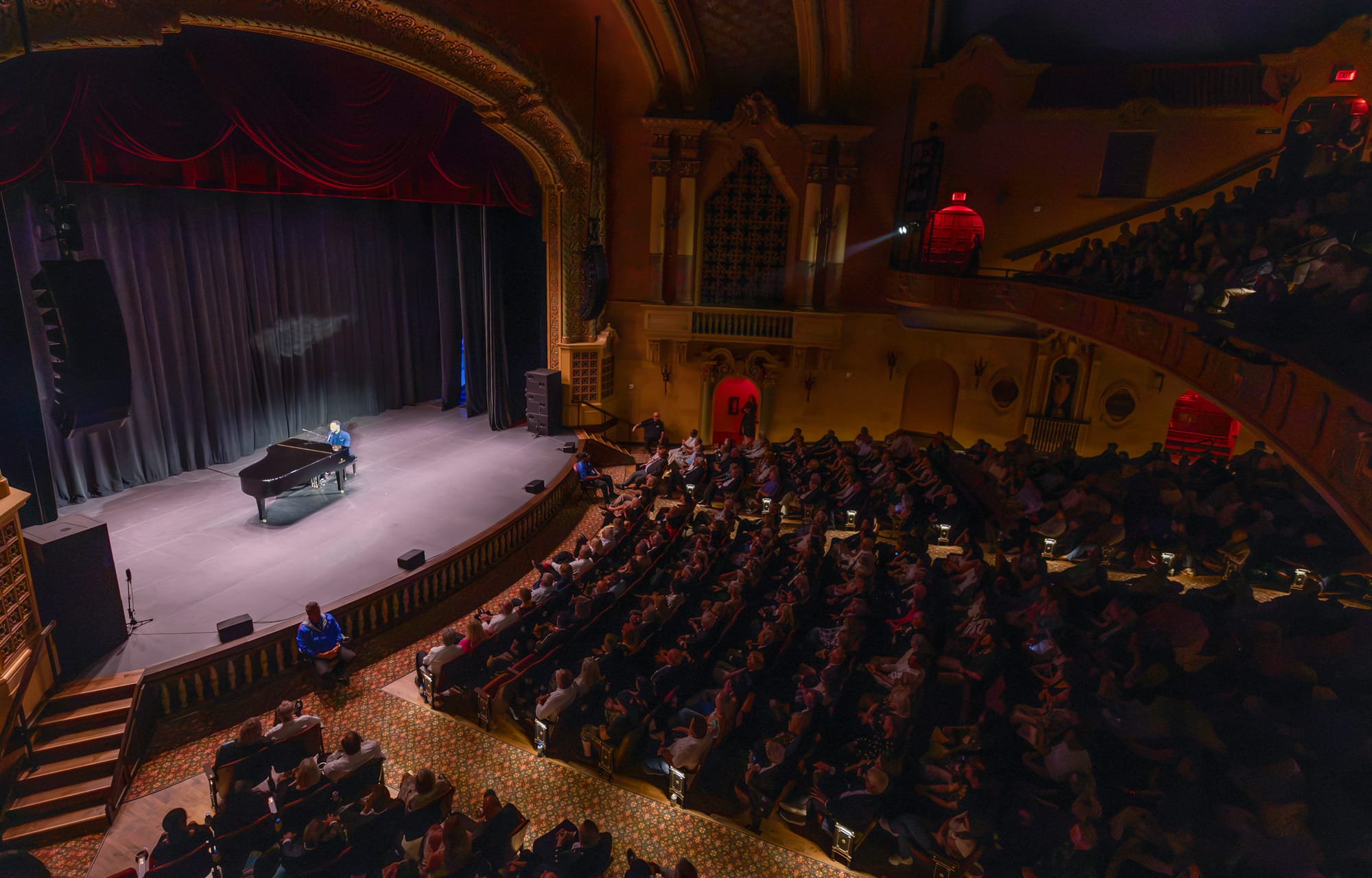
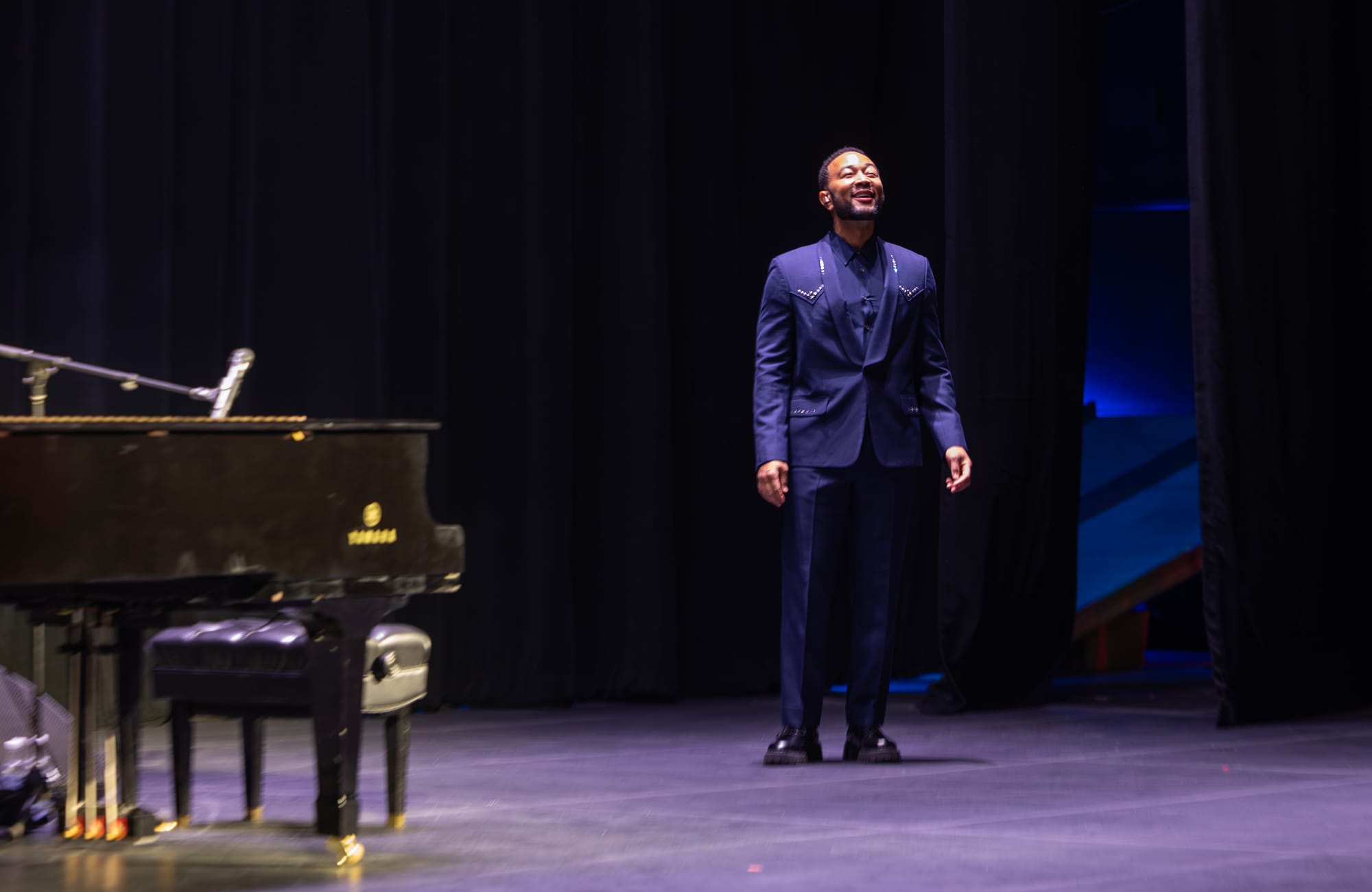
Sunday’s audience was brimming over with the pleasure of being on hand for another historic night, one that Olden called the true beginning of the Orpheum’s second century. John Legend — a singer-songwriter who chose his stage name at age 25, then backed it up by collecting an EGOT — was an inspired choice to provide the Orpheum's musical rededication (and a great "get" for the Grumpy Old Men, the philanthropists who underwrote his appearance).
The songs Legend chose, both originals and covers, focused on timeless themes that would have been equally familiar to 13th-century troubadours or early-20th-century vaudevillians: nearness to the beloved, or distance from the beloved, and yearning or anxiety over the prospect of one state giving way to the other. “Come and go with me. There’s so much new to see … so much I want to show you,” he sang to open a one-hour set that felt all too brief.
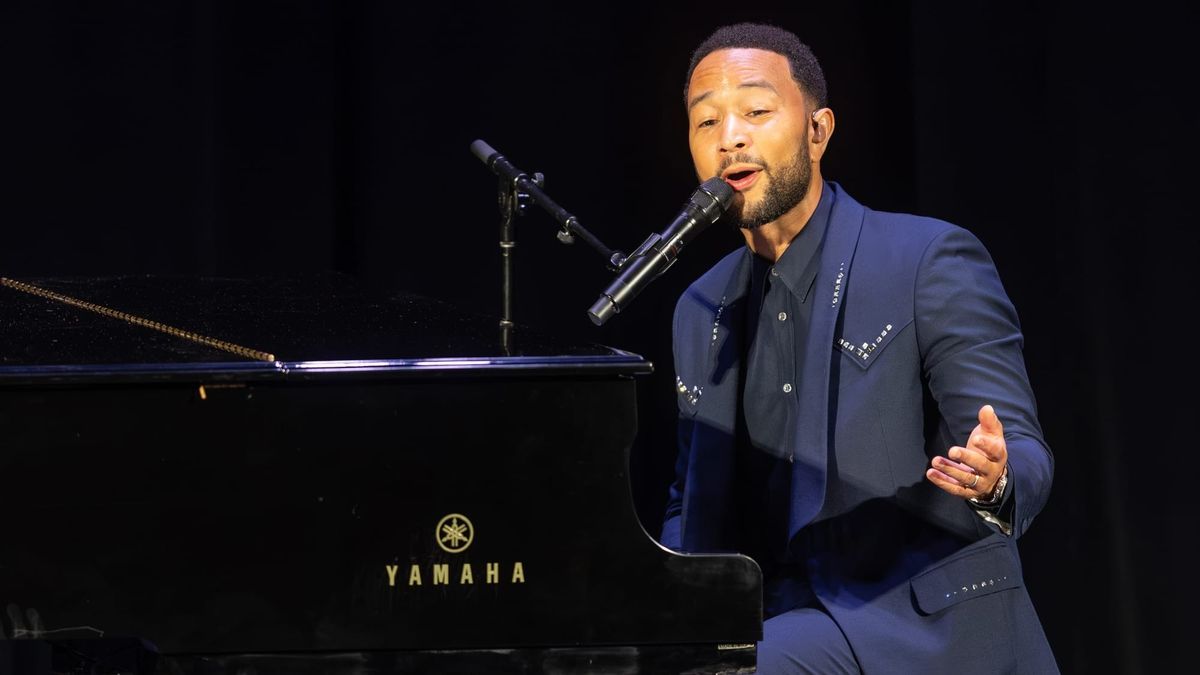
"Shall we sing this song together?" Legend asked the audience as he launched into one of his signature tunes, "Ordinary People." But few people took up the invitation, perhaps because it was his voice we wanted to hear, alone on stage with his piano — a slightly reedy voice at mid-range, sweeping smoothly upward to hit bold, well-supported high notes. The piano and his voice were both closely miked, so piano overtones hung in the air, creating almost organ-like effects at times.
Being part of such an event meant more than witnessing a good show, or even a historic one. At the risk of belaboring my metaphors, the restored Orpheum, as inaugurated by Legend’s concert, is not just a door onto the past, but a mirror of Wichita now — one in which we can see ourselves, and one in which we are given leave to hold ourselves in high regard. We’re the sort of people, the sort of city, to go out of our way to hold onto a beautiful place like this.
And we’re worthy of the values it represents and contains: the aesthetic value, the artistic value, the emotional value, the civic value. That’s a worthwhileness that will carry on for decades, a lasting legacy that is only just beginning, or beginning again.
Sam Jack is a poet, a classical tenor, and the adult services librarian at Newton Public Library. He performs with several local groups, including Wichita Chamber Chorale, Wichita Grand Opera, and Opera Kansas. He received a Master of Fine Arts in creative writing from the University of Montana.
❋ Derby man has the kind of voice that turns heads — and chairs
❋ Socializing while sober: how some Wichitans are cultivating alcohol-free communities
❋ As a small creative business closes, the owner mourns
❋ Painting through it: Autumn Noire on 20 years of making art
❋ How a guy from Wichita resurrected 'Dawn of the Dead'
❋ Bygone Friends University museum housed curious collections
Support Kansas arts writing
The SHOUT is a Wichita-based independent newsroom focused on artists living and working in Kansas. We're partly supported by the generosity of our readers, and every dollar we receive goes directly into the pocket of a contributing writer, editor, or photographer. Click here to support our work with a tax-deductible donation.