The rockets' red, white and blue glare
On America's 250th birthday, Kansas skies will fill with sound and light from backyard enthusiasts chasing ever-bigger booms – and from professional operations, like Wichita's Victory Pyrotechnics.
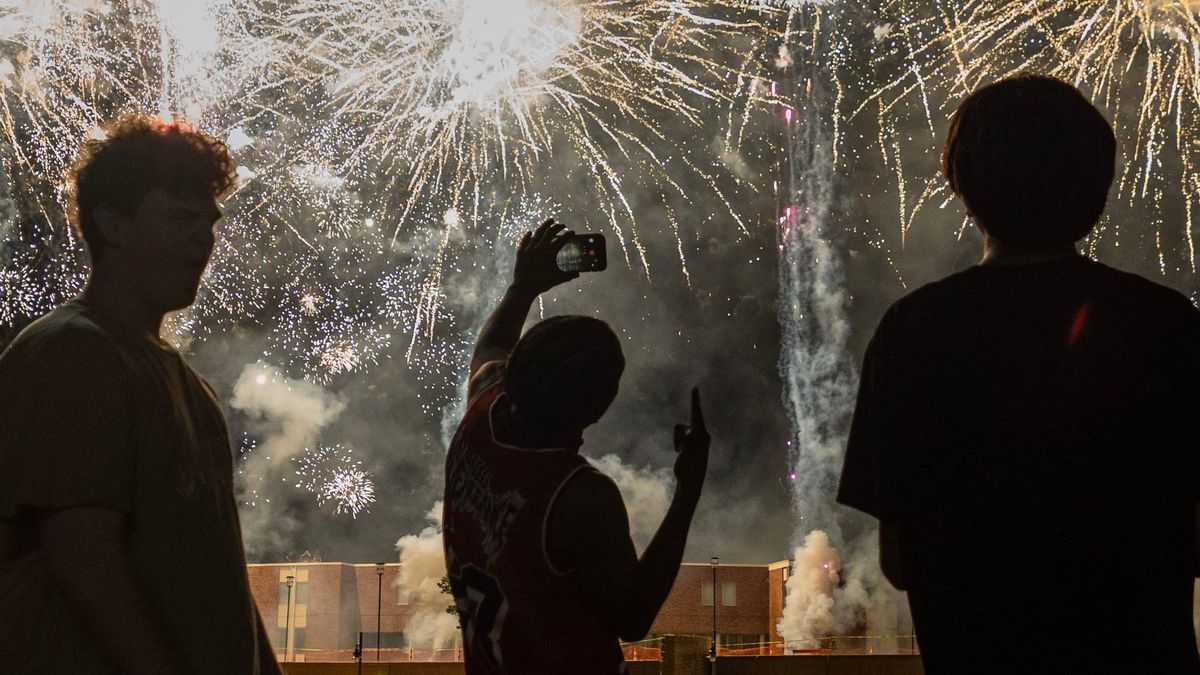
In my first memory of a firework, I’m sitting in an umbrella stroller on a wet lawn behind the clubhouse at Wichita’s Rolling Hills Country Club on the Fourth of July. A blazing hard bulb of white and yellow stars expands outward with a loud, delayed report. Outward, outward, growing larger than I thought it could, faster and faster. I remember shrinking back into the stroller seat and shielding my face with my hands, guarding against an unprecedented acceleration that showed every sign of continuing until it would collide with my family in their lawn chairs.
The firework didn’t scare me so much as startle me into incomprehension. Until then, the sky had seemed only an empty backdrop. The firework transformed it into a space where unseen forces were at work, where something powerful could suddenly appear.
For the country club’s fireworks show, then as now, residents of the surrounding neighborhood joined members of the club in rows of lawn chairs on the clubhouse’s back lawn, looking west across the fairways and greens of the tenth, first, and eighth holes to the safe distance where the pyrotechnicians set up their launchers as dusk fell. I remember squinting out into the shadows and the dimming light, trying to make out what the men were doing.
At a certain point of deepening dusk, when it seemed that the moment of ignition was imminent, the pyrotechnicians would launch a single test shell, a comet, to gauge the wind speed and direction. A few minutes later, the show would start in earnest, the lights of headlamps and handheld flares bobbing back and forth as the men lit their battery of mortars and fountains.
The first few shells went up one at a time, with a decent pause between each launch. First I would hear the thump of a lift charge, like a muffled bass drum, then a soundless interval as the shell flew upward, its progress traceable thanks to the little light of a burning time fuse. At (hopefully) the correct altitude, each shell burst.
Fireworks shell effects all have different names, I learned much later. The hard bulb that so startled me when I was 3 or 4 was a peony: a globe of stars that burns brightly and then winks cleanly into dark cinders. A peony with trails is called a chrysanthemum: each star draws a radiating line across the sky. Shells full of long-burning stars that linger and droop toward the ground are called willows, brocades or crowns. Stars that fly out from a central point, then split, multiply, and fly outward again are crossettes.
The reports — the sounds — arrived a split second after each aerial explosion. In addition to generic booming, some fireworks crackled, hummed, sizzled, or screamed. At Rolling Hills, finales were often punctuated by a single salute — a shockingly loud bang, accompanied by a bright flash. And if that signal was not clear enough to satisfy the children protesting their parents’ movement toward waiting vehicles, one of the men would point his flashlight toward the clubhouse and wave it back and forth, receiving in exchange a smattering of applause that sounded feeble after the just-concluded cannonade.
The drive home from the country club was usually just an intermission before a second, self-curated show in our own house’s front yard — this, the successful culmination of a week-long campaign of parental persuasion.
The headquarters for this campaign was the back row of our minivan. The Fourth of July is coming right up, I’d remark, pointing out a yellow-and-white-striped tent. I wonder what they’re selling in those booths this year? My parents would reply, reasonably, that there was really no need for us to spend money on consumer-grade wares. The professional show was bigger, better, and free. I would sometimes concede the point, or at least let the matter drop, but each subsequent tent was its own fresh talking-point and news peg.
What is the truly moderate position on this question, I would ask. We had before us two linked, but really separate, kinds of experience: on the one hand, giant exothermic prodigies viewed from across a gulf of several hundred yards, on the other hand (a sure-to-remain-attached hand, Mom, because yes, we will be careful!) bespoke bangs and pops in our own domestic sphere. Scrawny but scrappy fountains whistling in the soprano range. Burning bits of lofted cardboard flying out of sight over the roof and into the backyard, us kids running after them to make sure they didn’t set a fire.
How do you define “enough” of that latter experience? Surely, to set that “enough” at zero is not moderation, but puritanical astringency! Eventually — sometimes on July 3, sometimes on Independence Day itself — my parents would agree to buy “not a lot,” but “some” consumer fireworks.
That “some,” which usually translated into 30 or 40 minutes of lighting fuses and scampering away, satisfied me — but other kids, or more to the point their dads, apparently saw the home fireworks display as a necessary assault on the oppressive ideas of reason, moderation, and proportion. Alongside the piecemeal shells and cakes, each fireworks stand sold combo boxes of impressive size and staggering expense. The Goddard Lions Club tent offered a box called “The Godfather” for the hard-to-fathom sum of $300. (Later $400, $500, or more.) These boxes, 6 feet tall and stuffed with hundreds of explosive items, seemed to promise that he who shot them off would attain either nirvana or nervous exhaustion. The Lions sold out of Godfathers every year, sometimes a week before July 4.
What a ruckus all those fireworks made when they went off, what an uproar! From my house, a few miles west of Wichita in rural Sedgwick County, the reports of thousands of individual shells and fountains combined to create a toneless, endless rumble that rolled outward from the city and filled the empty fields for miles in every direction.
Wichita’s aggregated explosions changed the city’s visual footprint, too. On a normal, clear night at my house, the constellations were visible overhead, but the city’s lights created a skyglow that blotted out the stars on the western horizon. On the Fourth of July, that skyglow intensified, swallowing more and more of the night sky in a smear of red. If it were any other day, one might think the whole city was going up in flames.
I still spend Fourth of Julys at that house, and the din has only gotten louder and longer, the odd intensification of the city’s skyglow only more pronounced. In 2000, when I was 11 years old, Americans lit 102 million pounds of consumer Fourth of July fireworks, according to the American Pyrotechnics Association. By 2019, that weight had more than doubled. It temporarily doubled again during the COVID pandemic, to a peak of 461 million pounds in 2021, or approximately the weight of two fully loaded aircraft carriers.
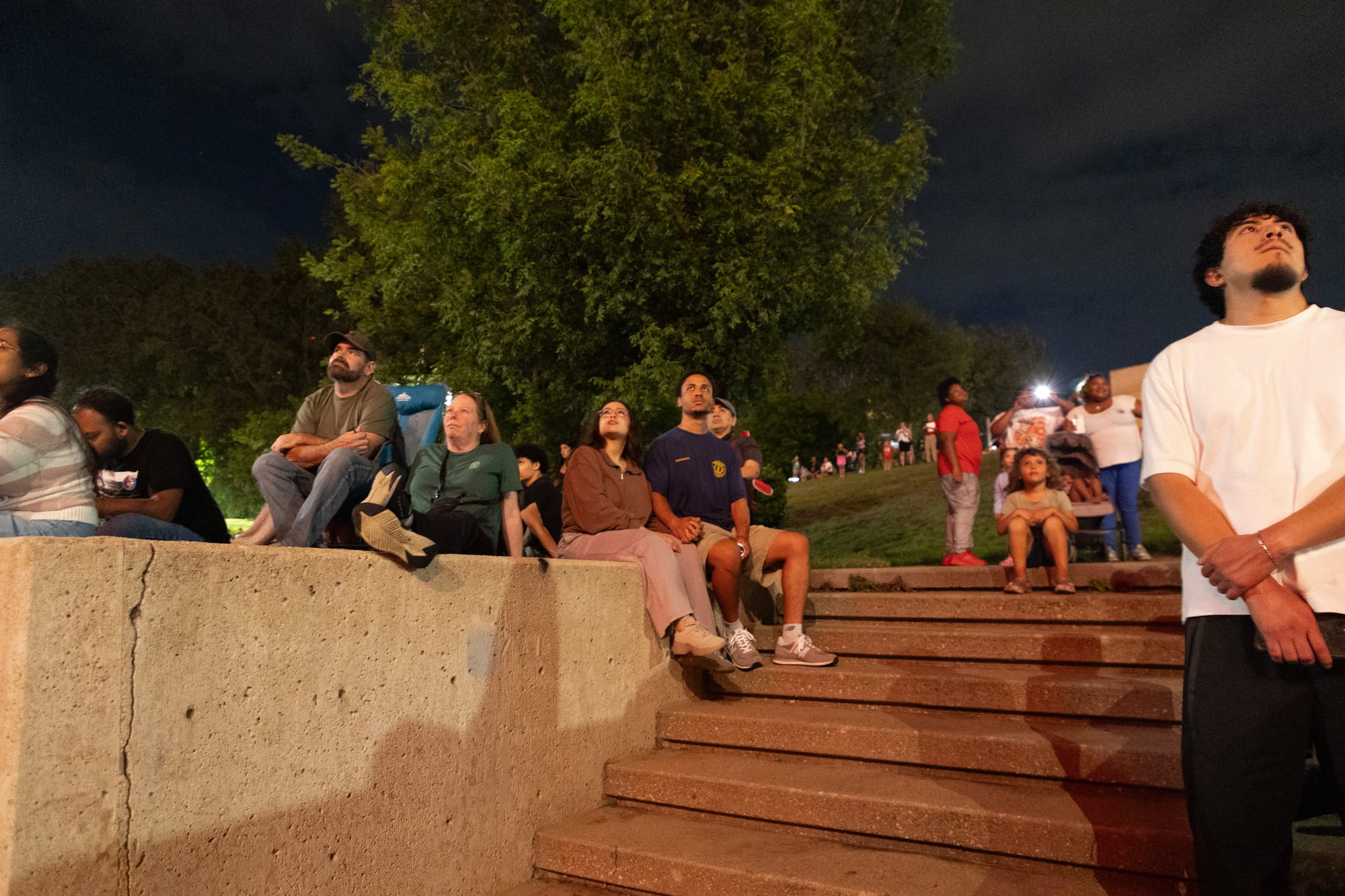
On the Fourth of Julys of 2013 (163 million pounds) through 2017 (229 million), I was a reporter for The Times-Sentinel, a newspaper company covering seven small to tiny cities west and south of Wichita. Sometime between February and May in each of those years, I sat in the city council chambers of Goddard, Clearwater, Garden Plain, and Haysville and heard arguments and complaints relating to fireworks and their regulation. They were approximately the same each year. Residents would point out that the annual bombardment went on for not just one night, and not just one weekend, but for weeks on end, starting as soon as the fireworks stands opened in mid- to late June and continuing sporadically through the 5th, 6th, or 7th of July. Pets had to be dosed with Xanax and locked in the basement. Veterans with PTSD suffered too. (As I write this, KAKE News reports that this year, Hutchinson’s salt mine museum will be opened to veterans looking to escape the din by descending 650 feet underground.)
Beyond those specific ills, there was a general sense among the complainers that the annual fireworks frenzy had gone beyond what was reasonable. It had grown past its relatively modest 20th-century scale, and was now out of place in the snug neighborhood streets of these bedroom communities, and so the question was posed: Shouldn’t local government intervene, somehow, to set things back to rights?
City council members made some minor tweaks each year, but they mostly avoided confronting the question of whether reason or compassion demanded the fireworks be curtailed dramatically. To do so would be to confront another reality, also mostly unspoken, yet obvious to everybody: The enthusiasts would not abide constraint. Reduce the sale days? They would drive to a stand in the next city over. Allow only “safe and sane” ground-based fountains, and not high-flying mortar shells? Just as Wichita residents did until aerials were legalized inside the city in 2023, the enthusiasts would drive to the next city, the next county, the next state, then return home to launch illicit shells with extra relish at having defended their liberty.
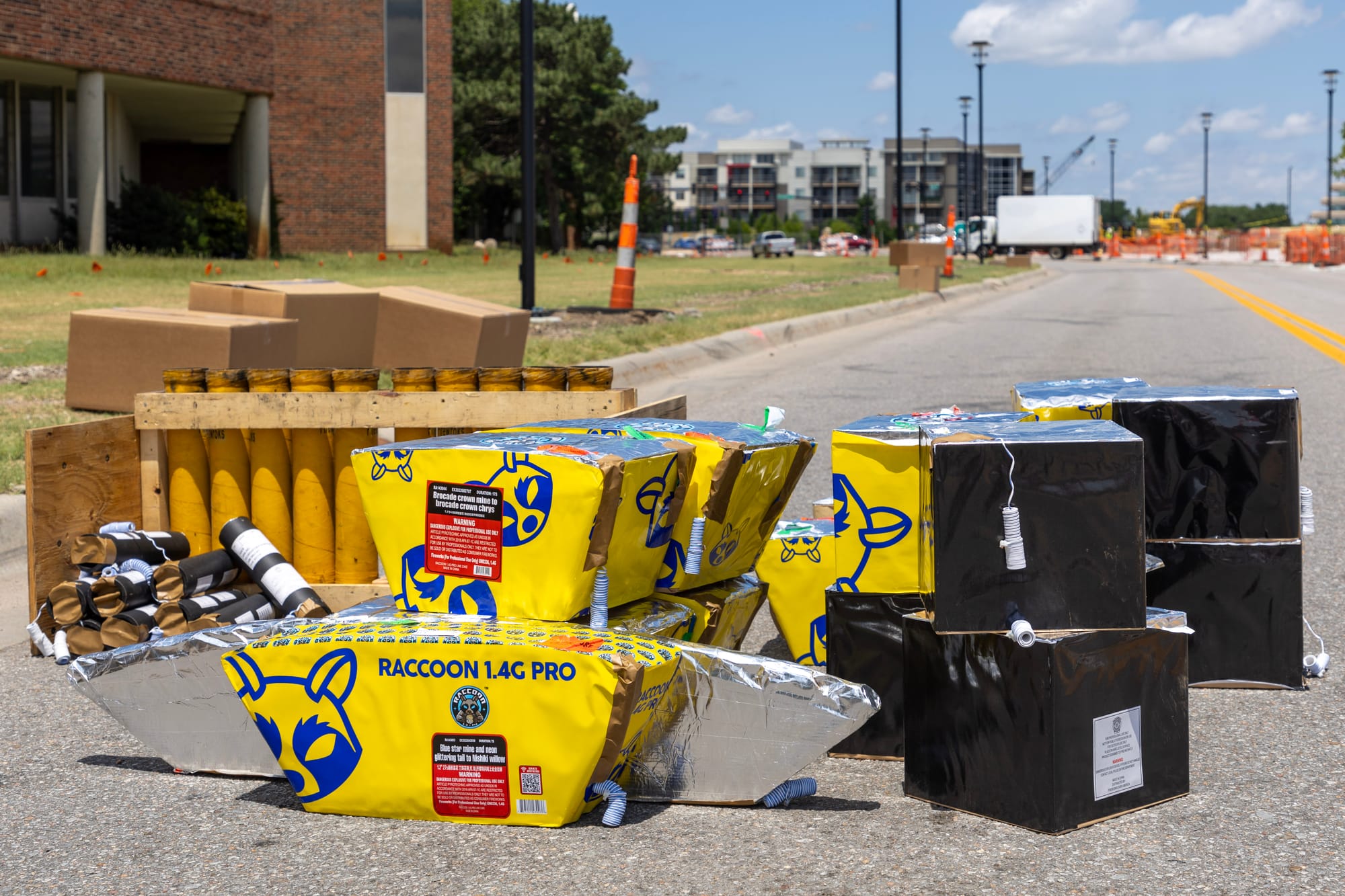
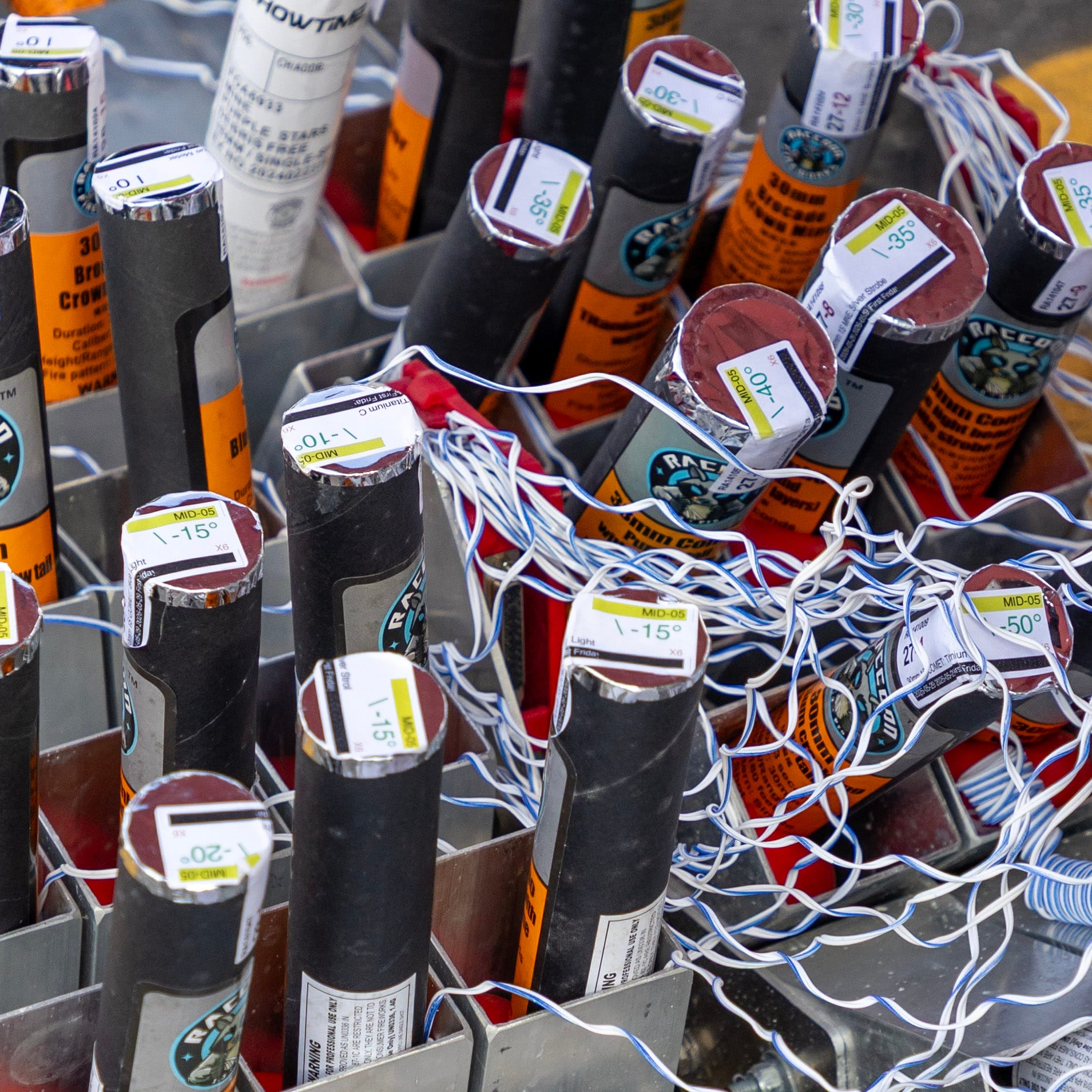
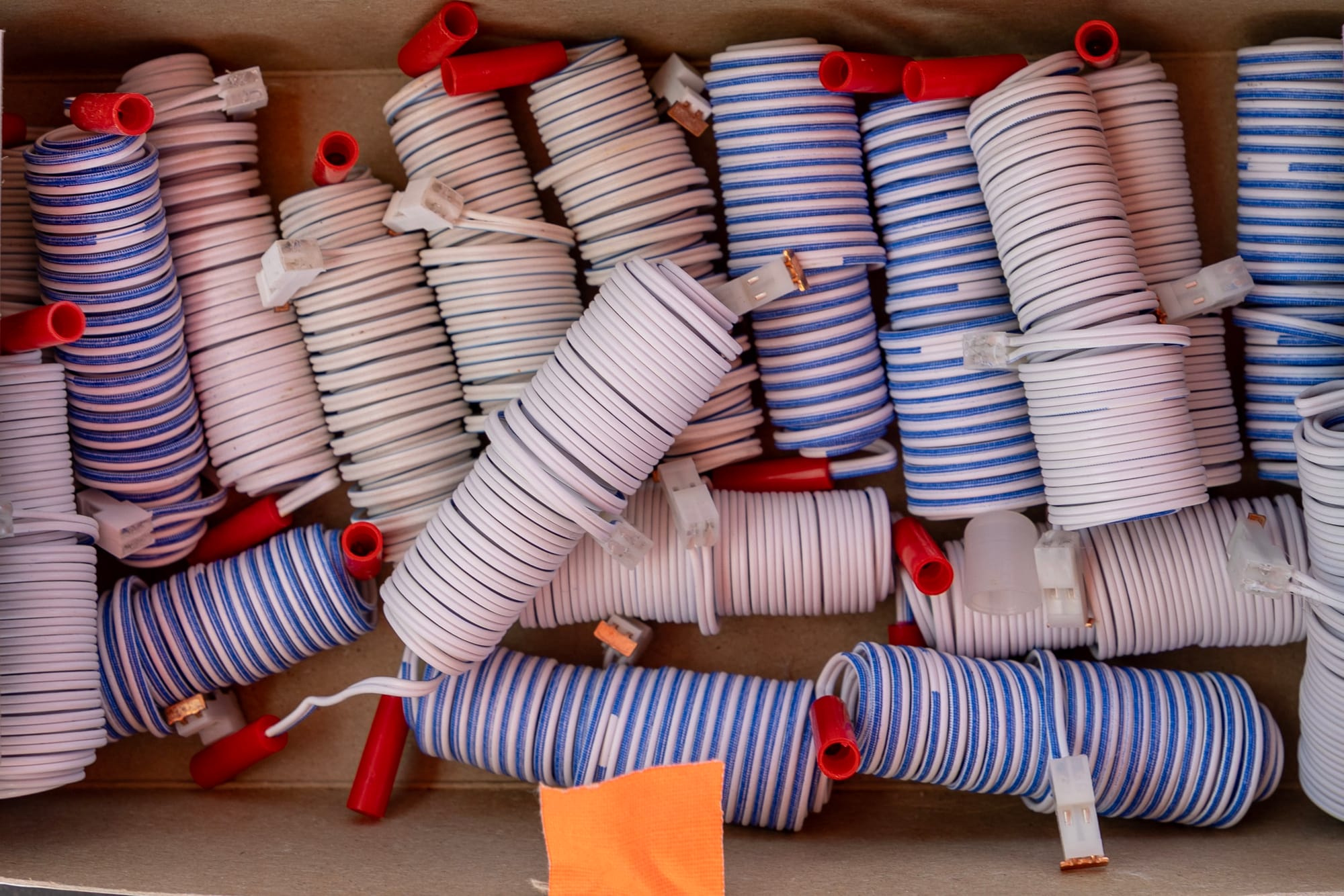
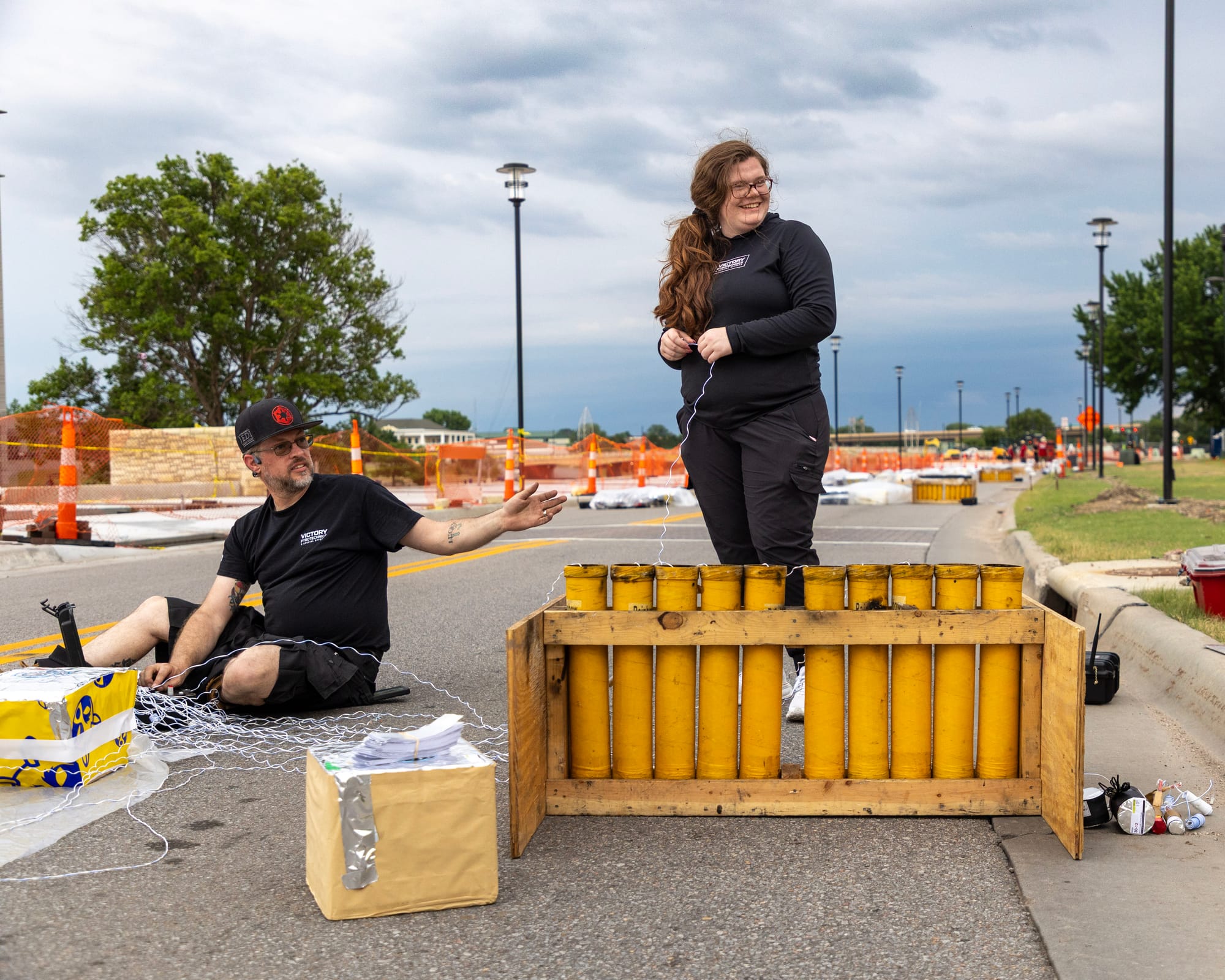
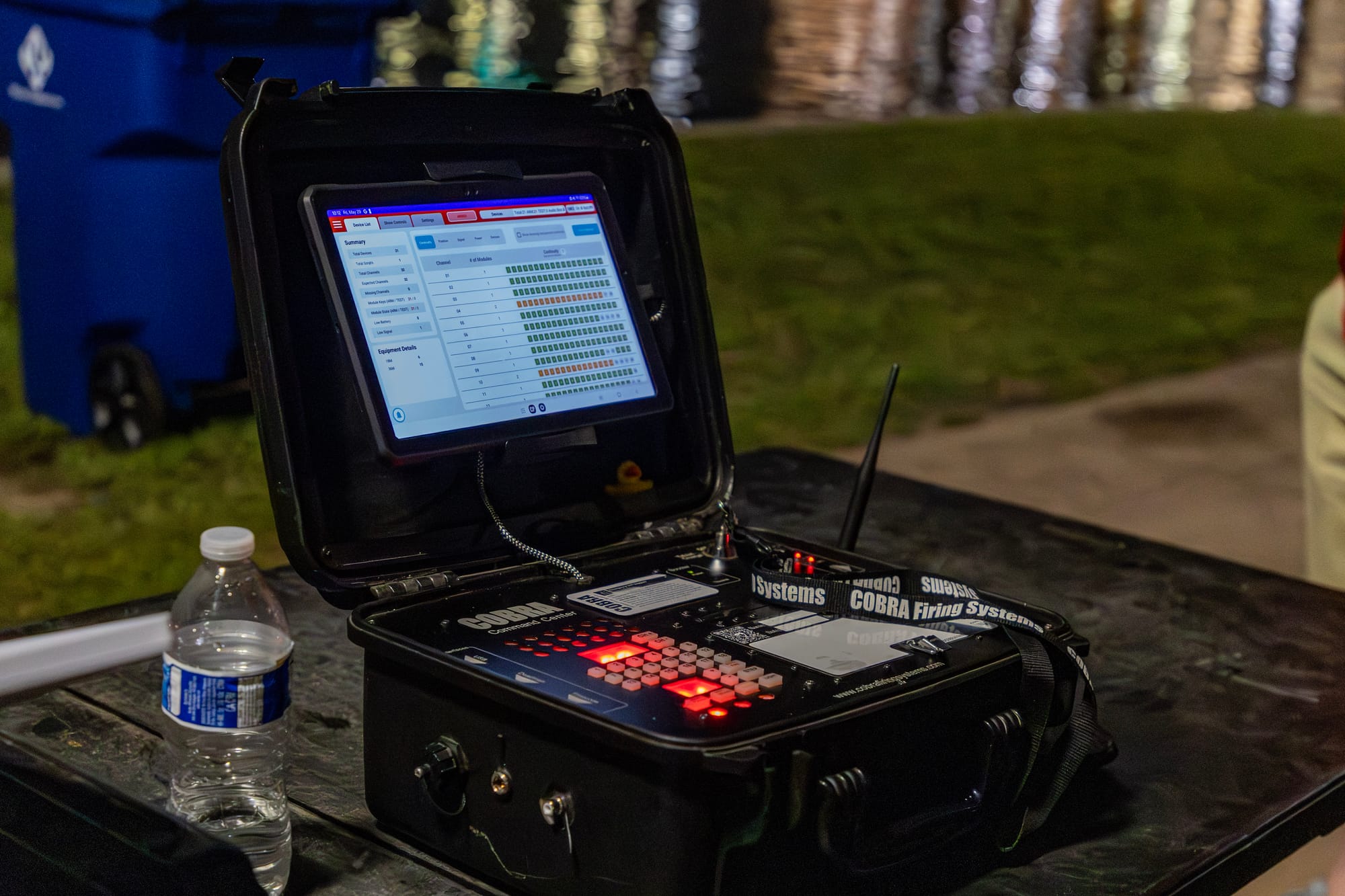
Victory uses a COBRA launch system to fire its shows. Each firework is individually wired to an electric igniter. The igniters are plugged into weatherproof field modules positioned across the firing site. A control console, positioned at a safe distance, sends fire commands to the field modules via encrypted radio. Photo by Kendra Cremin for The SHOUT.
Responding to an unexplained inner urging, the average amateur fireworks enthusiast has spent the last quarter century in the pursuit of “more” and “bigger.” The pyrotechnician, on the other hand, today uses no more ordnance than he (or, increasingly among the professional ranks, she) did in 2003. The professional pyro has used the last few decades to realize a dream centuries of professional forefathers considered unattainable: fireworks perfectly synchronized to music.
Invented, along with gunpowder, in China around A.D. 900 or 1000, fireworks eventually spread to Europe and by the 1700s had become a popular way for the continent’s wealthy and powerful to flaunt their wealth and power. In “Fireworks: A History and Celebration,” George Plimpton describes early European pyrotechnicians as wizardly figures who were employed by royals and were sometimes noblemen themselves. European fireworks of this era were limited to a few dim colors. Only the roughest sort of coordinated firing could be managed, and mishaps were frequent. So fireworks masters turned to other means of producing spectacle. They built enormous, temporary follies called “machines” on which fireworks could be lit: fantasy castles, forts or temples decorated with allegorical and patriotic figures that would be illuminated by the rockets’ glare.
Music, while often present at these extravaganzas, was a side attraction at best — and without amplification you had to throw a lot of instrumentalists out there if they were to have any hope of being heard above the explosions. The 1856 coronation fireworks of Tsar Alexander II were accompanied by “a band of two thousand instruments and a choir of one thousand singers,” according to Plimpton. The famous 1749 London fireworks show that marked the signing of the Treaty of Aix-la-Chapelle featured a “machine” 410 feet long and 114 feet high and was accompanied by Handel’s still-famous “Music for the Royal Fireworks.” Handel scored that music for 36 woodwinds, nine horns, nine trumpets, and three pairs of timpanis, plus additional drums to be played ad libitum — a huge ensemble for the time and place. Yet even that gathering of musicians was probably inaudible to most of the spectators over the sound of the fireworks and the 101 cannons. The show started at 8:30 p.m. Around 9:30 p.m., a large portion of the machine caught fire and went on to burn until 2 a.m. Handel’s “Music” is 15 minutes long.
By 1984, Plimpton reported that “the art of matching fireworks and music has monopolized the attention of fireworks choreographers — too much so, it seems to me. … Even the visual effects (the burst of a chrysanthemum on the final chord of a symphonic piece) cannot be precise because of the slight difference in fuse lengths. About the most music can do for fireworks, or vice versa, is to reflect moods or pacing, or to illustrate what the music score calls for — as in the cannonading in Tchaikovsky’s 1812 Overture.”
Plimpton’s skepticism about “matching fireworks and music” turned out to be misplaced. Digital systems fire each shell on an exact electronic cue, timed so the burst lands on the beat. An electronic system was in routine use at Walt Disney World by the following year, giving each night’s performance the same, exact timing.
As the 21st century dawned, digital firing systems were still prohibitively expensive, limiting the cutting-edge tech to Disney, big-city municipal shows, and broadcast events. But prices kept going down through the 2010s, and by 2015 a system was within reach of an ambitious Clearwater teenager named Cody Hanna.
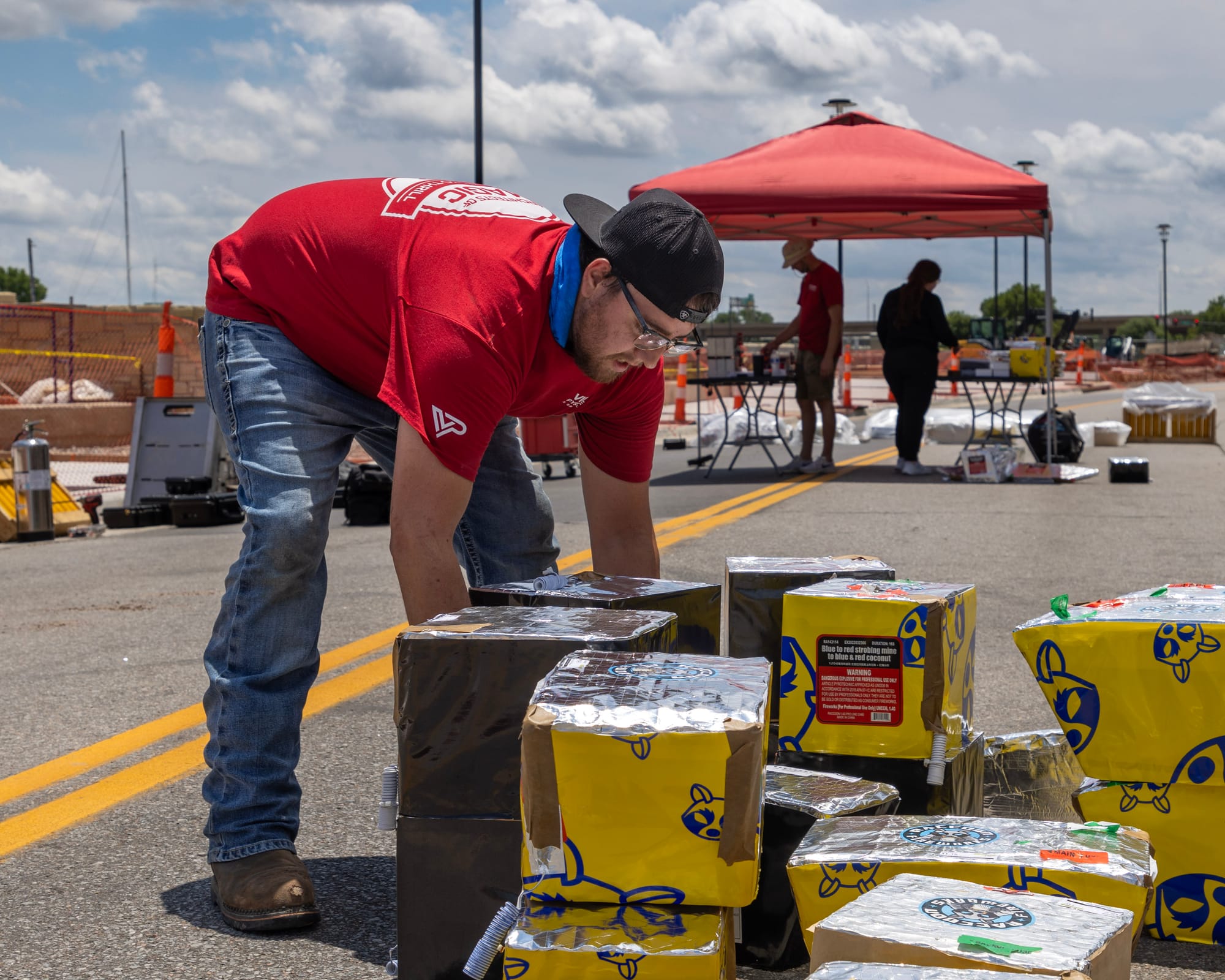
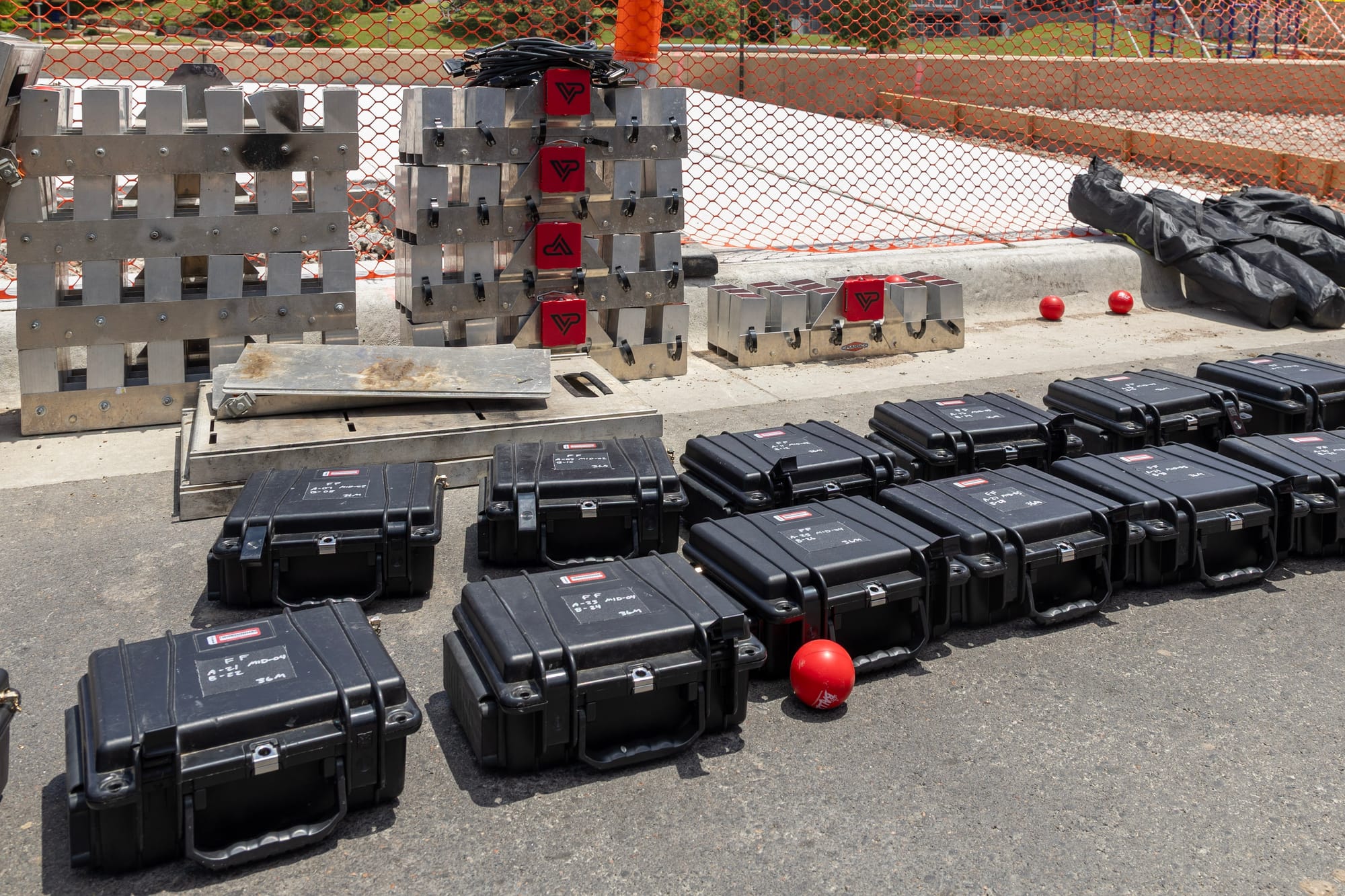
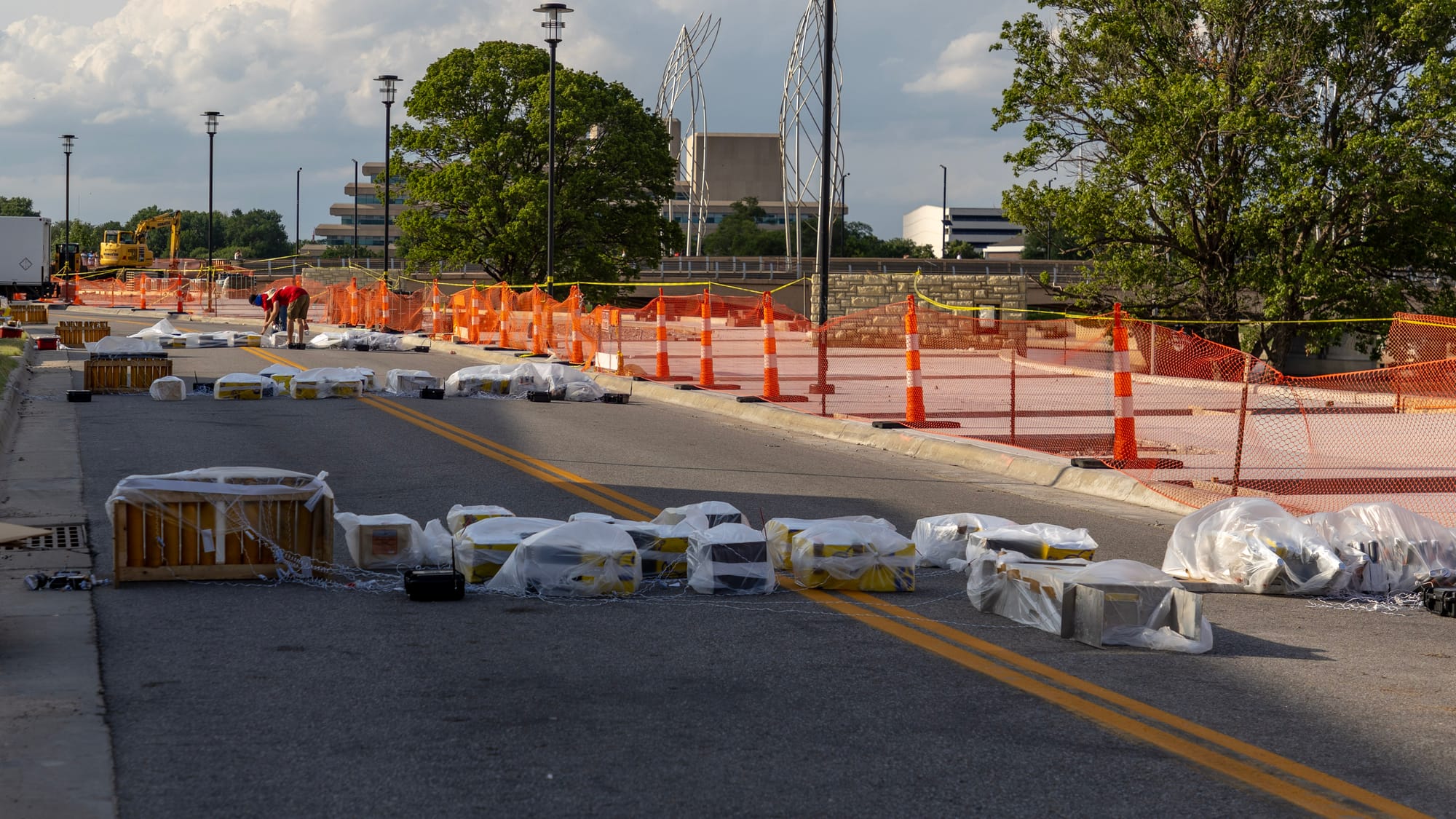
Left: A Victory crew member positions multi-shot cakes – multiple aerial fireworks linked to a single fuse. Right: Wireless field modules are lined up on McLean Boulevard, ready for deployment during setup for Victory’s May 29 RiverFest show. Photo by Kendra Cremin for The SHOUT.
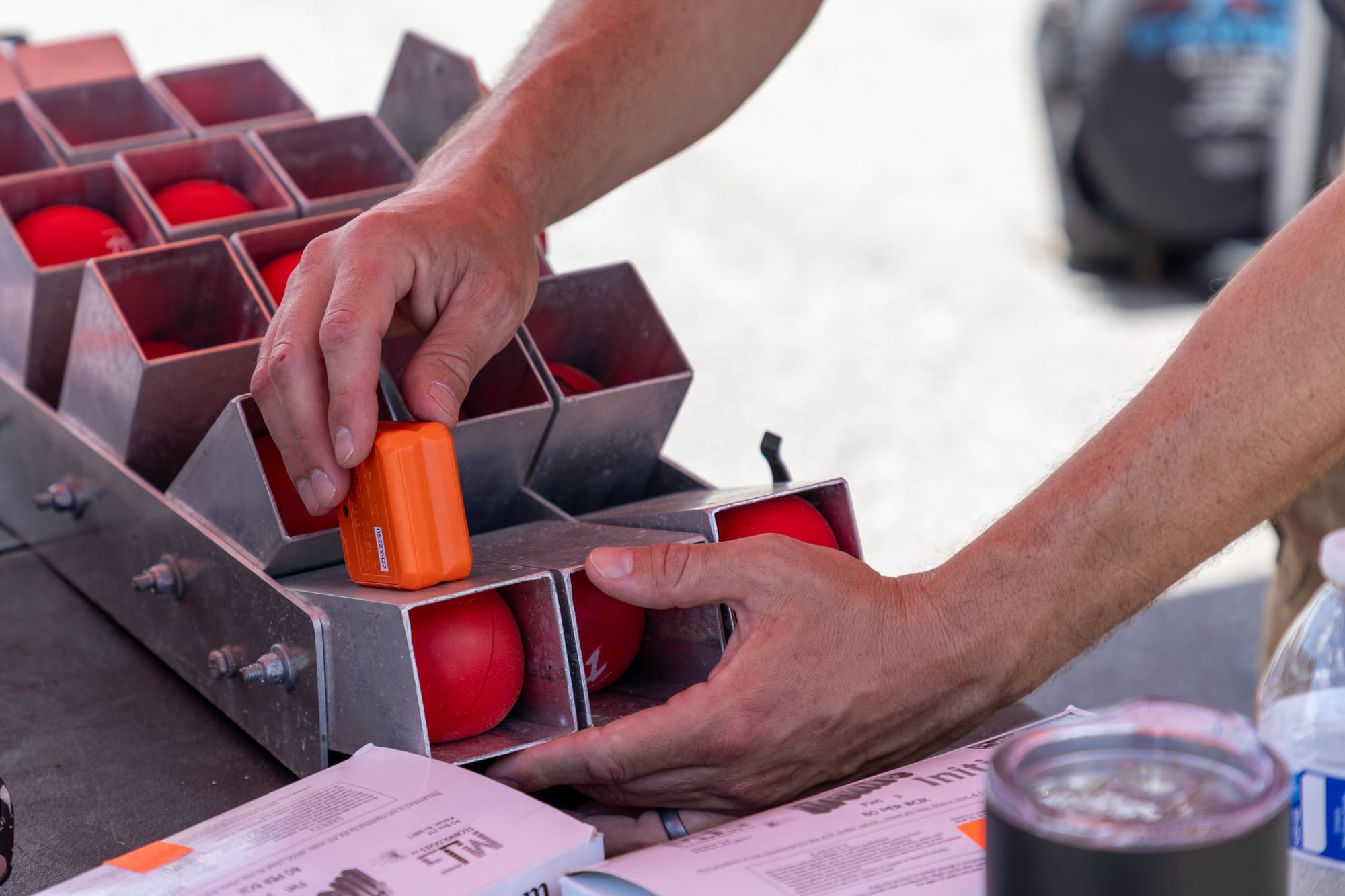
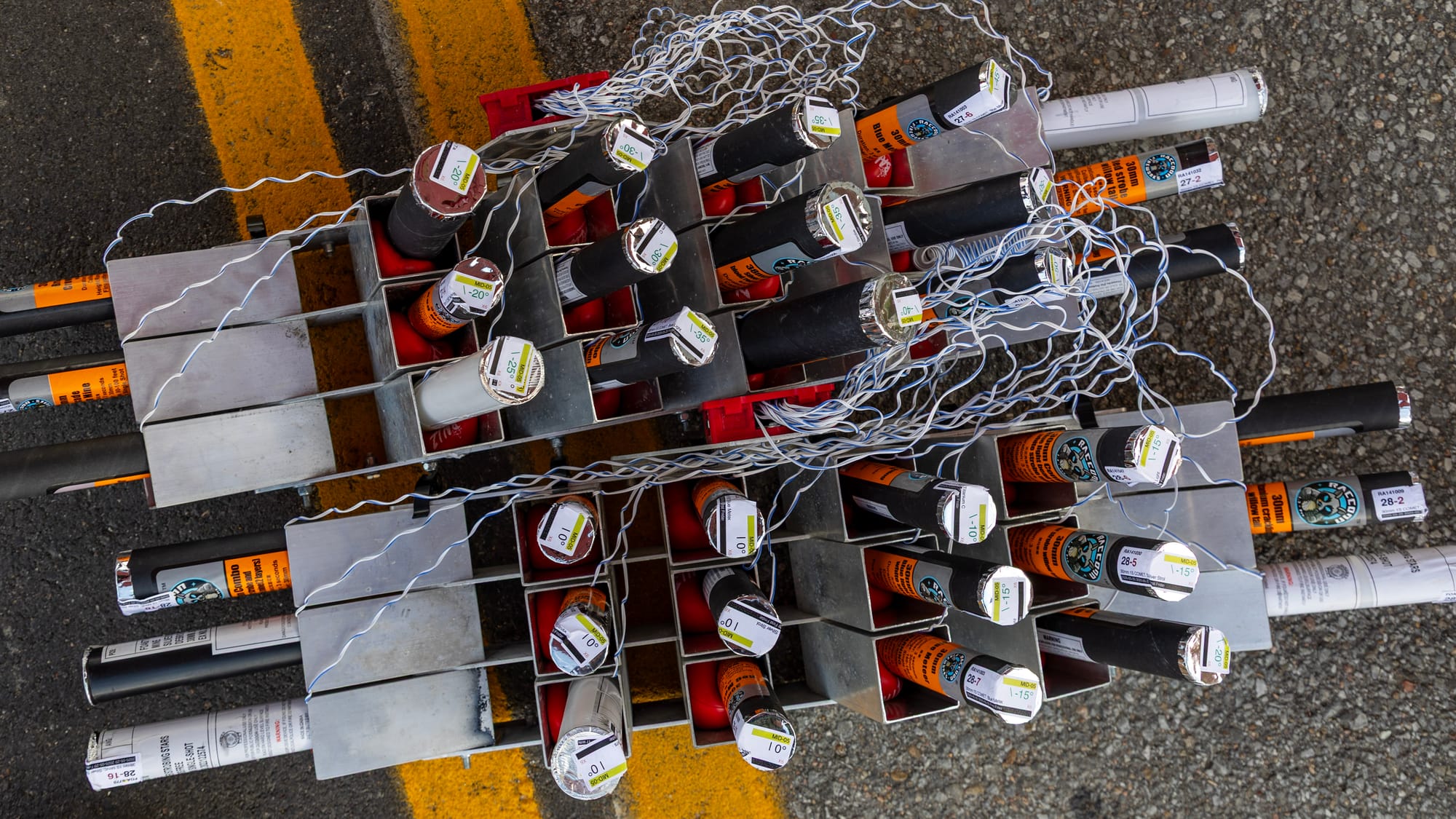
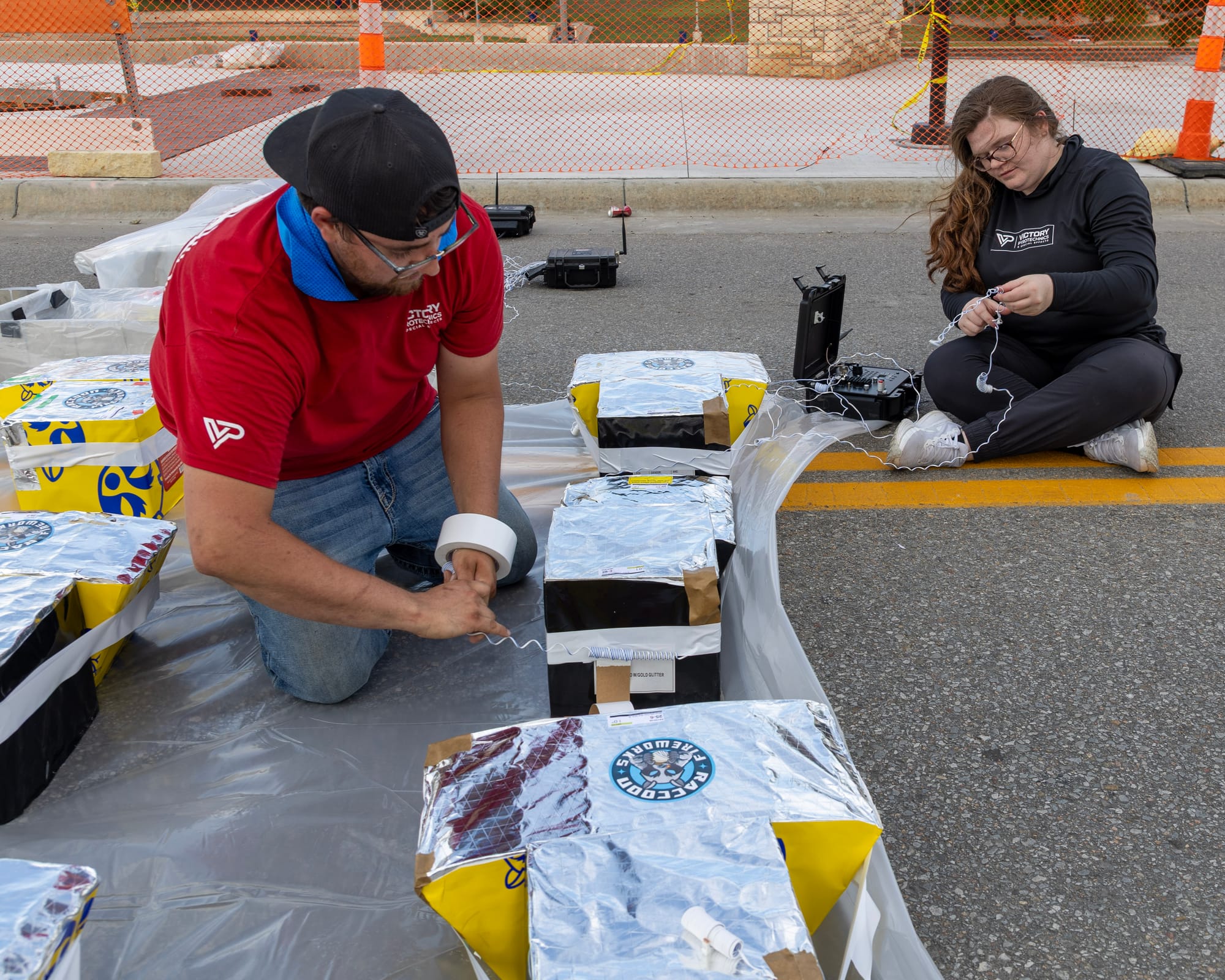
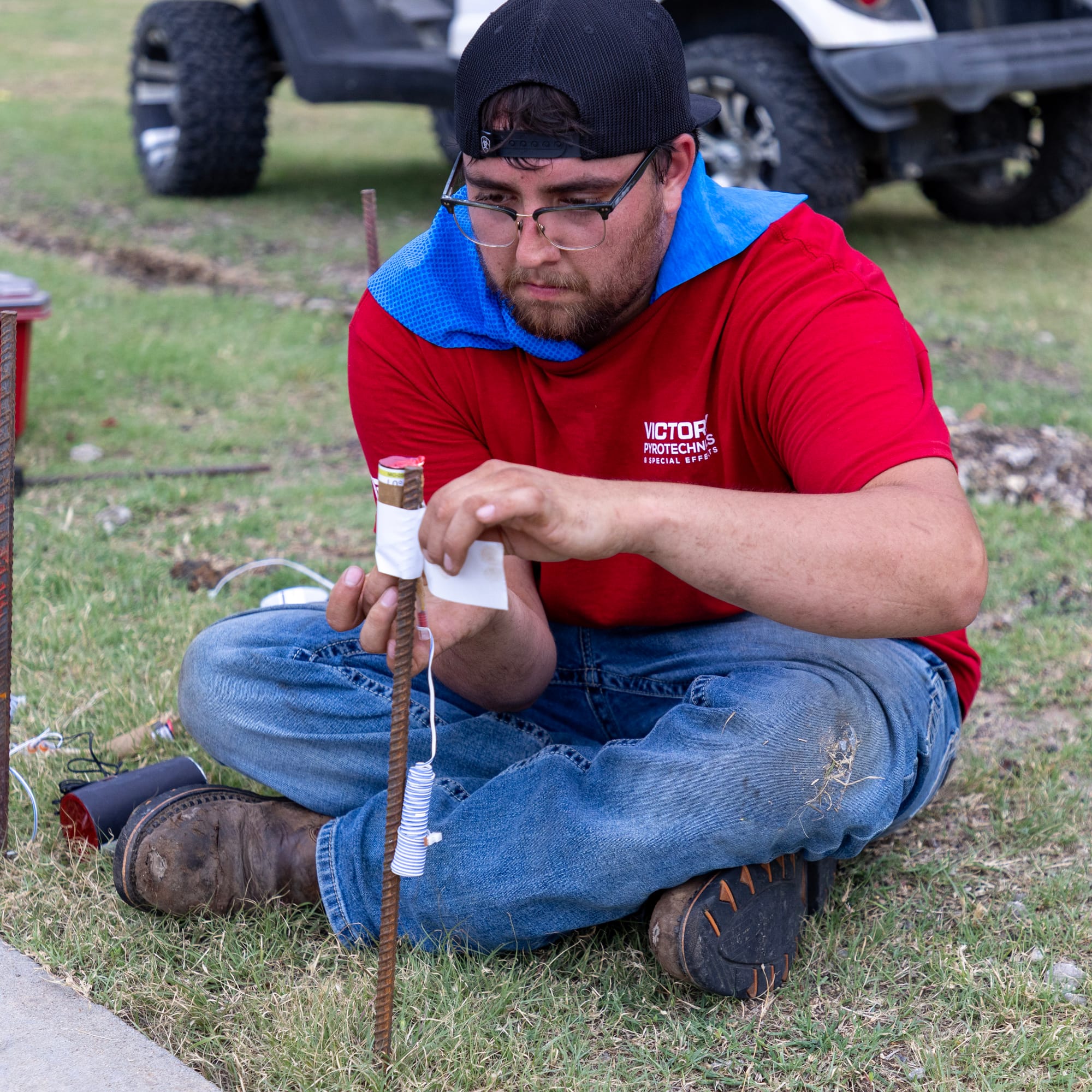
Left: An overhead view shows how each device is labeled and numbered. Crew members consult detailed, software-generated instruction booklets as they set up the show. Right: Victory crew members connect electric fuses to individual fireworks, called “devices” in pyrotechnics parlance. Photo by Kendra Cremin for The SHOUT.
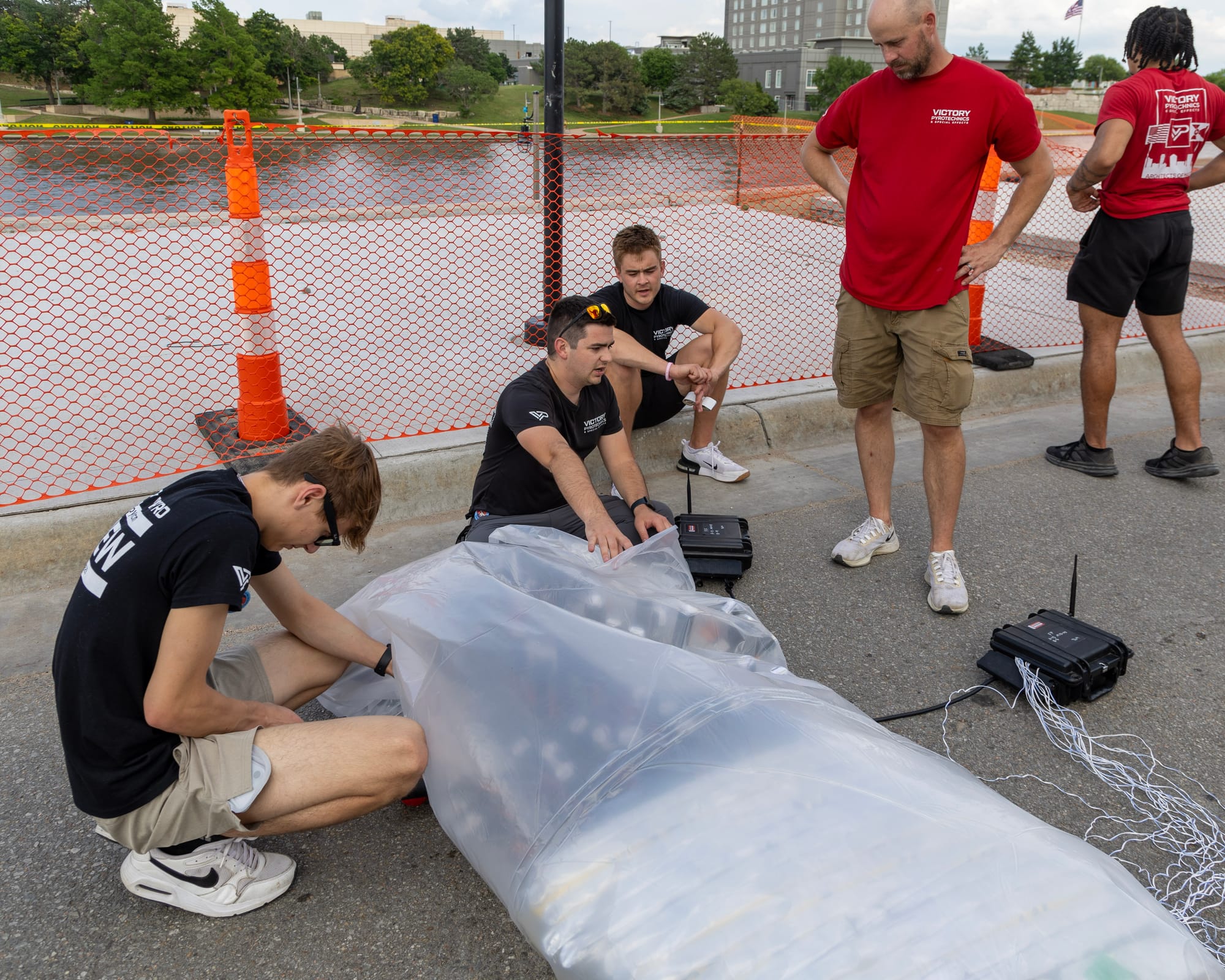
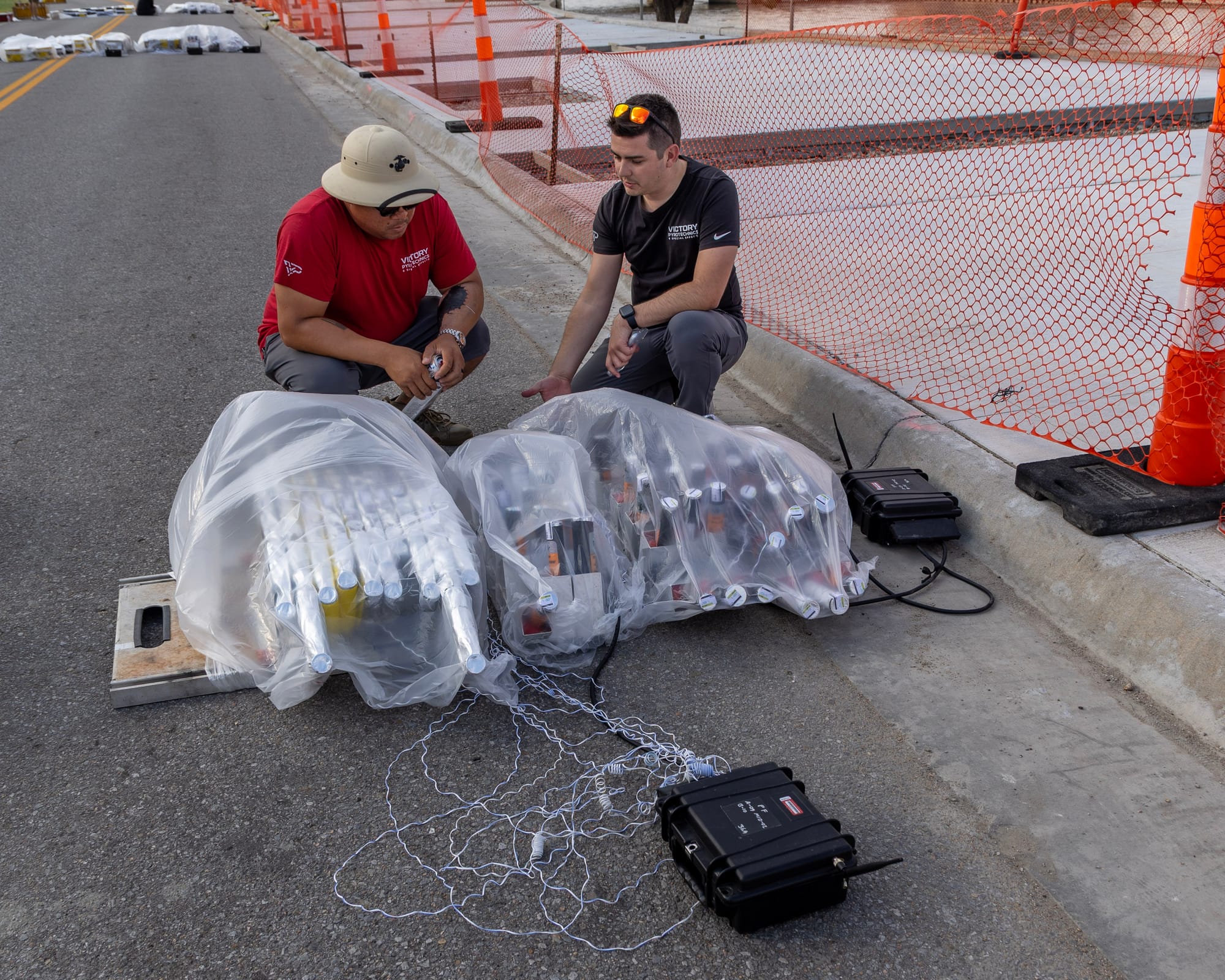
As rain threatened during late afternoon, Victory crew members hurried to finish their setup and protect the unlaunched fireworks with plastic sheeting. There was no need to remove the plastic again before the show: the fireworks simply punched through it. Photo by Kendra Cremin for The SHOUT.
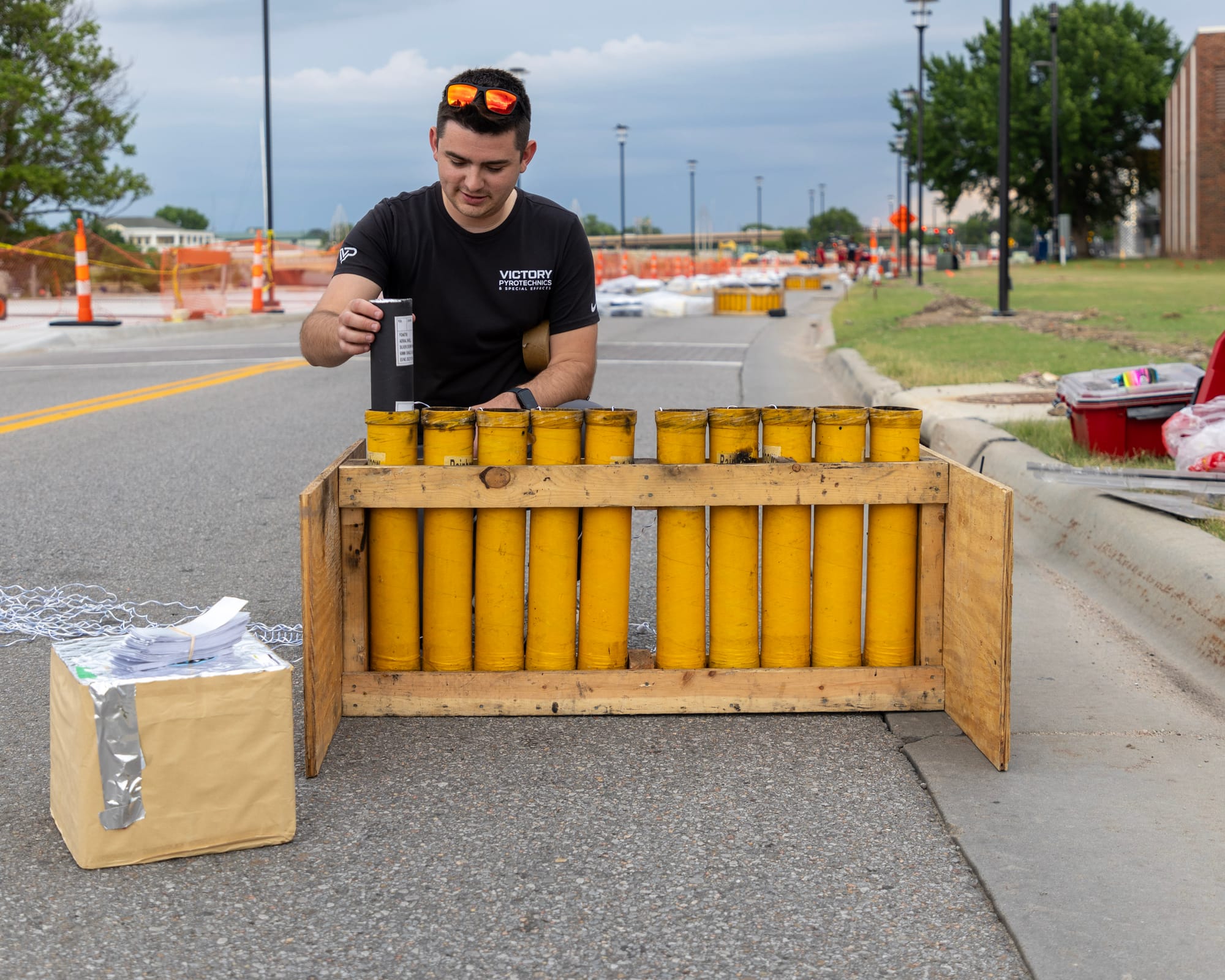
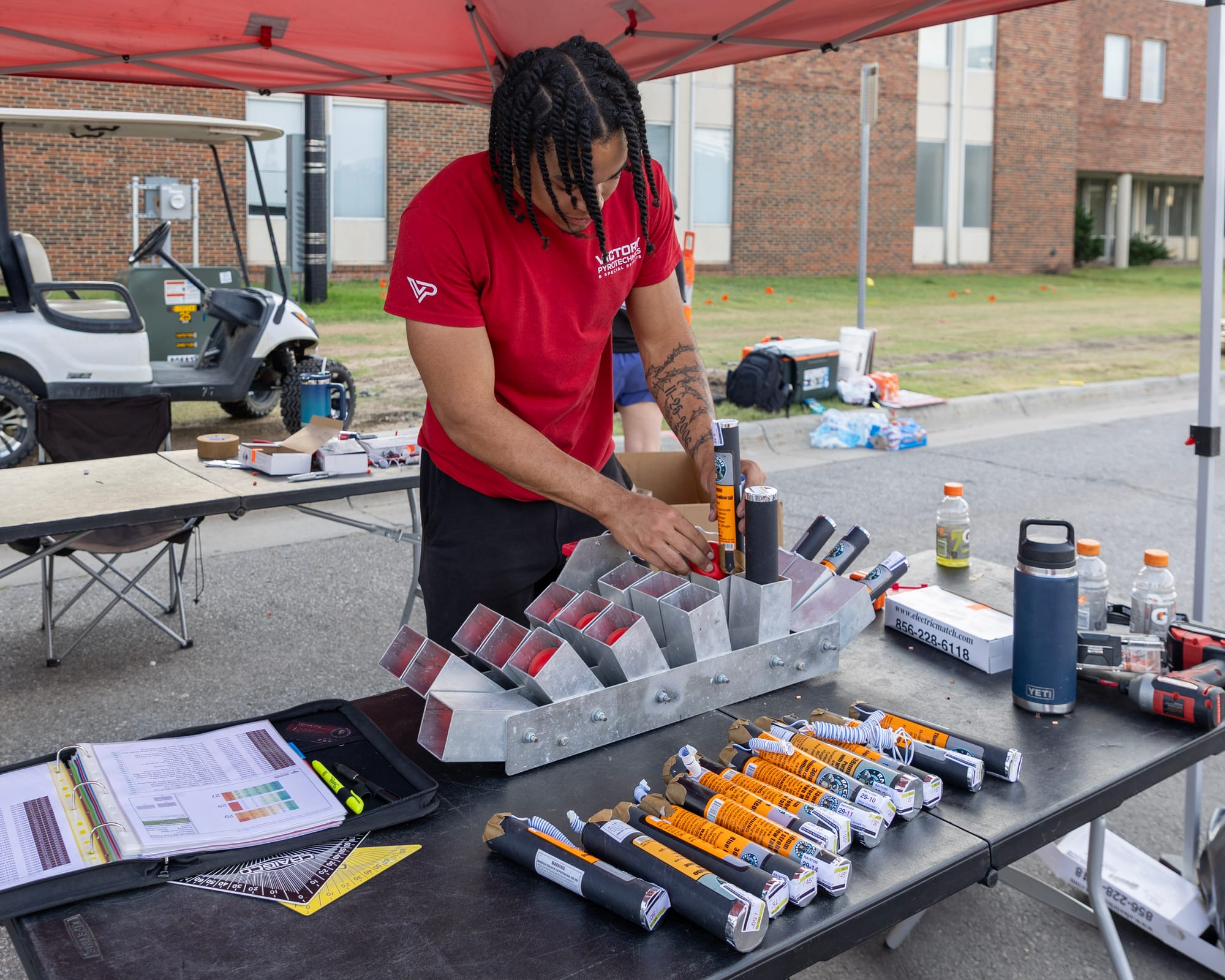
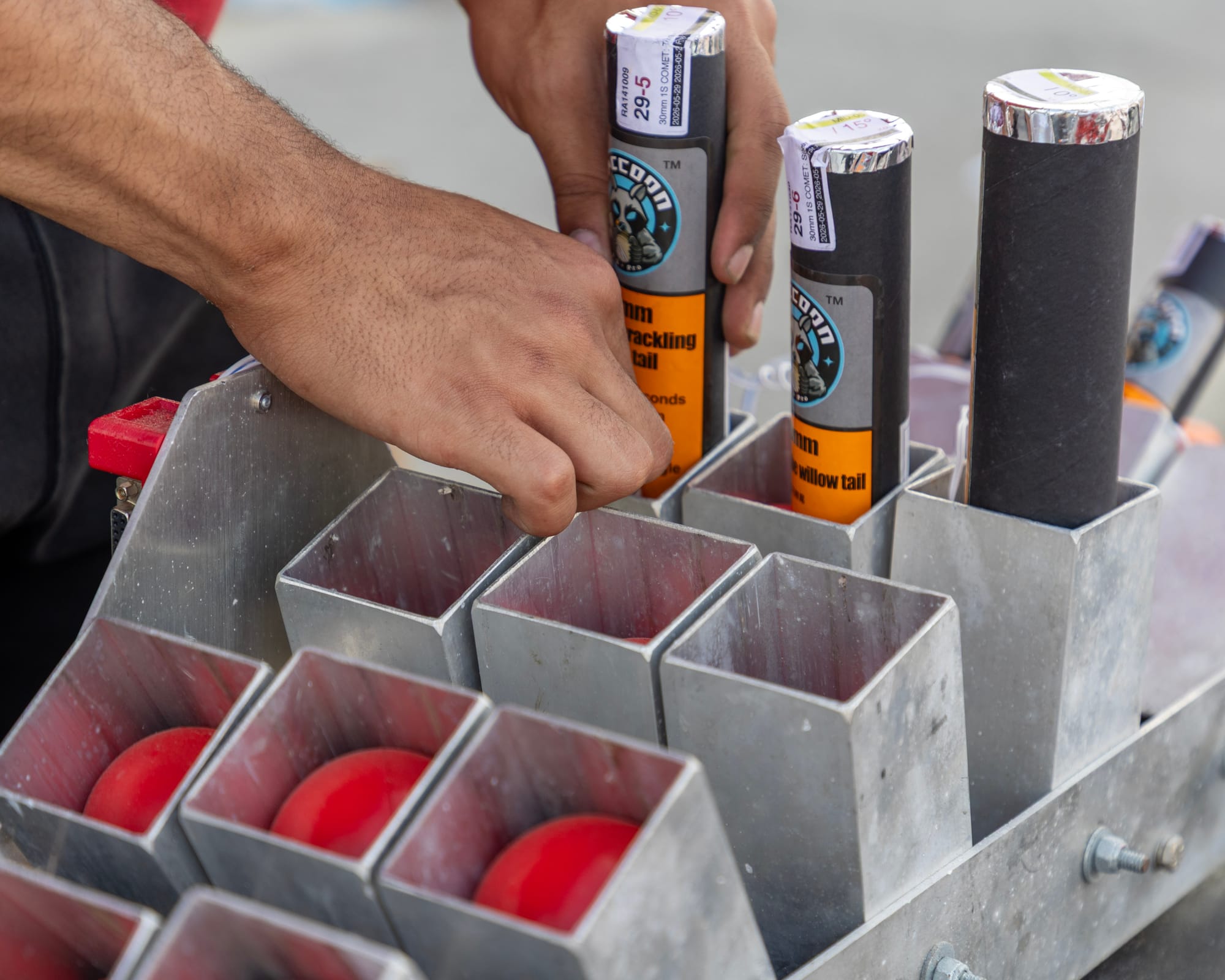
A Victory crew member works to assemble elements for the show. Detailed printed instructions are visible in a binder on the table. Photo by Kendra Cremin for The SHOUT.
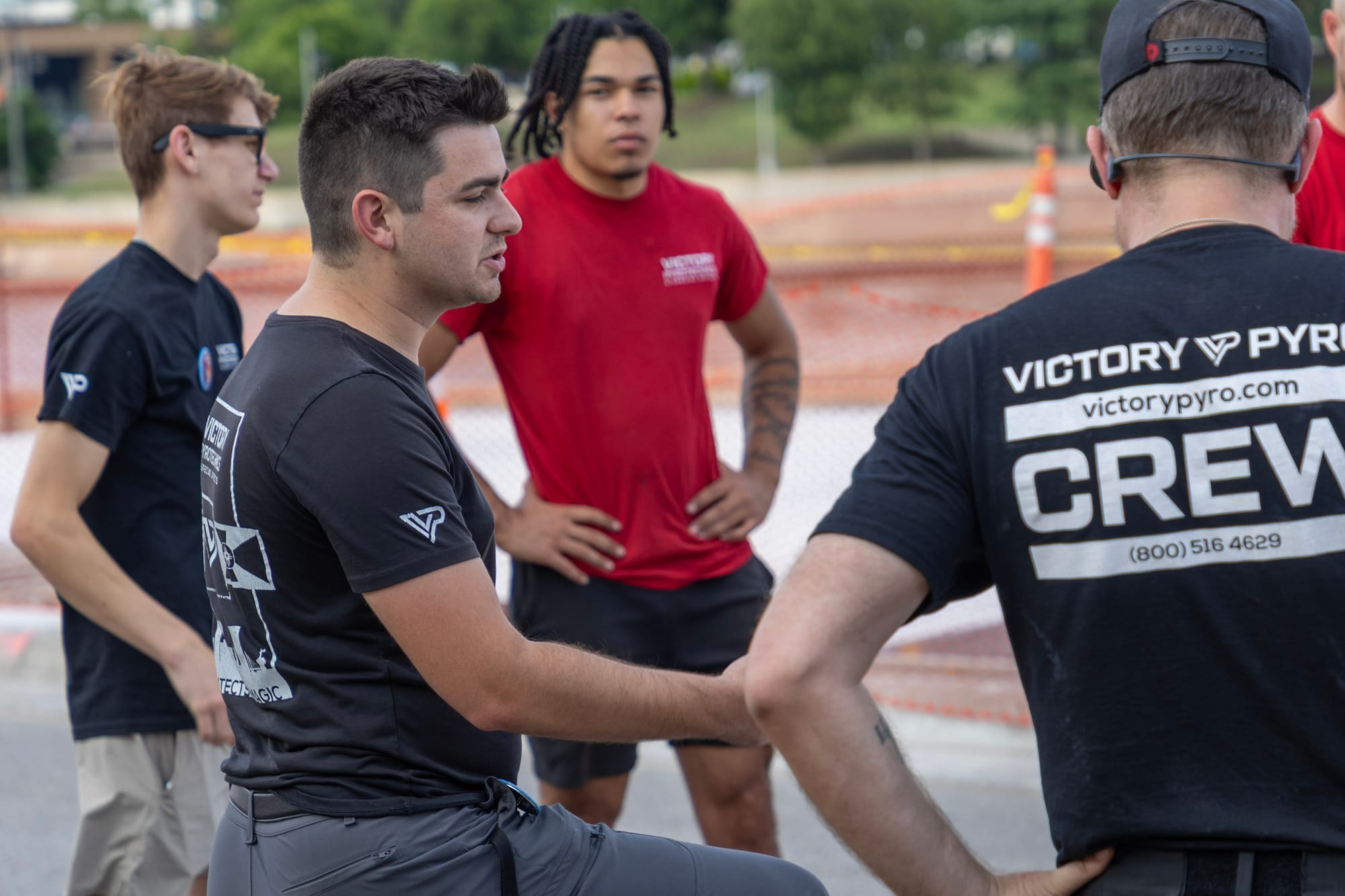
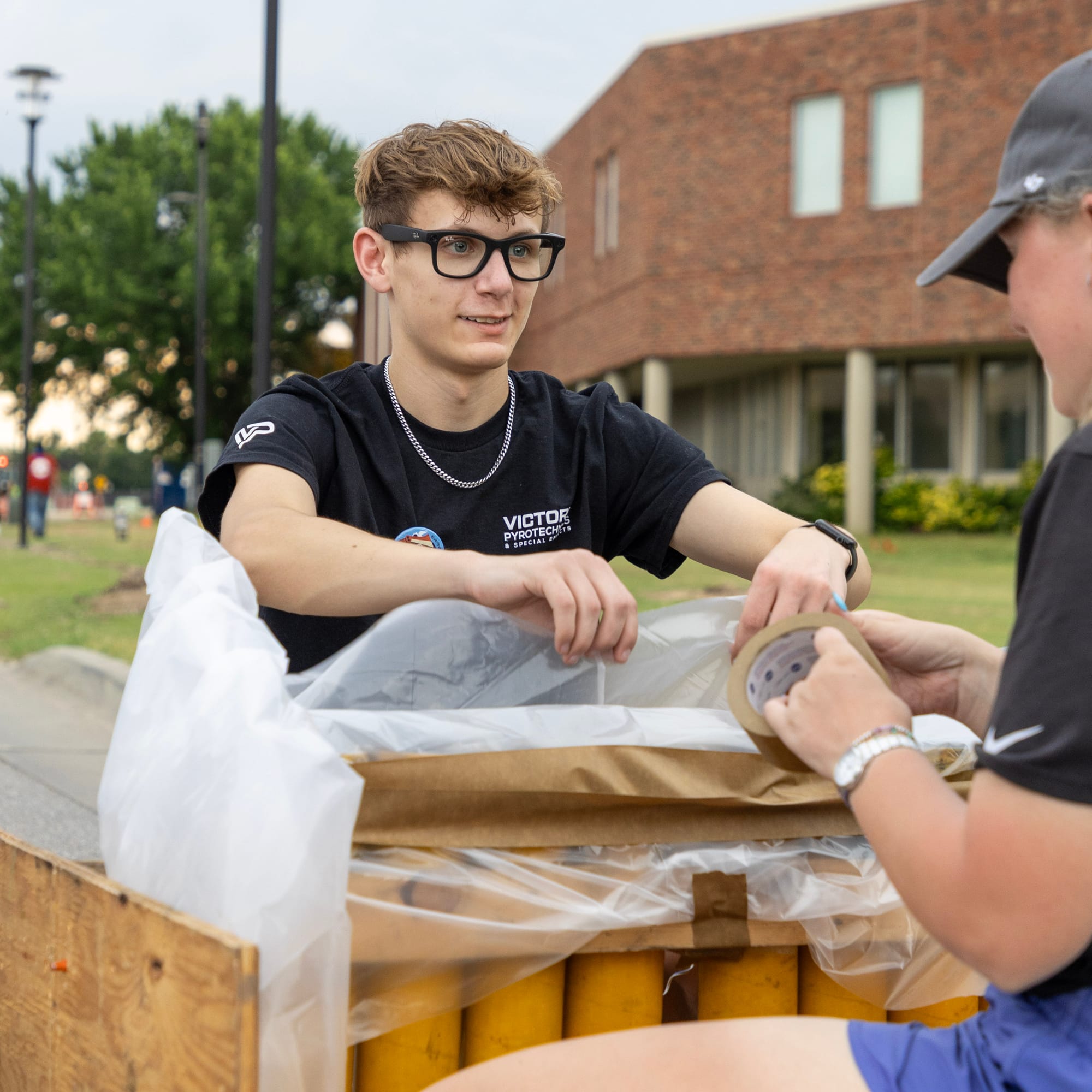
Jacob Foster, right, is Victory’s lead show designer. Foster, 18, designed and launched a computer-controlled show for Salina’s Thunder on the Plain pyrotechnics event last fall. Hanna saw the show and invited Foster to join the Victory Team. Photo by Kendra Cremin for The SHOUT.
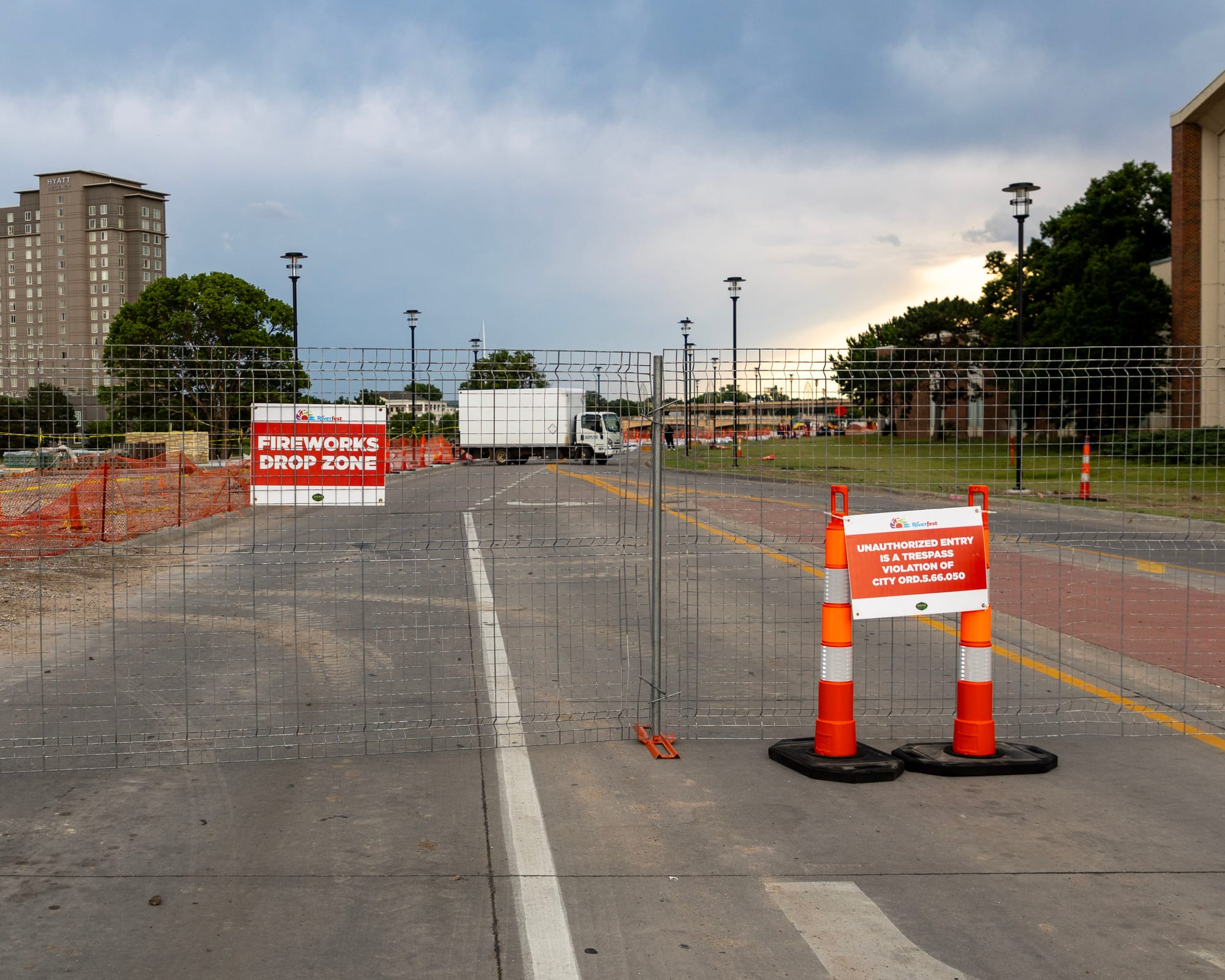
Setup completed, members walked across the Douglas Street bridge to enjoy a concert by The Jacksons and watch the fireworks show alongside the public. With everything programmed, placed, and plugged in, the entire show was launched at the press of a single button. Photo by Kendra Cremin for The SHOUT.
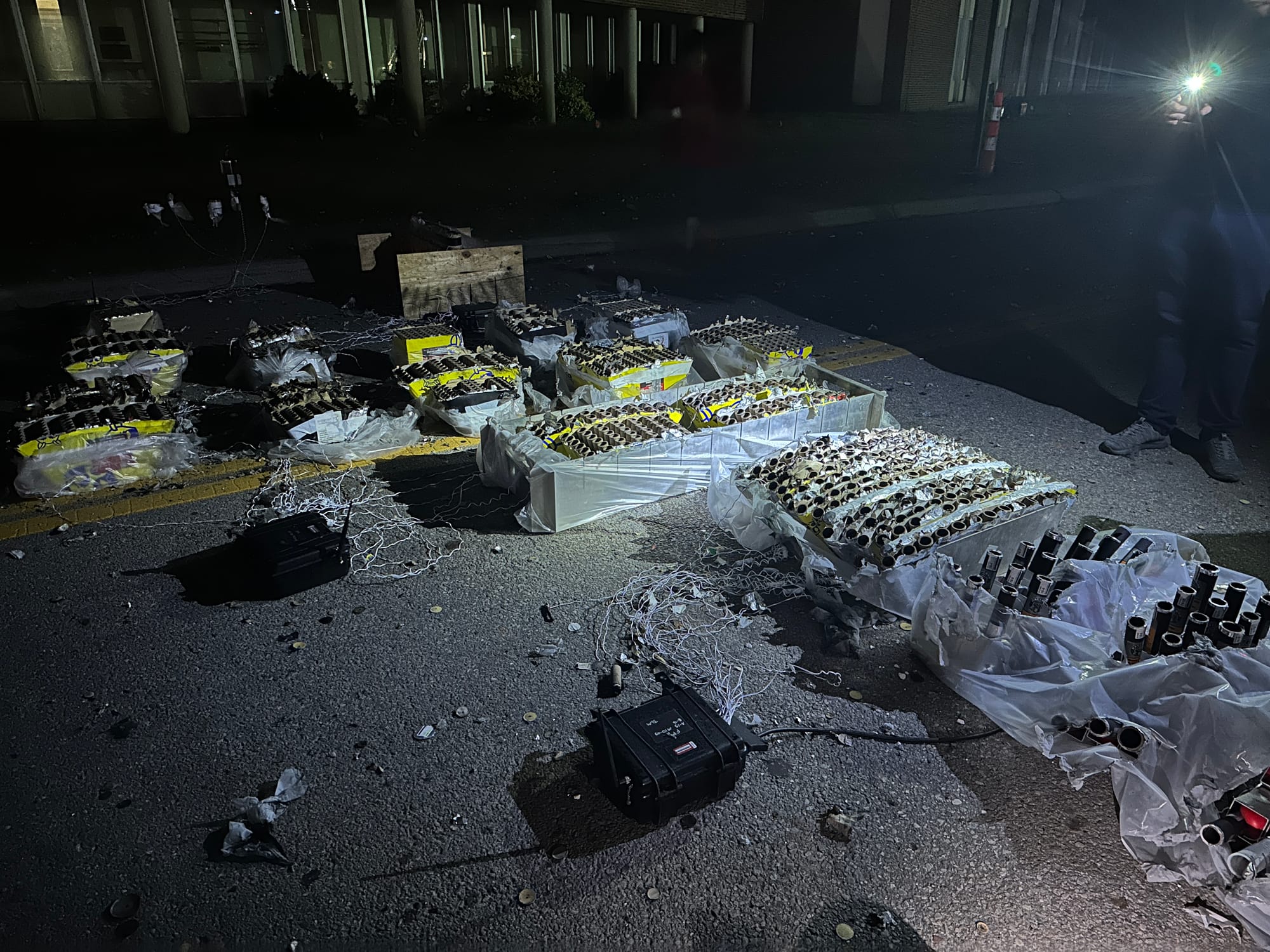
As an elementary school kid, Hanna told me, he was captivated by Christmas lights — especially the computer-synchronized light shows that became popular starting in 2004. “I would do shows in my bedroom and on our bunkbeds, putting up thousands of lights and charging my family to come into my bedroom during the holidays,” he said. “Eventually, my family let me move on to the exterior, and that turned into Christmas light shows set to music.”
During his sixth grade year, Hanna’s family went to Disney World, where he was “mesmerized” by the spectacles staged in the parks each evening, combining lights, lasers, props, and original musical scores that shaped emotional storytelling beats.
“I came home saying, ‘I want to do that,’” Hanna said. A few months later, his dad took him to a fireworks stand, where they spent several hundred dollars. “That year was our first fireworks show, and every year after that, the shows grew and grew, to the point where in my senior year, we certainly had more people attending this backyard show than the city of Clearwater did at their professional show.”
In the early years of his backyard show, Hanna incorporated music using the time-honored, inexact method: a crew of confederates lit fuses and manually cued music while trying to stay roughly synchronized with a script.
“We had a flatbed trailer, two computer speakers and a laptop, and I had like 20 YouTube tabs open. Somebody’s job was to press play on each tab as we went around lighting fireworks,” Hanna recalled.
I first reported on Hanna in The Times-Sentinel in 2015, when he was a Clearwater High School sophomore who won a prize in a business-plan competition for his proposed fireworks business. That same year, Hanna later told me, the nonprofit organization Youth Entrepreneurs bought him his first COBRA firing system — the same high-end system used by professionals and the same brand he still uses today.
Victory Pyrotechnics, the company Hanna founded during freshman year at K-State, now employs Hanna and co-owner Kennady King full time, along with a handful of frequent part-timers and several dozen more occasional crew members. The company designs and shoots many of Wichita’s biggest shows, including three shows during this year’s Riverfest, Wind Surge (soon to be Turbo Tubs) fireworks that follow each Friday home game, and the city’s upcoming Independence Day show “Red White & Boom!” Victory is headquartered in Hanna’s backyard in rural Clearwater, but the flatbed trailer has been replaced by a metal-frame workshop with rows of electronic firing modules and charging racks neatly arrayed on shelves. (The fireworks themselves are stored in a “magazine” a few miles away.)
When I met Hanna at his workshop, he introduced me to Jacob Foster, his lead show designer. Like Hanna, Foster caught the fireworks bug young and quickly moved beyond the brute impulse to blow up a lot of stuff as loudly as possible. Neither of these two fit my naive idea of a pyrotechnician, which I suppose was inspired by those men I had glimpsed in the distance at the country club. My image was a man of middle age or older, probably with a singed mustache and a missing finger, perhaps a bit deaf, perhaps with a bit of a crazed look from all of the nearby explosions. But Hanna and Foster are young — Foster is 18, while Hanna is now 27 — and quiet and alert rather than chaotic or boisterous.
When I met other Victory crew members during the set-up for Wichita Riverfest’s opening fireworks on May 29, they came off the same way: focused workers with an air of professional dispassion — though some cracks formed in that facade as night fell and the moment of ignition approached. Most of the other crew were of an age with Hanna, or younger, and they seemed to be friends or acquaintances from his childhood and college years mixed with people who joined through a regular employment application process. Some of the men and women in Victory shirts were being paid to be there, while others came just to hang out and see the show, and it wasn’t always clear who fell into which category.
At Victory HQ a few days earlier, Foster previewed the Riverfest show for me using simulation software called Finale. He had summoned up a 3D model of a stretch of McLean Boulevard as seen from the intended viewing area, the east bank of the Arkansas River by Century II. Into this landscape he placed virtual, unlaunched fireworks, spread out across five firing positions spanning several hundred feet. From there, Foster explained, he choreographed the show by placing the bursts of the hundreds of fireworks (“devices”) on a timeline of the prerecorded musical accompaniment, which for this show was music of Michael Jackson, Janet Jackson, and the Jackson Five. (The surviving members of the Jackson Five performed at RiverFest.)
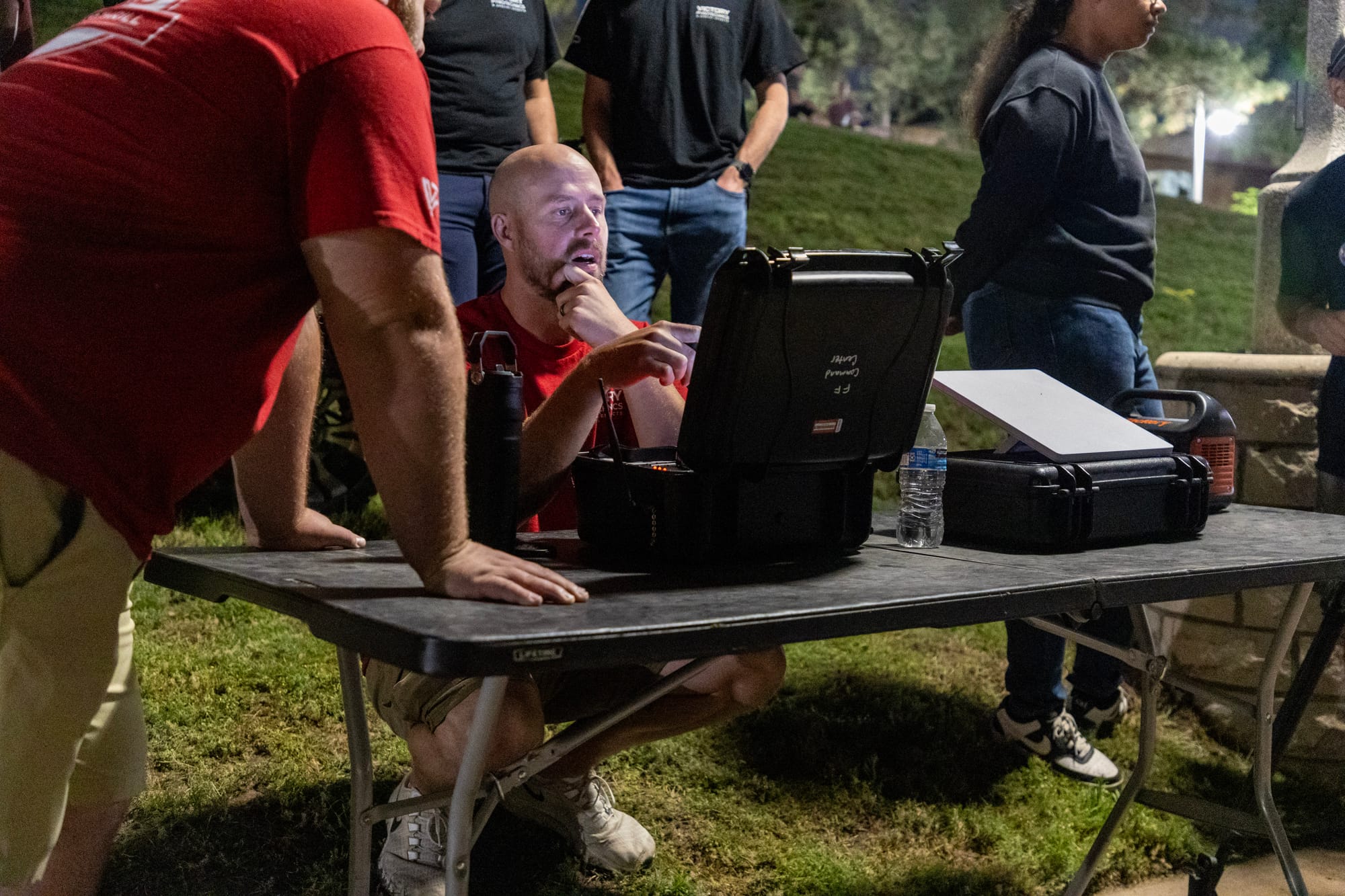
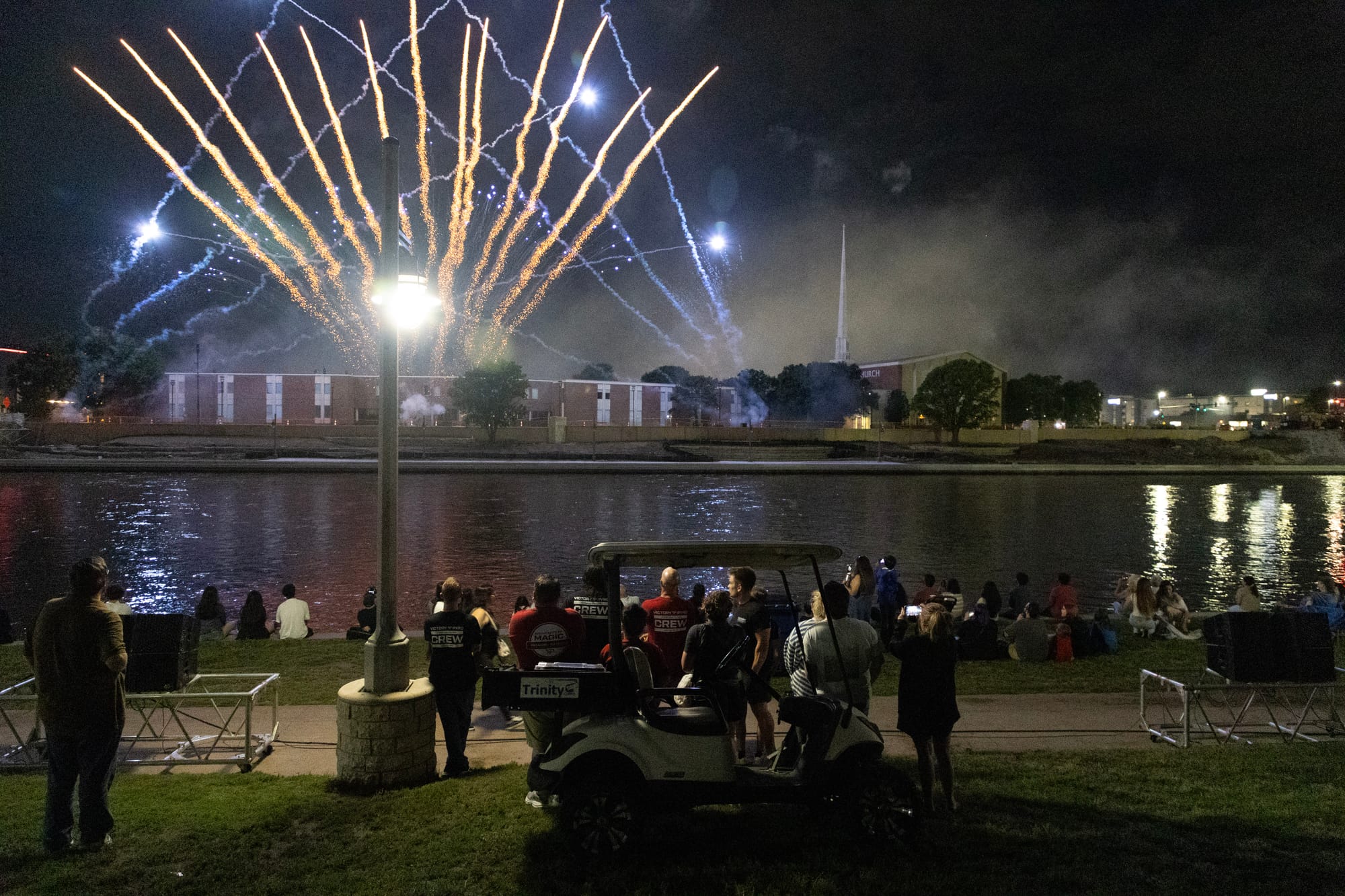
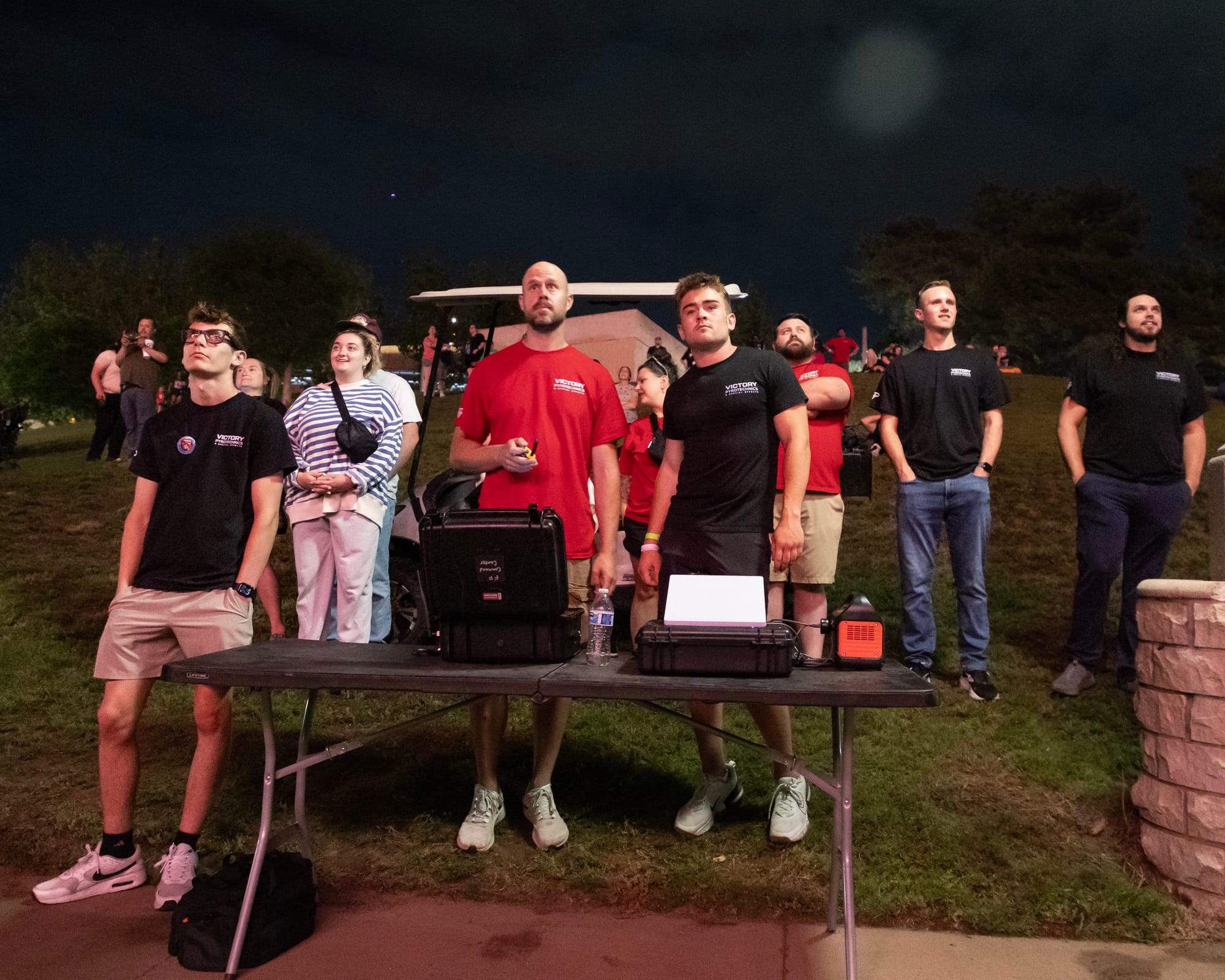
From A. Price Woodard Park, Victory crew members watch their show as it launches on the opposite bank of the Arkansas River. The park had been outfitted with portable speakers to play the show’s synchronized soundtrack. Photos by Kendra Cremin for The SHOUT.
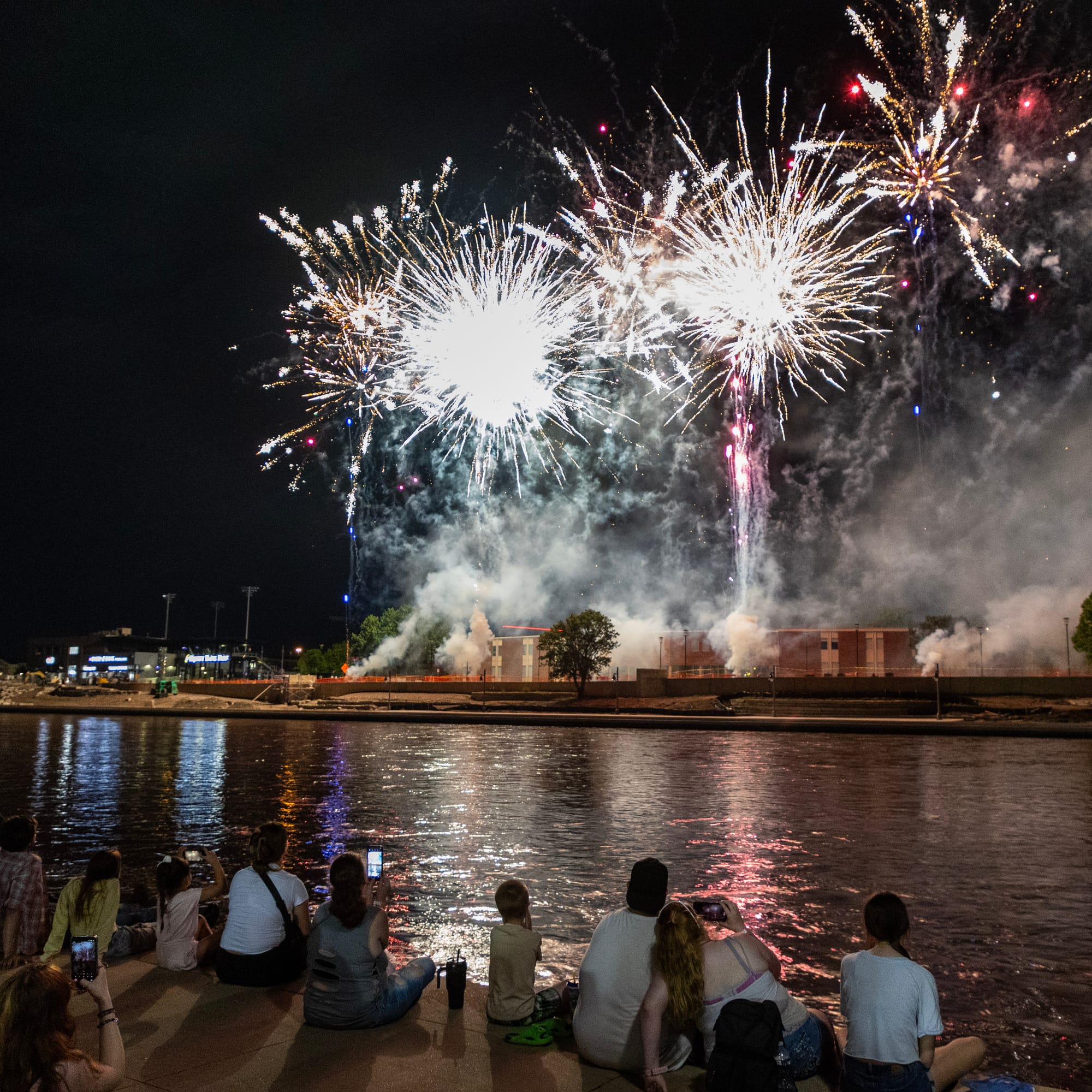
The show went by very rapidly: It was about 8 minutes long. But if you watched a video of it six or seven times, like I did, you could find a lot to say other than “ooh” and “ahh.”
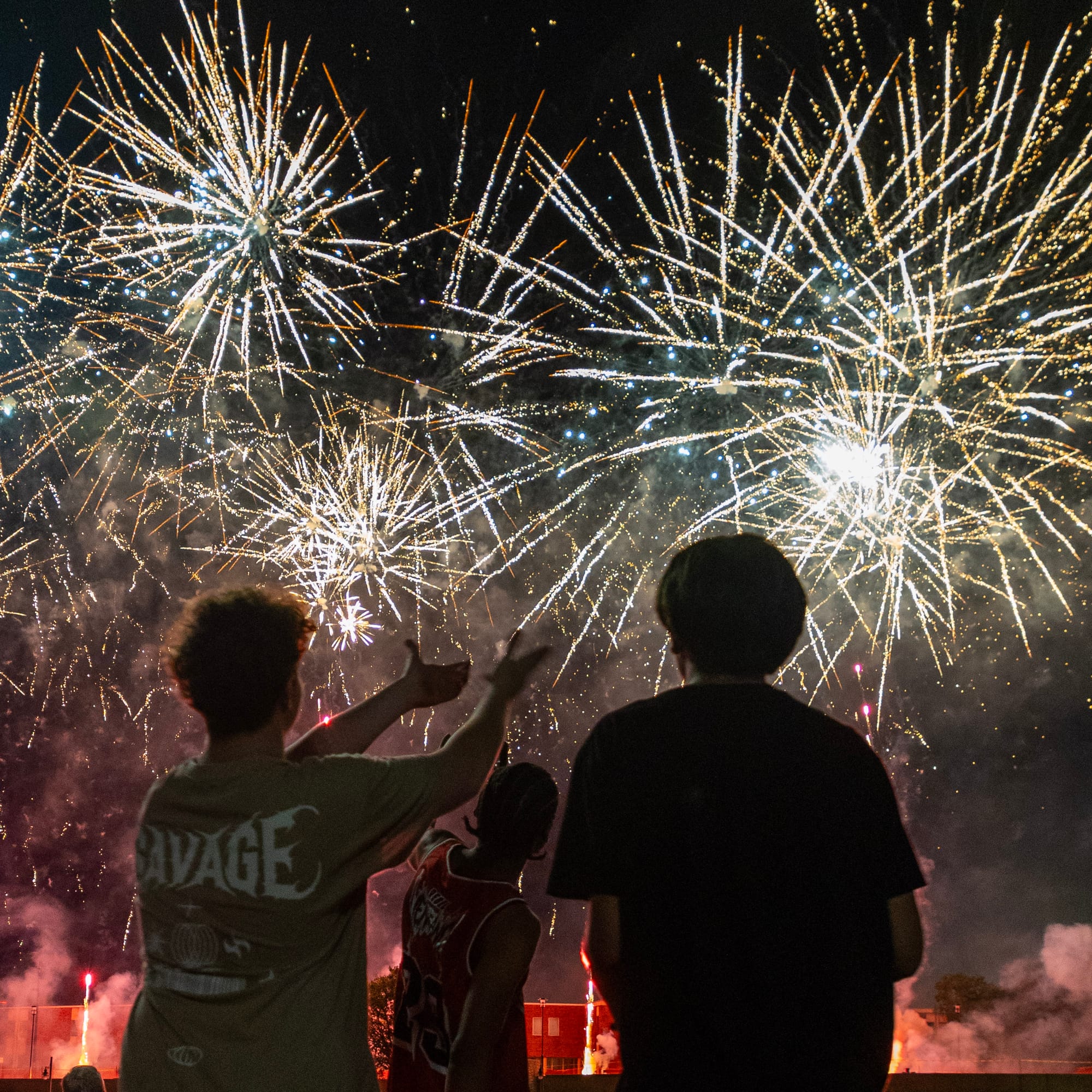
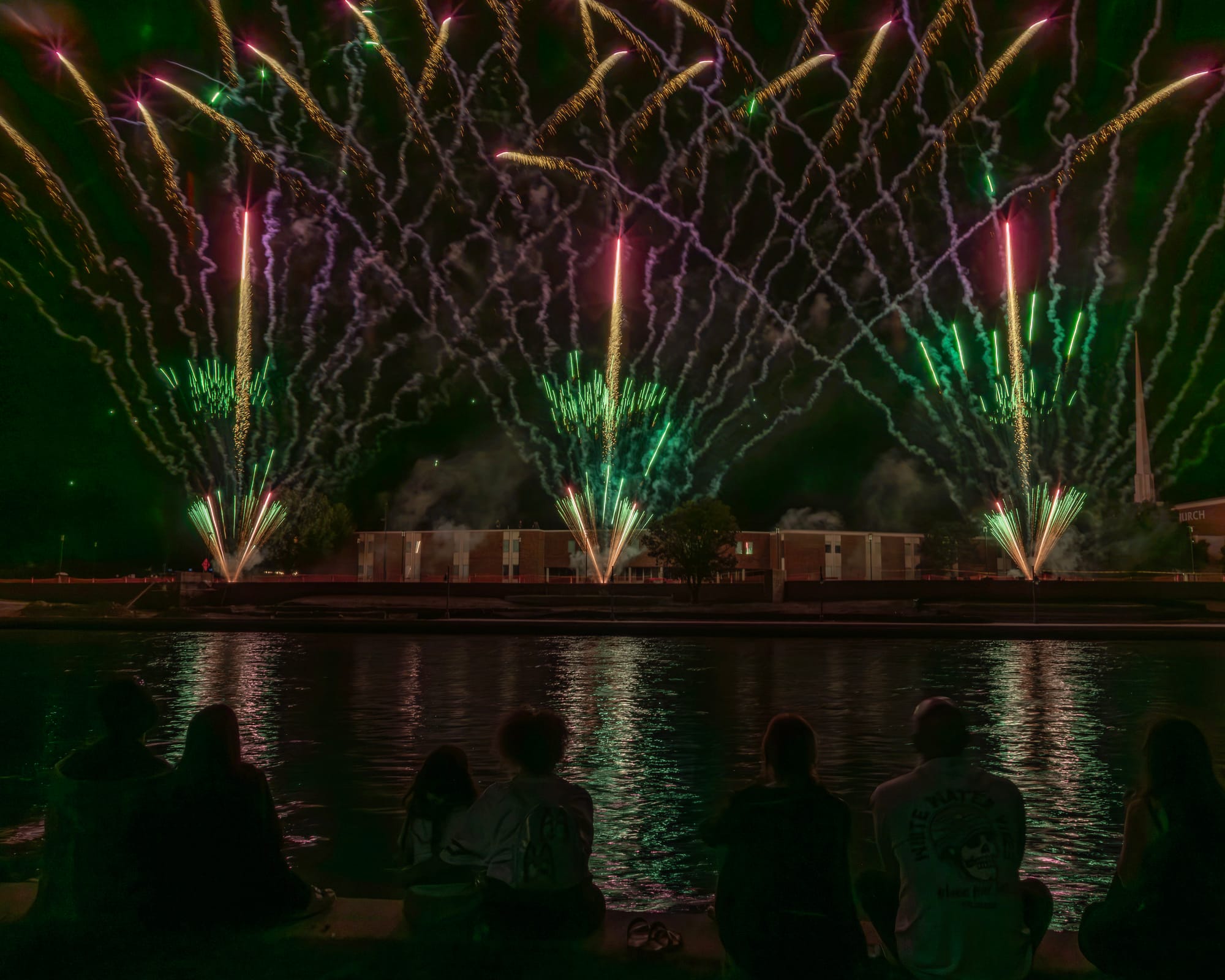
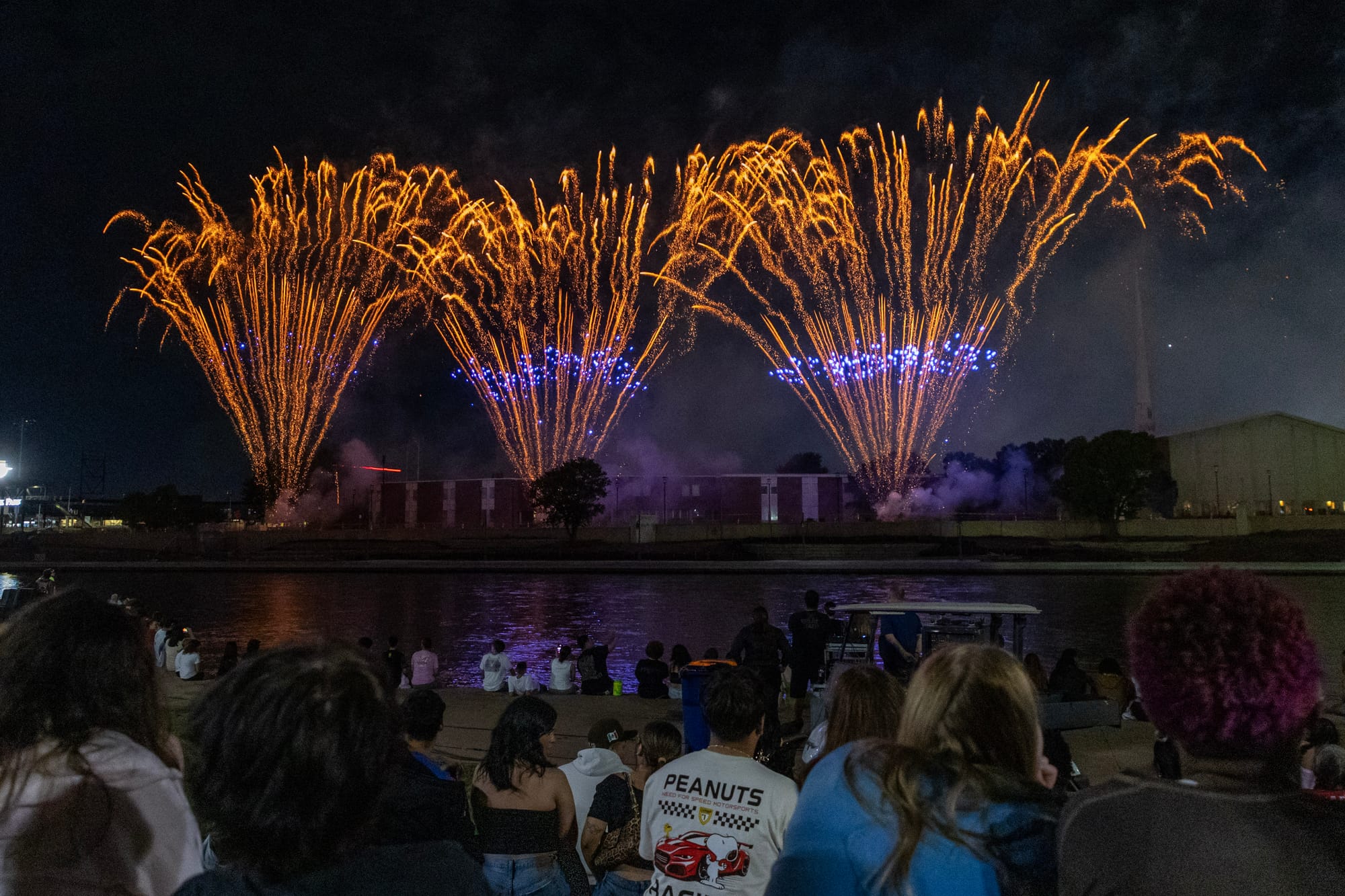
During Janet Jackson’s “Rhythm Nation,” as the chorus of men’s voices sang “we are part of,” thick fans of red and green stars climbed from three launch positions. As those fans faded, and just as the chorus settled on the words “Rhythm Nation,” the colors dissolved into a broad horizontal band of gold willows. When Jackson sang “It’s time to give a damn, let’s work together,” low-angle red and blue comets shot outward to north and south, so aggressively that some appeared to skim over the heads of spectators on the Douglas bridge. A final fan shot erupted from the center firing position: red and blue stars beneath a loudly crackling burst of white.
The “Thriller” section began with three silent pillars of red comets to mark the song’s opening, evoking the color of Michael Jackson’s famous jacket. On “It’s close to midnight” and “Under the moonlight,” stark white embers blinked into view and drifted slowly, momentarily downward. On the phrase “You start to freeze,” white stars burst low in the sky, exactly on the word “freeze,” followed immediately by a second layer of white stars at higher altitude. When the chorus finally arrived, the word “Thriller” was punctuated by skirts of red stars spreading beneath white fans.
By the time the show reached “Billie Jean,” the choreography became almost overwhelmingly dense. During the chorus — “Billie Jean is not my lover” — multiple, powerful shells burst in exact unison; their combined reports produced a rushing echo that swept up the river and rebounded against downtown buildings, sidewalks and concrete embankments. As the segment accelerated toward the finale, nearly every beat in the music found its visual and aural counterpart in a launch, while the sky became fully occupied at low, middle, and high altitudes. In accordance with long pyrotechnic tradition, the show concluded in a brief, blinding concatenation of shells that left the riverfront awash in smoke.
The idea of “liminal spaces” has been gaining steam on artsy corners of the internet for the last few years. Liminal spaces, in the internet sense, have been constructed by human hands, but the humans are now absent. These spaces are defined by our inattention. The eerie feeling they give us comes from the sense that, if we focus on them, we will start to see the world we move through as a series of ramshackle stage sets.
For all the attention and care our civic and business leaders lavish on the downtown riverfront area, I think it is something like a liminal space for most people, most of the time. We glance down at the river from our car windows as we cross a bridge, or maybe we don’t even glance.
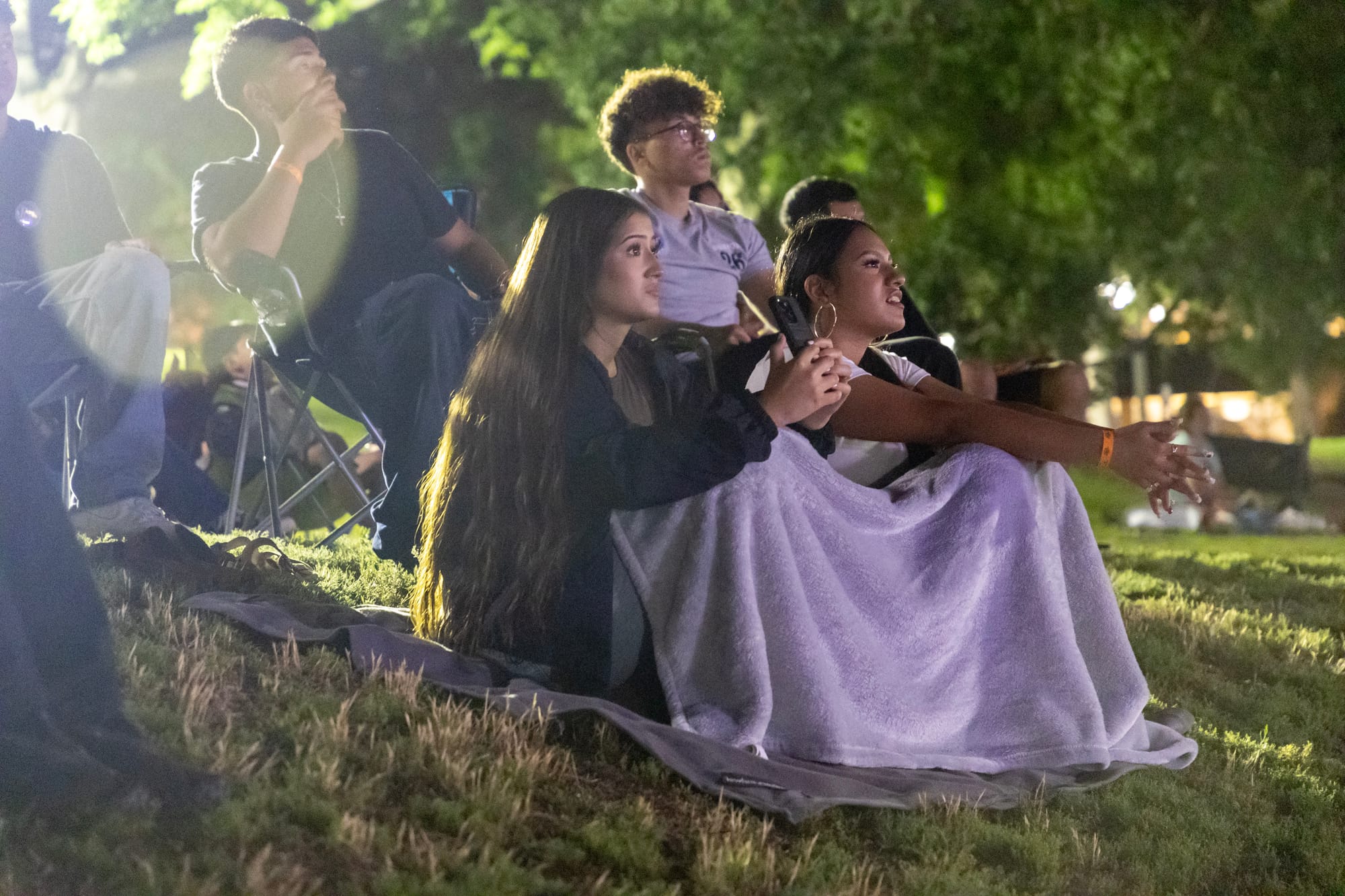
From my perspective, the convening of this social spectacle — all of us at large in the open air, dry and cool after a day of off-and-on showers — broke that liminality; it turned a 1,500-foot section of the Arkansas River into a vast playing space, an unwalled “room” framed on the east bank by Century II, on the west bank by the former Metropolitan Baptist Church’s lofty steeple, and at north and south by the Waterman and Douglas bridges with their stylized feather towers. A room to occupy along with several thousand neighbors, rather than a void space to cross; a room large enough and tall enough to hold not just the spectacle of the fireworks, but the thousands of spectators on the riverbank and bridges, and the strongly flowing current of the Arkansas, and the noises that lofted easily across the big spans of open air, noises of traffic and wind, and of fireworks’ crackle, and of people murmuring, yelling, laughing, and watching one another be at large in the outdoors.
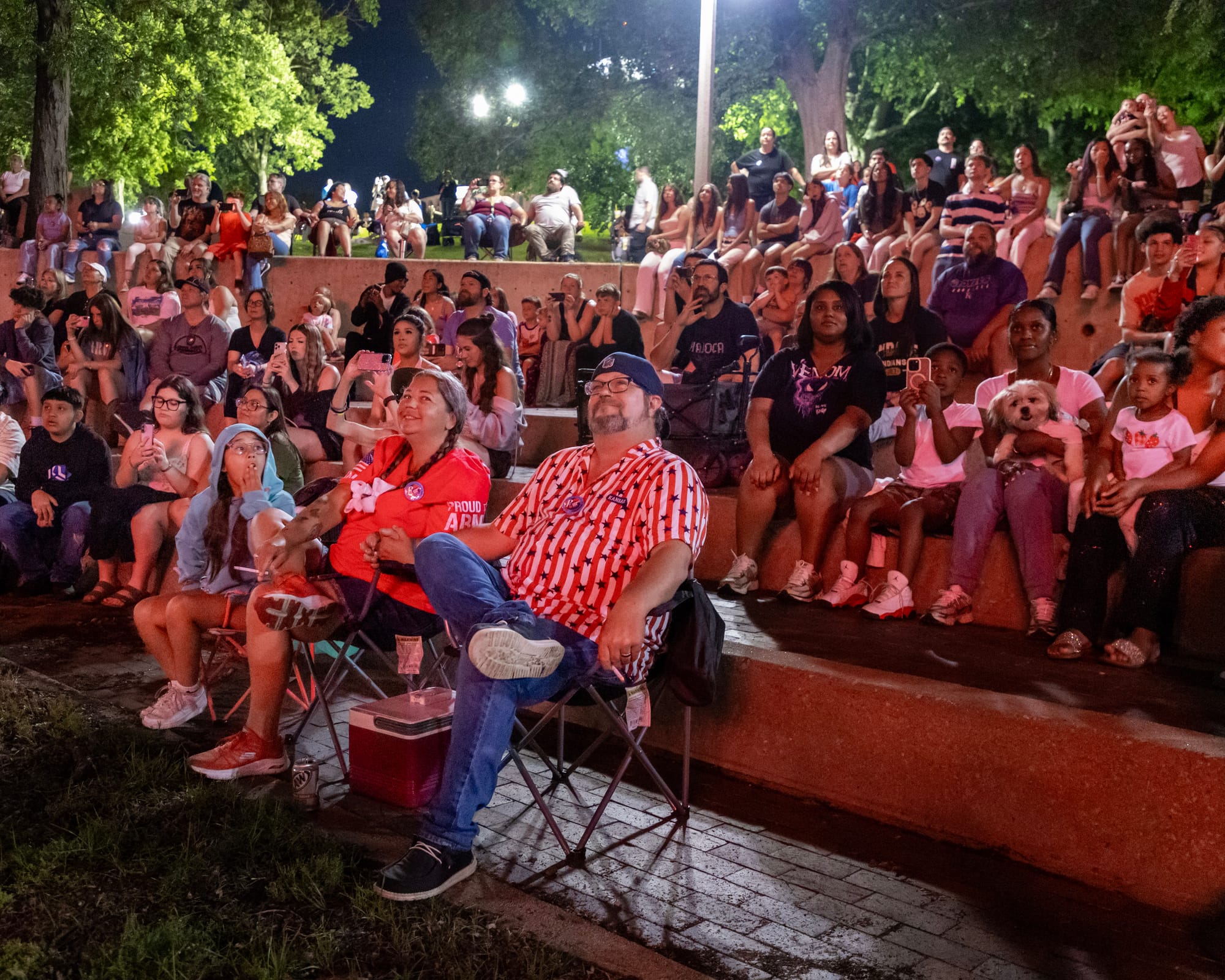
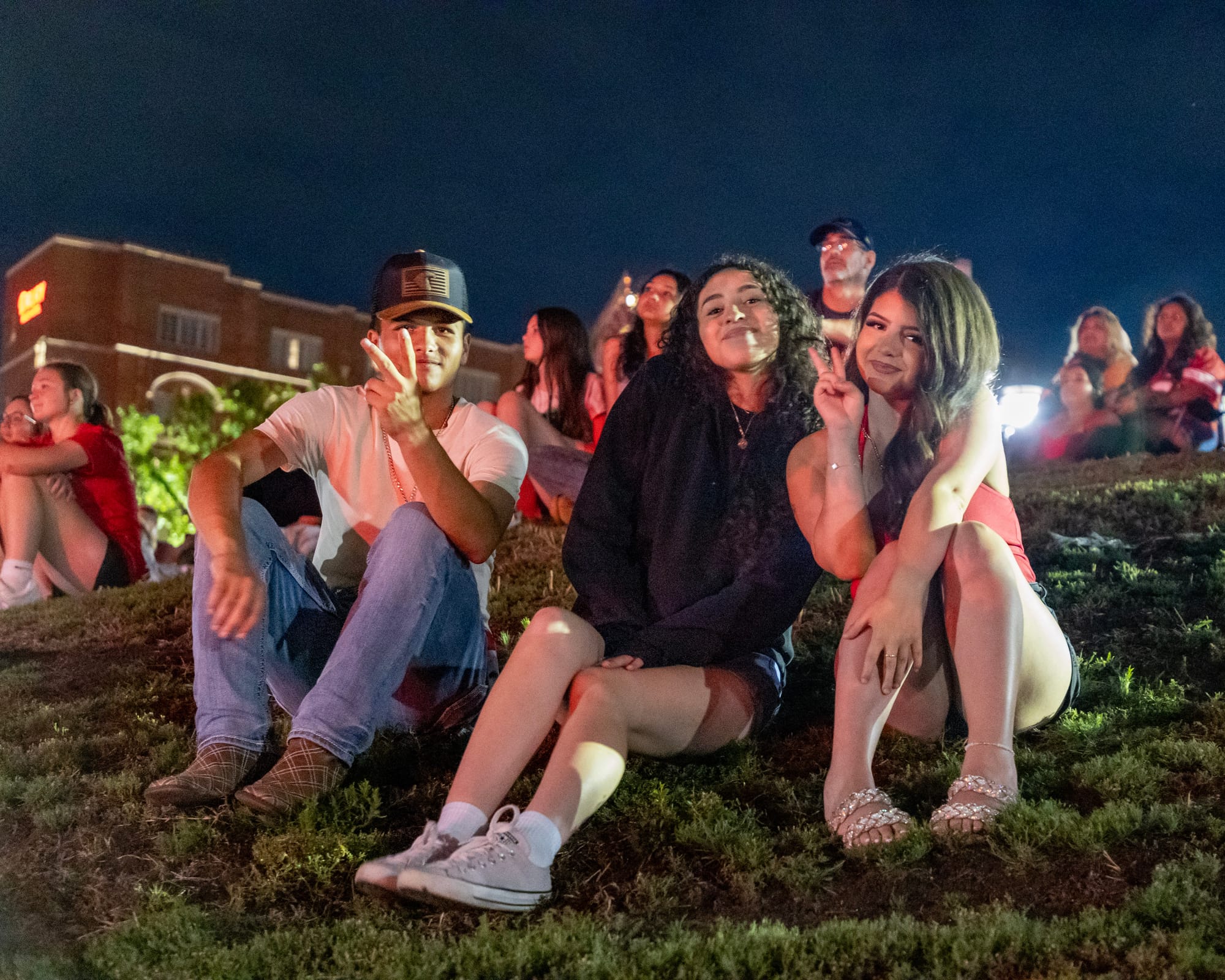
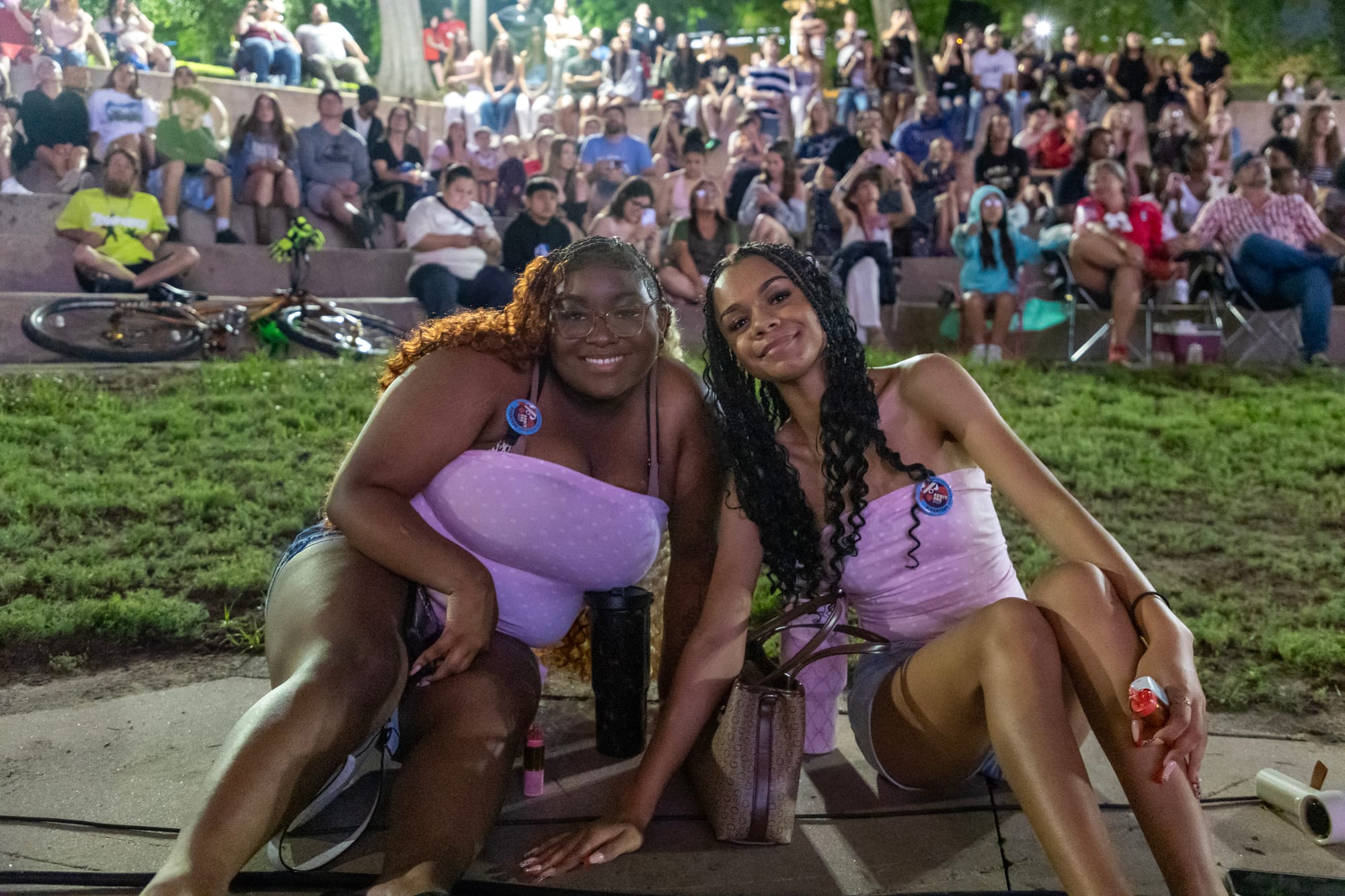
Photos by Kendra Cremin for The SHOUT.
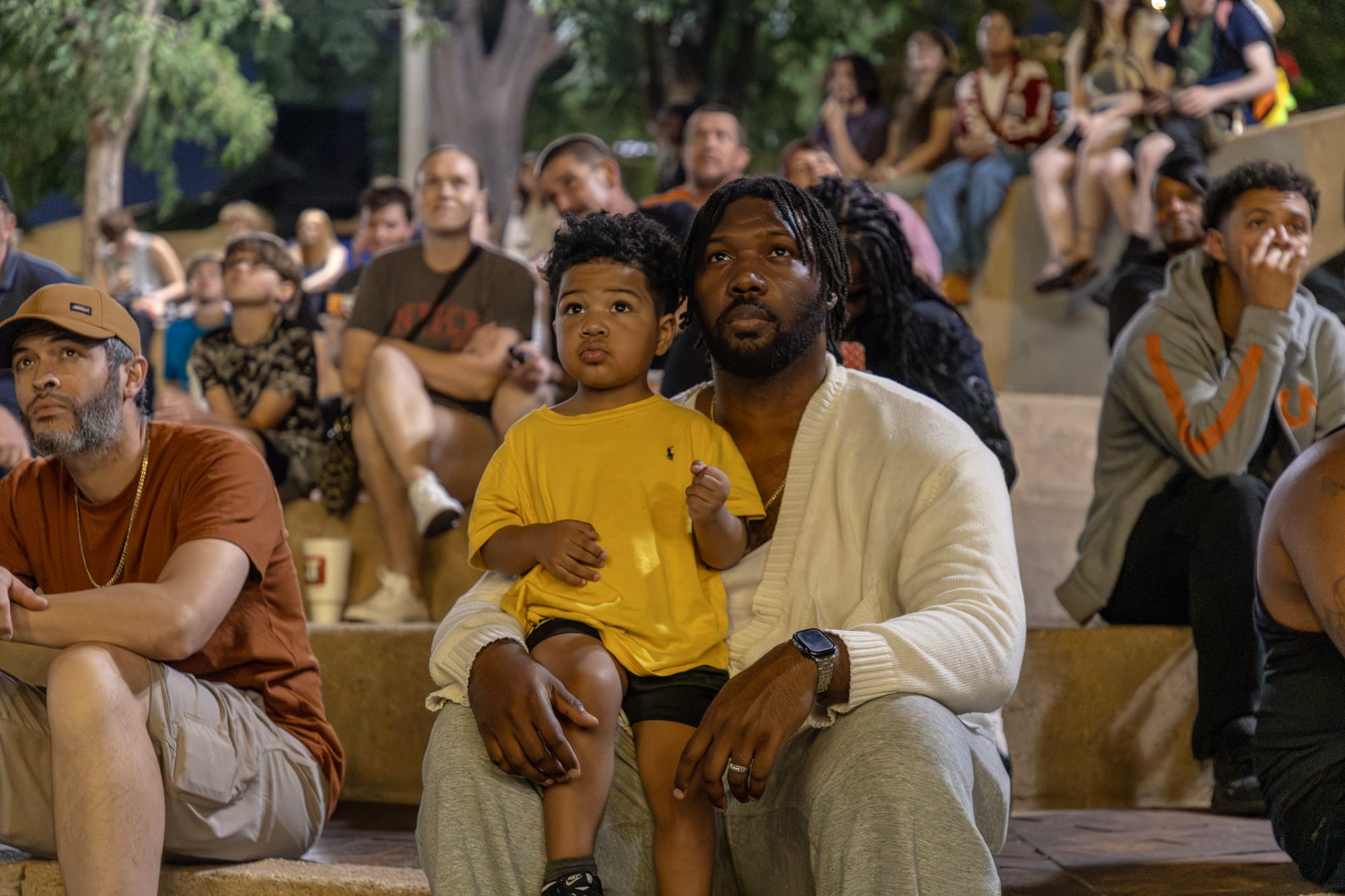
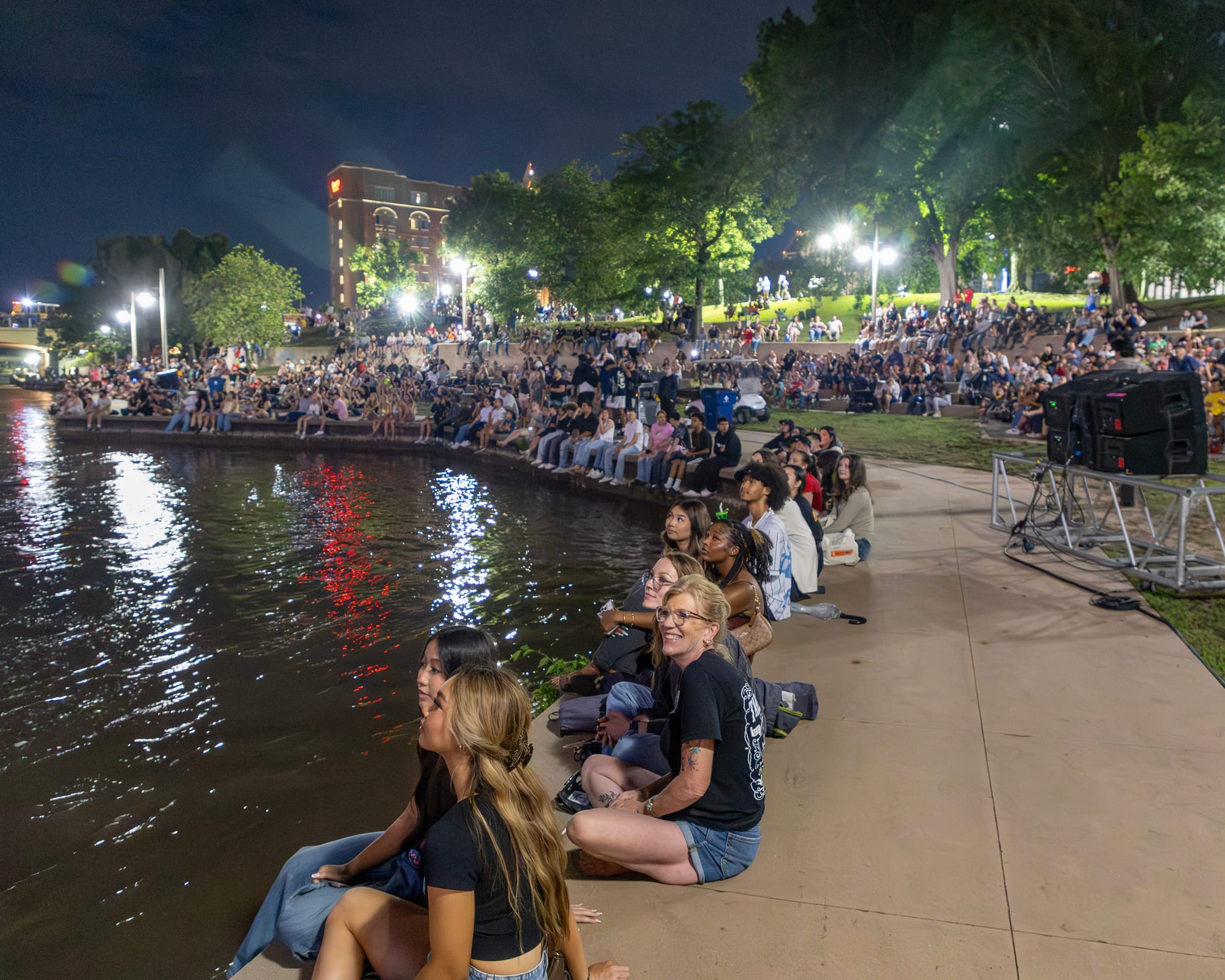
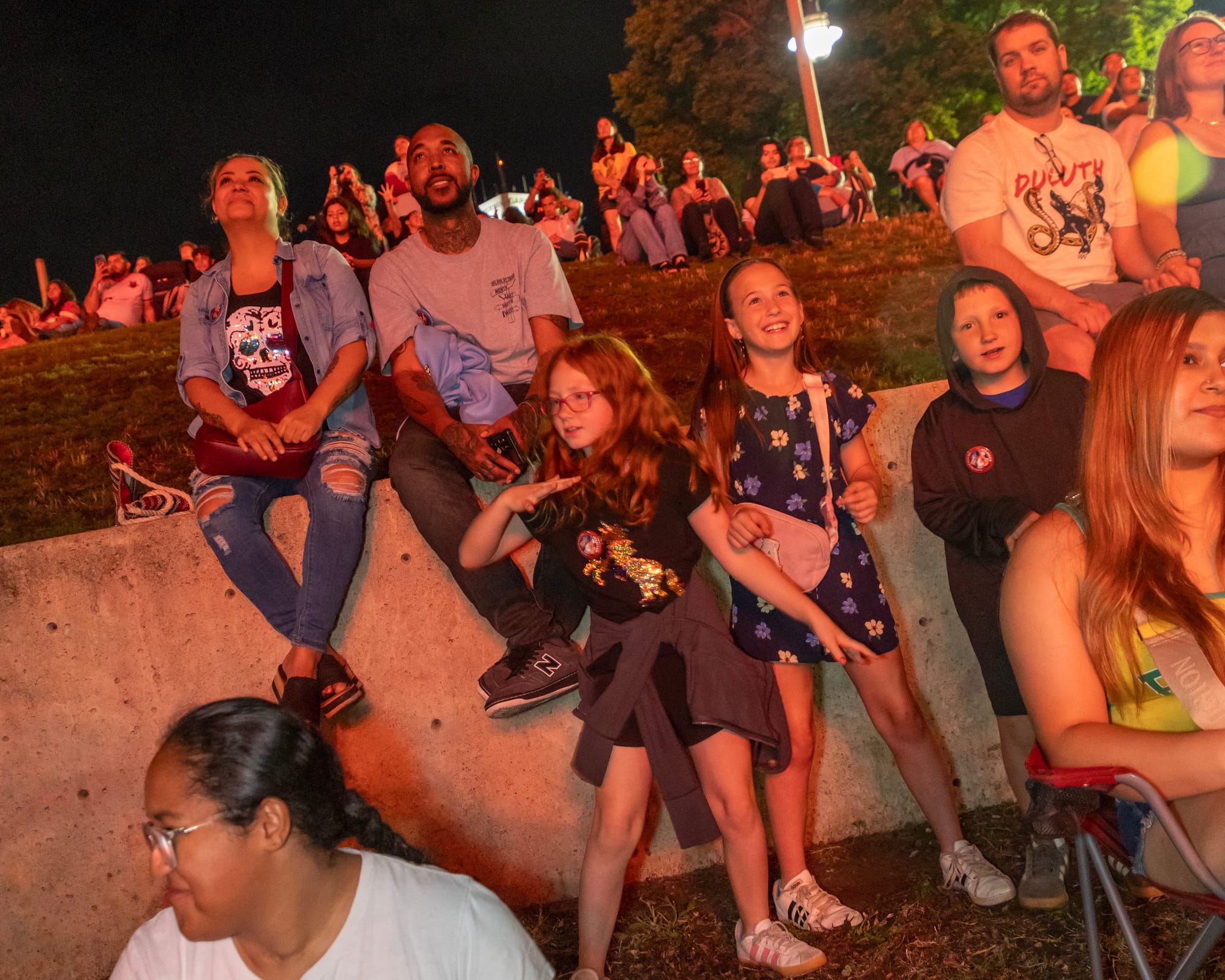
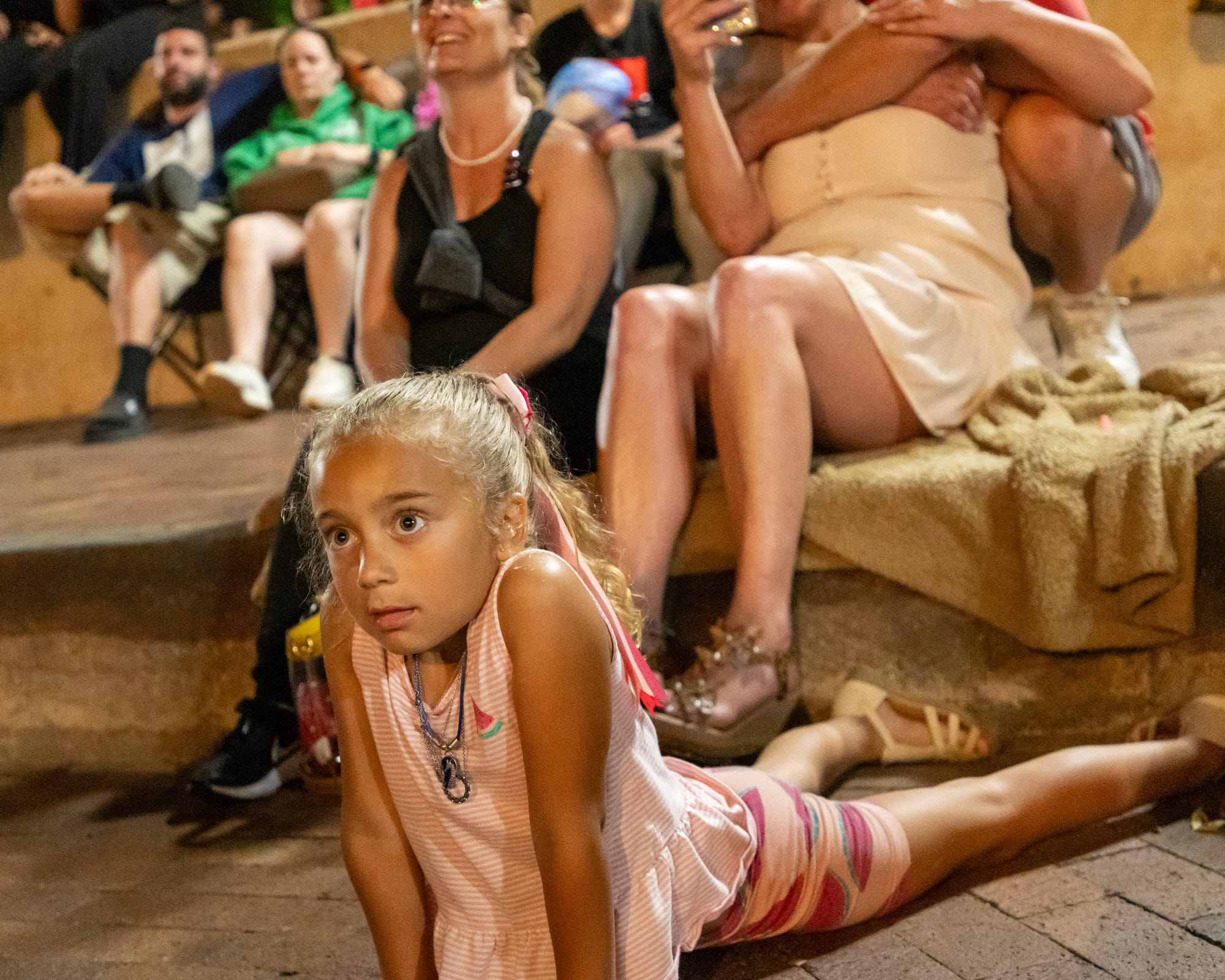
Photos by Kendra Cremin for The SHOUT.
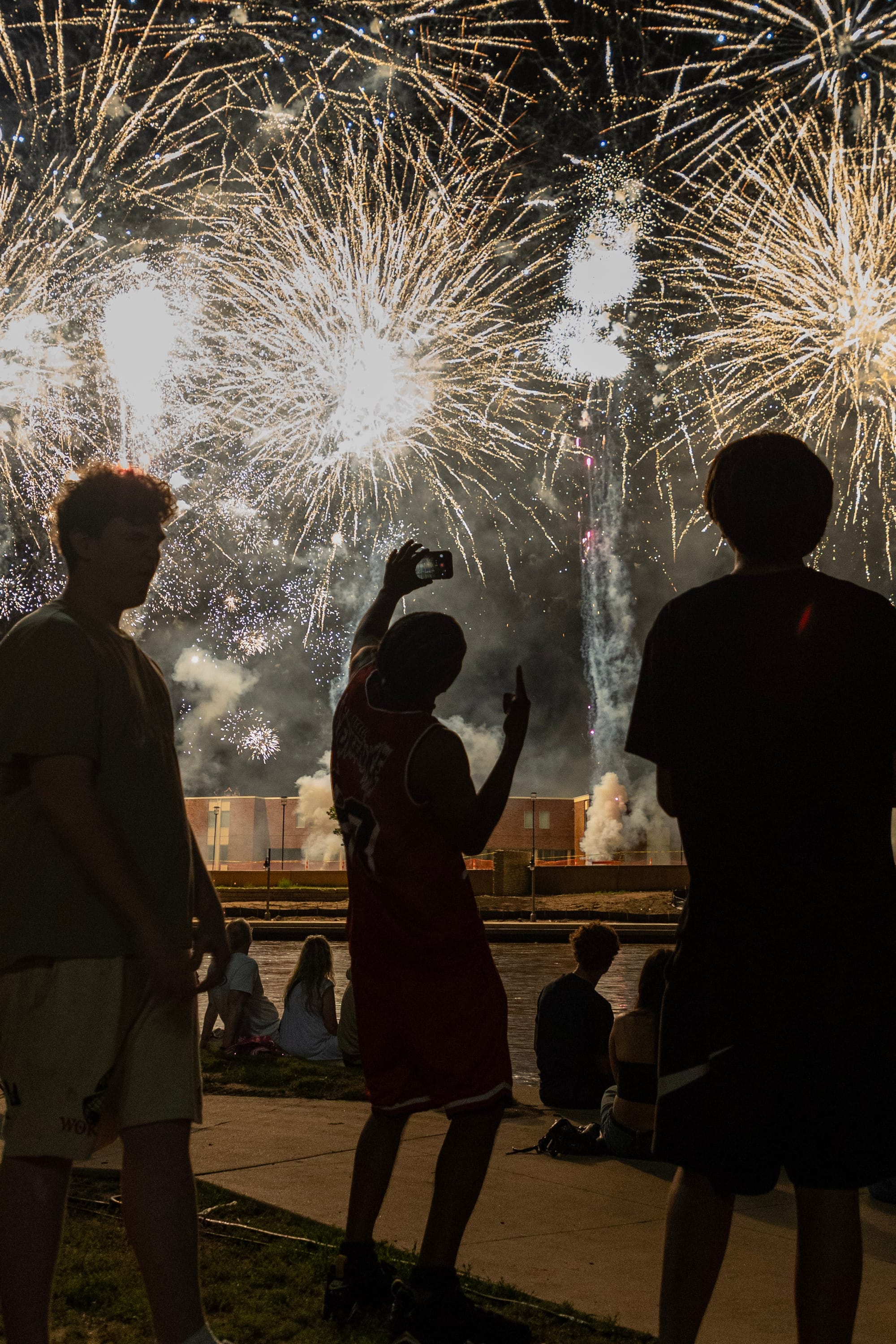
Sam Jack is a poet, a classical tenor, and the adult services librarian at Newton Public Library. He performs with several local groups, including Wichita Chamber Chorale, Wichita Grand Opera, and Opera Kansas. He received a Master of Fine Arts in creative writing from the University of Montana.
Kendra Cremin is a photographer, artist and part-time Instructor at Wichita State University. Her areas of focus are lifestyle, commercial, fine art, documentary photography and where to get her next cup of coffee.
❋ Derby man has the kind of voice that turns heads — and chairs
❋ Socializing while sober: how some Wichitans are cultivating alcohol-free communities
❋ As a small creative business closes, the owner mourns
❋ Painting through it: Autumn Noire on 20 years of making art
❋ How a guy from Wichita resurrected 'Dawn of the Dead'
❋ Bygone Friends University museum housed curious collections
Support Kansas arts writing
The SHOUT is a Wichita-based independent newsroom focused on artists living and working in Kansas. We're partly supported by the generosity of our readers, and every dollar we receive goes directly into the pocket of a contributing writer, editor, or photographer. Click here to support our work with a tax-deductible donation.