25 years on, 'Feather Towers' still carries Wichita forward
Designed in part as a nod to the city’s aviation history, the Arkansas River bridges have become quiet landmarks.
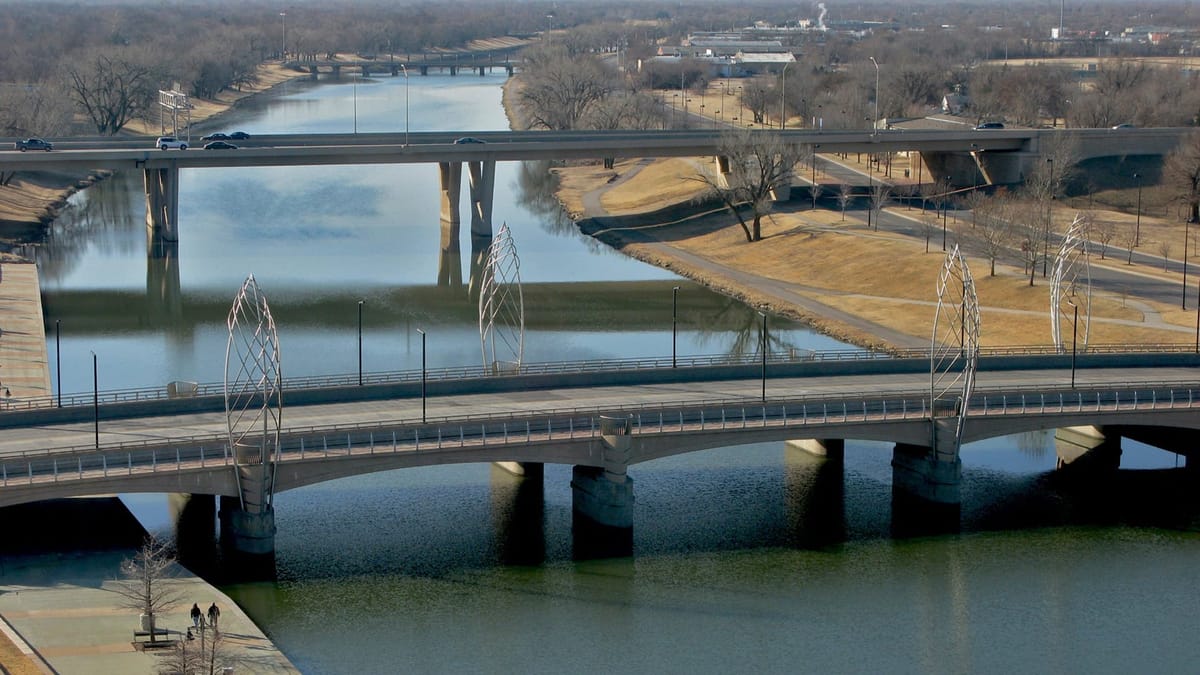
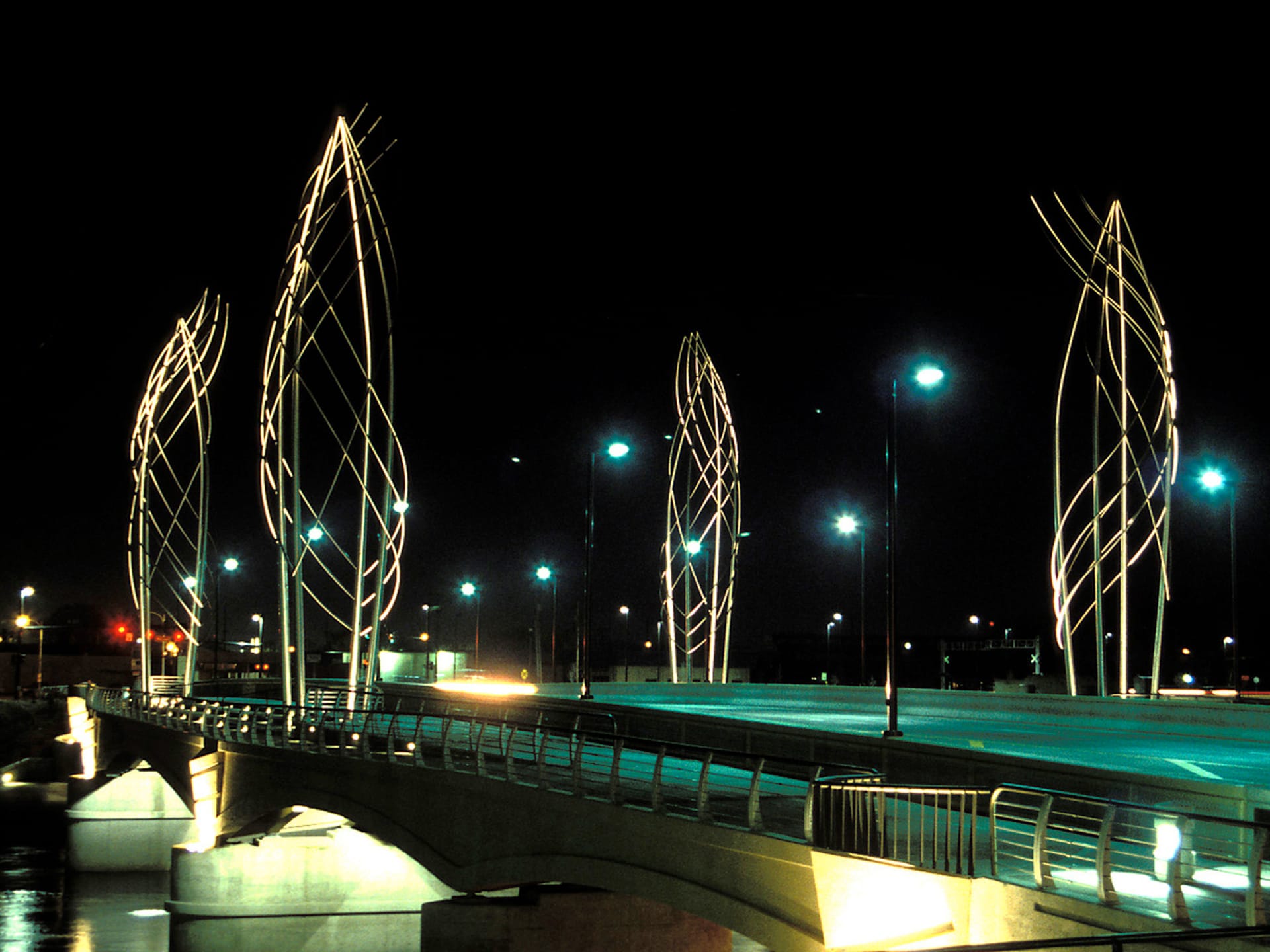
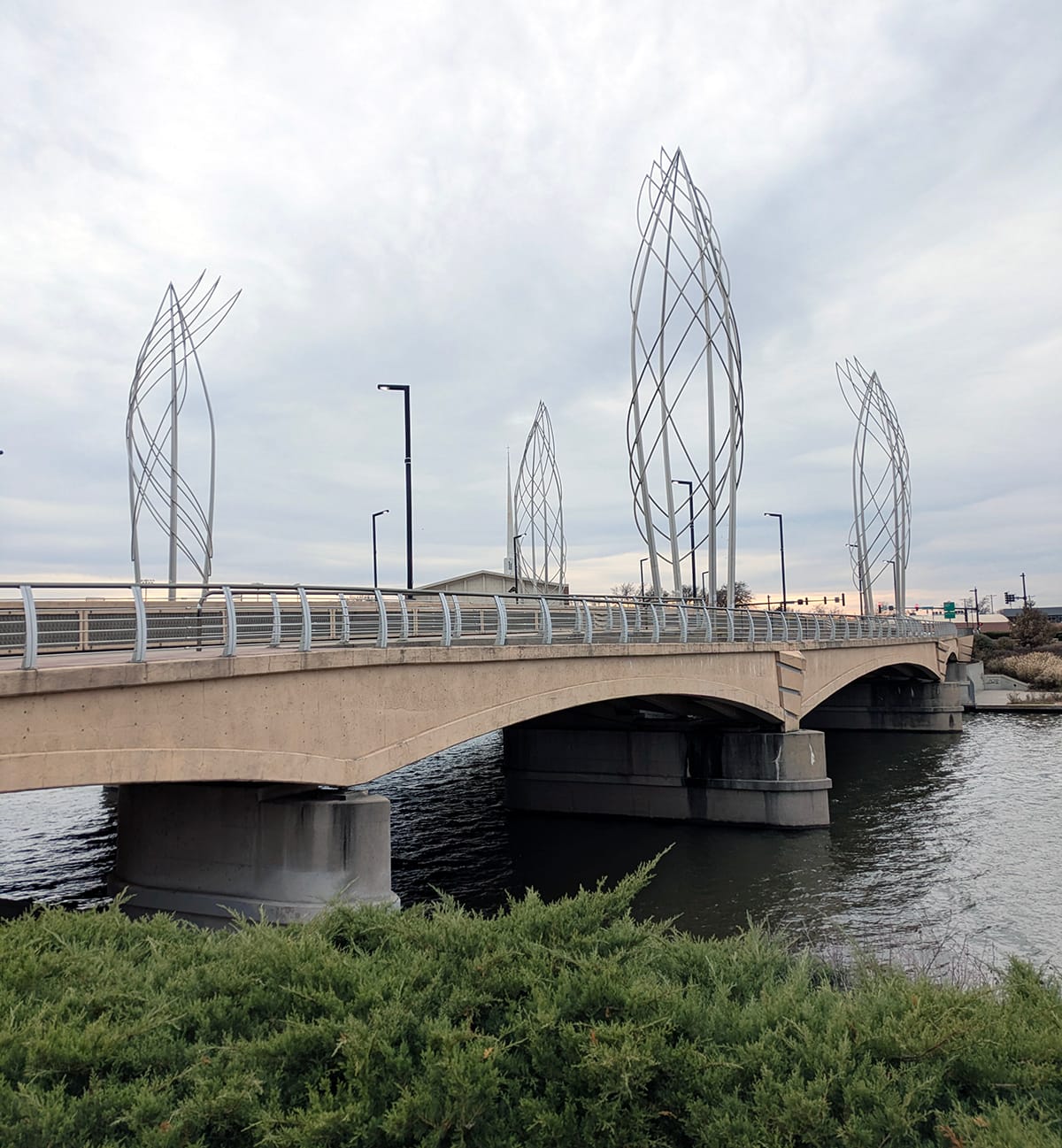
Along the Arkansas River bridges of Douglas Avenue and Waterman Street, the tall, curvilinear stainless steel structures known as the “Feather Towers” by Vicki Scuri might subconsciously bring up memories for many locals. In particular, they may recall an experience near the water: boat races during Wichita Riverfest, attending a Wind Surge baseball game, or “dragging Douglas” from College Hill to Delano. For thousands of residents, the “Feather Towers" are simply part of their daily commute.
It has been more than 25 years since the city unveiled the landmark structures — public artworks designed not only to be seen and interpreted from many angles, but to be used.
The City of Wichita’s stance on public art is currently a positive one, bolstered by the Percent for Art Program, a 2019 City Council-approved ordinance that allots 2% of the city’s Capital Improvement Program budget to be devoted to the funding, selection, creation, and maintenance of public art.
But in 1995, when the bridges were set to be redesigned, Wichita struggled with a positive self image. Several City Council members felt that public art should be funded by private donations and consistently voted against such projects. Winning the members over to the concept of public money for public art was a hard-fought battle. Thanks to the advocacy of the city’s Public Art Advisory Board and the vision of then-mayor Bob Knight, who asserted that public art could uplift communities and become points of pride for the city, the City Council changed their approach. Now, by virtue of spanning the river for a quarter century, the “Feather Towers” represent a long-standing commitment to notable public art and an improved pride in its city image.
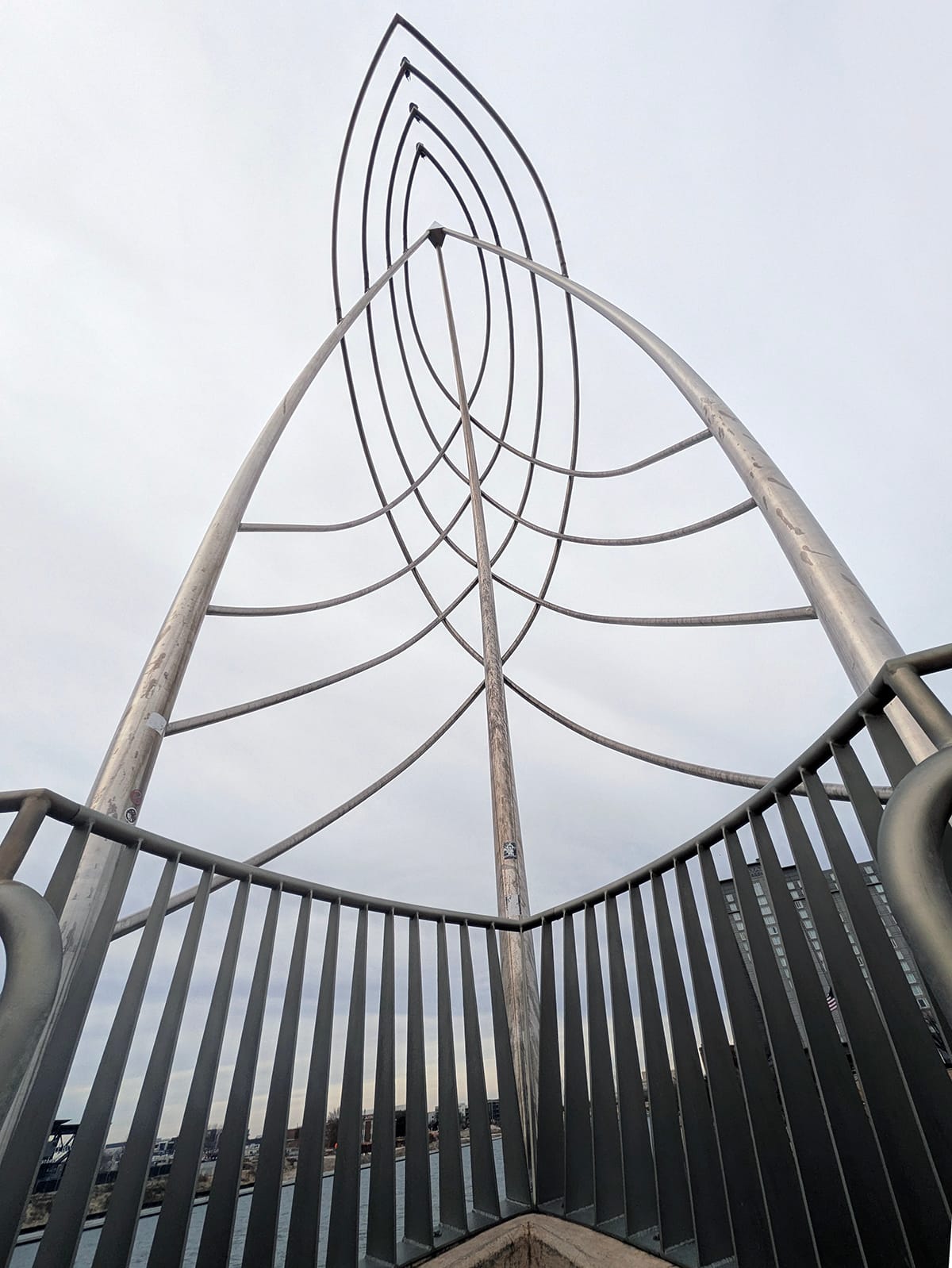
“I think in many ways our city is adrift. I think its spirit is flat and defensive, and I think we need things that lift our spirit, and ennoble us, and give us confidence that with our human resources and with our financial resources that if we pull together and we’re balanced in our approach, we can do truly great things as a city,” Knight said in 1995. (Rhonda Holman and Russell Fortmeyer, “Wind Spirit Gateway,” Wichita Eagle, January 11, 1997, 9A)
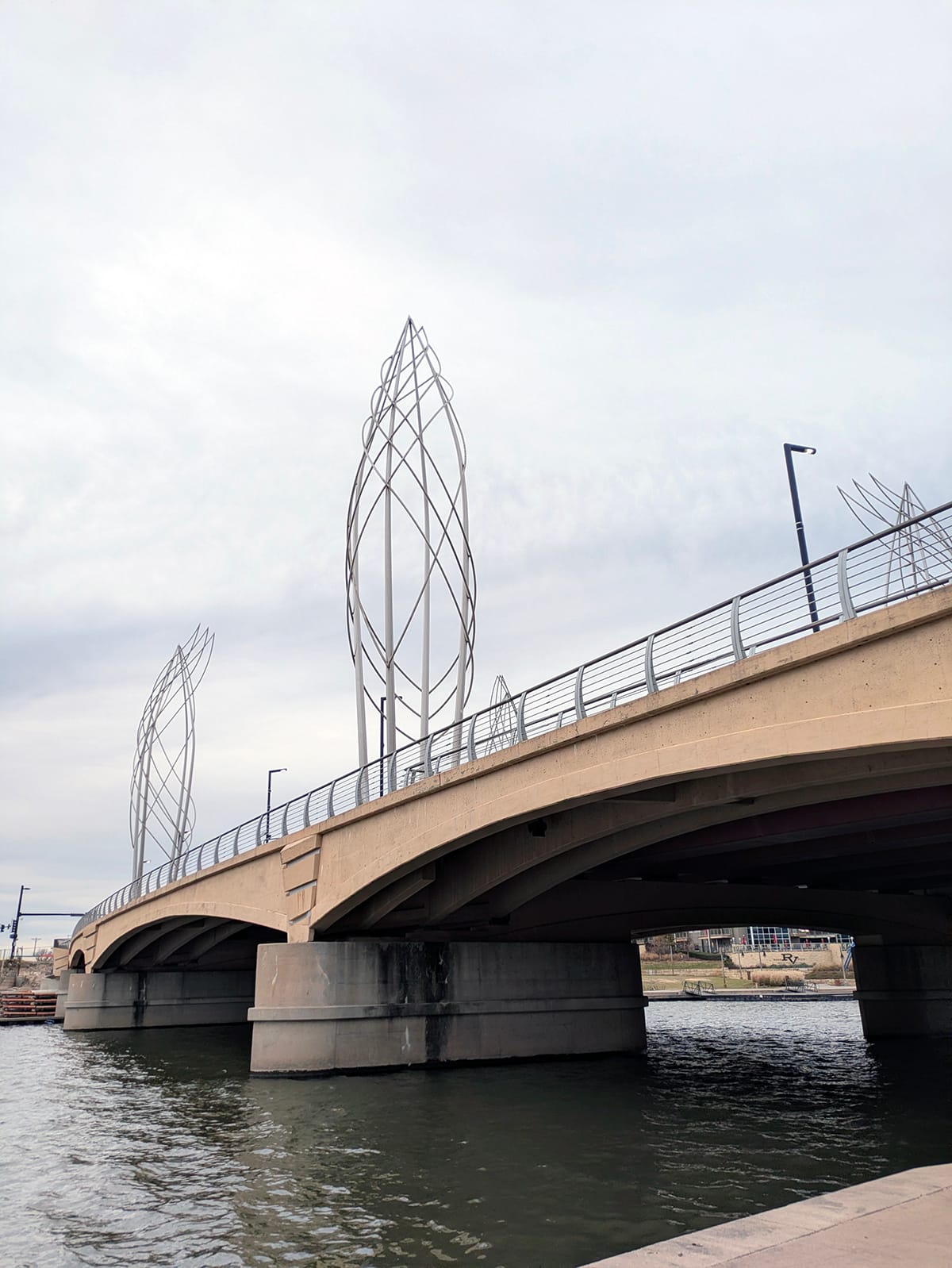
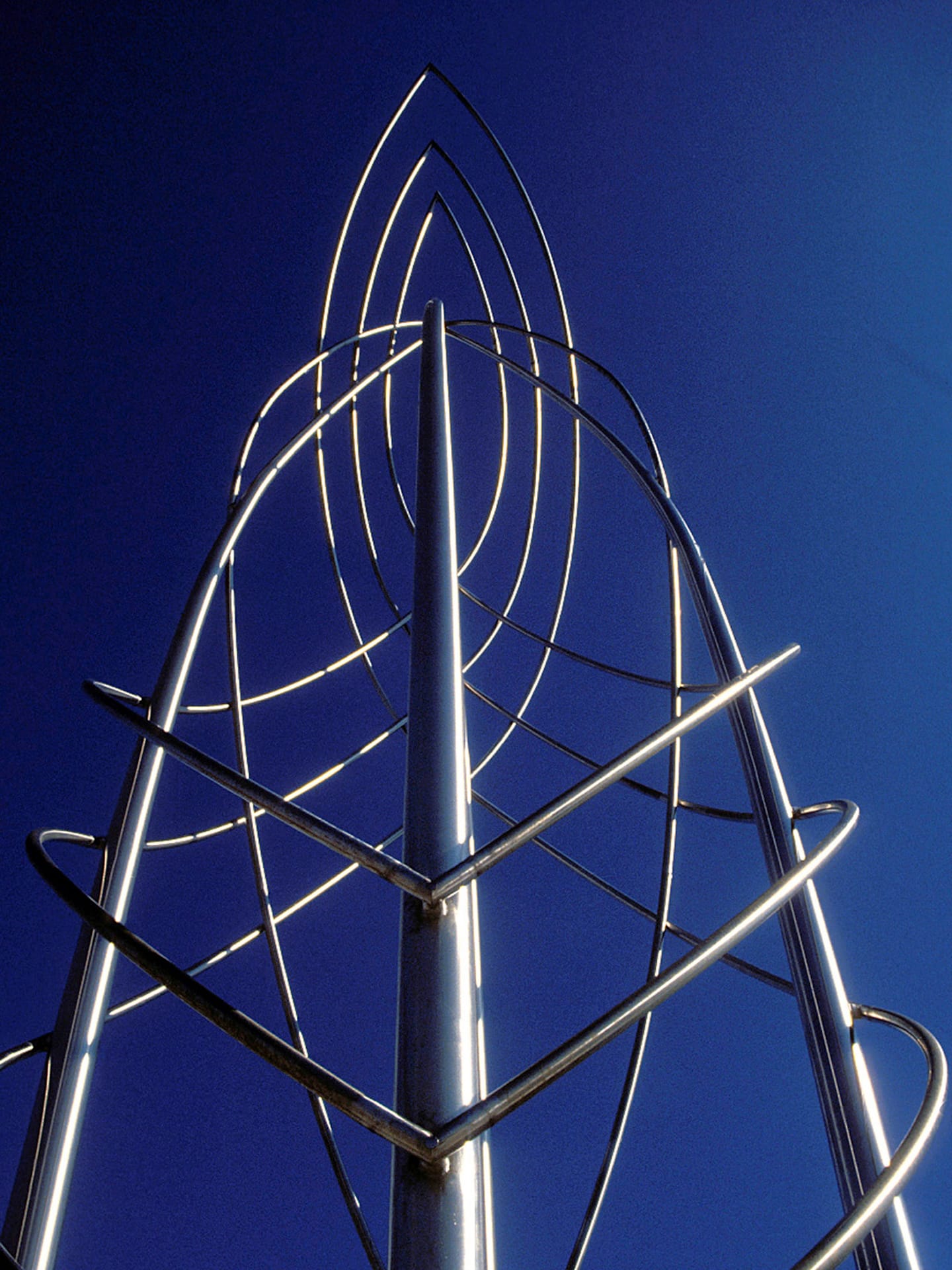
Accompanied by piers with overlook points that resemble the bow of a boat, the stainless steel towers on the Waterman bridge each stand at 40 feet tall and resemble a mast, a feather, or a wing; whether a bird’s wing or a plane’s, is up to the interpreter. Through wisps extending beyond the main structures, suggesting upward motion, natural light casts feathery shadows on the ground. At night, the towers are illuminated from below.
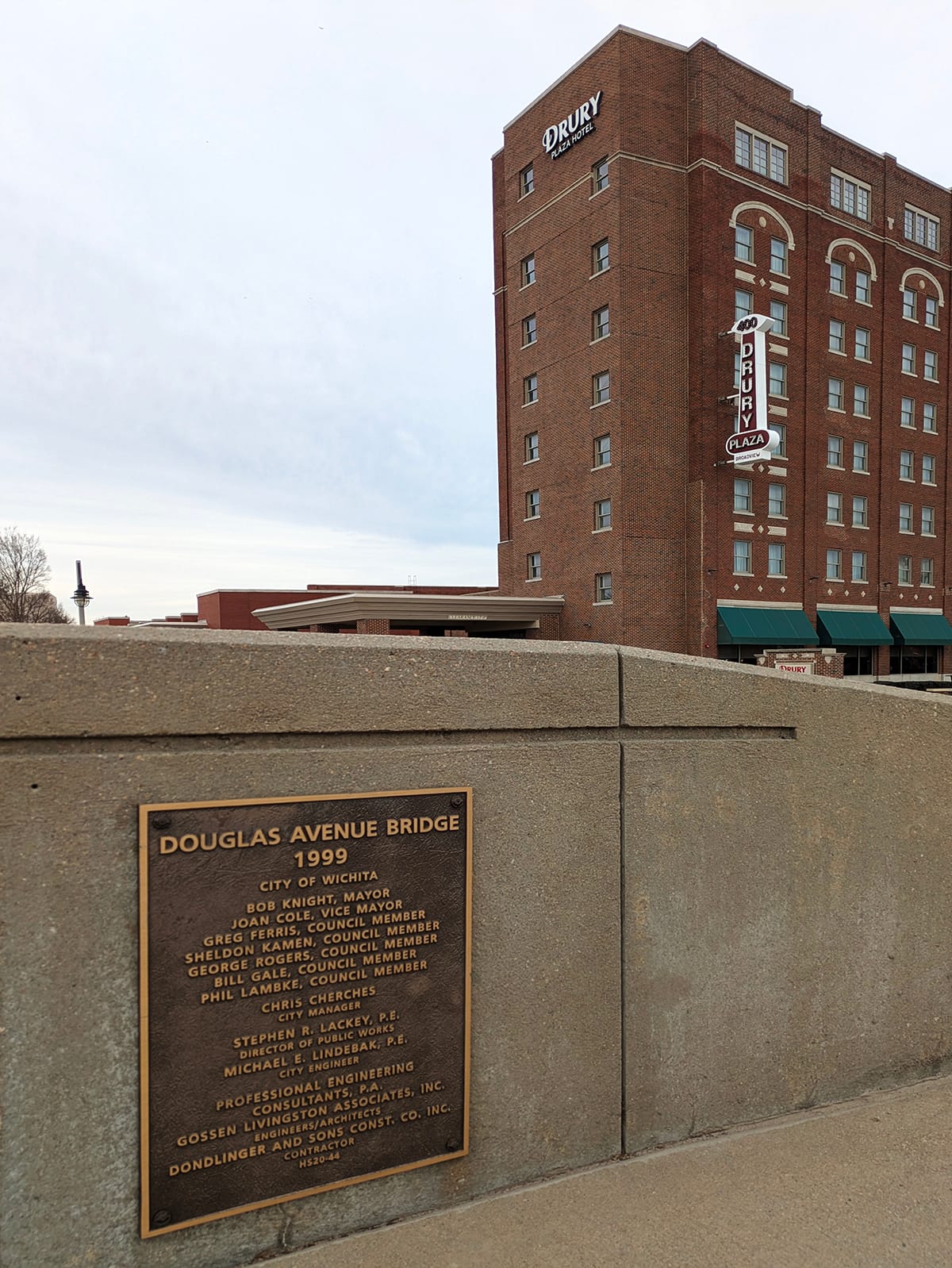
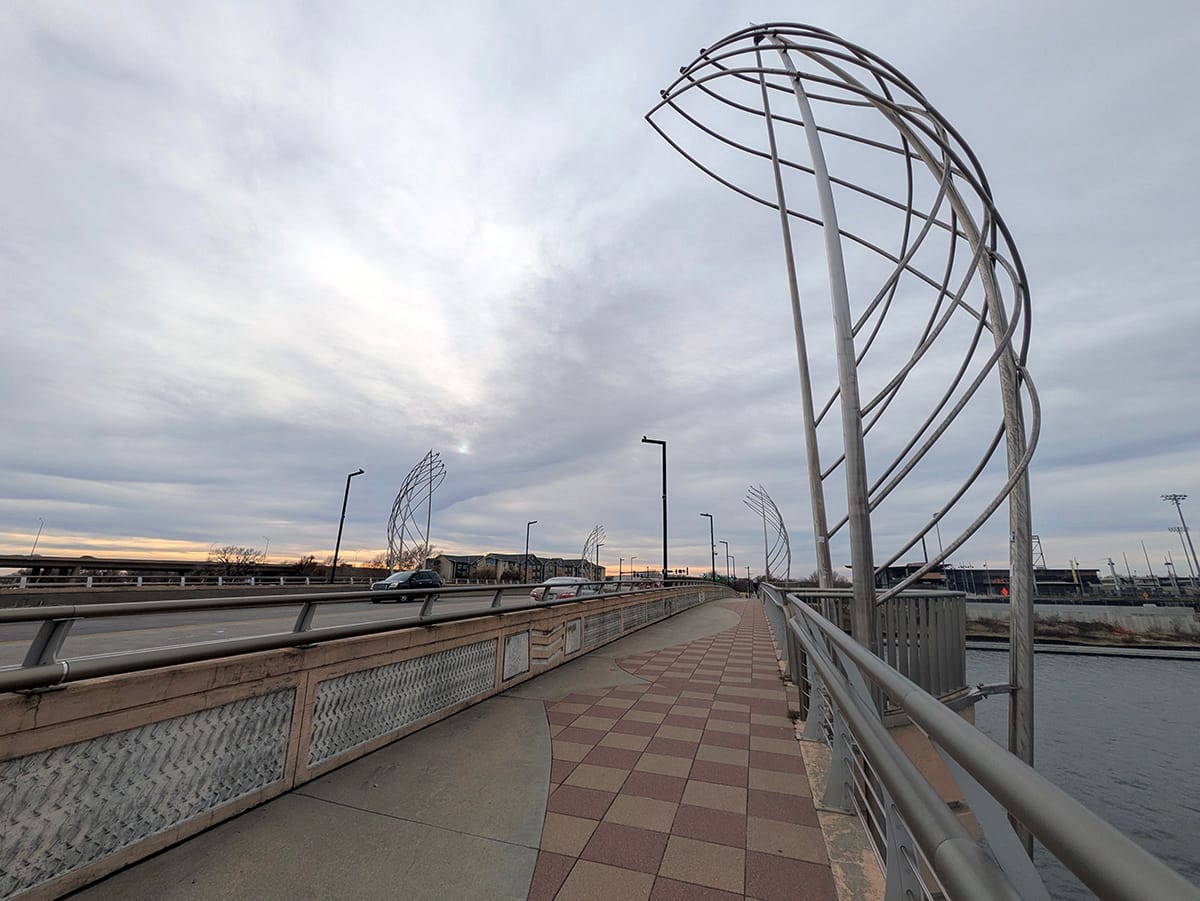
The towers on the Douglas bridge are much taller, 65 feet high, but continue the same motifs of movement in the form of feathers or wings (or bows or masts). At this location, the towers serve as an anchor between two levels of pedestrian walkway with two extended steps in between. Blocks of alternating red and tan cement tiles delineate the walkway levels. The walls of the walkway are lined in chevrons and wavy tire tread patterns cast in the cement.
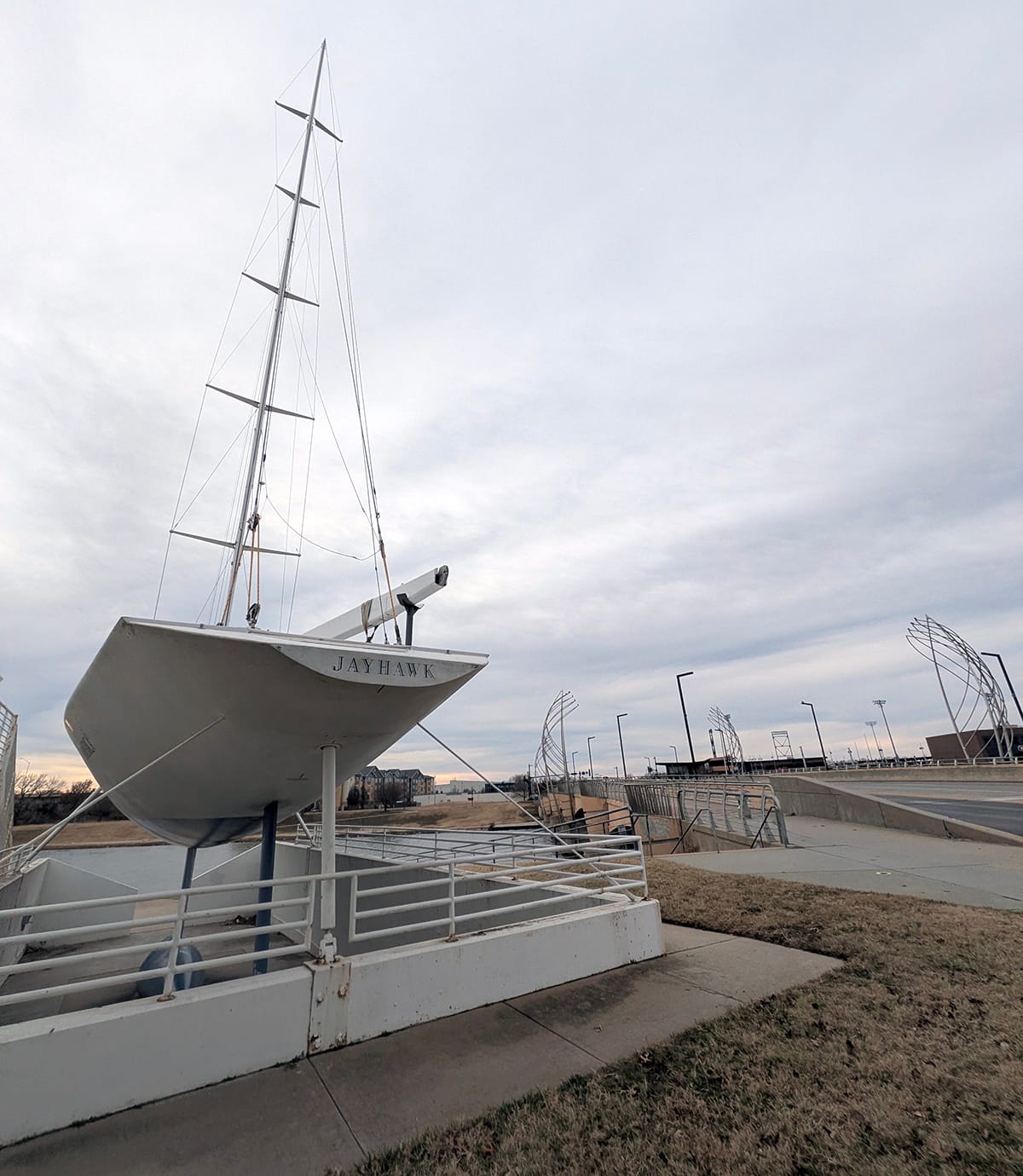
“We were looking at nautical and aeronautical themes,” said Scuri in a March 2000 Wichita Eagle article about her design process. “In particular, The Jayhawk (Bill Koch’s America’s Cup qualifying boat), which is seated right next to the Lewis Street bridge, was one of the impetuses of the curved linear shapes, as would be the airfoil shapes and the wind patterns that you would get on aircraft.”
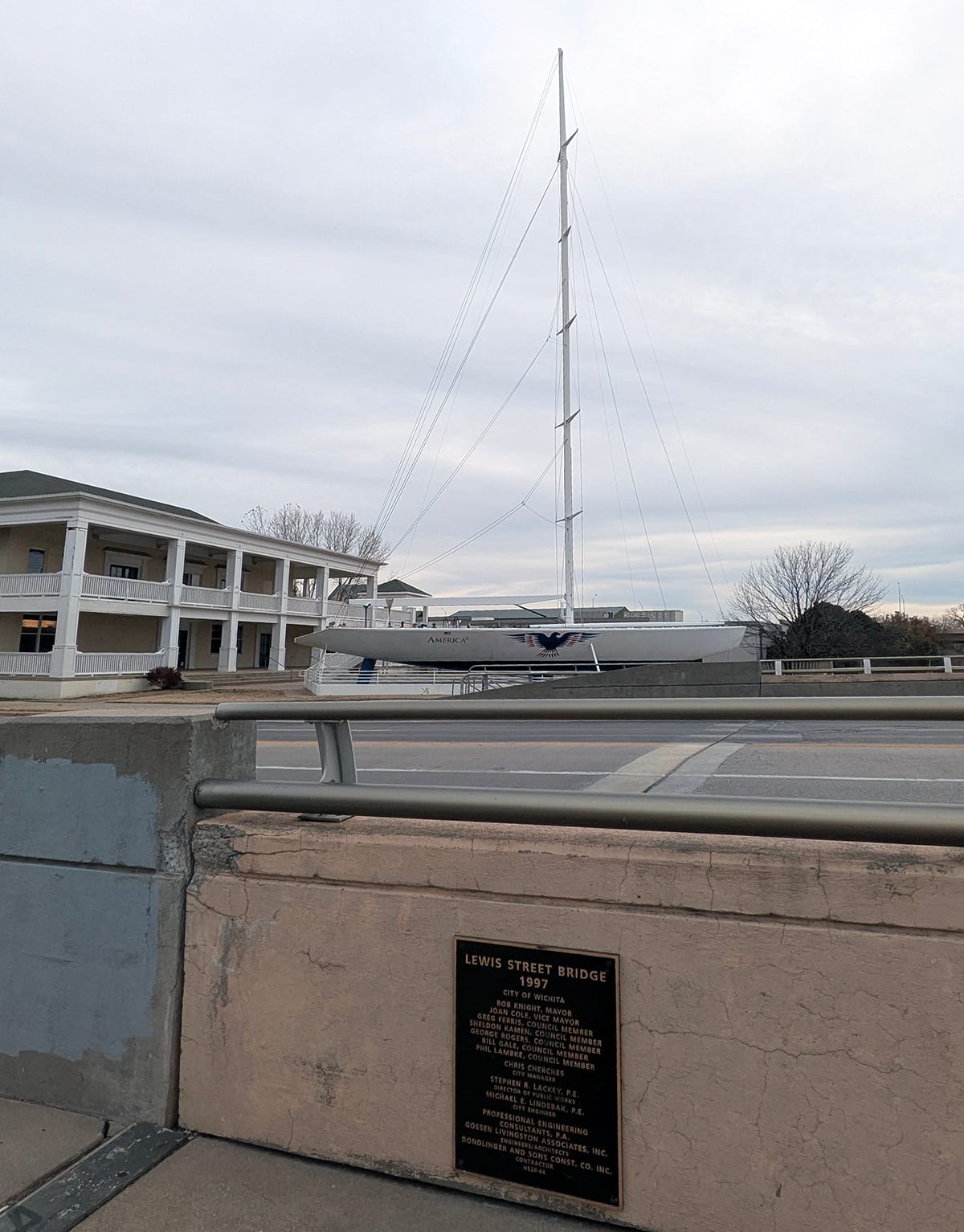
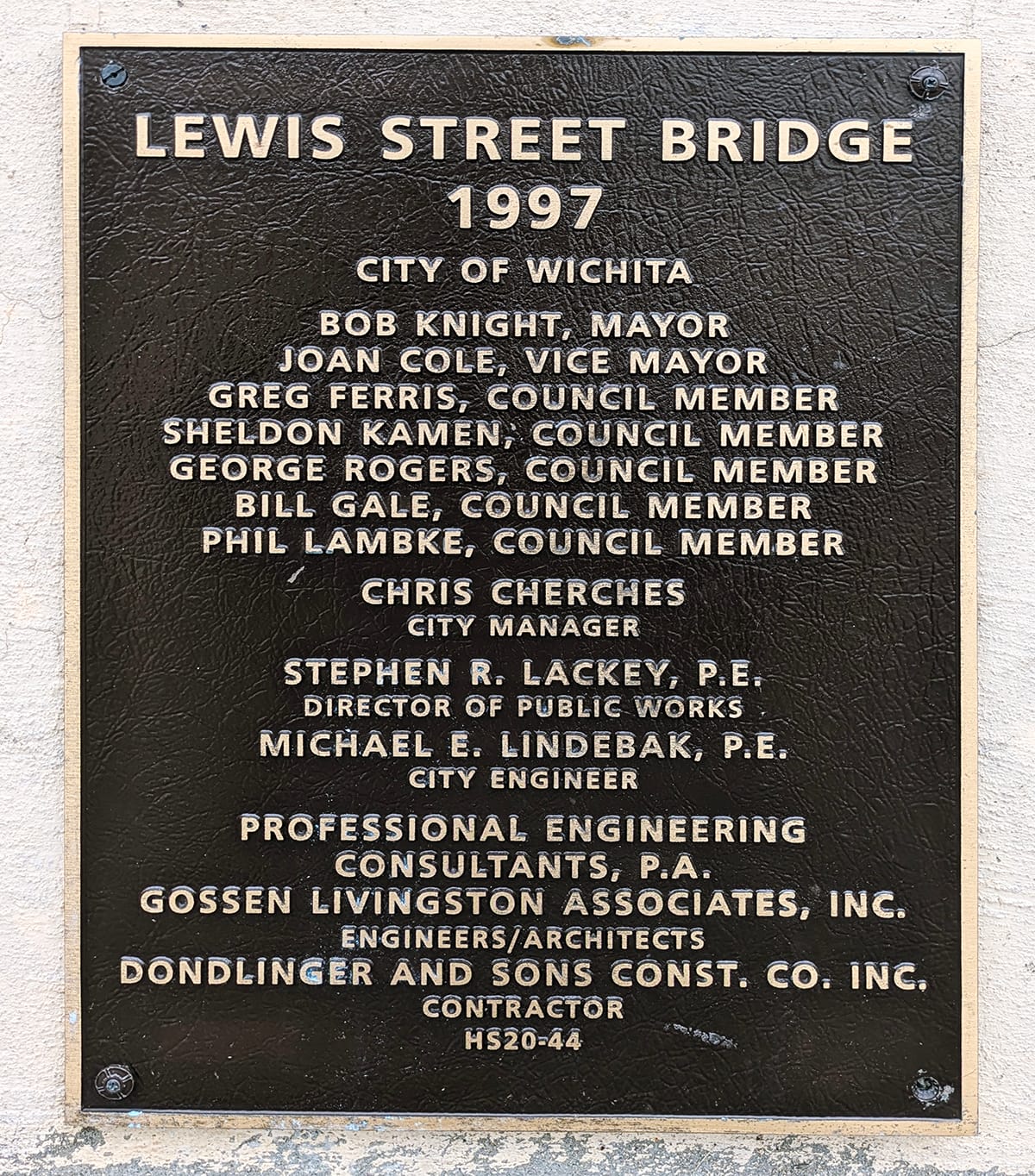
From the Waterman Street (formerly Lewis Street) Bridge plaque, passerby can also view The Jayhawk. Photos by Jessy Clonts Day for The SHOUT.
“Wichita is a very windy city. It has a very close connection with the aircraft industry; it has a very close connection with the river. And certainly The Jayhawk is a point of community pride. So we hoped to bring all of this together in something that didn’t speak to any one so directly that it overpowered the rest, but made you think of all of them.” (Chris Schull, “Go See It!,” Wichita Eagle, March 19, 2000, 1D)
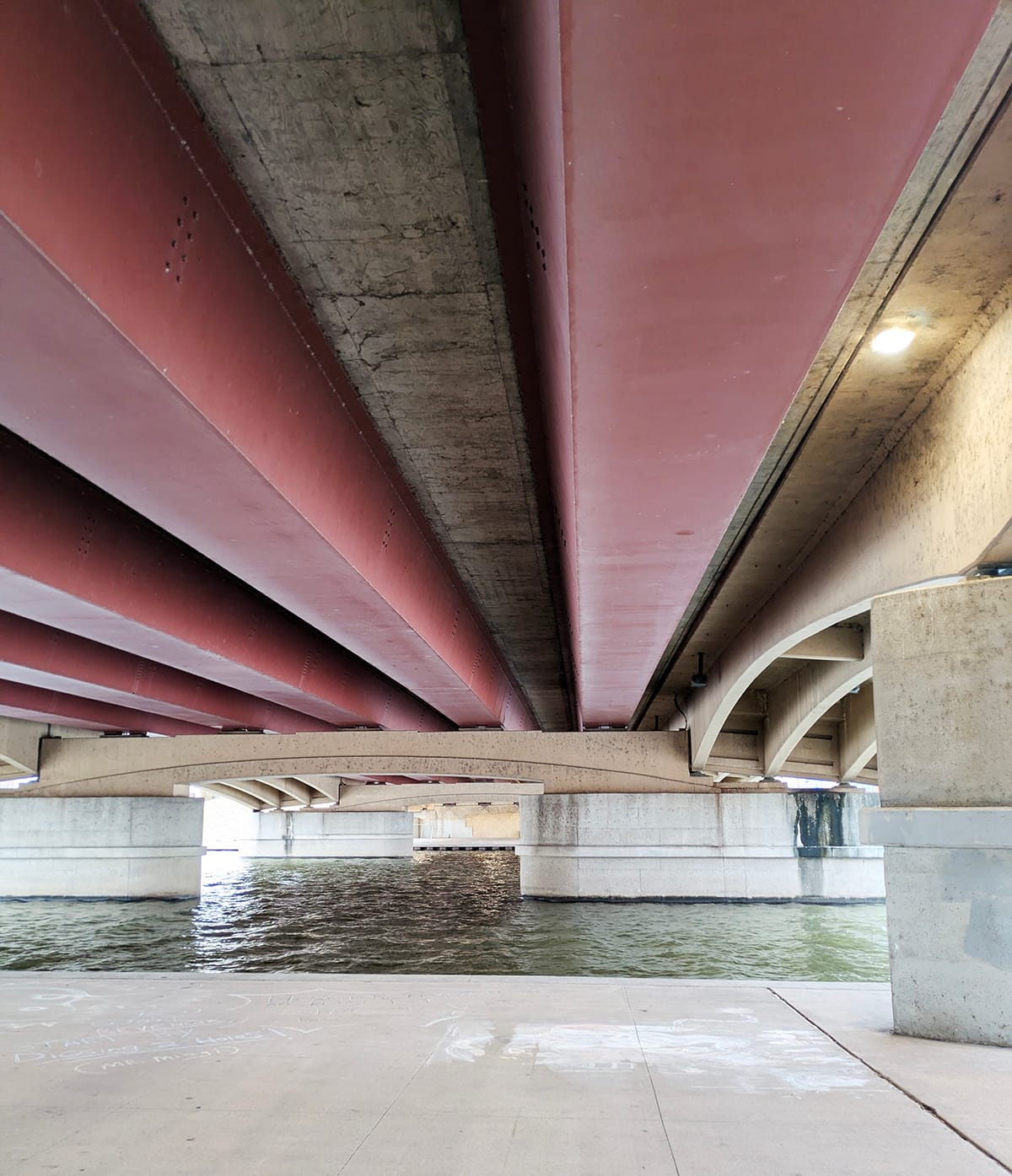
Although the two bridges were reportedly in fair condition when they were replaced, they were nearly 100 years old and the City of Wichita was eager to put a modern mark on its community identity. With a budget of $5.23 million per bridge from the city’s 1995-2004 Capital Improvement Program, the plan was for the Waterman Street (formerly Lewis Street) bridge to be rebuilt in 1996 and the Douglas Avenue bridge to be rebuilt in 1997. They were completed in 1997 and 1999 respectively. Because the artwork was integrated into the overall design of the bridges, there was no separate budget for “public art” connected to the project, according to an April 1995 Wichita Eagle article.
The design by Vicki Scuri Siteworks in Seattle, Wichita’s Professional Engineering Consultants, and the Gossen Livingston Associates architectural firm was chosen by a five-member jury out of 28 teams and six finalists in March 1995, then unanimously approved by the Wichita Public Art Advisory Board.
Although the original design included neon towers, a supposed nod to Wichita’s 1920’s reputation as the “Neon Capital of the World,” they were eventually edged out of the final design due to ongoing maintenance concerns. The tire tread patterning and chevron shapes that border the pedestrian walkway were originally intended to be accented in red, to incorporate the original Osage name for the river: Red Water.
Scuri made an extensive site review and visited Wichita many times over the development of the towers, which took several years. With a long resume designing public projects, including parking garages, pedestrian bridges, and playgrounds, Scuri was already recognized for her work in six states at the time. In 2001, the Americans for the Arts Public Art Network gave “Feather Towers” national recognition as a “Best in Public Art Projects” in their annual Year in Review.
Scuri went on to design a series of highway interchanges and roadway improvements along Wichita’s East Kellogg expansion project as well as three wind screens along the northeast side of the Wichita Art Museum sculpture garden.

“My Public Art projects promote civic identity, placemaking, human scale, social engagement, beauty and pride of ownership for communities across the U.S.,” Scuri wrote in a recent email. “Including Public Art in the civic realm is a win-win situation, as it expands the dialogue and it creates a more interdisciplinary and humane response to the design of public space.”
Since those early public artworks were battled over and built in the early 1990s, the City of Wichita has nearly doubled its public art collection, from limestone signage around the Museums on the River to the realistic bronze sculptures throughout downtown and the famed and beloved “River Troll” by Connie Ernatt. In the years since the COVID pandemic, new public works in the city have notably highlighted themes of community identity, calling attention to its Indigenous, African-American and Latino cultural history. But it’s prudent to remember that it took the hard-line support of a mayoral administration to advocate for investing in beautifying the city without a promise of monetary return.
“Public art represents, to me, a community that is intact, is vibrant and is whole,” Mayor Knight said in a July 1995 Wichita Eagle interview. “And it’s an investment by our community in trying to expand the personal horizons of our citizens and, in my view particularly, the young. So I think it has value.” (Rhonda Holman, “Public art does a city good, mayor says,” Wichita Eagle, July 2, 1995, 2D)
With the digitization of the city’s listed 285 public works and the newly created position of Public Art Manager, currently held by Jana Erwin, it is clear that Wichita remains dedicated to building its image as a proudly diverse city of the Plains, anchored by its tributary river to the Mississippi, a river of the true Wild West, and its history as the Air Capital of the World. As a quiet and enduring landmark, the design of “Feather Towers” may well represent the movement into this contemporary era.
This piece is part of a series about works in the City of Wichita's public art collection. Many works in the collection can be viewed online, and you can find our work on public art here.
The Details
Feather Towers
Stainless steel, concrete, and lighting device components
Located at 400 W. Waterman St. and 400 W. Douglas Ave. in downtown Wichita.
"Feather Towers" is part of the City of Wichita Public Art Collection
Learn more on the Public Art Archive pages for the Feather Towers at the Douglas Street Bridge and for the Waterman Street Bridge.
Jessy Clonts Day is a writer, roller skater, mother, and fourth generation Kansan. After living ten years in the American South and Southwest, she and her spouse returned to Kansas to raise their family, where the sunsets are otherworldly and the arts community is alive and well.
❋ Derby man has the kind of voice that turns heads — and chairs
❋ Socializing while sober: how some Wichitans are cultivating alcohol-free communities
❋ As a small creative business closes, the owner mourns
❋ Painting through it: Autumn Noire on 20 years of making art
❋ How a guy from Wichita resurrected 'Dawn of the Dead'
❋ Bygone Friends University museum housed curious collections
Support Kansas arts writing
The SHOUT is a Wichita-based independent newsroom focused on artists living and working in Kansas. We're partly supported by the generosity of our readers, and every dollar we receive goes directly into the pocket of a contributing writer, editor, or photographer. Click here to support our work with a tax-deductible donation.