Push and pull: Marco Hernandez at Bethel College
In 'Reclaiming My Roots,' the Wichita-based printmaker asserts his Mexican identity. The exhibition is on view in Bethel's Regier Art Gallery through February 12.
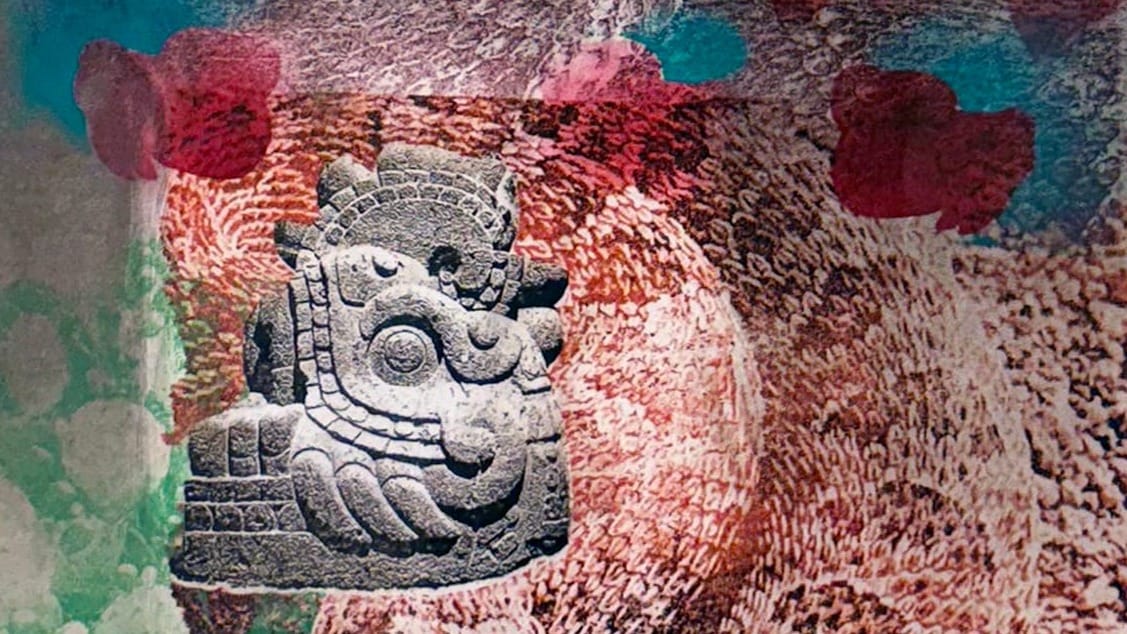
The serpent. The eagle. The cactus.
Land and air. Protection and discovery. Doubts and nightmares.
“Reclaiming My Roots,” a printmaking exhibition by Marco Hernandez, explores the push and pull of the artist’s dual Mexican and American cultural backgrounds: the exchange between tradition, spirituality, and resources. The show is on view in the Regier Art Gallery at Bethel College in North Newton, Kansas through February 12.
The first work viewers encounter in the show, an etching titled “Mis Dudas y Pesadillas” (“My Doubts and Nightmares”), features a portrait of the artist in a chair surrounded by the foreboding yet protective images of a snake and an eagle —symbols of both Mexico and the U.S. The horns of a devil and the halo of an angel hover over the artist’s head, as the image’s white background shifts to a murky, dark foreground — the space on which Hernandez's chair sits. And while doubts and nightmares are in the title of the piece, there’s a level of relaxation too. The central figure — Hernandez — looks resolved, not worried.
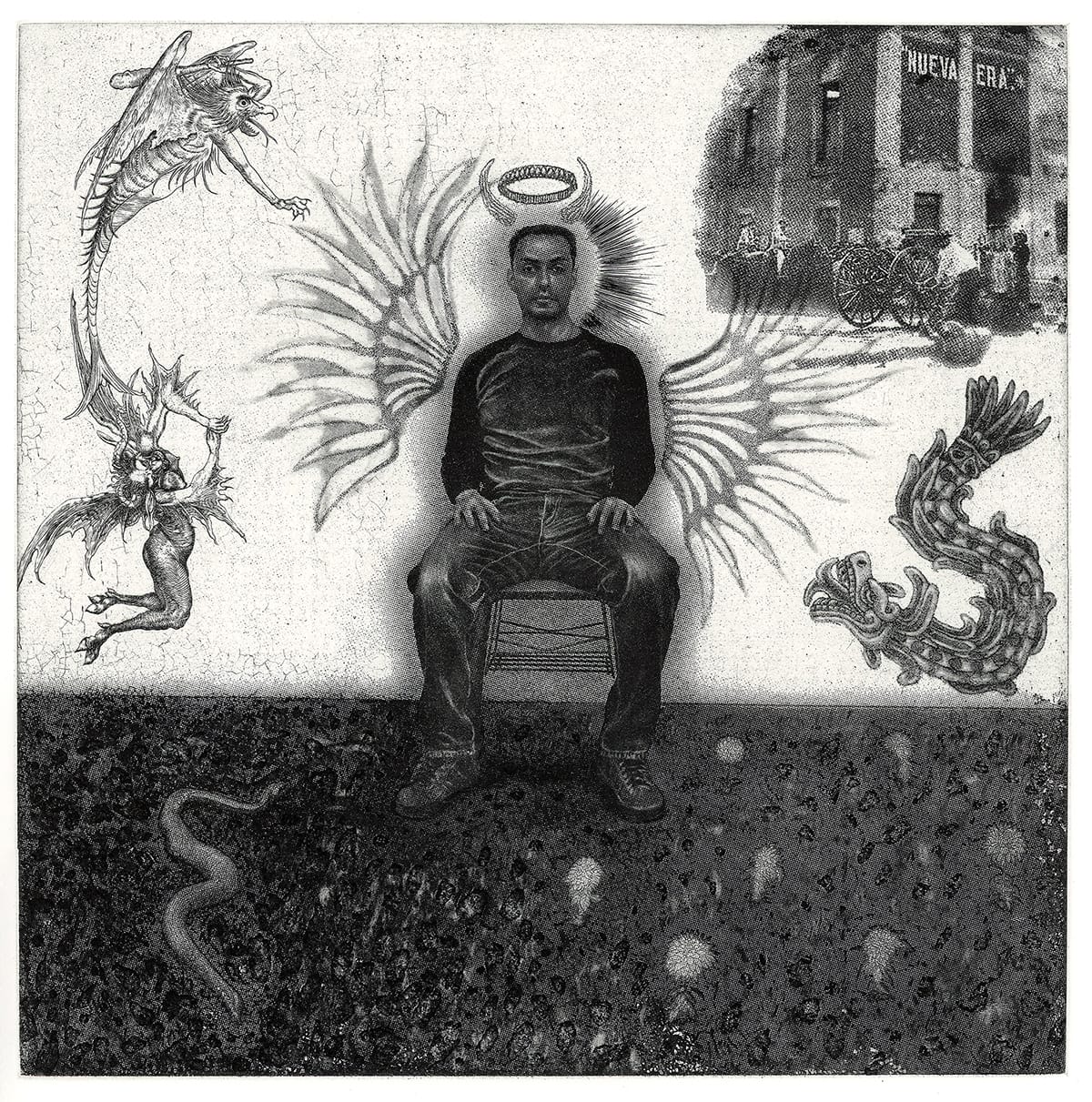
Opposites appear throughout the exhibition, as do images of the snake and eagle.
Five of Hernandez's works — created using monotype and paper lithography techniques — feature distinctive iconography, realistic representations, and snippets of architecture mixed together around a central focal point or image. Each has a play of colors — reds, greens, and golds — that the artist layers with shifting spaces of opacity. In “La Serpiente Guardiana” (“The Guardian Serpent”), a snake sits in the middle of the composition. Organic shapes in gradient hues revolve around this serpent icon of the Aztecs. Below this is the carved doorway of architectural ruins. The angularity of the carvings contrast sharply with the serpentine shapes above.
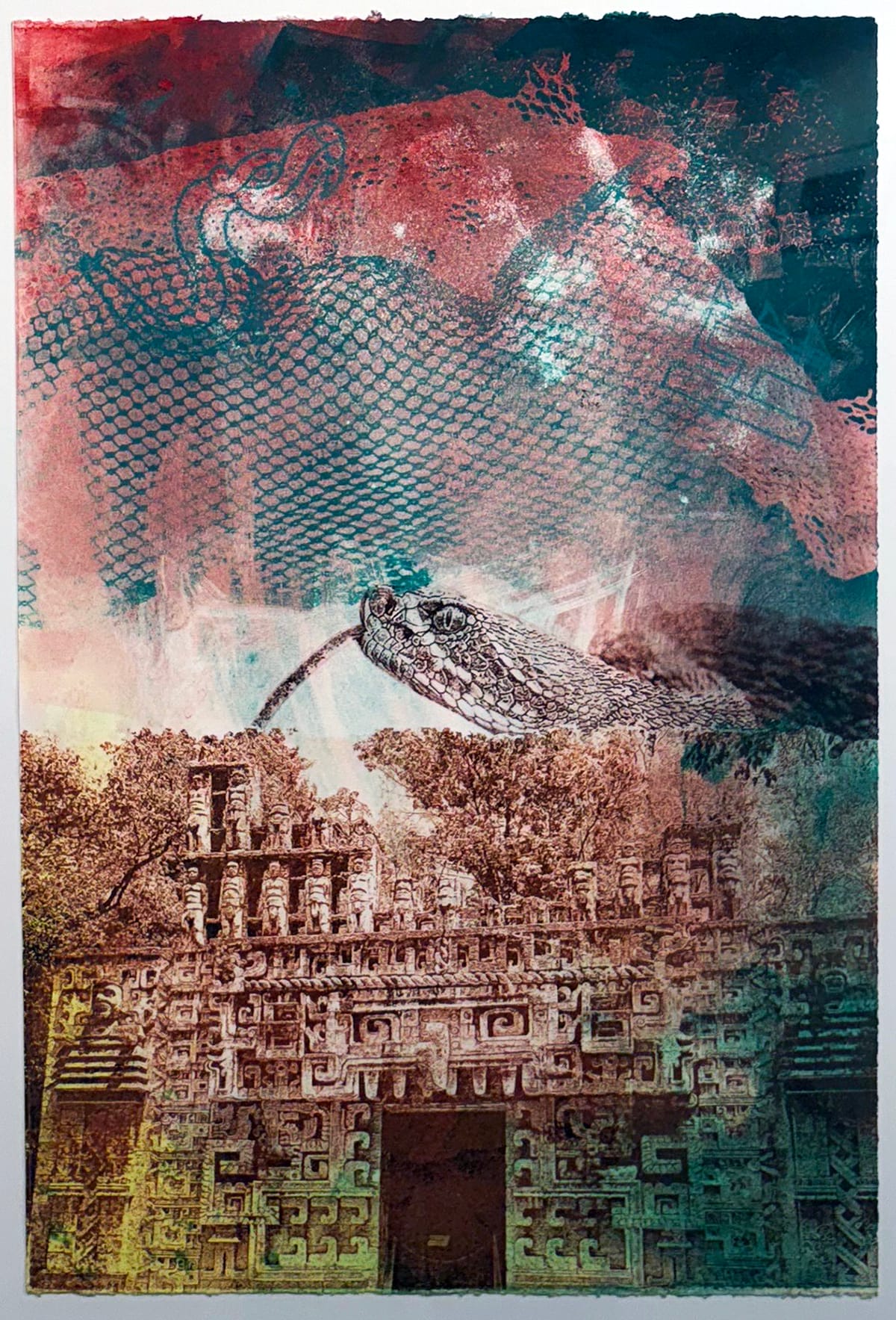
Hernandez repeats this treatment of icon, reality, and architecture throughout the five monotype and paper lithographs, yet each work’s focus differs: In one, we see a set of ruins; in another, an agave plant; in the third, we encounter an eagle soaring across the four winds; and in the last, a cactus. In each piece, it’s clear that Hernandez is reclaiming his roots in both concrete and spiritual ways.
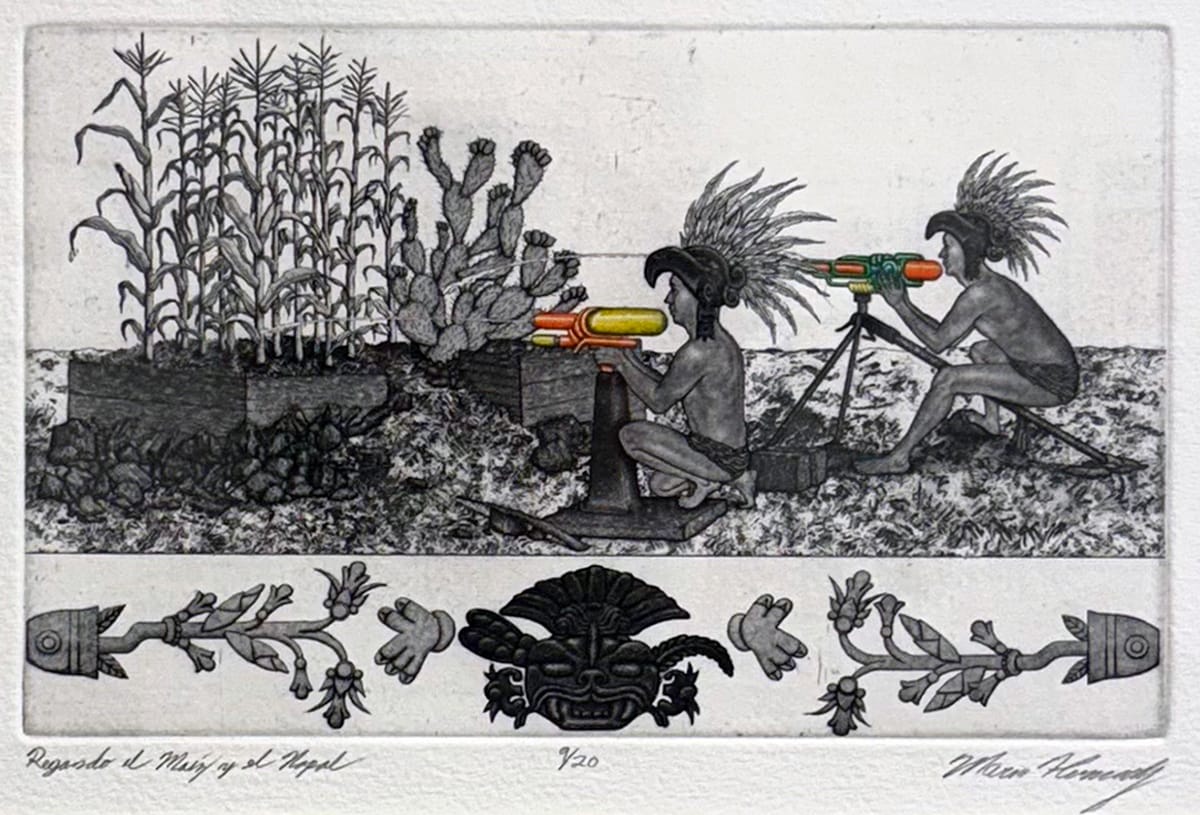
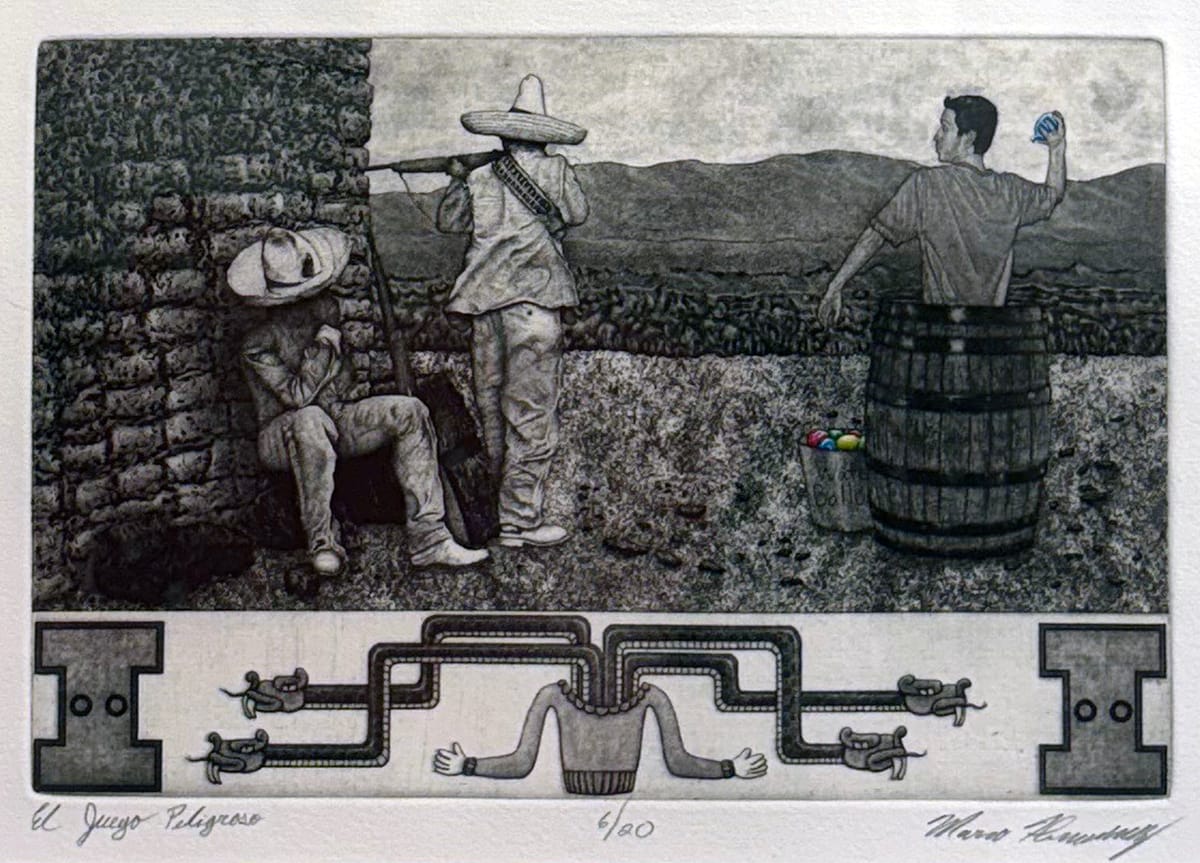
The vibrant interplay of color in his monotype and paper lithographs contrasts sharply with the more muted color palette of his etchings. There are sprays and small pops of color in “El Juego Peligroso” (“The Dangerous Game”) and “Regando el Maiz y el Nopal” (“Watering the Corn and the Cactus”), both etchings with watercolor accents. The weight of his etching style — the dark, saturated hue of black ink — matches the works’ contemplative tone. But that contemplation is tempered by the playfulness of watercolor Super Soakers wielded by Aztec warriors to water crops or a young boy readying to lob a water balloon.
In another etching, “Le Ejecucion del Nopal” (“The Cactus’s Execution”), the skeletal figure of a conquistador directs a firing squad. The target is a cactus backed against a wall. There’s an absurdity to this work, though no comedy. A traced map of Mexico floats against the wall, and underneath the tableau are the icons of the snake and the eagle.
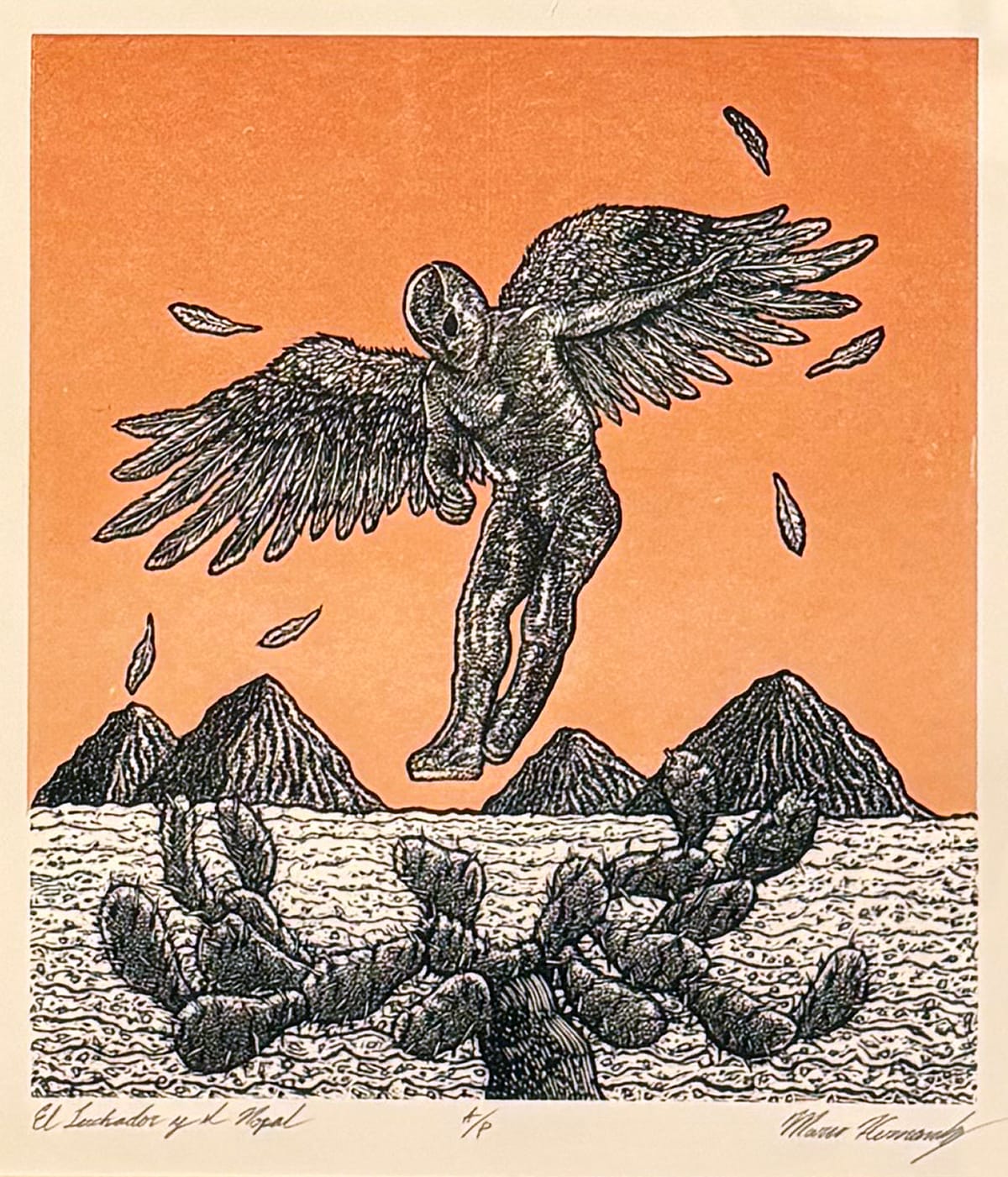
In addition to the snake and eagle, Hernandez repeats images of cacti in these etching. In one, a masked luchador attacks a cactus. In another, a cactus faces a stone-throwing group of genderless bodies. In “El Luchador y el Nopal” (“The Wrestler and the Cactus”), the wrestler evokes an Icarus figure, though whether he’s falling or flying is unclear. And whether the cactus is open to embrace the wrestler or obliterate him is up to the viewer to unravel.
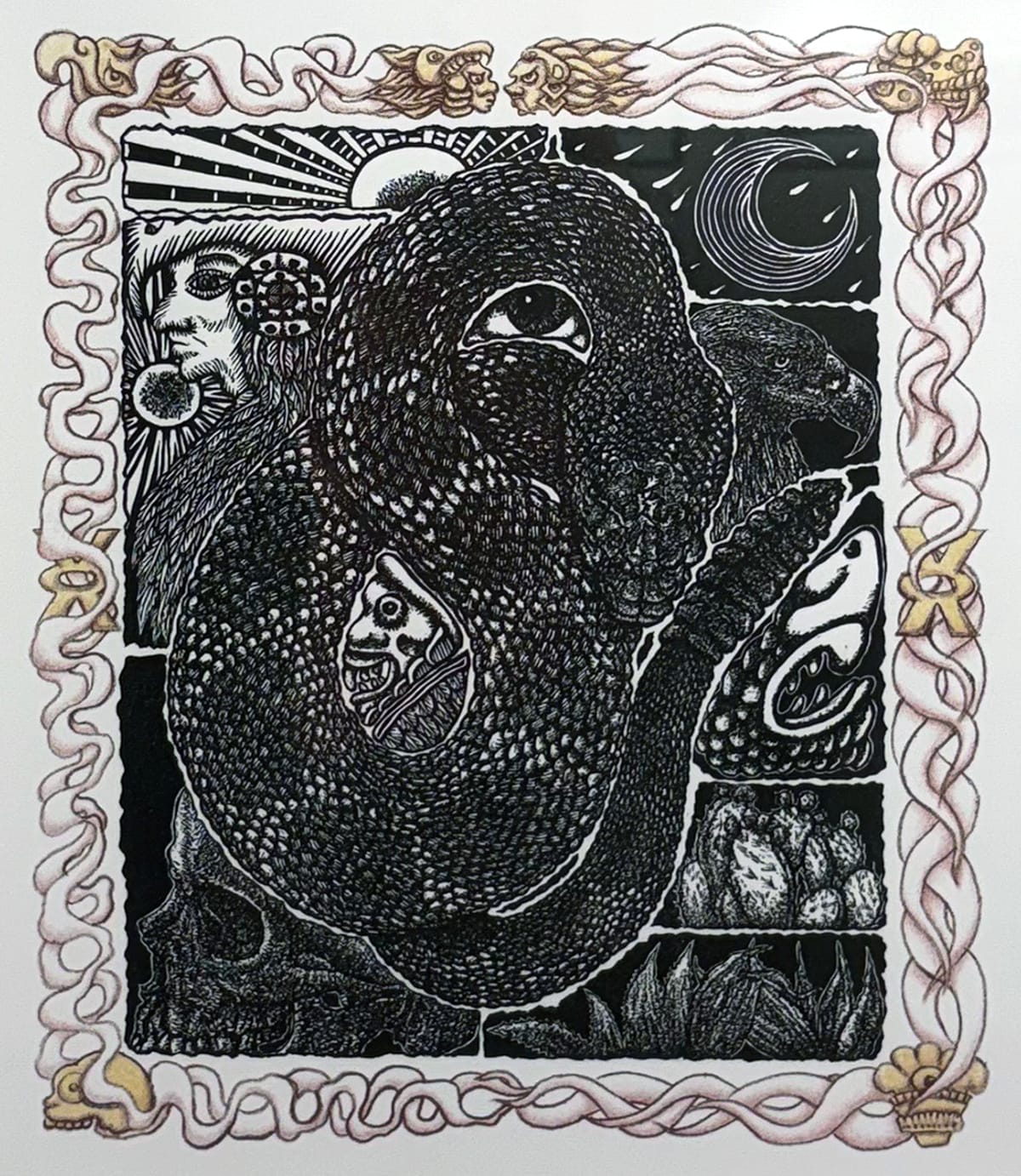
“Mi Cultura” (“My Cuture”), a relief and silkscreen work, features a rattlesnake coiled around figures of light and dark, male and female, and land and air. The composition lacks negative space.. The only relief is the edge of the frame, where we see woven, smoke-like wisps interlocked with bird and fanged skulls. At the top of the frame, two faces oppose one another.
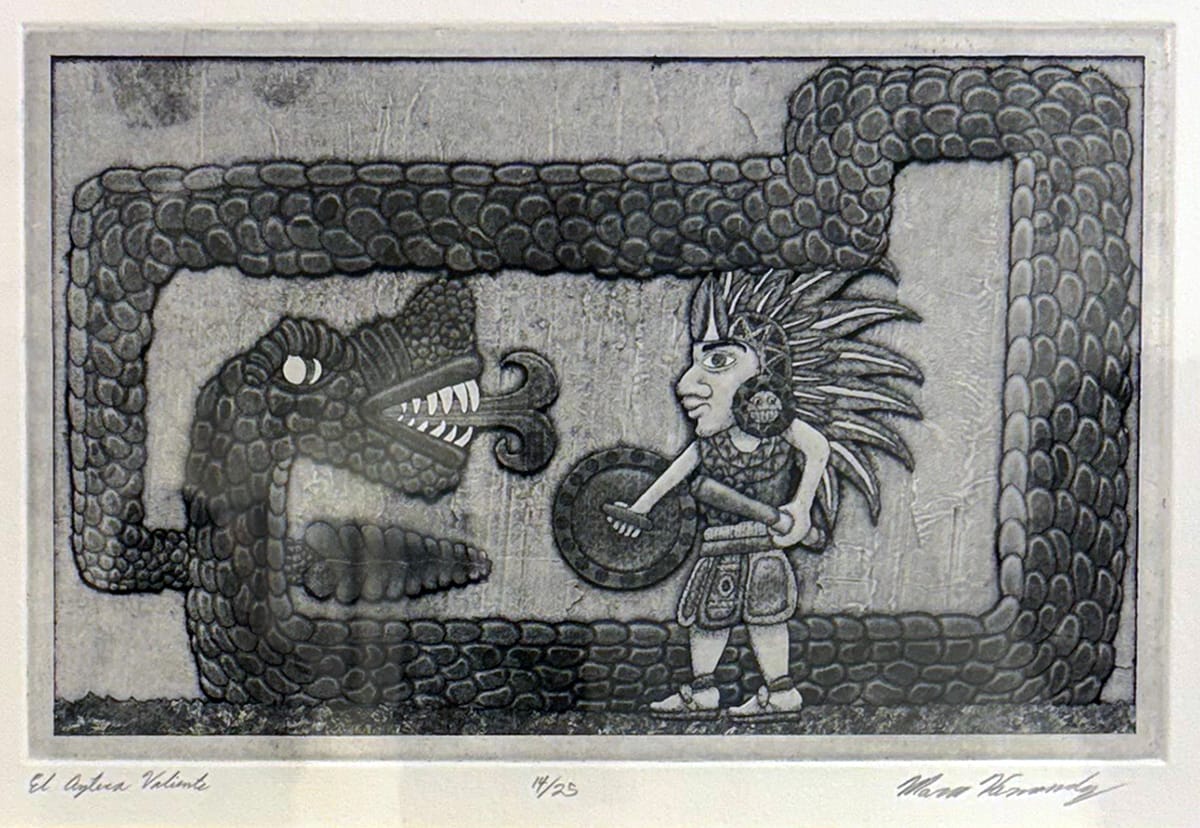
The wisps float around the edges of another etching, “Atrapado pero Valiente” (“Trapped but Brave”), and a serpent coils again, though in this image it’s entwined around a warrior. The same valiant warrior stands against the serpent in “El Azteca Valiente” (“The Brave Aztec”), though this etching looks much more like the engravings in one of the ruins of Meso-America. The saturation in the etching and the shape of the serpent draw the eye to the warrior with shield and sword in hand.
While the serpent looks foreboding as it faces down a warrior, it serves a protective purpose on the shoulders of a deity in “Antes de la Guerra” (“Before the War”). In this work, Hernandez uses depth of color — playing with light and dark — in depicting two deities who confront one another, a serpent and an eagle on their respective shoulders. Between the two figures, birds dot the horizon, pulling darker hues from the earth into the sky. Light and dark. Earth and sky. Snake and eagle.
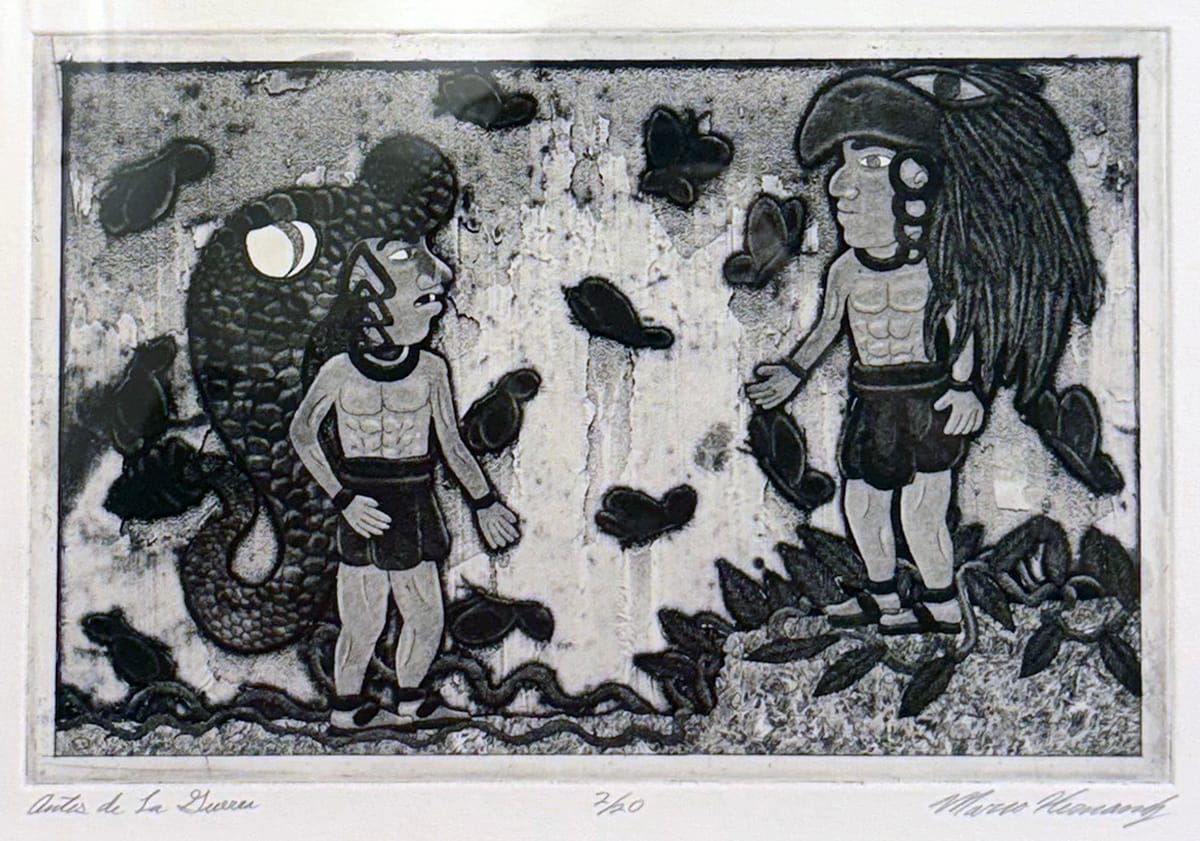
These two figures are both protective and formidable, foundational yet ephemeral. In that push and pull, Hernandez navigates his reclamation of culture.
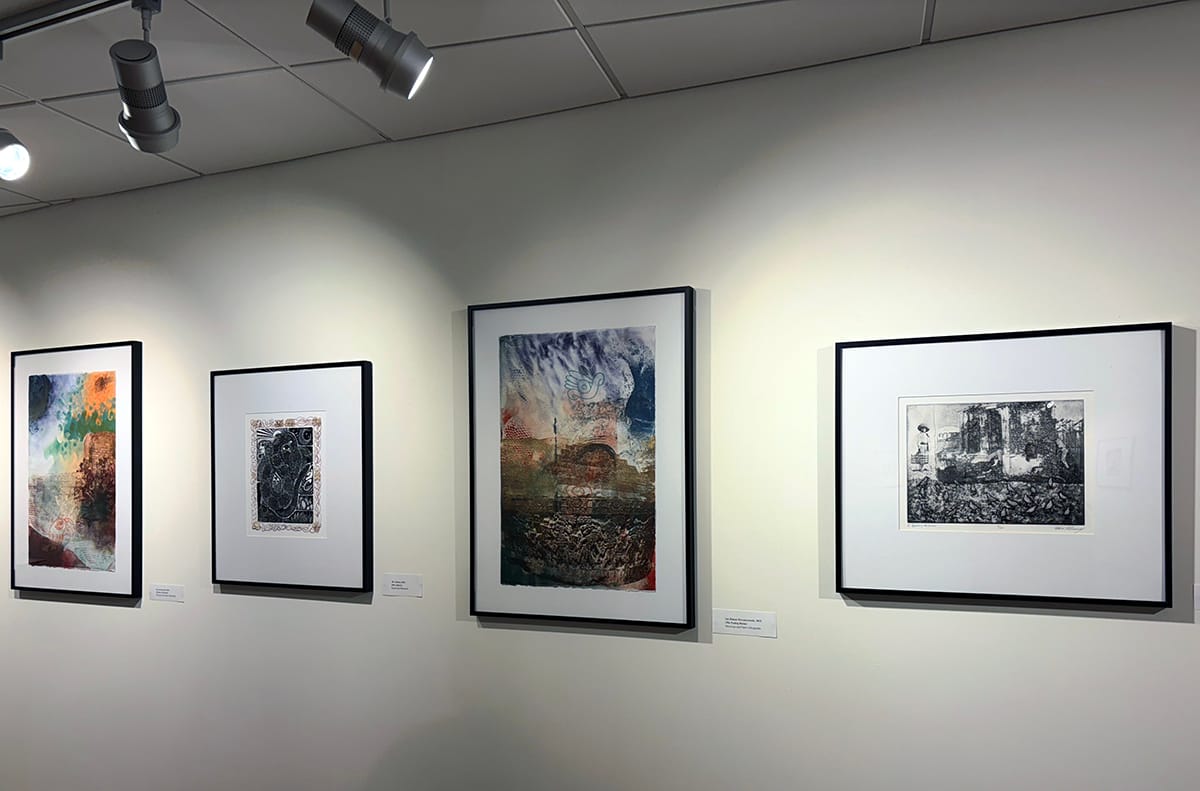
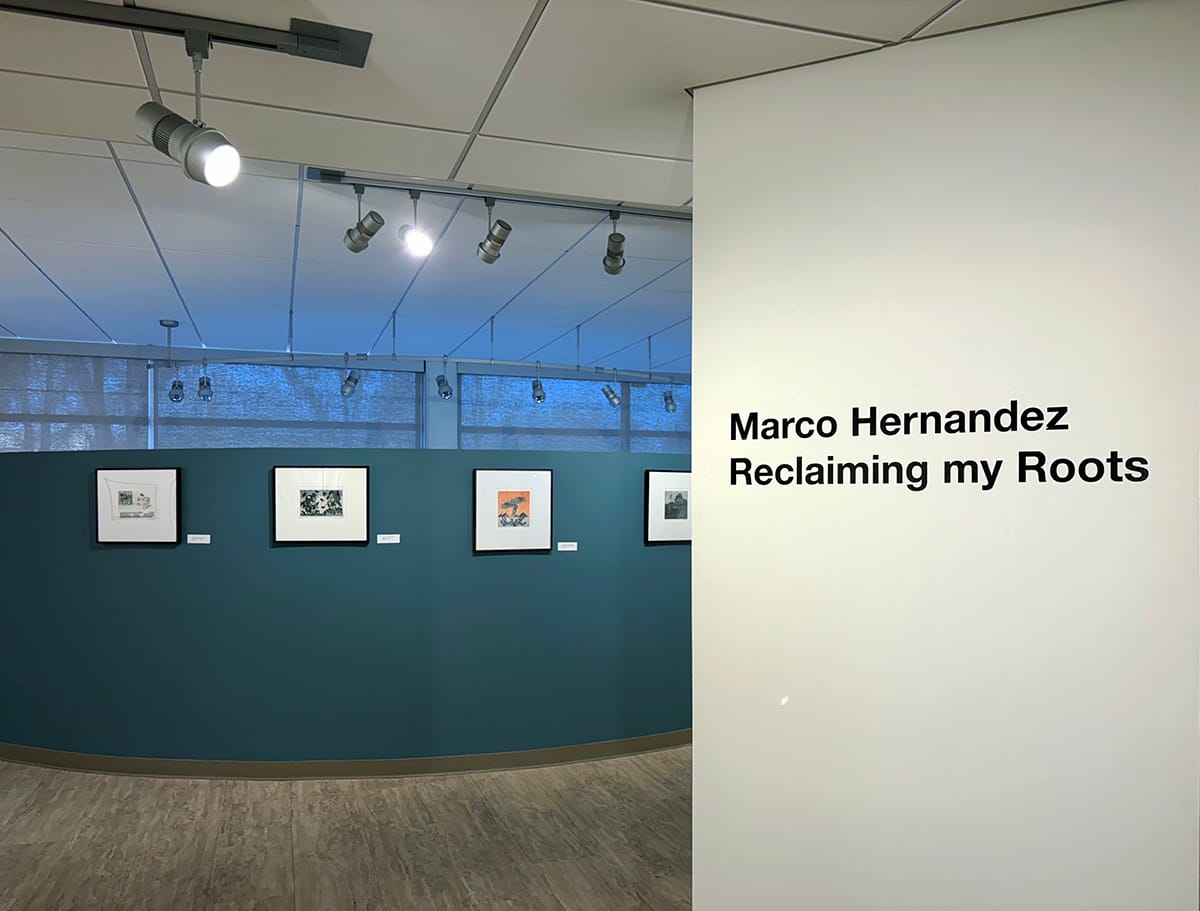
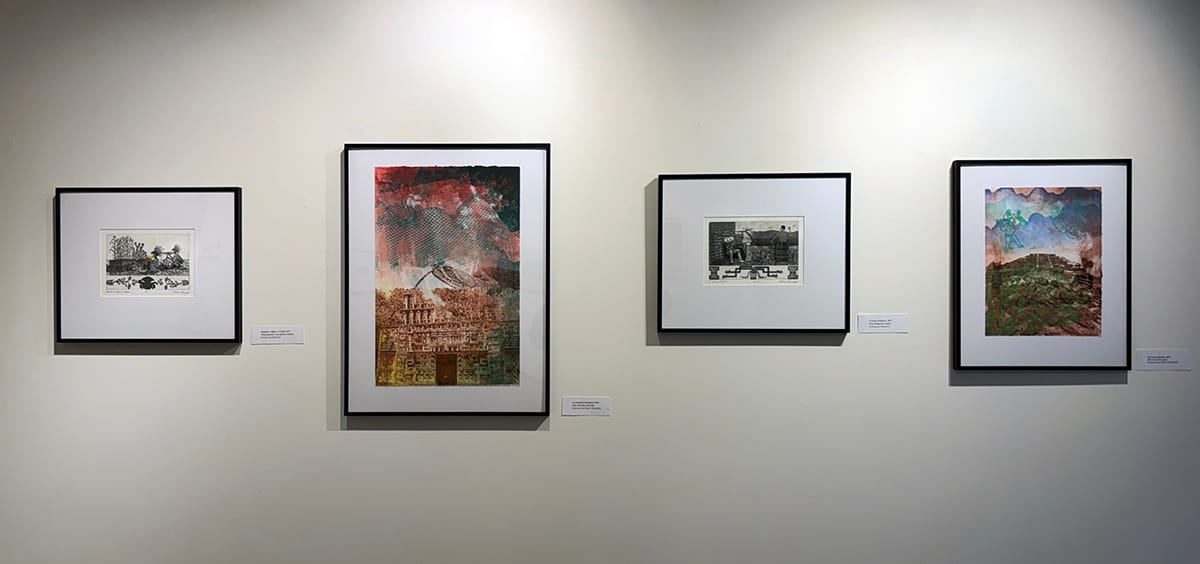
Installation views from "Reclaiming My Roots." Photos by Shelly Walston for The SHOUT.
The Details
Marco Hernandez, “Reclaiming My Roots”
January 20-February 12, 2026 in the Robert W. Regier Art Gallery, Luyken Fine Arts Center on the Bethel College campus, 300 E. 27th St., North Newton, Kansas
A closing reception will take place from 6-7 p.m. Thursday, February 12. The regular gallery hours are 9 a.m.-5 p.m. Monday through Friday and 2-4 p.m. on Sundays.
Admission is free, and the facility is accessible to people with physical disabilities.
Shelly Walston is an educator, reader, writer, and collector of commemorative state plates. She's been teaching English at the high school level for more than two decades. When not grading essays, working on her novel, walking the dogs, or playing strategy games, you'll find Shelly sprawled on her couch, reading a book. More of her writing and book reviews can be found at shellywalstonwrites.com.
❋ Derby man has the kind of voice that turns heads — and chairs
❋ Socializing while sober: how some Wichitans are cultivating alcohol-free communities
❋ As a small creative business closes, the owner mourns
❋ Painting through it: Autumn Noire on 20 years of making art
❋ How a guy from Wichita resurrected 'Dawn of the Dead'
❋ Bygone Friends University museum housed curious collections
Support Kansas arts writing
The SHOUT is a Wichita-based independent newsroom focused on artists living and working in Kansas. We're partly supported by the generosity of our readers, and every dollar we receive goes directly into the pocket of a contributing writer, editor, or photographer. Click here to support our work with a tax-deductible donation.