Creating connection: Ellen Kleckner at Emporia State University
In “Tracing the Divide," the artist plays with material and form. The exhibition is on view in the Eppink Gallery through February 27.
In her exhibition “Tracing the Divide,” on view in the Eppink Gallery at Emporia State University through February 27, Ellen Kleckner presents objects that come across as props for ironic performances and absurdist play. In fact, all of the sculptures in the show are more than one thing. Kleckner combines and crafts the objects with more than one material, and she often creates them in collaboration with another artist — her plus-one dancing partner.
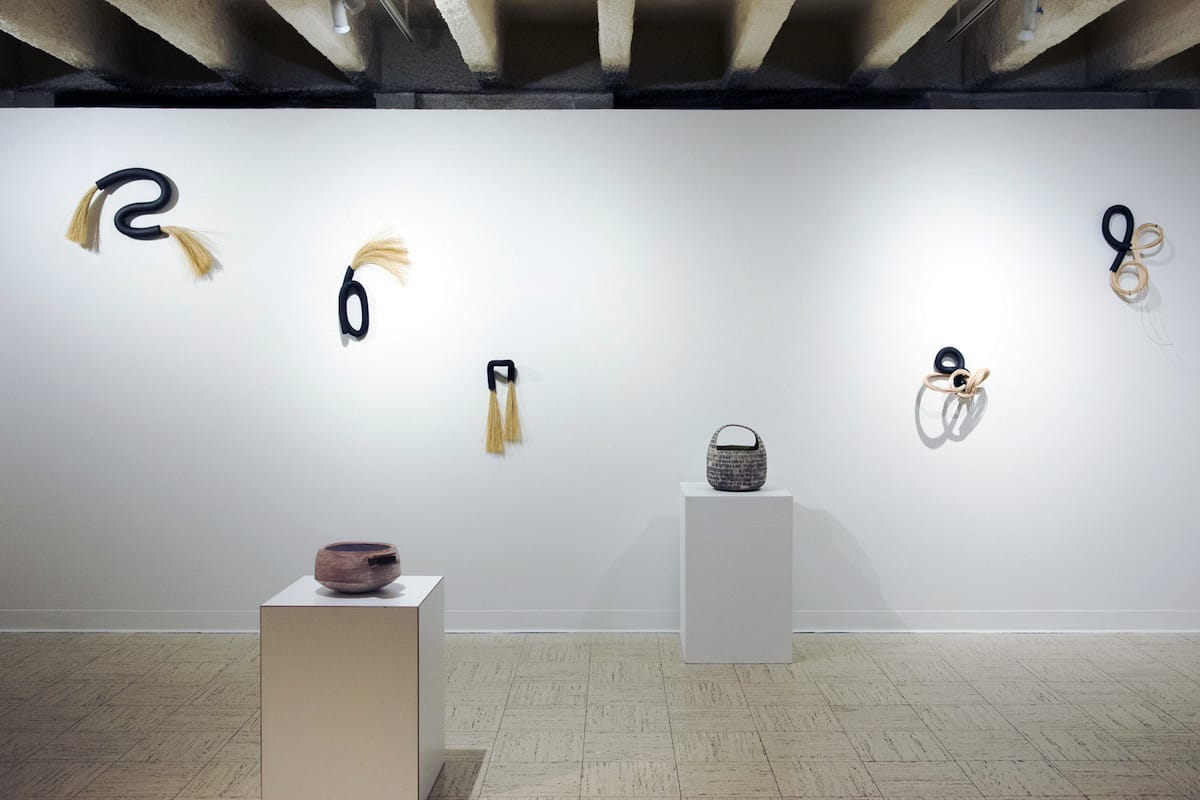
This dance is implied in the exhibition’s installation. With an aversion to symmetry, pieces like the “Lineation” series — curving tubes of ceramic and graphite with Tampico plant fibers emerging from the ends like the ponytails — undulate across the wall. The arrangement mimics the sight line observed in bird flight rather than the grid-based geometry of most gallery spaces.
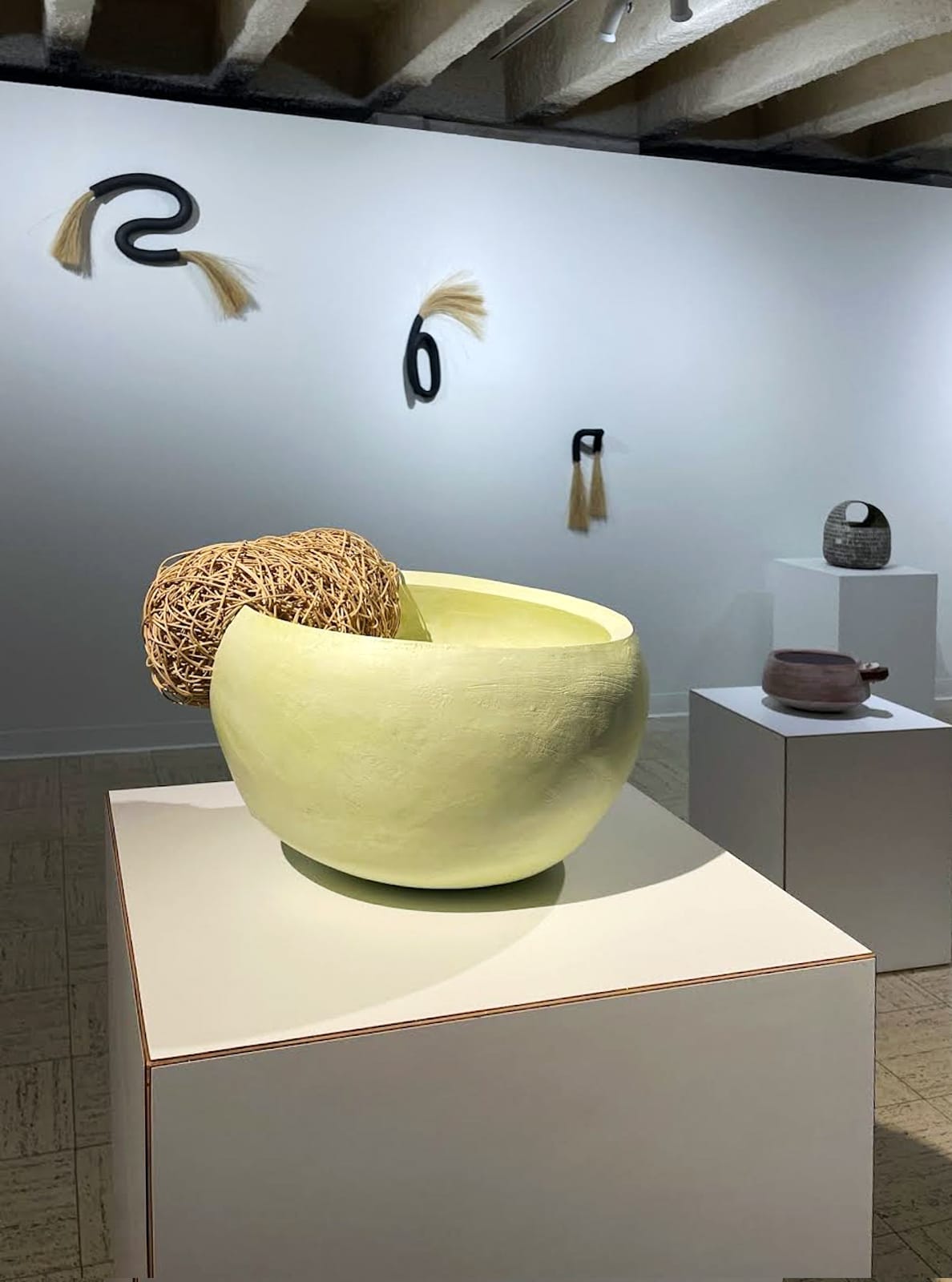
Kleckner places some sculptures on pedestals no higher than two feet tall. “Mazor,” a stoneware bowl, sits on one of the low pedestals, allowing viewers to investigate its ramen-looking reed growth with ease. She mounts other wall works, such as “Green Circle” — a looped reed wreath with a mossy green ceramic grip — lower than three feet from the floor. Across the length of the exhibition space, the point of view switches from a human’s eye level to bird’s eye several times. What is a top view for most adults is eye level for a child or anyone experiencing the art from a chair and, overall, the presentation defies the expectation that a gallery visitor is any one type of person. Human connection is the common denominator of the exhibition experience.
Ellen Kleckner is the current visiting artist at ESU. In her own words, she is “an artist and educator who maintains a research-driven studio practice integrating community engagement, material investigation, and collaborative making. Her work explores the convergence of ceramics with wood, steel, and fiber through joinery systems that emphasize tension, mutual reliance, balance, and the desire for connection.”
For the past few years, Kleckner has been working collaboratively with Linda Tien on a project titled “Im-ple-ment Archive” that investigates hand tools. In these works, nothing plugs in and no batteries are required.
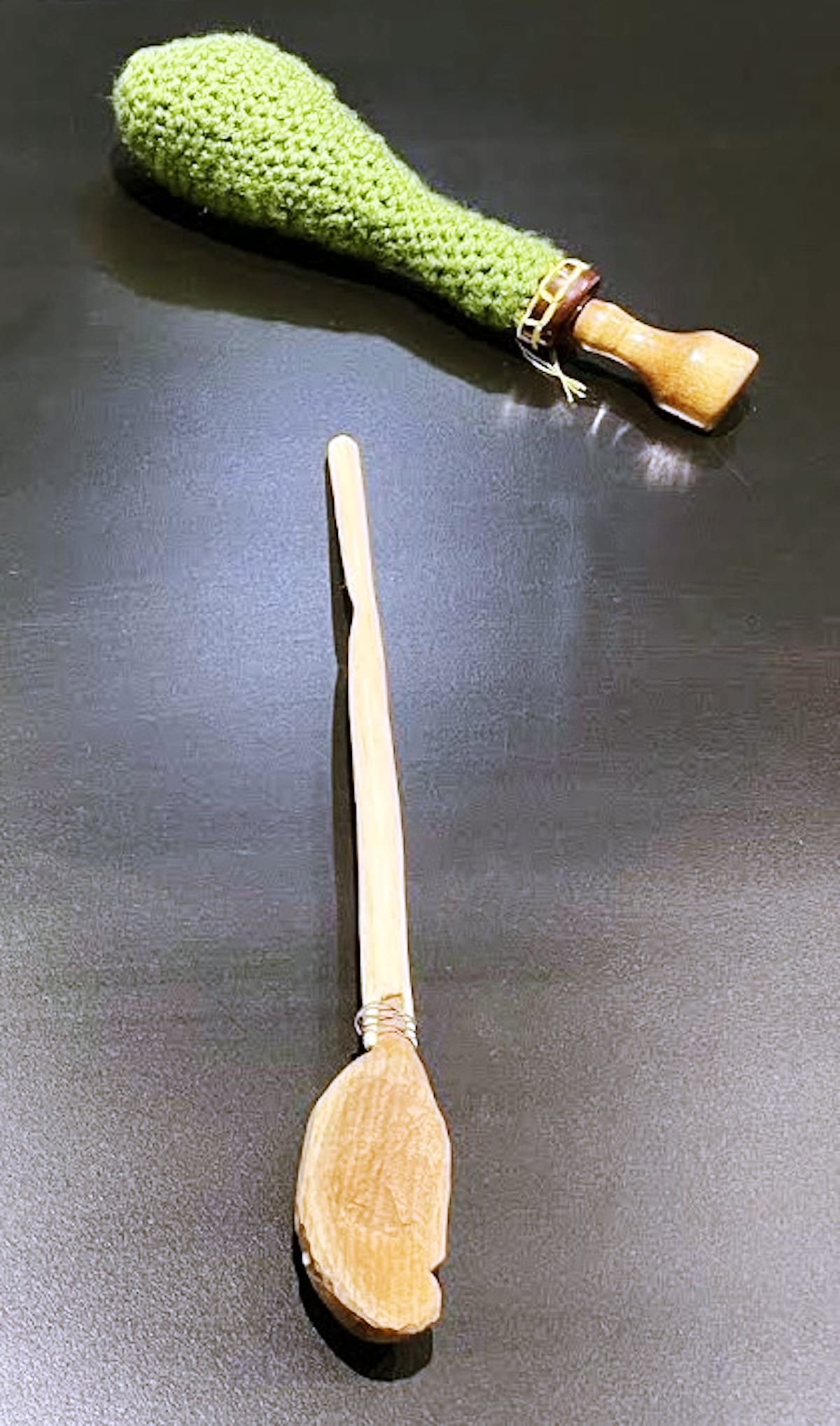
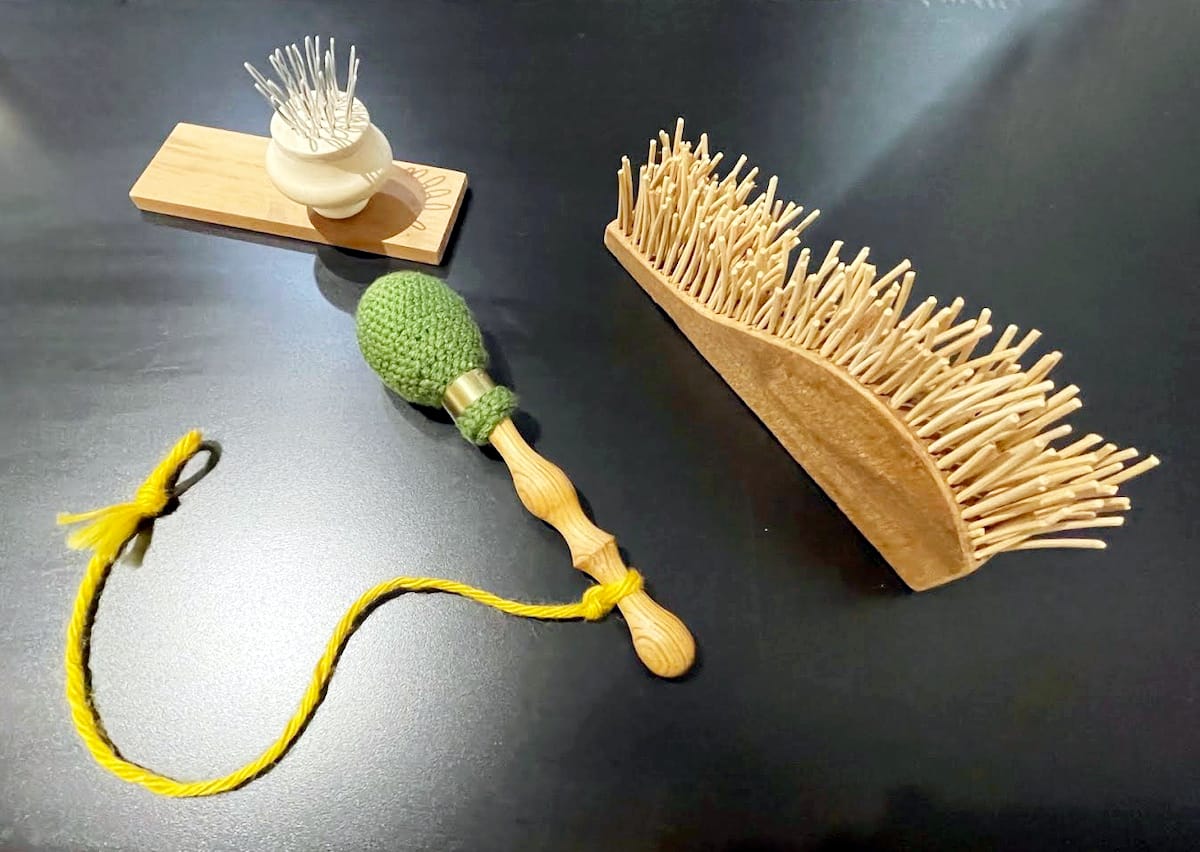
Kleckner studied ceramics at Ohio University, the University of Nebraska Lincoln, and the Appalachian Center for Craft in Smithville, Tennessee. Tien studied metalsmithing and jewelry design at Texas Tech University and Indiana University. The two artists partner by problem-solving design solutions for disparate materials. They use the formal elements of art-making — color, line, movement, shape, space, texture, and value — as ingredients for reinvention. Their collaborative “Objects for Touch” demonstrates this attention to design principles. It includes sculptural versions of dressing-table items such as an undulating brush with spaghetti-like bristles, a ceramic bobby pin holder with lovely porcelain pins, and something that looks like a makeup applicator carved from wood, with a green knitted brush end and yellow yarn tied to the end for hanging.
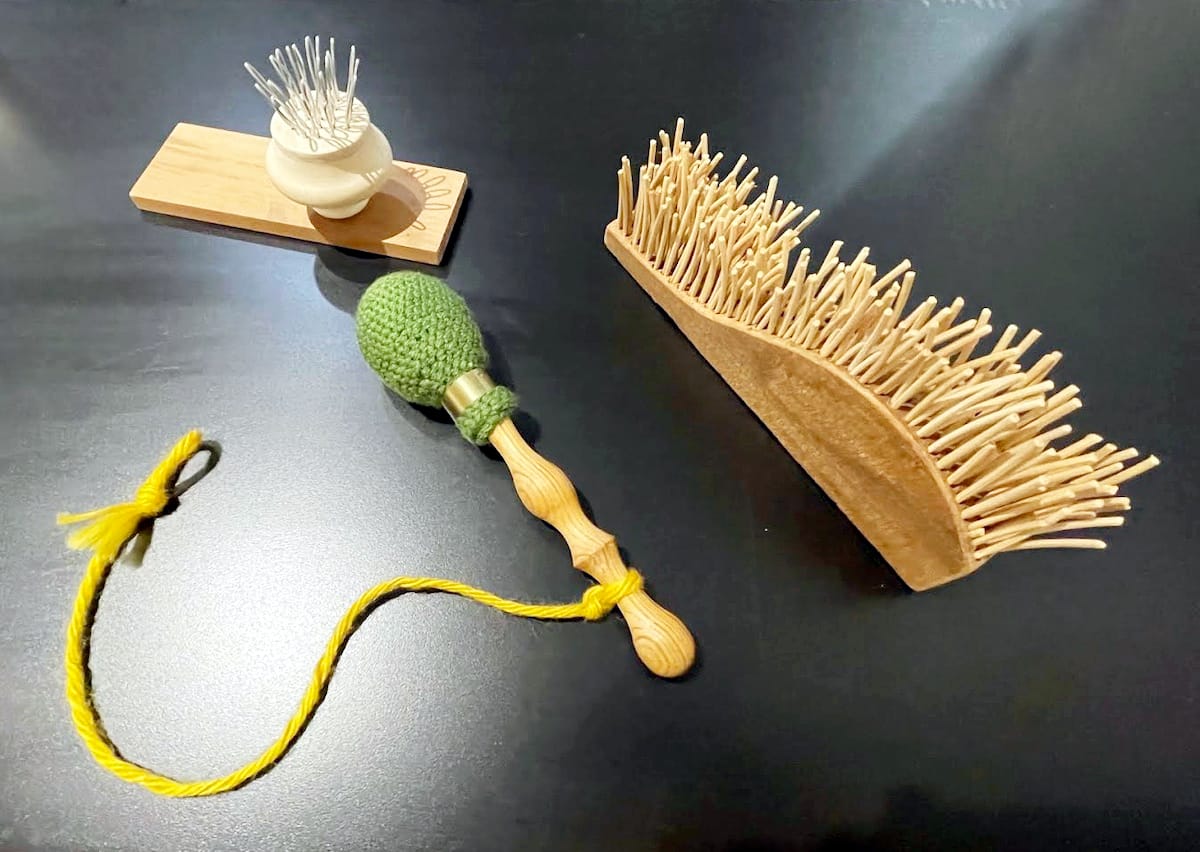
This attention to craft makes their work credible. The backstory behind it might be a narrative about a factory somewhere producing these brushes, sock-darning-pipes, and sexually ambiguous petting tools. Their collaborative pieces are elegant, provocative, and sometimes flat-out funny.
In Kleckner’s work, the goal of connection is completed through touch, when the audience follows the prompts of handwritten signs to “Please handle and replace object thoughtfully.”
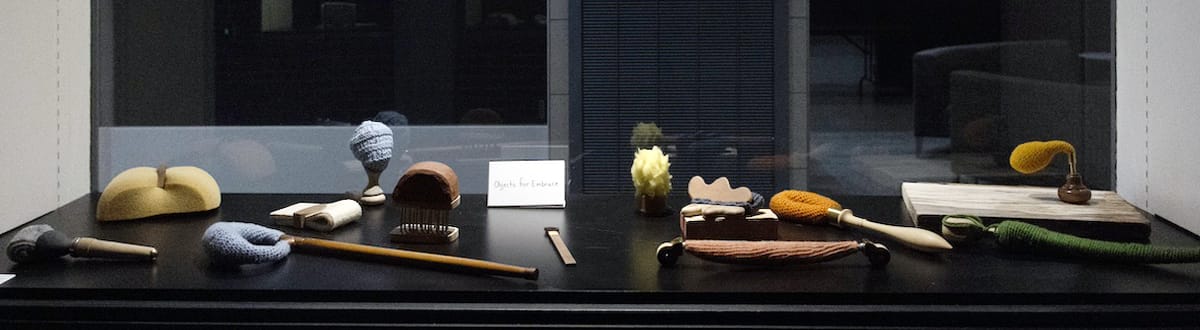
She arranges a total of five collections titled “Im-ple-ment Archive” for visitors to interact with:
“Objects For Embrace,” “Objects For Touch,” “Objects For Tending,” “Objects For Nurture,” and “Objects For Care.” The directions in the titles offer a performance score — an encouragement to play around with the objects and feel them in your hand.
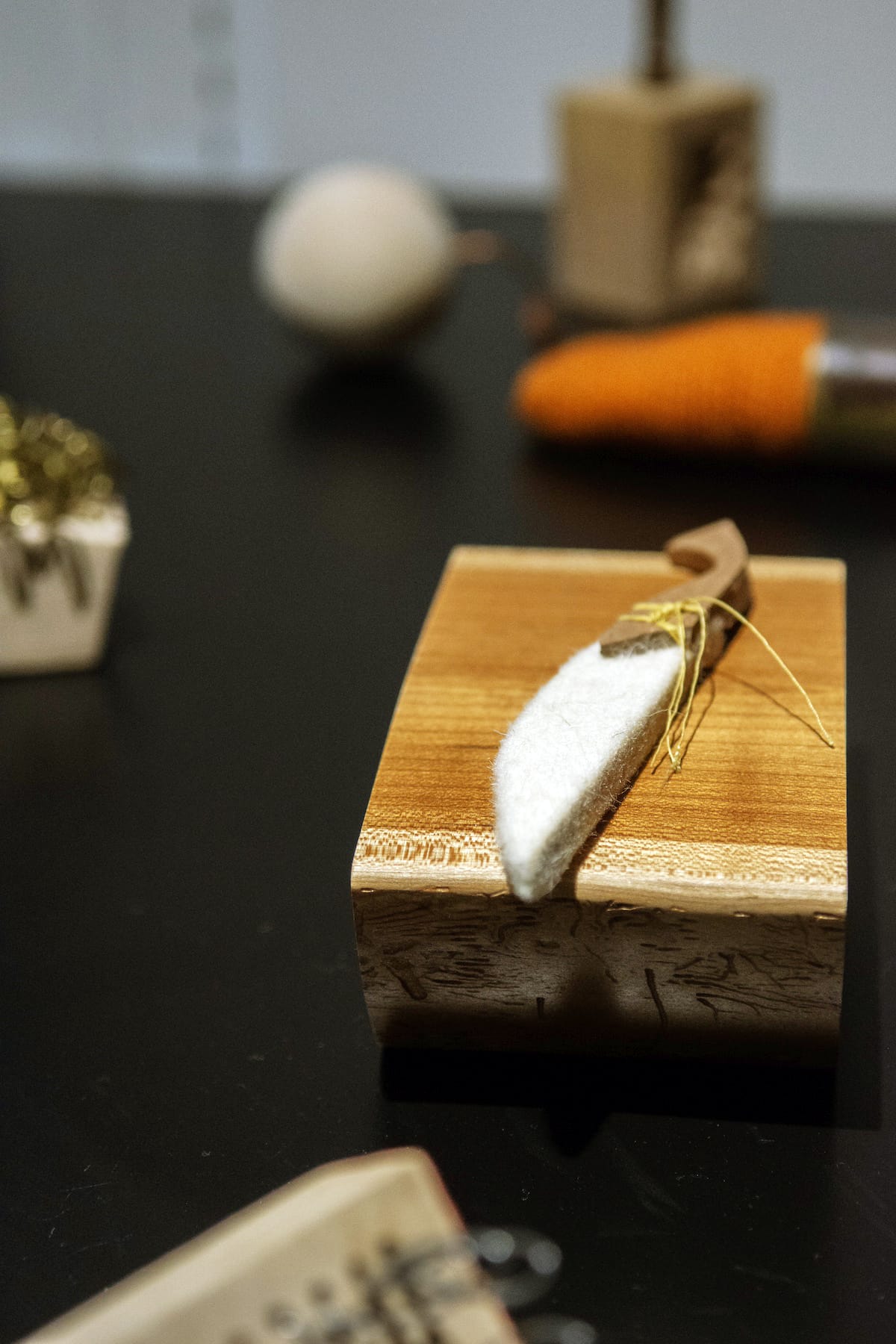
With these objects, the artist offers up care and ensures that no one will get a splinter or run a hand over a sharp edge. “Objects for Tending,” for instance, includes a knife with a blade made of felt. Ensuring that visitors have a good experience is baked into these pieces. The experience is intimate — an audience of one, you and the work, which fits in your hand. The various components would fit comfortably in a kitchen drawer. I imagined them arranged next to a fur-lined teacup.
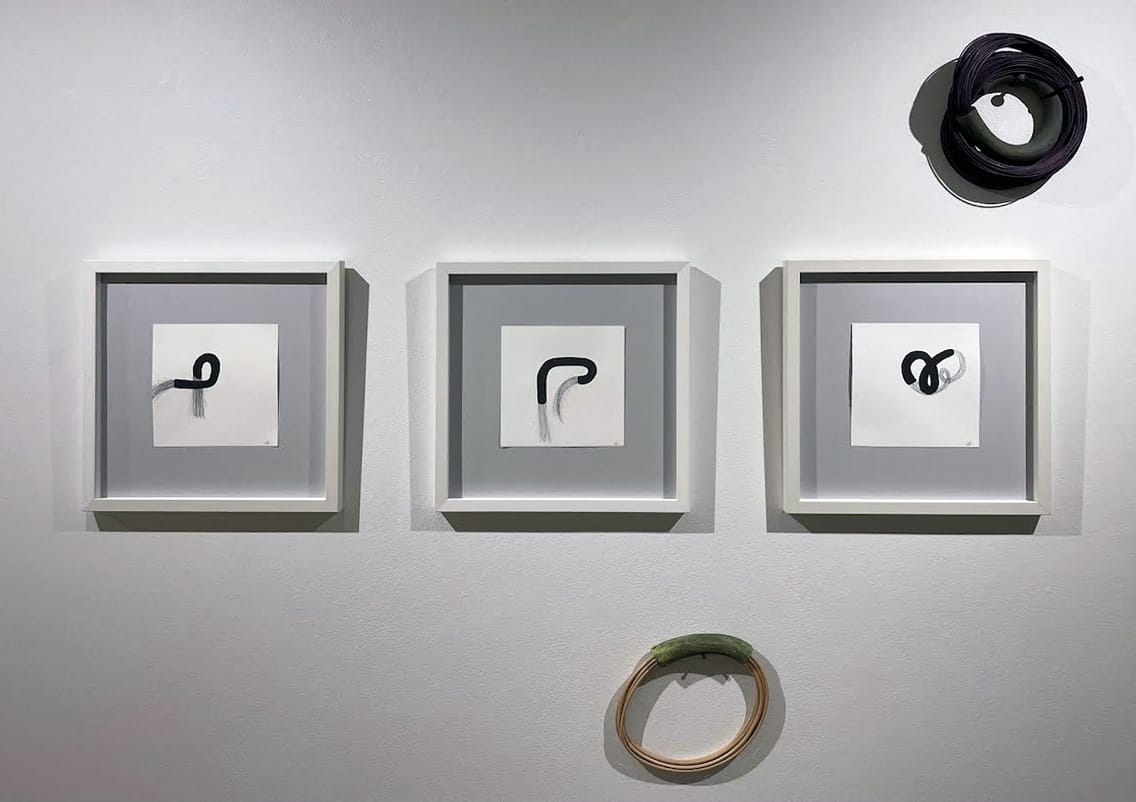
In her artist statement, Kleckner speaks of an additive process “emphasizing seams, handles, and points of contact. These elements mark places of connection and reliance, where forms are supported through relationship rather than singular stability.” Gallery and outreach director Stephanie Alaniz notes the “drawerly” quality of the sculptures and the sculptural presentation of the framed drawings.
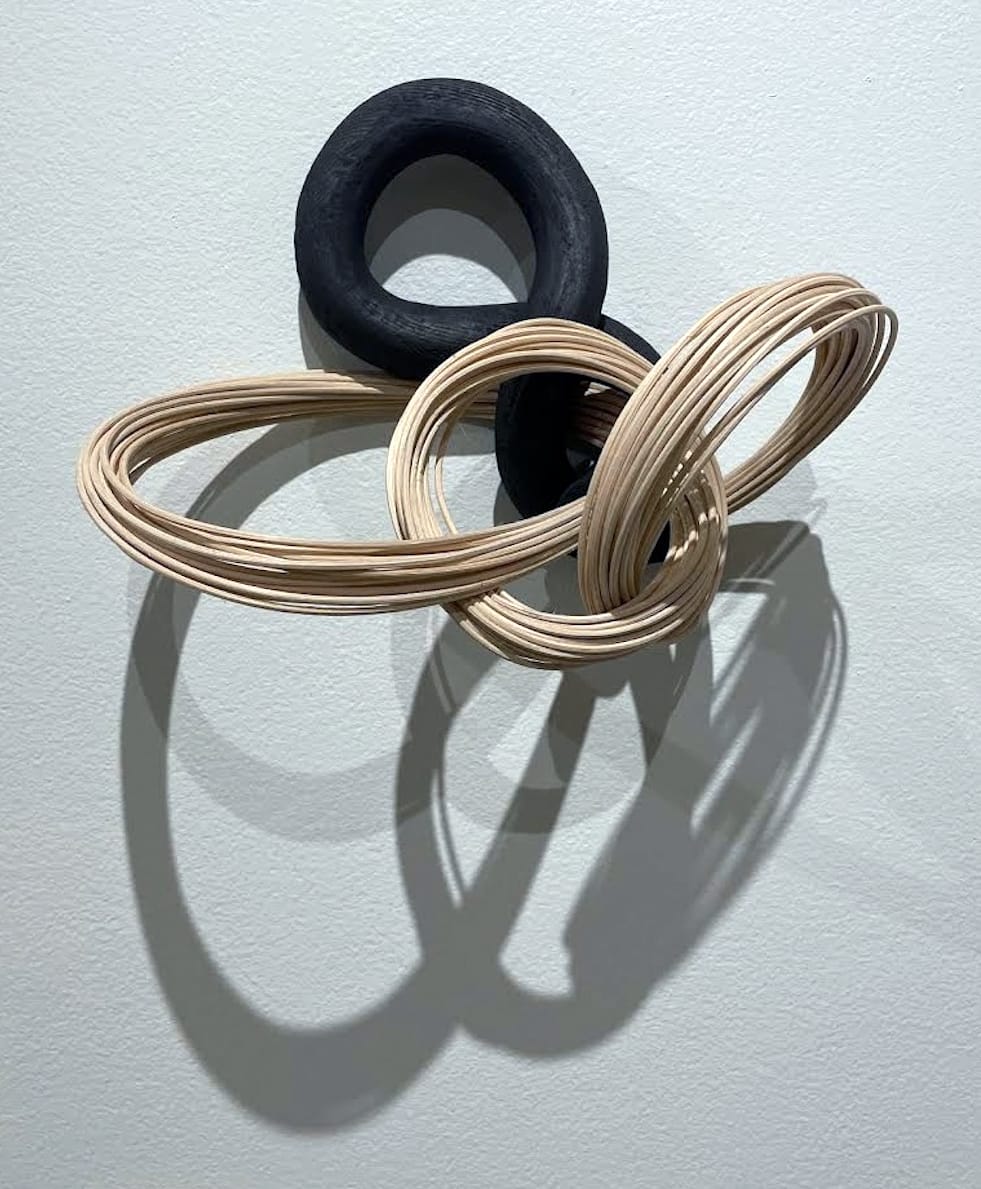
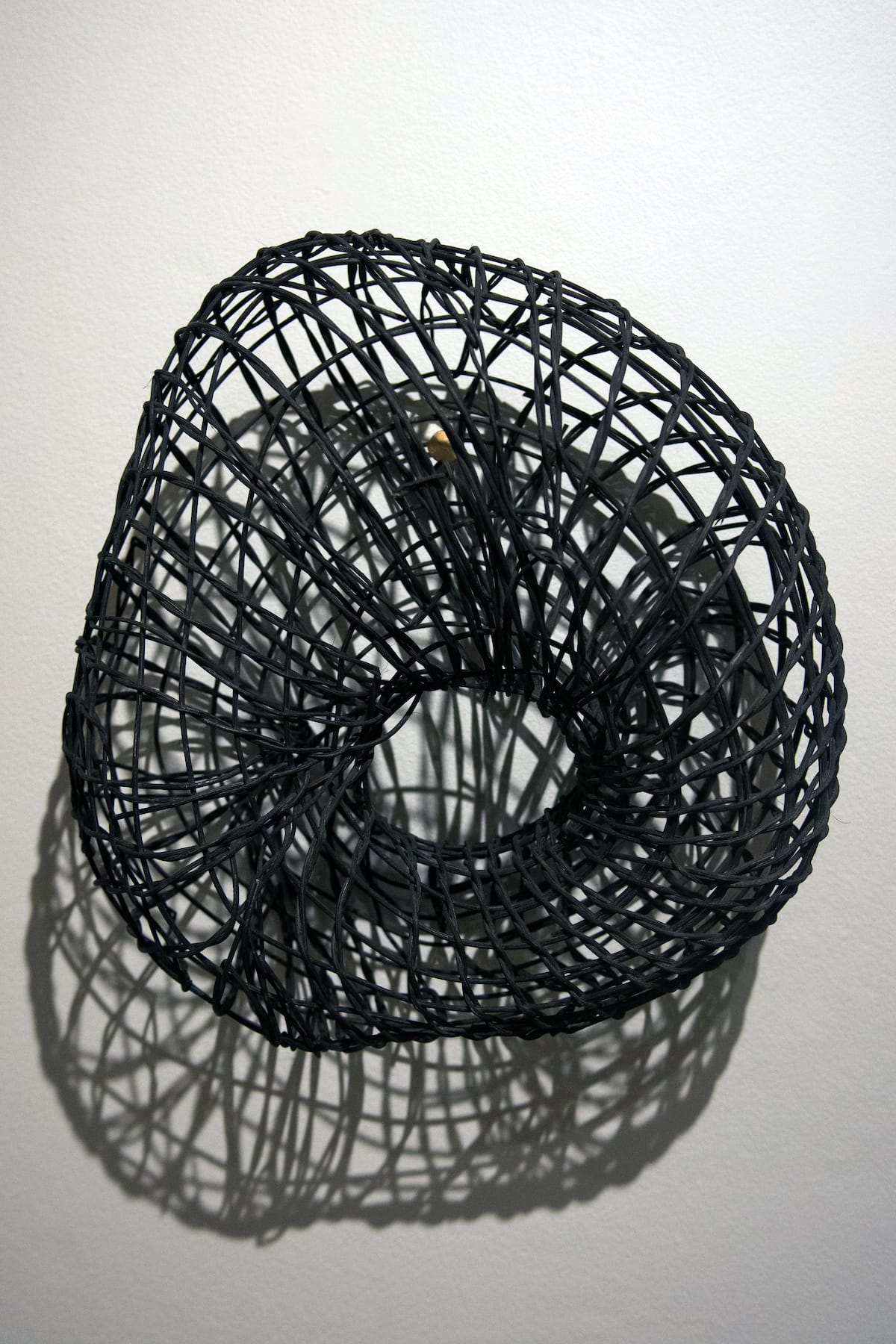
The wall-mounted “Lineation” pieces mentioned earlier, the most formal of her offerings, look as if they have been captured mid-twist-and-turn — frozen in a moment of becoming. Combining ceramic, reed, iron, steel, reeds and Tampico — a plant fiber made from yucca plants — Kleckner maintains the identity and integrity of each material and metamorphoses them to make a new thing that is singular and whole. Scattered across the gallery wall, they roll down and then back up a landscape with no horizon. The dramatic shadows thrown by “Lineation 5” — interlocking circles of bound reeds and ceramic coils blackened with graphite that protrude from the wall — give the illusion of deeper space and grow the footprint of a relatively small, compact sculpture.
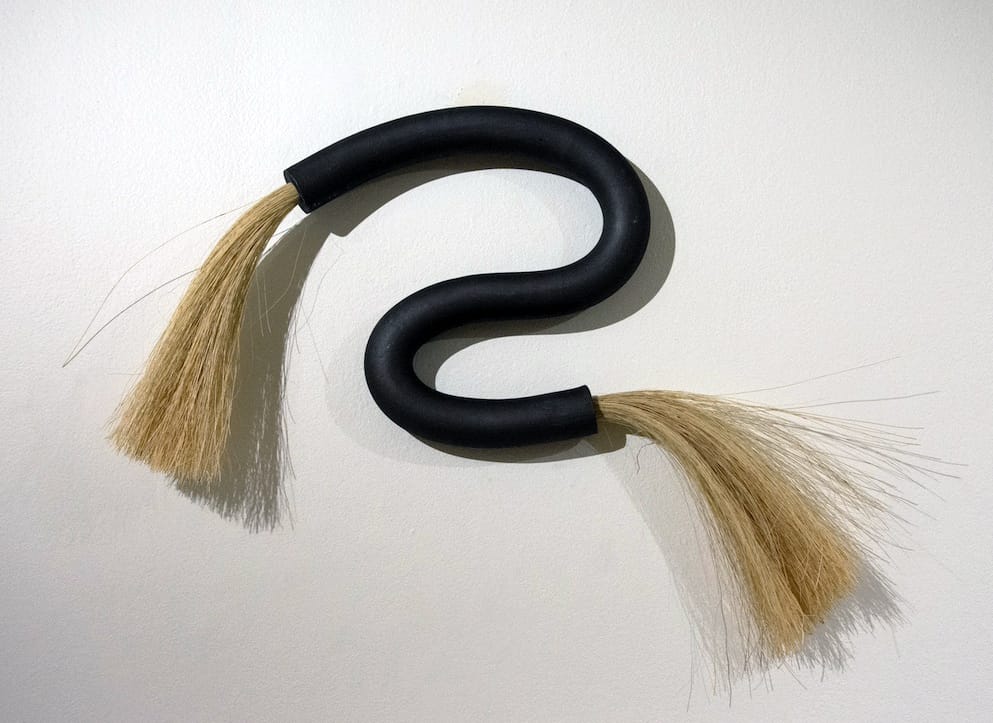
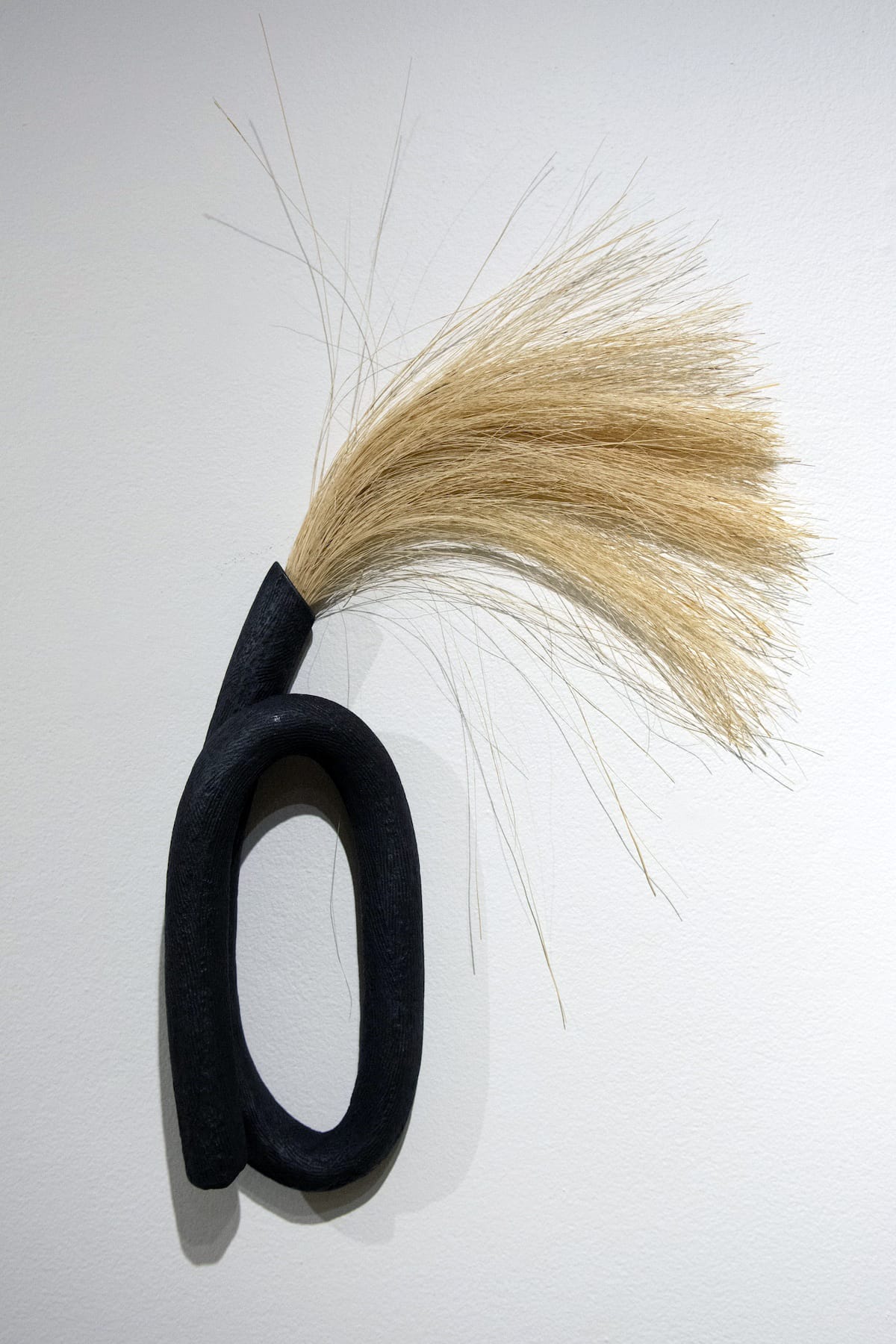
From left: “Lineation 1,” ceramic, graphite, and Tampico; “Lineation 8,” ceramic, graphite, Tampico. Courtesy photo by Naomi Hart for the the Eppink Gallery.
There are two pieces mounted on rockers that face each other from opposite ends of the exhibition. “Rocker 251 (Roland Too),” made of stoneware, graphite, wood, and copper, and “Rocker 242 (Freya)” made of ceramic, milk paint, wood, aluminum, and yarn. The body of both pieces is ceramic with four legs connecting the vessel body with bent wood rockers. Their proportions suggest rocking horses over furniture.
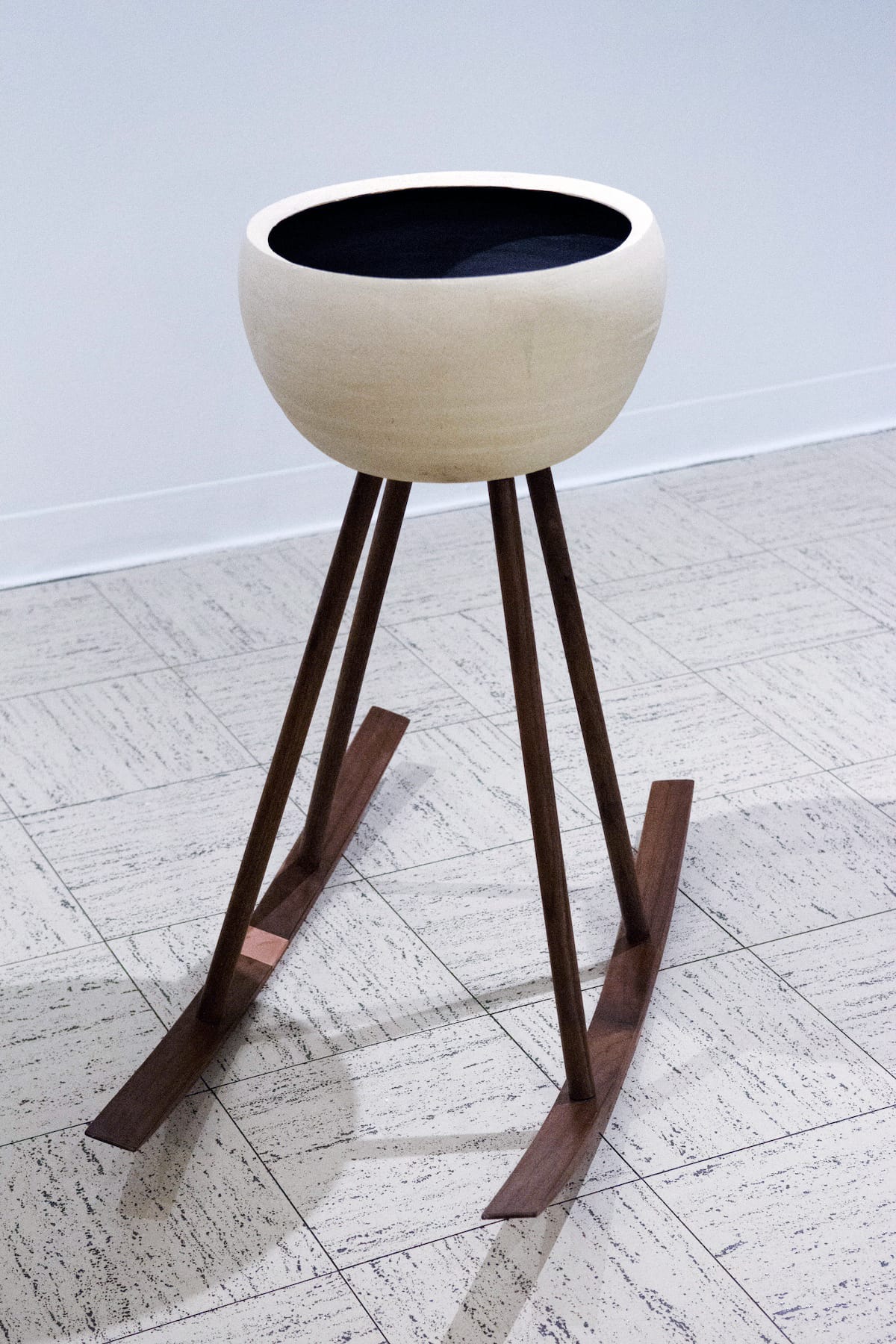
In “Rocker 251,” Kleckner uses a rounded bowl shaped like the lower half of a globe, from the equator down, with a flattened bottom where Antarctica would be. The vessel is deep and appears human-sized — more of the body than for the body. There is an organic imperfection to the shape that feels like the signature of the maker. Hands made this.
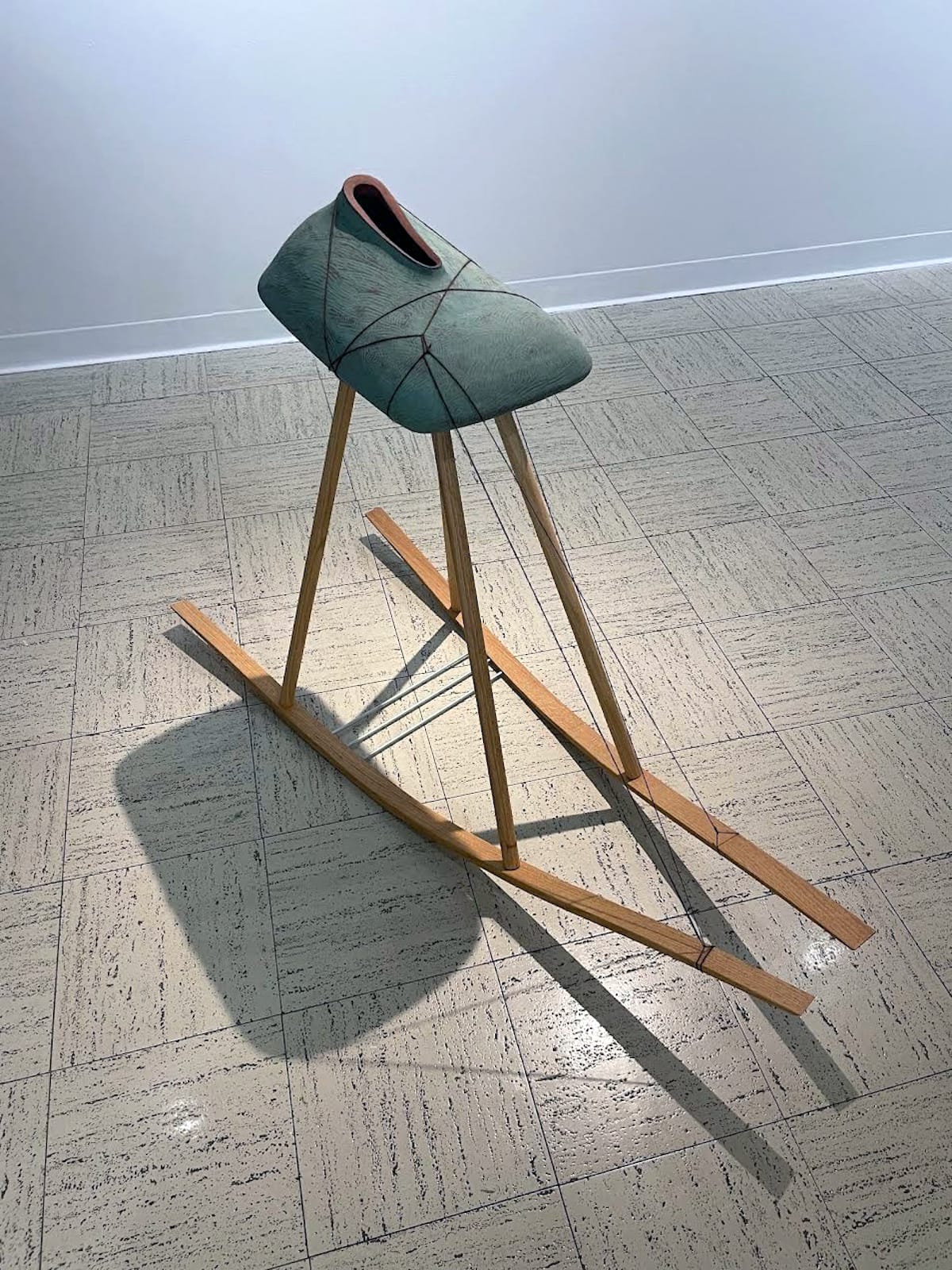
“Rocker 242” bears even more maker’s marks. It’s a closed, saddle-shaped vessel with a slotted opening that makes it difficult to look inside — it’s private. The exterior has a scarred, embossed texture that attests to time and records the making. The entire piece is reinforced with yarn, tied up in the same manner a gardener might shore up a tomato plant or redirect the limb of a young sapling — some art needs tending.
Overall, Kleckner’s work delivers connection. Art-goers aren’t often invited to touch the art, to enjoy a little play, or to interact in real time with their community. “Tracing the Divide” presents a visual vocabulary to imagine connection that honors contrast. Kleckner provides a model for collaboration where differences are celebrated and transformation is possible.
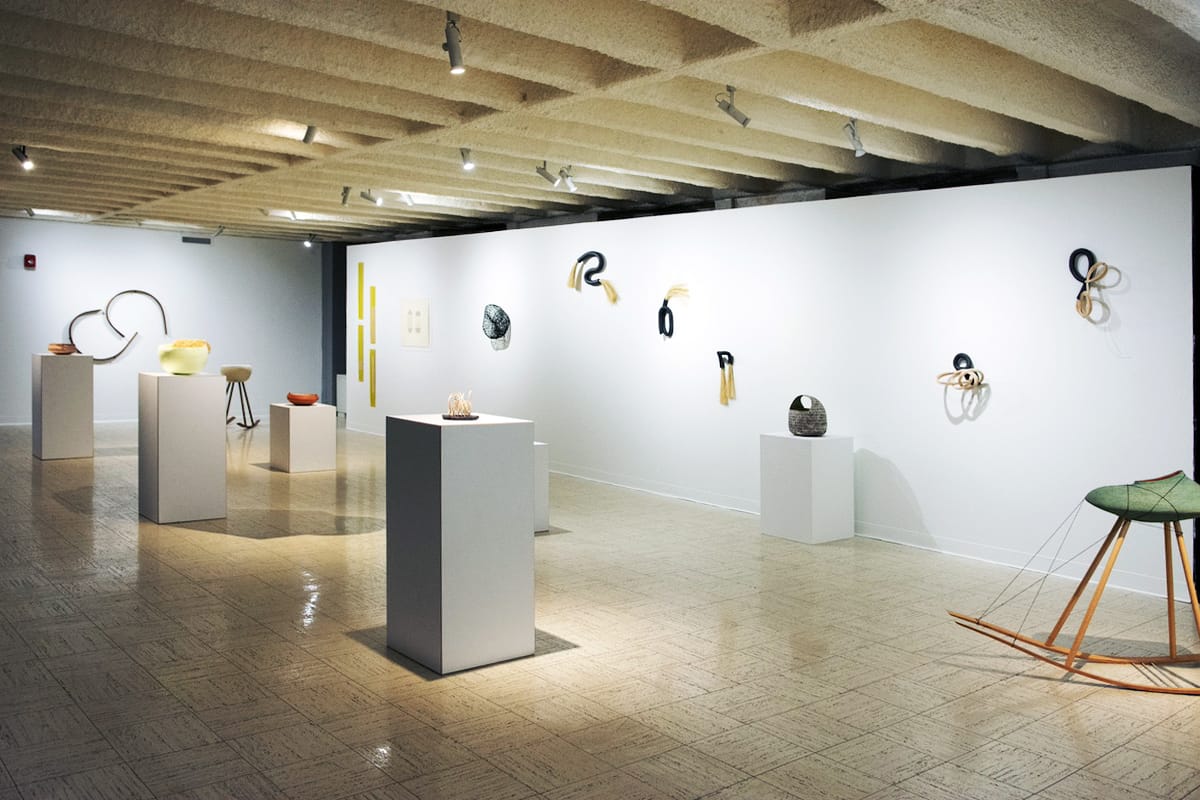
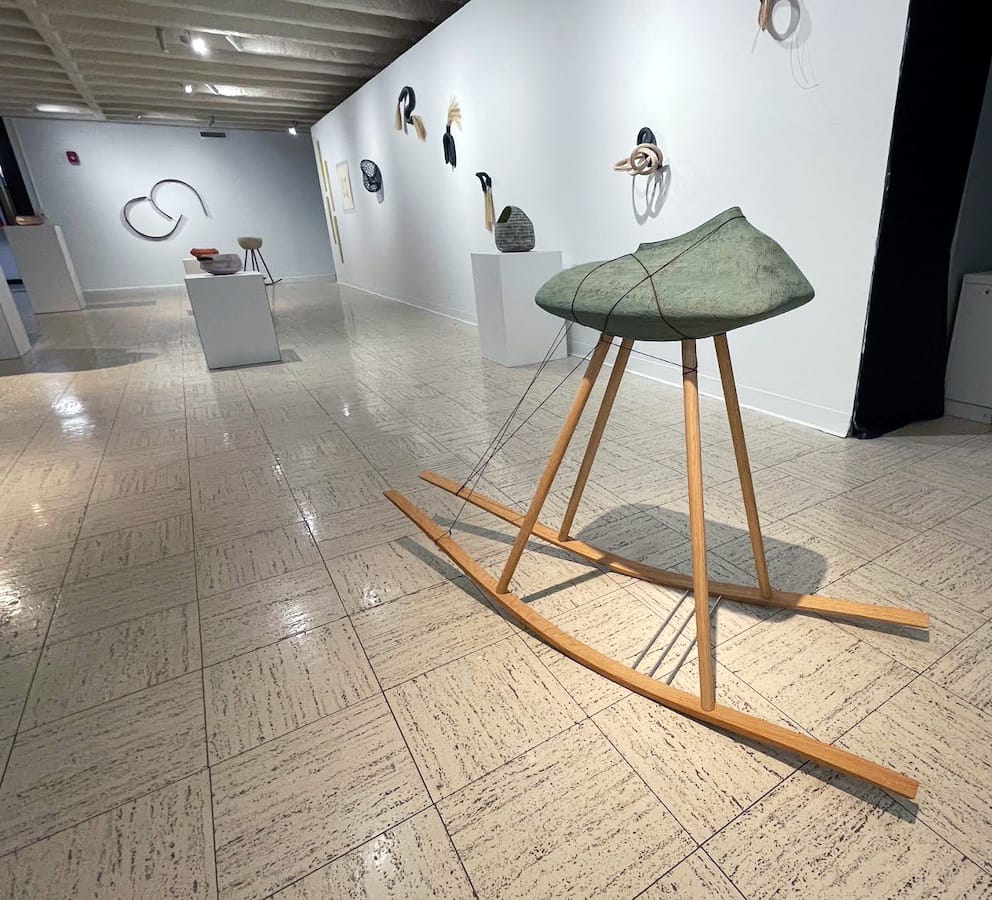
Installation views of Ellen Kleckner’s exhibition “Tracing the Divide” in the Eppink Gallery at Emporia State University. Photos by Christine Olejniczak for The SHOUT.
The Details
Ellen Kleckner, “Tracing the Divide”
January 20-February 27, 2026 in the Eppink Gallery, Emporia State University, 1331 Market St. in Emporia, Kansas
Admission is free, and the facility is accessible to people with physical disabilities.
Learn more about exhbtions at Emporia State.
Christine Olejniczak is an artist, curator and writer living in Lawrence, Kansas. She considers the sound of drawing to be her first language and Fluxus artists as the trunk and major limbs on her art family tree. When she’s not performing the sound of drawing, she is working on graphic scores, doing plein air studies, or reading. Learn more about Christine on her website and Instagram page @christineolejniczak22.
❋ Derby man has the kind of voice that turns heads — and chairs
❋ Socializing while sober: how some Wichitans are cultivating alcohol-free communities
❋ As a small creative business closes, the owner mourns
❋ Painting through it: Autumn Noire on 20 years of making art
❋ How a guy from Wichita resurrected 'Dawn of the Dead'
❋ Bygone Friends University museum housed curious collections
Support Kansas arts writing
The SHOUT is a Wichita-based independent newsroom focused on artists living and working in Kansas. We're partly supported by the generosity of our readers, and every dollar we receive goes directly into the pocket of a contributing writer, editor, or photographer. Click here to support our work with a tax-deductible donation.