‘Seized’ is a measured, hopeful case study about freedom of the press
Kansas City filmmaker Sharon Liese’s documentary about the raid on the Marion County Record premiered last week at the Sundance Film Festival. Tickets to screen the film online are available for a (very) limited time.
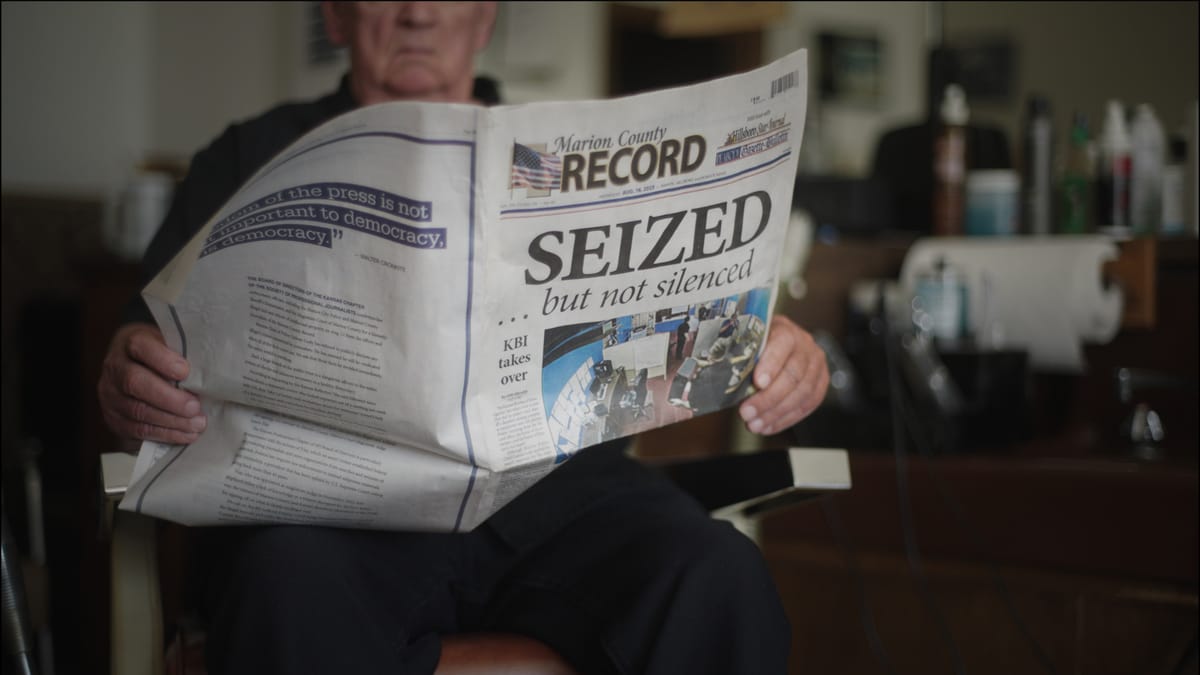
When Sharon Liese first heard about the police raid on a small Kansas newspaper and the home of its editor, she drove to Marion, Kansas to see for herself.
"'You get the scoop because you were the first one here,'" Marion County Record editor Eric Meyer told her.
The result of Liese's initiative is “Seized,” a moving, balanced account of tensions between the newspaper, law enforcement, city government, and local residents. As insight into the life of a journalist, the film might become required watching for budding reporters and informed citizens.
The documentary premiered last Sunday at the 2026 Sundance Film Festival. Tickets are available for online streaming through February 2 at 12:55 a.m. Central Time on the festival's website.
The film opens with a shot of a field of buffalo in a field in golden light. The background music is an old-timey cowboy song about "newspaper people" and "freedom of the press."
"'Seized' is a First Amendment story,” Liese says a Sundance video that runs before the film. “But it's also a story about a community newspaper."
Meyer’s mother Joan, the paper's 98-year-old co-owner, was home alone when the police carried out concurrent raids at the house and newspaper office. She died shortly afterward. "I knew that it was gonna make news,” Eric Meyer says in the documentary. “The angle of my mother's death ratcheted it into high gear."
In camera footage from the home raid, Joan Meyer says, "This is the worst I've ever seen … Nazi stuff … Nothing but a bunch of bullies … You guys are gonna cause me a stroke.”
"A coroner came…and he said the stress of the raid contributed to her death," Meyer says in the documentary.
Our free email newsletter is like having a friend who always knows what's happening
Get the scoop on Wichita’s arts & culture scene: events, news, artist opportunities, and more. Free, weekly & worth your while.
No spam. Unsubscribe anytime.
“Seized” traces how the impact of the raid reverberated throughout the community.
"It messed me up — how I think of myself,” says a police officer who was involved in the raid. “Now, I feel for Eric, but honestly I feel worse. Am I gonna lose my career, my pension?"
Throughout the film, a cast of small-town characters weigh in on the raid and the public outcry as the dust begins to settle.
"Marion is its own little thing … and it is a microcosm … of the world," says Thane Schwartz, a Marion County resident.
One of the film’s characters is Finn Hartnett, a young reporter from New York who joins the Marion County Record as a staff writer directly following the raid.
"I thought people in a small town would support the paper, but not really," says Hartnett, who makes Marion his home for a year.
At several points in the film, Eric Meyer says the raid was an attempt to infringe on the freedom of the press, a claim some local officials dispute. Near the end of the film, Liese stages an on-camera dialogue between Marion Mayor Mike Powers and Eric Meyer.
"It's about a system that did not work right because someone decided to be a bully," Meyer says during the joint interview.
"I'm sorry, but in this story you're the bully," Powers retorts. The power struggle is complicated. Lawsuits involving millions of dollars are at stake.
“Seized” reflects the messy reality of the raid and its aftermath. Its story also gives me hope for the future of the First Amendment. The national outcry and subsequent successful lawsuits prove Americans still care about freedom of the press.
And while the raid divided Marion County, many members of the community retain a grudging respect for the role of the newspaper. "You're not gonna make everybody happy, no matter what you print,” says a Marion resident in a cowboy hat.
Meyer echoes that sentiment. "You don't get into this business to be loved,” he says.
“The old saying 'show me a beloved newspaperman, and I'll show you a shitty paper' is kinda true."
Note: This post was updated on February 1 to correct two errors:The quote from Liese is from a video that runs before the film, not the documentary. The police officer quoted in the review is not Gideon Cody, the onetime chief of the Marion Police Department. Read about our commitment to sharing accurate information.
The Details
"Seized"
The documentary premiered at the Sundance Film Festival in Park City, Utah on January 25. It's available to view online through 1:55 a.m. Monday, February 1.
Online tickets for individual films cost $36.58 with taxes and fees.
Learn more and purchase a ticket.
Past Poet Laureate of Kansas (2017-2019) Kevin Rabas teaches at Emporia State University, where he directs the creative writing program. He has 16 books, including "Lisa’s Flying Electric Piano" and "Elizabeth’s City." Rabas also teaches screenwriting and filmmaking and directs the Donald Reichardt Center, which includes a university cinema studio. He lives in Newton.
❋ Derby man has the kind of voice that turns heads — and chairs
❋ Socializing while sober: how some Wichitans are cultivating alcohol-free communities
❋ As a small creative business closes, the owner mourns
❋ Painting through it: Autumn Noire on 20 years of making art
❋ How a guy from Wichita resurrected 'Dawn of the Dead'
❋ Bygone Friends University museum housed curious collections
Support Kansas arts writing
The SHOUT is a Wichita-based independent newsroom focused on artists living and working in Kansas. We're partly supported by the generosity of our readers, and every dollar we receive goes directly into the pocket of a contributing writer, editor, or photographer. Click here to support our work with a tax-deductible donation.