
Painters Sarah Winkler and Barry Fitzgerald present works of glowing grandeur and playful restraint
Two solo exhibitions at Lindsborg's Birger Sandzén Memorial Gallery offer a captivating juxtaposition of styles.
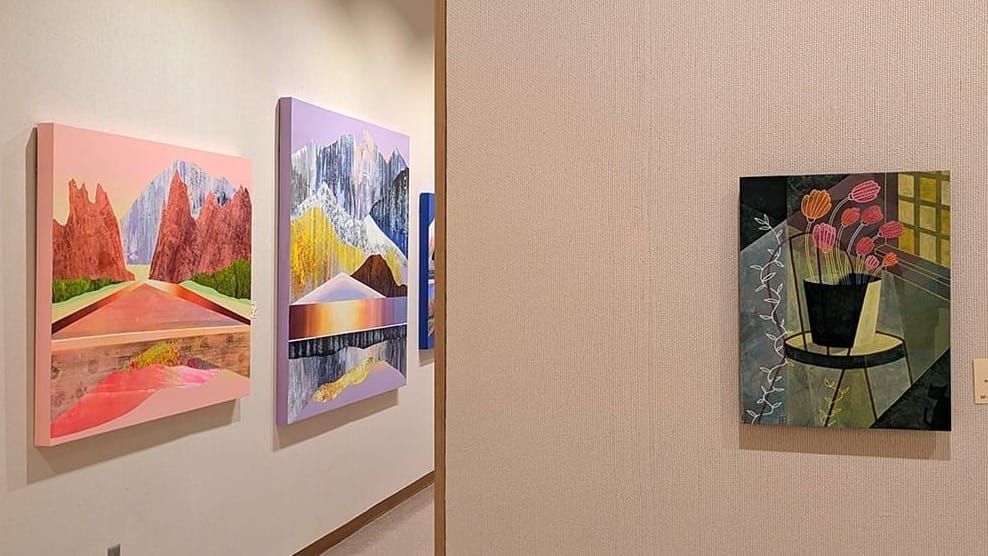
Sarah Winkler’s bold, grandiose paintings of mountainous landscapes couldn’t be more different from Barry Fitzgerald’s meticulous acrylic and ink illustrations of flowers and buildings. Separately, each exhibition is striking, but moving back and forth from one to the other, appreciation for each artist’s work can grow.
Winkler’s “The Big Pretty” and Fitzgerald’s “House Plants” are two of four special exhibitions currently on view at the Birger Sandzén Memorial Gallery on the campus of Bethany College in Lindsborg, Kansas. Winkler’s work is vibrant and expansive and grabbed me right away; it’s impossible to walk past her work without stopping to take it in. Fitzgerald’s is more restrained in both hue and scale, and I appreciated the way his art reeled me in more slowly, rewarding my attention with delightfully playful details.
Based in Morrison, Colorado, Sarah Winkler paints scenes from the Rocky Mountain West, especially locations in her adopted home state. Her exhibition “The Big Pretty” is immediately eye-catching, not only due to the size of the paintings but also because of the brilliant, natural glow emanating from her work. The Sandzén Gallery has displayed her 13 paintings in one medium-sized room off a short hallway; it is lovely to sit in the middle of the room and admire them all at once.
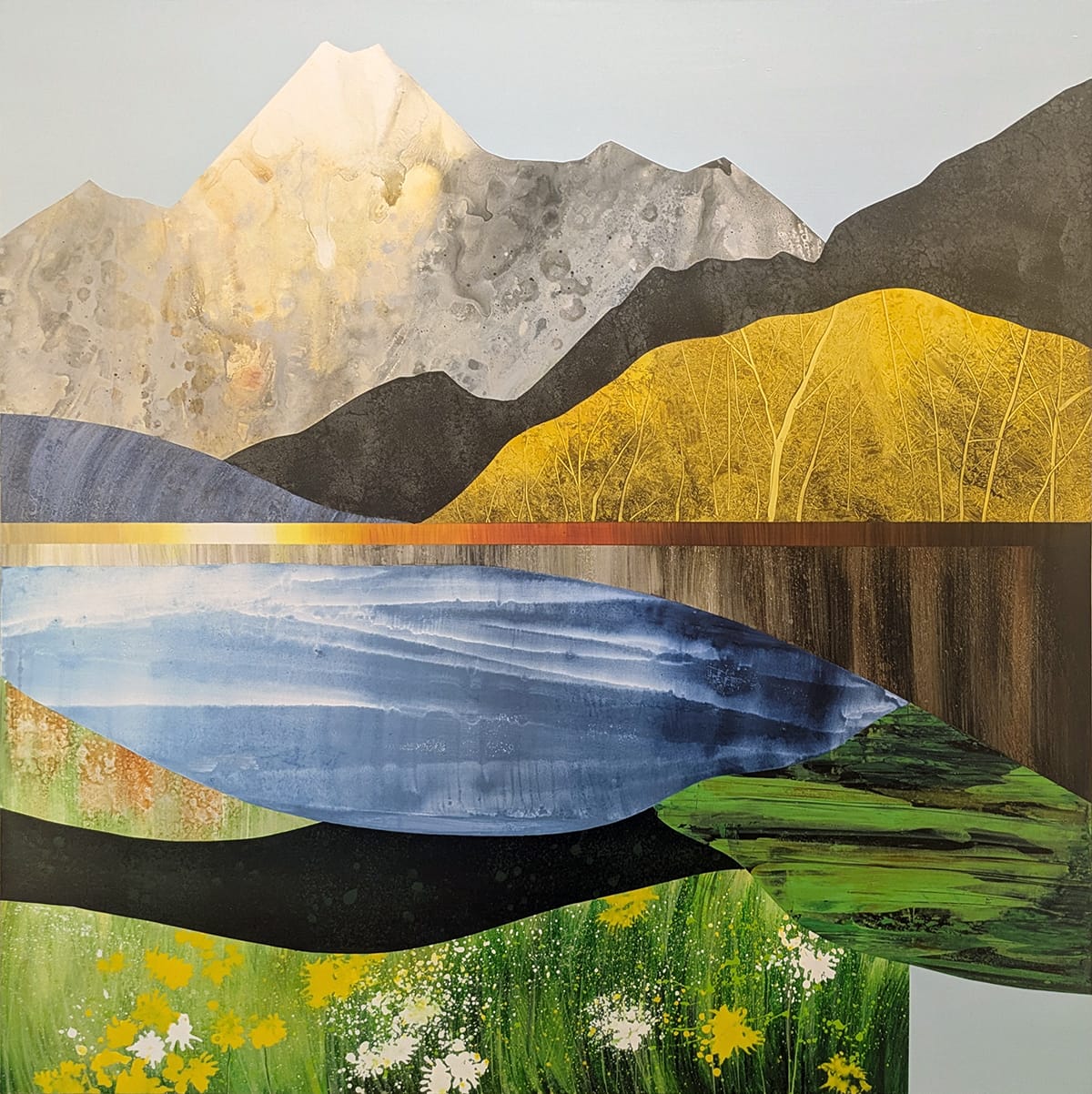
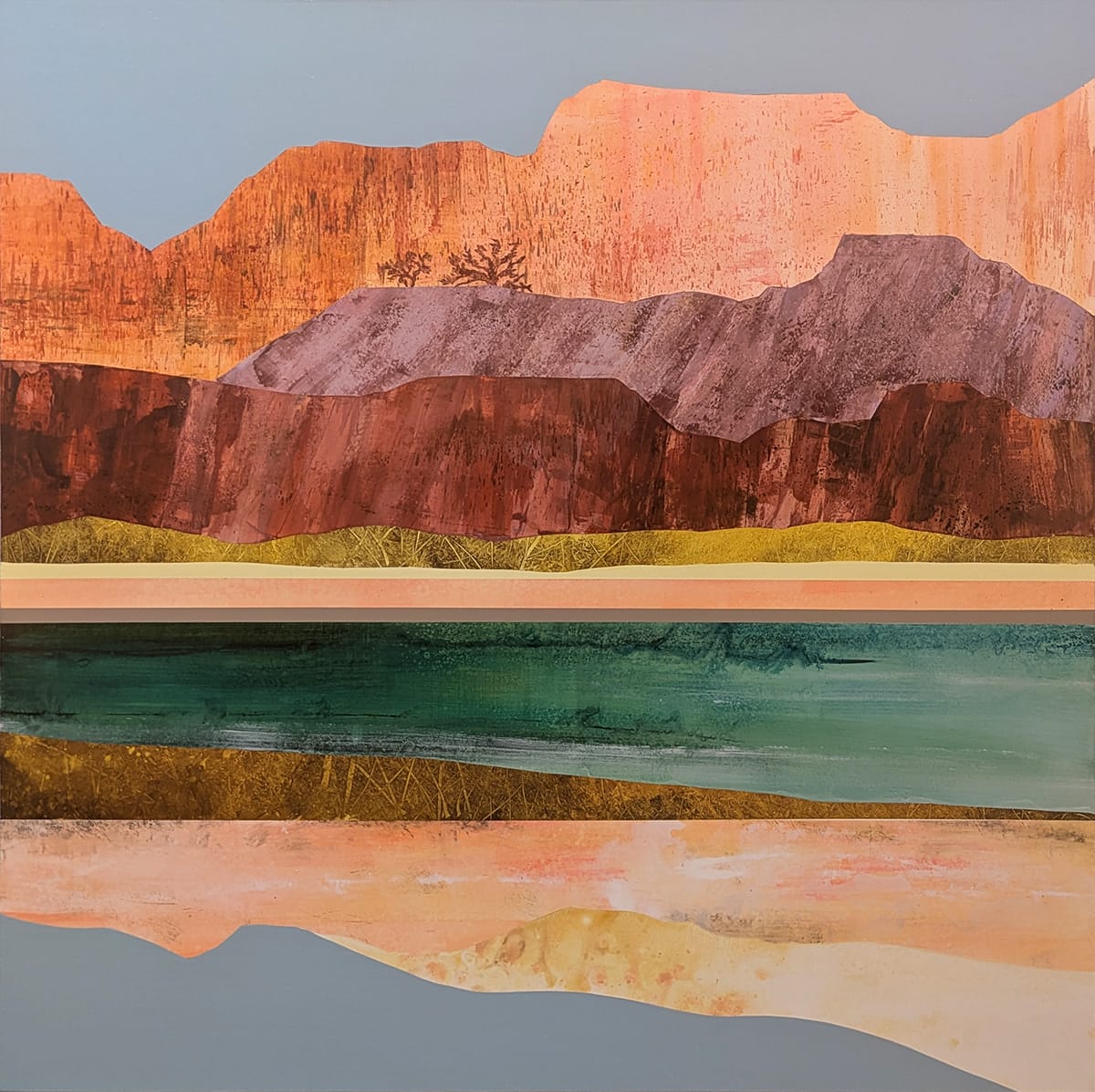
Winkler uses a distinctive collage approach to create her landscapes, resulting in intriguing textures. All 13 paintings are acrylic on panels, but each looks quilt-like from afar, as if it were created through collages of fabric, metal, and wood. Winkler builds her scenes out of segments of color, some completely smooth and others textured with visible brushstrokes, splattered or sponged patterns, and prints that mimic natural patterns observed in wood and rocks.
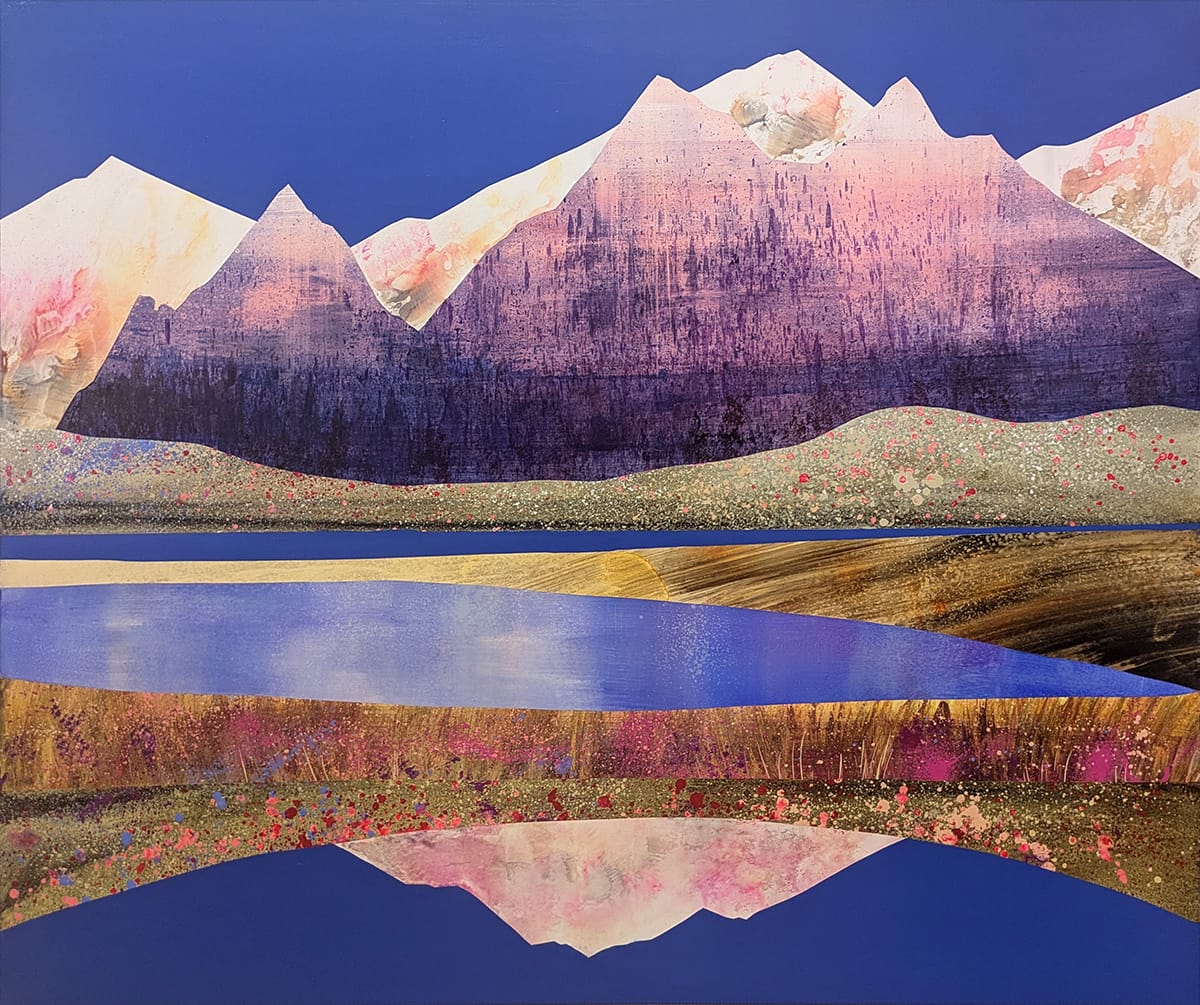
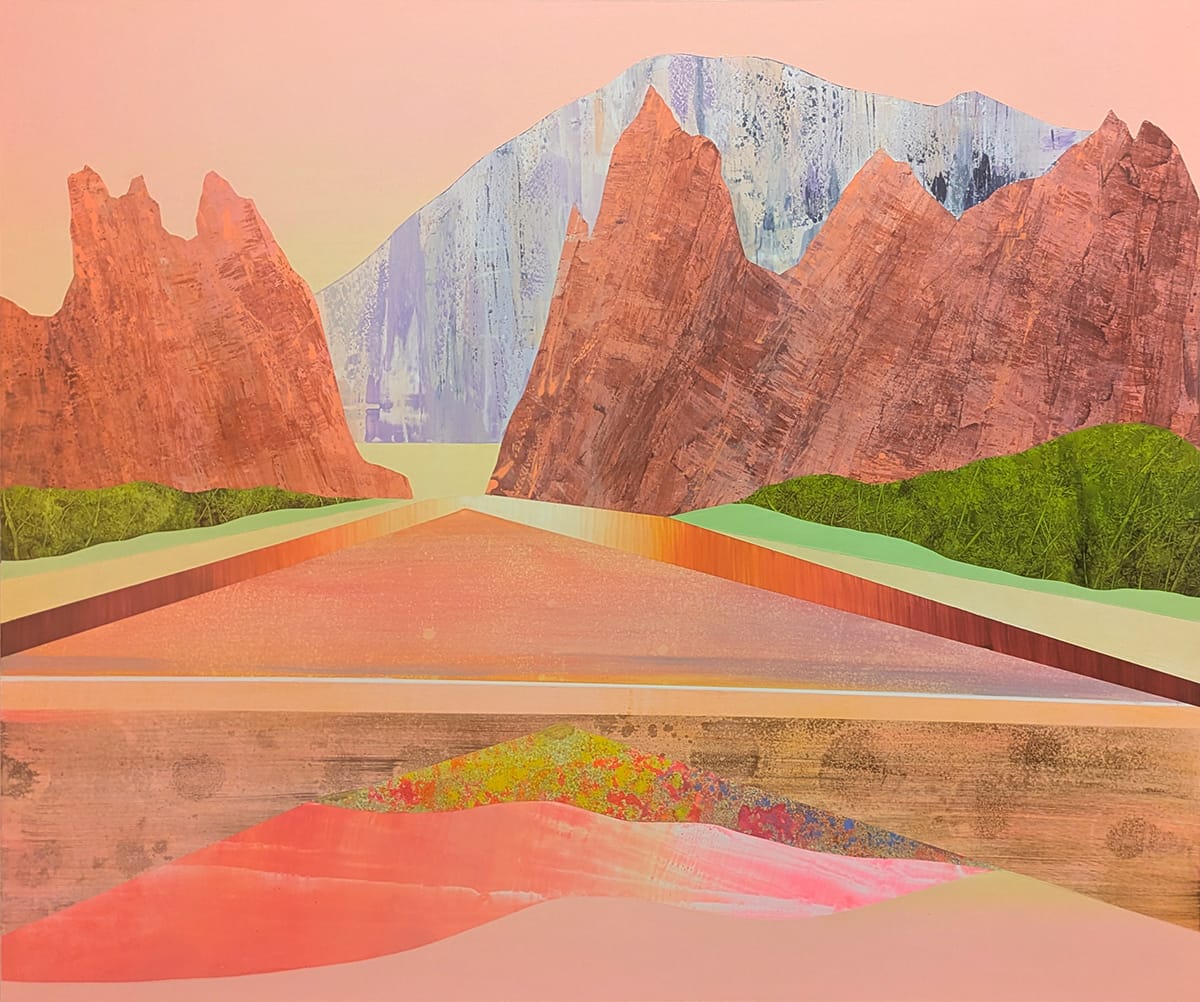
From left: Sarah Winkler, “Wild Mountain Meadow,” 2026, acrylic on panel, 40 by 48 inches; Sarah Winkler, “Garden of the Gods,” 2026, acrylic on panel, 40 by 48 inches. Photos by Kate Storhoff for The SHOUT.
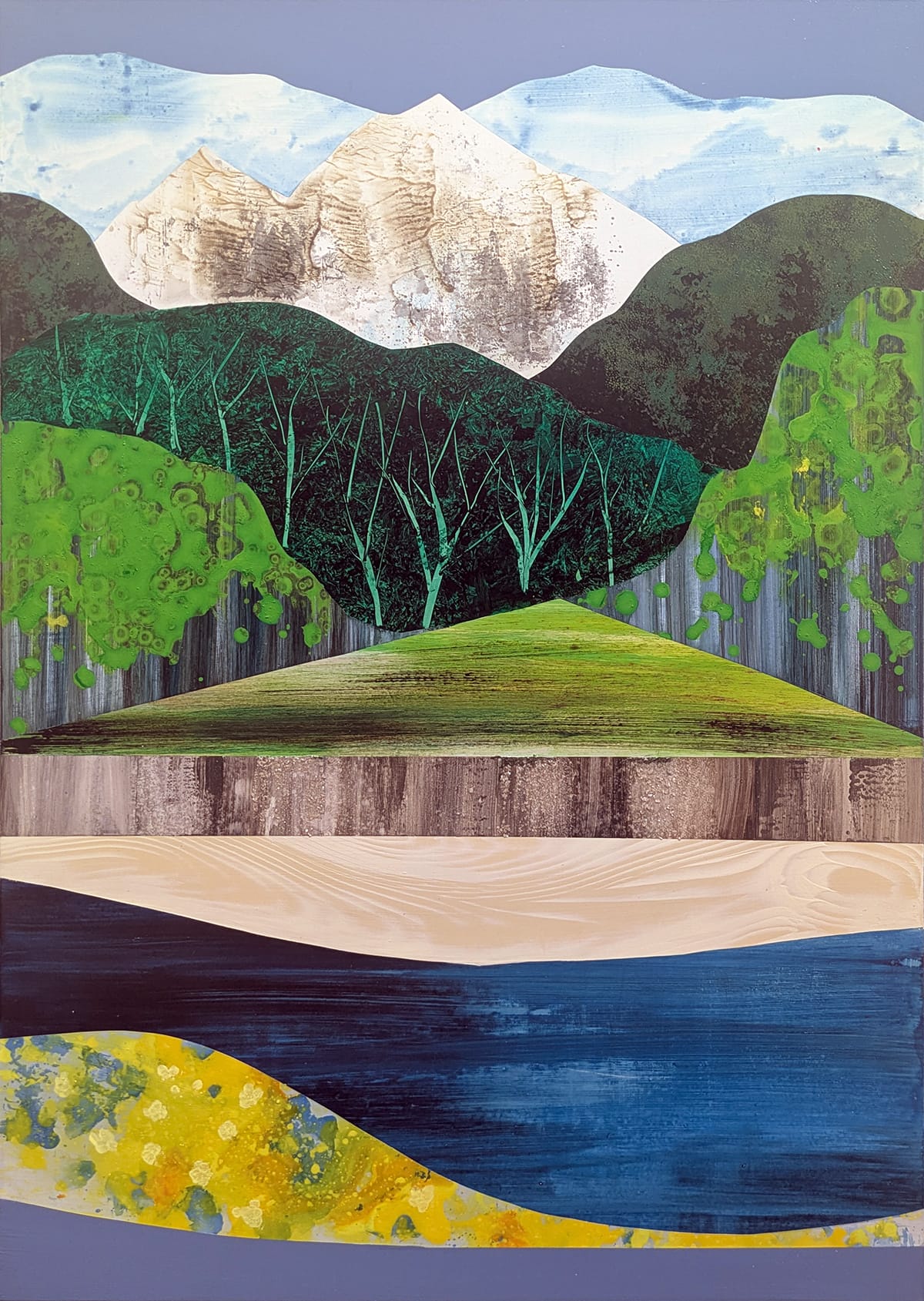
In “Verdant Valleys,” Winkler frames the painting at the top and the bottom with bands in a flat, crisp, cornflower blue. Each segment beneath the blue sky has its own distinctive texture: marbled and rocklike mountains make way for sponged forested hills; a rock-gray horizontal stripe across the middle of the panel, dividing the hills from the valley below, has mica added into the paint to enhance the geological texture; and the segment between this stripe and the deep blue lake below looks so much look real wood I had to get up close to confirm the wooden whorls were indeed created with paint.
“It’s as if each scene becomes a microcosm of time and place,” Winkler writes in her artist’s statement. The carefully partitioned layers in each painting help the viewer experience the geological layers Winkler sees. We are not just looking at a beautiful landscape but also acknowledging the way natural forces spent centuries creating the scene.
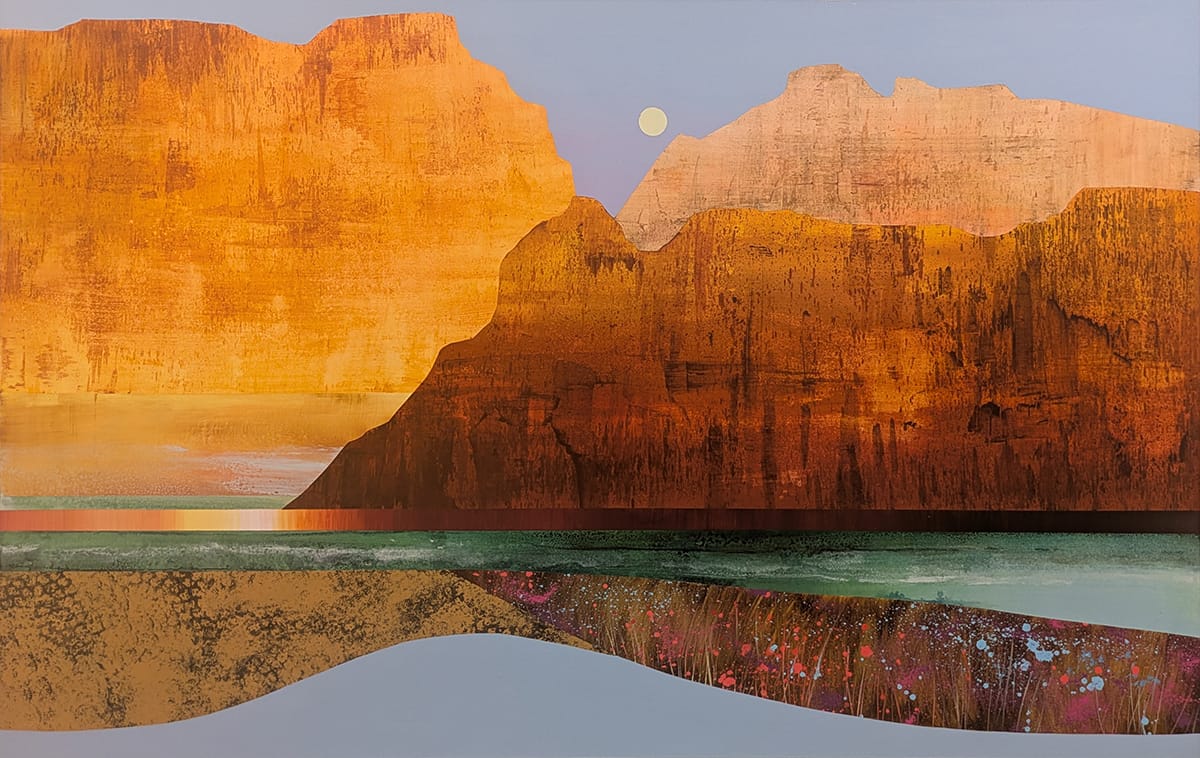
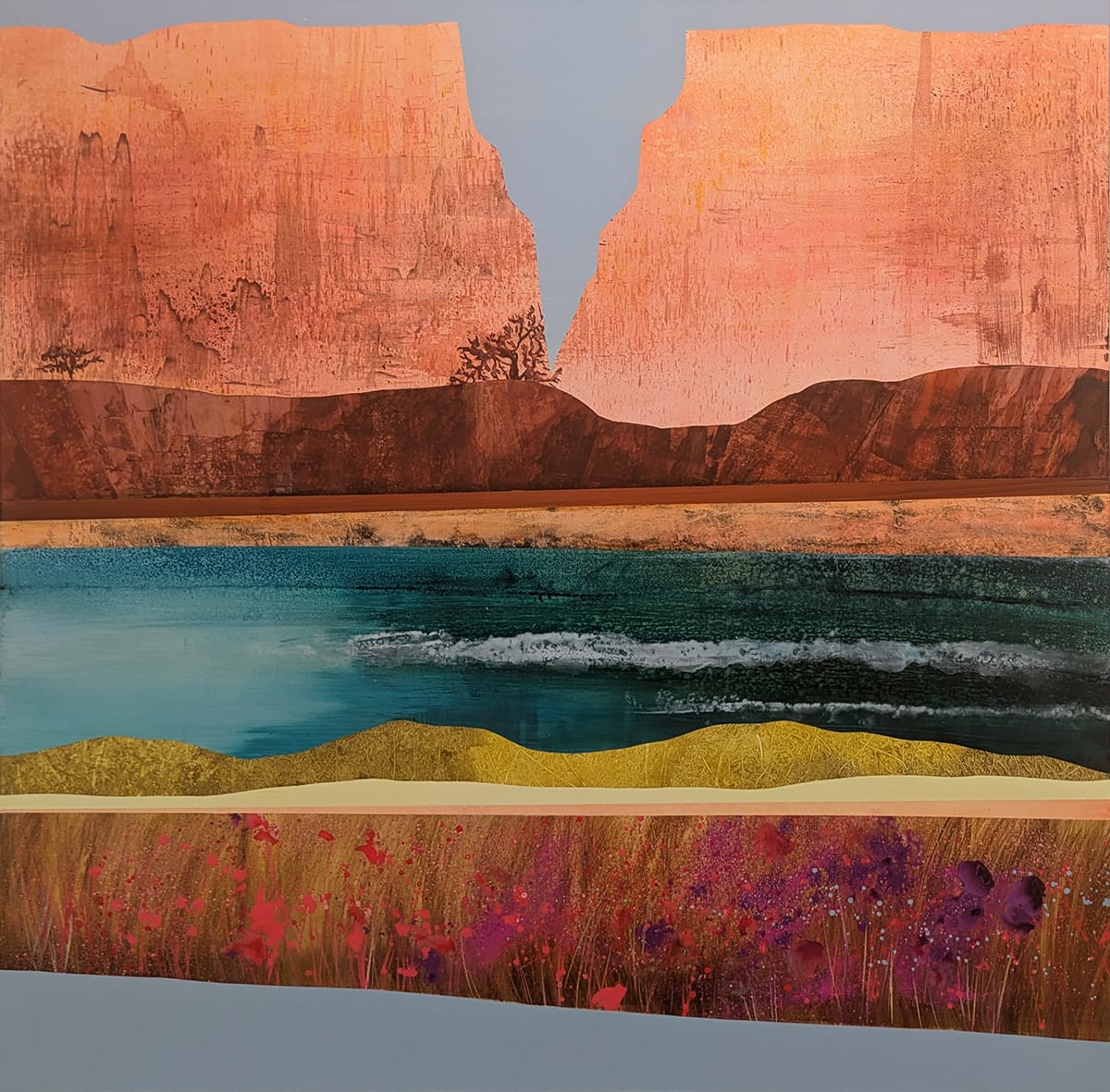
From left: Sarah Winkler, “Moonrise on the Colorado River,” 2026, acrylic on panel, 48 by 72 inches; Sarah Winkler, “Moab Utah,” 2026, acrylic on panel, 48 by 48 inches. Photos by Kate Storhoff for The SHOUT.
“I aim to channel the awe of the present moment with the vastness of geological time in each painting,” Winkler writes.
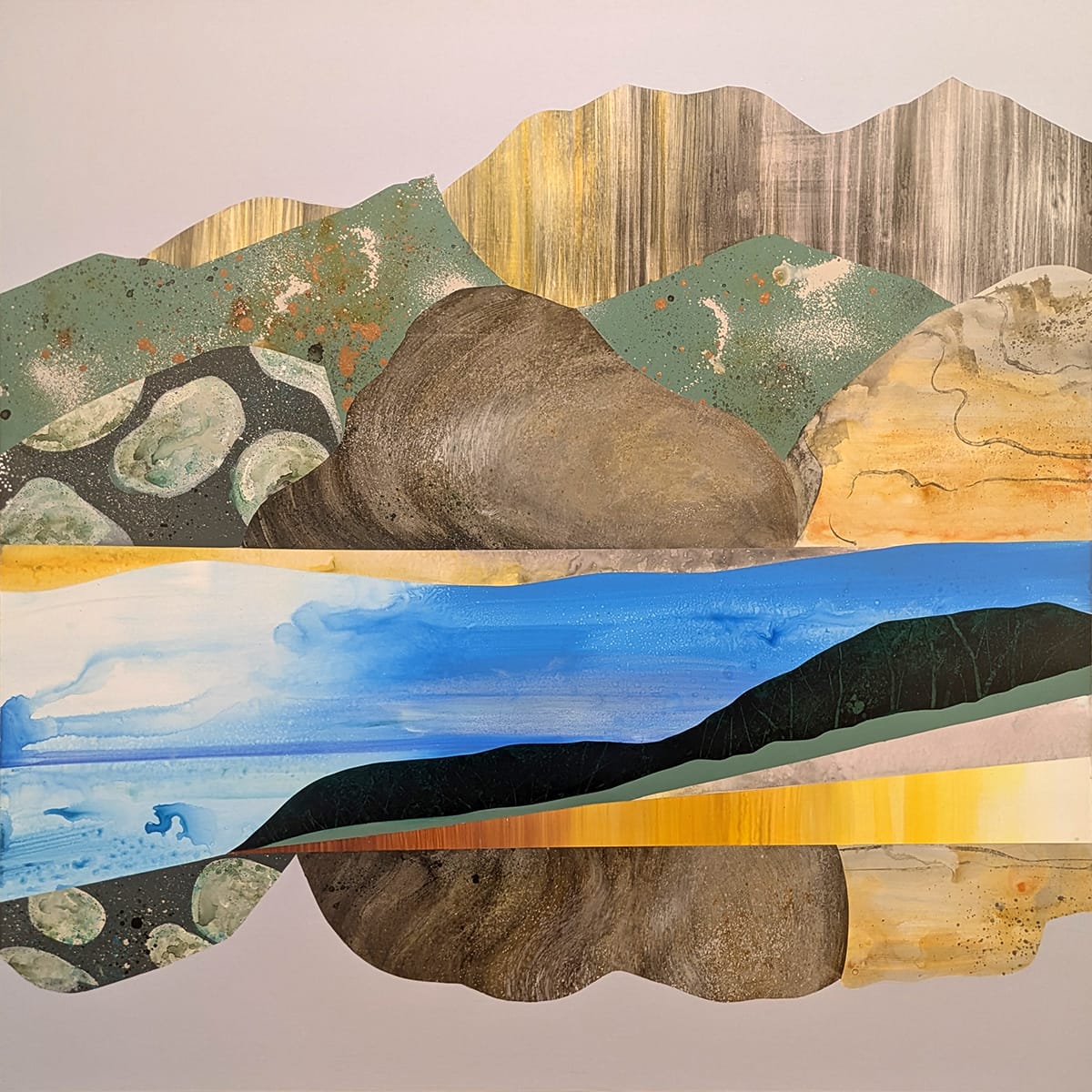
This eye for natural grandeur makes “The Big Pretty” an exhibition suited to the Sandzén Gallery. In fact, even the name comes from the painter Birger Sandzén, who referred to Rocky Mountain landscapes as the “Big Pretty.”
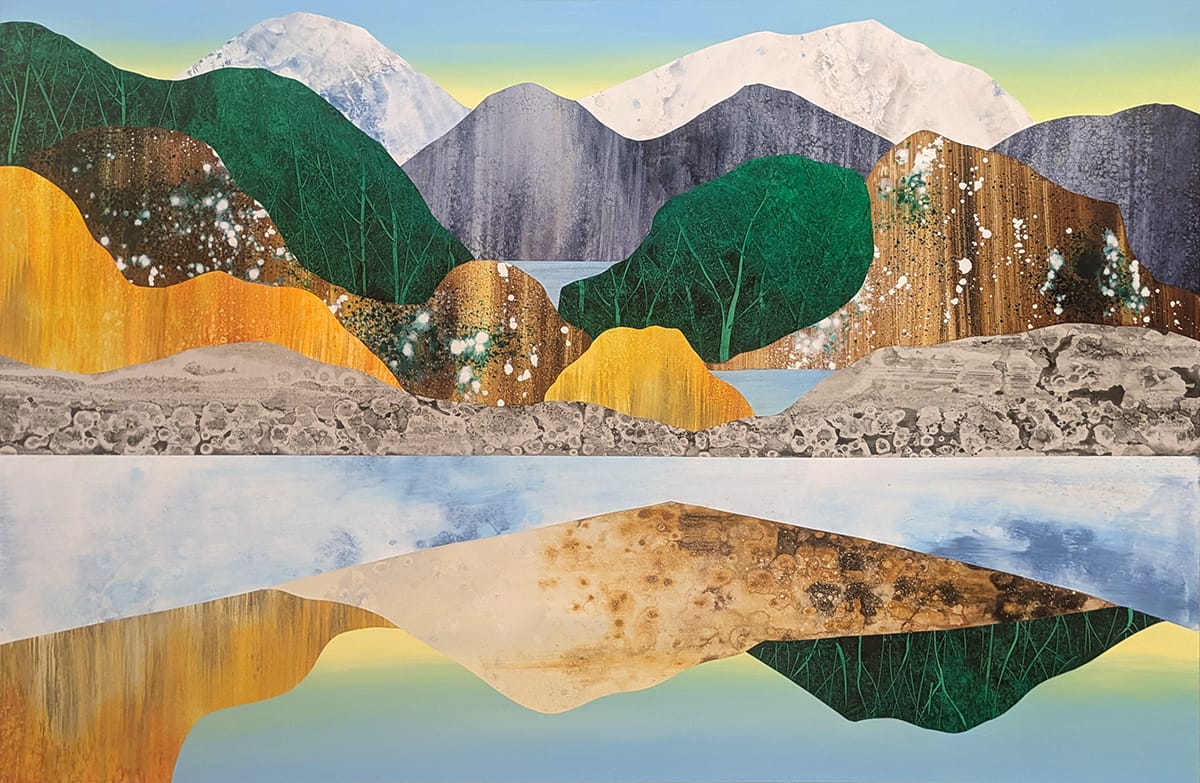
Winkler stumbled upon the Sandzén Gallery when she detoured through Lindsborg during a snowstorm, although she was already a fan of his work.
“His interest in geology, light and shadow, contrast, vivid color, and texture echoes my own,” she writes.
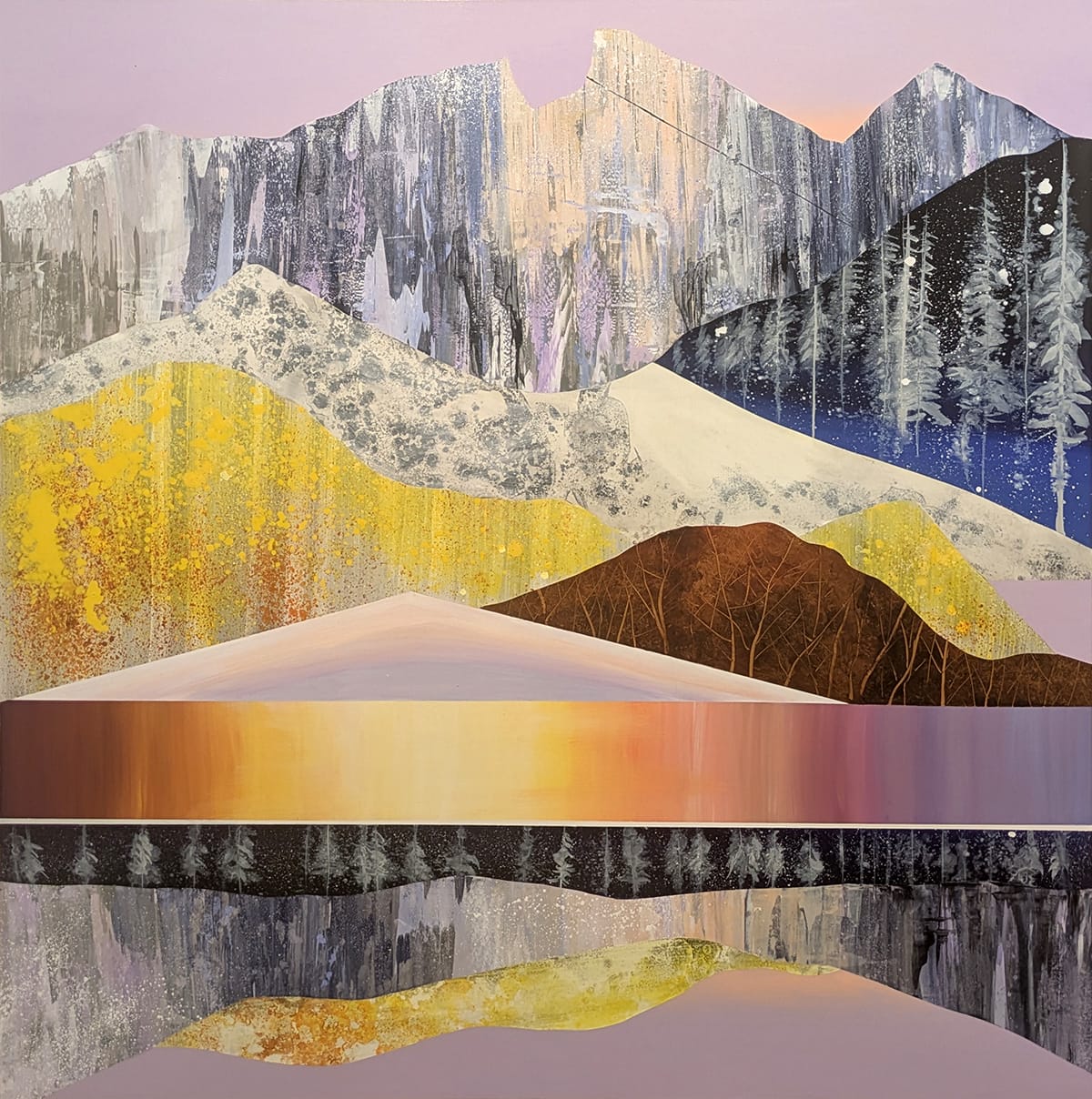
Winkler’s “A Mountain Symphony, Longs Peak, Rocky Mountain National Park, Colorado” pays homage to Sandzén’s painting of the same name. Hers depicts the same landmarks from the same perspective as Sandzén’s, but Winkler’s captures a different time of day and year. Hers is a winter sunset: the trees are dusted with snow and the lake in the foreground is so smooth it looks like it could be covered in ice. This pristine surface displays the reflection of a glowing sunset that we see only a glimpse of in Winkler’s lilac-colored sky, in just a wisp of pale orange above the mountains.
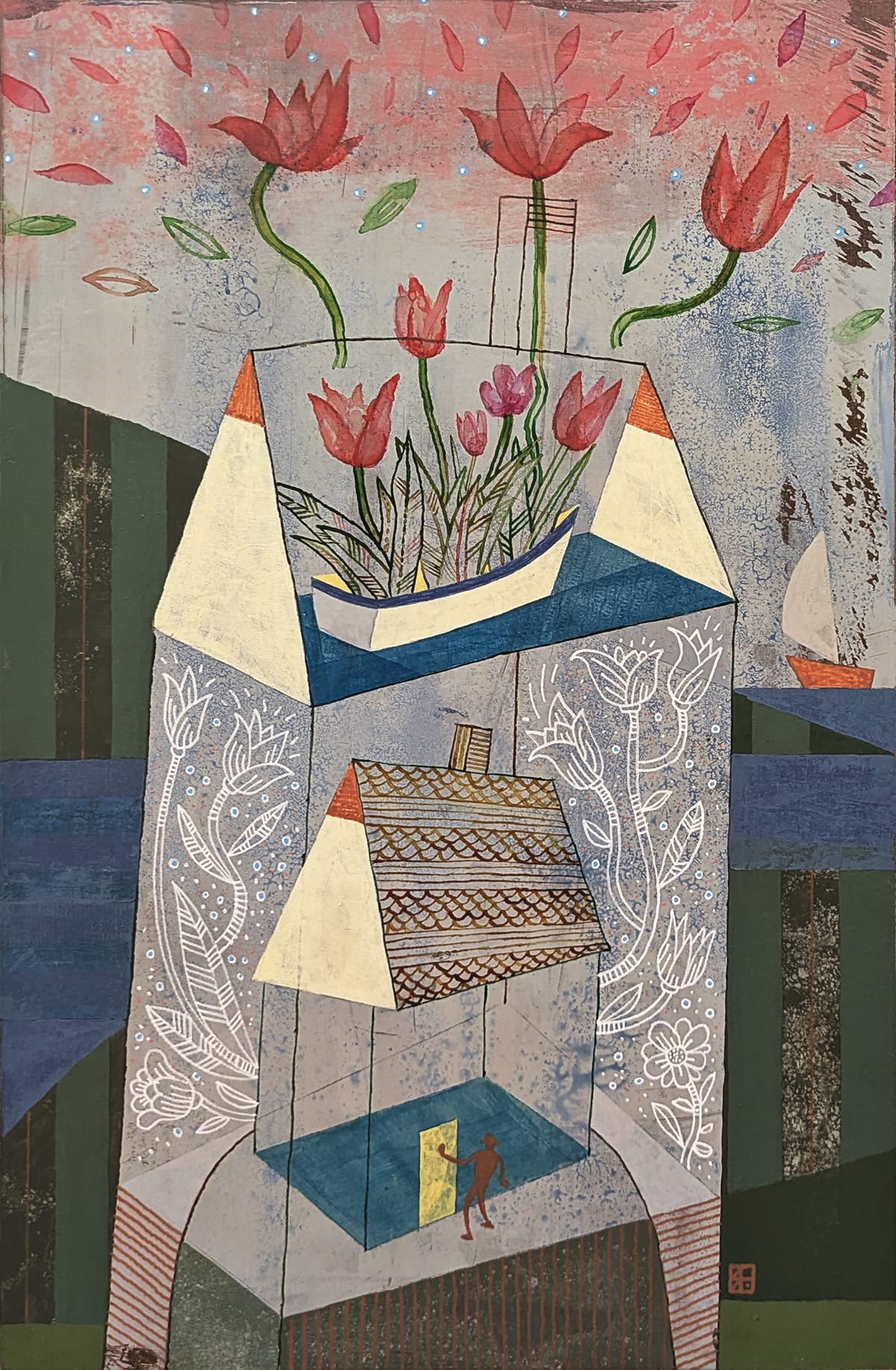
Just around the corner from “The Big Pretty" are the 21 paintings in the exhibition “House Plants,” displayed on both sides of a short hallway. Barry Fitzgerald lives in Lawrence, Kansas, where he is a Professor of Illustration at the University of Kansas. His exhibition, named for its experimentation with combining plants and buildings, rather than for the kinds of plants we keep in our homes, is characterized by a playful restraint.
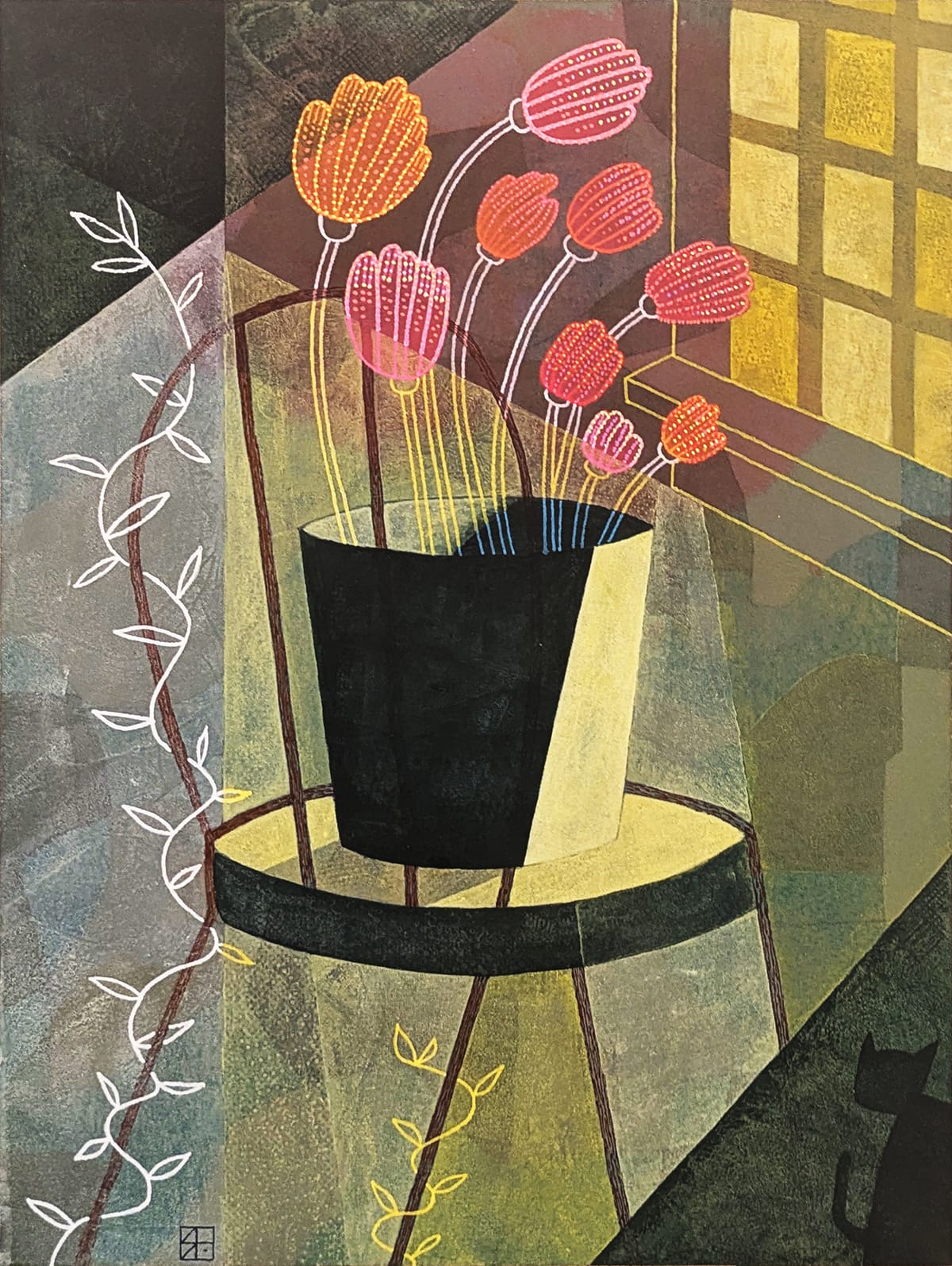
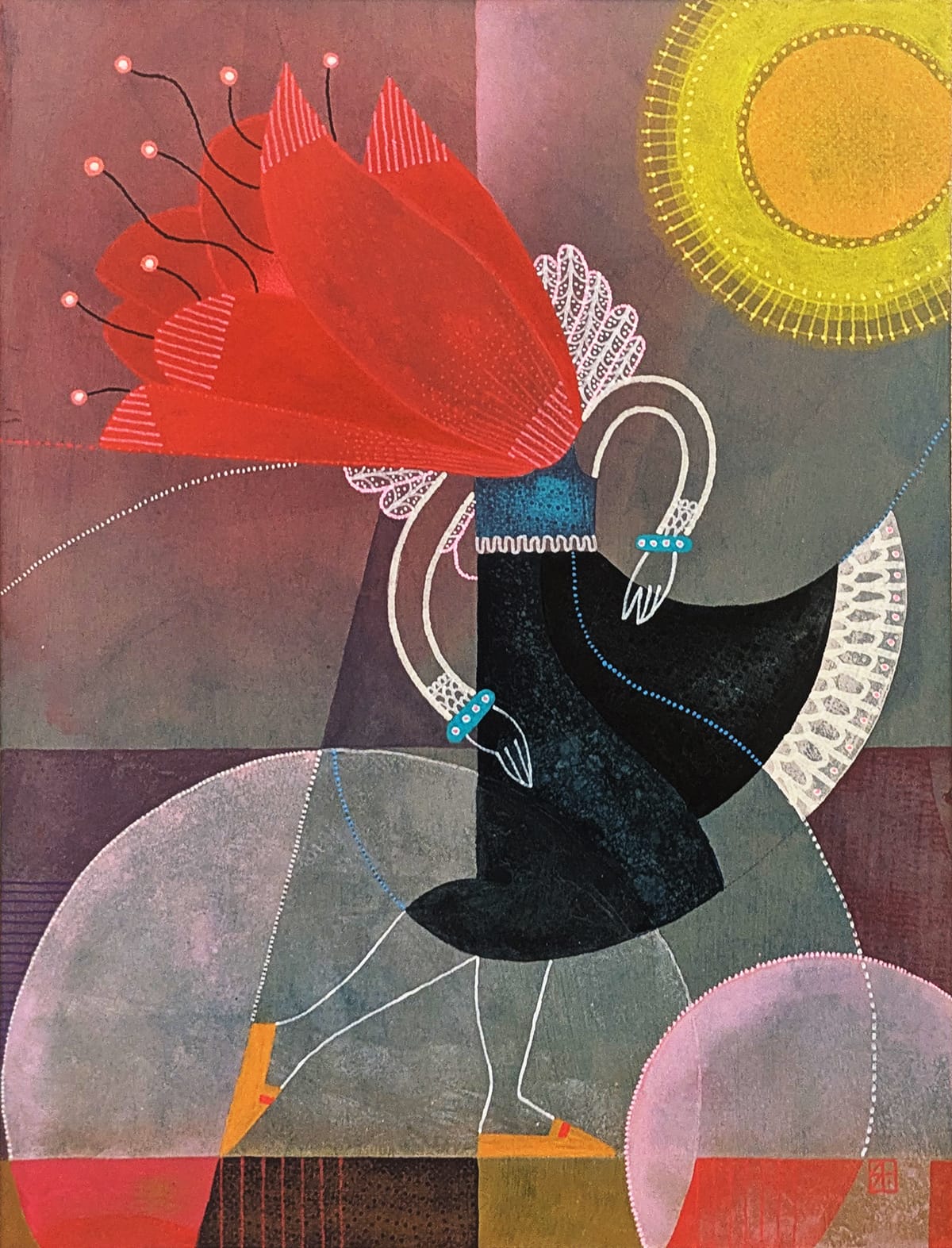
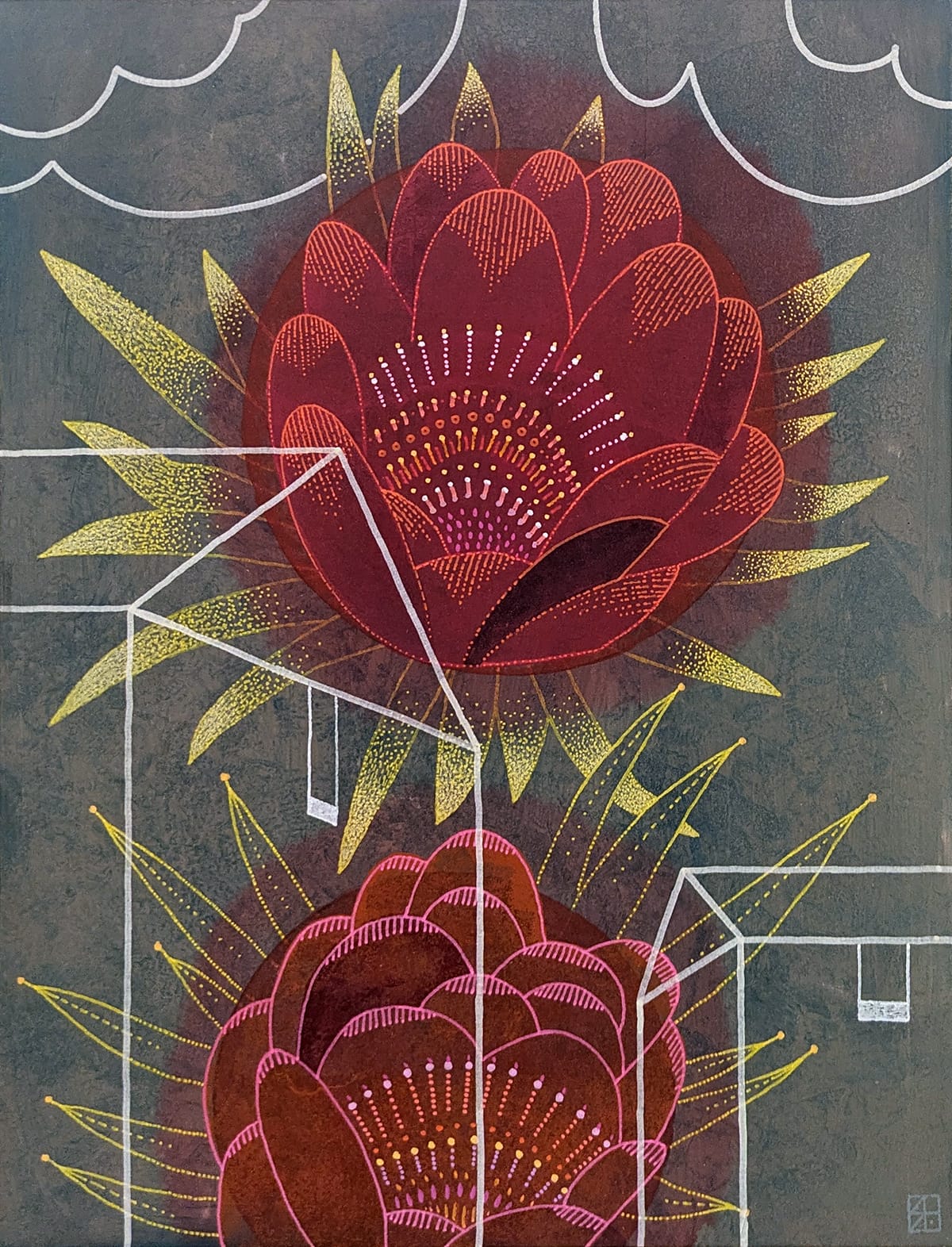
Paintings by Barry Fitzgerald, from left: “Sway,” 2026, acrylic and ink on MDF board, 12 by 16 inches; “Handle with Care,” 2026, acrylic and ink on MDF board, 12 by 16 inches. Photos by Kate Storhoff for The SHOUT.
Upon first glance, the small size (most are about 12 by 16 inches) and quiet color schemes of the paintings belie the humor and cleverness that a longer viewing reveals. All are acrylic and ink on three different surfaces: canvas, MDF board, and Masonite board. Some general characteristics I observed included muted colors with pops of vibrancy; textures created from both tiny and larger-scale patterns (see, for example, the ovals in the sky in both “Open House” and “Springtime Skiff”); and a lively layering of his subjects: plants, buildings, and human forms.
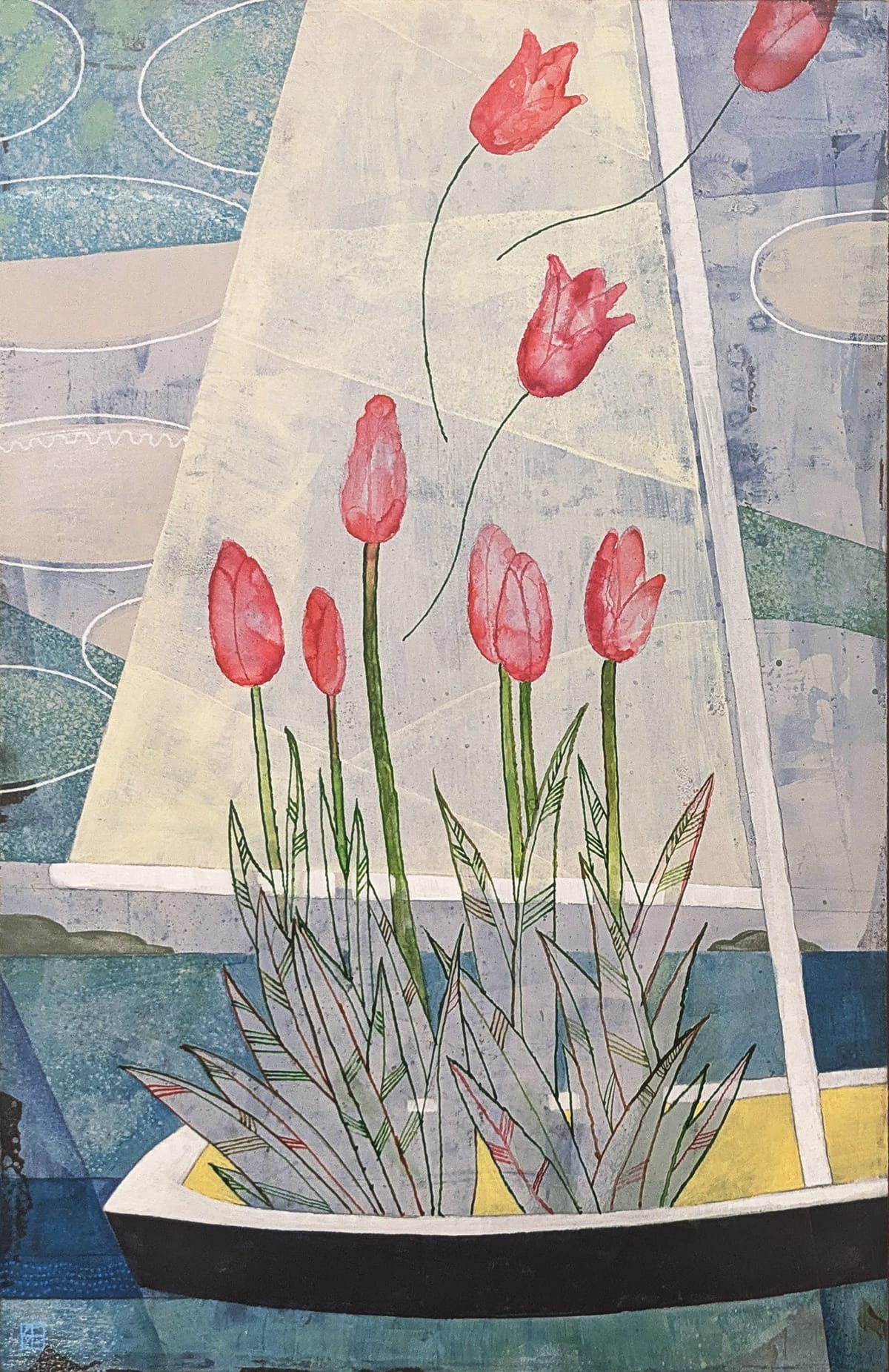
“The final combinations are intended to ask questions more than give answers, although some summations of narratives may linger through the work,” Fitzgerald writes in his artist’s statement.
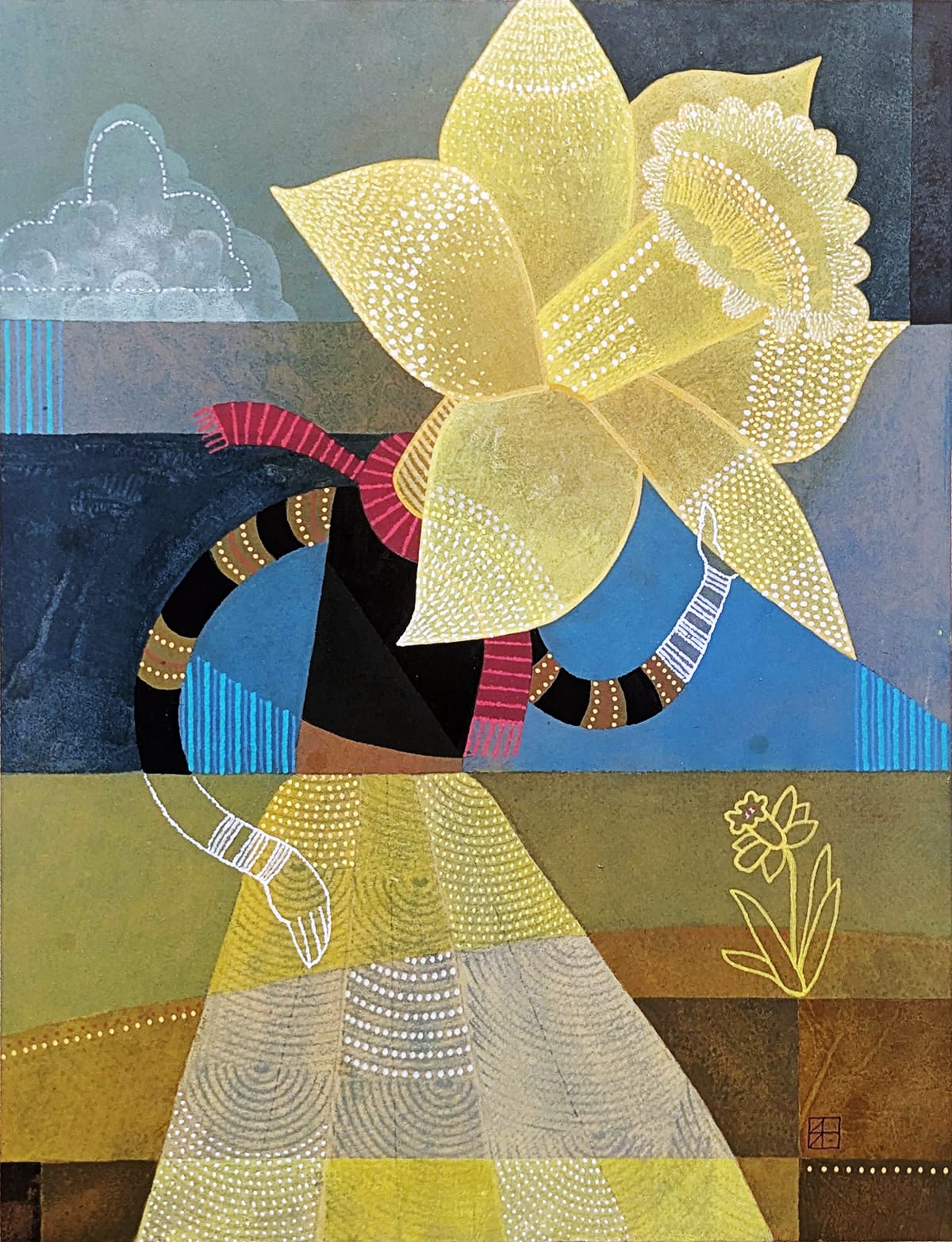
This permission to wonder at his work is key. For example, in “Spring Rain” are we looking at a woman with a flower instead of a head, or a flower with a woman’s body? I like to think it’s the latter; the way the second, smaller daffodil in the picture — this one depicted only as an ink outline with a stem and leaves, rather than a body — looks up at the woman made me think of a mother and child. As I wondered, I enjoyed the details in the work, especially the mirroring in textures such as the tiny dots in the leaves of the large daffodil and the skirt.
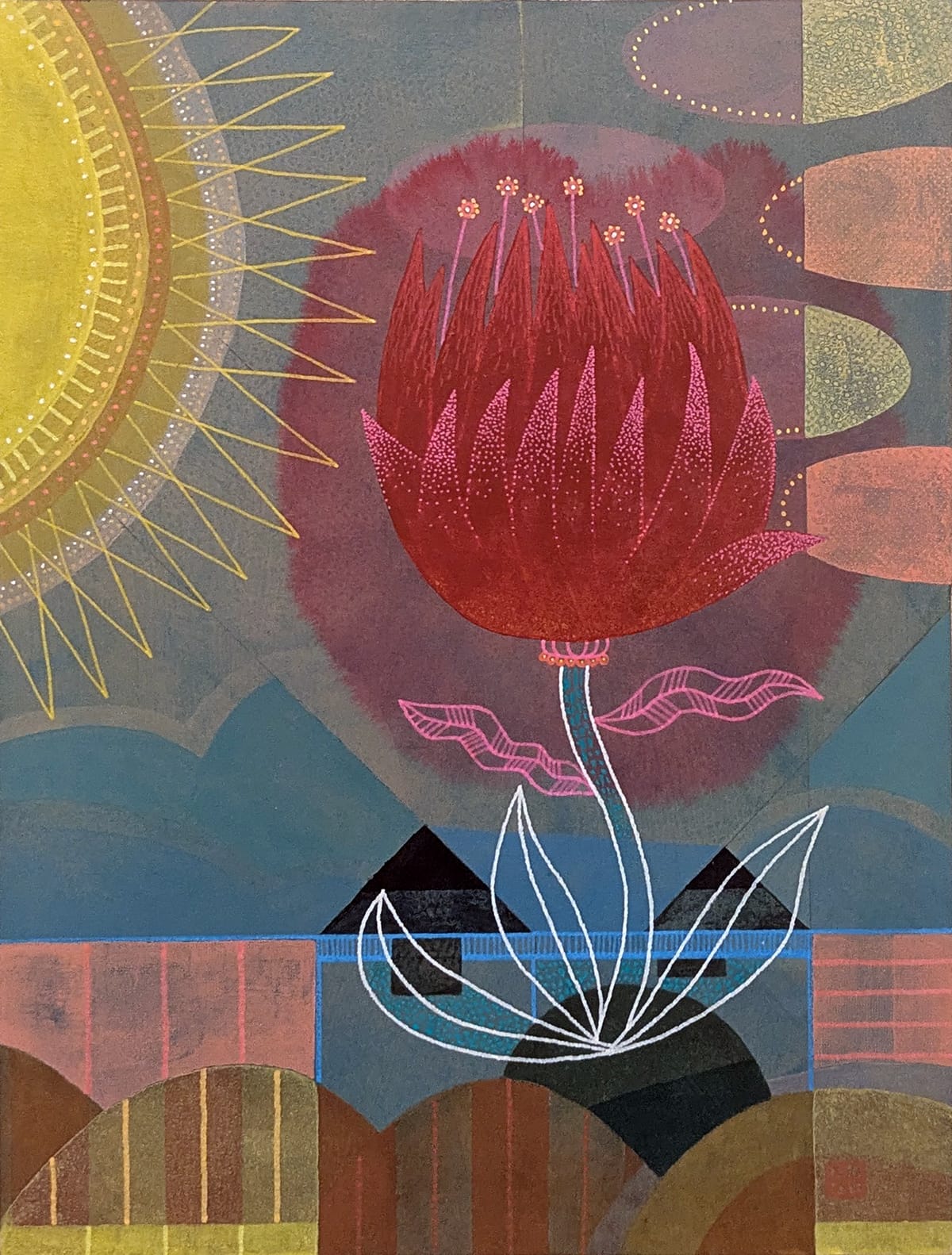
Fitzgerald’s work anthropomorphizes plants and flowers even if they are not affixed to any human body parts. In “Open House,” the central flower growing out of two much smaller houses resonates with a welcoming aura. Its size (and its invasion of the buildings) makes it seem a bit otherworldly, but the way it glows happily in the sunshine marks it as something from our own planet to which we can relate.
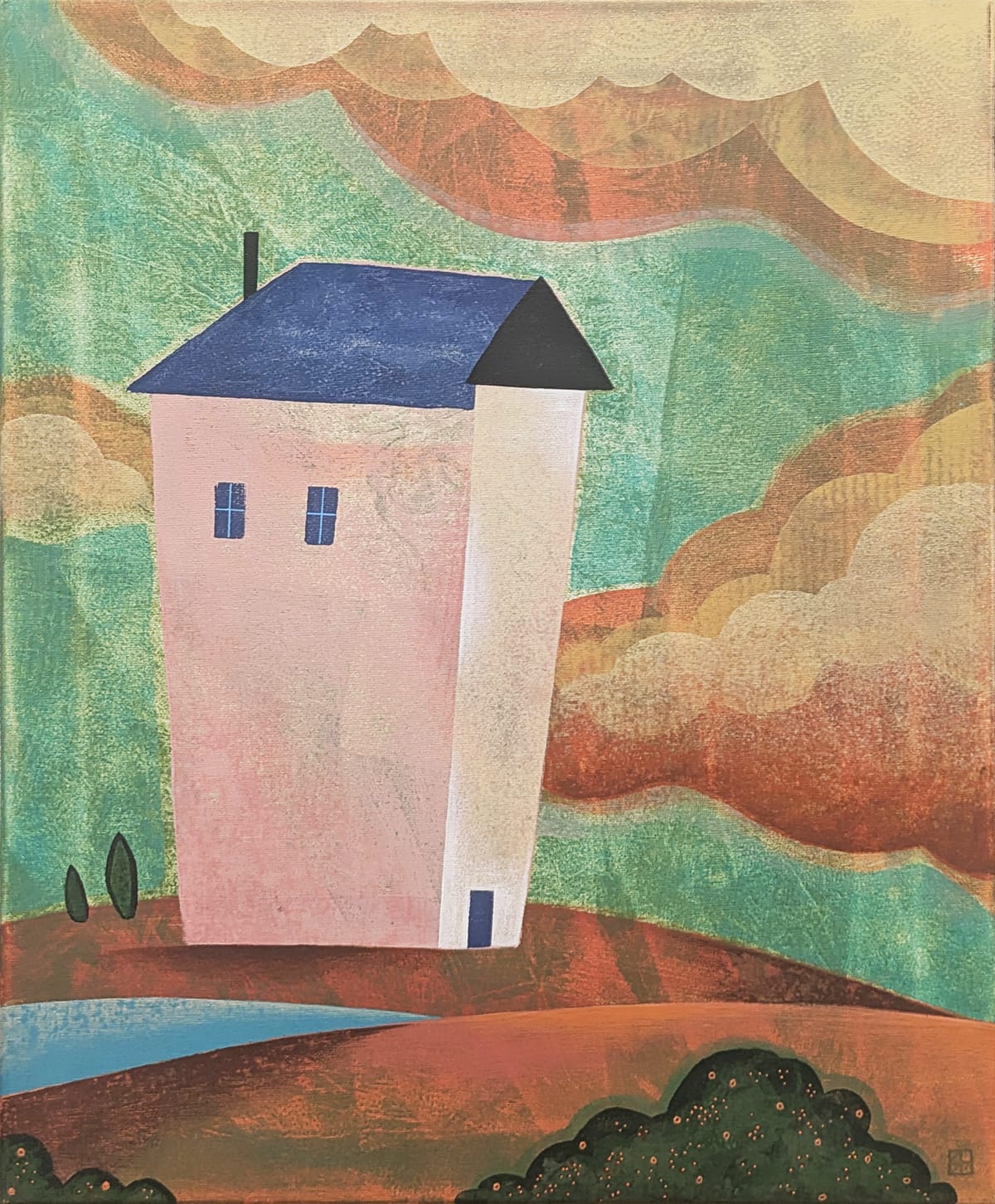
In “Home on the Range,” Fitzgerald displays a quirky, somewhat Seussian aesthetic. The landscape seems recognizable as Kansan hills, which I found refreshingly familiar after immersing myself in Winkler’s Rocky Mountains grandeur. But the whimsical proportions of the house -– its stretched-out body with a tiny door at the bottom, a big gulf of white space, and two tiny windows at the top — suggest a more magical version of a familiar sight. I love the way the house sits atop the highest hill, secure among fluffy clouds in a turquoise sky; it captures the feeling of being at home in a wide-open landscape.
Lindsborg is about an hour north of Wichita, and the Sandzén Gallery alone makes a visit well worth the drive. Before heading back to Wichita, I stopped by the Coronado Heights Castle and took in the best views of Kansas I’ve seen since I moved here almost two years ago. I like to think I studied the landscape differently after spending time with Winkler and Fitzgerald’s art, admiring the sprawling beauty and hunting for playful details.
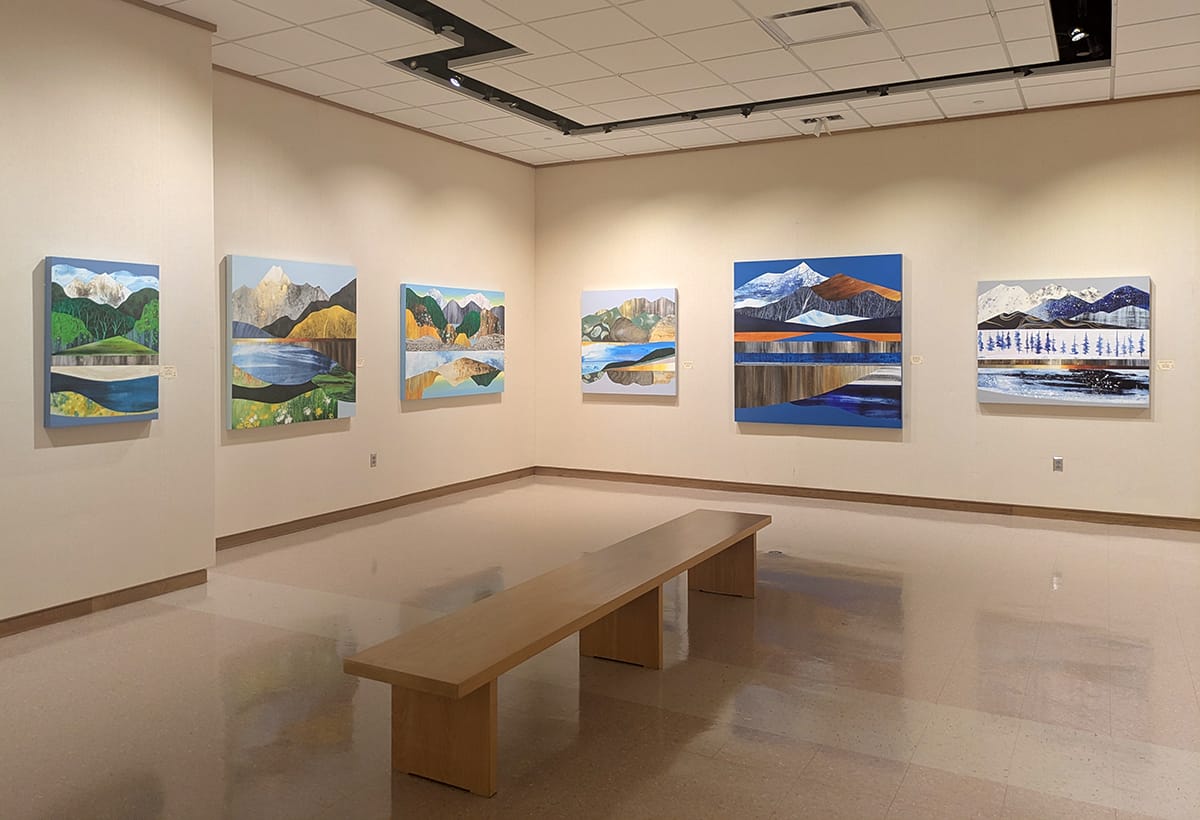
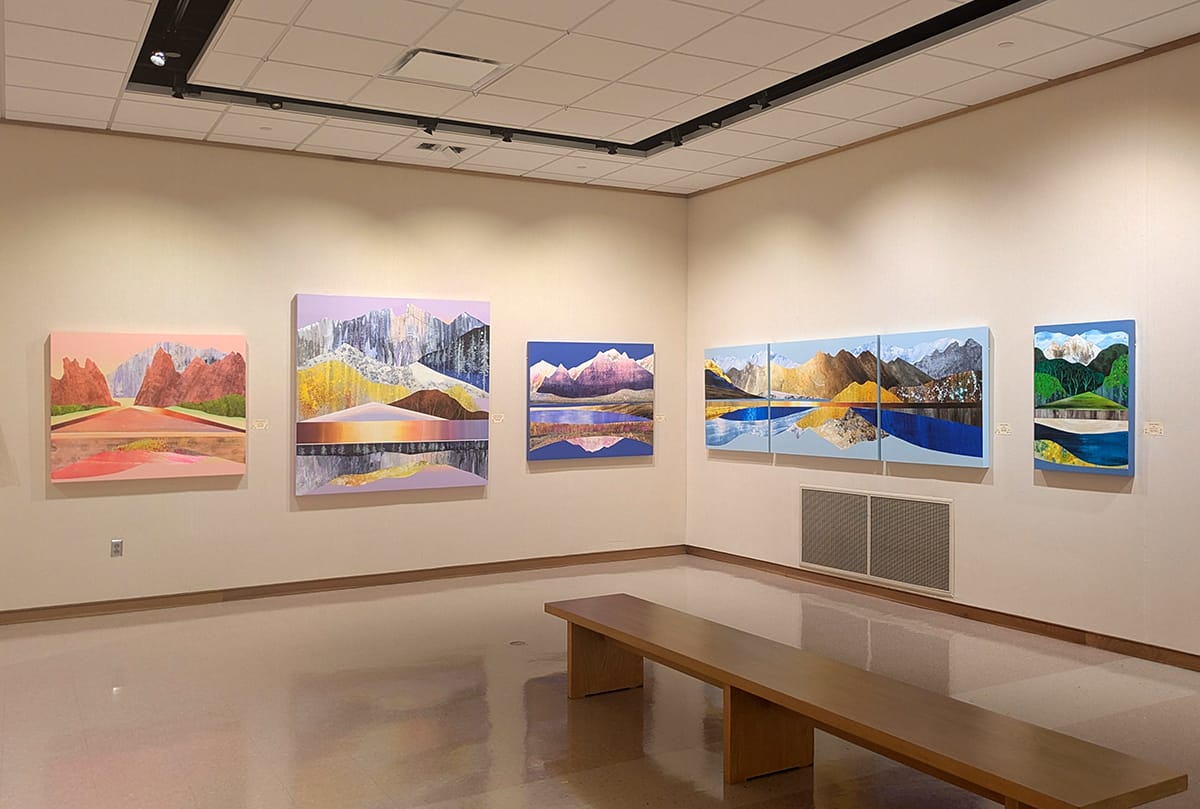
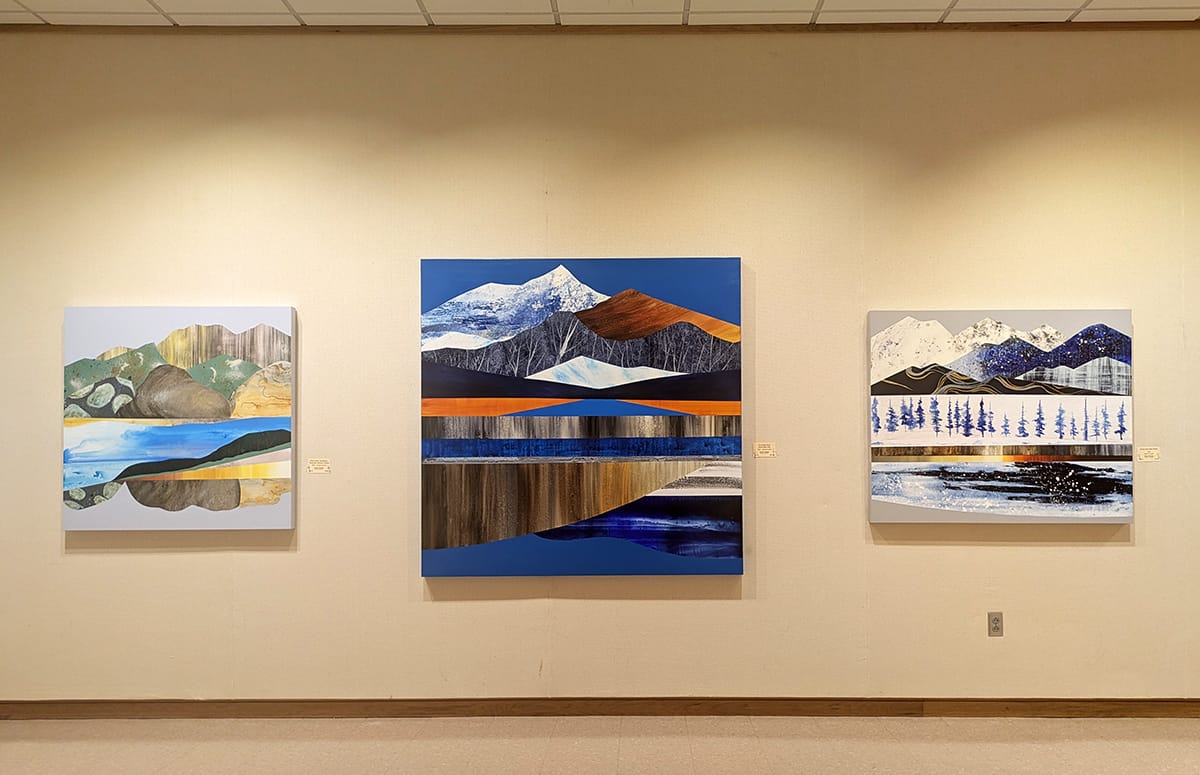
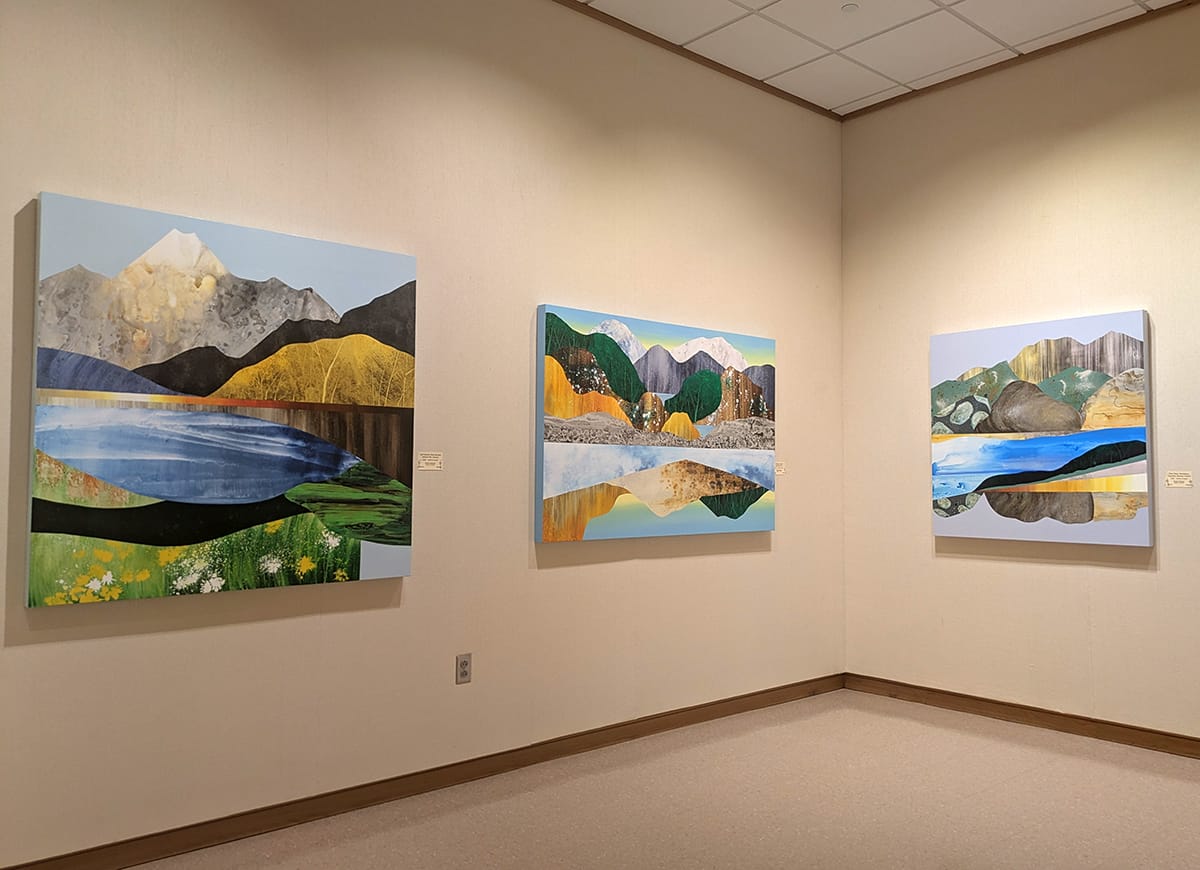
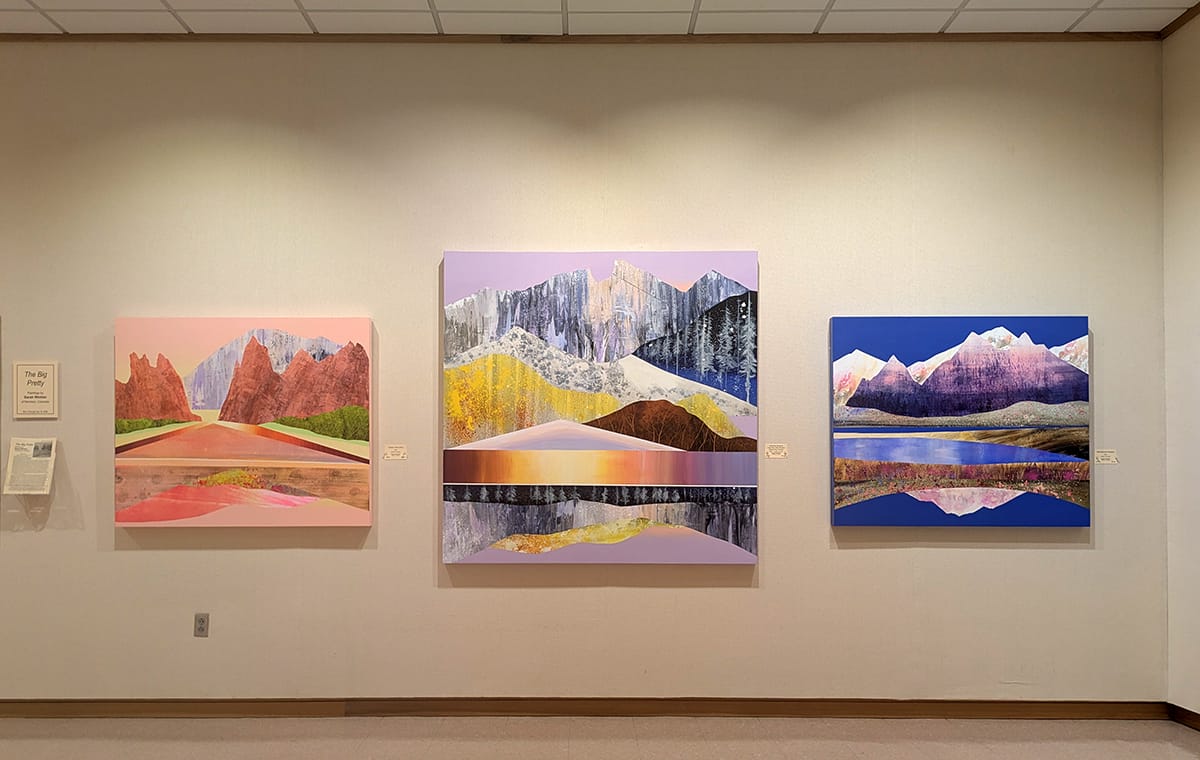
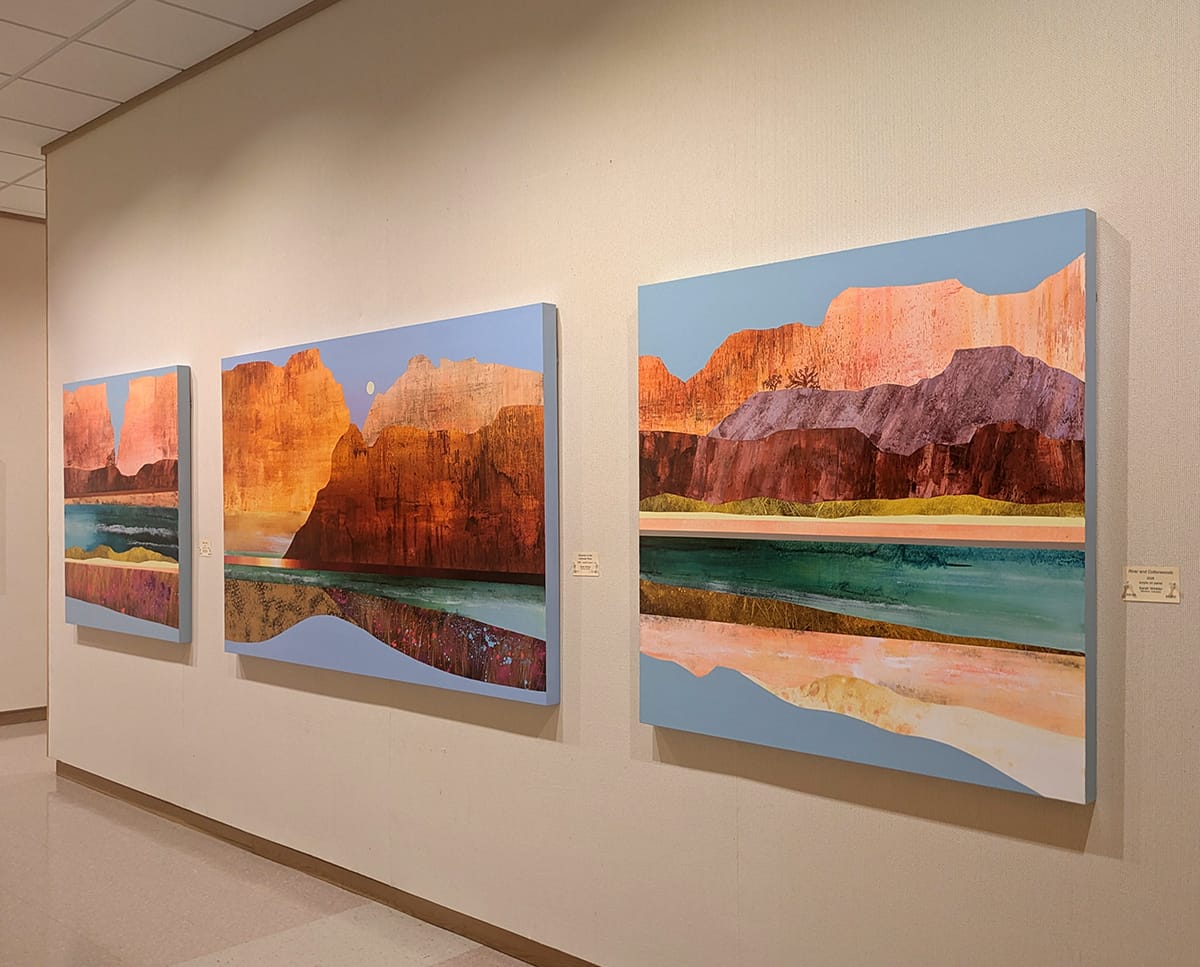
Installation views of the exhibition "The Big Pretty" by Sarah Winkler at the Birger Sandzén Memorial Gallery. Photo by Kate Storhoff for The SHOUT.
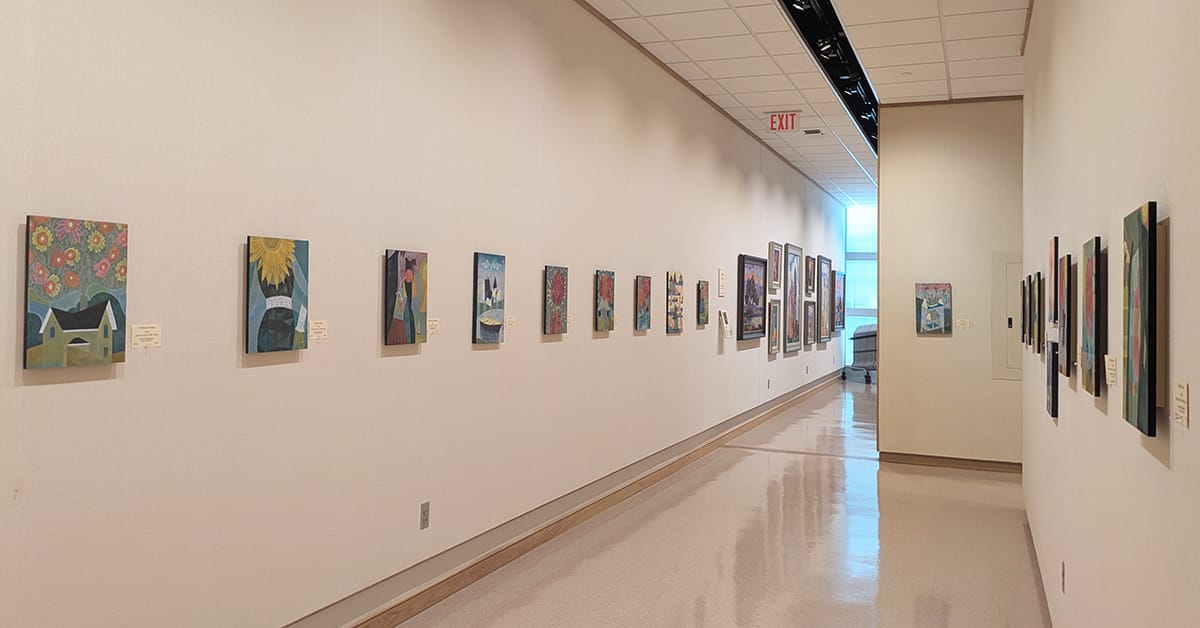
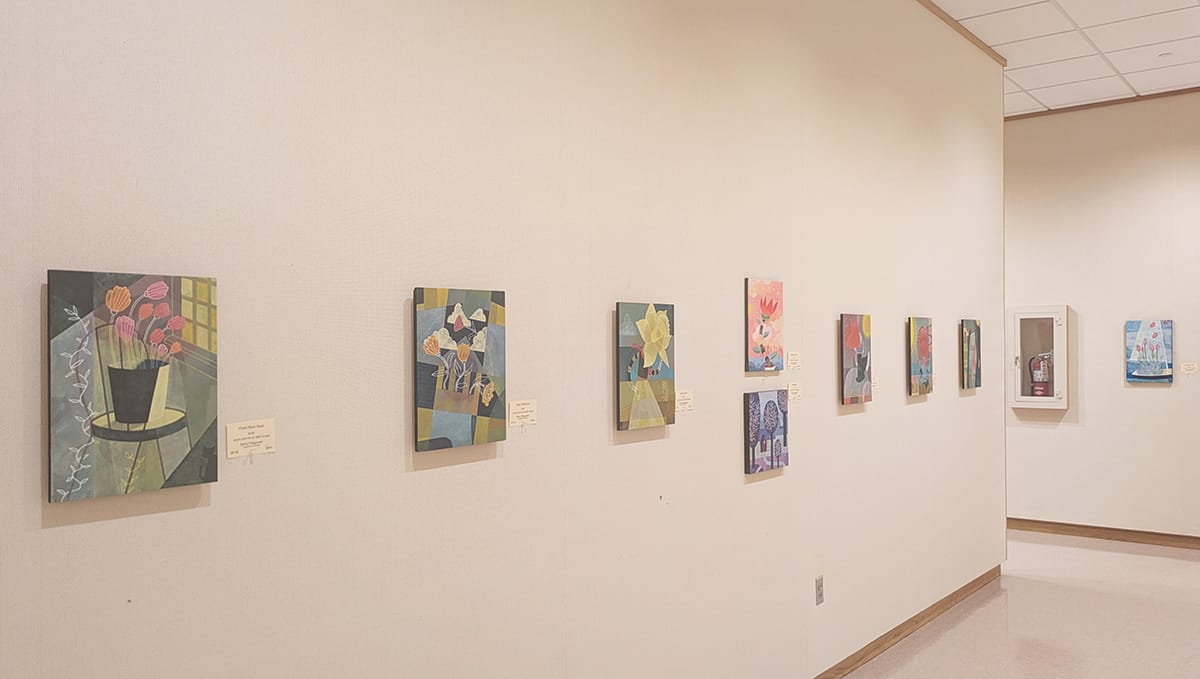
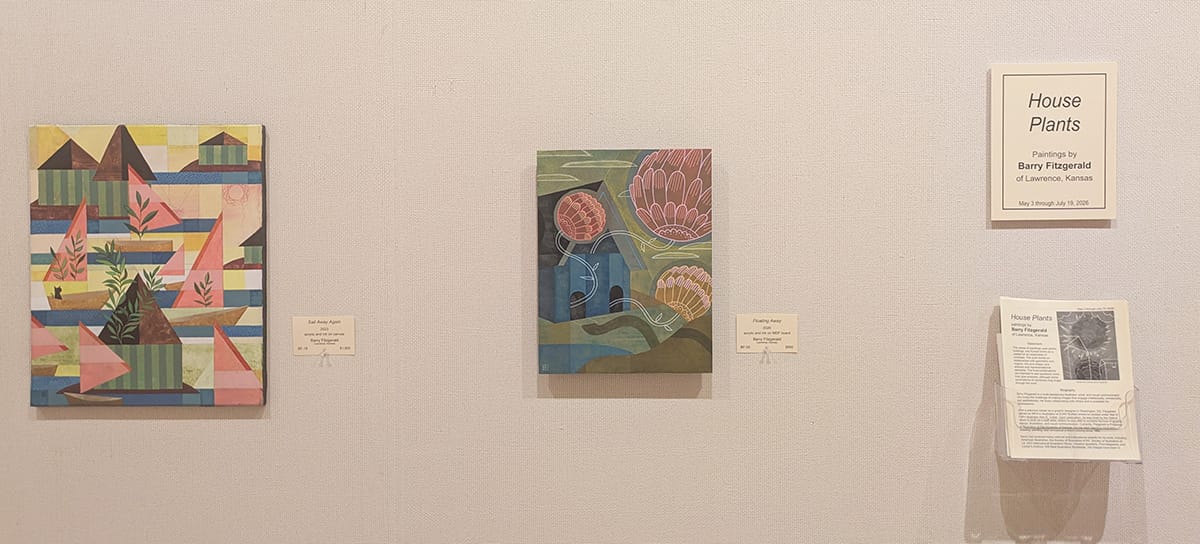
Installation views of the exhibition "House Plants" by Barry Fitzgerald at the Birger Sandzén Memorial Gallery. Photo by Kate Storhoff for The SHOUT.
The Details
"The Big Pretty" by Sarah Winkler & "House Plants" by Barry Fitzgerald
May 3-July 19, 2026 at the Birger Sandzén Memorial Gallery, 401 N. 1st Street in Lindsborg, Kansas
The gallery is open 10 a.m.-5 p.m. Tuesday–Saturday and 1 p.m.-5 p.m. Sunday.
Admission is free, and the facility is accessible to people with physical disabilities.
Learn more about "The Big Pretty" and "House Plants" on the Birger Sandzén Memorial Gallery website.
Kate Storhoff is a musicologist whose research focuses on contemporary American composers. Before moving to Wichita, she managed an independent bookstore and taught at Wake Forest University and the University of North Carolina School of the Arts. She plays the clarinet, piano, and Northumbrian smallpipes.
❋ Derby man has the kind of voice that turns heads — and chairs
❋ Socializing while sober: how some Wichitans are cultivating alcohol-free communities
❋ As a small creative business closes, the owner mourns
❋ Painting through it: Autumn Noire on 20 years of making art
❋ How a guy from Wichita resurrected 'Dawn of the Dead'
❋ Bygone Friends University museum housed curious collections
Support Kansas arts writing
The SHOUT is a Wichita-based independent newsroom focused on artists living and working in Kansas. We're partly supported by the generosity of our readers, and every dollar we receive goes directly into the pocket of a contributing writer, editor, or photographer. Click here to support our work with a tax-deductible donation.