Albert Paley’s 'Paragon' is a symbol of Wichita’s commitment to innovation and growth
Though the 2011 sculpture barely came to be, its impact goes beyond stated references to aviation and Native American history.
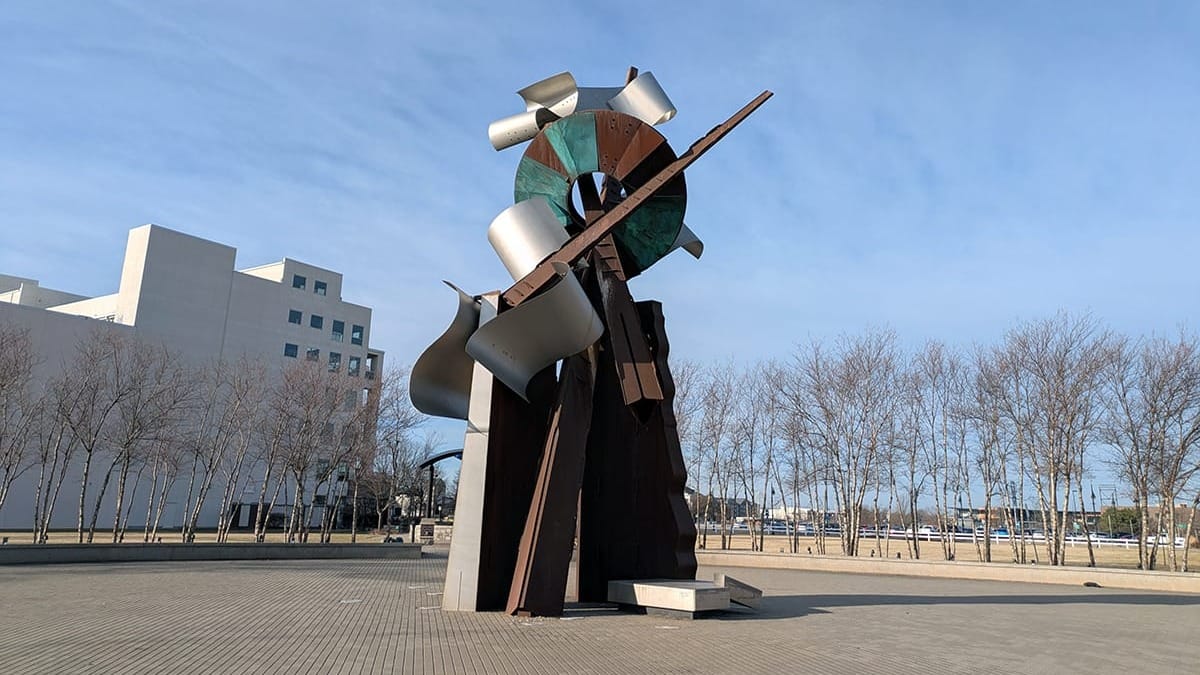
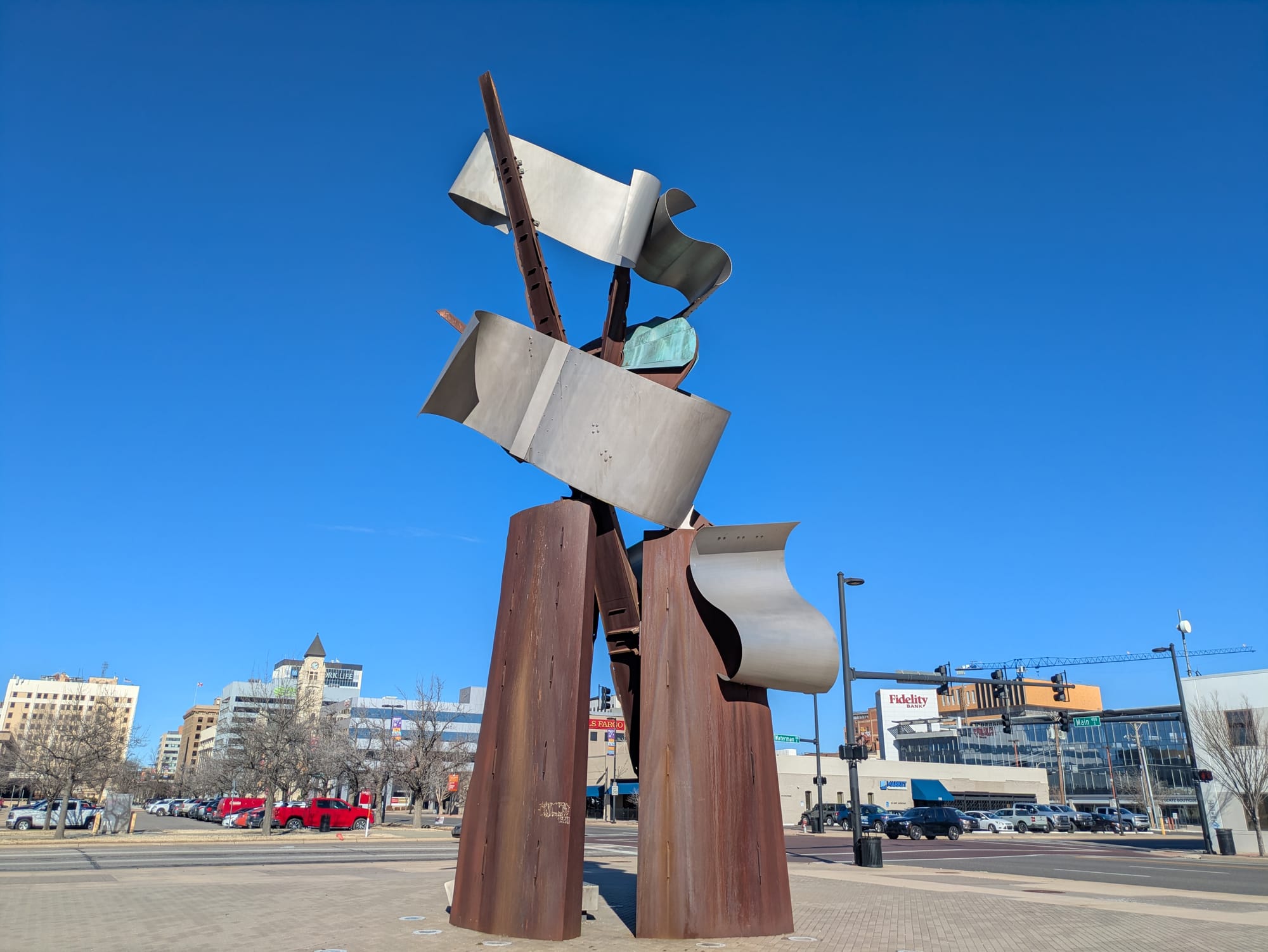
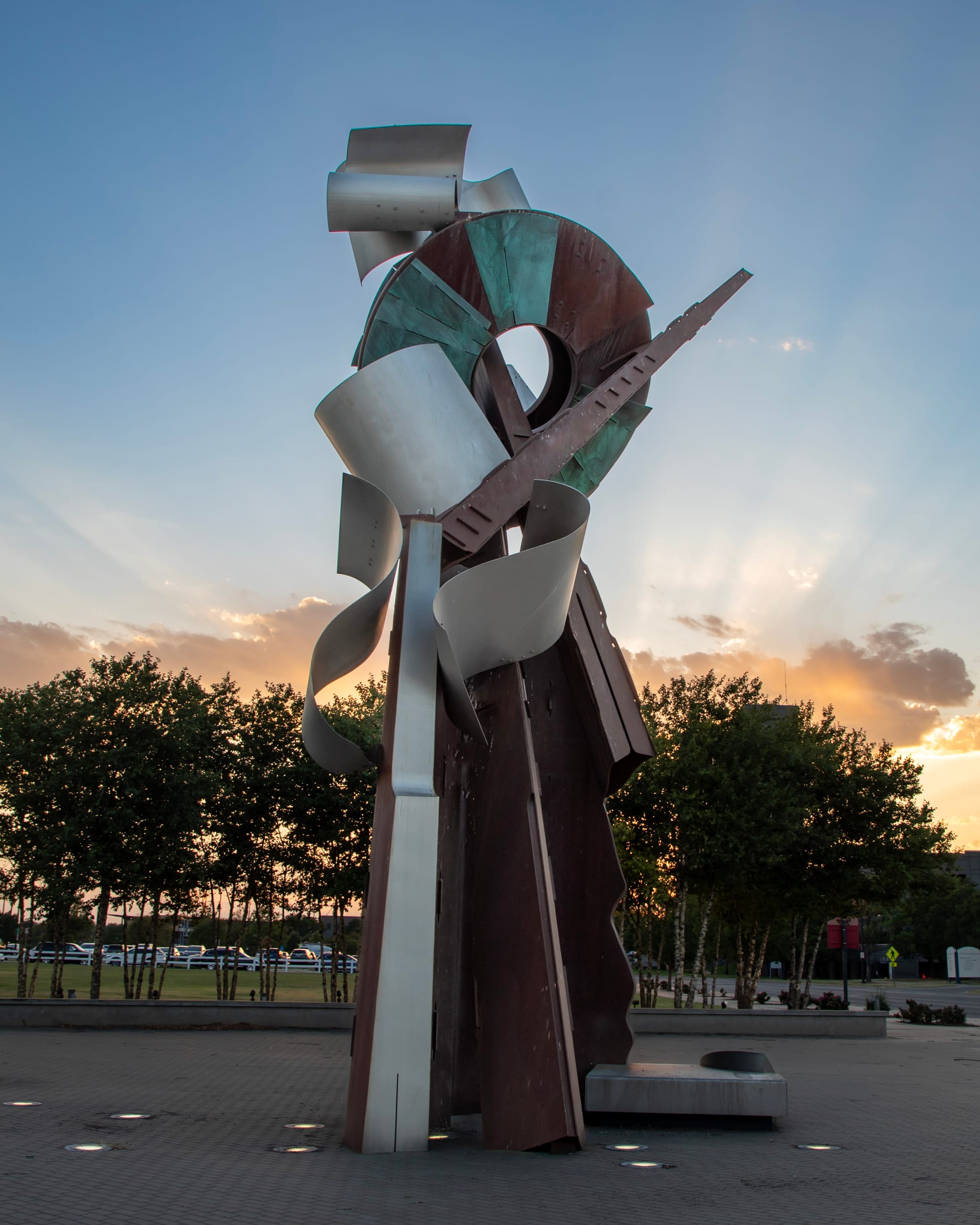
At the corner of Waterman and Main Streets, a massive metal sculpture called “Paragon” stands proudly at almost 40 feet tall, centered in its own square where the sun hits it perfectly at least twice a day. Every time I’ve visited this spectacular piece of art, created by renowned sculptor Albert Paley, I’ve noticed something new, such as the way the sunlight changes the color of the bronze and steel. As I learned more about its history, I realized how lucky we are to have this magnificent piece in our public art collection.
When I moved to Wichita a year and a half ago, one of the first things I noticed about the city was its emphasis on public art. On my first visit, I was intrigued by the statues that populate downtown. Then I started to notice the art built into ordinary structures, like the feathers on the bridges I crossed on my way to the museums, or the gargoyles on the old City Hall. Later, I was delighted to learn that the sheer amount of art scattered throughout Wichita is intentional and something Wichitans regard with pride. Funding for art is built into project budgets and since 2019 has been paid for through the Two Percent for Art Ordinance.
As many readers will know, Wichita launched the WaterWalk East Bank redevelopment project in September 2002 with the goal to transform space along the Arkansas River into a mixed-use district where residents can live, shop, dine, and walk. The project included plans for public art with the purpose of enhancing the aesthetics of the space and attracting investment. In 2010, the City of Wichita issued a national request for proposals for the WaterWalk Art Project. After a review of 16 national and three local artist proposals, the committee selected American sculptor and metalsmith Albert Paley and chose the corner of Waterman and Main as the site for his project.
Paley, born in 1944 and based in Rochester, New York, is one of the country’s most respected and innovative metal sculptors. He credits a 1974 commission from the Renwick Gallery of the Smithsonian American Art Museum as a pivotal moment in his career, when he moved from focusing on jewelry and body ornamentation to creating more architectural pieces. Since then, he has spent half a century creating site-specific sculptures that can be viewed all over the United States and internationally.
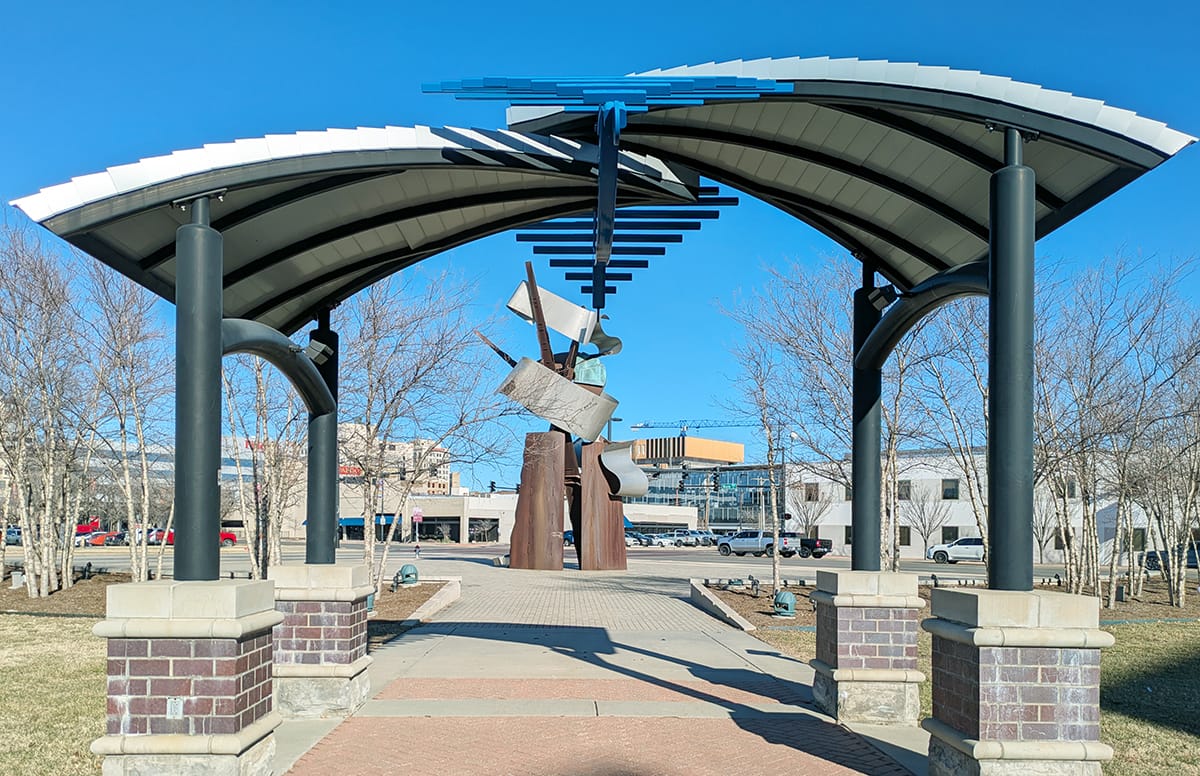
His impressive portfolio made the committee’s choice easy; a report from the City Council Meeting on September 14, 2010, records that Paley was selected “based on his experience and prestige as a public artist, the size and scope of his previously completed public art projects, and the creative possibilities of the design concepts he proposed.”1
In May 2011, the City Council approved the sculpture in a 4-3 vote, finalizing a budget of $350,000 drawn from tax increment finance money that was earmarked for use in the WaterWalk district. The budget included fabrication and construction as well as Paley’s fee. Paley and the architect for the project got to work quickly, and “Paragon” was completed in October 2011.
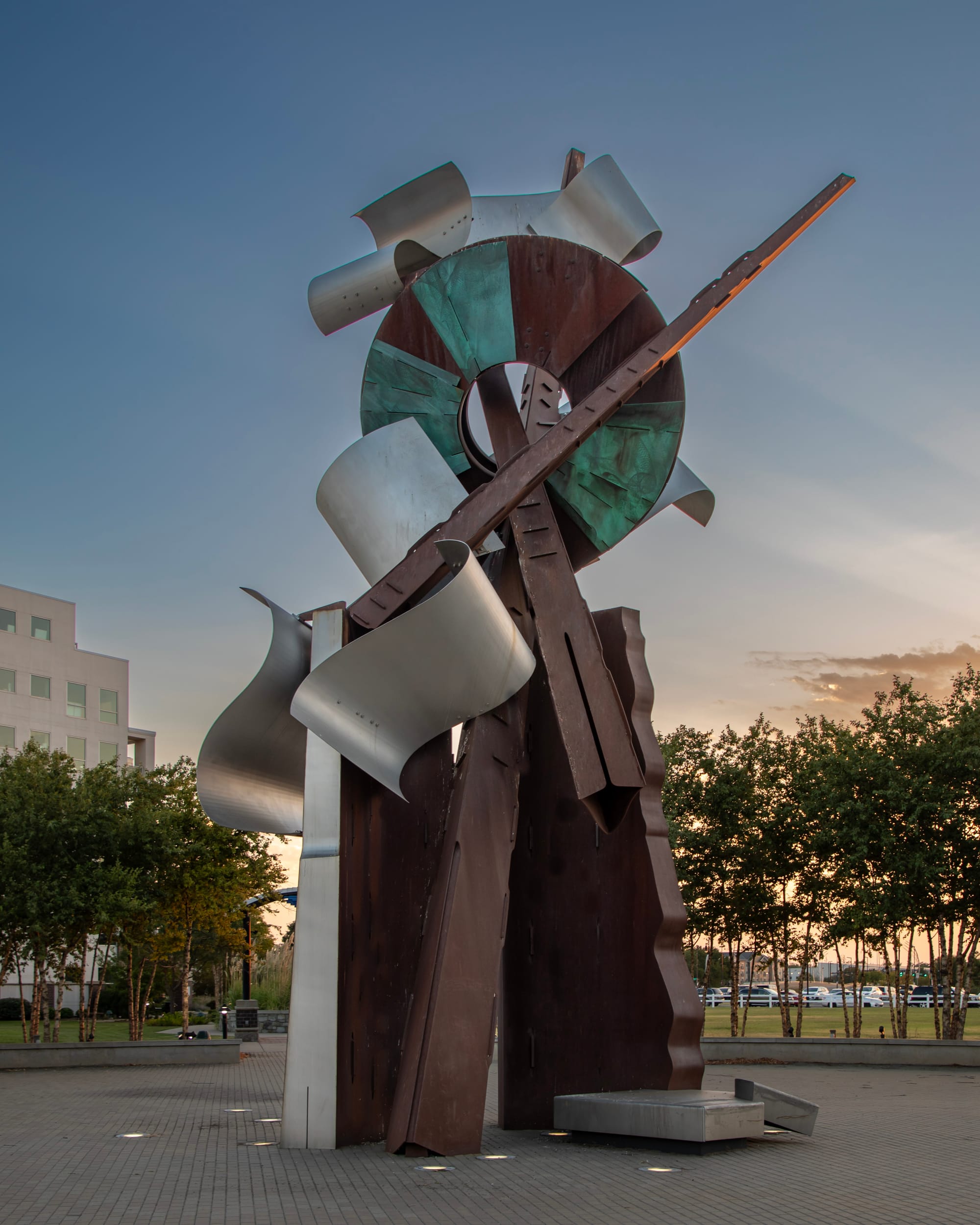
Like many of Paley’s outdoor sculptures, “Paragon” is constructed of Cor-Ten (weathering) steel, stainless steel, and bronze. The design represents Wichita’s Native American heritage and its significance as a center of the aviation industry. “Paragon” can be viewed from all angles, but if you stand at the corner of Waterman and Main Streets, looking toward the WaterWalk, you will see three vertical rectangular blocks of Cor-Ten steel adorned with curved stainless steel, with two long thin bars of rust-colored steel crossing each other and reaching upward toward the sky. One of the bars passes through the centerpiece of the sculpture, a wheel-like circle constructed in steel and bronze, topped with additional lighter stainless steel decorations.
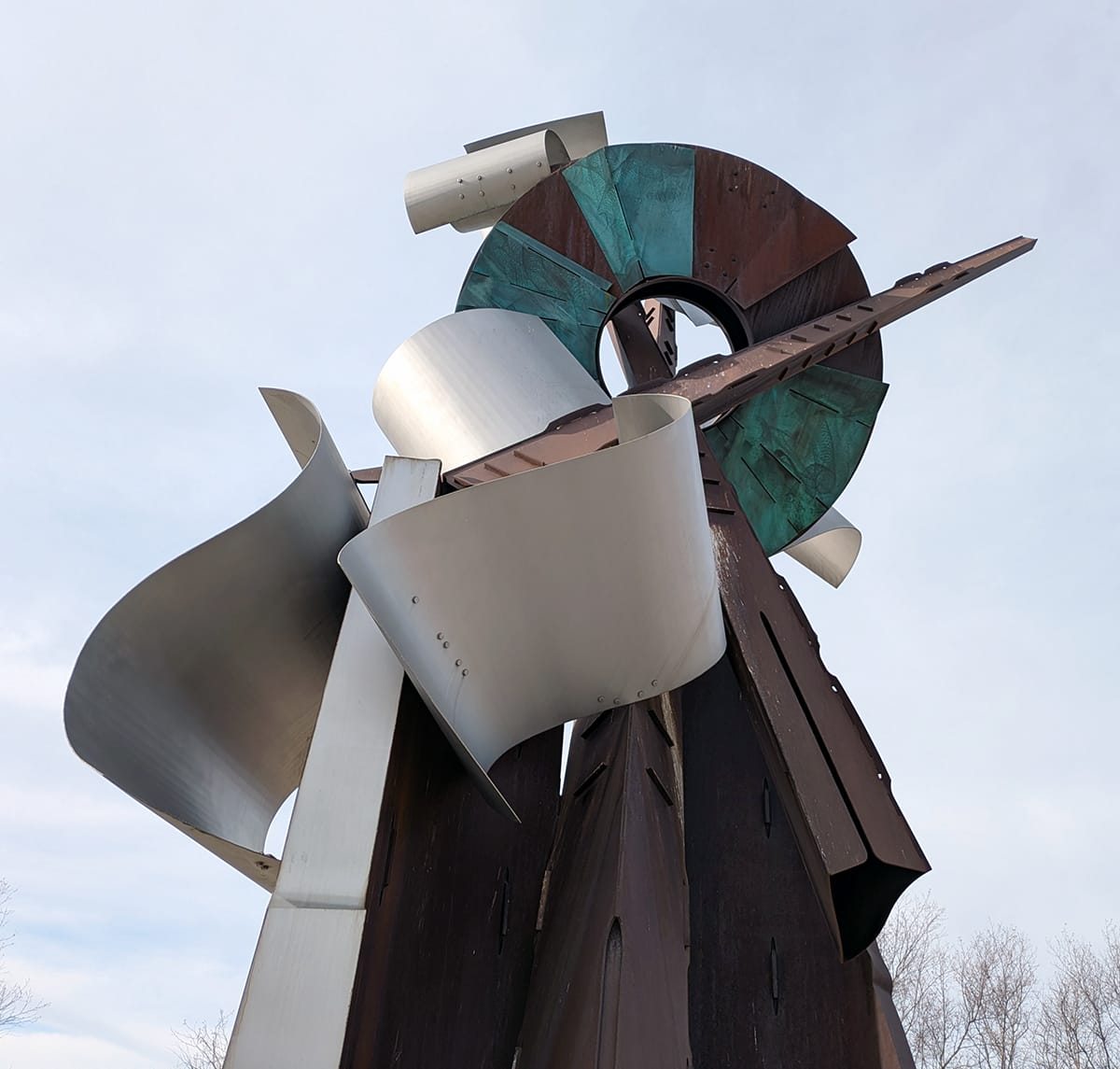
Paley selected his materials in colors special to indigenous Americans: rust-colored Cor-Ten steel, silver stainless steel, and teal oxidized bronze. Both the Cor-Ten steel and the bronze grew into their colors naturally over time. The steel rusted over a short period of time after it had been exposed to the elements, a quality of Cor-Ten steel that allows it to develop this color and texture without damaging the structural integrity. The bronze oxidized to turn green.
To reference flight, Paley incorporated shapes similar to “Feather Towers” — the sculptures built into the bridges that cross the Arkansas River — as well as in the way the sculpture reaches for the skies. Resting atop three Cor-Ten and one stainless steel planer column, stainless curlicues and brown Cor-Ten spires jut out in all directions and pierce through a Cor-Ten and verdigris circle. The bronze-decorated circle immediately draws the eye and recalls a wheel, or even a propeller, and the Cor-Ten steel bars that pass through and around it are rugged, appearing as if they were taken straight from an old piece of machinery. All of Paley’s references come together in the contrast between the hard lines of the bars and base made from the rougher weathering steel with the fluid, natural curves of the stainless steel that decorates the top and sides.
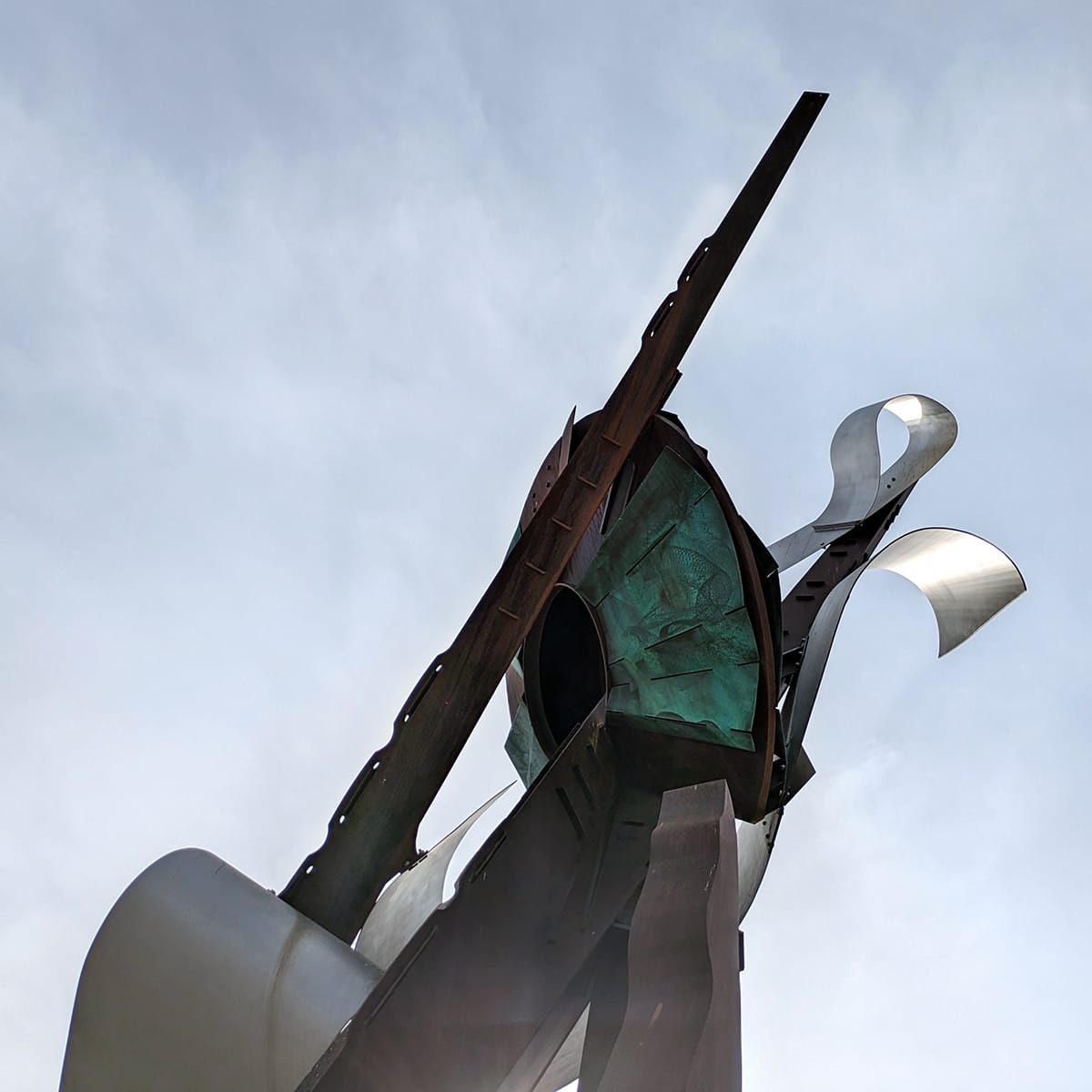
“Everyone thinks of steel as inorganic or industrial or impersonal,” said Paley in a video interview for the Smithsonian. “When it’s actually being heated, it’s moving, like a dancer. And then it cools and it’s frozen. When people see my work, you experience motion, emotionally.”
I love this idea of experiencing motion in a sculpture, especially Paley’s emphasis on finding emotion in steel. I am not a visual artist; I am a classical musician and music historian. My expertise is in art that unfolds over time, that is constantly in motion and is never the same twice. But as I got to know “Paragon,” I found many of the same qualities present in this sculpture.
One of my favorite pieces of music is “Inuksuit” by John Luther Adams. A site-determined piece, it changes every time it is played based on the location in which it is performed. “Paragon” is the opposite: It’s site-specific, designed specifically for its location. Yet, like music, it changes every time it is viewed.
The location is part of the magic of “Paragon.” It is best observed in the sunlight, ideally early in the morning when the sun hits it from the east, or in the evening as the sun sets behind it. The sunlight and shadows impact the textures and shades of the steel and bronze. On a cloudy day, the oxidized bronze pops against the sky. Once you know what to look for, you’ll spot something new every time you pass the sculpture.
The stated “goal impact” of this art project was to elevate quality of life, and I can vouch for the fact that the time I’ve spent with “Paragon” has enhanced my experience of Wichita. But I am curious about whether the more specific goals were reached. Part of the initial hope behind this commission was to provide a visual bridge that connected existing hubs like Century II with the new WaterWalk; it would create an aesthetic focal point to welcome visitors to the area and, perhaps more importantly, encourage further development.2
However, much of what was hoped for the WaterWalk has not yet come to pass. As a new Wichitan, sometimes it seems to me like mentioning the WaterWalk means opening a can of worms. While it could be argued that 2011 was the wrong time to commission this piece of art (to be fair, the three council members who voted “no” voiced these opinions to the Wichita Eagle), I think this misses the point of what “Paragon” represents.
I am not sure what Paley intended when he named his sculpture, but if a paragon is a perfect example or representation of something, perhaps our “Paragon” can be understood as a symbol of our city that goes beyond the stated references to aviation and Native American history. To me, this includes Wichita’s commitment to the arts and its legacy as a place where innovation can thrive. Building “Paragon” in 2011 was a visible commitment and tribute to Wichita's growth, and we can be reminded of these aspirations when we view the sculpture today.
The Details
Paragon
Steel (alloy), stainless steel, and bronze (metal)
Located at 100 E. Waterman St. in downtown Wichita.
"Paragon" is part of the City of Wichita Public Art Collection
Learn more on the Public Art Archive page for "Paragon."
1 Thank you to Jana Erwin, Wichita’s public art manager, for providing me with the records in her collection about “Paragon.”
2 A year after “Paragon” was constructed, the City installed the Fountains at WaterWalk, also with the stated goal to “support aesthetics and quality of life in the core area and encourage economic development near the river.”
Kate Storhoff is a musicologist whose research focuses on contemporary American composers. Before moving to Wichita, she managed an independent bookstore and taught at Wake Forest University and the University of North Carolina School of the Arts. She plays several instruments.
❋ Derby man has the kind of voice that turns heads — and chairs
❋ Socializing while sober: how some Wichitans are cultivating alcohol-free communities
❋ As a small creative business closes, the owner mourns
❋ Painting through it: Autumn Noire on 20 years of making art
❋ How a guy from Wichita resurrected 'Dawn of the Dead'
❋ Bygone Friends University museum housed curious collections
Support Kansas arts writing
The SHOUT is a Wichita-based independent newsroom focused on artists living and working in Kansas. We're partly supported by the generosity of our readers, and every dollar we receive goes directly into the pocket of a contributing writer, editor, or photographer. Click here to support our work with a tax-deductible donation.