A tail of a whale/a wail of a tale: On Harry Bertoia’s 'Interrupted Flight'
Much like the structure itself, the history of Bertoia's sculpture is winding and complicated.
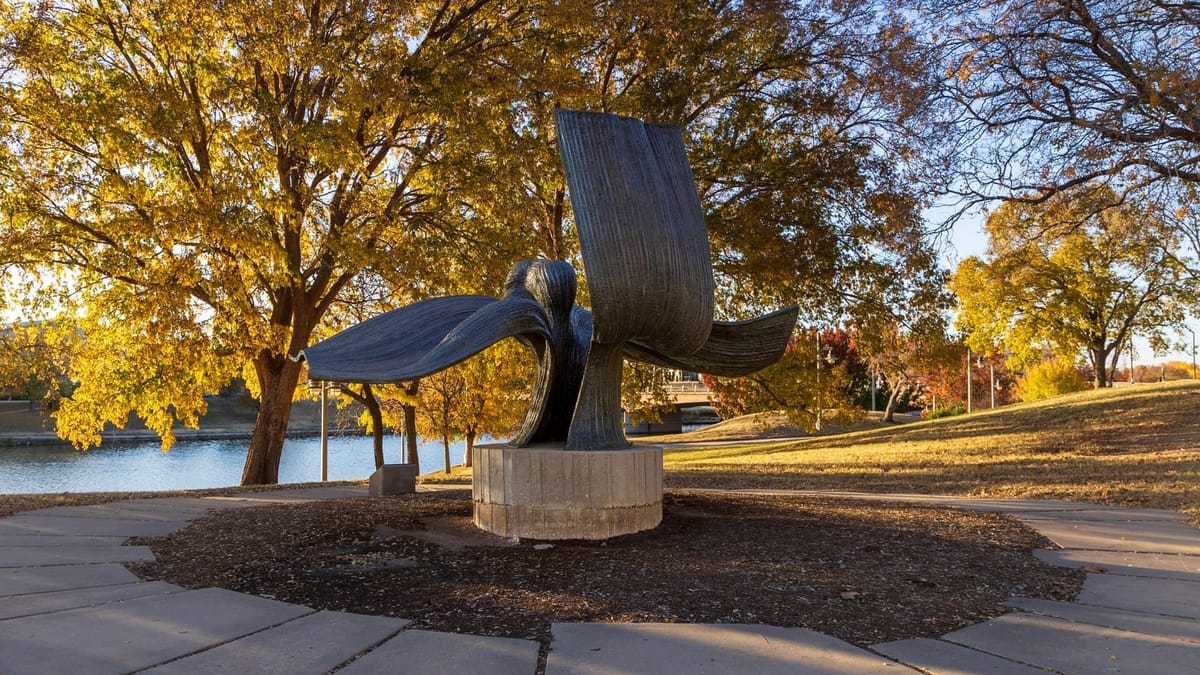
Tucked away amid a copse of trees situated between Century II and the east bank of the Arkansas River stands one of Wichita’s finest — and, arguably, most underappreciated — of its 212 pieces of public art. Titled “Interrupted Flight,” the piece by sculptor and designer Harry Bertoia (1915-1978) was placed in its current location 50 years ago, in September 1975.
As the plaque next to the sculpture will inform you, it was commissioned to honor A. Price Woodard, Jr. (1919-1972), a Wichita lawyer, school board member, and the first elected African American city council member who, from 1970 to 1971, exactly a century after Wichita’s founding, also served as the city’s first Black mayor.[1] Woodard passed away unexpectedly in 1972. In addition to memorializing him with the Bertoia sculpture, the city also honored Woodard by naming the riverside A. Price Woodard, Jr. Park, in which the sculpture sits, and the A. Price Woodard neighborhood in northeast Wichita after him.
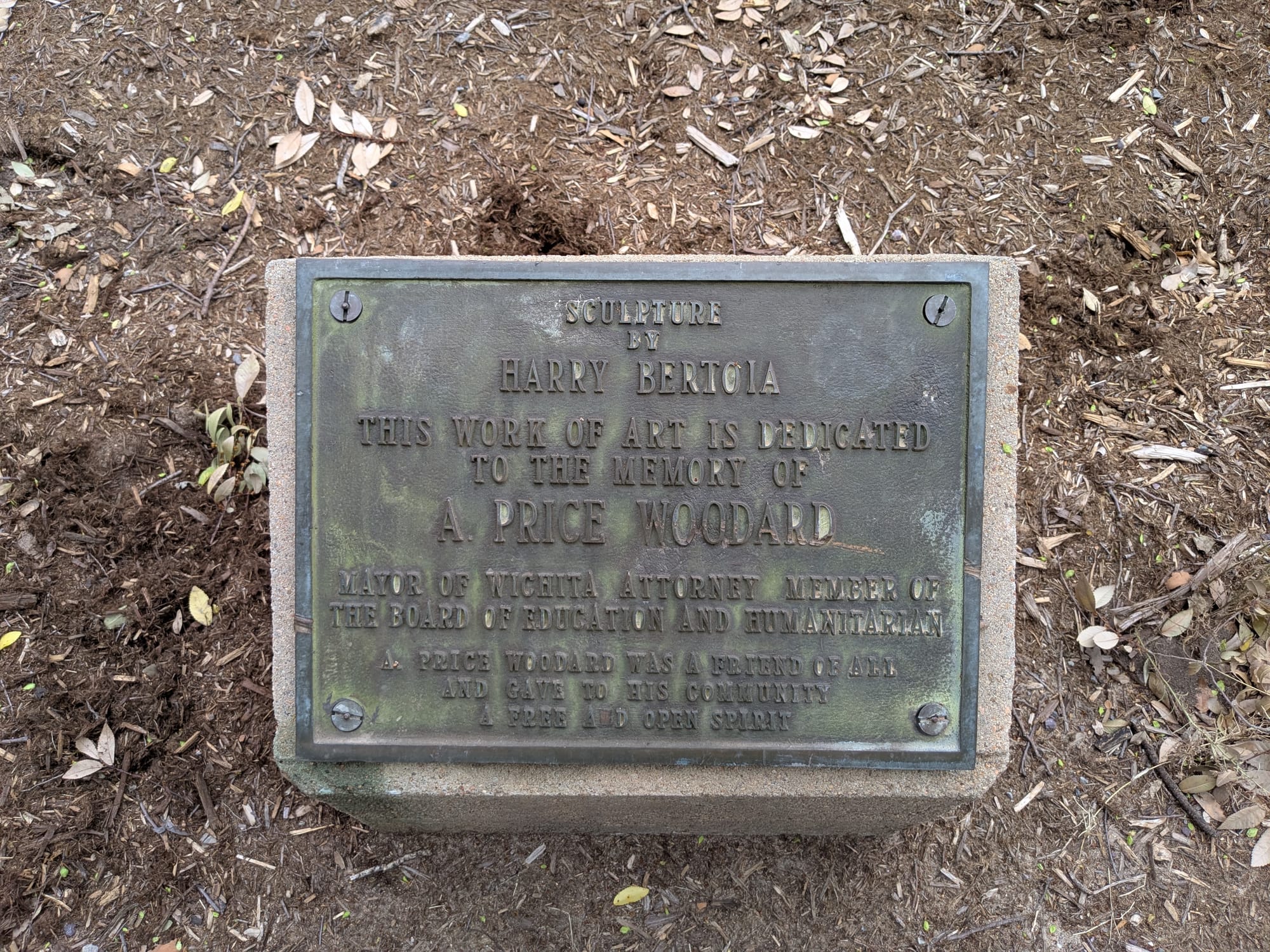
Though it’s hard to tell today, the mid-century modern Bertoia sculpture is a witness and remnant of a turbulent time in Wichita history — a period of both urban renewal and significant civil unrest. Century II opened to the public a mere six years earlier, in 1969, funded in part by the federal Urban Renewal Agency and meant to replace older, dilapidated structures by the river as well as provide an exciting center for civic and artistic life in the city.
At the same time, not all Wichita residents stood to benefit equally from public investments in civic life. The reason Woodard became mayor in his first year as City Council member was, evidently, to help quell racial discontent in a city which shared in America’s larger history of racist segregation, anti-Black violence, and economic discrimination. 1970, specifically, was the year that the Wichita School Board finally implemented a plan to desegregate the city’s schools, pursuant to the 1954 Brown v. Board Supreme Court decision (in which a group of Kansas plaintiffs from Topeka played a pivotal role).[2]
By 1975, when the Bertoia sculpture was dedicated, Wichita would also have its first woman mayor, Connie Ames Peters Kennard, who served a total of two 1-year terms before the close of the decade (and is not, to the best of my knowledge, memorialized anywhere in Wichita — I’d love to be corrected on this by any readers who know otherwise).
It might be a stretch to connect these things, especially since I don’t have the space here to develop a dissertation-style argument, but the timing of the arrival of the Bertoia sculpture strikes me as significant. It came, I contend, at the last moment before the end of the 20th century in America when the language of high Modernism — of abstraction and of complex form that exists on its own terms without reference to an easy or obvious narrative — could still be placed in public space and stand in for a vision of a society where all people share universal aspirations while accepting difference, disagreements, and the inevitability of agonistic struggle as part of public life.
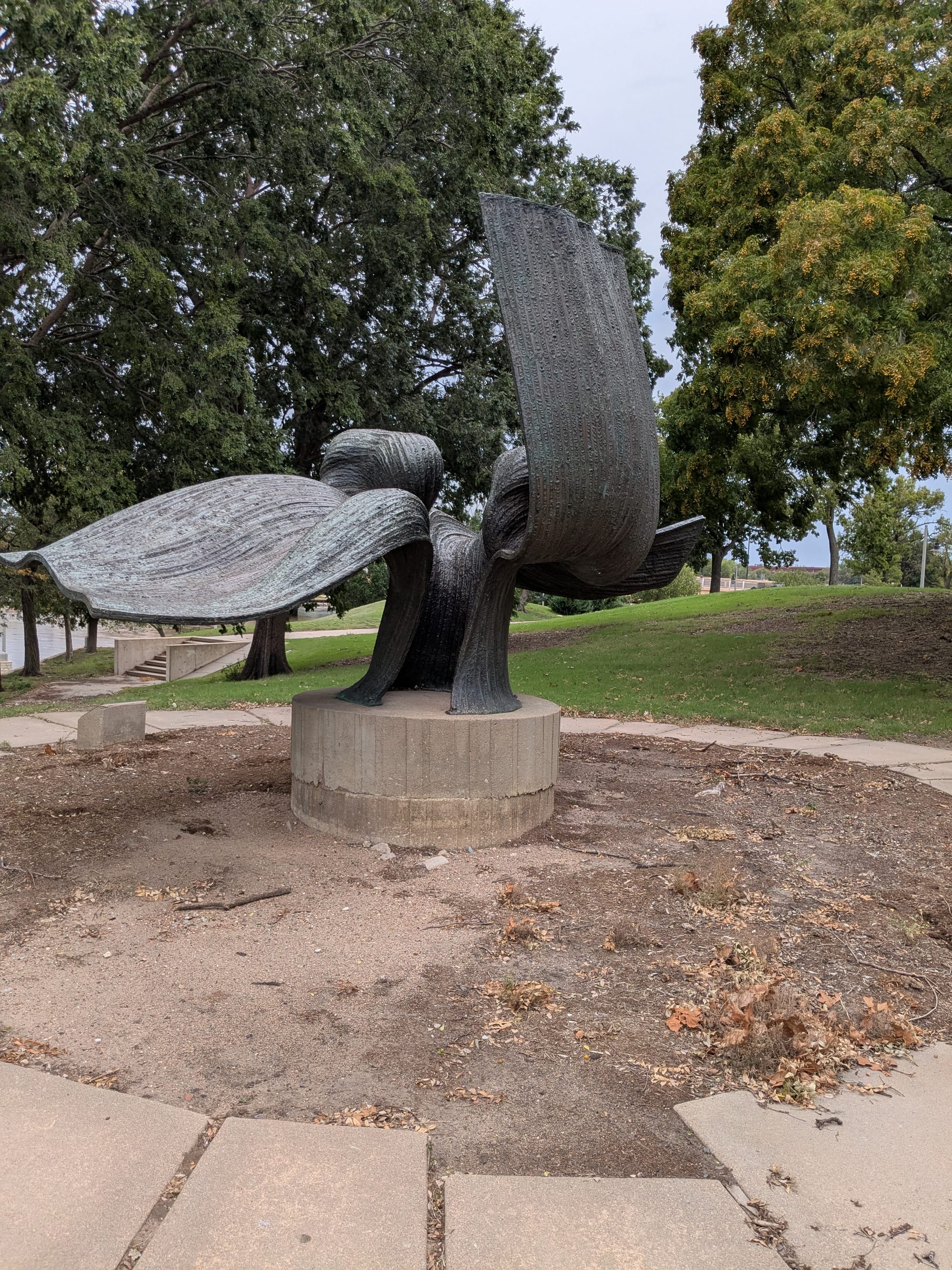
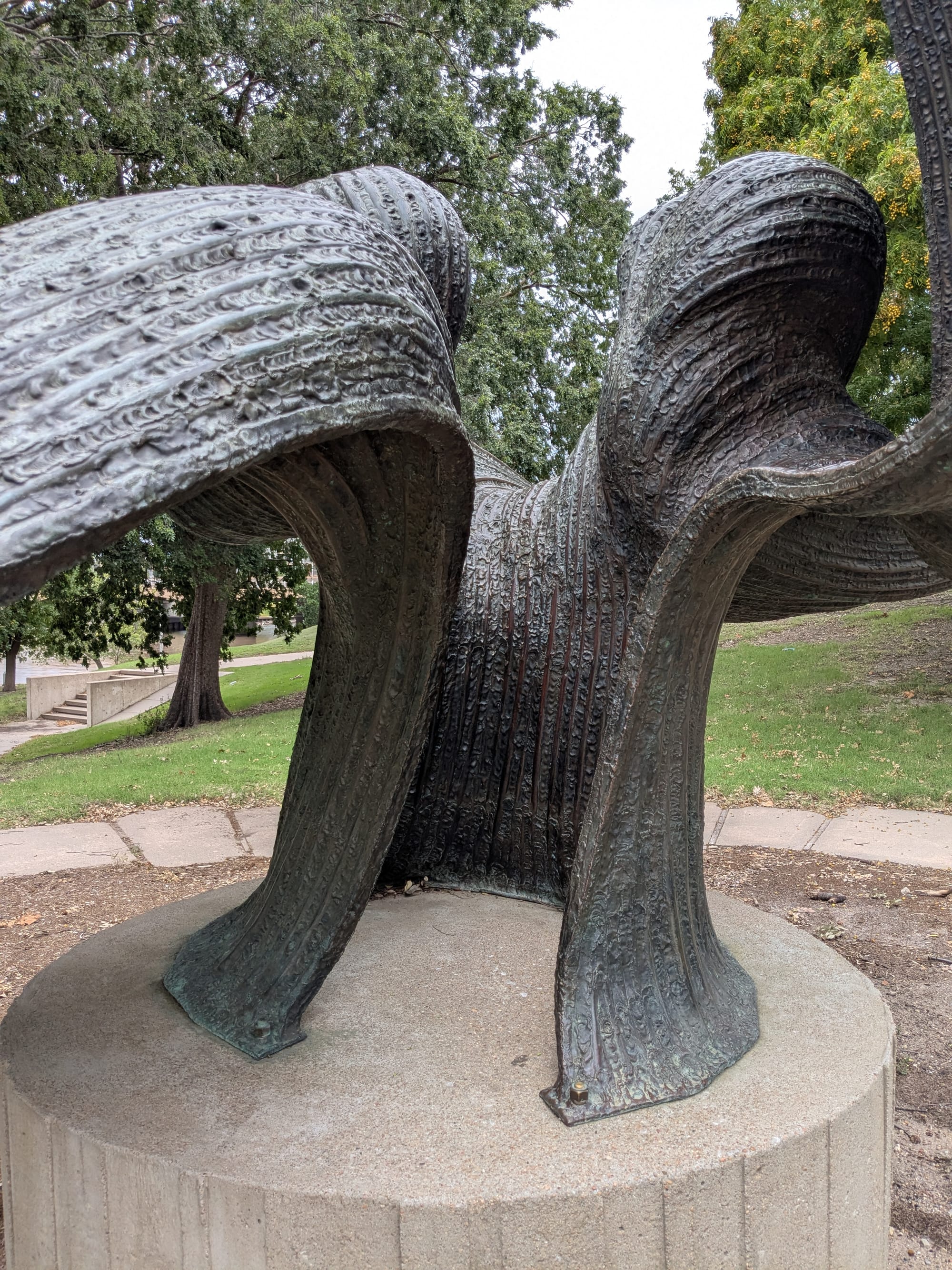
Approaching the sculpture from Century II, onlookers can peek in the innermost part of the sculpture, the almost-cylindrical shape at the bottom of the structure where bronze sinks transitions to concrete. Photos by Ksenya Gurshtein for The SHOUT.
You might reasonably think that this is too much meaning to project onto an obscure hunk of metal, but consider this description of the project, produced by the Second Century Sculpture Committee at the time of the work’s commissioning (and now found in the Wichita Art Museum archives):
“Created in bronze-welded copper tubing, this majestic sculpture by Harry Bertoia unfurls itself on a grassy knoll above the amphitheatre in A. Price Woodard, Jr. Memorial Park. The 7,000-pound, 12-foot tall untitled work[3] realizes a dream of Wichita’s former mayor who admired Bertoia’s work. Woodard hoped one day there would be a Bertoia masterpiece in Wichita. Posthumously, that dream becomes reality.”
I find it deeply moving that bringing the Bertoia sculpture to Wichita was a realization of Price Woodard’s own wish for his city, and that he was memorialized in this way rather than, say, a more conventional bronze effigy. (Notably, in August the Design Council approved a request for qualifications for artists to create a bust of Woodard, which the City of Wichita evidently felt needs to be added to the park.)
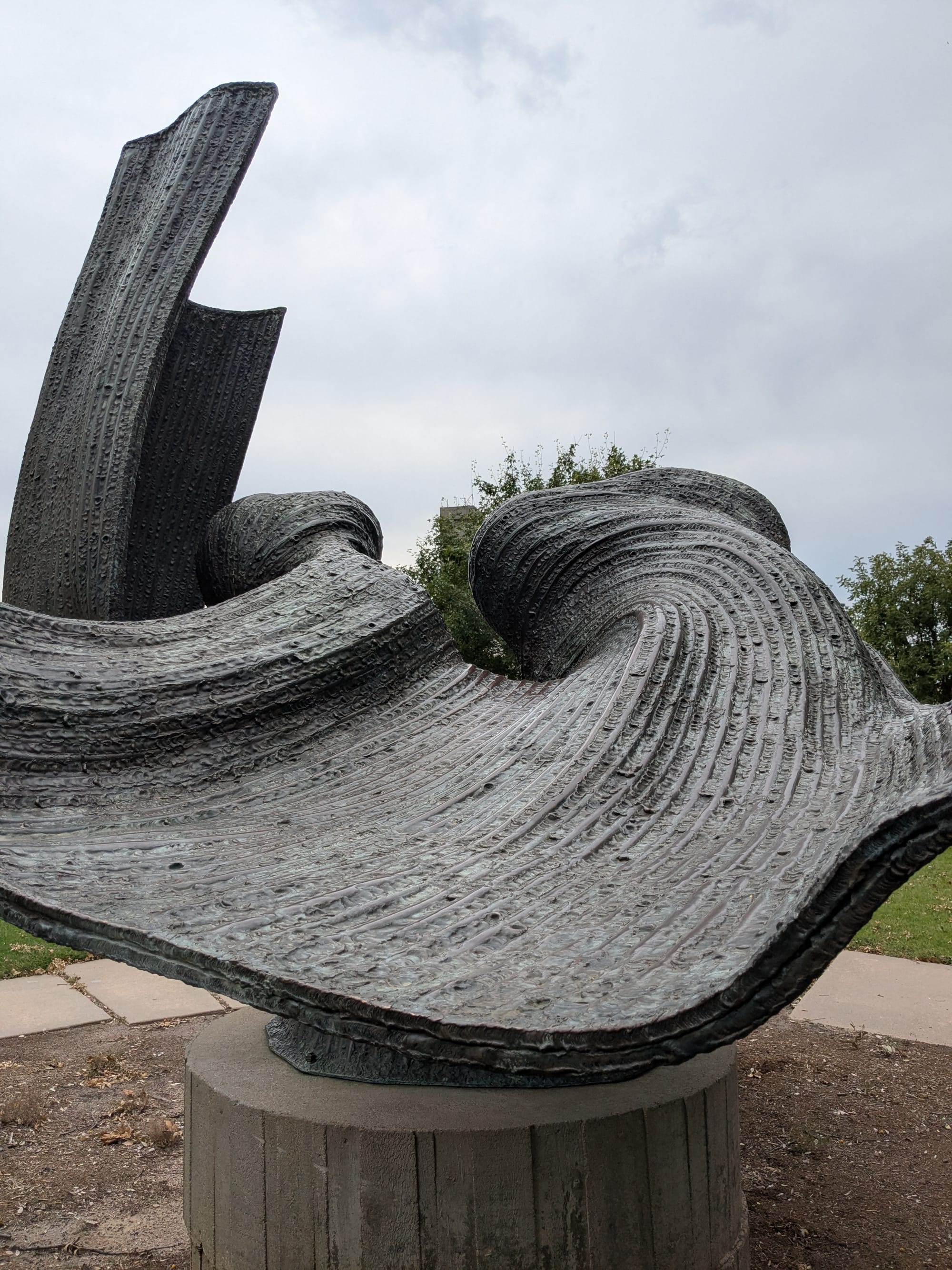
The word in the description above that particularly stirs my imagination is “unfurls.” “Unfurls” captures the sense of continuous revelation I experience when encountering this piece. It is a quintessentially sculptural work that takes advantage of three-dimensional space and exists fully in the round. As you circumambulate it, the work shifts and morphs, constantly becoming something new and unexpected. The piece is not the same from any two angles, and it invites you to continue exploring its lines and curves over and over thanks to the dynamism of each constituent part, an industrial-age Bernini rooted in Bertoia’s organic and intuitive working method when making such works.
The website of the Woodmere Art Museum in Philadelphia offers a fascinating video that captures Bertoia’s process of working with industrial copper tubing and hand-welded bronze rods to produce another work very similar to the Wichita sculpture. The Wichita sculpture was the last large-scale commission Bertoia produced in this novel technique before his death in 1978 — a death hastened by his experimental use of materials such as beryllium copper.
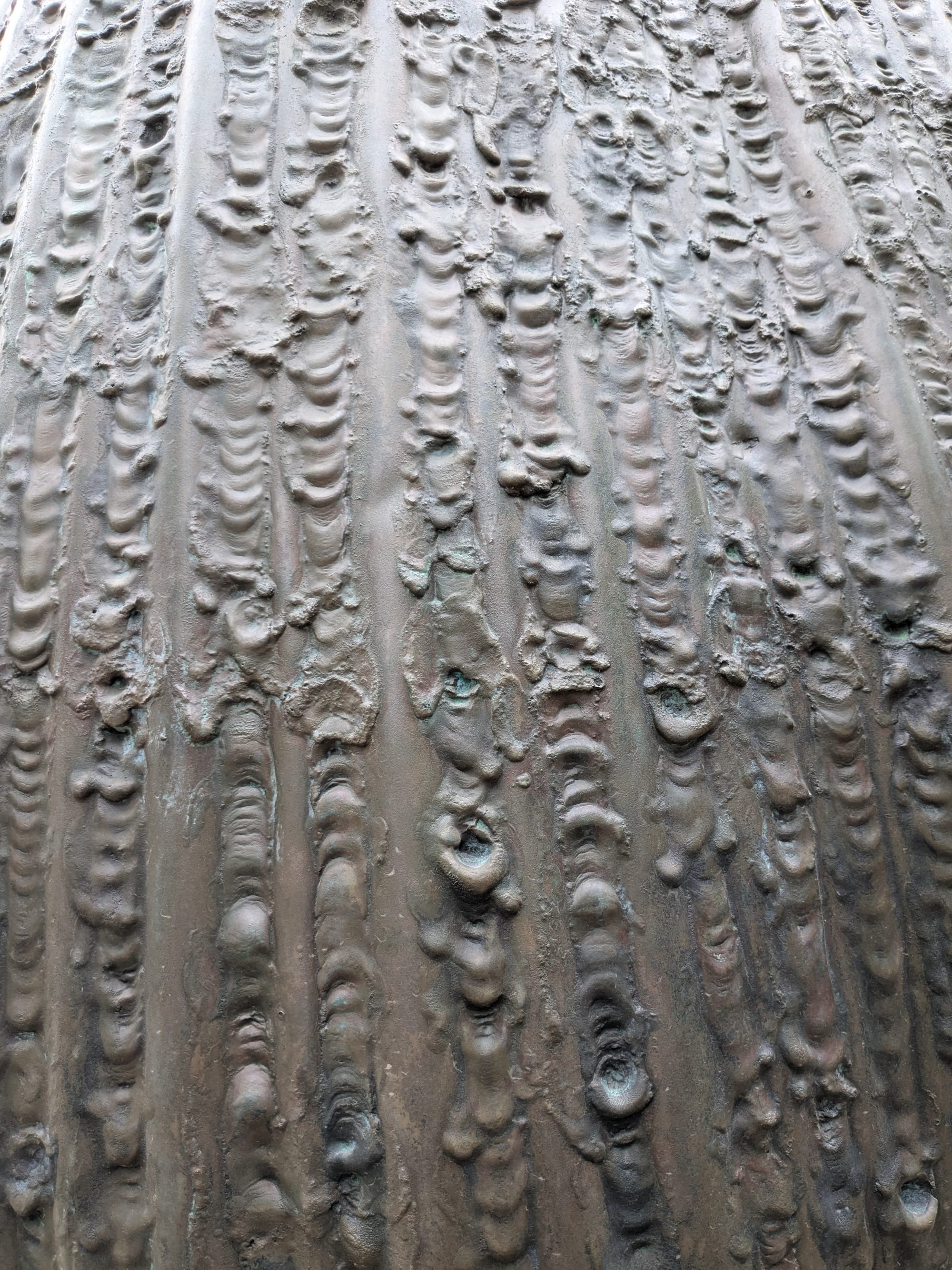
Bertoia wrote of “Free Interpretation of Plant Forms,” the sculpture similar to “Interrupted Flight” that is now on view at the Woodmere but was originally commissioned as a public art fountain for Philadelphia’s Civic Center:
“Conceptually, the initial intent was to produce a work embodying gentleness and strength. To partake of basic qualities, to have an inherent sense of growth, movement, and vitality and to make poetic sense to every walk of life. I endeavor to shun the particular, such as a wave, but to capture the motion of all waves through time, to echo the sound of the first, the viscera of the female, the unfolding blossom and the shadow of the mother’s hearth and lapping water, briefly to offer the observer a glimpse of identity with the formative power of an earthly life and the associations from his own experience. Simply stated - to have a fountain that would be great fun and enjoyed by many.”
On the one hand, this writing — and, perhaps, also the artistic impulse behind it? — is maddening in its simultaneous bombast and vagueness.[4] Can anything make poetic sense to every walk of life? How, exactly, do you capture the motion of all waves through time?! And could we maybe leave ladies’ reproductive parts as a supposed vehicle for a universal origin story out of it? And yet Bertoia was not wrong that his work does leave ample room for observers to bring in their own experiences — and that engaging with the resulting piece is great fun, so long as you are comfortable with ambiguity.
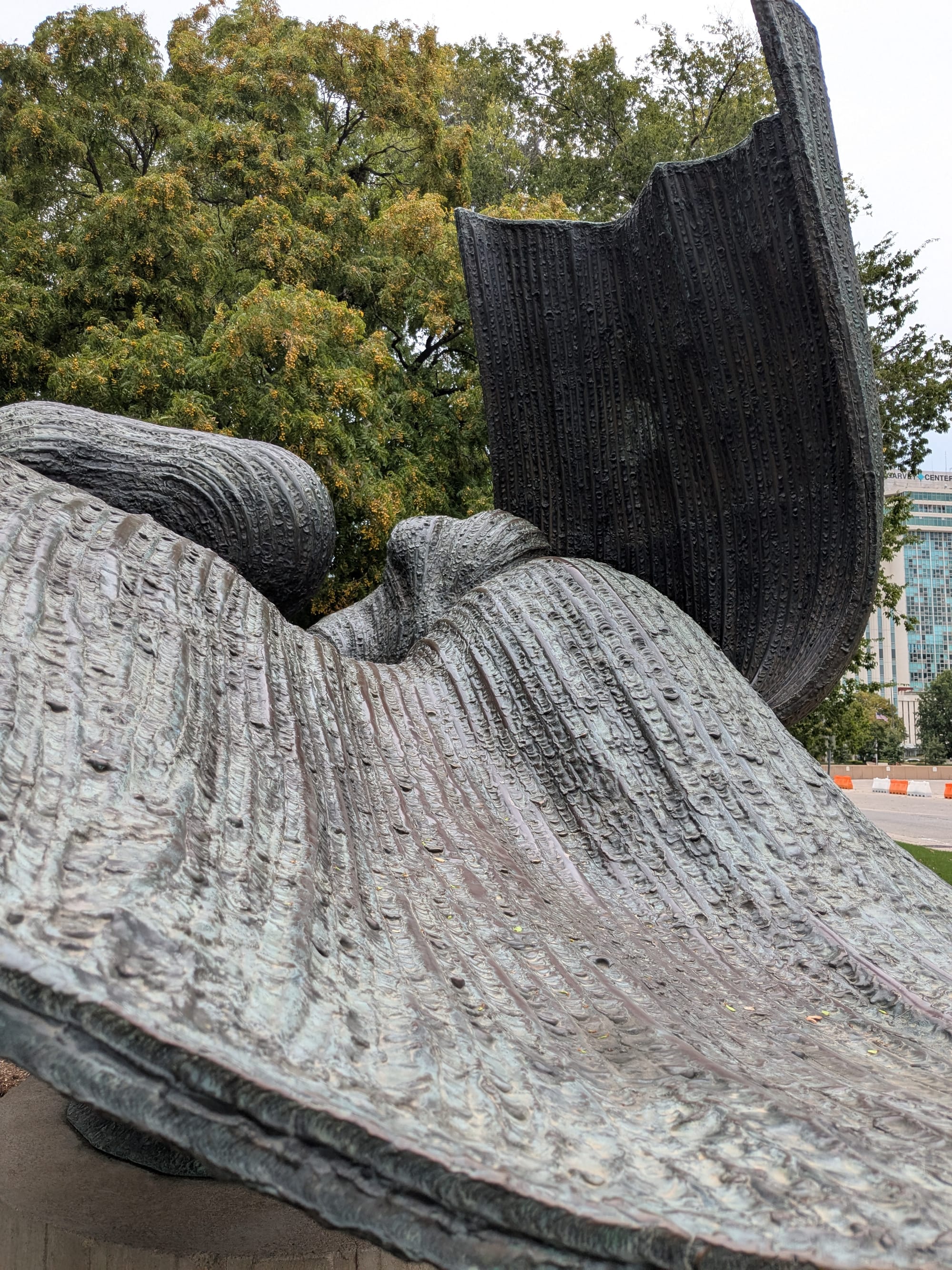
Working on this text, I’ve come across multiple interpretations of what Bertoia’s unfurling form might represent: a bird, wings, a whale tail, a plant. As with many other works, Bertoia clearly drew inspiration from nature for this piece, but any one clear reference point remains elusive. The sculpture’s title — likely added after the work’s creation and probably by someone other than Bertoia, who did not generally title his work — adds further mystery. Is this form crashing or lifting off, mourning a loss or promising future growth? It, arguably, does all these things at once, becoming a visual embodiment of both complexity and possibility — not a trivial thing to pull off.
Another piece of evidence concerning the ambitions of those who commissioned this work can be found in the records shared with me by Jana Erwin, the City of Wichita public art manager. In the last several years, she has undertaken the task of cataloguing all of the public art that belongs to the city and making information about it publicly available. “At the meeting of the Board of Park Commissioners on October 29, 1973, Keith E. Parker [of the Second Century Sculpture Committee, which commissioned the sculpture] commented that ‘the sculpture presents a sort of flowing or unfolding effect, which depicts the artist’s conception of the relationship of the sculpture with the landscape, the river location, etc.; and is meant to be indicative of the City of Wichita, its surroundings and the many things which are currently taking place within the area.’”
Art historian Marin Sullivan, in her essay in “Harry Bertoia: Sculpting Mid-Century Modern Life,” offers another relevant — and far less pretentious — Bertoia quote about his intentions:
“It is my meaning that art should belong to everyday life. It should be incorporated in the society where it can be seen by everyone, where it can encourage a more open attitude toward art. By this, one could reduce the distance between today’s art and the public. I am interested in my fellow being, in what they say about me and what I can tell them. The moment of sharing is equal to the moment of creation.”
To me, Bertoia’s artistic aspirations — realized successfully, in my humble opinion, in “Interrupted Flight” — are directly linked to what public art in public space should say about our larger aspirations as a society. It ideally asserts that we should strive to be open-minded and curious and that we should place art in public spaces that creates opportunities for conversation, dialogue, exchange of ideas, and multiple viewpoints.
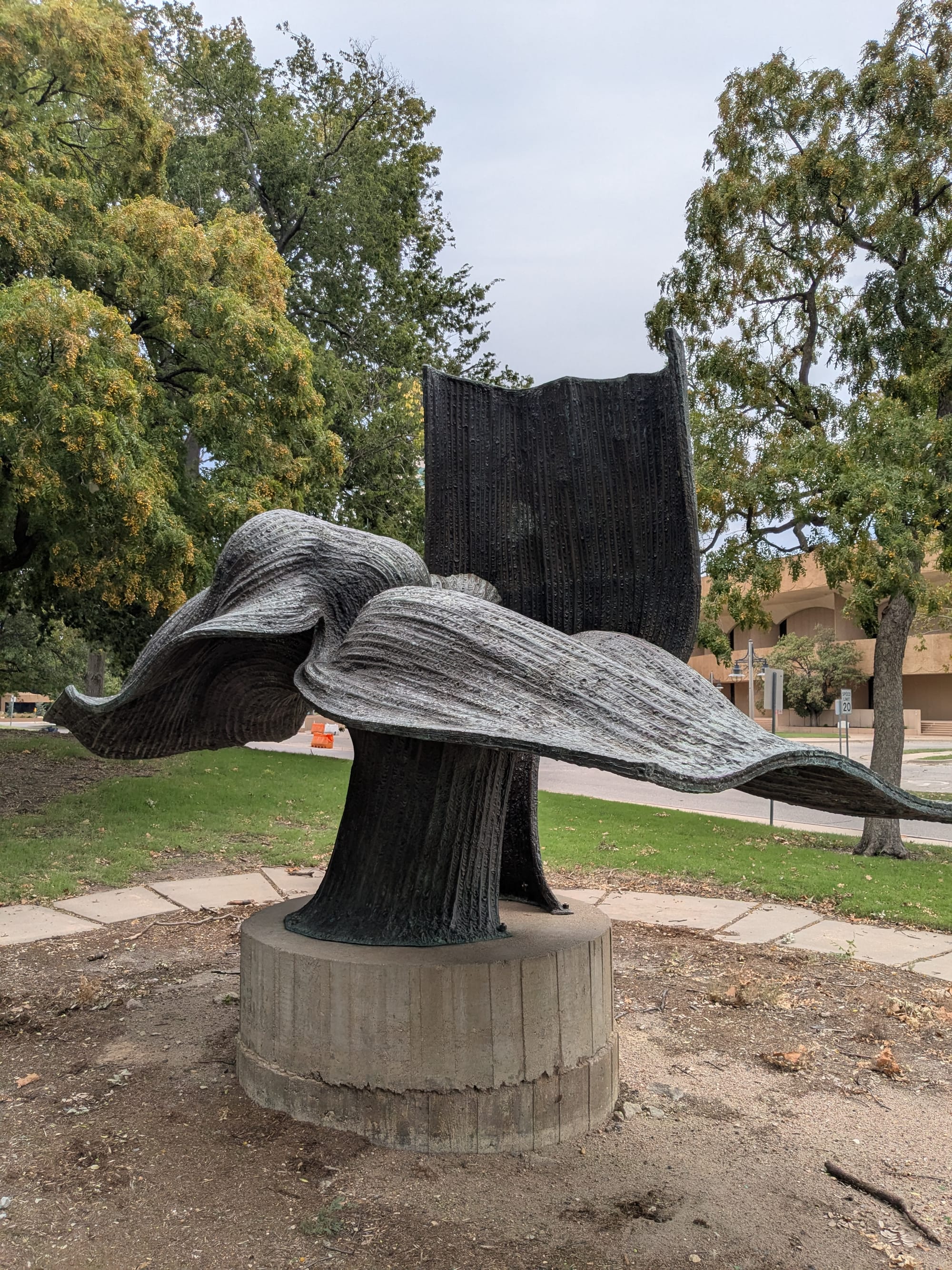
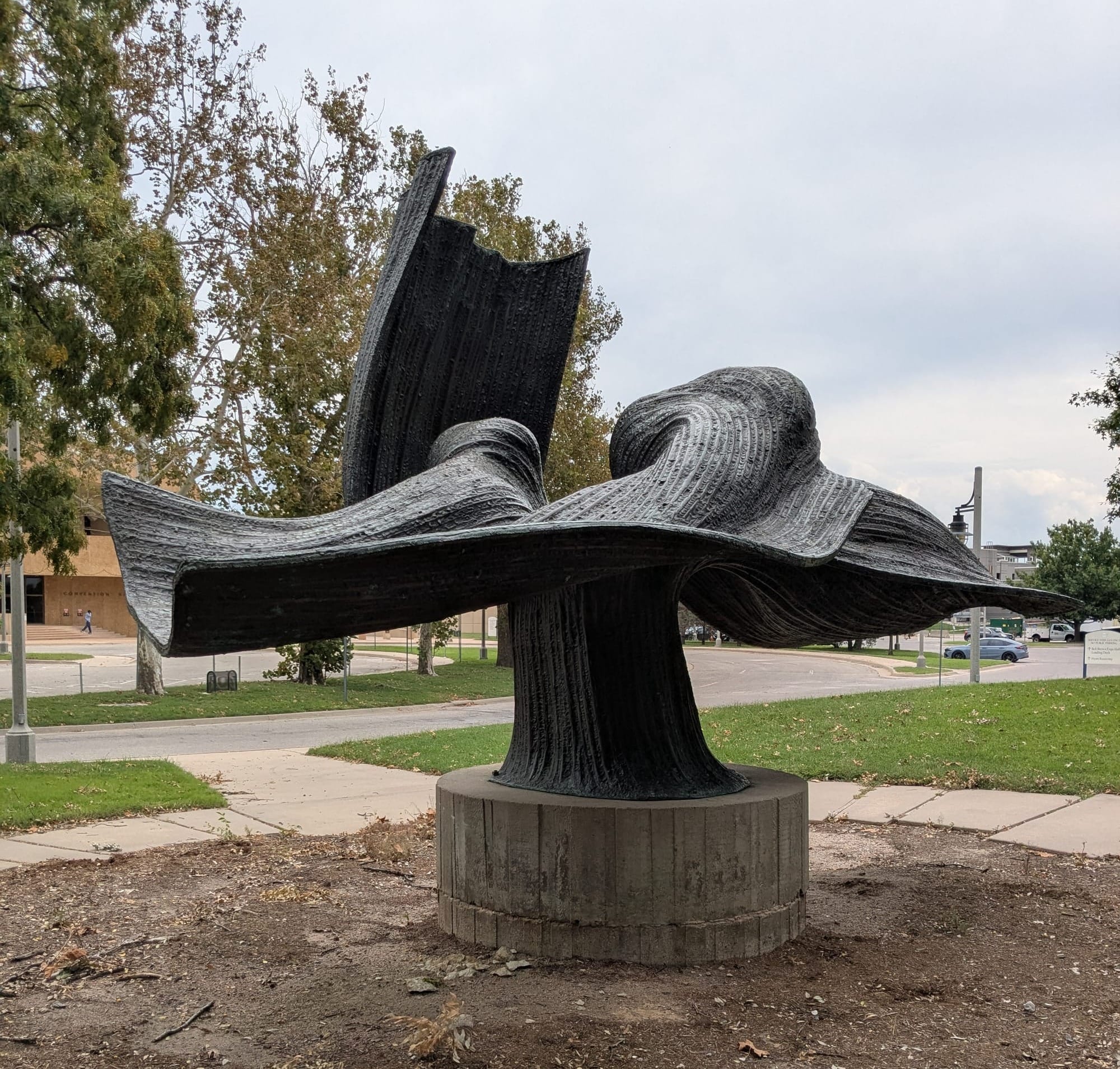
Side and "rear" views of the sculpture beckon viewers with its bronze to take a lap around the sidewalk path and participate in an open-minded exploration and interpretation. Photos by Ksenya Gurshtein for The SHOUT.
One of the core questions that, since the 19th century, drove and bedeviled modern art, with its many avant-gardes, experiments, and increasingly expanding definitions of “art,“ was what kind of an audience any given work of art imagines, attracts, and rewards. An even harder question that modern art posed for itself was whether a work of art can produce the audience it hopes to have. The best answers we have to date, I can confidently report, are an unequivocal “Maybe. Sometimes.”
Even if someone in our data-driven world were to undertake research to answer these questions in regards to “Interrupted Flight,” such research would immediately run into thorny methodological issues: How do you quantify one person’s aesthetic elation? By what metric do you measure another’s dislike, indifference, or potentially productive confusion? In the absence of “official” answers, the best that each of us can do at the moment is go see Harry Bertoia’s “Interrupted Flight” for ourselves and, perhaps, looking pensively at the Arkansas River flowing below, ponder how it can inform the expectations we place on our public art today.
[1] At the time, mayors in Wichita were not elected directly by the voters for four-year terms but, rather, were selected by the city council from among its members for one-year terms.
[2] Valuable information on the history of racial violence in Wichita in the late 1960s and the efforts to desegregate Wichita schools
[3] The Harry Bertoia online catalogue raisonne lists the dimensions of the sculpture as 10 by 18 by 9 feet.
[4] To be fair, verbal vagueness and underspecification were endemic to Modernism as a whole. The sheer number of 20th century works titled simply “Forms in Space” or some variation on that is astonishing.
The author would like to express her gratitude to art historian Marin Sullivan; Chloe Lang, the registrar and director of collections and exhibitions at the Wichita Art Museum; and Jana Erwin, the City of Wichita’s public art manager, for sharing information and research materials that were invaluable in the writing of this text.
Ksenya Gurshtein is a curator, arts writer, and art historian living in Wichita. As a curator, she has worked at the Ulrich Museum of Art, Skirball Cultural Center, and the National Gallery of Art, among other institutions. As a scholar and critic, she has written widely on a range of topics in modern and contemporary art. Her work strives to foreground lesser-known histories and stories, look to places and topics that have historically been peripheral to the Western canon, and support the work of arts institutions and artists as agents of social change. More of her writing can be found here.
❋ Derby man has the kind of voice that turns heads — and chairs
❋ Socializing while sober: how some Wichitans are cultivating alcohol-free communities
❋ As a small creative business closes, the owner mourns
❋ Painting through it: Autumn Noire on 20 years of making art
❋ How a guy from Wichita resurrected 'Dawn of the Dead'
❋ Bygone Friends University museum housed curious collections
Support Kansas arts writing
The SHOUT is a Wichita-based independent newsroom focused on artists living and working in Kansas. We're partly supported by the generosity of our readers, and every dollar we receive goes directly into the pocket of a contributing writer, editor, or photographer. Click here to support our work with a tax-deductible donation.