Century II’s iconic shape compromises the arts it's meant to showcase. Wichita performers reflect on what could be next.
Supporters of a new performing arts center, deflated after the failed sales tax vote, say that public-private dollars are crucial in achieving that dream.
Editor's Note: SHOUT contributor Sam Jack wrote the following story for a series in The Journal, a publication of the Kansas Leadership Center. It is republished here with permission.
As the Wichita Symphony Orchestra rehearsed “Rhapsody in Red, White, and Blue” last month, some musicians on stage were wearing coats and gloves. Because doors elsewhere in Century II had been opened for an RV show, the building’s heating system couldn’t keep up. Had the temperature in the Concert Hall gone much lower, rehearsal would have had to be called off.
Timothy Storhoff, the symphony’s executive director, described the coats-and-gloves rehearsal as an example of the issue that Century II’s users often navigate. Shortcomings of the building impose operational costs, limit programming and force workarounds that audiences may not always see.
“People come and have a great show, a great experience — at least we work really hard for it to happen — so our goal is that people are not thinking about the deficits of the space when they come,” said Angela Cassette, the managing director of Music Theatre Wichita. “But I also think that makes the issues feel less urgent than they really are.”
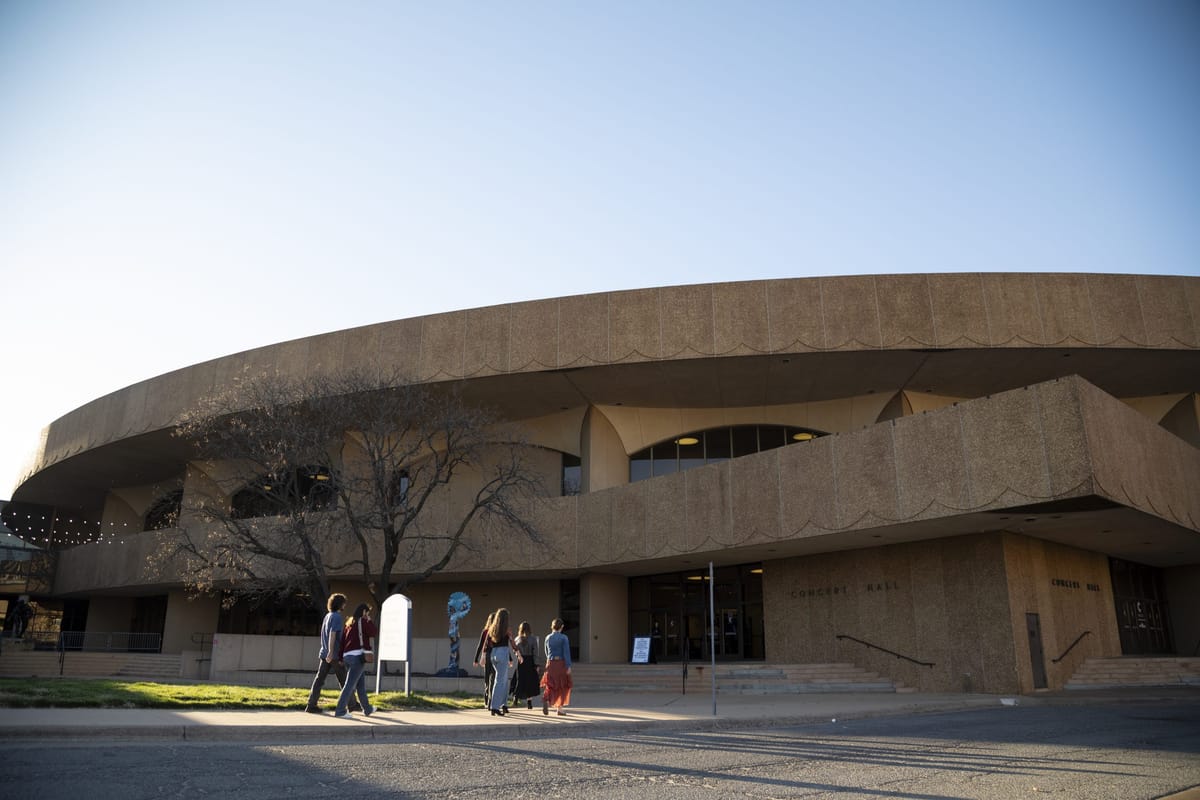
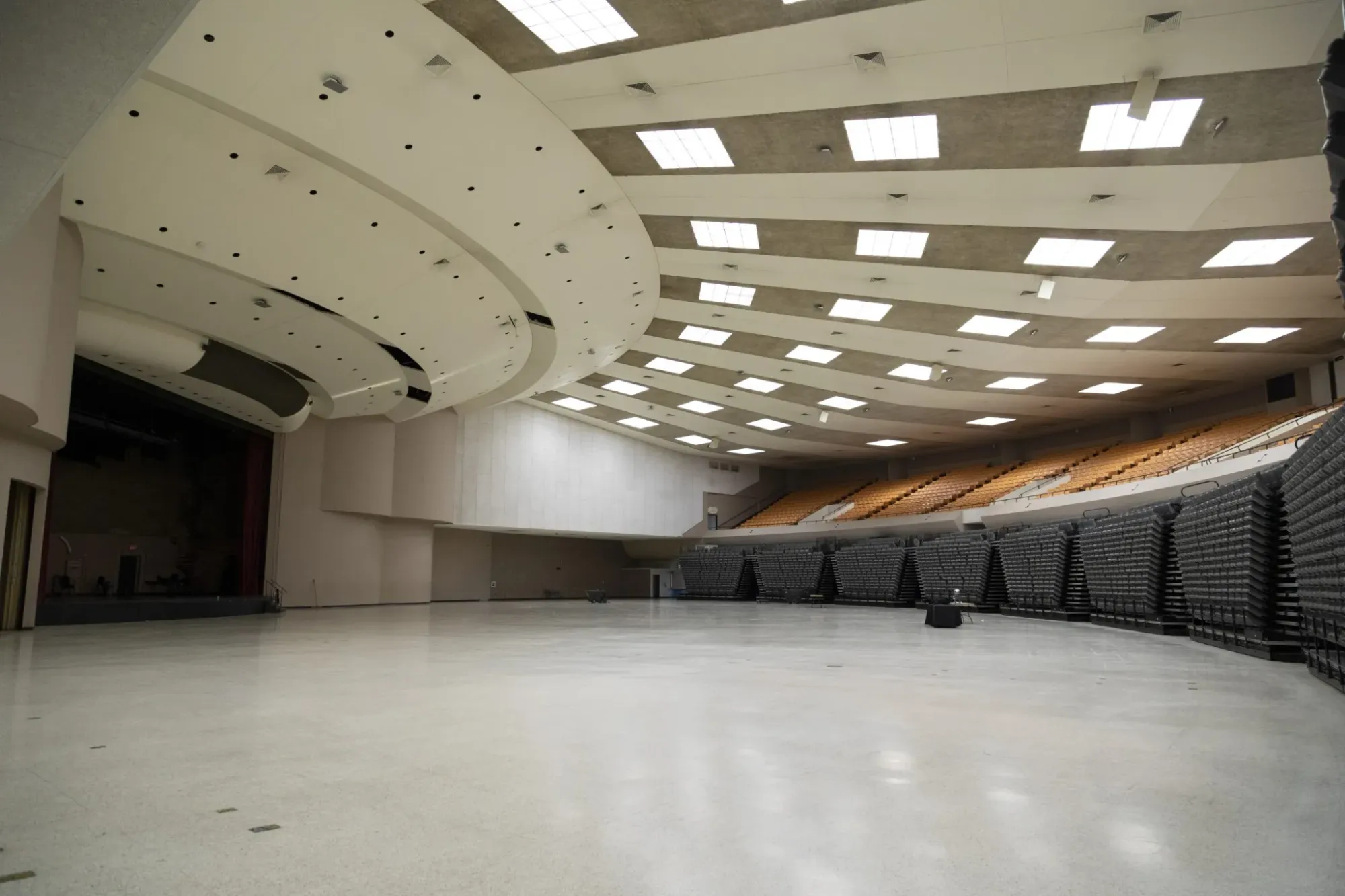
Century II’s round, blue roof makes it a distinctive presence on Wichita’s skyline. But Cassette suggested there may be good reasons why “round” is an unusual shape for a performing arts center.
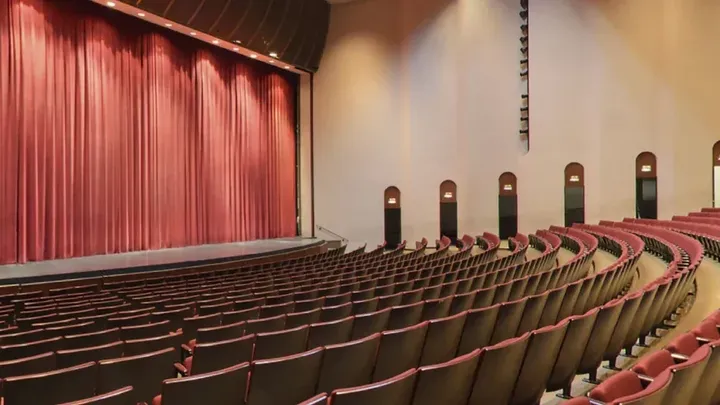
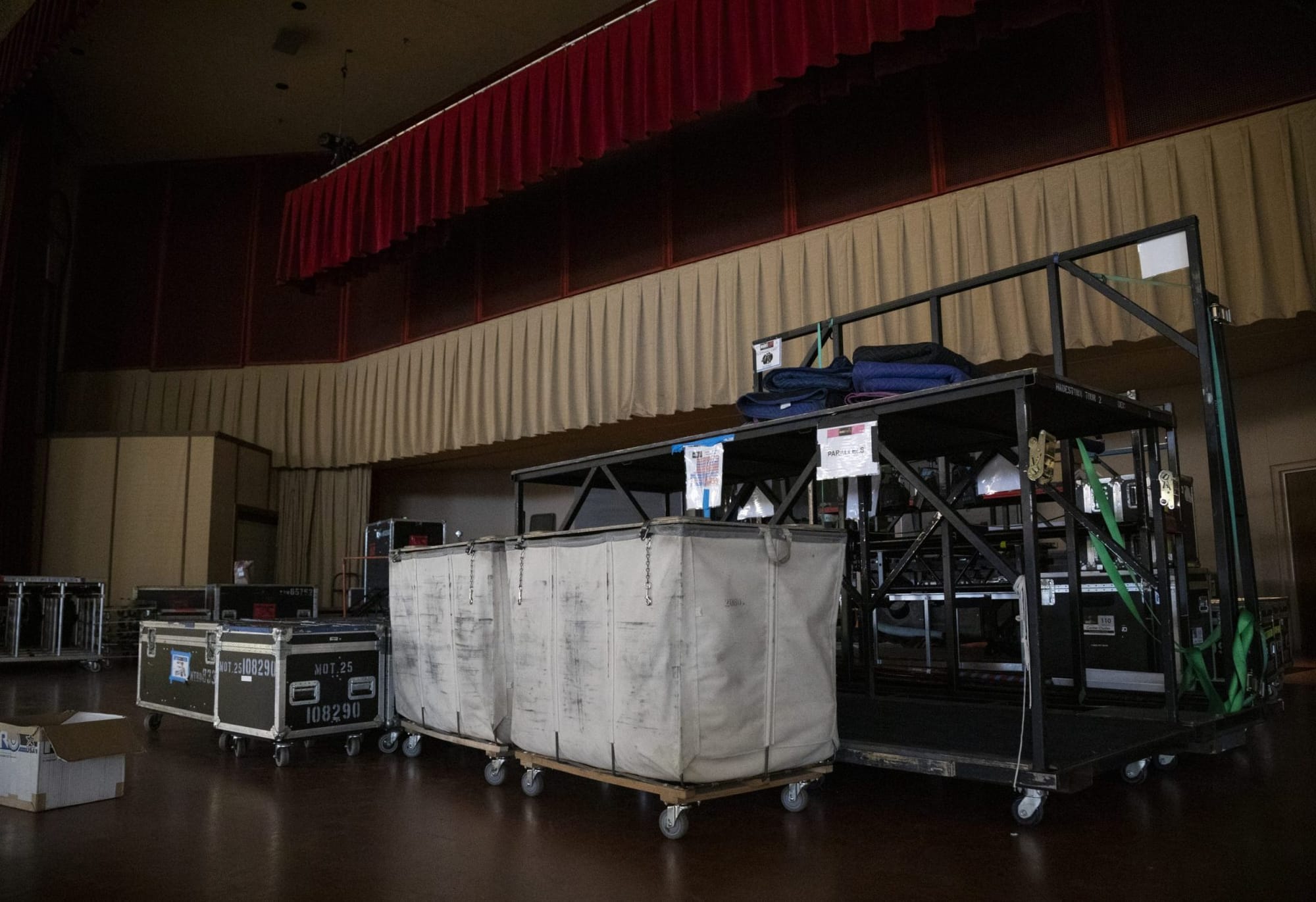
“There are no right angles. That means you have strangely shaped rooms, and a strangely shaped stage,” she said. “If you’ve been backstage on the Concert Hall stage, you know that it’s a slice of a pie. The widest part of the pie is the part that the audience sees. During a show, we’ve got at least twice as many people as you see on stage, working in the dark, working with large scenery. And their space is really compromised.
“The challenge that we repeat, and we’ve said it in every article for the past 15 or 20 years, is that because there are three stages that meet each other in the middle, there is no loading dock that can take you onto a stage.” Instead, sets, lighting rigs, and audio equipment must be moved in by hand. Large-scale touring productions have to park their semitrailers in Kennedy Plaza and haul their equipment across the floor and stage of the Exhibition Hall.
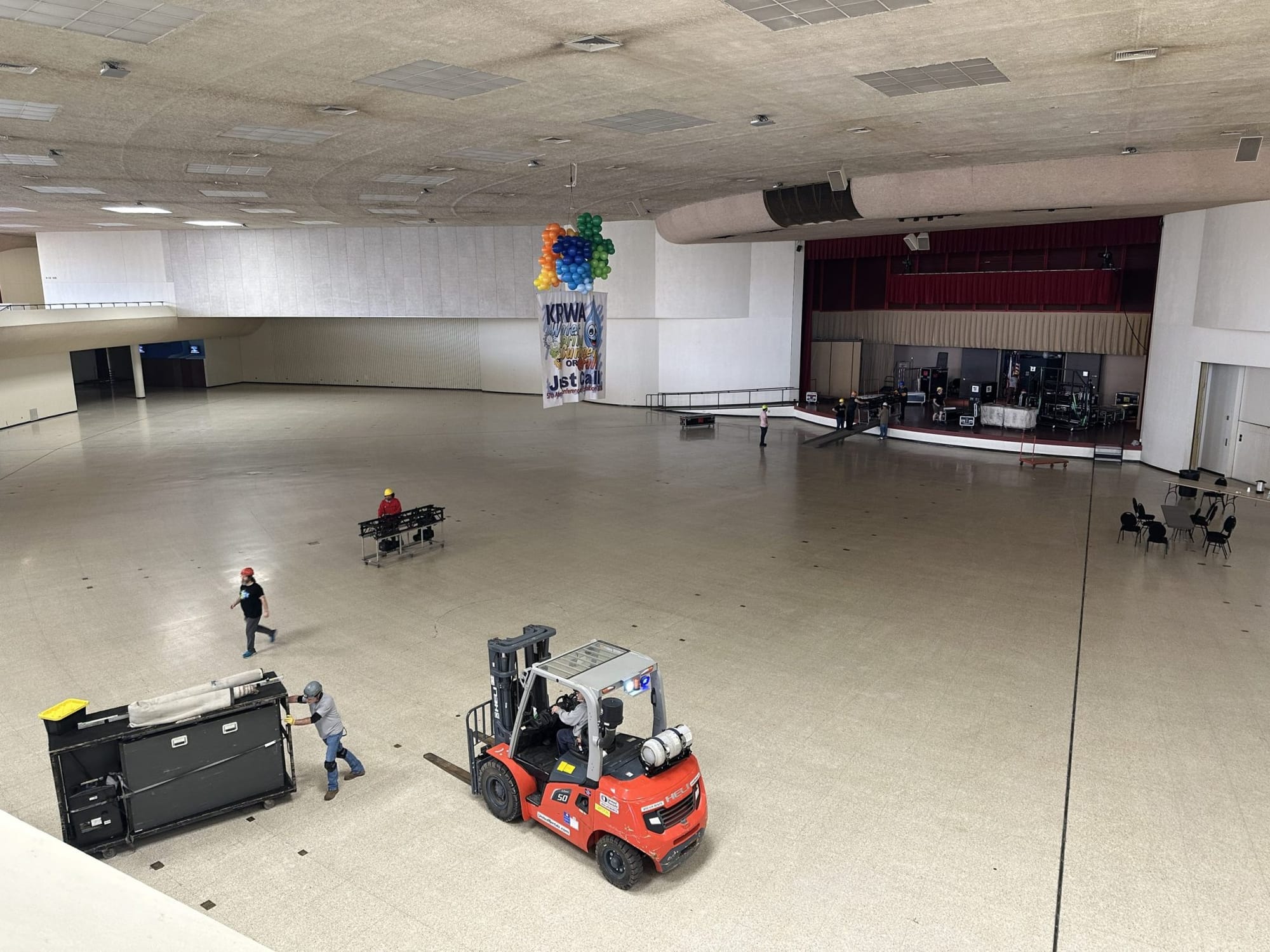
When the symphony wants to incorporate video or projected images, it spends upwards of $20,000 to rent screens and projectors — and the hall’s own sound system cannot be trusted for amplified performances, such as last season’s tribute to Elton John.
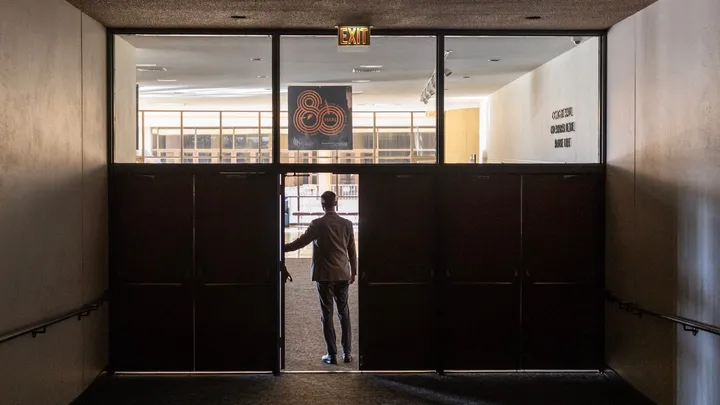
The audience experience has its own shortcomings. There is no center aisle — a challenge for anyone with mobility constraints. The lobby immediately splits visitors left or right at the entrance, lacking a central gathering space. Restrooms are cramped. The building’s Cold War-era concrete construction resists modern wireless infrastructure. The isolation of the site, surrounded by parking lots and the Arkansas River, also limits the walkability to restaurants and downtown businesses that other performing-arts districts use to generate economic spillover.
City budget documents show that Century II drew roughly 134,000 performing-arts attendees and 108,000 convention and other attendees in 2024, the most recent year for which data is available. Stakeholders say those numbers reflect a ceiling imposed by the facility itself. Cassette estimated that Music Theatre Wichita, the symphony and other tenant organizations occupy five to six months of Concert Hall dates, leaving little room for conventions, school events, university performances or community programming.
The constraint extends beyond the Concert Hall. Because sound bleeds between the Concert Hall, Exhibition Hall, Convention Hall and Mary Jane Teall Theatre, simultaneous bookings create auditory conflicts. Managers try to limit those, but the only reliable solution is to leave the other halls empty, which means that a complex designed for simultaneous use often can’t function that way.
The challenges post-sales tax election
When Wichita voters overwhelmingly rejected a one-cent sales-tax proposal on March 3, they closed a potential path toward addressing those constraints. The package would have allocated $25 million for Century II improvements, though the details of what exactly that meant were not specified. A $75 million investment in a new downtown performing arts center, also part of the sales tax proposal, would have been contingent on the balance of its construction cost — at least another $75 million — being covered via private philanthropy.
Aaron Bastian, the Fidelity Bank CEO who helped lead the Wichita Forward coalition behind the proposal, said the group believed roughly $75 million in private fundraising was attainable. Matt Burchett, a Wichita Forward organizer, agreed with that estimate. “If you need a whole lot more than that, I think it becomes a challenge to fully fund a performing arts center like this with private philanthropy,” Bastian said. “There’s too many other good ideas out there that draw in philanthropic support.”
Burchett said there are reasons to avoid a fully private facility beyond availability of funds. “The best opportunity for the arts to be accessible to the broadest audience is when it’s publicly owned and publicly guided,” he said. “Private facilities, both nonprofit and for-profit, have to figure out pathways to make sure they stay open and viable, and those are not always the most inclusive. A public facility gives us opportunities to bring in programs and fund initiatives for as many Wichitans as possible.”
In the wake of the vote, none of the stakeholders interviewed described any active effort to revive the project. Bastian said he had not had any conversations that would suggest any interest in continuing to work on the idea. Cassette said the loss felt especially difficult because a sales tax was not the first path explored. It was one of many, and alternatives had also stalled.
“If there were other great paths, then we would’ve taken them by now,” she said. “So that’s a little bit challenging.”
The result leaves the infrastructure problem unresolved, with no clear next step. Wichita’s performing arts organizations still describe Century II as a building that does not match the quality of the work happening inside it.
Broader civic questions also remain: When communities reach this kind of impasse with aging cultural infrastructure, what responses have actually worked elsewhere? And what do those experiences suggest might be required in Wichita?
Two communities offer partial answers.
Public-private wins Wichita could learn from
When Oklahoma State University set out to build the McKnight Center for the Performing Arts in Stillwater, the project’s leaders made a decision that distinguished it from most performing arts campaigns. The marquee gift, $25 million from alumni Ross and Billie McKnight, was designated not for construction but for a programming endowment, meaning the center has guaranteed annual income to spend on concerts, shows and related artistic activities. The building itself, which cost $72 million, was funded with other private gifts and tax-exempt bonds. OSU’s then-president, Burns Hargis, spearheaded another $25 million in fundraising for the programming endowment, building it to $50 million.
Mark Blakeman, the center’s executive director and first employee, described the programming endowment as foundational. The center’s 1,100-seat hall sits in a market of roughly 50,000 people, too small by standard industry economics to attract top-tier performers on ticket revenue alone.
“Performing arts centers get built, and they are great spaces, but if you don’t have the financial resources or the organizational skill to bring in great talent, the building never really does quite what it’s supposed to do,” Blakeman said. “The programming endowment has made all the difference for us.”
The results have been striking for a venue of its size. The McKnight Center has hosted residencies by the New York Philharmonic, the Chicago Symphony Orchestra, the Philadelphia Orchestra and the Seoul Philharmonic. A recent Jimmy Webb concert was taped for PBS’ “Great Performances” — the first time, Blakeman said, that the series had taped in Oklahoma. The center’s season-ticket holders come from places as far as California and Florida.
What distinguishes the McKnight Center, Blakeman said, is a willingness to invest in relationships with visiting artists rather than simply renting out the hall. “A lot of facilities, they don’t want to take any risk, so they turn into a rent space, basically,” he said. That dynamic is easily recognizable in Century II’s current operating model.
The extra annual revenue from their programming endowment allows the Center to entice performers who ordinarily wouldn’t consider a smaller market like Stillwater.
When a major orchestra visits, the engagement typically includes multiple performances, master classes for every instrument section, conductor sessions with university students and young people’s concerts for area schools. “We’re really trying to cultivate relationships between visiting artists and students in the community and on campus here,” Blakeman said.
The McKnight Center benefits from its place in a university ecosystem, with alumni donor pipelines and a campus setting that provides built-in audiences and institutional support. A downtown, civic venue without that anchor would need to build such a support structure independently.
When asked about the potential for a university partnership in Wichita, Bastian and Cassette both acknowledged the possibility, but noted complications. Cassette said the performing arts community has a strong conviction that a new center needs to be downtown in order to generate economic and cultural spillovers that a less central location, such as Wichita State University’s campus, would be unlikely to elicit.
The Buddy Holly Hall of Performing Arts and Sciences in Lubbock, Texas, is in many respects a close analog to the facility Wichita Forward envisioned: a downtown performing arts center with a price tag in the $150 million range; a calendar anchored by resident organizations, including a symphony and a ballet company; loading docks designed for modern touring trucks; and two theaters that can be programmed simultaneously without sound bleed.
The project was led by the Lubbock Entertainment and Performing Arts Association, a 501(c)(3) nonprofit formed in 2013 that raised money through major gifts, naming rights, personal seat licenses, suite sales and institutional partnerships. The city of Lubbock contributed the project site but no direct construction funding. The final project cost was approximately $158 million. The nonprofit owns Buddy Holly Hall, while a professional venue manager — Legends Global, which also manages Century II — handles day-to-day operations and booking.
The facility’s 425-seat Crickets Studio Theater was designed in collaboration with the Lubbock Independent School District and now serves as a home to the school district’s visual and performing arts programs. At the project’s groundbreaking, the association’s board chairman described the arrangement as meaning no tax dollars would have to go toward building a new school auditorium. In Wichita, where USD 259 faces constrained finances and declining enrollment, and where WSU is planning to demolish its 550-seat Wilner Auditorium, a similar model of institutional co-tenancy could broaden the coalition and strengthen the public case for investment.
‘Trust was the main issue’
Whatever the right model for Wichita might be, there is little disagreement among the city’s performing-arts stakeholders about the underlying need. Bastian, with Wichita Forward, said he has been involved with many of the city’s performing arts organizations.
“They do incredibly quality work,” he said. “They put on fantastic performances that are renowned in the region and in some cases the country. But I don’t believe that the facility we have available to them is as quality as the performances that are happening in our city.”
Nor do stakeholders regard a comprehensive renovation of Century II as a realistic alternative. Burchett said that multiple studies have detailed the limitations, and that the cost of modernizing the building to accomplish what a new facility would — including significant investments in sound barriers, backstage reconfiguration and a fundamental realignment of how the space is designed — would be prohibitive. Storhoff, the symphony executive director, put it simply: Even after a major renovation, “it would still be a pie-shaped concert hall without backstage space.”
But the performing arts community’s consensus on the need has not translated into public consensus on a path forward.
Blakeman offered Oklahoma City’s Metropolitan Area Projects Plan as an example of how communities sustain public investment over time. Oklahoma City voters have approved nearly $10 billion in public investment through fifteen consecutive ballot measures since 1993. The key, Blakeman said, is that officials have delivered exactly what they promised. Bastian, Burchett and Cassette all identified trust as the central obstacle to bringing that kind of investment to Wichita.
“I think trust was the main issue of this vote,” Bastian said. “Trust gets built one conversation, one decision, at a time. And to truly rebuild trust will take time and consistency.”
Cassette, who has been at Music Theatre Wichita since 2013, noted that the leaders of the Wichita Forward coalition had been engaging with the building’s limitations for more than a decade, touring Century II, asking what does and doesn’t work.
“I think one of the challenges for us, as a society right now, is some of these conversations are so nuanced that they have to be longform conversations,” she said. “I think that the kinds of problems we are facing as a city and as a society are not ones that we can solve with, ‘Here’s the twelve-second commercial that you can see as you’re scrolling on Facebook.’”
Storhoff offered a starker assessment of where things stand. “A part of me kind of worries that Century II becomes the third rail of Wichita politics now,” he said, “and people are going to be like, ‘Let’s stay away from that,’ and that’ll mean no investment in fixing up what’s here, and no push to get something else.”
Over the decades, several performing arts center concepts have been offered and shelved; Storhoff described finding files in his office from his predecessor with plans and studies stretching back thirty years.
The question is whether the community can summon the sustained public confidence that would make any version of it viable. Evidence from other communities suggests that it is possible, with varying mixes of public and private resources. It also suggests that trust is the hardest part. Harder than designing the building, harder than raising the first dollar and harder than winning any single vote.
“Ultimately if you want to preserve things, you’re going to have to say yes to something,” Cassette said. “You can’t just tear down everybody’s ideas all the time.”
About the series
Wichita voters overwhelmingly rejected a 1% sales tax that was projected to generate $850 million to divide among several initiatives: homelessness, affordable housing, property tax relief, public safety infrastructure, a performing arts center and the renovation of Century II.
Post-vote, The Journal is utilizing our solution journalism expertise to investigate solutions that Wichita could learn from to respond to its biggest challenges. The series, led by Journal Reporter Stefania Lugli, will explore potential paths forward for each spotlighted issue during the sales tax campaign.
This is part three of the six-part series. Read part two here.
Sam Jack is a poet, a classical tenor, and the adult services librarian at Newton Public Library. He performs with several local groups, including Wichita Chamber Chorale, Wichita Grand Opera, and Opera Kansas. He received a Master of Fine Arts in creative writing from the University of Montana.